www.bjorl.org
Brazilian
Journal
of
OTORHINOLARYNGOLOGY
ORIGINAL
ARTICLE
Mode
of
recording
and
modulation
frequency
effects
of
auditory
steady
state
response
thresholds
夽
Bahram
Jalaei
a,b,∗,
Moslem
Shaabani
c,
Mohd
Normani
Zakaria
aaUniversitiSainsMalaysia,SchoolofHealthSciences,AudiologyProgramme,Kelantan,Malaysia bIranUniversityofMedicalSciences,DepartmentofAudiology,Tehran,Iran
cUniversityofSocialWelfareandRehabilitationSciences,DepartmentofAudiology,Tehran,Iran
Received17June2015;accepted30December2015 Availableonline29March2016
KEYWORDS
Auditorysteadystate response;
Hearingthreshold; Contralateral recording;
Ipsilateralrecording
Abstract
Introduction:Theperformanceofauditorysteadystateresponse(ASSR)inthresholdtesting whenrecordedipsilaterallyandcontralaterally,aswellasatlowandhighmodulation frequen-cies(MFs),hasnotbeensystematicallystudied.
Objective:To verifythe influences ofmode of recording (ipsilateralvs.contralateral) and modulationfrequency(40Hzvs.90Hz)onASSRthresholds.
Methods:Fifteenfemaleand14malesubjects(aged18---30years)withnormalhearing bilat-erallywerestudied.Narrow-bandCE-chirp®stimuli(centerdat500,1000,2000,and4000Hz) modulatedat40and90HzMFswerepresentedtotheparticipants’rightear.TheASSRthresholds werethenrecordedateachtestfrequencyinbothipsilateralandcontralateralchannels.
Results:DuetopronouncedinteractioneffectsbetweenmodeofrecordingandMF(p<0.05 by two-way repeatedmeasuresANOVA), meanASSR thresholdswere thencompared among fourconditions(ipsi-40Hz,ipsi-90Hz,contra-40Hz,andcontra-90Hz)usingone-wayrepeated measuresANOVA.Atthe500and1000Hztestfrequencies,contra-40Hzconditionproducedthe lowestmeanASSRthresholds.Incontrast,athighfrequencies(2000 and4000Hz),ipsi-90Hz conditionrevealedthelowestmeanASSRthresholds.Atmosttestfrequencies,contra-90Hz producedthehighestmeanASSRthresholds.
Conclusions:Basedonthefindings,thepresentstudyrecommendstwodifferentprotocolsfor anoptimumthreshold testingwith ASSR, atleastwhen testing young adults. Thisincludes theuseofcontra-40Hzrecordingmodeduetoitspromisingperformanceinhearingthreshold estimation.
© 2016 Associac¸˜ao Brasileira de Otorrinolaringologia e Cirurgia C´ervico-Facial. Published by Elsevier Editora Ltda. This is an open access article under the CC BY license (http:// creativecommons.org/licenses/by/4.0/).
夽 Pleasecitethisarticleas:JalaeiB,ShaabaniM,ZakariaMN.Modeofrecordingandmodulationfrequencyeffectsofauditorysteady
stateresponsethresholds.BrazJOtorhinolaryngol.2017;83:10---5.
∗Correspondingauthor.
E-mail:[email protected](B.Jalaei).
PeerReviewundertheresponsibilityofAssociac¸ãoBrasileiradeOtorrinolaringologiaeCirurgiaCérvico-Facial. http://dx.doi.org/10.1016/j.bjorl.2015.12.005
PALAVRAS-CHAVE
Respostaauditivade estadoestável; Limiarauditivo; Registro contralateral; Registroipsilateral
Mododeregistroeefeitosdamodulac¸ãoemfrequênciasnoslimiaresderesposta auditivadeestadoestável
Resumo
Introduc¸ão: Odesempenhodarespostaauditivadeestadoestável(RAEE)emtestesdelimiar com registrosipsilateral e contralateral, e modulac¸ões em frequências (MFs) não tem sido sistematicamenteestudados.
Objetivo: Verificar a influência do modo de registro (ipsilateral vs. contralateral) e da modulac¸ãoemfrequências(40Hzvs.90Hz)noslimiaresdeRAEE.
Método: Foramestudados15mulherese14homens(18-30anos)comaudic¸ãobilateralnormal. EstímulosCE-chirp® debandaestreita(centrados em500,1.000,2.000e4.000Hz) modula-dosem40e90HzdeMFforamapresentadosàorelhadireitadosparticipantes.Emseguida, os limiaresde RAEEforamregistradosem cadafrequênciadeteste noscanais ipsilaterale contralateral.
Resultados: Devido aos pronunciados efeitos de interac¸ão entre o modo de registro e MF (p<0,05por variânciacomdois fatorespara medidas repetidas---ANOVA duasvias), os limi-aresmédiosdeRAEEforamentãocomparadosentrequatrocondic¸ões(Ipsi-40Hz,Ipsi-90Hz, Contra-40HzeContra-90Hz),comousodevariânciaecomumfatorparamedidasrepetidas (ANOVA umavia).Nasfrequênciasdetestede500e1.000Hz,acondic¸ãoContra-40Hz pro-duziuosmaisbaixoslimiaresmédios deRAEE.Em contraste,em altasfrequências(2.000e 4.000Hz),acondic¸ãoIpsi-90HzrevelouosmaisbaixoslimiaresmédiosdeRAEE.Namaioria dasfrequênciasdeteste,acondic¸ãoContra-90Hzproduziuosmaiselevadoslimiaresmédios deRAEE.
Conclusões: Combasenosachadosdopresenteestudo,osautoresrecomendamdoisprotocolos diferentesparaarealizac¸ãodeumtestedelimiaresidealcomRAEE,pelomenosemadultos jovens.IssoincluiousodomododeregistroContra-40Hz,devidoaoseudesempenhopromissor nasestimativasdolimiarauditivo.
© 2016 Associac¸˜ao Brasileira de Otorrinolaringologia e Cirurgia C´ervico-Facial. Publicado por Elsevier Editora Ltda. Este ´e um artigo Open Access sob uma licenc¸a CC BY (http:// creativecommons.org/licenses/by/4.0/).
Introduction
Auditory steady state response (ASSR) is an electrical potentialevokedbyperiodicamplitude modulatedand/or frequency modulated stimuli. Differently from conven-tionalauditoryevokedpotentials,ASSRutilizesanobjective thresholddetectionmethod,whichprovidescliniciansand researchersaconvenientwayforestimatingbehavior hear-ingthresholds.
The ASSR thresholds have been shown to be closely relatedtopuretoneaudiograminvariousstudies.Infact, ASSRs evoked by stimuli at 90 and 40Hz modulation fre-quencies (MFs) show consistency with auditory brainstem response (ABR) and activity in the upper region of cen-tralauditory nervoussystem (CANS),respectively.1---4 That is, similartoABR, 90Hz ASSRis thechoicefor estimating auditorysensitivityatmidandhighfrequencies.The40Hz ASSR,however,performslikethecortical auditoryevoked potential(CAEP),whichissuitablefordeterminingauditory sensitivityatlowfrequencies.5,6
The effects of mode of recording (i.e., ipsilateral vs. contralateral) on ASSR have also been investigated. Van Maanen and Stapells7 conducted a study on younger (≤6 months) andolder (>6 months)infants with normal hear-ingbilaterally.TheyrecordedASSRthresholdat500,1000, 2000, and 4000Hz carrier frequencies (CFs) with MFs of
between81 and101Hz. Bothipsilateralandcontralateral recordingswereobtainedateachCF.Theythenfoundthat theipsilateralrecordingyieldedbetterASSRthresholdsthan contralateralrecordingat allCFs.Consequently,they rec-ommended the use of only ipsilateral recording in ASSR thresholddetermination,atleastwhentestinginfants.On theother hand, Kafand Danesh8 conducted astudy com-paringthe ipsilateralandcontralateralrecordingsofASSR amonghealthyfemaleadults.TheASSRswererecordedatan intensitylevelof65dBSPLatCFsof500,2000,and4000Hz andatMFsof39and79Hz.Theythenfoundnosignificant differencesof ASSRamplitudes andlatenciesbetweenthe ipsilateralandcontralateralconditionsatbothMFs.
groups. Thus, the present study aimed to compare ASSR thresholdsbetweencontralateralandipsilateralrecordings at40and90HzMFsinhealthyyoungadults.
Methods
Participants
This study employed descriptive and repeated measures design.Fifteen female and14 maleparticipants withage ranging from 18 to28 years(mean of 23.4±2.65 years), right-handed,withnormalhearinginbothears(thresholds ≤15dBHLfrom500to4000Hz)andwithoutanyrecordof headinjuries andneurological disordersor anyactive ear pathologytookpartinthestudy.Allofthemagreedto volun-taryparticipationbysigningthewritteninformedconsent. Prior to testing, an ethical approval from the respective institutionwasobtained,inaccordancewiththeDeclaration ofHelsinki(USM/PPP/JEPeM[245.3(5)]).
Equipmentandstimuli
To ensure normal hearing status, basic audiologic evalu-ations including otoscopy, admittance audiometry (Model AZ26,byInteracoustic)andpuretoneaudiometry(ModelAC 40two-channelaudiometer)wereperformedonall partici-pantsinasound-treatedroomwithintheAudiologyClinic, UniversityHospital.
ASSRthresholdswerethenrecordedwithatwo-channel Eclipse system (Interacoustic Corporation, Denmark) and narrow-bandCE-chirp®signalscenteredat500,1000,2000,
and4000Hzwereusedastheteststimuli.Thechirpstimuli weredesignedtocompensateforthecochleardelayandto produceabiggerresponse.10 Theamplitudeandfrequency modulationdepthswere100%and20%(±10%),respectively. Foreachteststimulus,themodulationfrequencieswere40 and90Hz.ThestimuluslevelwascalibratedindBnHL.The commonmode rejection (CMR) ratio of pre-amplifier was morethan115dBat anyfrequency.Thenumberofepochs andtimeanalysiswere16and1s,respectively.Therecorded responseswereamplified100,000timesandfilteredusinga band-passof0.1---100Hz(12dB/octave).
Fourscalp electrodeswere placedon theparticipant’s head:non-invertingontheforehead,invertingoneach mas-toid, and ground on the cheek. For both ipsilateral and contralateral recordings, the insert earphone was placed onlyintherightear(i.e.,ASSRsrecordedintherightand leftchannelsrepresentedipsilateralandcontralateral con-ditions, respectively). The impedance of electrodes was maintainedtobe less than3k throughout the measure-ments.
ASSRprocedure
Aftergivingtheproperinstructionstotheparticipants,the ASSRtestingbegan.Whilelyingcomfortablyonatestbed, thestimuliwere presentedtothe right earofthe partic-ipants using the multiple auditory steady state response (MASTER)techniquethroughtheinsertearphone.This tech-niqueoffersatime-effectivewayforstimuluspresentation,
asfourfrequenciescanbetestedsimultaneously.The mea-surementstartedwith40HzMFandwasfollowedby90Hz MFrecordings, astheparticipantsweretypicallyawakeat thebeginningofthetesting.Nevertheless,duringthe40Hz ASSR measurements, the participants’ state was closely monitoredtoensureadequatewakefulness.
Fordetectingtheresponseinaquickandaccurate man-ner, the ASSR Eclipse system utilized the ‘Full Spectrum DetectionEngine’method.Withthismethod,amplitudeand phasecoherencecomponentswerecombined,andresponses fromhigherharmonicswerealsoincluded inthedetection algorithm.Incomparisontotheuseofinformationonlyfrom the firstharmonic, significantlyhigher responsedetection rates andshorterdetectiontimeswereobserved whenall available responses (amplitude and phase) from first and higherharmonicswereutilized.11
Withthe ASSREclipse device, at a particular intensity level, the response is considered present if it reaches an amplitude level that is within 95% confidence within the defaulttimeof6min.Inthecurrent study,theASSR mea-surementstartedat60dBnHLofintensity.Iftheresponse wasclearlydetected(reached95%confidence)soonerthan the default time, the trial was stopped and the stimu-lus intensity was decreased by 10dB. If the confidence of response was less than 50% during the first 3min, the trial was stopped and the test was repeated at a sim-ilar level. If unclear response was still observed (<50% confidence),thetrial wasstoppedandthestimulus inten-sity wasincreased by 5dB. The measurements continued untilASSRthresholdwasobtained.TheASSRthresholdwas definedasthelowestintensitylevelthatelicitedresponse with 95% confidence in 6min. At the threshold level, the measurements were repeated twice to confirm the test reproducibility. The ASSR thresholdwas obtained at each test frequency at different MFs and for both recording conditions. To avoid fatigue during the recording, 10min of break was given to the participants between each trial.
Statisticalanalysis
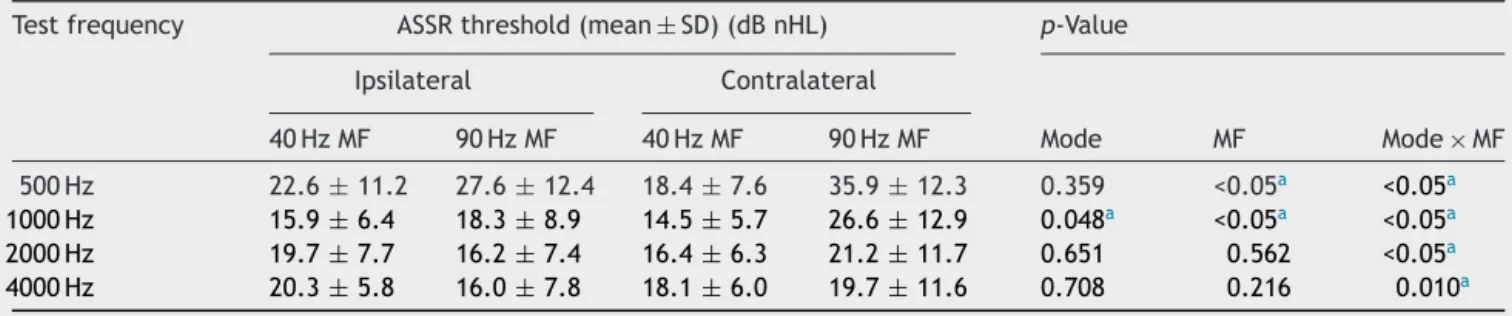
Table1 DescriptiveandinferentialstatisticalanalysesofASSRthresholds(indBnHL)fordifferentmodesofrecordingsand modulationfrequenciesatspecifiedtestfrequencies.
Testfrequency ASSRthreshold(mean±SD)(dBnHL) p-Value
Ipsilateral Contralateral
40HzMF 90HzMF 40HzMF 90HzMF Mode MF Mode×MF
500Hz 22.6±11.2 27.6±12.4 18.4±7.6 35.9±12.3 0.359 <0.05a <0.05a 1000Hz 15.9±6.4 18.3±8.9 14.5±5.7 26.6±12.9 0.048a <0.05a <0.05a 2000Hz 19.7±7.7 16.2±7.4 16.4±6.3 21.2±11.7 0.651 0.562 <0.05a 4000Hz 20.3±5.8 16.0±7.8 18.1±6.0 19.7±11.6 0.708 0.216 0.010a
MF,modulationfrequency.
a Significantatp<0.05.
Results
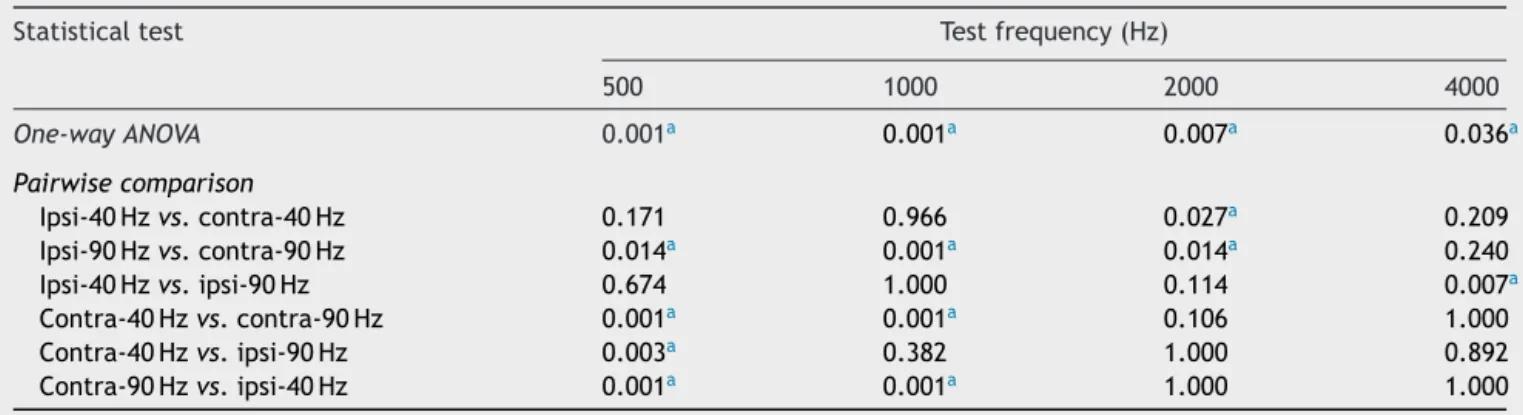
Mean and standard deviation of ASSRthresholds for both recordingmodesatdifferentMFsatspecifictestfrequencies areshownin Table1.Descriptively,exceptat the4000Hz testfrequency,contra-90Hzconditionrevealedthehighest meanASSRthresholdatalltestfrequencies.Atthe4000Hz testfrequency,thehighestmeanASSRthresholdwasnoted inipsi-40Hzcondition.At500and1000Hztestfrequencies, thelowestmeanASSRthresholdswerenotedincontra-40Hz condition. This is followed by ipsi-40Hz condition, which showedslightly higher meanASSRthresholds than thatof contra-40Hz condition (4.2 and 1.4dB higher at 500 and 1000Hz, respectively). Whereas at 2000 and 4000Hz test frequencies,ipsi-90Hzconditionproducedthelowestmean ASSRthresholds.The secondlowest meanASSRthresholds werefoundincontra-40Hzcondition(0.2and2.1dBhigher thanipsi-90Hzconditionat2000and4000Hz,respectively). To confirm these descriptive observations, two-way repeated measures ANOVA was conducted; the statistical outcomesareshowninTable1.Asshown,significant inter-action effects (between mode of recording andMF) were found at alltest frequencies(p<0.05). Consequently, the interpretationofthemaineffects(i.e.,theeffectsofmode ofrecordingandMFonASSRthresholds)canbemisleading. To address this issue, one-way repeatedmeasures ANOVA wascarried out and the simple main effects were deter-mined.Atalltestfrequencies,Mauchly’stestofsphericity revealedthatthesphericityhadnotbeenviolated(p>0.05). Consequently, correction of the degrees of freedom was not required. Table 2 reveals the statistical outcomes of this analysis.As shown, the mean ASSRthresholds among theconditions(i.e.,ipsi-40Hz,contra-40Hz,ipsi-90Hz,and contra-90Hz)werefoundtobestatisticallydifferentfrom eachotheratalltestfrequencies(p<0.05).
The pairwise comparisons using Bonferroni correction at each test frequency was then performed; the results are shown in Table 2. At the 500Hz test frequency, sta-tisticallysignificantresultswereobtainedin‘ipsi-90Hzvs. contra-90Hz’,‘contra-40Hzvs.contra-90Hz’,‘contra-40Hz
vs. ipsi-90Hz’ and ‘contra-90Hz vs. ipsi-40Hz’ conditions (p<0.05). At the 1000Hz test frequency, three condi-tions (i.e., ‘ipsi-90Hz vs. contra-90Hz’, ‘contra-40Hz vs. contra-90Hz’ and ‘contra-90Hz vs. ipsi-40Hz’) produced statistically significant outcomes (p<0.05). At both the
500and 1000Hz test frequencies, the mean ASSR thresh-oldswerestatisticallydifferentbetween contra-40Hzand contra-90Hzconditions.This supportstheearlier observa-tionthat the contra-40Hz condition produced the lowest mean ASSR threshold, while the contra-90Hz condition revealedthehighestmeanASSRthreshold.
Atthe2000Hztestfrequency,onlyonecondition(i.e., ‘ipsi-40Hz vs. contra-40Hz’) revealed a significant result (p=0.027). Similarly, at the 4000Hz test frequency, only onecondition (i.e., ‘ipsi-40Hz vs.ipsi-90Hz’) produced a statisticallysignificantoutcome(p=0.007).
Discussion
Comparisonbetweenlowandhighmodulation frequencies
Recallthat thepresent study aimedtocompare theASSR thresholdsrecordedathighandlowmodulationfrequencies, aswellasbetweenipsilateralandcontralateralrecordings in healthy adults. At the 500 and 1000Hz test frequen-cies, no significant differences in ASSR threshold were found between ipsi-40Hz and ipsi-90Hz conditions. How-ever, contra-90Hz condition produced significantly higher ASSR thresholds than that of contra-40Hz condition. The weak efficiency of ASSR at low frequencies and at high MF found in the present study is in line with previous studies.12---14 The possible reason is that the ASSR at high MFisgeneratedpredominantly bytheauditorybrainstem. Consequently,itshowsalmostsimilarperformancewithABR inthethresholdtesting.15,16ElevatedABRthresholdsatlow frequencieshavebeenwelldocumentedandarerelatedto poorerneuralsynchrony.17,18
Table2 p-Valuesforone-wayrepeatedmeasuresANOVAandpairwisecomparisonsateachtestfrequency.
Statisticaltest Testfrequency(Hz)
500 1000 2000 4000
One-wayANOVA 0.001a 0.001a 0.007a 0.036a
Pairwisecomparison
Ipsi-40Hzvs.contra-40Hz 0.171 0.966 0.027a 0.209
Ipsi-90Hzvs.contra-90Hz 0.014a 0.001a 0.014a 0.240
Ipsi-40Hzvs.ipsi-90Hz 0.674 1.000 0.114 0.007a
Contra-40Hzvs.contra-90Hz 0.001a 0.001a 0.106 1.000
Contra-40Hzvs.ipsi-90Hz 0.003a 0.382 1.000 0.892
Contra-90Hzvs.ipsi-40Hz 0.001a 0.001a 1.000 1.000
aSignificantatp<0.05.
midbrain,thalamus,andprimaryauditorycortex.19If com-paredwithhighMFASSR(i.e.,predominantlygeneratedby theauditorybrainstem),lowerASSRthresholdsat40HzMF ispossiblyduetoincreasedneuralconnectionsandbinaural activitieswithintheseupperregionsofCANS.4Furthermore, since female subjects were also included in the present study, the superiority of ASSR at 40Hz MF might also be influencedbyahormonalfactor.Estrogen,theprimarysex steroidforfemales,isknowntoaffectGABAergic transmis-sionthatmodulates ASSR amplitudes (seeZakaria etal.20 andGriskova-Bulanovaetal.21fordetaileddiscussions).
At 2000 and 4000Hz test frequencies, the mean ASSR thresholds found in the present study were descriptively lower in ipsi-90Hz condition than in ipsi-40Hz condition. This difference was then found to be statistically signif-icant only at the 4000Hz test frequency (Table 2). Both conditions(‘ipsi-40Hz vs.ipsi-90Hz’ and‘contra-40Hzvs. contra-90Hz’)revealedinsignificantstatisticalresultsatthe 2000Hztestfrequency.Thesefindingsareinconsistentwith theresults of the previous studies that found lower ASSR thresholdswithlowMFstimuli.6,14 The reasonfor this dis-similarityisunclearandpossiblyduetothemethodological difference.Thepresentstudy usednarrowbandCE-chirp®
stimulifordeterminingASSRthresholds,whereaspuretones wereutilizedforrecordingASSRthresholdsintheprevious studies.Sincethe stimuliusedaredifferent,some differ-encesinthestudyoutcomeswouldbeexpected.
Comparisonbetweenipsilateralandcontralateral recordings
InthefieldofASSR,literatures regardingthe influenceof ipsilateralandcontralateralrecordingsarelimited.Inthe presentstudy,themajorityoftestfrequencies(500,1000, and4000Hz)foundnosignificantdifferencesinASSR thresh-old between ipsi-40Hz and contra-40Hz conditions. This suggeststhatthemodeofrecordinghasasubtleinfluenceon ASSRthresholdsevokedbylowMFstimuli.Thisfindingisin linewiththestudybyKafandDanesh8thatfoundno signif-icantdifferencesinASSRamplitudesandlatenciesbetween ipsilateraland contralateral recordingsat 500, 2000, and 4000HzCFswith39HzMF.
In contrast, for 90Hz MF stimuli, ipsi-90Hz condition produced statistically lower ASSR thresholds than that of
contra-90Hz condition at 500, 1000, and 2000 test fre-quencies. In fact, at these test frequencies, contra-90Hz condition revealed the highest mean ASSR thresholds. Herein, a significant mode of recording effect on ASSR thresholdsisnotedfor highMFstimuli.Thisresult contra-dictshighMFfindingsinthestudyofKafandDanesh.8That is,intheirstudy,theASSRamplitudesandlatenciesbetween ipsilateralandcontralateralrecordingswerenotfoundtobe statisticallydifferentfromeachotheratalltestedCFswith 79Hz MF.This dissimilarity ispossiblydue tothe method-ologicaldifference.WhilethepresentstudyemployedASSR thresholddetermination, KafandDanesh8 recorded ASSRs at asupra-thresholdlevel (i.e.,65dB SPL).Asstated ear-lier,ASSRsrecordedatthresholdandsupra-thresholdlevels mightyielddifferentoutcomes.9
Thesuperiorityof highMFASSRinrecordingipsilateral ASSR thresholds found in the present study is also incon-sistent withthe studyby SmallandStapells.22 Foradults, theyfound thatthe ASSRthresholdsrecordedat high MFs between ipsilateralandcontralateralrecordings werenot statisticallydifferentat500,1000,2000,and4000HzCFs. The reasonfor thisdisagreementis perhapsdueto differ-ence in sample size. While Small and Stapells22 recorded ASSR thresholds in 11 adults,the present study recruited a higher number of participants (n=29). It is known that a larger sample size would increase the statistical power and the likelihood for rejecting the null hypothesis.23 In otherwords,thesignificantipsilateralASSRresultsobtained for high MF in the present study seem valid due to the larger sample size. Nevertheless, the findings of the cur-rentstudyareconsistentwithpreviousstudiesininfants.7,22 VanMaanenandStapells7determinedASSRthresholdsand amplitudesintwoagegroupsofinfants(>6monthsand≤6 months)atCFsof500,1000,2000,and4000Hzmodulated between81and101Hz.Theythenfoundthatthe contralat-eralASSRsshowedmuchsmalleramplitudesandwereoften absentrelativetotheipsilateralresponses.Inlinewiththis, SmallandStapells22 foundthatforinfants(meanageof21 weeks), the ipsilateral ASSR thresholds were significantly lowerthan thecontralateralASSRthresholds atall tested CFsforbothair-andbone-conductionstimulations.
effectswasanticipatediffrequencyisincludedasoneofthe factors.Secondly,thepresentstudyonlytestedtherightear oftheparticipants.SinceASSRshowsapronounced lateral-ityeffect,24theoutcomesofthepresentstudymightnotbe applicabletotheleftear.Inthisregard,futurestudiesare warrantedtocomparetheASSRthresholdsbetweenears,as wellastofurthersupporttherelevanceofrecordingmode andmodulationfrequencyinASSRrecording.
Conclusions
An effort has been made to determine the influences of mode of recording and modulation frequency on ASSR thresholds in young adults. At low frequencies (500 and 1000Hz),the40HzMFproducedlowerASSRthresholdsthan thatof90HzMF.Athighfrequencies(2000and4000Hz),the ipsi-90Hz produced the lowest ASSRthresholds. Based on theoutcomesofthepresentstudy,theauthorssuggesttwo differentprotocolsforanoptimumthresholddetermination withASSRinyoungadults.Inthefirstprotocol,theuseof lowMFstimuliforrecordingASSRthresholdsatlow frequen-ciesis suggested.Athigh frequencies,highMFstimuliare recommended.Forallconditions,therecordingmodeis ipsi-lateral.Inthesecondprotocol,theuseoflowMFstimuliis recommended for determining ASSRthresholds at all test frequencieswithcontralateralrecording.
Funding
Research University (RU) Grant (1001/PPSK/812114), Uni-versitiSainsMalaysia.
Conflicts
of
interest
Theauthorsdeclarenoconflictsofinterest.
Acknowledgements
This study was part of a research project funded by a Research University (RU) Grant (1001/PPSK/812114), Uni-versitiSainsMalaysia(USM).Someofthestudyfindingshave beenpreviouslypublished(Zakariaetal.).20
References
1.KuwadaS,AndersonJ,BatraR.Sourcesofthescalp-recorded amplitude-modulationfollowingresponse. JAm AcadAudiol. 2002;13:188---204.
2.BatraR,KuwadaS,StanfordTR.Temporalcodingofenvelopes and their interaural delays in the inferior colliculus of the unanaesthetizedrabbit.JNeurophysiol.1989;61:257---68. 3.Creutzfeldt OD, Hellweg FC, Schreiner C. Thalamocortical
transformationofresponsestocomplexauditorystimuli.Exp BrainRes.1980;39:87---104.
4.HerdmanAT,LinsO,VanRoomP.Intracerebralsourcesofhuman auditorysteady-stateresponses.BrainTopogr.2002;15:69---86. 5.TomlinD, RanceG, GraydonK. A comparisonof 40Hz audi-torysteady-stateresponse(ASSR)andcorticalauditoryevoked
potential (CAEP) thresholds in awake adult subjects. Int J Audiol.2006;45:580---8.
6.VanMaanenA, StapellsDR.Comparison ofmultiple auditory steady-stateresponses(80vs40Hz)andslowcortical poten-tialsforthresholdestimationinhearing-impairedadults.IntJ Audiol.2005;44:613---24.
7.VanMaanenA,StapellsDR.Normalmultipleauditory steady-stateresponsethresholdstoair-conductedstimuliininfants.J AmAcadAudiol.2009;20:196---207.
8.Kaf WA, Danesh AA. Air-conduction auditory steady-state response:comparisonofinterchannelrecordingusingtwo mod-ulationfrequencies.JAmAcadAudiol.2008;19:696---707. 9.Vander Werff KR, Brown CJ. Effect of audiometric
configu-rationon thresholdand suprathreshold auditorysteady-state responses.EarHear.2005;26:310---26.
10.DauT, Wagner O,Mellert V,Kollmeier B.Auditory brainstem responses with optimized chirp signals compensating basilar membranedispersion.JAcoustSocAm.2000;107:1530---40. 11.CebullaM,StürzebecherE,ElberlingC.Objectivedetectionof
auditorysteady-stateresponses:comparisonofone-sampleand q-sampletest.JAmAcadAudiol.2006;17:93---103.
12.Swanepoel DW, Hugo R, Roode R. Auditory steady-state responsesforchildrenwithsevertoprofoundhearingloss.Arch OtolaryngolHeadNeckSurg.2004;130:531---5.
13.KafWA,SaboDL,DurrantJD.Reliabilityofelectricresponse audiometryusing80Hz auditorysteady-stateresponses.IntJ Audiol.2006;45:477---86.
14.van der Reijden CS, Mens LM, Snik FM. Frequency-specific objective audiometry: tone-evokedbrainstem responses and steady-stateresponsesto40Hzand90Hzamplitudemodulated stimuli.IntJAudiol.2006;45:40---5.
15.Cone-WessonB,DowellRC,TomlinD,RanceG,MingWJ.The auditorysteady-stateresponse:comparisonswiththeauditory brainstemresponse.JAmAcadAudiol.2002;13:173---87. 16.Johnson TA, Brown CJ. Thresholdprediction using the
audi-tory steady-state response and the tone burst auditory brainstemresponse: a within-subject comparison.Ear Hear. 2005;26:559---76.
17.McGeeT,KrausN,KillionM,RosenbergR,KingC.Improvingthe reliabilityoftheauditorymiddlelatencyresponseby monitor-ingEEGdeltaactivity.EarHear.1993;14:76---84.
18.Sininger YS, Abdala C. Hearing threshold as measured by auditory brainstem response in human neonates. Ear Hear. 1994;17:395---401.
19.Kraus N, McGee T, Stein L. The auditory middle latency response. In:JacobsenJT, editor.Principlesandapplications inauditoryevokedpotentials.Boston:Allyn&Bacon;1994.p. 123---54.
20.Zakaria MN, JalaeiB,Abdul WahabNA.Gender and modula-tionfrequencyeffectsonauditorysteadystateresponse(ASSR) thresholds.EurArchOtorhinolaryngol.2015;273:349---54. 21.Griskova-Bulanova I,Griksiene R, Korostenskaja M, Ruksenas
O. 40Hz auditorysteady-state response in females: when is it better to entrain? Acta Neurobiol Exp (Wars). 2014;74: 91---7.
22.SmallSA,StapellsDR.Normal ipsilateral/contralateral asym-metriesininfantmultipleauditorysteady-stateresponsesto air-andbone-conductionstimuli.EarHear.2008;29:185---98. 23.TaylorDJ,MullerKE.Computingconfidenceboundsforpower
andsamplesizeofthegenerallinearunivariatemodel.AmStat. 1995;49:43---7.