DOI: http://dx.doi.org/10.5007/1980-0037.2013v15n3p437
original article
RBCDH
Licence Creative Commom
CC
1 Faculdade Nobre de Feira de Santana. Faculdade de Edu-cação Física. Feira de Santana, BA. Brazil
2 Faculdade Maria Milza. Faculdade de Educação Física. Governador Mangabeira. BA Brazil
3 Universidade Federal de Pelotas. Escola Superior de Educação Física. Pelotas, RS. Brazil
Received: 07 September 2012 Accepted: 02 January 2013
Efects of concurrent training on health
aspects of elderly women
Efeitos do treinamento concorrente sobre aspectos da
saúde de idosas
Anderson Leandro Peres Campos1,2
Lourenço dos Santos Del Ponte3
Adriana Schüler Cavalli3
Mariângela da Rosa Afonso3
José Franscisco Gomes Schild3
Felipe Fossati Reichert3
Abstract – Training programs that include aerobics and strength exercises, either at the same session or alternate days are deined as concurrent training (CT). he objective of this study was to verify the efects of a CT program on biochemical parameters, cardiovas-cular itness, body composition and neuromuscardiovas-cular aspects. Twenty two elderly women physically active were randomly allocated to one of the ive groups: AS (aerobic exercises followed by strength training; n=5), SA (strength activities followed by aerobics exercises; n=5), AG (aerobics exercise only; n=5), SG (strength activities only; n=4), CG (control group; n=3). he program lasted 12 weeks. Tests of dynamic and static strength, lexibility, aerobic power, body composition and biochemical parameters were conducted. In the aerobics power test, AS and SA groups showed diferences in the post-test compared to the CG. In dynamic strength test of upper limbs, the groups S, SA, AS showed statistical diferences from the CG in the post-test (p=0.009, 0.006 and 0.002 respectively). Only the AS group presented some diference from the pre to post-tests (P=003). AG, SG, SA, AS showed diferences in the post-test in relation to the CG for the lower limbs strength test (p<0.001). From pre to post-test within the same group, the groups SG, SA and AS showed diferences (p=0.001, 0.03, 0.02). Stretching, static strength, biochemical factors and body composition showed no association with any of the groups. We concluded that CT was equivalent to the strength and aerobics exercises performed exclusively.
Key words: Aging; Physical exercise; Physical itness.
INTRODUCTION
Concurrent training (CT) is a model of exercise prescription that combines strength training and aerobic capacity in the same period of time and that has been extensively investigated in recent years1-3. Studies have shown that CT does not afect the development of aerobic capacity and may even improve it4. But when it comes to strength capacity, some authors suggest that CT may reduce the development of strength gain, muscle hypertro-phy and power when compared to strength training alone1,5. Jefrey6 claims that the aerobic exercise model applied to CT may inluence the development of strength, and that cycling exercises would be superior to the treadmill in the development of strength in the lower limbs since it reproduces the biomechanical motion of exercises like leg press or squat with the greatest similarity.
Studies investigating CT in the elderly are hardly mentioned in the sci-entiic literature, but some studies have observed that this type of training is capable of developing strength and aerobic capacity7,8. Conversely, Cadore
et al.9 found that, in elderly males, CT (aerobic before strength training)
can negatively interfere with strength gain when the same muscle group is activated. From the perspective of health promotion, CT appears to be an alternative option to improve cardiorespiratory itness and strength gain. Given these discrepancies found in the literature, the present study aimed to assess the efects of a CT program on biochemical, cardiovascu-lar itness, body composition, and neuromuscucardiovascu-lar parameters in elderly women, comparing them to the efects of strength programs and aerobic exercises exclusively.
METHODOLOGY
An experimental study with random allocation was carried out. Women aged 60 years or more and physically active, i.e., engaged in at least 150 minutes per week of moderate to vigorous intensity activity in the last six months (estimated by the short version of the International Physical Activity Questionnaire) was allocated to one of the experimental groups. Women allocated to the control group (CG) had the same age but were not physically active, as they held only one session per week of 50min of hydrogymnastics.
hirty women were selected and throughout the study there were eight dropouts, leaving the program with 22 participants distributed as follows: AS (aerobic activity followed by strength training, n = 5), SA (strength training followed by aerobic activity, n = 5); A (only aerobic training, n = 5), S (only strength training, n = 4), and CG (control group, only hydrogymnastics, n = 3).
not perform any other type of physical exercise during the experimental protocol period. he study was approved by the Research Ethics Committee of Physical Education School from the Federal University of Pelotas under the protocol number 020/2011.
Training protocol
An adjustment period lasting two weeks was conducted so the participants could get a better assimilation of the order and execution of the exercises as for equipment familiarization. Shortly ater, the participants were invited to go to the Laboratory of Research and Extension in Measurements and Evaluation to carry out the pre-testing.
he training program lasted 12 weeks, comprising three weekly ses-sions with a 25% maximum limit of absences as a criteria to remain in the program.
he AS group performed aerobic training by walking on a treadmill followed by strength training, which consisted of eight exercises involving large and small muscle groups: chest press, behind-the-beck bat bull-down chest press, behind-the-beck bat bull-down, knee extension, knee lexion, biceps pulley, triceps pulley, leg press and curl abdominal on the ground. he SA group performed the same activities of the AS group but in a re-verse order (strength training followed by aerobic exercise). he ST group performed only strength training and the TA group only aerobic exercise.
he program began ater the adaptation period and the initial and inal ive minutes were always used to warm-up and cool-down respectively. he remaining time was divided between aerobic and strength training, excepting abdominal exercise (three sets of 30 repetitions). At the end of the study participants were submitted to a new section of evaluation for the post-testing.
he schedule of the training program consisted of three workouts per week, strength trainings were executed in three series. In weeks 1 and 2: 18 to 20 RM (repetition maximum) plus 20 minutes of aerobic training at 65% of MHR (maximum heart rate); in weeks 3 and 4: 15-17 RM plus 25 min of aerobic training at 65% MHR. In weeks 5 and 6: 12-14 RM plus 25 min of aerobic training at 75% MHR; in weeks 7 and 8: 8-10 RM plus 30 min of aerobic training at 80% MHR; in weeks 9 and 10: 6-8 RM plus 30 min of aerobic training at 85% MHR, and ending with weeks 11 and 12 perform-ing between 4 and 6 RM plus 30 min of aerobic trainperform-ing at 85% MHR.
Biochemical analysis of blood
Muscle Strength
he static strength of the lower limbs and lumbar spine was assessed us-ing a Baseline® dynamometer with a resolution of 10 kgf and handgrip strength using the Jamar® handgrip dynamometer with resolution of 2 kgf. he dynamic force was measured using the 1RM for bench press exercises and bilateral knee extension, where the elderly women held 5 minutes of general warm-up on the treadmill followed by stretching and warming-up on speciic machines, the maximum load was deined ater three attempts with three minutes of pause in both test and retest.
Body Composition
Muscle, bone and residual mass and fat percentage were measured fol-lowing the Drinkwater and Ross10 protocol, by which the total body mass
is subdivided into fat mass, muscle mass, bone mass and residual mass. For this purpose, subcutaneous fat and bone weight were estimated. With this information and the total body mass, muscle and residual mass were also estimated by taking measurements of the following skinfolds: triceps, biceps, subscapular, suprailiac, pectoral, midaxillary, abdominal, medial thigh and medial leg. Skinfold were measured using with a Harpenden skinfold caliper type with precision of 0.1 mm (Sanny). For measuring waist circumference, hip, thigh, leg medial and arm medial an inelastic metal tape (Sanny) was used. he bone diameters were measured with a caliper (Sanny) in the in bistyloid and bicondylar femoral points, biacromial, biiliac-crest, biepicondylar humerus, bimalleolar, transversus thoracic, anterior-posterior diameter of the chest11.
Cardiovascular itness and lexibility
he cardiovascular itness was estimated with the six-minute-walk test and the intensity of the aerobic workout through the maximum heart rate. Wells and Dillon’s11 ‘sit and reach test’ was applied to measure the lexibility.
Statistical Analysis
Data were analyzed using the statistical sotware STATA 9.0. he normal-ity of the sample was checked with the Shapiro-Wilk’s. he comparison between the average percentage change in each group was assessed through paired t-tests. Analysis of variance (ANOVA) for comparisons between the groups with post hoc of Bonferroni was used when the p value was <0,05. he accepted signiicance level was p <0.05.
RESULTS
Because eight participants dropout during the period of intervention, a total of 22 elderly women were analyzed: ive in AS group, ive in the SA group, ive in group A, four in group S and three in the CG, as shown in Table 1.
Table 1. Characterization of the sample at the baseline presented in mean and standard deviation.
Groups (n) Body mass (Kg) Height (m) BMI (Kg/m2) Age (years)
Aerobic training (5) 67.42±18.03 1.56±0.61 27.4±6.62 63.6±2.51 Strength training (4) 64.84±11.90 1.59±0.30 25.32±4.24 70±6.27 Strenght/aerobic training (5) 66.68 ±14.20 1.59±0.45 26.24±4.90 66±3.50 Aerobic/strenght (5) 81.15±16.10 1.57±0.75 28.58±7.63 62±2.50 Control group (3) 70.6±17.27 1.57±0.30 28.58±7.30 74±4.35
BMI = Body Mass Index.
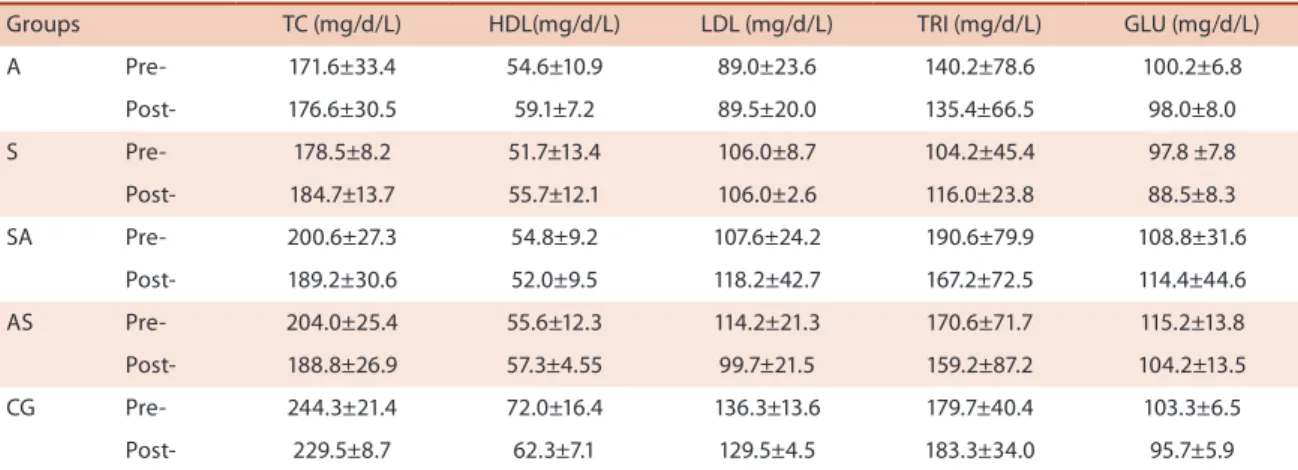
Table 2. Comparison of lipid proiles means of pre- and post-test by group and between groups.
Groups TC (mg/d/L) HDL(mg/d/L) LDL (mg/d/L) TRI (mg/d/L) GLU (mg/d/L) A Pre- 171.6±33.4 54.6±10.9 89.0±23.6 140.2±78.6 100.2±6.8
Post- 176.6±30.5 59.1±7.2 89.5±20.0 135.4±66.5 98.0±8.0 S Pre- 178.5±8.2 51.7±13.4 106.0±8.7 104.2±45.4 97.8 ±7.8 Post- 184.7±13.7 55.7±12.1 106.0±2.6 116.0±23.8 88.5±8.3 SA Pre- 200.6±27.3 54.8±9.2 107.6±24.2 190.6±79.9 108.8±31.6
Post- 189.2±30.6 52.0±9.5 118.2±42.7 167.2±72.5 114.4±44.6 AS Pre- 204.0±25.4 55.6±12.3 114.2±21.3 170.6±71.7 115.2±13.8 Post- 188.8±26.9 57.3±4.55 99.7±21.5 159.2±87.2 104.2±13.5 CG Pre- 244.3±21.4 72.0±16.4 136.3±13.6 179.7±40.4 103.3±6.5
Post- 229.5±8.7 62.3±7.1 129.5±4.5 183.3±34.0 95.7±5.9
TC = total cholesterol; HDL = High-density lipoprotein; LDL = Low-density lipoprotein; TRI = triglycerides; GLI = glucose; A = Aerobic training; S = Strength Training; SA = Strength followed by aerobic, AS = aerobic followed by strength; CG = Control Group
he results for the variables body composition; fat, muscle, bone and residual mass and percentage, body weight and waist circumference are shown in Table 3. Regarding the components of body composition, none of the four exercise programs proved to be efective for a modiication of the variables under this study, since it showed no diferences between groups or from pre- to post-test in the same group.
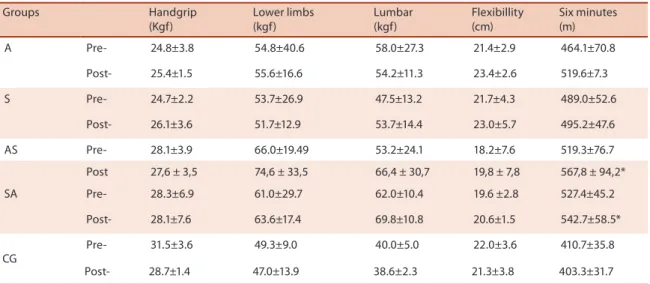
As shown in Table 4, ater analyzing the static strength and lexibility variables, no signiicant diferences were found from pre- to post-test in the same group. However in the test of aerobic power estimated by the six-minute-walk test, group AS and SA showed diferences in post-test when compared to CG with p values of 0.01 and 0.04 respectively.
he dynamic force was measured before and ater training. In the up-per limb strength represented by bench press exercises, groups S, SA, AS showed statistical diference in post-test when compared to the control group (p = 0.009, 0.006 and 0.002 respectively). Ater analyzing the difer-ence pre- and post- training in the same group, only the AS group showed signiicant changes (p = 0,03) as shown in Figure 1.
Figure 1. Comparison of dynamic strength of upper and lower limbs means of the pre- and post-test by group and between groups.
UL = Upper limbs, LL = lower limbs; * Signiicant diference between pre- and post-training (P <0.05), # Signiicant diference when compared to control group (p <0, 001).
Table 3. Comparison of body composition variables in pre- and post-tests (data are presented in means with their respective standard deviations).
Groups Total Body Mass (Kg)
Waist circum-ference (Cm)
Relative body fat (%)
Absolute fat mass (kg)
Bone Mass (kg)
Residual Mass (kg)
Muscle Mass (kg) A Pre- 67.4±18.0 91.4±10.5 35.6±11.3 22.6±2.9 7.7±1.4 15.2±2.9 22.0±16.2 Post- 67.1±17.8 90.3±12.4 31.2±7.0 20.2±3.2 7.9±1.4 15.1±2.9 23.9±13.0 S Pre- 64.8±11.9 91.4±6.7 40.1±12.8 27.0±13.0 8.6±0.6 15.6±2.9 13.6±4.8 Post- 64.5±11.8 91.5±8.8 38.3±15.5 26.0±15.0 8.4±0.8 15.5±2.9 14.5±6.5 SA Pre- 66.7±14.2 93.5±12 39.6±6.8 26.8±9.4 8.0±0.8 16.1±3.4 15.7±3.9 Post- 65.8±13.3 96±11.8 33.6±5.4 22.6±8.2 8.2±0.9 15.9±3.2 19.2±2.2 AS Pre- 81.1±16.1 103±10.6 33.2±8.0 26.1±4.2 8.5±1.6 18.3±2.4 28.2±13.4 Post- 80±15.1 103±10.4 31.0±7.1 24.2±4.7 8.5±1.7 18.0±2.4 29.3±12.5 CG Pre- 70.6±17.3 95±22 46.4±9.8 33.7±14.6 8.0±0.5 17.0±4.2 11.9±3.1
Post- 73.3±15.6 96±21 46.9±10.8 35.4±15.1 8.2±0.6 17.6±3.8 12.0±3.2
A = Aerobic training; S = Strength Training; SA = Strength followed by aerobic, AS = aerobic followed by strength; CG = Control Group
Table 4. Comparison of static strength, lexibility and aerobic power within and between groups.
Groups Handgrip (Kgf)
Lower limbs (kgf)
Lumbar (kgf)
Flexibillity (cm)
Six minutes (m) A Pre- 24.8±3.8 54.8±40.6 58.0±27.3 21.4±2.9 464.1±70.8
Post- 25.4±1.5 55.6±16.6 54.2±11.3 23.4±2.6 519.6±7.3 S Pre- 24.7±2.2 53.7±26.9 47.5±13.2 21.7±4.3 489.0±52.6
Post- 26.1±3.6 51.7±12.9 53.7±14.4 23.0±5.7 495.2±47.6 AS Pre- 28.1±3.9 66.0±19.49 53.2±24.1 18.2±7.6 519.3±76.7 Post 27,6 ± 3,5 74,6 ± 33,5 66,4 ± 30,7 19,8 ± 7,8 567,8 ± 94,2* SA Pre- 28.3±6.9 61.0±29.7 62.0±10.4 19.6 ±2.8 527.4±45.2
Post- 28.1±7.6 63.6±17.4 69.8±10.8 20.6±1.5 542.7±58.5*
CG
Pre- 31.5±3.6 49.3±9.0 40.0±5.0 22.0±3.6 410.7±35.8 Post- 28.7±1.4 47.0±13.9 38.6±2.3 21.3±3.8 403.3±31.7
DISCUSSION
he consistency of inding from studies investigating the efects of con-current training is still conlicting, thus the establishment of training criteria and their inluence on practitioners’ health promotion is hindered. Although several studies have been published on the subject of concurrent training, only a few reports investigated the elderly population, especially regarding the order of exercises execution 12-15. he advantages of
perform-ing CT in this population are related to the fact that this model of exercise program might result in similar gains in aerobic capacity when compared to an isolated training model1,7,16.
he present study did not veriied changes in levels of static strength. hese results corroborate with the ones reported by Souza et al.17 in the
sense that performing aerobic exercises previously to the strength model was not able to change the strength rates for the lumbar region. However, most studies seeking to determine the inluence of the aerobic component into the strength levels show that there is a decreased rate of strength gains in lower limbs18. However, we have found contrasting results where the AS
group showed improvements from the pre- to the post-test (p=0.02) for the 1RM test for leg press exercise.
Similarly, Wood et al.7, submitted elderly individuals to ST and CT for
12 weeks; the TS group performed 2 sets and CT group performed a series. Ater this period, a similar gain in muscle strength was observed in both groups (38-44%, respectively), but no diferences between groups. Izquierdo et al.12 investigated elderly individuals, divided into two groups: a group
performing two sessions and another performing CT, that is, a session of ST per week and another of AT on ergometer. Ater 16 weeks of training, no diferences were observed regarding gains in muscle strength between groups. In this study, diferences were only found when comparing to the CG regarding the dynamic muscular strength, results that resemble the indings by Wood and Isquierdo7.
Still, gender diferences, number of sessions and series and the aerobic training model should be noted, since in the present study only women participated and all groups performed three weekly sessions with the same volume of strength and aerobic training, unlike the mentioned studies7,12
in which CT groups performed a smaller volume of sets per exercise when compared to ST ones. his is one aspect that limits comparisons between studies. Another important parameter to be discussed is the model of aerobic training, since in this study was performed on a treadmill, what according Jefrey6 would be a disadvantage when compared to the cycle
ergometer for the development of strength in the lower limbs because it reproduces with better similarity the leg press motion exercises.
Concerning the results of the variable fat percentage, the present study matches the indings by Viana et al.19, which showed no signiicant
study also found similar results to Rossato et al.20 who concluded that the
performance of a combined training of strength and aerobic, in a same session, was not able to lead to signiicant modiications in relative body fat, lean mass and bone mass in adult women.
On the other hand, Sillanpaa et al.21 analyzed the body composition
changes, through DEXA, skinfolds, bioimpedance and waist circumfer-ence of 53 men aged between 40 and 65 years during 21 weeks of concur-rent training. he researchers noted that the percentage of fat decreased, on an average of 5-8% in all groups, concluding that concurrent training (aerobic and strength) was more eicient to decrease the percentage of fat when compared to isolated training.
Our indings also diverge from the 10-week-study by Dolezal & Pot-teiger22, who found diferences in the percentage of fat in the three studied
groups: strength, aerobic and concurrent. It is important to highlighting the diiculties of comparing studies, since gender relations, mainly driven by hormonal issues as well as time, intensity and duration of sessions inlu-ence the energy expenditure. Furthermore, according to the ACSM23, to
reduce the percentage of fat, regular exercise and nutritional control should be associated. Because the diet of the participants was not controlled, this could be an explanation to the fact that this research has not found any signiicant change in the values of fat percentage.
Statistically signiicant changes were not found for any of the variables in the biochemical proile as in body composition, which is in contrast with LeMura et al.24 since in their study with sedentary young women showed
that the aerobic group decreased TRI and increased HDL. Likewise Ghah-ramanloo et al25 observed that sedentary young males showed signiicant
improvements in HDL and LDL in the aerobic group and concurrent train-ing. One of the diiculties in comparing the current study with indings from LeMura and Ghahramanloo is the age and itness of participants. he fact that both studies assessed sedentary individuals suggests that these acute responses to the exercise are faster in sedentary individuals than physically active.
Regarding aerobic capacity, the present study showed a diference in the post-test between groups AS and SA compared to the CG (p=0.01 and 0.04 respectively), but no improvements from pre- to post-training. Similar results were found by Maiorana et al.26 veriied improvements in aerobic
capacity in older adults with heart failure ater eight weeks of concurrent training. Moreover, Campos et al.27 assessed the efects of a concurrent
training program where hypertensive women with a minimum age of 50 years were submitted to a muscle endurance training followed by aerobic training, resulting in diferences in VO2max of 1.48 to 1.87 (L.min-1). Yet,
diferences in training intensities among studies make it diicult to com-pare their results.
ater 12 weeks of intervention in their study with adult women. Rebelato et al.29 found no diference in levels of lexibility of elderly women who
participated in a itness program involving strength workouts and aerobic power in the same session. Contradicting the results of the present study, Boganha et al.30 found improvements in lexibility when studying the
ef-fects of 10-week-program with three sessions of CT (strength and aerobic) in postmenopausal women, thus a plausible explanation for the diference between the results may be the fact that the study by Boganha et al.30
as-sessed sedentary women.
Some limitations of this study should be observed. he small sam-ple size per group inluenced negatively in the statistical power and may have let out some important diferences as well as statistically signiicant. he lack of a nutritional control of the participants’ diet is also another aspect that may have negatively inluenced the results.
Regarding dynamic strength, the study’s results suggest that the physi-cal exercise program was efective only when compared to the CG, except for the A group in upper limb strength testing, although no diferences were found between the trained groups. As for cardiovascular itness, AS and SA were diferent compared to the CG, but no improvement was observed from pre- to post-training. In sum, our indings suggest that CT in elderly women was similar to performing either aerobic and strength exercises separately. Further studies are warranted, including nutritional control and a larger sample size, to increase the power of statistical analyses.
REFERENCES
1. Bell GJ, Syrotuik D, Martin T P, Burnham R, Quinney H. Efect of strength training and endurance training on skeletal muscle properties and hormone concentrations in humans. Eur J Appl Physiol 2000; 81(5):418-27.
2. Hakkinen K, Alen M, KraemerJW, Gorostiaga E, Izquierdo M, Rusko H, et al. Neuromuscular adaptations during concurrent strength and endurance training versus strength training. Eur J Appl Physiol 2003; 89(1):42-52.
3. McCarthy JP, Pozniak MA, Agre JC. Neuromuscular adaptations to concurrent strength and endurance training. Med Sci Sports Exerc 2002;34 (3):511-19. 4. Pollock ML, Franklin BA, Balady GJ, Chaitman BL, Fleg JL, Fletcheb B, et al. AHA
Science Advisory. Resistance exercise in individuals with and without cardiovascu-lar disease: beneits, rationale, safety, and prescription: an advisory from the com-mittee on exercise, rehabilitation, and prevention, council on clinical cardiology, American Heart Association; position paper endorsed by the American College of Sports Medicine Circulation 2000;22 (3):828-33.
5. Hunter GH, McCarthy JP, Bamman MM. Efects of resistance training on older adults. Sports Med 2004;34(5):329-48.
6. Jefrey CG. Comparison of two lower-body modes of endurance training on lower-body strength development while concurrently training. J Strenght Cond Res 2009;23(7):979-87.
7. Wood RH, Reyes R, Welsch MA, Favaloro-Sabatier J, Sabatier M, Lee CM, et al. Concurrent cardiovascular and resistance training in healthy older adults. Med Sci Sports Exerc 2001; 33(10):1751-58.
9. Cadore EL, Pinto R S, Lhullier FLR, Correa CS, Alberton CL, Pinto SS, et al. Physiological efects of concurrent training in elderly men. Int J Sports Med 2010; 31(10):689-97.
10. Drinkwater DT & Ross WD. Anthropometric fractionation of body mass. In: Ostyn M, Beunen G, Simon J. Kinanthropometry II. International series of sport scince Baltimore:University Park Press 1980
11. Heyward VH. he physical itness specialist certiication manual, he Cooper Institute for Aerobic Research. Champaign: Human kinetics, 2007.
12. Izquierdo M, Ibañez J, Häkkinen K, Kraemer WJ, Larrión JL, Gorostiaga EM. Once weekly combined resistance and cardiovascular training in healthy older men. Med Sci Sports Exerc 2004;36(3):435-43.
13. Karavirta L, Häkkinen A, Sillanpää E, Garcia-Lopez D, Kauhanen A, Haapa-saari A, et al. Efects of combined endurance and strength training on muscle strength, power and hypertrophy in 40-67-year-old men. Scand J Med Sci Sports 2011;21(3):402-11.
14. Cadore EL, Izquierdo M, Alberton CL, Pinto RS, Conceição M, Cunha G et al. Strength prior to endurance intra-session exercise sequence optimizes neuro-muscular and cardiovascular gains in elderly men. Exp Gerontol 2012; 47(2):164-69. 15. Sillampää E, Häkkinen A, Nyman K, Cheng S, Karavirta L, Laaksonen DE et al.
Body composition and itness during strength and/or endurance training in older men. Med Sci Sports Exerc 2008;40(5):950-8.
16. Cadore EL, Pinto RS, Pinto SS, Alberton CL, Correa CS, Tartaruga MP, et al. Efects of strength, endurance and concurrent training on aerobic power and dynamic neuromuscular economy in elderly men. J Strength Cond Res 2011;25(3):758-66 17. Souza EO, Tricoli V, Franchini E, Paulo AC, Regazzini M, Ugrinowitsch C. Acute
efect of two aerobic exercise modes on maximum strength endurance. J Strenght Cond Res 2007;21(4):1286-90.
18. Sporer B, Wenger H. Efects of aerobic exercise on strength performance following various periods of recovery. J Strenght Cond Res 2003;17(4):188-92.
19. Viana MV, Filho JF, Dantas EHM, Perez AJ. Efeitos de um programa de exercícios físicos concorrentes sobre a massa muscular, a potência aeróbica e a composição corporal em adultos aeróbicos e anaeróbicos. Fitn Perf J 2007;6(3):135-39. 20. Rossato M, Binotto MA, Roth MA, Temp H, Carpes FP, Alonso JL. Efeito de um
treinamento combinado de força e endurance sobre componentes corporais de mulheres na fase de perimenopausa. Rev Port Cienc Desp 2007;7(1):92-9.
21. Sillanpaa E, Hakkinen A, Nyman K, Mattila, Cheng S, Karavirta L, et al. Body composition and itness during strength and/or endurance training in older men. Med Sci Sports Exerc 2009;40(5):950-8.
22. Dolenzal B, Potteiger J. Concurrent resistance and endurance training inluence basal metabolic rate in non dieting individuals. J Appl Physiol 1998;85(6):695-700. 23. Chodzko-Zajko, Wojtek J., David N, Fiatarone Singh, Maria A. Minson, Christo-pher T et al. Exercise and physical activity for older adults. Med Sci Sports Exerc 2009;41(7):1510- 30
24. LeMura LM, von Duvillard SP, Andreacci J, Klebez JM, Chelland SA, Russo J. Lipid and lipoprotein. proiles, cardiovascular itness, body composition, and diet during and ater resistance, aerobic and combination training in young women. Eur J Appl Physiol 2000;82(6):451-58.
25. Ghahramanloo E, Midgley AW, Bentley DJ. he efect of concurrent training on blood lipid proile and anthropometrical characteristics of previously untrained men. J Physiol Activity Health 2009;6(6):760-66.
26. Maiorana A, O’Driscoll G, Dembo L, Cheetham C, Goodman C, Taylor R, et al. Efect of aerobic and resistance exercise training on vascular function in heart failure. American J Physiol Heart Circulation 2000;27(4):199-205.
Corresponding author
Anderson Leandro Peres Campos Departamento de Educação Física Avenida Maria Quitéria, 2116 - Kalilandia,
44025-250 - Feira de Santana, BA. Brasil
E-mail: [email protected]
28. Da Silva MC, Rombaldi AJ, Campos ALP. Ordem dos exercícios aeróbios e de força na aptidão física de mulheres acima de 50 anos. Rev. Bras. Cineantropom Desempenho Hum 2010;12 (2):134-39.
29. Rebelatto JR, Calvo JI, Orejuela JR, Portillo JC. Inluência de um programa de atividade física de longa duração sobre a força muscular manual e a lexibilidade corporal de mulheres idosas. Rev Bras Fisioter 2006;10 (1):127-32.