Licence
Efects of a low intensity strength training
program on overweight/obese and
premenopausal/menopausal women
Efeitos do treinamento de força de baixa intensidade em
mulheres com sobrepeso/obesidade e pré-menopausa/
menopausa
Cristian Álvarez1
Rodrigo Ramírez Campillo2
Abstract– Obesity-related complications may be compounded by the detrimental consequences of menopause. Strength training programs may have an impact on this relationship. Our objective was to examine strength (1RM) and kinanthropometric altera-tions for overweight/obese pre- and menopausal women who participated in a strength program. Methods: 35 women were separated into: overweight premenopausal (n=8), obese premenopausal (n=9), overweight menopausal (n=8) and obese menopausal (n=10) categories. Participants attended a strength program for 8 weeks. Kinanthropometric characteristics and 1RM were determined at baseline, week 4 (except 1RM) and week 8. Results: All groups reduced (p< 0.05) body weight, body mass index (BMI), skinfolds and waist circumference. Furthermore, all groups achieved an increase (p< 0.05) in 1RM. When grouped per menopausal state or BMI, a more signiicant increase in strength was seen in menopausal and obese subjects. A signiicant correlation was observed for menopausal state, BMI and strength. he strength changes were signiicantly superior vs. kinanthropometric changes. Within kinanthropometric changes, skinfolds exhibit a more signiicant reduction vs. body weight, BMI and waist circumference. Conclusions: all groups showed changes in strength and kinanthropometric parameters. Strength adaptations were superior in menopausal and obese women. he strength adaptations exhibit a superior magnitude vs. kinanthropometric changes. In short term, a strength program may lead to important health and functional beneits, especially in menopausal or obese women.
Key words: Obesity; Menopause; Resistance training.
Resumo– As complicações relacionadas à obesidade podem ser agravadas pelas
consequ-ências prejudiciais da menopausa. Programas de força podem ter um impacto sobre esta relação. O objetivo foi examinar alterações cineantropométricas e força em mulheres com excesso de peso/obesas e pré-menopausa/menopausa que participaram de um programa de força. Participaram do estudo 35 mulheres que foram separadas em grupos: excesso de peso pré-menopausa (n = 8), obesas pré-menopausa (n = 9), excesso de peso menopausa (n = 8) e obesas menopausa (n = 10). Os sujeitos foram treinados durante oito semanas. Características cineantropométricas e de força foram analisadas no início, na quarta e oitava semana (exceto força). Os grupos conseguiram uma redução no peso corporal, IMC, da gordura subcutânea e circunferência da cintura. Todos os grupos obtiveram um aumento (p < 0,05) na força máxima. Um aumento de força signiicativamente maior foi observado em mulheres obesas ou na menopausa. Uma correlação signiicativa foi observada para estado menopausal, IMC e força. As mudanças de força foram signiicativamente mais ele-vadas versus mudanças cineantropométricas. Dentro das mudanças cineantropométricas, a gordura subcutânea apresentou uma redução mais signiicativa versus o peso corporal, IMC e circunferência da cintura. Pode-se concluir que os grupos apresentaram alterações nos parâmetros cineantropométricos e de força. As adaptações de força foram superiores em mulheres na menopausa e obesas. As adaptações de força apresentaram uma magnitude superior versus alterações cineantropométricos. Em curto prazo, o programa de treinamento de força pode conduzir a importantes benefícios na saúde e funcionais, especialmente, em
1 Centro de Salud Familiar de Los Lagos, Programa de Promoción de la Salud, Región de Los Ríos, Chile.
2 Universidad de Los Lagos. Departamento de Ciencias de la Actividad Física. Región de Los Lagos, Chile.
Short title: Strength training for overweight/obese women Álvarez & Ramírez-Campillo
INTRODUCTION
he ENS survey, conducted in 2009-2010, has provided evidence that more than 64% of women in Chile, older than 17 years, are overweight or obese1. Obesity/overweight is a highly prevalent chronic disease associated with numerous co-morbidities including cardiovascular disease, diabetes, hy-pertension, some types of cancer2,3, and functional/mobility impairment4,5. Moreover, obesity-related complications may be compounded by the
detrimental consequences of menopause4,6. he conluence of aging and
obesity may create an ideal environment for skeletal muscle catabolism and decline in physical function (strength). During menopause there is an altered hormonal status (less anabolic), that is aggravated by obesity, leading to decreased muscle mass and development of sarcopenic obesity, a condi-tion that may be translated into a reduced ability to perform daily activities such as walking, chair rising, stair climbing, body transfer, among others7. he relationship between obesity, increased age and physical disability will increase from the year 20128 onwards. Treatment for obesity has proven diicult, with a high proportion of those who lose weight, subsequently
regaining much of the weight loss9. he high prevalence of obesity, the
increasing relationship between obesity-aging-physical disability and the lack of treatment success argue for the evaluation of strategies to prevent/ treat overweight and obesity. here is widespread consensus that lifestyle changes, such as increased skeletal muscle activities, are the cornerstones in both prevention and treatment of obesity and the metabolic syndrome10. Strength training must be an integral part of adult itness programs11. Un-like aerobic exercise, which results in signiicant increases in energy expenditure during, and for a short time following cessation of the activity, the energy expenditure during strength training is relatively low12,13,but the increase in energy expenditure ater cessation of the activity may be elevated14. A strength training session of minimum volume (11 min per session) demonstrated a signiicant efect on post exercise energy expenditure and fat oxidation15. Fur-thermore, strength training has demonstrated a beneicial efect on body com-position in overweight/obese postmenopausal16 and premenopausal women17,18. he objective of the present study was to determine the efects of a guided short duration low intensity (but metabolically strenuous) strength training program with kinanthropometric measurements and muscle strength in overweight/obese and premenopausal/menopausal women. In contrast to other studies published so far, we investigated whether such an intervention would produce diferent results in premenopausal versus menopausal women. In addition, the efects of overweight/obesity on the outcome of the intervention were also assessed.
METHODS
Inclu-between 25 and 35, and absence of contraindication to exercise. Also, direct descendants of parents with diabetes type 2 were included, because there is little scientiic evidence regarding their response to a strength training program. All subjects completed a comprehensive medical examination and routine blood tests. Subjects were excluded if they had arrhythmia, tachycardia and/or chronic obstructive pulmonary disease, osteoarticular disease, ischemia; or were taking drugs or medication that afected body weight or metabolic variables. Seventeen participants were premenopausal, 18 were classiied menopausal (41 – 68 years). Menopause classiication was performed by anamnesis and hormonal analysis. If follicle-stimulating hormone (FSH) and luteinizing hormone (LH) were higher than 20 IU/ ml and estradiol <30 pmol/l participants were classiied as menopausal19. Sixteen participants were classiied as overweight (BMI 25-29.8 kg/m2) and nineteen were classiied as obese (BMI 29.9-35 kg/m2)1.
Participants were divided into four groups: overweight premenopausal (OvPre, 8 women, age 29.9 ± 5.4 years, BMI 28.0 ± 1.4 kg/m2), obese pre-menopausal (ObPre, 9 women, age 31.1 ± 4.8 years, BMI 32.8 ± 2.2 kg/m2), overweight menopausal (OvM, 8 women, age 48.1 ± 6.4 years, BMI 28.0 ±
1.5 kg/m2), and obese menopausal (ObM, 10 women, age 51.4 ± 8.5 years,
BMI 35.1 ± 2.8 kg/m2). Sample size was computed according to observed
changes in 1RM (delta=5,1 kg; d.s=1) in a group of postmenopausal women submitted to strength training19. A total of 8 participants per group would yield a power of 80% and a ά of 0,05.
Written informed consent was given for all subjects; the study protocol was approved by the ethical committee of the Los Lagos Family Health Center (Los Rios Region, Chile) and the Physical Activity Sciences Depart-ment of Los Lagos University (Los Lagos Region, Chile).
Data collected at baseline, and at the end of weeks 4 and 8, included body weight, height, BMI, waist circumference, and skinfolds (triceps, subscapular, iliac crest, medial calf). Maximal strength (1RM) in squat (SQ), bent row (BR), shoulder press (ShP) and biceps curl (BC) exercises were also assessed at baseline, and at the end of week 8.
All subjects were instructed not to change their dietary or physical activity habits during the 8 week intervention period.
Anthropometry
Height was measured while subjects were barefoot with a professional
sta-diometer (Health o Meter®, USA), recorded to the nearest 0.1 cm. Weight
was measured with the participants wearing light clothing or underwear,
and was recorded to the nearest 0.01 kg using a digital scale (OMRON®,
Model HBF-INT). BMI was calculated according to weight divided by
height squared (kg/m2). Waist circumference was measured at the level
Short title: Strength training for overweight/obese women Álvarez & Ramírez-Campillo
(Hoechstmass®, West Germany 1-150 cm). All kinanthropometric measure-ments (including skinfolds and waist circumference) were determined by
the ISAK anthropometric protocol20. All the measurements were obtained
by the same person, with a certiied ISAK level III.
Maximal strength test (1RM)
Maximal strength (1RM) of the lower (SQ) and upper body (BC, ShP, BR) was determined with free weight equipment, according to previous reco-mendations21. Previous to the 1RM test, subjects took part in 3 familiariza-tion sessions (over a 1 week period), where the correct execufamiliariza-tion technique of the exercises performed was stressed. All measurements were taken at baseline and at week 8.
Strength training
Subjects attended twice-weekly 24-40 minute guided low intensity (but metabolically strenuous) strength training sessions during eight weeks. he training sessions were supervised by a trained exercise counselor. Adher-ence was assessed by participant attendance at the sessions. AdherAdher-ence was good, as participants attended more than 80% of the sessions. Participants completed 4 strength exercises each session (SQ, BR, ShP and BC). he training program considered the progressive overload principle. During weeks 1-3 subjects completed 3 series for each exercise, with 20%1RM. During weeks 4-6 subjects completed 4 series for each exercise with 25% 1RM. he last 2 weeks, subjects completed 5 series for each exercise with 30%1RM. Repetitions in each series were completed until voluntary ex-haustion (usually 1 minute of muscular work). A rest period of one minute was allowed between series and exercises.
Statistical analysis
Adherence to the 8 week strength training program was good (OvPre 92%, ObPre 93%, OvM 90% and ObM 95%) and no dropouts were reported.
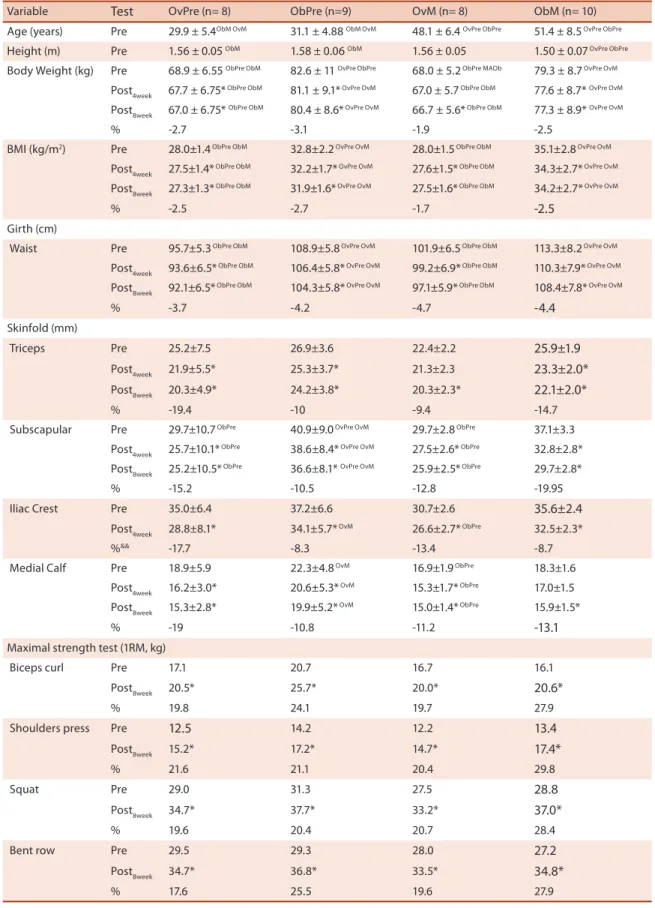
he descriptive characteristics of subjects at baseline and at the end of weeks 4 and 8 are summarized in Table 1.
When grouped for menopausal state (data not shown) at baseline, body weight, BMI, skinfolds, waist circumference, and maximal strength, did not dif-fer between pre- and menopausal women. On the other hand, when grouped per BMI (data not shown), body weight, BMI, waist circumference, and subscapular skinfolds were diferent at baseline between overweight and obese women.
Body weight, BMI, waist circumference and skinfolds (triceps, subscap-ular, iliac crest, calf) were reduced in all groups (p<0.05), while maximal strength of the upper (BC, ShP, BR) and lower body (SQ) increased signii-cantly (p<0.05) ater the 8 week strength training intervention (Table 1).
Some of the kinanthropometric variables (body weight, BMI, waist circumference, subscapular fat-fold) showed a rapid modiication (week 4) with training (Table 1).
No signiicant diferences were observed between groups for the per-centage changes (between weeks 0 to 8) of the dependent variables, except for BR, where ObM and OvM had a more signiicant increase than OvPre, and OvM had a more signiicant increase than ObPre.
When grouped per BMI, obese subjects had a more signiicant in-crease in maximal strength in the BC (27.3%) and BR (27.5%) exercises vs. overweight subjects (20.1 and 18.7%, respectively). All the other variables modiications were similar between obese and overweight subjects.
When grouped per menopausal state, menopausal women had a more signiicant increase in maximal strength in the BC (27.2%), ShP (27.7%) and BR (27.9%) exercises vs. premenopausal subjects (20.6, 22.1 and 18.9%, respectively). All the other variables’ modiications were similar between menopausal and postmenopausal subjects.
Age and BMI showed no signiicant correlation with kinanthropomet-ric changes. Only the 1RM increase in SQ showed a signiicant correlation (r=0.45; p<0.007) with age. BMI only correlates with 1RM increase in ShP (r=0.37; p=0.03) and BR (r=0.47; p=0.005).
Short title: Strength training for overweight/obese women Álvarez & Ramírez-Campillo
Table 1. Individual, kinanthropometric and strength characteristics of subjects.
Variable Test OvPre (n= 8) ObPre (n=9) OvM (n= 8) ObM (n= 10)
Age (years) Pre 29.9 ± 5.4ObM OvM 31.1 ± 4.88 ObM OvM 48.1 ± 6.4 OvPre ObPre 51.4 ± 8.5 OvPre ObPre
Height (m) Pre 1.56 ± 0.05 ObM 1.58 ± 0.06 ObM 1.56 ± 0.05 1.50 ± 0.07 OvPre ObPre
Body Weight (kg) Pre 68.9 ± 6.55 ObPre ObM 82.6 ± 11 OvPre ObPre 68.0 ± 5.2 ObPre MAOb 79.3 ± 8.7 OvPre OvM
Post4week 67.7 ± 6.75* ObPre ObM 81.1 ± 9.1* OvPre OvM 67.0 ± 5.7 ObPre ObM 77.6 ± 8.7* OvPre OvM
Post8week 67.0 ± 6.75* ObPre ObM 80.4 ± 8.6* OvPre OvM 66.7 ± 5.6* ObPre ObM 77.3 ± 8.9* OvPre OvM
% -2.7 -3.1 -1.9 -2.5
BMI (kg/m2) Pre 28.0±1.4 ObPre ObM 32.8±2.2 OvPre OvM 28.0±1.5 ObPre ObM 35.1±2.8 OvPre OvM
Post4week 27.5±1.4* ObPre ObM 32.2±1.7* OvPre OvM 27.6±1.5* ObPre ObM 34.3±2.7* OvPre OvM
Post8week 27.3±1.3* ObPre ObM 31.9±1.6* OvPre OvM 27.5±1.6* ObPre ObM 34.2±2.7* OvPre OvM
% -2.5 -2.7 -1.7 -2.5
Girth (cm)
Waist Pre 95.7±5.3 ObPre ObM 108.9±5.8 OvPre OvM 101.9±6.5 ObPre ObM 113.3±8.2 OvPre OvM
Post4week 93.6±6.5* ObPre ObM 106.4±5.8* OvPre OvM 99.2±6.9* ObPre ObM 110.3±7.9* OvPre OvM
Post8week 92.1±6.5* ObPre ObM 104.3±5.8* OvPre OvM 97.1±5.9* ObPre ObM 108.4±7.8* OvPre OvM
% -3.7 -4.2 -4.7 -4.4
Skinfold (mm)
Triceps Pre 25.2±7.5 26.9±3.6 22.4±2.2 25.9±1.9
Post4week 21.9±5.5* 25.3±3.7* 21.3±2.3 23.3±2.0*
Post8week 20.3±4.9* 24.2±3.8* 20.3±2.3* 22.1±2.0*
% -19.4 -10 -9.4 -14.7
Subscapular Pre 29.7±10.7 ObPre 40.9±9.0 OvPre OvM 29.7±2.8 ObPre 37.1±3.3
Post4week 25.7±10.1* ObPre 38.6±8.4* OvPre OvM 27.5±2.6* ObPre 32.8±2.8*
Post8week 25.2±10.5* ObPre 36.6±8.1* OvPre OvM 25.9±2.5* ObPre 29.7±2.8*
% -15.2 -10.5 -12.8 -19.95
Iliac Crest Pre 35.0±6.4 37.2±6.6 30.7±2.6 35.6±2.4
Post4week 28.8±8.1* 34.1±5.7* OvM 26.6±2.7* ObPre 32.5±2.3*
%&& -17.7 -8.3 -13.4 -8.7
Medial Calf Pre 18.9±5.9 22.3±4.8 OvM 16.9±1.9 ObPre 18.3±1.6
Post4week 16.2±3.0* 20.6±5.3* OvM 15.3±1.7* ObPre 17.0±1.5
Post8week 15.3±2.8* 19.9±5.2* OvM 15.0±1.4* ObPre 15.9±1.5*
% -19 -10.8 -11.2 -13.1
Maximal strength test (1RM, kg)
Biceps curl Pre 17.1 20.7 16.7 16.1
Post8week 20.5* 25.7* 20.0* 20.6*
% 19.8 24.1 19.7 27.9
Shoulders press Pre 12.5 14.2 12.2 13.4
Post8week 15.2* 17.2* 14.7* 17.4*
% 21.6 21.1 20.4 29.8
Squat Pre 29.0 31.3 27.5 28.8
Post8week 34.7* 37.7* 33.2* 37.0*
% 19.6 20.4 20.7 28.4
Bent row Pre 29.5 29.3 28.0 27.2
Post8week 34.7* 36.8* 33.5* 34.8*
% 17.6 25.5 19.6 27.9
OvPre: overweight premenopausal women; ObPre: obese premenopausal women; OvM: overweight menopausal women; ObM: obese menopausal women; *: P<0.05 vs. week 0; OvPre: P<0.05 vs. OvPre group; ObPre: P<0.05 vs. ObPre group; MOv: P<0.05 vs. MOv group; MOb: P<0.05 vs. MOb group; &:
data from week 8 not shown (missing data); &&: Pre: previous to intervention; Post
4week: after four weeks of intervention; Post8week: after eight weeks of
We found that an 8 week guided low intensity (but metabolically strenuous) strength training program led to a substantial and signiicantly favorable reduction in kinanthropometric risk factors in both pre- and menopausal women, with overweight or obesity. Other strength training studies have also demonstrated a beneicial efect on kinanthropometric variables
in overweight/obese postmenopausal16 and premenopausal women17,18.
Strength training may have a positive impact on weight management as a result of increased fat-free mass (FFM)22,23 and increased fat oxidation15,24. Increased FFM may result in increased resting metabolic rate (RMR)25 and
increased physical activity energy expenditure (PAEE)26. Also, strength
exercises may acutely elevate the energy expenditure. It has been shown that ater a strength training session (similar to the training sessions used in our investigation)14 RER fell from 0.9 to 0.79-0.84, and the rest oxygen consumption increased from 3.3 ml/kg/min to 3.9 ml/kg/min during 48 h. If this data is extrapolated to our investigation subjects, and consider-ing that mean body weight of subjects was 74.7 kg, this will translate into an extra 129 L of oxygen consumption during a 48 h period. If 1 liter of oxygen is equivalent to 5 kcal27, subjects have expended an extra 645 kcal during this period. hus, hypothetically, with 2 strength training sessions per week, for 8 weeks, subjects had expended an extra 10320 kcal during this period, equivalent to 1.2 kg of fat mass28, close to the mean 1.85 kg of body weight lost by the study subjects. herefore, it is not unconceiv-able that the strength training program applied had induced a signiicant weight reduction, independent of diet modiication. hese results support recommendations by various health organizations to include RT as part of a healthy Lifestyle11.
It was observed that the four skinfolds assessed were signiicantly re-duced ater training (-13.5, -14.5, -16.9 and -12.3% for triceps, subscapular, iliac crest and calf, respectively). he reduction in the four skinfolds was similar. It may be argued that part of the skinfolds reduction may be at-tributed to a mechanical efect, where an increased muscle mass following the strength training may compress de skinfolds; but this phenomenon is not signiicant in women29. hus, the strength training protocol described in this study may provide an attractive alternative to aerobic exercise pro-grams for body composition modiication
Obesity-related complications may be compounded by the detrimental
consequences of menopause4,6. he conluence of aging and obesity may
Short title: Strength training for overweight/obese women Álvarez & Ramírez-Campillo
women, indicating that strength training programs may have a positive impact on the increased prevalence of the obesity-aging-disability triad8.
When subjects were grouped by menopausal state, no signiicant dif-ferences were observed for the dependent kinanthropometric variables, but when grouped for BMI, signiicant diferences were observed, indicating that BMI, not menopausal state, is the major contributing factor to kinan-thropometric risk factor.
he study had several limitations. First, we did not control caloric intake during intervention. his may have afected the kinanthropomet-ric variables, although all subjects were instructed not to change their dietary habits during the 8 week intervention period. Secondly, we did not control objectively physical activity level during the intervention period, although all subjects were instructed not to change their physical activity habits during the 8 week intervention period. Finally, the adherence to the intervention program is another confusion factor. For this reason analyses were adjusted per adherence level.
CONCLUSIONS
A guided short duration low intensity (but metabolically strenuous) strength training program induced substantial and signiicant changes in kinanthropometric parameters in overweight or obesity, pre- or meno-pausal women with no signiicant diferences between these groups. he obese and/or menopausal women may be particularly respondent to the strength stimulus of strength training exercises.
he results of this study may suggest that programs designed to inter-vene in overweight or obesity and pre- or menopausal women by means of strength training, should be part of obesity management action in this population group. Implementation of the program described in this study has considerable potential in other situations, given that the physical space required is widely available in other realities and it relies on the use of low-cost, easily obtainable equipment.
Acknowledgements
Financial support obtained from the Department of Physical Activity Sci-ences, University of Los Lagos (Región de Los Lagos, Chile).
REFERENCES
1. Ministerio de Salud, Gobierno de Chile. Segunda Encuesta Nacional de Salud 2009-2010. Available from: <http://www.minsal.gob.cl/portal/url/item/bcb03d7b-c28b64dfe040010165012d23.pdf> [2012 Mar 17]
2. Kopelman P. Health risks associated with overweight and obesity. Obes Rev 2007;8(Suppl. 1):13-7.
3. Uauy R, Albala C, Kain J. Obesity trends in Latin America: transiting from under-to overweight. J Nutr 2001;131(3):893S-9S.
the efects of resistance training. Int J Sports Med 2010;31(11):761-7.
7. Vincent HK, Raiser SN, Vincent KR. he aging musculoskeletal system and obesity-related considerations with exercise. Ageing Res Rev 2012;11(3):361-73.
8. Manton KG. Recent declines in chronic disability in the elderly U.S. population: risk factors and future dynamics. Annu Rev Public Health 2008;29:91-113.
9. Borg P, Kukkonen-Harjula L, Fogelholm M, Pasanen M. Efects of walking or resistance training on weight loss maintenance in obese, middle-aged men: a randomized trial. Int J Obes 2002;26(5):676-83.
10. Mosca L, Appel LJ, Benjamin EJ, Berra K, Chandra-Strobos N, Williams CL, et al. Evidence-based guidelines for cardiovascular disease prevention in women. Circulation 2004;109(5):672-93.
11. Pate RR, Blair SN, Haskell WL, Macera CA, Bouchard C, Bruchner D, et al. Physical activity and public health: a recommendation from the Centers for Dis-ease Control and Prevention and the American College of Sports Medicine. JAMA 1995;273(5):402-7.
12. Melby C, Scholl C, Edwards G, Bullough R. Efect of acute resistance exercise on postexercise energy expenditure and resting metabolic rate. J Appl Physiol 1993;75(4):1847-53.
13. Phillips WT, Ziuraitis JR. Energy cost of the ACSM single-set resistance training protocol. J Strength Cond Res 2003;17(2):350-55.
14. Schuenke MD, Mikat RP, McBride JM. Efect of an acute period of resistance exercise on excess post-exercise oxygen consumption: implications for body mass management. Eur J Appl Physiol 2002;86(5):411-7.
15. Kirk EP, Donnelly JE, Smith BK, Honas J, Lecheminant JD, Bailey BW, et al. Minimal resistance training improves daily energy expenditure and fat oxidation. Med Sci Sports Exerc 2009;41(5):1122-9.
16. Brochu M, Malita MF, Messier V, Doucet E, Strychar I, Lavoie JM, et al. Resistance training does not contribute to improving the metabolic proile ater a 6-month weight loss program in overweight and obese postmenopausal women. J Clin Endocrinol Metab 2009;94(9):3226-33.
17. Hunter GR, Byrne NM, Sirikul B, Fernández JR, Zuckerman PA, Darnell BE, et al. Resistance training conserves fat-free mass and resting energy expenditure following weight loss. Obesity 2008;16(5):1045-51.
18. Byrne HK, Wilmore JH. he efects of a 20-week exercise training program on resting metabolic rate in previously sedentary, moderately obese women. Int J Sport Nutr Exerc Metab 2001;11(1):15-31.
19. Figueroa A, Park SY, Seo DY, Sanchez-Gonzalez MA, Baek YH. Combined resist-ance and endurresist-ance exercise training improves arterial stifness, blood pressure, and muscle strength in postmenopausal women. Menopause 2011;18(9):980-4.
20. Marfell-Jones MJ, Olds T, Stewart AD, Carter L. International standards for an-thropometric assessment. Potchefstroom, South Africa, International Society for the Advancement of Kinanthropometry, 2006.
21. Ritti RM, Serpeloni E, Salvador EP, Nakamura FY, Cheche FL, Ramos de Oliveira A. Impacto de oito semanas de treinamento com pesos sobre a força muscular de homens e mulheres. Rev Bras Med Esporte 2005;11(4):224-8.
22. Donnelly JE, Jakicic JM, Pronk NP, Smith BK, Kirk EP, Jacobsen DJ, et al. Is resist-ance training efective for weight management? Evid Based Prev Med 2003;1:21-9.
23. Rabelo HT, Bezerra LA, Terra DF, Lima RM, silva MA, Leite TK, et al. Efects of 24 weeks of progressive resistance training on knee extensors peak torque and fat-free mass in older women. J Strength Cond Res 2011;25(8):2298-303.
Short title: Strength training for overweight/obese women Álvarez & Ramírez-Campillo
Corresponding author
Cristian Gabriel Álvarez Lepín Centro de Salud Familiar de Los Lagos. Centro de Promoción de Salud de la Mujer Calle Pratt 162, Región de Los Ríos, Chile.
E-mail: [email protected] 25. Alpert SS. he cross-sectional and longitudinal dependence of the resting metabolic
rate on the fat-free mass. Metabolism 2007;56(3):363-72.
26. Ades PA, Savage PD, Broucha M, Tischler MD, Lee NM, Poehlman ET. Resistance training increases total daily energy expenditure in disabled older women with coronary heart disease. J Appl Physiol 2005;98(4):1280-5.
27. Flood DK. Practical math for health itness professionals. Champaign: Human Kinetics; 1996.
28. Wilmore JH, Després JP, Stanforth PR, Mandel S, Rice T, Gagnon J, et al. Altera-tions in body weight and composition consequent to 20 wk of endurance training: the HERITAGE Family Study. Am J Clin Nutr 1999;70(3):346-52.