EVALUATION OF THE LACRIMAL SYSTEM BY RADIOLOGICAL
METHODS*
Fabiano Celli Francisco1
, Antonio Carlos Pires Carvalho2
, Gilberto Torres Neto3 , Vivian Frida Murta Francisco4
, Luis Alberto Moreira de Souza5
, Marina Celli Francisco6 , Lea Mirian Barbosa da Fonseca7
, Bianca Gutfilen8
, Adhemar Azevedo de Mendonça Júnior9
The authors perform a revisional and iconographic study of the lacrimal system by means of radiological methods, namely, conventional radiography, linear tomography, computed tomography and magnetic reso-nance imaging. Image methods are essential to define diagnosis and therapy, considering that besides demon-strating alterations of the lacrimal system, they may indicate the patients with better prognosis associated with the surgical approach. Considering the lower cost, lower radiation dose, low rate of complications, and level of information that can be obtained dacryocystography by means of linear tomography is recommended as the initial investigation method.
Keywords: Dacryocystography; Lacrimal system; Obstruction of the lacrimal system.
Avaliação da via lacrimal pelos métodos radiológicos.
Os autores realizam um estudo revisional e iconográfico das vias lacrimais através dos métodos radiológi-cos, sendo eles a radiografia convencional, a tomografia linear, a tomografia computadorizada e a ressonân-cia magnética. Os métodos de imagem são fundamentais para definir diagnóstico e terapia, pois, além de demonstrarem as alterações das vias lacrimais, sugerem quais os pacientes que terão melhor prognóstico com a abordagem cirúrgica. Pelo seu custo mais baixo, menor dose de radiação, baixo índice de complica-ções e pela informação que pode ser obtida, recomenda-se que a dacriocistografia por tomografia linear seja o método inicial de investigação.
Unitermos: Dacriocistografia; Via lacrimal; Obstrução da via lacrimal.
Abstract
Resumo
* Study developed at Clínica Radiológica Emílio Amorim and Department of Radiology, Faculdade de Medicina da Universidade Federal do Rio de Janeiro (UFRJ), Rio de Janeiro, RJ, Brazil.
1. Physician Assistant at Clínica Radiológica Emílio Amorim, Fellow Master Degree at Universidade Federal do Rio de Janeiro (UFRJ), Rio de Janeiro, RJ, Brazil.
2. Associate Professor, PhD, Department of Radiology at Fa-culty of Medicine, Adjunct Coordinator for the Program of Post-Graduation in Radiology, Universidade Federal do Rio de Janeiro (UFRJ), Rio de Janeiro, RJ, Brazil.
3. Assistant Professor, Master of the Discipline of Radiology, Faculdade de Ciências Médicas da Universidade do Estado do Rio de Janeiro (UERJ), Rio de Janeiro, RJ, Brazil.
4. Physician Assistant at Clínica Radiológica Emílio Amorim, Rio de Janeiro, RJ, Brazil.
5. Physician Assistant at CT Scan Centro de Diagnóstico, Rio de Janeiro, RJ, Brazil.
6. Sixth year Student in Medicine at Universidade Evangélica do Paraná, Curitiba, PR, Brazil.
7. Titular Professor of Nuclear Medicine, Head for Department of Radiology, Faculdade de Medicina da Universidade Federal do Rio de Janeiro (UFRJ), Rio de Janeiro, RJ.
8. Associate Professor for Department of Radiology, Coordi-nator for the Program of Post-Graduation in Medicine (Radiolo-gy), Faculdade de Medicina da Universidade Federal do Rio de Janeiro (UFRJ), Rio de Janeiro, RJ.
9. MD at Clínica Radiológica Emílio Amorim, Rio de Janeiro, RJ, Brazil.
and drainage due to the large volume of tears. Another even more common situation is epiphora caused by the inefficient tears drainage secondary to the partial or com-plete obstruction of the lacrimal system(1,2).
Other processes requiring radiological investigation are diverticula, fistulas, peri-or intraluminal masses and obstruction sec-ondary to surgical intervention(3).
Imaging study of the lacrimal system in patients with epiphora allows the diagno-sis of lacrimal obstructions and their pos-sible complications and, from the therapeu-tic point of view, is relevant, since it pro-vides safer information for indicating the surgery and the type of procedure to be performed (4).
The aims of the present study are to demonstrate imaging methods available for assessment of the lacrimal pathways and the reasoning of the imaging study which we consider as the method of choice.
ANATOMY OF THE LACRIMAL PATHWAYS
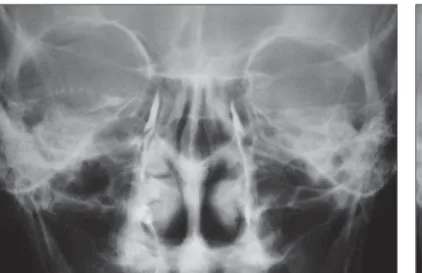
Each lacrimal drainage system is formed by lower and upper lacrimal canali-culi, common canaliculus, lacrimal sac, and nasolacrimal duct. The tear penetrates the lacrimal pathway through the lower and upper lacrimal ostia (lacrimal point), minute orifices (0.3 mm in diameter) seen on the medial margin of the lower and up-per eyelids(5) (Figure 1).
The lower and upper lacrimal canaliculi present a vertical portion measuring 2 mm, and a horizontal portion measuring about 8 mm. As the horizontal portion meets the vertical one, its internal diameter increases, achieving 2 mm(2,6).
The junction of the lower and upper lacrimal canaliculi occurs in 90% of pa-tients, constituting the common canalicu-lus, also termed Maier’s sinus or ampulla of lacrimal canaliculus. In the other 10%, the canaliculi connect the lacrimal sac in-dependently. The Maier’s sinus meets the lateral wall of the lacrimal sac at the level of the junction between the upper and
INTRODUCTION
The main indication for the evaluation of the lacrimal pathways is epiphora which is the excessive tearing of any etiology. It may originate in the excessive tear produc-tion, resulting in inadequate evaporation
Mailing address: Dr. Fabiano Celli Francisco. Hospital São Braz – Departamento de Radiologia. Rua Frei Rogério, 579. Porto União, SC, Brazil, 89400-000. E-mail: fabianocellifrancisco@ ig.com.br
middle thirds. This opening is guarded by a fold of mucous membrane called Rosen-müller’s valve(2,6). Some authors question
the existence of this valve, arguing that it is just an angulation of about 58º formed by the junction between the common canaliculus and the lacrimal sac(5).
The lacrimal sac is lodged in a deep groove formed by the lacrimal bone. It is the wider portion of the lacrimal pathway and measures about 4–8 mm in anteropos-terior diameter, 1–2 mm transversally, and 10–12 mm in length. At its distal end there is a fold of mucous membrane
denomi-nated Krause’s valve. Below this valve, the lacrimal pathway continues as the nasolac-rimal duct through an extent of 12–18 mm (10 mm through the bone nasolacrimal ca-nal), up to the inferior nasal meatus. In the middle of the intra-osseous portion of the nasolacrimal duct there is a fold of mucous membrane called Taillefer’s valve, and, at the end of the duct, the Hasner’s valve(6,7).
LACRIMAL PATHWAYS EVALUATION
The first contrast-enhanced radiographs of the lacrimal pathways were performed by Ewing in 1909(8), utilizing a bismuth
subnitrate solution, aiming at demonstrat-ing a lacrimal abscess.
Currently, the lacrimal pathways study is divided into functional and anatomical evaluations. The functional evaluation is performed by means of staining tests, scin-tigraphy and magnetic resonance imaging. The anatomical evaluation is performed by means of dacryocystography with conven-tional radiographs, linear computed tomog-raphy and magnetic resonance imaging(1).
Dacryocystography
Dacryocystography demonstrates the lacrimal pathways by means of radiography after contrast agent injection(1). Currently,
oil-soluble and water-soluble contrast me-dia are available. The oil-soluble contrast media are more slowly eliminated, however they tend to obstruct the lacrimal ducts,
particularly if they present with some alter-ation. Also, they may cause a false appear-ance polycystic sac, since the oil is poorly miscible with the lacrimal secretion(9).
Oil-soluble contrast media should not be uti-lized in the suspicion of tumors, trauma-tism or fistulae, considering the risk of leakage and permanence in the subcutane-ous tissue for many years, inducing the formation of granulomas(10).
Other studies report that the use of wa-ter-soluble contrast media result in more real information because of its character-istics (pH and viscosity, for example) more similar to tears. In a normal lacrimal path-way, the contrast medium completely dis-appears after ten minutes. Contrast medium traces may be found only in the nasopha-rinx(9,11).
Initially, the patient is submitted to pan-oramic radiography of the face. Anesthetic eye drops are instilled, lacrimal canaliculi are characterized and, after contrast me-dium administration, radiographic images acquisition is performed (Figure 2). Addi-tional views, with different degrees of obliquity may be obtained to demonstrate the lacrimal pathways.
Although this study is inexpensive and easy to perform, with low radiation dose, and allowing the identification of the site of obstruction, presence or not of lacrimal pathways dilatation and some alteration of adjacent structures, dacryocystography may present some inconclusive results(1)
(Figure 3).
Figure 3. Conventional dacryocystography. Complete obstruction of the right lacrimal pathway at the level of the Krause’s valve (arrow). Pervi-ous and morphologically normal left lacrimal pathway.
Linear tomography-dacryocystography
The demonstration of the lacrimal path-ways also may be performed by means of linear tomography.
The technique is very similar to the con-ventional dacryocystography, starting with facial radiographs and instillation of anes-thetic eye drops. Lacrimal canaliculi are characterized and the patient’s head is fixed. After collimation restricted to the area of interest, the water-soluble contrast medium is administered and, simulta-neously, the acquisition of linear tomo-graphic images is performed. Generally, four images are sufficient to demonstrate the lacrimal pathways. The water-soluble contrast medium is chosen for the already mentioned reasons.
Some authors(9,12) recommend a
bilat-eral evaluation to allow the comparison with the contralateral pathway and mainly for detecting asymptomatic alterations. We agree with this technique, since in experi-enced hands, the cannulation of lacrimal canaliculi is very fast and painless, besides allowing an early diagnosis in a significant number of cases, avoiding a new exposure of the patient to ionizing radiation and ad-ditional onus. All the patients will benefit from the comparison with the contralateral pathway, a significant factor in some diag-nostic circumstances. With this technique, Takano & Mendonça(9) have found
alter-ations in 8.3% of asymptomatic contralat-eral lacrimal pathways.
Linear tomography-dacryocystography is inexpensive and easy to perform in com-parison with the most recent methods and with lower radiation dose than computed tomography. This method allows demon-strating lacrimal canaliculi (Figure 4), the site of obstruction, lacrimal pathways dila-tation (Figure 5), fistulae (Figure 6), lacri-mal calculi (Figure 7), a higher number of alterations in adjacent structures than the conventional dacryocystography and, in experienced hands, does not present incon-clusive results and complications.
This method does not present metal or paramagnetic artifacts (Figure 8).
Computed tomography dacryocystography
Computed tomography dacryocysto-graphy allows the documentation not only
Figure 4. Linear CT dacryocystography. Morphologi-cally normal lacrimal pathways. Better visualization of lacrimal canaliculi than the conventional dacryo-cystography.
Figure 7. Linear CT dacryocystography. Complete obstruction of the right lacrimal pathway at the level of the Taillefer’s valve (white arrow). Note the image of a round filling failure produced by a radio-transparent calculus (gray arrow) obstructing the left lacrimal pathway at the level of the Krause’s valve.
Figure 6. Linear CT dacryocystography. Fistulous route originating in the right lacrimal sac and end-ing in the right middle nasal meatus.
Figure 5. Linear CT dacryocystography. Complete obstruction of right Rosenmüller’s valve (arrow) with dilatation of the corresponding Maier’s sinus.
of lacrimal pathways, but also of adjacent bones and soft tissues(13).
Anesthetic eye drops are instilled with the patient supine. The lacrimal canaliculi are cannulated, and the patient´s head is fixed. Acquisition of helical axial images is performed simultaneously with the injec-tion of water-soluble contrast medium. This set of images may be three-dimension-ally reconstructed (Figures 9 and 10), facili-tating the images interpretation by other specialists accustomed to interpreting coro-nal images.
The comparison with the previous methods demonstrates that CT dacryo-cystography is a very expensive method, demanding a high radiation dose, although is extremely useful in the diagnosis of lac-rimal pathways obstruction associated with intranasal diseases, facial fractures and maxillofacial tumors(14,15).
MRI dacryocystography
Figure 9. CT dacryocystography. Pervious lacrimal pathways. Right maxillary sinusopathy. A,B,C: Axial images. D,E: 3D reconstruction.
Figure 8. A,B: Facial radiographs before contrast injection show metal fragments from firearm projectile. C: Linear CT dacryocystography shows complete obstruction of right lacrimal pathway at the level of the Krause’s valve (arrow).
evaluation of the orbit, since it provides best images of soft tissues. The administra-tion of diluted gadolinium may be per-formed as follows:
1 – Eyedrops may be instilled into the conjunctival sac of each eye. This is a non-invasive method, allowing a functional
evaluation of the lacrimal pathways(16)
(Figure 11).
2 – Another alternative is the lacrimal canaliculi catheterization, followed by di-luted gadolinium administration (Figure 12). The catheters are removed and coro-nal, T1-weighted images are acquired. Some authors suggest acquisition of coro-nal T1- and T2-weighted images with fat-suppression, both before and after contrast medium administration(17).
Some studies report that CT and MRI sensitivity is similar(16,17). Although MRI is
Figure 11. Normal MRI dacryocys-tography. A,B: Coronal, T1-weighted images, after instillation of two gado-linium-containing eye drops into each conjunctival sac, so there is a little chance to acquire a single im-age demonstrating the whole lacri-mal pathway.
Figure 12. MRI dacryocystography. Initially, lacrimal canaliculi were char-acterized and diluted gadolinium was administered. Coronal, T1-weighted images were acquired after catheters removal (A), such images may be 3D reconstructed (B). Complete obstruc-tion of lacrimal pathways at the level of the Krause’s valve (arrows).
CONCLUSIONS
The lacrimal system evaluation may be performed by means of several imaging methods. It is up to the physician to choose the most appropriate imaging method, avoiding the delay between the definite diagnosis and the treatment. As an example of first choice, the authors suggest linear CT dacryocystography, leaving the more expensive and less available methods for patients with problems of lacrimal path-ways associated with previous history of facial traumas, tumors in the medial portion of the face, intranasal diseases or maxillo-facial surgery.
REFERENCES
1. Schellini SA, Hercules LA, Padovani CR, Nas-cimento SM, Lopes PS, Schellini RC. Dacriocis-tografia na propedêutica da via lacrimal excretora de adultos. Arq Bras Oftalmol 2005;68:89–92. 2. Schatz CS. Dacryocystography. In: Bergeron RT,
Osborn AG, Som PM, editors. Head and neck imaging. 1st ed. St. Louis, MO: CV Mosby, 1984; 669–680.
3. Watkins LM, Janfaza P, Rubin PAD. The evolu-tion of endonasal dacryocystorhinostomy. Surv Ophthalmol 2003;48:73–84.
4. Amin M, Moseley IF, Rose GE. The value of in-tubation dacryocystography after dacryocystorhi-nostomy. Br J Radiol 2000;73:604–607. 5. Linberg JV, Moore CA. Symptoms of
canalicu-lar obstruction. Ophthalmology 1988;95:1077– 1079.
6. Clark R. Aparato lacrimal. In: González CF, Bec-ker MH, Flanagan JC, editors. Diagnostico por la imagen en oftalmología. Barcelona: Ediciones Doyma, 1988;77–87.
7. Tucker SM, Linberg JV, Nguyen LL, Viti AJ, Tucker WJ. Measurement of the resistance to fluid flow within the lacrimal outflow system. Ophthalmology1995;102:1639–1645. 8. Ewing AE. Roentgen ray demonstrations of the
lacrimal abcess cavity. Am J Ophthalmol 1909; 24:1–4.
9. Takano BA, Mendonça-Júnior AA. Dacriocisto-grafia: aspectos radiológicos nas alterações das vias lacrimais – análise de 24 casos. Radiol Bras 1996;29:23–29.
10. Munk PL, Burhenne LW, Buffam FV, Nugent RA, Lin DT. Dacryocystography: comparison of wa-ter-soluble and oil-based contrast agents. Radiol-ogy 1989;173:827–830.
11. Patrão ALS. Dacriocistografia. Rev Bras Oftalmol 1983;XLII:68–72.
12. Silva JAF, Kambara A. Dacriocistografia sob in-jeção contínua. Arq Bras Oftalmol 1980;43:183– 187.
13. Moran CC, Buckwalter K, Caldemeyer KS, Smith RR. Helical CT with topical water-soluble con-trast media for imaging of the lacrimal drainage apparatus. AJR Am J Roentgenol 1995;164:995– 996.
14. Saraç K, Hepsen IF, Bayramlar H, Uguralp M, Toksoz M, Baysal T. Computed tomography dacryocystography. Eur J Radiol 1995;19:128– 131.
15. Waite DW, Whittet HB, Shun-Shin GA. Techni-cal note: computed tomographic dacryocysto-graphy.Br J Radiol 1993;66:711–713. 16. Karagulle T, Erden A, Erden I, Zilelioglu G.
Na-solacrimal system: evaluation with gadolinium-enhanced MR dacryocystography with a three-dimensional fast spoiled gradient-recalled tech-nique. Eur Radiol 2002;12:2343–2348. 17. Manfrè L, DeMaria M, Todaro E, Mangiameli A,
Ponte F, Lagalla R. MR dacryocystography: com-parison with dacryocystography and CT dacryo-cystography. AJNR Am J Neuroradiol 2000;21: 1145–1150.