627 627 627 627 627 Mem Inst Oswaldo Cruz, Rio de Janeiro, Vol. 96(5): 627-634, July 2001
Spatio-temporal Dynamics and Transition from Asymptotic
Equilibrium to Bounded Oscillations in
Chrysomya albiceps
(Diptera, Calliphoridae)
Wesley Augusto Conde Godoy/
+, Fernando José Von Zuben*,
Cláudio José Von Zuben**, Sérgio Furtado dos Reis***
Departamento de Parasitologia, IB, Universidade Estadual Paulista, Rubião Junior, 18618-000 Botucatu, São Paulo, Brasil *Departamento de Engenharia de Computação e Automação Industrial ***Departamento de Parasitologia, IB,Universidade Estadual de Campinas, Campinas, SP, Brasil **Departamento de Zoologia, IB,
Universidade Estadual Paulista, Rio Claro, SP, Brasil
The sensitivity of parameters that govern the stability of population size in Chrysomya albiceps and describe its spatial dynamics was evaluated in this study. The dynamics was modeled using a density-dependent model of population growth. Our simulations show that variation in fecundity and mainly in survival has marked effect on the dynamics and indicates the possibility of transitions from one-point equilibrium to bounded oscillations. C. albiceps exhibits a two-point limit cycle, but the introduction of diffusive dispersal induces an evident qualitative shift from two-point limit cycle to a one fixed-point dynamics. Population dynamics of C. albiceps is here compared to dynamics of Cochliomyia macellaria, C. megacephala and C. putoria.
Key words: spatial dynamics - sensitivity analysis - Chrysomya albiceps
The invasion of new habitats by organisms is an important ecological phenomenon since invad-ing species generally have tremendous ecological and economic impact on new areas (Hengeveld 1989, Andow et al. 1993, Kareiva 1996). Biologi-cal invasions can take place in different ways in-cluding invasions into patchy environments and by stratified diffusion both in short and long-range dis-persal (Shigesada & Kawasaki 1997). The conse-quences of an invasion may vary from competi-tion for food or space between invading and na-tive species, to invasion of parasites and the spread of epidemic diseases (Hengeveld 1989, Shigesada & Kawasaki 1997).
Invader populations depend on physical and bio-logical factors for success in invasion and coloniza-tion process (Stiling 1996). Among the main bio-logical factors associated to population growth as
well as success in colonization, persistence and ex-tinction of populations in new areas deserve special attention since the future of the invading species in its new habitat depends basically on the period of time that they stay in the new habitat (Hengeveld 1989, Caughley & Gunn 1996, Hanski 1998).
The temporal change in the population density of organisms at certain spatio-temporal coordinates can occur as a result of births, deaths, immigration and emigration (Rhodes & Odum 1996, Hastings 1997). Methodologically it is simpler to study de-mographic processes only in a temporal context because they are essentially an one-dimensional problem (Turchin 1998). Migration, however, in-volves two scales – temporal and spatial – render-ing its study intrinsically more complex (Schneider 1989). Ecologists have realized that movement is a critical but little understood process affecting population numbers (Ranta et al. 1998). Movement can subtract or add individuals to a population, can alter the outcome of species interactions, provide crucial genetic variability and rescue population from extinction (Kendall & Fox 1998, Turchin 1998). However, to know whether any of these postulated effects are of practical importance, we need to be able to investigate dispersal.
Around twenty years ago, three species of blow-flies originary from Africa and Asia, Chrysomya albiceps, C. megacephala and C. putoria have be-come established in Brazil (Guimarães et al. 1978, 1979, Baumgartner & Greenberg 1984). This
inva-Research supported by grants from Fundação de Amparo à Pesquisa do Estado de São Paulo (nos. 95/9299-9 and 98/07474-6).
CJVZ, FJVZ and SFR has been supported by research fellowships from Conselho Nacional de Desenvol-vimento Científico e Tecnológico.
+Corresponding author. Fax: +55-14-821.3744. E-mail:
628 628 628 628
628 Spatio-temporal Dynamics of C. albiceps Wesley Augusto Conde Godoy et al.
sion has culminated with the sudden decline in popu-lation numbers of an ecologically similar species, Cochliomyia macellaria (F.), which is native to the Americas (Greenberg & Szyska 1984). Some life-history aspects of the introduced species can be im-plied in the displacement of the native species C. macellaria, since C. albiceps is a species that ex-hibits a predatory behavior on larvae of other spe-cies during the larval stage (Coe 1978, Gagné, 1981, Erzinçlioglu & Whitcombe 1983, Faria et al. 1999). This behavior has been studied in details by a choice and no-choice experiment, where there are strong evidences to believe that C. albiceps larvae prefer C. macellaria larvae instead of C. megacephala and C. putoria (Faria et al. 1999). In addition Chrysomya species have shown higher competitive ability than C. macellaria in experi-mental and natural conditions (Wells & Greenberg 1992a,b,c, Reis et al. 1999). Besides the biologi-cal invasion problem, these species are important mechanic vectors of diseases and causers of facul-tative myiasis in humans and animals (Zumpt 1965, Greenberg 1971, 1973, Baumgartner & Greenberg 1984, Wells 1991).
We have initiated a research program as an at-tempt to better understand the blowflies invasion process (Godoy et. al. 1996, 1997, Reis et al. 1996). In this program we have integrated mathematical and biological approaches in order to address ques-tions involving spatio-temporal dynamics. By use of mathematical models of population growth, the dynamic behavior of two invader species, C. megacephala and C. putoria, and of the native spe-cies C. macellaria was analyzed and the results indicate that the introduced and native species dif-fer markedly in their equilibrium dynamics (Godoy et al. 1993, 1996, 1997, Von Zuben et al. 1993, Reis et al. 1996, Teixeira et al. 1998). Application of the mathematical model using density-depen-dent parameters such as fecundity and survival derived from experimental populations showed that C. megacepahala and C. putoria exhibit stable oscillations with numbers fluctuating between two points in sucessive generations (Godoy et al. 1993, Von Zuben et al. 1993), whereas in C. macellaria the dynamics is characterized by damping oscilla-tions in population size leading to one fixed point equilibrium (Reis et al. 1996, Godoy et al. 1997). In this paper we investigate the theoretical dy-namics of experimental populations of C. albiceps as an attempt to understand its population biol-ogy and compare the results obtained with those observed by Reis et al. (1996), Godoy et al. (1997) and Teixeira et al. (1998). We specifically, ana-lyzed the population dynamics of C. albiceps by means of a mathematical model that incorporates fecundity and survival as density-dependent
demo-graphic parameters in discrete time. We also in-vestigated the sensitivity of these parameters to changes in the magnitude of its values and ana-lyzed the dynamic behavior in a spatial structure based on the coupled lattice maps formalism, in order to investigate if the population dynamics of these species is influenced by spatial migration.
MATERIALS AND METHODS
Laboratory population of C. albiceps - Speci-mens of C. albiceps were collected in the vicini-ties of the campus of Universidade Estadual Paulista, Botucatu, São Paulo, Brazil. Adult flies were maintained in laboratory conditions in cages (30x30x30cm) covered with nylon at 25 ± 1°C and were fed water and sugar ad libitum. Adult females were fed fresh beef liver to permit the complete development of the gonotrophic cycle (Linhares 1988). The experiment was performed using the generation F2, which is progeny of one generation which had its life cycle completed in the labora-tory. Exploitative intraspecific competition among immatures, which is known to occur under natural conditions (de Jong 1976, Lomnicki 1988) was established in the laboratory by setting up six rep-licated larval densities, developing in 20 g of ground beef, ranging from 100 to 1,000 larvae per vial at intervals of 200.
This range of densities is suitable to simulate intraspecific competition process in C. albiceps since it produces decrease in demographic param-eters as a function of density (Godoy et al. 1993, Von Zuben et al. 1993, Reis et al. 1994, 1996). Fecundity was measured counting the number of eggs per female and expressed as the average of daily egg output, which is based on the length of the gonotrophic cycle of Chrysomya species at 25°C (Avancini & Prado 1986, Linhares 1988). Maximum sample size for estimation of fecundity was 30 females per vial. Sample sizes smaller than 30 in some vials were due to either low immature survival rates or incomplete ovarian development. Survival was estimated as the number of adults emerging from each vial.
629 629 629 629 629 Mem Inst Oswaldo Cruz, Rio de Janeiro, Vol. 96(5), July 2001
where F* and S* are the intercepts in the re-gression analysis of fecundity and survival as a function of larval density. These parameters de-scribe the theoretical values for maximum fecun-dity and survival, respectively. The factor of ½ indicates that only half of the population are adult females which contribute with eggs to the next gen-eration. The values of f and s are regression coef-ficients that estimate the slope of fecundity and sur-vival on the density of immatures. The exponen-tial function was used because it fitted the C. albiceps data equal to or better than linear and hy-perbolic functions and, the linear regression is known to produce larger slopes in absolute mag-nitude that produces larger eigenvalues which do not accurately describe the model dynamics at car-rying capacity (Mueller 1986). In addition the de-crease in fecundity as a function of density of immatures can be viewed biologically as a Pois-son process, which is decribed by an exponential function (Rodriguez 1989).
The effect of parameter variation on the popu-lation dynamics of C. albiceps was investigated through simulations varying maximum fecundity (F*) and survival (S*), intercepts in the regression analysis. All simulations were carried out with Matlab (Moler et al. 1987). In the simulations re-ported here, fecundity was arbitrarily allowed to vary up to a mean daily egg output of 40 eggs (the maximum value of fecundity observed for females of this species; pers. obs.).
Spatial structure was incorporated to equation (1) employing the physical formalism of coupled map lattices (Bascompte & Solé 1994). The spa-tial dimension was incorporated as a discrete lat-tice of points with the populations arranged on the nodes of this square lattice and the population in each node is linked with dispersal to the four near-est neighbors. The spatial structure is incorporated to equation (1) yielding an equation for the spatio-temporal dynamics as
nt+1(i, j) =½ F* S* e– (f + s) n
t (i, j)nt (i, j) +D∇2nt (r) (2) where D, is the diffusion rate that indexes dispersal as the fraction of the population that is exchanged in each node, (i, j), and
∇2n
t(r) = nt(i - l, j) + nt(i + l, j) + nt(i, j -1) + nt(i, j + 1) - 4nt (i, j)
(3)
defines the geometry of the diffusion between points in the lattice. The term D∇2nt(r) gives the diffusion effects which define the individuals that disperse to the adjacent nodes, and those that im-migrate from these nodes. Dispersal between nodes,
i. e., the local populations, was established in a 3 x 3 lattice yielding a total of nine adjacent nodes. Dispersal occurred by simple diffusion with a fixed fraction of each population migrating to a nearest neighbor each generation. The migration rate (D) was set to 0.2 and both it and the carrying capacity and the migration rate (D) were kept constant throughout generations although varied randomly between adjacent nodes. The spatio-temporal dy-namics was simulated using eqn 2 and carried out with MatLab (Moler et al. 1987).
The findings for the temporal and spatial dy-namics of C. albiceps obtained in this paper are compared and discussed with those obtained for C. megacephala, C. putoria and C. macellaria, which are described in Godoy et al. (1996, 1997) and Reis et al. (1996) using the same mathemati-cal formalism.
RESULTS
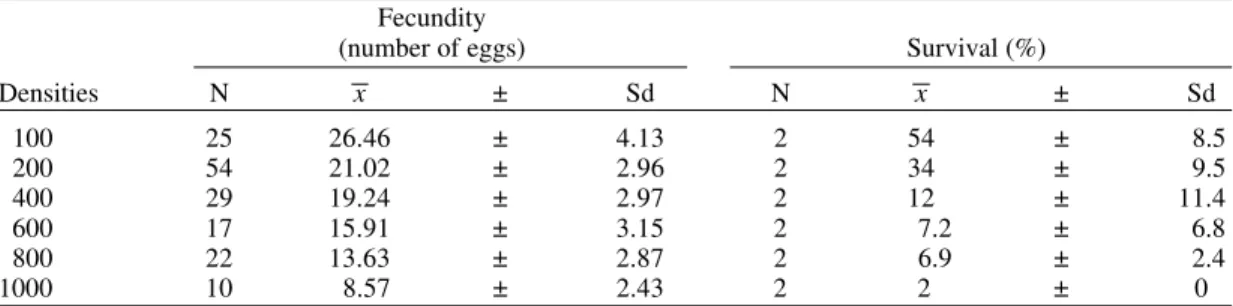
Survival and fecundity of C. albiceps decreased as function of density of immatures and this de-crease was statistically significant (Tables I, II). Slopes of the exponential regression for fecundity and survival were significantly different from zero (P < 0,001) (Table II). Theoretical values for maxi-mum fecundity (F*) and survival (S*), and the re-gression coefficients (Table II) describing the de-pendence of fecundity (f) and survival (s) upon density of immatures were incorporated to equa-tion (4), which can be written as
nt+1 =½[(27.11 e– 0.001 nt )(0.56 e– 0.003 nt)nt ] (4)
The qualitative dynamics of C. albiceps can be assessed by the eigenvalue associated with equa-tion (1), which is larger than 1 in modulus (λ = -1.0398) and has so two points stable equilib-rium.
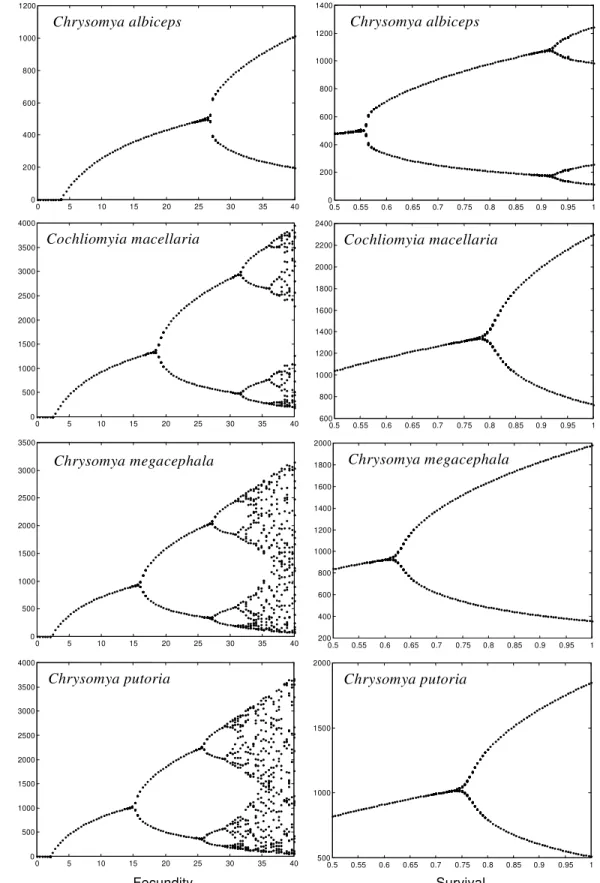
The dynamic behavior observed for C. albiceps was derived from the application of fixed param-eter values to the non-linear difference equation (1). Bifurcation diagrams show that increasing val-ues for fecundity produce qualitative changes in the dynamics of the C. albiceps (Fig. 1) and, for values of fecundity larger than 26 eggs, there is apparently a transition in the dynamics from stable equilibrium to two point limit cycle. When sur-vival is analyzed, the upper limit is 1.0, which rep-resents a theoretical maximum viability of 100%. In this case we can see that the effect of survival on the dynamics of C. albiceps is much more no-ticeable than that of fecundity, since two bifurca-tions were realized (Fig. 1).
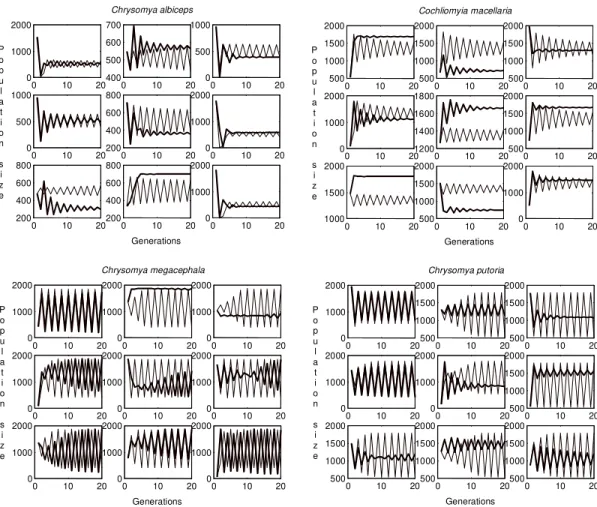
The consequences of diffusive dispersal for the population dynamics of C. albiceps are illustrated in Fig. 2. The oscillations in population numbers nt+1 = ½ F* S* e– (f + s) nt n
630 630 630 630
630 Spatio-temporal Dynamics of C. albiceps Wesley Augusto Conde Godoy et al.
as a function of time measured in generations is shown, both for the non-spatial homogeneous model, equation (1), and the spatially structured model, equation (2) (Fig. 2). Our simulations sug-gest that the linkage between populations intro-duced by diffusive dispersal produces a qualita-tive effect on the local dynamics of C. albiceps from two point limit cycle to stable equilibrium (Fig. 2). In addition, spatial structure introduced a small quantitative effect in the population dynam-ics, characterized by the change in the spectrum of the oscillations.
DISCUSSION
The mathematical analysis performed in this study reveals that C. albiceps shows a dynamic behavior represented by a limit cycle of two points, since λ = -1,0398 (larger than one in module). This behavior was also observed in C. megacephala and C. putoria (Godoy et al. 1993, Von Zuben et al. 1993), but it differs from the native species, C. macellaria, that shows damping oscillations in population size leading to one fixed point equilib-rium (Reis et al. 1996). We noted, however, that the value of λ obtained for C. albiceps is very close to one if compared to the other values observed for C. megacephala, λ = -1.3761 and C. putoria, λ = -1.2399 (Godoy et al. 1996). This result sug-gests that C. albiceps is a species apparently more susceptible to changes in its dynamic behavior than C. megacephala and C. putoria.
TABLE II
Parameters of regression analysis of fecundity and survival on larval density
Fecundity Survival
Maximum (F) 27.11 0.565
Regression coeficient (f) 1 x 10⁻³ 3 x 10⁻³
t value 18.36a 5.48
r2 68.5 75
F 337 30
a:P < 0.001
TABLE I
Mean daily fecundity and survival in six larval densities of Chrysomya albiceps
Fecundity
(number of eggs) Survival (%)
Densities N x ± Sd N x ± Sd
100 25 26.46 ± 4.13 2 54 ± 8.5
200 54 21.02 ± 2.96 2 34 ± 9.5
400 29 19.24 ± 2.97 2 12 ± 11.4
600 17 15.91 ± 3.15 2 7.2 ± 6.8
800 22 13.63 ± 2.87 2 6.9 ± 2.4
1000 10 8.57 ± 2.43 2 2 ± 0
Stability of equilibrium has been extensively investigated in insect populations (Dennis et al. 1995, Costantino et al. 1995, 1997, 1998, Cushing et al. 1998) and perhaps the most important ques-tion arising in this context be what governs the tran-sitions from stable to unstable equilibria. The ef-fects produced by the manipulation of the param-eter values are well known in theoretical popula-tion models (May & Oster 1976, Edelstein-Keshet 1998) and evidences for such changes come from theoretical and empirical studies (Cavalieri & Koçak 1995, Costantino et al. 1995, 1997, Denis et al. 1995, 1997). Experiments designed to test prediction of population models have shown that shifts in dynamical behavior can occur, from stable point equilibria, to stable limit cycles, to aperiodic cycles in response to changes in the rate of adult stage mortality (Costantino et al. 1995, 1997, Denis et al. 1995, 1997).
In our study the simulations revealed that the transition from asymptotic stable equilibrium to bounded oscillations occurs with an increase in fecundity and survival. It is interesting to note that the results of this study indicate a more frequent variation of dynamic behavior when the survival values are manipulated. Recently, Godoy et al. (1996) used the same technique to analyse the tran-sition of dynamic behavior in C. megacephala, C. putoria and C. macellaria and observed that the effect of survival on the dynamics of these species is much less noticeable than of fecundity, since no more than one bifurcation was obtained in the three species studied (Fig. 1). Fecundity was shown in the simulations to be the most important demo-graphic parameter to bring about shifts in the dy-namic behavior of experimental populations of C. megacephala, C. putoria and C. macellaria (Godoy et al. 1996).
con-631 631 631 631 631 Mem Inst Oswaldo Cruz, Rio de Janeiro, Vol. 96(5), July 2001
0 5 10 15 20 25 30 35 40
0 200 400 600 800 1000 1200
Chrysomya albiceps
0.5 0.55 0.6 0.65 0.7 0.75 0.8 0.85 0.9 0.95 1 0
200 400 600 800 1000 1200 1400
Chrysomya albiceps
0 5 10 15 20 25 30 35 40
0 500 1000 1500 2000 2500 3000 3500 4000
Cochliomyia macellaria
0.5 0.55 0.6 0.65 0.7 0.75 0.8 0.85 0.9 0.95 1 600
800 1000 1200 1400 1600 1800 2000 2200 2400
Cochliomyia macellaria
0 5 10 15 20 25 30 35 40
0 500 1000 1500 2000 2500 3000 3500
Chrysomya megacephala
0.5 0.55 0.6 0.65 0.7 0.75 0.8 0.85 0.9 0.95 1 200
400 600 800 1000 1200 1400 1600 1800 2000
Chrysomya megacephala
0 5 10 15 20 25 30 35 40
0 500 1000 1500 2000 2500 3000 3500 4000
Chrysomya putoria
0.5 0.55 0.6 0.65 0.7 0.75 0.8 0.85 0.9 0.95 1 500
1000 1500 2000
Chrysomya putoria
Fig. 1:bifurcation diagrams for stable population sizes as a function of the variation in fecundity and survival for Chrysomya albiceps, Cochliomyia macellaria, C. megacephala and C. putoria.
Population size
632 632 632 632
632 Spatio-temporal Dynamics of C. albiceps Wesley Augusto Conde Godoy et al.
firm the findings by Godoy et al. (1997) which re-vealed that the linkage between populations intro-duced by diffusive dispersal may produce qualita-tive and quantitaqualita-tive effects on the local dynamics of C. megacephala, C. putoria and C. macellaria (Fig. 2).
The dynamics system in which C. albiceps is inserted gives a wide range of interesting questions since it apparently balances between stability and periodic behavior. This apparent ambiguity as a function of both the parametric manipulation and the spatial structure introduced in the model, places C. albiceps between C. macellaria, the native spe-cies that exhibits stable dynamics and the other introduced species, C. megacephala and C. putoria, that show two point limit cycle (Reis et al. 1996). We consider this point interesting because in this sense C. albiceps is a species that shows a dynamic behavior more susceptible to changes than C. megacephala and C. putoria. We do not know if this characteristic is advantageous to C. albiceps,
however it has proved to be a species with con-spicuous abilities under competitive stress, what probably have influenced negatively the structure of the community where it lives (Ullyett 1950, Coe 1978, Faria et al. 1999).
The spread of invading organisms is the out-come of complex interactions involving the dynam-ics of populations at temporal and spatial scales (Hengeveld 1989). The importance of the spatial component has always been recognized (Lewis & Kareiva 1993), although recently a stronger em-phasis has been placed on spatial structure as re-sult of theoretical developments that have estab-lished a correlation between migration and dynamic behavior of populations (Comins et al. 1992, Allen et al. 1993, Hastings 1993, Bascompte & Solé 1995, Ruxton 1995, Kendall & Fox 1998). The results found in these investigations show two op-posite ways, on the one hand the complex or cha-otic temporal dynamics can be induced by the pres-ence of the spatial dimension (Comins et al. 1992,
Fig. 2: evolution of population size across generations obtained from the non-spatial, homogeneous model (draft line) given by equation (1), and the spatially structured model (bold line) given by equation (2).
0 10 20
0 1000 2000
0 10 20
0 1000 2000
0 10 20
0 1000 2000
0 10 20
0 1000 2000
0 10 20
0 1000 2000
0 10 20
0 1000 2000
0 10 20
0 1000 2000
0 10 20
0 1000 2000
0 10 20
0 1000 2000 Chrysomya megacephala Generations P o p u l a t i o n s i z e
0 10 20
500 1000 1500 2000
0 10 20
500 1000 1500 2000
0 10 20
500 1000 1500 2000
0 10 20
0 1000 2000
0 10 20
1200 1400 1600 1800
0 10 20
500 1000 1500 2000
0 10 20
1000 1500 2000
0 10 20
0 1000 2000
0 10 20
500 1000 1500 2000 Cochliomyia macellaria Generations P o p u l a t i o n s i z e
0 10 20
0 1000 2000
0 10 20
500 1000 1500 2000
0 10 20
500 1000 1500 2000
0 10 20
0 1000 2000
0 10 20
0 1000 2000
0 10 20
500 1000 1500 2000
0 10 20
500 1000 1500 2000
0 10 20
500 1000 1500 2000
0 10 20
500 1000 1500 2000 Chrysomya putoria Generations P o p u l a t i o n s i z e
0 10 20
0 1000 2000
0 10 20
400 500 600 700
0 10 20
0 500 1000
0 10 20
0 500 1000
0 10 20
200 400 600 800
0 10 20
0 1000 2000
0 10 20
200 400 600 800
0 10 20
200 400 600 800
0 10 20
633 633 633 633 633 Mem Inst Oswaldo Cruz, Rio de Janeiro, Vol. 96(5), July 2001
Pascual 1993) and on the other hand, simple peri-odic dynamics may be induced by the presence of the diffusive dispersal (Hastings 1993, Csilling et al. 1994). Our simulations indicate that the spatial dimension induces an overall stabilizing effect on the dynamics of C. albiceps. This paper, together with the previous focus the connection between population dynamics and the invasion of blowflies (Reis et al. 1996, Godoy et al. 1996, 1997), seem to confirm the findings of Costantino et al. (1995, 1997) and Allen et al. (1993), which have taken together a new conceptual thread connecting sen-sitivity to demographic changes, qualitative changes in dynamic behavior and extinction rates. In addition, the peculiar characteristics found in C. albiceps, which seem to have implications to population dynamics, open a series of new perspec-tives for studies of equilibrium dynamics.
ACKNOWLEDGMENTS
To the anonymous reviewer for making suggestions that improved the clarity of the manuscript.
REFERENCES
Allen JC, Schaeffer WM, Rosko D 1993. Chaos re-duces species extinction by amplifying local popu-lation noise. Nature 364: 229-232.
Andow DA, Kareiva PM, Levin SA, Okubo A 1993. Spread of invading organisms: patterns of spread. In KC Kim, BA Mcpheron (eds), Evolution of In-sect Pests. Patterns of Variation, John Wiley, New York, p. 219-242.
Avancini RMP, Prado AP 1986. Oogenesis in Chry-somya putoria (Wiedemann) (Diptera: Calli-phoridae). Int J Ins Morph Emb15: 375-384. Bascompte J, Solé RV 1994. Spatially induced
bifurca-tions in single-species population dynamics. J Anim Ecol 63: 256-264.
Bascompte J, Solé RV 1995. Appropriate formulations for dispersal in spatially structured models: reply. J Anim Ecol 64: 665-666.
Baumgartner DL, Greenberg B 1984. The genus Chry-somya (Diptera: Calliphoridae) in the New World. J Med Ent 21: 105-113.
Caughley G, Gunn A 1996. Conservation Biology in Theory and Practice, Blackwell Science, Cambridge, Massachusetts, 458 pp.
Cavalieri LF, Koçak H 1995. Intermittent transition be-tween order and chaos in an insect pest population.
J Theor Biol 175: 231-234.
Coe RL 1978. The decomposition of elephant carcases in the Tsavo (East) National, Kenya. J Arid Env 1: 71-86.
Comins HN, Hassell MP, May RM 1992. The spatial dynamics of host-parasitoid systems. J Anim Ecol 61: 735-748.
Costantino RF, Cushing JM, Dennis B, Desharnais RA 1995. Experimentally induced transitions in the dy-namic behaviour of insect populations. Nature 375: 227-230.
Costantino RF, Cushing JM, Dennis B, Desharnais RA, Henson SM 1998. Resonant population cycles in temporally fluctuating habitats. Bull Math Biol 60: 247-273.
Costantino RF, Desharnais RA, Cushing JM, Dennis B 1997. Chaotic dynamics in an insect population.
Science 275: 389-391.
Csiling AI, Jánosi M, Pastor G, Scheuring I 1994. Ab-sence of chaos in a self-organized critical coupled map lattice. Phys Rev E 50: 1083-10092.
Cushing JM, Costantino RF, Dennis B, Desharnais RA, Henson SM 1998. Nonlinear population dynamics: models, experiments and data. J Theor Biol194: 1-9.
Dennis B, Desharnais RA, Cushing JM, Costantino RF 1995. Nonlinear demographic dynamic dynamics: mathematical model, statistical methods and biologi-cal experiments. Ecol Monog 65: 261-281. Dennis B, Desharnais RA, Cushing JM, Costantino RF
1997. Transitions in population dynamics: equilib-ria to periodic cycles to aperiodic cycles. J Anim Ecol 66: 704-729.
de Jong G 1976. A model of competition for food. I. Frequency-dependent variabilities. Am Nat 110: 1013-1027.
Edelstein-Keshet L 1988. Mathematical Models in Bi-ology, Random House, New York, 586 pp. Erzinçlioglu YZ, Whitcombe RP 1983. Chrysomya
albiceps (Wiedemann) (Dipt., Calliphoridae) in dung and causing myiasis in Oman. Ent Mont Mag 119: 51-52.
Faria LDB, Orsi L, Trinca LA, Godoy WAC 1999. Lar-val predation by Chrysomya albiceps on Co-chliomyia macellaria, Chrysomya megacephala and
Chrysomya putoria. Ent Exp App 90: 149-155. Gagné RJ 1981. Chrysomya spp., old world blowflies
(Diptera, Calliphoridae), recently established in the Americas. Bull Ent Soc Am 27: 21-22.
Godoy WAC, Reis SF, Von Zuben CJ, Ribeiro OB 1993. Population dynamics of Chrysomya putoria (Wied.) (Dipt., Calliphoridae). J App Ent 116: 163-169. Godoy WAC, Von Zuben CJ, Reis SF, Von Zuben FJ
1996. Dynamics of experimental populations of na-tive and introduced blowflies (Diptera: Calli-phoridae): mathematical modelling and the transi-tion from asymptotic equilibrium to bounded oscil-lations. Mem Inst Oswaldo Cruz 91: 641-648. Godoy WAC, Von Zuben CJ, Reis SF, Von Zuben FJ
1997. The spatial dynamics of native and introduced blowflies (Dipt., Calliphoridae). J App Ent 121: 305-309.
Greenberg B, 1971. Flies and Disease, Vol. 1, Princeton University Press, Princeton, 865 pp.
Greenberg B, 1973. Flies and Disease, vol. 2, Princeton University Press, Princeton, 447 pp.
Greenberg, B, Szyska ML 1984. Immature stages and biology of fifteen species of peruvian Calliphoridae (Diptera). Ann Ent Soc Am 77: 488-517.
634 634 634 634
634 Spatio-temporal Dynamics of C. albiceps Wesley Augusto Conde Godoy et al.
Guimarães JH, Prado AP, Buralli GM 1979. Dispersal and distribution of thre e newly introduced species of Chrysomya Robineau-Desvoidy in Brazil (Diptera, Calliphoridae). Rev Bras Ent 23: 245-255. Hanski I 1998. Connecting the parameters of local ex-tinction and metapopulation dynamics. Oikos 83: 390-396.
Hastings A 1993. Complex interactions between dis-persal and dynamics: lessons from coupled logistic equations. Ecology 74: 1362-1372.
Hastings A 1997. Population Biology. Concepts and Models, Springer-Verlag, New York, 220 pp. Hastings A, Costantino RF 1987. Cannibalistic egg-larva
interactions in Tribolium: an explanation for the os-cillations in population numbers. Am Nat 120: 36-52. Hengeveld R 1989. Dynamics of Biological Invasions,
Chapman and Hall, NY, 160 pp.
Kareiva P 1996. Developing a predictive ecology for non-indigenous species and ecological invasions.
Ecology 77: 1651-1652.
Kendall BE, Fox GA 1998. Spatial structure, environ-mental heterogeneity and population dynamics: analysis of the coupled logistic map. Theor Pop Biol 54: 11-37.
Lewis MA, Kareiva P 1993. Allee dynamics and the spread of invading organims. Theor Pop Biol 43: 141-158.
Linhares AX 1988. The gonotrophic cycle of Chrysomya megacephala (Diptera: Calliphoridae) in the labo-ratory. Rev Bras Ent 32: 383-392.
Lomnicki A 1988. Population Ecology of Individuals,
Princeton University Press, Princeton, 223 pp. May RM, Oster GF 1976. Bifurcations and dynamic
complexity in simple ecological models. Am Nat 110: 573-599.
Moler C, Little J, Baugert S 1987. PC-MATLAB User’s Guide, version 3.2-PC, The Mathworks, Inc. Sherborn.
Mueller LD 1986. Density-dependent rates of popula-tion growth-estimapopula-tion in laboratory populapopula-tions. Am Nat 128: 282-293.
Pascual M 1993. Diffusion-induced chaos in a spatial predator-prey system. Philosophical Trans R Soc Lond B251: 1-7.
Prout T, McChesney F 1985. Competition among immatures affects their adult fertility: population dynamics. Am Nat 126: 521-558.
Ranta E, Kaitala V, Lundberg P 1998. Population vari-ability in space and time: the dynamics of synchro-nous population fluctuations. Oikos 83: 376-382. Reis SF, Stangenhaus G, Godoy WAC, Von Zuben CJ,
Ribeiro OB 1994. Variação em caracteres bionômicos em função da densidade larval em Chry-somya megacephala e Chrysomya putoria (Diptera, Calliphoridae). Rev Bras Ent 38: 33-46.
Reis SF, Teixeira MA, Von Zuben FJ, Godoy WAC, Von Zuben CJ 1996. Theoretical dynamics of ex-perimental populations of introduced and native blowflies (Diptera, Calliphoridae). J Med Ent 33: 537-544.
Reis SF, Von Zuben CJ, Godoy WAC 1999. Larval ag-gregation for food in experimental population of
Chrysomya putoria (Wied.) and Cochliomyia macellaria (F.) (Dipt. Calliphoridae). J App Ent123:
485-489.
Rhodes Jr OE, Odum EP 1996. Spatio-temporal ap-proaches in ecology and genetics: the road less trav-eled. In OD Rhodes Jr, RK Chesser, MH Smith (eds), Population Dynamics in Ecological Space and Time, The University of Chicago Press, Chicago, p. 1-7.
Rodriguez DJ 1989. A model of population dynamics for the fruit fly Drosophila melanogaster with den-sity dependence in more than one life stage and de-layed density effects. J Anim Ecol 58: 349-365. Ruxton GD 1995. Temporal scales and the occurrence
of chaos in coupled populations. TREE 10: 141-142. Schneider JC 1989. Role of movement in evaluation of area-wide insect pest management tatics. Env Ent 18: 868-874.
Shigesada N, Kawasaki K 1997. Biological Invasions: Theory and Practice, Oxford University Press, Ox-ford, 205 pp.
Stiling PD 1996. Ecology Theories and Applications,
Prentice Hall, NJ, 538 pp.
Teixeira MA, Von Zuben FJ, Godoy WAC, Von Zuben CJ, Reis SF 1998. Delayed density dependence at the immature stage in insects and the dynamic be-havior of nonlinear difference equations. Cien Cult 48: 268-272.
Turchin P 1998. Quantitative Analysis of Movement: Measuring and Modeling Population Redistribution in Animals and Plants, Sinauer Associates, Inc. Pub-lishers, Sunderland, 396 pp.
Ulllyett GC 1950. Competition for food and allied phe-nomena in sheep-blowfly population. Phil Trans R Soc Lond B334: 77-174.
Von Zuben CJ, Reis SF, do Val JBR, Godoy WAC, Ribeiro OB 1993. Dynamics of a mathematical model of Chrysomya megacephala (Diptera: Calli-phoridae). J Med Ent 30: 443-448.
Wells JD 1991. Chrysomya megacephala (Diptera: Calliphoridae) has reached the continental United States: review of its biology, pest status, and spread around the world. J Med Ent 28: 471-473. Wells JD, Greenberg B 1992a. Rates of predation by
Chrysomya rufifacies (Macquart) on Cochliomyia macellaria (Fabr.) (Diptera: Calliphoridae) in the laboratory: effect of predator and prey development.
Pan-Pac Ent68: 12-14.
Wells JD, Greenberg B 1992b. Laboratory interaction between introduced Chrysomya rufifacies and na-tive Cochliomyia macellaria (Diptera: Calli-phoridae). Env Ent 21: 640-645.
Wells JD, Greenberg B 1992c. Interaction between Chry-somya rufifacies and Cochliomyia macellaria
(Diptera: Calliphoridae): the possible consequences of an invasion. Bull Ent Res 82: 133-137.