Phylogeny of the Serrasalmidae (Characiformes) based on mitochondrial
DNA sequences
Guillermo Ortí, Arjun Sivasundar
1, Kelly Dietz and Michel Jégu
2School of Biological Sciences, University of Nebraska, Lincoln, NE, USA.
Abstract
Previous studies based on DNA sequences of mitochondrial (mt) rRNA genes showed three main groups within the subfamily Serrasalminae: (1) a “pacu” clade of herbivores (Colossoma, Mylossoma, Piaractus); (2) the “Myleus” clade (Myleus, Mylesinus, Tometes, Ossubtus); and (3) the “piranha” clade (Serrasalmus, Pygocentrus, Pygopristis, Pristobrycon, Catoprion, Metynnis). The genus Acnodon was placed as the sister taxon of clade (2+3). However, poor resolution within each clade was obtained due to low levels of variation among rRNA gene sequences. Com-plete sequences of the hypervariable mtDNA control region for a total of 45 taxa, and additional sequences of 12S and 16S rRNA from a total of 74 taxa representing all genera in the family are now presented to address intragroup relationships. Control region sequences of several serrasalmid species exhibit tandem repeats of short motifs (12 to 33 bp) in the 3’ end of this region, accounting for substantial length variation. Bayesian inference and maximum par-simony analyses of these sequences identify the same groupings as before and provide further evidence to support the following observations: (a)Serrasalmus gouldingi and species of Pristobrycon (non-striolatus) form a mono-phyletic group that is the sister group to other species ofSerrasalmus and Pygocentrus; (b) Catoprion, Pygopristis, andPristobrycon striolatus form a well supported clade, sister to the group described above; (c) some taxa assigned to the genusMyloplus (M. asterias, M tiete, M ternetzi, and M rubripinnis) form a well supported group whereas other Myloplus species remain with uncertain affinities (d) Mylesinus, Tometes and Myleus setiger form a monophyletic group.
Key words:piranhas, pacus, D-loop, phylogeny, Bayesian inference. Received: September 13, 2006; Accepted: April 19, 2007.
Introduction
Piranhas and pacus (Serrasalmids) form a distinctive assemblage of characiform fishes. For a long time, they were considered a subfamily within the family Characidae. Recent phylogenetic studies of these fishes, however, strongly suggest that Characidae is non-monophyletic and that serrasalmids are not closely related to taxa originally placed in the subfamily Characinae, or other characid sub-families (Zanata, 2000), but rather that they may be more closely related to Anostomoidea (Calcagnottoet al., 2005). All these arguments support the separate family status of piranhas and pacus; their relationships to other families within the order Characiformes, however, remain uncertain (Ortí and Meyer, 1997; Calcagnottoet al., 2005; Hubertet al., 2005). Species of the Serrasalmidae are endemic to the
Neotropics and are distributed widely in all the major river systems of South America. At least 60 species (in 15 gen-era) have been recognized. This family includes the well-known piranhas, notorious from accounts of their group-predatory behavior, the seed-eating tambaquí, which is highly regarded as a food species, and the pacus. Several serrasalmid species are of economic importance and are used in aquaculture (Junk, 1984; Marshall, 1995; Araujo-Lima and Goulding, 1997).
Characteristic features of serrasalmids include a com-pressed body, a long dorsal fin with more than 16 rays and the presence of sharp serrae arising from modification of abdominal scales. The number of these serrae is variable, ranging from 6 to 9 inAcnodonto over 60 inPiaractus.
Serrasalmids occupy diverse habitats from lowland floodplains and flooded forests to upstream habitats in the headwater regions of river systems (Lowe-McConnel, 1975; Géry, 1977, 1984). They also display a range of trophic specializations, with three general feeding habits: carnivory, frugivory and lepidophagy (feeding on the scales of other fishes). Feeding habit is reflected in the mor-www.sbg.org.br
Send correspondence to Guillermo Orti. School of Biological Sci-ences, University of Nebraska, 314 Manter Hall, Lincoln, 68588 NE, USA. E-mail: [email protected].
1
Current address: Stanford University Hopkins Marine Station, Pa-cific Grove, CA, USA.
2Current address: Museum National d’Histoire Naturelle,
phology and patterns of dentition found among these taxa (Goulding, 1980).
Carnivorous serrasalmids usually have one row of tricuspid teeth on each jaw, while frugivores have two se-ries of incisor or molariform teeth on the premaxilla, one row of teeth on the dentaries, and often a pair of sym-physeal teeth. The lepidophagous taxa have tuberculated teeth located on the outer side of the premaxilla that are used to remove scales from other fish. Not all species are specialists however, and their feeding habit varies with age and food availability (Nico and Taphorn, 1988; Wine-miller, 1989; Leite and Jégu, 1990). The arrangement and morphology of teeth have been the main characters tradi-tionally used in serrasalmid classification.
Eigenmann (1915) erected the subfamilies Serrasal-minae, containing six genera with one row of teeth on each jaw, and Mylinae, with nine genera having two rows of teeth on the premaxilla. The monotypic, lepidophagous ge-nusCatoprionwas included in the Mylinae. Classifications that followed also were based largely on dental morphol-ogy (Norman, 1929; Gosline, 1951; Géry 1977), and dif-fered mainly in the assignment of ranks for some taxa (e.g.
genera changed to subgenera).
In the first cladistic treatment of serrasalmid system-atics, Machado-Allison (1983) inferred the presence of two lineages, labeled A and B (Figure 1a), which correspond to the Mylinae and Serrasalminae of Eigenmann,
respec-tively, but including the genera CatoprionandMetynnis
with the piranha clade. The first test of this hypothesis with molecular data (Ortíet al., 1996) used mitochondrial DNA (mtDNA) sequences, and recovered a phylogeny of the group containing three or four distinct lineages rather than two (Figure 1b) based on fragments of the 12S and 16S rRNA genes. Relatively low levels of sequence divergence among the rRNA genes, however, resulted in poor resolu-tion within these groups, and a representative of the genus
Pygopristis was not included in that study. The mtDNA
data strongly suggested that Pristobrycon includes two
components: Prystobrycon striolatus, closely allied to
Catoprion, and the other species of Pristobrycon, more
closely related toSerrasalmusandPygocentrus. A recent
phylogenetic study of species of Serrasalmus and
Pygocentrus(Hubertet al., 2007) based on mitochondrial control region sequences provided higher resolution for this group. Within the “Myleusclade,” mtDNA data (Ortíet al., 1996) were not able to resolve with confidence the rela-tionships among the included taxa, but also did not support
the monophyly ofMyleus or the subspecies designations
proposed by Géry (1972, 1977): Myleus, Myloplus,
Prosomyleus, and Paramyloplus. A morphological
reas-sessment of elements included inMyleus(Jégu and Santos;
2002; Jéguet al., 2003) proposed the recognition ofMyleus setiger(formerlyMyleus pacu) as the only valid represen-tative of the genus and moved the other components to the
genusMyloplus(originally erected by Gill, 1896). We fol-low these taxonomic recommendations in this study.
Most recently, a multi-gene assessment of characi-form phylogeny based on mitochondrial (16S and cyto-chrome b) and nuclear DNA (4 fragments) supported the distinctive groping of serrasalmids among charciforms (Calcagnottoet al., 2005). But since that study focused on higher-level relationships among characiforms, it included only 12 serrasalmid taxa, and obtained inconclusive results for within family relationships.
The current study aims to evaluate the previous find-ings with an extended data set, and also employ a more vari-able molecular marker to resolve relationships at the shallower nodes within each of the groups. The taxonomic sampling of the 12S and 16S mtDNA sequence data set is here extended from 34 to a total of 74 serrasalmid taxa (in-cluding Pygopristis). In an attempt to increase resolution among closely related species, 44 sequences from the mito-chondrial control region (D-loop) representing all genera in
the family are employed. Albeit based on mtDNA sequence data only, this study represents the most comprehensive mo-lecular systematic treatment of this group to date.
Methods
Taxon sampling
Representatives of all serrasalmid genera were sam-pled from their natural habitat and also obtained from com-mercial sources (aquarium trade). Several specimens per genus, and in some cases more than one specimen per spe-cies were used to confirm taxonomic identifications and also to control for intraspecific variation. Outgroup taxa were chosen from the Anostomoidea and Cynodontidae based on a recent analysis of characiform relationships that suggest a close relationship of these groups to serrsalmids (Calcagnottoet al., 2005). A complete list of taxa used for this study, their associated Genbank accession numbers, their source and (when present) voucher information are presented as Supplementary Material (Table S1).
DNA amplification and sequencing
Genomic DNA was isolated from ethanol-preserved muscle tissue by proteinase K / SDS dissolution, followed by phenol/chloroform extraction and ethanol precipitation
(Sambrooket al., 1989). Segments of the small (12S) and
large (16S) subunits of the ribosomal RNA mitochondrial genes were amplified by PCR in 50µL reactions containing
10µL dNTPs (1 mM), 5µL reaction buffer (10X), 2 µL
MgCl2(50 mM), 2 µL of each primer (10µM), 0.5 µL
(2.5 U) of Taq DNA polymerase (Gibco BRL), 2µL of
tem-plate DNA (100 ng/µL) and 26.5µL H2O. PCR conditions
were as follows: 94 °C (3 min), 30 cycles of 94 °C (1 min), 57 °C (1 min), 72 °C (1 min), followed by 72 °C (2 min). Primers used for PCR and sequencing of the 12S fragment
were L1091 and H1478 (Kocheret al., 1989), and for the
16S fragment, 16Sar-L and 16Sbr-H (Palumbiet al., 1991). These primers amplify fragments of the 12S and 16S rRNA
genes corresponding to positions 1091-1478 and
2510-3059 in the human mitochondrial genome,
respec-tively (Andersonet al., 1981). Sequences of the 12S and
16S fragments published by Ortí et al. (1996) for 31
serrasalmin taxa were obtained from GenBank, and in-cluded in the phylogenetic analyses.
The mitochondrial D-loop region was amplified by
PCR in 50µL reactions containing 10µL dNTPs (1 mM) ,
5µL reaction buffer (10X), 2µL MgCl2(50 mM), 2µL of
each primer (10µM), 0.5µL (2.5 U) of Taq DNA
polymer-ase (Gibco BRL), 2µL of template DNA (100 ng/µL) and
26.5 µL H2O. PCR conditions were as follows: 94 °C
(3 min), 10 cycles of 94 °C (1 min), 53 °C (1 min), 72 °C (1 min), 10 cycles of 94 °C (1 min), 51 °C (30 s), 72 °C (1 min), 10 cycles of 94 °C (1 min), 50 °C (30 s), 72 °C (1 min), followed by 72 °C (2 min). The primers used for
PCR and sequencing were designed for this study: F-TTF
(5’-GCCTAAGAGCATCGGTCTTGTAA) and F-12R
(5’-GTCAGGACCATGCCTTTGTG). Additional internal primers used for sequencing were F-TTF2 (5’-CTAACT CCCAAAGCTAGTATT), F-12R2 (5’-CTACACTAGCT ACAACTATATAA), PM-DLF3 (5’-TAATGCATATTA TCCTTGAT) and F-DLR3 (5’-GTTTTGGGGTTTGACA GGA). These sequences consist of the complete control re-gion (approximately 1100 bp) along with the flanking tRNA genes - about 20 bp of tRNA Thr (3’ half), the com-plete tRNA Pro (approximately 70 bp), and about 65 bp of tRNA Phe (almost complete).
All samples were sequenced using the BigDye Termi-nator cycle sequencing reaction kit (Applied Biosystems Inc.) on an automated DNA sequencer (Applied Bio-systems 310 or an MJ Research Basestation) following manufacturer’s instructions. All templates were sequenced completely in both directions. The nucleotide sequence data determined for the present paper were deposited in GenBank (see Supplementary Material, Table S1).
Phylogenetic analysis
All sequences were aligned with Clustal X (Thomp-sonet al.1997) using default parameters. Each fragment (12S, 16S, and D-loop) was aligned separately and the ribo-somal gene alignments were subsequently verified using
the secondary structure models described by Ortí et al.
(1996). Alignment gaps that were inserted by ClustalX in putative stem regions that may imply disruption of hairpin structure were moved to contiguous loops or non-paired re-gions. D-loop sequences were compiled into two separate groups due to alignment ambiguities when alI sequences were aligned together. The two groups (the ‘piranha clade’ and the rest) differ substantially in total length for this frag-ment. Micro or minisatellite repeats within the variable control region were identified and excised from the se-quences before the alignment. Indels for all resulting align-ments were coded for phylogenetic analysis following the modified complex method described by Müller (2006) im-plemented in the program SeqState (Müller, 2005).
were concatenated for all further analyses. The D-loop data were compiled into 2 separate data sets, one for the ‘piranha clade’ and one for the remaining taxa of the family.
Tree searches were performed using PAUP* version 4.0b4a (Swofford, 2000), MrBayes 3.1.2 (Huelsenbeck and Ronquist, 2001, Ronquist and Huelsenbeck, 2003), and TreeFinder (Jobb, 2006). Maximum parsimony (MP) anal-yses performed in PAUP* used heuristic searches starting with stepwise addition trees and replicated 100 times, with each replicate starting with random input order of sequen-ces. Branch swapping was performed by the tree-bisec-tion-reconnection (TBR) method. The consistency index (CI) and the rescaled consistency index (RC) were com-puted for the best trees. Bootstrap values (BV) were used to estimate confidence in the resulting topology and were based on 100 replicates of heuristic search with starting trees obtained by stepwise addition. MP analyses were ap-plied to the DNA sequence data alone or in combination with the coded indel characters. Modeltest 3.7 (Posada and Crandall, 1998) was used to determine the optimal model of nucleotide evolution for each data set. Maximum likeli-hood (ML) searches were performed with TreeFinder spec-ifying the model determined by Modeltest. Bayesian inference (BI) was performed by running 4 MCMC chains simultaneously for 1 million generations, sampling every 100 steps (i.e., saving a total of 10,000 trees and parameter sets). MrBayes 3.1 by default runs two such MCMC chains simultaneously (Nruns = 2) and independently for each run, starting from different random trees. The value of 1 million generations was determined by examination of the average standard deviation of split frequencies (as they approach zero). At least two independent runs were performed to check for convergence. After each run, stationarity was verified by examination of the plot of generation versus the log probability of the data (the log likelihood values) and the burnin value was determined to summarize the results. This value was typically less than 2000 samples, but a con-servative value of 5000 was usually chosen. The DNA data were analyzed under the 6-parameter model (Nst = 6) with invariant sites and rate variation (rates = invgamma). Indels were coded as a second partition for the Bayesian analyses under the Standard model of evolution allowing for among site rate variation (rates = gamma), and both partitions were unlinked for the analysis (unlink statefreq = (all) revmat = (all) shape = (all) pinvar = (all)), allowing each to have its own rate (prset applyto = (all) ratepr = variable). A consen-sus tree was computed using the sumt command and the posterior probabilities (PP) were obtained directly from the frequency of each partition among the post-burnin trees.
Results
12S and 16S data
Mitochondrial rRNA sequences from a total of 74 serrasalmin taxa plus 9 outgroup species were collected
(to-tal = 83). The to(to-tal length of the combined 12S plus 16S alignment was 890 bp (347 bp of 12S and 543 bp of 16S). Length variation among sequences resulted in 58 additional indel characters coded by the modified complex method, 14 of which used a step matrix and the rest were unordered for MP analyses. None of the step matrices coded by SeqState was internally inconsistent. Of the total 948 characters, 580 were constant, 104 were variable but uninformative for par-simony, and 264 were informative. Pairwise sequence divergence ranged from 0 to 0.105 (uncorrected “p” or pro-portion of sites that differ) among the ingroup taxa, and from 0.055 to 0.144 between serrasalmids and the outgroup taxa. A total of 10 ingroup taxa were excluded from further analyses because their sequences were identical to another taxon that was included (see Supplementary Material, Ta-ble S1). Therefore a final data set of 73 taxa was used for phylogenetic inference.
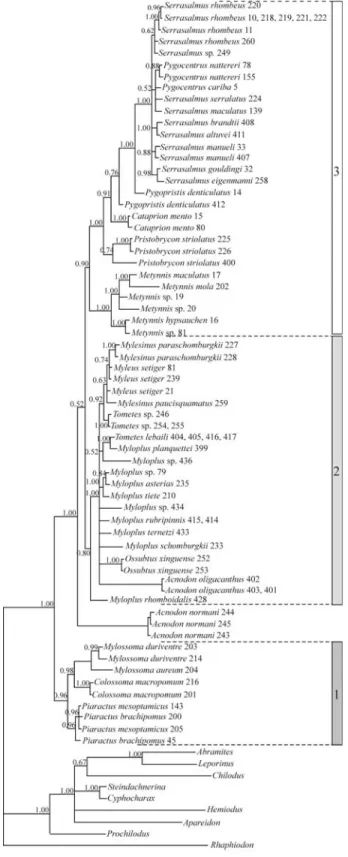
Model parameters for the mtDNA sequence data sug-gest significant levels of among site rate variation (propor-tion of invariable sites = 0.51, and alpha = 0.56), typical of ribosomal DNA data. Indel characters also exhibited signif-icant among-site rate variation (alpha = 1.0). The result ob-tained by Bayesian analysis (Figure 2) agrees with previous results based on mtDNA (Figure 1b) and with the other in-ference methods used in this study. The Serrasalmidae form a distinct, strongly supported monophyletic group, contain-ing three main clades: (1) a “pacu” clade, comprised of
Colossoma, Mylossoma and Piaractus that is the sister group to the other serrasalmids, (2) theMyleusclade, con-tainingMyleus,Mylesinus,TometesandOssubtus; and (3)
the “piranha” clade, with the genera Serrasalmus,
Pristobrycon, Pygocentrus, Pygopristis, Catoprion and
Metynnis.The analyses are not conclusive with regard to
the placement of Acnodon and also do not support the
monophyly of the two species (A. normani and A.
oligacanthus) included in the study. Results from ML anal-ysis are almost identical to the BI tree (Figure 2) differing only in the branching pattern with each major clade (mostly shown as polytomies in Figure 2). ML results also placeA. oligacanthus within the Myleus clade, separate from A. normani(outside of the Myleus clade). Maximum parsi-mony analyses yielded 740 equally parsimonious trees (L = 1224, CI = 0.43, RC = 0.32), a strict consensus of which recovers the monophyly of the piranha and the pacu clades, but not of theMyleusclade. MP bootstrap analysis yields BV = 56 and 95 for these two clades, respectively,
and no support for the Myleus clade. Interestingly, the
monophyly ofAcnodonwas recovered in several (but less
than 50%) of the 740 equally parsimonious trees.A
posteri-ori reweighting of characters (based on the RC, Farris,
1969, Carpenter, 1988) reduced the number of MP trees to 81, a strict consensus of which shows the same relation-ships among the main groups that were obtained with BI
(Figure 2) but with a monophyleticAcnodon(A. normani+
Relationships among taxa within these three groups are relatively well resolved for the pacu and piranha groups
but not among taxa in the Myleusclade. Within the pacu
group, the sister group relationship betweenColossomaand
Mylossomais recovered by ML analysis, and supported by a PP = 0.98 (Figure 2), but it does not receive support from MP bootstrap analysis. The five species ofMetynnisincluded in the study form a strong monophyletic group (PP = 1.0, BV = 92) and the genus is well supported (PP = 1.0 and BV = 78) as the sister group to all other taxa in the piranha clade
(Fig-ure 2). Pristobrycon striolatus forms a distinct taxon,
branching off next in the piranha clade, and quite separate from the other putativePristobryconspecies (P. serrulatus and P. eigenmanni) that group tightly withSerrasalmusand
Pygocentrus, the most derived group within the piranha clade. This result is robust in all methods of analysis and was
reported before (Ortí et al.1996). The two specimens
as-signed toPygopristis denticulatusused in this study do not form a monophyletic group in any analysis and their se-quence divergence is 0.025 (uncorrected “p” value), a rela-tively large difference for an intraspecific comparison. As reported earlier (Ortiet al., 1996) the relationships among species ofSerrasalmus,PygocentrusandPristobrycon, are not resolved by the 12S and 16S sequence data.
Mitochondrial control region data
Complete mitochondrial control region sequences from 45 serrasalmid taxa were collected. In agreement with
a priori expectations (e.g., Meyer, 1993), D-loop se-quences display much higher levels of variation than the rRNA genes, with sequence divergences ranging from 0.017 to 0.256 (uncorrected “p” divergence) among serra-salmid taxa. However, this higher level of polymorphism also resulted in problematic sequence alignment. Up to about 500 bp of the 5’ end of the control region (Domain I,
Brownet al., 1986) contained tandem repeats in several
taxa examined (Table 1). The repeated motifs ranged from 12 bp to 33 bp and some repeat patterns were imperfect (some repeats slightly different to the others). These motifs were repeated up to 17 times (in the case ofCatoprion) and they accounted for most of the variation in length of the am-plified fragments. Tandem repeat regions were not used for phylogenetic analyses because their homology among di-vergent serrasalmid taxa was impossible to assess. After excluding the repeated regions, the D-loop sequences were aligned separately for the “piranha” clade (18 taxa) and the other groups (27 taxa), resulting in alignment lengths of 1130 bp and 1180 bp, respectively. Indels were coded as above, resulting in the addition of 86 or 119 characters for each data set, respectively.
Figure 3 shows the BI tree for the pacu and theMyleus
clades based on the control region data. The data set ana-lyzed consisted of 1299 total characters, of which 583 were constant, 214 were variable but parsimony-uninformative and 502 were parsimony-informative. MP analysis
ered a single tree (L = 1941, CI = 0.55, RC = 0.34) that is al-most identical to the BI tree, differing only in the branching order among the more derived taxa. MP bootstrap analysis results agree well with PPs obtained with BI (Figure 3). In
agreement with the 12S and 16S data, Mylossoma and
Colossomaare placed as sister genera, but unlike the rRNA genes, control region data provide strong support for this relationship (PP = 1.0 and BV = 92). The monophyly of
both species ofAcnodonalso is supported strongly by the
control region data (posterior prob = 1.0 and MP bootstrap support = 98) andAcnodonis placed as the sister group of
Myleus, Myloplus, Mylesinus, Tometes, and Ossubtus.
Among these taxa there is not much resolution, except to support a basal position ofMyloplus rhombiodalisand a
ro-bust clade composed ofMyloplusspecies,M. rubripinnis,
M. asterias,M. tiete, andM. ternetzi,that forms the sister group to the rest of the taxa.
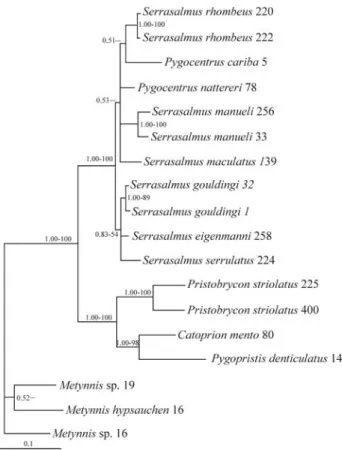
Figure 4 shows the BI tree for the piranha clade ob-tained with control region sequences. The data set analyzed consisted of 1216 total characters (1130 bp and 86 indel characters), of which 697 were constant, 189 were variable but uninformative and 330 were parsimony-informative. MP analysis recovered a single tree (L = 976, CI = 0.58, RC = 0.44) that is almost identical to the BI tree,
differing only in the branching order amongSerrasalmus,
Pygocentrus and (non-striolatus) Pristobrycon taxa. MP bootstrap analysis results agree well with PPs obtained with BI (Figure 4). The presence of three divergent groups of pi-ranhas is well supported: (1) the genusMetynnis, (2) the
Catoprion-Pygopristis-Pristobrycon striolatus group and (3) theSerrasalmus-Pygocentrus-group (Pristobrycon
spe-cies other than Pristobrycon striolatus, such as P.
serrulatus and P. eigenmanni, are here assigned to
Serrasalmus). The control region data resolved with high confidence (PP = 1.0 and BV = 100) the relationships amongCatoprion,P. striolatus, andPygoprististhat were not fully resolved in the 12S and 16S tree (Fig 2). Within theSerrasalmusclade, there is weak evidence (PP = 0.53)
for affinities among Pygocentrus and one group of
Serrasalmus species (S. manueli, S. maculatus, and S. rhombeus), and somewhat higher support (PP = 0.83 and
BV = 54) for affinities among putative Pristobrycon
(non-striolatus) with a different group ofSerrasalmus spe-cies (S. gouldingi, S. serrulatus,and S. eigenmanni).
Discussion
This study represents the most complete molecular systematic treatment of serrasalmids to date. Building on
Table 1- Tandem repeats in the 3’ region of the Control Region of serrasalmid taxa.
Taxon Repeat motif Number of
repeats1
Length of tandem repeat region
Catoprion AGTACATATGTATATAGTACATCATGGTTT 17 (p) 510 bp
Pristobrycon striolatus224,225 AGTACATATTATGTATATAGTACATGATGGTTT 3 or 7 (p) 99 to 231 bp
Metynnis hypsauchen ATGGTGATCTAAGTACATAATAGTTATATAGTACATA 3 (i) 111 bp 19Metynnis ATGGTGATCTAAGTACATTATATGTATATAGTACATA 4 (i) 148 bp 20Metynnis ATGATCTAAATACATTATATGTATATAGTACATA 4 (i) 136 bp
Serrasalmus rhombeus222, 220 ATGGTGATCTAAGTACATTATATGTATATAGTACATA 3 to 5 (i) 111 to 185 bp
Serrasalmus spilopleura139 GGCGCCCCACAT 5 (p) 60 bp 1
Number of perfect (p) or imperfect (i) repeats.
the previous study by Ortíet al.(1996), analyses presented here include additional taxa from all genera of the sub-family and add a new molecular marker (complete mtDNA control region sequences) to recover phylogenetic patterns or population structure among serrasalmids. As expected, the higher level of variation in the control region compared to the 12S and 16S mitochondrial rRNA genes provides better resolution of the relationships within each of the main clades (Figures 3 and 4). In agreement with previous estimates of rates of substitution-control region rates were found to range between 2.8 (Cannet al., 1984) to 5 times (Aquadro and Greenberg, 1983) the rate of the rest of the mtDNA genome-the higher rate observed for control region among serrasalmid taxa provided additional characters for phylogenetic inference of closely related species. The study also documents complex patterns of variation involving tandem repeats in the mitochondrial control region. This phenomenon has been generally accepted to account for size variation among vertebrate mitochondrial genomes (reviewed by Hoelzel, 1993, Rand, 1993) and has been was documented in fishes before (e.g.Bentzenet al., 1998).
Although based on a single molecular marker (mtDNA), the results of this study carry several taxonomic implications. Most notably, many of the generic designa-tions in the family seem to lack support or are clearly con-tradicted by the data. Some of these conclusions are not new:Pristobrycon striolatushas previously been regarded
as quite distinct from its congeners (Machado-Allison et
al., 1989), differing in several morphological aspects and
its well-supported grouping with Catoprion and
Pygopristis is consistent with the finding of Ortí et al.
(1996). Our present results confirm this observation and therefore we prefer to restrictPristobrycon to the single speciesP. striolatus, and place all other taxa previously as-signed to this genus inSerrasalmus. According to the clas-sification of Géry (1977), the genusSerrasalmuscontained
the subgenera Pygopristis, Pristobrycon, Pygocentrus,
Taddyella and the nominate subgenus Serrasalmus;
Serrasalmus(Pristobrycon)striolatuswas noted to resem-ble closely the subgenusPygopristis. This observation is well supported by our molecular analysis of control region
data, as this species forms a clade with Catoprion and
Pygopristis(Figure 4), and is not closely related to the other
specimen putatively assigned toPristobrycon(#224
desig-natedSerrasalmus serrulatushere) in the rRNA tree
(Fig-ure 2). Based on various morphological characters,
Serrasalmus gouldingiis distinct from other members of the genus (Machado-Allison and Fink, 1996). In this analy-sis, it was found to be more closely related to the remaining
Pristobryconthan it is to other species ofSerrasalmus. This
group containing S. gouldingi, S. eigenmanni and S.
serrulatus is the sister group to the Serrasalmus-Pygocentrusclade. The genusSerrasalmuscontains within it the genusPygocentrus. Results from analysis of control region sequences of a dense taxonomic sampling for
SerrasalmusandPygocentrusprovides strong evidence for
the monophyly ofPygocentrus but its relationship to
di-verse components ofSerrasalmusremains unresolved
(Hu-bertet al., 2007). Some of the poor resolution obtained in our study is evidently the consequence of poor taxonomic sampling.
Some authors (e.g.Géry, 1977) have recognized the
existence of four subgenera within Myleus, namely
Myloplus, Paramyloplus, Prosomyleus and the nominate subgenusMyleus, within this genus. These subgeneric dis-tinctions have been, as with all previous classifications, based primarily on dental morphology. Other authors, how-ever, rejected these subgeneric distinctions due to the lack of autapomoprhies (Machado-Allison and Fink, 1995). The
monophyly of subgenera withinMyleusis not supported by
analyses of mtDNA data. Analysis of theMyleusgroup
re-veals the polyphyly of the formerly designated genus
Myleus and supports the taxonomic rearrangement
pro-posed by Jégu and Dos Santos (2002) and Jégu et al.
(2003), but relationships among the various components of
this group remain tentative. The group formed byMyleus
setiger with Mylesinus and Tometes is relatively well-supported (PP = 1.00, BV = 67, Figure 3) suggesting strong affinities ofMyleuswith species designated to these
genera. A robust group of Myloplus species (M.
rubripinnis,M. asterias, M. tiete, andM. ternetzi) is also well supported by the control region data.
As these analyses have shown, there are several taxo-nomic inconsistencies in this subfamily. While this study represents the most comprehensive molecular systematic treatment of this group, and utilizes a highly variable mtDNA marker to provide resolution of shallow nodes, placement of some taxa remains uncertain. In order to pro-vide a strong foundation for taxonomic revision of the group, future studies would benefit from utilizing dense taxonomic sampling, nuclear gene sequences, together with mtDNA and morphological characters to help resolve some of these ambiguous relationships.
Acknowledgments
Many colleagues provided tissue samples for this study, but in particular we would like to thank Jorge Porto and Paulo Petry for their contributions. This work is part of Arjun Sivasundar’s MS thesis. Financial support came from the National Science Foundation (USA) through a CAREER Grant (DEB 9985045) to G.O.
References
Anderson S, Bankier AT, Barrell BG, de Bruijn MHL, Coulson AR, Drouin J, Eperon IC, Nierlich DP, Roe BA, Sanger F,et al.(1981) Sequence and organization of the human mito-chondrial genome. Nature 290:457-465.
Aquadro CF and Greenberg BD (1983) Human mitochondrial DNA variation and evolution: Analysis of nucleotide se-quences from seven individuals. Genetics 103:287-312. Araujo-Lima C and Goulding M (1997) So Fruitful a Fish:
Ecol-ogy, Conservation, and Aquaculture of the Amazon’s Tam-baqui. Columbia University Press, New York, 191 pp. Bentzen P, Wright JM, Bryden LT, Sargent M and Zwanenburg
KC (1998) Tandem repeat polymorphism and heteroplasmy in the mitochondrial control region of redfishes (Sebastes, Scorpaenidae). J Hered 89:1-7.
Brown GG, Gadaleta G, Pepe G, Saccone C and SbisE (1986) Structural conservation and variation in the D-loop-con-taining region of vertebrate mitochondrial DNA. J Mol Biol 192:503-511.
Calcagnotto D, Schaefer SA and DeSalle R (2005) Relationships among characiform fishes inferred from analysis of nuclear and mitochondrial gene sequences. Mol Phylogenet Evol 36:135-153.
Cann RL, Brown WM and Wilson AC (1984) Polymorphic sites and the mechanism of evolution in human mitochondrial DNA. Genetics 106:479-499.
Carpenter J (1988) Choosing among equally parsimonious cla-dograms. Cladistics 4:291-296.
Eigenmann C (1915) The Serrasalminae and Mylinae. Ann Carne-gie Mus Pittsburgh 9:266-272.
Farris JS (1969) A successive approximations approach to charac-ter weighting. Syst Zool 18:374-385.
Farris JS, Källersjö M, Kluge AG and Bult C (1994) Testing sig-nificance of incongruence. Cladistics 10:315-319.
Farris JS, Källersjö M, Kluge AG and Bult C (1995) Constructing a significance test for incongruence. Syst Biol 44:570-572. Géry J (1972) Poissons Characoïdes des Guyanes. I. Généralités.
II. Famille des Serrasalmidae. Zool Verhand 122:1-250. Géry J (1977) Characoids of the World. T.F.H. Publications Inc,
Neptune City, 672 pp.
Géry J (1984) The fishes of Amazonia. In: Sioli H (ed) The Ama-zon, Limnology and Landscape Ecology of a Mighty Tropi-cal River and its Basin. Junk Publishers, Dordrecht, pp 343-370.
Gosline W (1951) Notes on the characoid fishes of the Subfamily Serrasalminae. Proc Cal Acad Sci ser 4 27:17-64.
Goulding M (1980) The Fishes and the Forest: Explorations in Amazonian Natural History. University of California Press, Berkeley, 280 pp.
Hoelzel AR (1993) Evolution by DNA turnover in the control re-gion of vertebrate mitochondrial DNA. Curr Opin Genetics 3:891-895.
Hubert N, Bonillo C and Paugy D (2005) Does elision account for molecular saturation: Case study based on mitochondrial ri-bosomal DNA among Characiform fishes (Teleostei, Ostariophysii). Mol Phylogenet Evol 35:300-308.
Hubert N, Duponchelle F, Nuñez J, Garcia-Dávila C, Paugy D and Renno J-F (2007) Phylogeography of the piranha genera
SerrasalmusandPygocentrus: Implications for the diversi-fication of the Neotropical ichthyofauna. Mol Ecol 16:2115-2136.
Huelsenbeck JP and Ronquist F (2001) MRBAYES: Bayesian in-ference of phylogeny. Bioinformatics 17:754-755.
Jégu M and Dos Santos GM (1990) Description d’Acnodon senai
n. sp. du Rio Jari (Brésil, Amapá) et redescription d’A.normani (Teleostei, Serrasalmidae). Cybium 14:187-206.
Jégu M and Dos Santos GM (2002) Révision du statut deMyleus setiger Müller and Troschel, 1844 et de Myleus knerii
(Steindachner, 1881) (Teleostei, Characidae, Serrasalmi-nae) avec une description complémentaire des deux espèces. Cybium 26:33-57.
Jégu M, Keith P and Le Bail PY (2003)Myloplus planquettein. sp. (Teleostei, Characidae, Serrasalminae), une nouvelle espèce de grand Serrasalminae phytophage du bouclier guyanais (Guyane française). Rev Suisse Zool 110:823-853. Jobb G (2006) TREEFINDER, v. of May 2006. Munich,
Ger-many, http://www.treefinder.de.
Junk WJ (1984) Ecology, fisheries and fish culture in Amazonia. In: Sioli H (ed) The Amazon, Limnology and Landscape Ecology of a Mighty Tropical River and its Basin. Dr W Junk Publishers, Dordrecht, pp 443-476.
Kocher TD, Thomas WK, Meyer A, Edwards SV, Paabo S, Villablanca FX and Wilson AC (1989) Dynamics of mito-chondrial DNA evolution in animals. Proc Natl Acad Sci USA 86:6196-6200.
Leite RG and Jégu M (1990) Food habits of two species of
Lowe-McConnel RH (1975) Fish Communities in Tropical Fresh-waters: Their Distribution, Ecology and Evolution. Longman, London, 337 pp.
Machado-Allison A (1983) Estudios sobre la sistemática de la subfamilia Serrasalminae (Teleostei, Characidae). Parte II. Discusión sobre la condición monofilética de la subfamilia. Acta Biol Venez 11:145-195.
Machado-Allison A and Fink WL (1995) Sinopsis de las Especies de la Subfamilia Serrasalminae Presentes en la Cuenca del Orinoco. Serie Peces de Venezuela. Museo de Biologia, Ca-racas, 89 pp.
Machado-Allison A and Fink WL (1996) Los Peces Caribes de Venezuela: Diagnosis, Claves, Aspectos Ecologicos y Evo-lutivos. Universidad Central de Venezuela, Caracas, 149 pp.
Machado-Allison A, Fink WL and Antonio ME (1989) Revisión del géneroSerrasalmusLacepede, 1803 y géneros relacio-nados en Venezuela: I. Notas sobre la morfología y siste-mática de Pristobrycon striolatus (Steindachner, 1908). Acta Biol Venez 12:140-171.
Marshall E (1995) Homely fish draws attention to Amazon defor-estation. Science 267:814.
Meyer A (1993) Evolution of mitochondrial DNA of fishes. In: Hochachka PW and Mommsen P (eds) Molecular Biology Frontiers, Biochemistry and Molecular Biology of Fishes. Elsevier Press, Amsterdam, pp 1-38.
Müller K (2005) SeqState - Primer design and sequence statistics for phylogenetic DNA data sets. Appl Bioinf 4:65-69.
Müller K (2006) Incorporating information from length-muta-tional events into phylogenetic analysis. Mol Phylogenet Evol 38:667-676.
Nico L and Taphorn DC (1988) Food habits of piranhas in the low llanos of Venezuela. Biotropica 20:311-321.
Norman JR (1929) The South American characid fishes of the subfamily Serrasalmoninae with a revision of the genus
Serrasalmus Lacepede. Proc Zool Soc London 52:661-1044.
Ortí G and Meyer A (1997) The radiation of characiform fishes and the limits of resolution of mitochondrial ribosomal DNA sequences. Syst Biol 46:75-100.
Ortí G, Petry P, Porto JIR, Jégu M and Meyer A (1996) Patterns of nucleotide change in mitochondrial ribosomal RNA genes and the phylogeny of piranhas. J Mol Evol 42:169-182. Palumbi S, Martin A, Romano S, McMillan WO, Stice L and
Grabowski G (1991) The Simple Fool’s Guide to PCR. Uni-versity of Hawaii, Honolulu, 46 pp.
Posada D and Crandall KA (1998) Modeltest: Testing the model of DNA substitution. Bioinformatics 14:817-818.
Rand DM (1993) Endotherms, ectotherms, and mitochondrial ge-nome-size variation. J Mol Evol 37:281-295.
Ronquist F and Huelsenbeck JP (2003) MRBAYES 3: Bayesian phylogenetic inference under mixed models. Bioinformatics 19:1572-1574.
Saitou N and Nei M (1987) The neighbor-joining method: A new method for reconstructing phylogenetic trees. Mol Biol Evol 4:406-425.
Sambrook J, Fritsch EF and Maniatis T (1989) Molecular Clon-ing: A Laboratory Manual. 2nd ed. Cold Spring Harbor Lab-oratory Press, Cold Spring Harbor.
Swofford DL (2000) PAUP* Phylogenetic Analysis Using Parsi-mony (*and Other Methods), v. 4. Sinauer Assoc, Sun-derland.
Thompson JD, Gibson TJ, Plewniak F, Jeanmougin F and Higgins DG (1997) The ClustalX windows interface: Flexible strate-gies for multiple sequence alignment aided by quality analy-sis tools. Nucleic Acids Res 25:4876-4882.
Winemiller KO (1989) Ontogenetic diet shifts and resource parti-tioning among piscivorous fishes in the Venezuelan Llanos. Env Biol Fishes 26:177-199.
Zanata AM (2000) Estudo das relações Filogenéticas do gênero
Brycon Müller and Troschel, 1844 (Characidae, Characi-formes). Ph.D. Thesis, Universidade de São Paulo, São Paulo.
Supplementary Material
The following online material is available for this ar-ticle:
- Table S1: Specimen and sequence information This material is available as part of the online article from http://www.scielo.br/gmb.
Associate Editor: Antônio Sole-Cava