Engineering
www.abeq.org.br/bjchePrinted in BrazilVol. 34, No. 02, pp. 531 - 539, April - June, 2017 dx.doi.org/10.1590/0104-6632.20170342s20150717
LIPASE-CATALYZED ETHANOLYSIS OF
Jatropha
curcas
L. OIL ASSISTED BY ULTRASONICATION
L. A. Lerin
1, D. Remonatto
2, T. M. M. Pereira
2, M. C. Zenevicz
2,
A. Valério
2, J. V. Oliveira
2and D. de Oliveira
2*1Dipartimento di Scienze Chimiche e Farmaceutiche, Università di Ferrara, CAP: 44121, Ferrara, Italy.
2Department of Chemical and Food Engineering, Federal University of Santa Catarina, Florianópolis, SC, 88040-900, Brazil.
Phone: +55 48 3721 2515; Fax: +55 48 3721 9687 E-mail: [email protected]
(Submitted: November 5, 2015; Revised: December 30, 2015; Accepted: February 8, 2016)
Abstract – Transesteriication of non-edible oils using immobilized lipase is a promising process for biodiesel
production. Thus, this study aimed to evaluate the enzymatic transesteriication of the non-edible Jatropha curcas oil for FAEE production under ultrasound irradiation in a solvent-free system. The efects of enzyme concentration, water concentration, molar ratio of ethanol to oil and ultrasound power on the FAEE conversion
have been evaluated. The results show that enzyme concentration and irradiation power have a positive signiicant efect on FAEE conversion, where an increase in these variables leads to higher conversions. Conversion above
54% of FAEE was achieved with 1.5 hours of reaction time using ultrasound irradiation, reducing reaction time by at least 3 times, when compared with the same experimental conditions without ultrasound irradiation. Results showed that ultrasound can improve reaction conversion mainly by enhancing the mass transfer between the constituents of the reactions.
Keywords: Lipase; Jatropha curcas; transesteriication; ethanol; ultrasonication.
INTRODUCTION
In order to increase the commercial competitiveness of biodiesel, to ensure the availability of oil and to improve the use of the regional resources, it is expected that alternative vegetable non-edible oil crops will increase their participation as feedstock for biodiesel production (Bergmann et al., 2013; Hama and Kondo, 2013).
Therefore, it is necessary to ind new feedstock sources
suitable for biodiesel production, which would not drain the edible vegetable oil supply and that would be capable of growing in marginal lands with minimum agricultural inputs (Araújo et al., 2014).
Jatropha curcas L. (1753), belonging to the Euphorbiaceae family, is seen as one of the most
appropriate renewable alternative sources for biodiesel production in terms of availability and cost (Makkar et al., 2009; Rashid et al., 2010). The Jatropha seed is toxic, an advantage as its use for biodiesel production does not compete with the food chain market. Jatropha is native to Mexico and Central America and distributed in Latin America, Africa, India and South East Asia (Pandey et al., 2012; Gubitz et al., 1999). The plant is well adapted to arid
and semi-arid climatic conditions and can grow in diferent
land types, including marginal, degraded and contaminated lands (Openshaw, 2000; Foidl et al., 1996).
et al., 2013; Ariza-Montobbio et al., 2010; Kant and Wu, 2011; Edrisia et al., 2015). Furthermore, the use of ethanol instead of methanol is interesting due to the possibility of producing a fully renewable biodiesel, producing fatty acid ethyl ester (FAEE). According to Shah and Gupta (2007), for a sustainable technology, ethanol for biodiesel preparation would be derived from fermentation of sugars, which in turn would be obtained from plant starches/ celluloses.
Lipase-catalyzed transesteriication of feedstock oil has
been considered as one of the most promising techniques for biodiesel production, a mixture of fatty acid alkyl esters (Zhao et al., 2015). The catalytic ability of lipase has shown high purity of products and less wastewater generation and mild reaction conditions are required (Guldhe et al., 2015).
Diferent lipases have been used in biodiesel production,
among which immobilized lipase shows great potential for industrial application due to high stability with regard to temperature and chemicals. This enables easy handling, recovery and recycling of the biocatalyst, and hence lowering the costs (Ranjbakhsh et al, 2012; Yang et al., 2013; Kalantari et al., 2013).
Processes of production of biodiesel face various problems related to lower rates of synthesis typically attributed to mass transfer limitations due to the heterogeneous nature of the reaction system, and the requirement of high molar ratio (alcohol to oil) as
transesteriication itself is a reversible reaction. Both
of these facts result in high operating cost and energy
consumption and hence low production eiciency for the
biodiesel production (Maddikeri et al., 2012). Thus, there
is a need to develop sustainable process intensiication
technology for biodiesel processing from non-edible oil sources with an objective to improve the mixing, mass and heat transfer between two liquid phases in the
transesteriication reaction and, consequently, reduce
the cost of the process. Among alternative technologies, the use of microwave and ultrasound as energy sources have presented potential results (Gole and Gogate, 2012a; Jadhav and Gogate, 2014). Recent developments in sonochemistry (Veljkovic et al., 2012; Deshmane et al., 2008) attracted great attention with the use of an
ultrasound bath as a new, eicient mixing tool, based on emulsiication of immiscible liquids (reactants) by
microturbulence, which is generated by the implosion of cavitation bubbles (Andrade-Tacca et al., 2014; Gebicka and Gekicki, 1997). Hence, to overcome the drawbacks of the conventional stirring method, an ultrasound bath is considered to be green methodology due to its high
eiciency and mild reaction conditions (Waghmare et al.,
2015). Transesteriication reactions depend on the basic
parameters such as molar ratio, catalyst concentration, and reaction temperature. In addition, the parameters based on the sonochemical reactors such as power dissipation,
frequency of irradiation and type of the reactor also afect
the reaction rates (Gole and Gogate, 2012b).
Many interesting works using ultrasound to enhance biodiesel conversion with reaction catalyzed by enzymes are described in the literature (Waghmare et al., 2015; Lerin et al., 2014; Awadallak et al., 2013; Batistella et al., 2012; Fiametti et al., 2012; Kumar et al., 2011). However, we have not found reports that describe the ethanolysis of Jatropha curcas oil under ultrasound irradiation. Given this scenario, the present work attempts to contribute to build a platform for fatty acid ethyl ester (FAEE) production exploring non-edible raw materials. Based on these aspects, the aim of this work was to report the experimental data on
lipase-catalyzed transesteriication of Jatropha curcas oil with ethanol to produce FAEE in an ultrasound bath using commercial immobilized lipase (Novozym 435). The
following process conditions were evaluated: efects of
temperature, enzyme concentration, water concentration, oil to ethanol molar ratio and ultrasound irradiation power on the reaction yield in a solvent-free system.
MATERIALS AND METHODS
Materials
The Jatropha curcas L. seed oil used in this work, kindly donated by Biotins Energia S.A. (Brazil), extracted by cold mechanical pressing, used as received. Ethanol, n-heptane (Merck, 99.9% purity) and n-hexane (Nuclear, 99.5% purity) were used without further treatment. Commercial immobilized lipase Novozym 435 from Candida antarctica (immobilized on a macroporous anionic resin, 1.4 wt% water) was kindly provided by Novozymes Latin America Ltda. (Araucária, Brazil) and presented an enzyme activity of around 37.91 U/g.
Oil characterization
Table 1. Fatty acid composition of the Jatropha curcas seed oil.
Fatty acid Content (wt%)
Palmitic acid (16:0) 13.73
Stearic acid (18:0) 5.79
Oleic acid (18:1) 42.37
Linoleic acid (18:2) 37.52
Linolenic acid (18:3) 0.59
Experimental procedure
Enzymatic ultrasound-assisted transesteriication
reactions were carried out using an ultrasonic water bath (Unique Inc., model USC-1800 A - temperature accuracy of ± 0.5 °C, São Paulo, Brazil) in which a round bottom
lask of 50 mL capacity closed with a lid was placed. The
ultrasonic bath was equipped with a transducer having longitudinal vibrations, operating frequency of 37 kHz and maximum rated electrical power output of 132 W. The ultrasonic transducer (surface area of 282.2 cm2) is itted at the bottom of the bath, horizontally along the length of the bath. To determine the best reaction conditions, a Plackett-Burman experimental design with 12 assays, with triplicate runs at the central point was used. To increase FAEE production in a solvent-free system the experimental design was studied employing as variables: oil-to-ethanol molar ratio (1:3 to 1:10), irradiation power (40 to 100%), temperature (40 to 70 °C), enzyme concentration (5 to 20 wt% by weight of substrates), and water concentration (0 to 10 wt% by weight of substrates); for all assays the reaction time was kept constant at 2 h. The software Statistica® 8.0 (Statsoft Inc., USA) was used to assist the design and the statistical analysis of experimental information, adopting a
conidence level of 95% (p < 0.05).
Kinetic study of lipase-catalyzed transesteriication of
Jatropha curcas oil with ethanol
Based on the results obtained previously in the experimental designs, kinetic reactions were performed
with diferent enzyme concentration of 10, 20, 30, and 40
wt% (by weight of substrates). For the kinetic study of
lipase-catalyzed transesteriication of Jatropha curcas oil with ethanol the variables oil to ethanol molar ratio (1:10), temperature (70 °C), irradiation power (100% - 132 W) were kept constant with no water addition. Samples were taken from the bulk reaction system at 15, 30 min, and 1, 1.5, 2, 3 and 4 h. It may be important to emphasize that, in all cases, destructive experiments, without sampling, were carried out.
In order to assess the real efect of ultrasound on the
production of FAEE, tests without ultrasound and without enzyme were also carried out in the best experimental condition determined previously in this work (oil to ethanol
molar ratio of 1:10, 70 °C, irradiation power of 100% (132 W), enzyme concentration of 30% and 1.5 h).
Reuse of biocatalyst
To evaluate the Novozym 435 enzyme reuse in the
lipase-catalyzed transesteriication of Jatropha curcas oil
with ethanol the experimental condition was ixed as: 70
°C, irradiation power of 100% (132 W), without addition of water, oil to ethanol molar ratio of 1:10, enzyme concentration of 30 wt% (by weight of substrates), and 2 h of reaction time. At the end of each reaction time, the enzyme
was recovered by iltration using ilter paper, followed
by hexane washings under moderate vacuum. Then, the product of the reaction was dried in an oven (JP 101, J. Prolab) at 40 °C for 2 h and then kept in a desiccator for 24
h. An aliquot of 0.2 g of enzyme was used for esteriication
activity determination. The remaining enzyme used in the previous batch was reused in subsequent cycles, until 6 cycles. The enzymatic activity was measured before and after each cycle and the residual activity was determined following the methodology described below. The reaction conversion in FAEE of each cycle was also evaluated.
Lipase esteriicationactivity
The esteriication activity of Novozym 435 was determined as the initial rate of the esteriication reaction
between lauric acid and n-propanol as described by Oliveira et al. (2006). All enzymatic activity determinations were
performed in triplicate. The residual esteriication activity was deined according to Eq. (1).
Product quantiication
In the irst step, samples were submitted to ethanol
evaporation to constant weight in a vacuum oven (65 °C, 0.05 MPa - Quimis, model Q819V2) and then diluted with 2 mL of ethanol and 8 mL of heptane. After this, 50 µL
of solution was transferred to a 1 mL volumetric lask,
adding 50 µL of internal standard methyl heptadecanoate at a concentration of 5000 mg L-1 and illed with heptane.
���������������� % = �������������
Table 2. Matrix of the Plackett-Burman experimental design (coded and real values) for FAEE production in solvent-free system under sonochemical irradiation after 2 hours of reaction.
Assay Temperature (°C) MRa [E] (wt%)b [H
2O] (wt%)
c IA (%)d FAEE yield (wt%)
1 1 (70) -1 (1:3) 1 (20) -1 (0) -1 (40) 28
2 1 (70) 1 (1:10) -1 (5) 1 (10) -1 (40) 11
3 -1 (40) 1 (1:10) 1 (20) -1 (0) 1 (100) 42
4 1 (70) -1 (1:3) -1 (5) 1 (10) -1 (40) 19
5 1 (70) 1 (1:10) 1 (20) 1 (10) 1 (100) 39
6 1 (70) 1 (1:10) 1 (20) -1 (0) 1 (100) 47
7 -1 (40) 1 (1:10) 1 (20) 1 (10) -1 (40) 17
8 -1 (40) -1 (1:3) 1 (20) 1 (10) 1 (100) 24
9 -1 (40) -1 (1:3) -1 (5) 1 (10) 1 (100) 15
10 1 (70) -1 (1:3) -1 (5) -1 (0) 1 (100) 16
11 1 (40) 1 (1:10) -1 (5) -1 (0) -1 (40) 13
12 1 (40) -1 (1:3) -1 (5) -1 (0) -1 (40) 16
13 0 (55) 0 (1:6.5) 0 (12.5) 0 (5) 0 (70) 21
14 0 (55) 0 (1:6.5) 0 (12.5) 0 (5) 0 (70) 23
15 0 (55) 0 (1:6.5) 0 (12.5) 0 (5) 0 (70) 22
a Oil to ethanol molar ratio. b Enzyme concentration. c Water concentration. d Irradiation power amplitude.
��������� ��% = ∑�− ���
��� � ���
������� �100 (2)
Thereafter, 1 µL of solution was injected in triplicate on a gas chromatograph (Shimadzu GC-2010), equipped with FID, auto-injector AOC-20i and a capillary column RTX - Wax (30 m x 0.25 mm x 0.25 µm). Column temperature was programmed from 120 °C, holding 2 min, heating to 180 °C at 15 °C/min, holding 3 min, and to 250 °C at 5 °C/min, holding 2 min. Helium was used as carrier gas, and the injection and detector temperatures were 250 °C
with a split ratio of 1:50. Compounds were quantiied
upon analysis following the standard UNE-EN 14103 (Standard UNE-EN 14103, 2003) and FAEE content was then calculated based on the content of ethyl esters in the analyzed sample (Eq. (2)).
where: FAEE yield (wt%) is fatty acid ethyl esters, ∑A is the sum of areas corresponding to ester peaks (C14:0-C24:0) and the internal standard (C17:0), AIS is area of the internal
standard (C17:0), CIS is concentration of internal standard in the injected sample (mg.L-1), C
sample is concentration of injected sample (mg/L).
RESULTS AND DISCUSSION
Efect of process variables on FAEE conversion in the
solvent-free system
According to Aguieiras et al. (2014) a solvent-free reaction medium shows several advantages such as an increase of biodiesel productivity and reduction of environmental issues (toxicity of the organic solvent) and processing costs (recovery and losses). The results of Plackett-Burman experimental design (coded and real values) for FAEE production in solvent-free system are shown in Table 2. It can be observed from this table that
the highest reaction conversion was veriied in the assays 3
(42%) and 6 (47%), corresponding to the highest ethanol to oil molar ratio (10:1), irradiation power of 100%, enzyme concentration 20 wt%, and no water addition (0%).
Experimental data were statistically treated and the
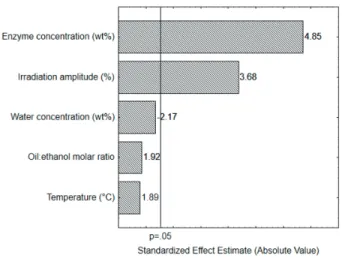
variables efects on the FAEE yield are shown in the Pareto chart (Figure 1) at 95% conidence level (p <0.05). Inspection of this igure shows that enzyme concentration and irradiation power amplitude had a positive signiicant efect on FAEE yield, where an increase in these variables
leads to higher conversions. The oil to ethanol molar ratio, temperature, and water concentration did not
show a signiicant efect on the reaction conversion. The transesteriication reaction requires three moles of ethanol
per mole of triglyceride to yield three moles of FAEE and
one mole of glycerol. The theoretical minimum required molar ratio of ethanol to oil should therefore to be 1:3.
However, transesteriication is an equilibrium reaction in
which a high molar ratio is used to drive the reaction to FAEE.
The use of 100% ultrasonic irradiation power led to higher conversions. This result is probably due to the
physical efects of the cavitation phenomena, mainly
Figure 1. Pareto chart of the efects of the independent
studied variables on the FAEE yield in solvent-free system
(p<0.05). Experimental data and conditions shown in
Table 1. available interfacial area between the reactants increases
greatly, giving faster reaction rates and the requirement of less-severe conditions, in terms of the operating temperature (Deshmane et al., 2009).
The efect caused by the ultrasound irradiation also explains the non-signiicant efect of temperature.
Whereas the overall temperature is lower with the ultrasonic irradiation the reactants are exposed to higher temperatures locally, although for few microseconds, due to the continuous process of generation and collapse of cavities (Sutkar and Gogate, 2009; Gole and Gogate, 2012a). However, it is known that the reaction temperature increases the collision chance between enzyme and substrate molecules, increasing the interaction. Therefore, the increase of temperature decreased the reaction medium viscosity, increasing cavitation events and the rate of emulsion formation, thus increasing biodiesel production (Yu et al., 2010). Based on this, for the next steps of the study the temperature of 70 °C was used.
It was observed that there was a considerable increase in ethyl ester formation with a decrease in addition of water. A maximum conversion of 47% of ethyl esters was obtained without adding water, however, the oil had a water content of 0.33%. With increasing level of water content, the hydrolytic activity of lipase increases and the
transesteriication yield tends to decrease. The water content
could decrease the enzyme activity due to the observed enzyme particle aggregation that might consequently lead to limited access of the substrate to the enzyme active site (Karboune et al., 2006). Hence, this optimum level of water plays an important role in minimizing hydrolysis
and maximizing transesteriication activity of immobilized
lipase (Abdulla and Ravindra, 2013).
Kinetic study: efect of enzyme concentration
The efect of enzyme concentration on FAEE yield in
solvent-free system under ultrasound-assisted system was evaluated at 70 °C, keeping the oil-to-ethanol molar ratio constant at 1:10, irradiation power amplitude (100%), with no water addition, and enzyme concentration in a range of 10, 20, 30 and 40 wt% (based on the substrate amount). Figure 2 shows the experimental data results obtained in
this step. From the igure it is possible to observe that the
initial reaction rates increased with increasing enzyme concentration, leading to reasonable yields in short reaction time.
The FAEE production in the presence of enzyme in a solvent-free system showed conversions of 48, 54, and 56% after 1.5 h of reaction, respectively for 20, 30, and 40 wt% of enzyme concentration. After 2 h of reaction time a small increase (52 to 56%) was observed in FAEE yield when 40 wt% of enzyme concentration was used. On the other hand, for 10 wt% enzyme concentration, lower conversions were achieved, reaching 34% of FAEE after 2
h. It is worth noting that the conversions obtained at higher enzyme concentrations (20, 30, and 40 wt%) after 1.5 and 2 h were similar and, considering the cost of the enzyme, it seems that 30 wt% of enzyme and 1.5 h of reaction time is the best condition for FAEE production in the present study.
The enzymatic ethanolysis reaction of Jatropha curcas oil using an ultrasound bath showed good conversions in a short reaction time (1.5 h), being at least 3 times shorter when compared with experiments conducted under the same experimental conditions without ultrasound irradiation (18%). For tests with ultrasound irradiation and without enzymes it was not observed the production of FAEE was not observed.
Abdulla and Ravindra (2013) using Burkholderia cepacia lipase immobilized in alginate and κ-carrageenan (5.25 g), 35 °C, 1:10 molar ratio of oil (10 g) to ethanol, 1 g water, 230 rpm in 20 hours reaction reached 60% ethyl esters. Soumanou et al. (2012) tested diferent immobilized enzymes for alcoholysis of Jatropha curcas oil and achieved the highest conversion (93%) using immobilized Pseudomonas cepacia lipases on Accurel 1282 after 16 h, whereas the lowest conversion was found with Novozym 435. A study of Jatropha curcas oil methanolysis in ultrasound showed 84.5% conversion of methyl esters using immobilized Enterobacter aerogenes lipase on silica, molar ratio oil to methanol 1:4, reaction time 30 min, ultrasonic amplitude 50% (100 W/m3) and cycle 0.7 s (Kumar et al., 2011).
Biodiesel production using Jatropha seed oil reported by Shah and Gupta (2007), by Pseudomonas cepacia lipase immobilized on Celite and ceramic at 200 rpm, molar ratio of 1:4 (oil:ethanol) and 40 °C in 24 h reaction showed 80 and 68 wt% biodiesel yield, respectively. With Pseudomonas cepacia lipase immobilized on Celite with addition of 5% (w/w, enzyme) water the yield was above 85% after 12 hours of reaction (Shah and Gupta, 2007). Several studies comparing enzymatic reactions for the production of biodiesel by a conventional method and ultrasound-assisted showed that the ultrasonication process led to similar yields of esters as the conventional
procedure, while signiicantly decreasing the reaction time,
so the use of ultrasonic irradiation was a time saving and economical method of producing biodiesel fuel (Teixeira et al., 2009; Subhedar et al., 2015; Subhedar and Gogate (2016).
Biocatalyst reuse
According to Batistella et al. (2012), the utilization of enzymatic systems to produce biodiesel has been considered attractive due to several factors like mild reaction conditions (energy saving), the possibility of using waste oils (low price, not competing with the food chain), easy glycerol and catalyst recuperation, and low environmental impact (minimal waste water treatment). Nevertheless, the process productivity is not generally satisfactory and the cost of the catalyst remains comparatively prohibitive from an industrial point of view.
In addition, as pointed out by Wang et al. (2001), the cost involved in enzyme immobilization together with utilization cycles should be taken into account in the global economic analysis of an industrial biodiesel plant. It has been argued by Rahman et al. (2012) that lipases may lose their activity in non-aqueous medium and selectivity and
stability may also be afected. Undoubtedly, the possibility
of catalyst reuse is crucial for enzymatic process feasibility and accordingly reaction cycles for immobilized enzyme were performed under ultrasound irradiation.
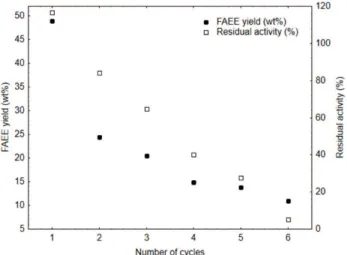
Figure 3 presents results in terms of FAEE reaction yield and enzyme residual activity as a function of cycle
number. It can be observed from this igure that the enzyme kept the initial activity only in the irst cycle of
reuse. In the second and third cycles, a reduction in the enzyme residual activity (84 and 64%) was accompanied by a reduction in reaction conversion (24 and 20%). From
the fourth cycle, a dramatic loss of residual esteriication
activity was observed (from 40 to 5%) until the sixth cycle of utilization, so it seems that the enzyme activity is closely related to the reaction conversion, which can be attributed to the possible interaction enzyme-substrate. This decrease in the FAEE conversion in the solvent-free system from the second reuse cycle is due to the low solubility of glycerol (reaction mixture) and a long exposure time of the enzyme
to irradiation. The glycerol has a strong negative efect expressed as a blocking efect on the enzyme activity. This efect has been attributed to the deposition of glycerol
on the enzyme surface (Santin et al., 2014; Michelin et al., 2015). Lerin et al. (2014) reported that the residual enzyme activity and the product conversion are directly dependent of the energy used (potency and frequency), exposure time (to irradiation), substrates and solvents used in the reaction. The observed decrease in FAEE production and residual activity as a function of cycle number can also be related to the denaturation (alteration) of protein structure originated from the heat-induced destruction of noncovalent interactions, i.e., the breakage of the weak ionic and hydrogen bonding that stabilizes the three dimensional structure of the enzyme (Yadav and Lathi, 2006).
Diferent results were reported in the literature for the
stability of immobilized lipases during the reuse in batch
process. The results obtained by Subhedar and Gogate (2016) using ultrasound showed that the biodiesel yield and catalytic activity of immobilized lipase decreases after each cycle of catalyst use. Shah and Gupta (2007) studied biodiesel production from crude Jatropha oil using Pseudomonas cepacia lipase immobilized on Celite and on ceramic; after four times, a rapid decline in activity was observed for both enzyme preparations. However, Abdulla and Ravindra (2013), found that Burkholderia cepacia lipase immobilized in alginate and κ-carrageenan
for esteriication of crude Jatropha curcas oil was stable
and retained 73% relative transesteriication activity after
six cycles of reuse.
CONCLUSIONS
The use of non-edible oil for biodiesel production
allows a diversiication of oil crops in Brazil and provides
the social seal for biodiesel producers that buy this oil from family farmers. Results from this work show a promising perspective for the use of an environmentally benign technique to produce FAEE under mild conditions and relatively short reaction time, being at least 2 times shorter when compared with the reaction performed under the same conditions without ultrasound irradiation. FAEE showed conversions of 48, 54, and 56% after 1.5 h of reaction time, respectively, for 20, 30, and 40 wt% of enzyme concentration under ultrasound-assisted system at 70 °C, oil to ethanol molar ratio constant at 1:10, irradiation power amplitude (100%), and with no water addition. Enzyme reuse brought interesting insights to the
enzyme-catalysis ield, showing the complex behavior of
lipases in the reaction system. In this work 6 cycles of reuse were possible before complete enzyme denaturation. The
enzyme transesteriication process described in this study
appears to be a promising alternative to the traditional process of biodiesel production and can contribute to develop an economically feasible enzymatic biodiesel process.
ACKNOWLEDGEMENTS
The authors thank CNPq and CAPES for the inancial
support of this work and scholarships.
REFERENCES
Abdulla, R., Ravindra, P. Immobilized Burkholderia cepacia lipase for biodiesel production from crude Jatropha curcas L. oil. Biomass Bioenergy, v. 56, p. 8-13 (2013).
Abhilash, P.C., Srivastava, P., Jamil, S., Singh, N. Revisited Jatropha curcas as an oil plant of multiple beneits: critical research needs and prospects for the future.
Environmental Science and Pollution Research, v. 18, p. 127–131 (2011).
Aguieiras, E.C.G., Oliveira, E.D.C., de Castro, A.M., Langone, M.A.P., Freire, D.M.G. Biodiesel production from Acrocomia aculeata acid oil by (enzyme/enzyme)
hydroesteriication process: Use of vegetable lipase
and fermented solid as low-cost biocatalysts. Energy fuels. v. 135, p. 315–321 (2014).
Andrade-Tacca, C.A., Chia-Chi, C., Yi-Hung, C., Dar-Ren, J., Yi-Yu, W., Yue-Quen, Y., Ching-Yuan, C. Reduction of FFA in Jatropha curcas oil via sequential direct-ultrasonic irradiation and dosage of methanol/sulfuric
acid catalyst mixture on esteriication process. Energy
Conversion and Management, v. 88, p. 1078–1085 (2014).
Araújo, F.D., Araújo, I.C., Costa, I.C.G., Moura, C.V.R., Chaves, M.H., Araújo, E.C.E. Study of degumming process and evaluation of oxidative stability of methyl and ethyl biodiesel of Jatropha curcas L. oil from three
diferent Brazilian states. Renew Energy, v. 71, p. 495–
501 (2014).
Ariza-Montobbio, P., Lele, S., Kallis, G., Martinez-Alier, J. The political ecology of Jatropha plantations for biodiesel in Tamil Nadu, India. Journal of Peasant Studies, v. 37, p. 875–897 (2010).
Awadallak, J.A., Voll, F., Ribas, M.C., da Silva, C., Filho, L.C., da Silva, E.A. Enzymatic catalyzed palm oil hydrolysis under ultrasound irradiation: diacylglycerol synthesis. Ultrasonics Sonochemistry, v. 20, p. 1002– 1007 (2013).
Batistella, L., Lerin, L.A., Brugnerotto, P., Danielli, A.J., Trentin, C.M., Popiolski, A., Treichel, H., Oliveira, J.V., de Oliveira, D. Ultrasound-assisted
lipase-catalyzed transesteriication of soybean oil in organic
solvent system. Ultrasonics Sonochemistry, 19, p. 452-458 (2012).
Bergmann, J. C., Tupinamba, D. D., Costa, O. Y. A., Almeida, J. R. M., Biodiesel production in Brazil and alternative biomass feedstocks. Renewable and Sustainable Energy Reviews, v. 21, p. 411-420 (2013). Deshmane, V.G., Gogate, P.R., Pandit, A.B.
Ultrasound-assisted synthesis of biodiesel from palm fatty acid distillate. Industrial & Engineering Chemistry Research, v. 48, p. 7923–7927 (2008).
Deshmane, V. G.; Gogate, P. R.; Pandit, A. B. Ultrasound assisted synthesis of isopropyl esters from palm fatty acid distillate. Ultrasonics Sonochemistry, v. 16, p. 345-350 (2009).
Fiametti, K.G., Ustra, M.K., de Oliveira, D., Corazza, M.L., Furigo, A., Oliveira, J.V. Kinetics of ultrasound-assisted lipase-catalyzed glycerolysis of olive oil in solvent-free system. Ultrasonics Sonochemistry, v. 19, p. 440–451 (2012).
Foidl, N., Foidl, G., Sanchez, M., Mittelbach, M., Hackel, S. Jatropha curcas L. as a source for the production of biofuel in Nicaragua. Bioresource Technology, v. 58, p. 77–82 (1996).
Gebicka, L., Gekicki, J.L. The efect of ultrasound on
heme enzymes in aqueous solution. Journal of Enzyme Inhibition and Medicinal Chemistry, v. 12, p. 133–141 (1997).
Gole, V.L., Gogate, P.R. Intensiication of synthesis of
biodiesel from nonedible oils using sonochemical reactors. Industrial and Engineering Chemistry Research, v. 51, p. 11866-11874 (2012a).
Gole, V.L., Gogate, P.R. A review on intensiication of
synthesis of biodiesel from sustainable feed stock using sonochemical reactors. Chemical Engineering and Processing, v. 53, p. 1-9 (2012b).
Gubitz, G.M., Mittelbach, M., Trabi, M. Exploitation of the tropical oil seed plant Jatropha curcas L. Bioresource Technology, v. 67, p. 73–82 (1999).
Guldhe, A., Singh, B., Mutanda, T., Permaul, K., Bux, F. Advances in synthesis of biodiesel via enzyme catalysis: Novel and sustainable approaches. Renewable & Sustainable Energy Reviews, v. 41, p. 1447–1464 (2015).
Hama, S. and Kondo, A. Enzymatic biodiesel production: an overview of potential feedstocks and process development. Bioresource Technology, v. 135, p. 386– 95 (2013).
Jadhav, S.H., Gogate, P.R. Ultrasound assisted enzymatic conversion of non edible oil to methyl esters. Ultrasonics Sonochemistry, v. 21, p. 1374-1381 (2014). Kalantari, M., Kazemeini, M., Arpanaei, A. Evaluation
of biodiesel production using lipase immobilized on magnetic silica nanocomposite particles of various structures. Biochemical Engineering Journal, v. 79, p. 267–273 (2013).
Kant, P. and Wu, S. The extraordinary collapse of Jatropha as a global biofuel. Environmental Science & Technology, v. 45, p. 7114–7115 (2011).
Karboune, S., Archelas, A., Baratti, J. Properties of epoxide hydrolase from Aspergillus niger for the hydrolytic kinetic resolution of epoxides in pure organic media. Enzyme and Microbial Technology, v. 39, p. 318–324 (2006).
Kumar, D., Kumar, P., Johari, R., Singh, C.P. Enzymatic
transesteriication of Jatropha curcas oil assisted by ultrasonication. Ultrasonics Sonochemistry, v. 18, p. 923–927 (2011).
Lerin, L., Ceni, G., Richetti, A., Kubiak, G., Oliveira, J.V., Toniazzo, G., Treichel, H., Oestreicher, E.G., Oliveira, D. Successive cycles of utilization of Novozyme 435 in
three diferent reactions systems. Brazilian Journal of
Chemical Engineering, v. 28, p. 181-188 (2011). Lerin, L.A., Loss, R.A., Remonatto, D., Zenevicz, M.C.,
Balen, M., Oenning Netto, V., Ninow, J.L., Trentin, C.M., Oliveira, J.V., de Oliveira, D. A review on lipase-catalyzed reactions in ultrasound-assisted systems. Bioprocess and Biosystems Engineering, v. 37, p. 2381–2394 (2014).
Maddikeri, G.L., Pandit, A.B., Gogate P.R. Intensiication
approaches for biodiesel synthesis from waste cooking oil: a review. Industrial and Engineering Chemistry Research, v. 51, p. 14610-14628 (2012).
Makkar, H., Maes, J., De Greyt, W., Becker. K. Removal and degradation of phorbol esters during pre-treatment
and transesteriication of Jatropha curcas oil. Journal of the American Oil Chemists’ Society, v. 86, p. 173–18 (2009).
Michelin, S., Penha, F.M., Sychoski, M.M., Scherer, R.P., Treichel, H., Valério, A., Di Luccio, M., Oliveira, D., Oliveira, J.V. Kinetics of ultrasound-assisted enzymatic biodiesel production from Macauba coconut oil. Renew Energy, v. 76, p. 388–393 (2015).
Oliveira, D., Freire, D.M.G., Oliveira, J.V., Dariva, C., Feihrmann, A.C., Cunha, A.G., Beviláqua, J. V.,
Destain, J. Inluence of compressed luids treatment
on the activity of Yarrowia lipolytica lipase. Journal of Molecular Catalysis B: Enzymatic, v. 39, p. 117-123 (2006).
Openshaw, K. A review of Jatropha curcas: an oil plant of
unfulilled promise. Biomass Bioenergy, v. 19, p. 1–15
(2000).
Pandey, V.C., Singh, K., Singh, J.S., Kumar, A., Singh, B., Singh, R.P. Jatropha curcas: a potential biofuel plant for sustainable environmental development. Renewable and Sustainable Energy Reviews, v. 16, p. 2870–2883 (2012).
Rahman, M.B.A., Jumbri, K., Hanaiah, N.A.M.A.,
Abdulmalek, E., Tejo, B.A., Basri, M., Salleh, A.B.
Enzymatic esteriication of fatty acid esters by
tetraethylammonium amino acid ionic liquids-coated Candida rugosa lipase. Journal of Molecular Catalysis B: Enzymatic, v. 79, p. 61–65 (2012).
Ranjbakhsh, E., Bordbar, A.K., Abbasi, M., Khosropour, A.R., Shams, E. Enhancement of stability and catalytic
activity of immobilized lipase on silica-coated modiied
magnetite nanoparticles. Chemical Engineering Journal, v. 179, p. 272–276 (2012).
Shah, S. and Gupta, M.N. Lipase catalyzed preparation of biodiesel from Jatropha oil in a solvent free system. Process Biochemistry, v. 42, p. 409–414 (2007).
Singh, A.K., Fernando, S.D., Hernandez, R. Base
catalyzed fast transesteriication of soybean oil using
ultrasonication. Energy Fuels, v. 21, p. 1161–1164 (2007).
Soumanou, M.M., Djenontin, S.T., Tchobo, F.P., Sohounhloue, D.C.K., Bornscheuer, U.T. Lipase-catalysed biodiesel production from Jatropha curcas oil. Lipid Technology, v. 24, p. 158-160 (2012). Stavarache, C., Vinatoru, M., Maeda, Y. Ultrasonic versus
silent methylation of vegetable oils. Ultrasonics Sonochemistry, v. 13, p. 401-407 (2006).
Subhedar, P.B., Botelho, C., Ribeiro, A., Castro, R., Pereira, M.A., Gogate, P.R., Cavaco-Paulo, A. Ultrasound
intensiication suppresses the need of methanol excesso
during the biodiesel production with Lipozyme TL-IM. Ultrasonics Sonochemistry, v. 27, p. 530-535 (2015). Subhedar, P.B., Gogate, P.R. Ultrasound assisted
intensiication of biodiesel production using enzymatic interesteriication. Ultrasonics Sonochemistry, v. 29, p.
67-75 (2016).
Teixeira, L.S.G., Assis, J.C.R., Mendonça, D.R., Santos, I.T.V., Guimarães, P.R.B., Pontes, L.A.M., Teixeira, J.S.R. Comparison between conventional and ultrasonic preparation of beef tallow biodiesel. Fuel Process Technology, v. 90, p. 1164–1166 (2009). Santin, C.M.T., Scherer, R.P., Nyari, N.L.D., Dalla Rosa,
C., Dallago, R.M., Oliveira, D., Oliveira, J.V. Batch
esteriication of fatty acids charges under ultrasound
irradiation using Candida antarctica B immobilized in polyurethane foam. Biocatalysis and Agricultural Biotechnology, v. 3, p. 90-94 (2014).
UNE-EN 14103:2003. Fat and oil derivatives. Fatty Acid
Methyl Esters (FAME). Determination of ester and linolenic acid methyl ester contents. AENOR, Madrid, Spain (2003).
Veljkovic, V.B., Avramivic, J.M., Stamenkovic, O.S. Biodiesel production by ultrasound-assisted
transesteriication: State of the art and the perspectives.
Renewable & Sustainable Energy Reviews, 16, p. 1193–1209 (2012).
Waghmare, G.V., Vetal, M.D., Rathod, V.K. Ultrasound assisted enzyme catalyzed synthesis of glycerol carbonate from glycerol and dimethyl carbonate. Ultrasonics Sonochemistry, v. 22, p. 311–316 (2015). Wang, X., Liu, X., Zhao, C., Ding, Y., Xu, P. Biodiesel
production in packed-bed reactors using lipase-nanoparticle biocomposite. Bioresource Technology, 102, p. 6352–6355 (2001).
Yadav, G.D., Lathi, P.S. Intensiication of enzymatic
synthesis of propylene glycol monolaurate from 1,2-propanediol and lauric acid under microwave irradiation: kinetics of forward and reverse reactions. Enzyme and Microbial Technology, v. 38, p. 814-820 (2006).
Yang, J., Hu, Y., Jiang, L., Zou, B., Jia, R., Huang, H. Enhancing the catalytic properties of porcine pancreatic
lipase by immobilization on SBA-15 modiied by
functionalized ionic liquid. Biochemical Engineering Journal, v. 70, p. 46–54 (2013).
Yu, D., Li, T., Hao, W., Song, W., Ye, W., Dongxiao, M., Xuexun, F. Ultrasonic irradiation with vibration for biodiesel production from soybean oil by Novozym 435. Process Biochemistry, v. 45, p. 519–525 (2010). Zhao, X., Qi, F., Yuan, C., Du, W., Liu, D.