Corresponding author: César Avellaneda, Technology Development Center – CDTec, Federal University of Pelotas – UFPel, Rua Felix da Cunha, 806, Centro, CEP 96010-00, Pelotas, RS, Brazil, e-mail: [email protected]
Influence of the NiO Nanoparticles on the Ionic
Conductivity of the Agar-based Electrolyte
Dalal Jaber Suliman Abdullah Audeh, José Bernedo Alcázar, Carlos Veiga Barbosa,
Neftalí Lenin Villarreal Carreño, César Antonio Oropesa Avellaneda
Materials Engeneering, Federal University of Pelotas – UFPel
Agnieszka Pawlicka
Institute of Chemistry of São Carlos – IQSC, University of São Paulo – USP
Ellen Raphael
Department of Natural Sciences – DCNAT, Federal University of São João Del Rei – UFSJ
Abstract: NiO nanoparticles with an average size of 15 nm were prepared by a simple, reproducible and low-cost
controlled method, using nickel nitrate hexahydrate (Ni(NO3)2⋅6H
2O). These nanoparticles were added to an agar-based polymer electrolyte formula, resulting, after reflux and solution casting, in a proton conducting membrane. The highest ionic conductivity values of 5.19×10⁻⁵ S cm–1 at room temperature and 3.32x10⁻⁴ S cm–1 at 80 °C, were obtained for the sample with 50 wt. % of acetic acid and 0.25 g of NiO. Moreover, the samples showed 75 % of transparency in the visible region, a homogeneous surface and mainly amorphous structure. All the obtained results suggest that agar-based polymer electrolyte with NiO nanoparticles are promising candidates for electrochemical devices application.
Keywords: Polymer electrolyte, ionic conductivity, agar, NiO nanoparticles.
Introduction
The accelerated population growth, environmental pollution and energy critical global issues lead to development and application of renewable and environmentally friendly energy materials. This new tendency starts to become the field of materials science in a deeply important and active side[1]. Fields as aerospace, electronic circuitry, computing architecture[2,3], new energy storage devices[1], and solid-state electrochemical devices started to adopt the eco-friendly materials in their product research and development. Particularly, rechargeable batteries, electrochromic displays, capacitors, sensors[4,5], super-capacitors[6], and electrochromic glasses[7] are the most researched solid-state electrochemical devices, which can suffer modifications. In such context, the development of polymer electrolyte materials is a challenge to be faced by scientific research[1,2].With this regard the best candidates for such applications can be ceramics and polymers, including natural ones and resulting in hybrids or gels ionic conducting membranes[5,8].
Ionic conductivity of poly(ethylene oxide) (PEO) was firstly observed by P.V. Wright in 1973 but its real technological importance was realized only in early 1980’s[9]. The last few years, poly(ethylene oxide) has been widely studied in many laboratories[5]. However, as PEO is a synthetic polymer some attention has thus been shifted to the use of natural macromolecules because of their biodegradability, low production cost, good physical and chemical properties and good membrane formation properties. Thus, more recently natural polymer-based electrolytes, such as hydroxyethyl cellulose[10], starch[11], chitosan[12-14], gelatin[15,16], and
agar[17-19] were also proposed. The analyzed samples revealed that similarly to the poly(ethylene oxide)-based electrolytes[20-22], the charge carries can be either Li+ species[23] or protons[12,15]. Also both, hopping and/ or vehicular mechanism of the conducting species are responsible for ionic conductivity properties[24]. In the case of hopping model the ionic movement is due to the ions displacement between coordination sites. In the vehicular model, the low glass transition temperatures allow to free volume creation, which promote the segmental motion of the polymer chains facilitating the ions migration and consequently ionic conductivity[25]. Aiming to increase the ionic conductivity values of the polymer electrolytes some additives as plasticizers and/ or fillers are used[12,26]. Concerning the ceramic fillers it was found that ionic conductivity is strongly dependent on the particle size and concentration[26]. It was found that small sized particles and low quantities promoted an increase on ionic conductivity values of the samples[26].
Attending the new research tendencies the present article describes preparation and characterization of agar-based polymer electrolytes with NiO nanoparticles. As mentioned above an appropriate concentration of NiO nanoparticles may cause an ionic conductivity improvement. Aiming to verify the influence of the NiO nanoparticles on ionic conductivity values of the agar-based proton conducting electrolyte membranes different NiO quantities were added and studied by electrochemical, spectroscopic and microscopic analysis. Thus, AC impedance spectroscopy was used to study the influence of NiO nanoparticles concentration and the temperature on the ionic conductivity. The
-surface morphology of the films was obtained by SEM; the structure was examined by X-ray diffraction measurements and the transmittance was measured by UV–Vis spectroscopy.
Experimental Details
Nickel oxide nanoparticles preparation
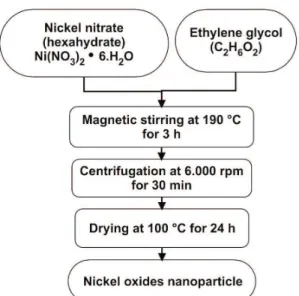
The NiO nanoparticles were prepared using slightly modified synthesis described by Yong Hu et al.[27]. Chemical reagents were used without purification. Figure 1 illustrates the flow diagram of the NiO nanoparticles preparation. First, 0.01 mol of the Ni(NO3)2⋅6H2O (Vetec) was introduced to a round
bottom flask and dissolved in 100 mL of nontoxic ethylene glycol (Synth).The solution was stirred under
reflux at 190 °C for 3 hours and then cooled to room temperature. Finally, the nickel oxide nanoparticles were collected by centrifugation at 6,000 rpm for 30 min., using 3K30 centrifuge and dried at 100 °C for 24 hours.
Polymer electrolytes with NiO nanoparticles
The electrolytes were obtained according to procedure described by Raphael et al.[18]. Figure 2 illustrates the flow diagram for the modified procedure of the electrolyte-NiO solution and films. In a glass flask, 0.5 g of agar (Aldrich) was dispersed in 30 mL of Milli-Q water and
heated under magnetic stirring for 3 min. up to100 °C for complete dissolution. Next, 1.5 g of acetic acid (Synth), 0.5 g of glycerol (Synth) as a plasticizer, 0.5 g
of formaldehyde (Synth) and different quantities of NiO
nanoparticles (0.001-0.25 g) were added to this solution under stirring for 6 additional minutes and heated up to 100 °C. The resulting solution was then cooled down to 30 °C, poured on Petri dishes and let to dry up for 48 hours between 30 and 40 °C. The resulting films were stored in a dry box.
Characterization techniques
Impedance spectroscopy
The ionic conductivity measurements of the electrolyte-NiO samples with area of 1.5 cm2 were then carried out using SOLARTRON instrument model SI-1260 with the frequency response analyzer module. The samples were pressed between two steel electrodes in a Teflon cell under vacuum. The bulk resistances (R
b) of the electrolyte-NiO samples were obtained from the impedance spectrum collected over frequency range between 0.1 Hz and 107 Hz with amplitude of 5 mV.
X-ray diffraction
The structures of the electrolyte films with and without NiO were examined by X-ray diffraction. The diffraction patterns were obtained with SHIMADZU model XRD 6000, with CuKαradiation (λ=1.5418 Å) in an angle range (2θ) of 10 to 80°.
UV–Vis spectroscopy
The UV-Vis optical spectra were recorded with an Agilent Instruments Spectrophotometer, operating in the190- 1100 nm range.
SEM
SEM pictures were obtained with LEO model 440.
Results and Discussions
The ionic conductivity depends on several factors, such as ionic conducting species concentration, cationic or anionic types of charge carriers, the charge carriers mobility, the influence of nanofillers and the temperature[28]. Figure 3 displays the impedance plots for agar-based electrolyte membranes with and without nanoparticles of NiO measured at different temperatures. The intercept of the semicircle with the real axis gives the electrolyte bulk resistance (Rb). The ionic conductivity is
then deduced from the Rb values by employing the formula σ = l/RbA, where l is the thickness of the electrolyte
sample and A is the contact area between the electrolyte
and the electrode. The ionic conductivity is found of 1.4×10⁻⁵ and 5.19×10⁻⁵ S/cm at room temperature, and 3.32×10⁻⁴ and 5.14×10⁻⁴ S/cm at ~80 °C for agar and agar with NiO nanoparticles, respectively. The increase of ionic conductivity of the samples with increase of the temperature can be explained in therm of thermal
Figure 1. Flow diagram of the NiO nanoparticles preparation.
Figure 3. Complex impedance plots for the agar-based electrolyte
containing 0.25 g of NiO nanoparticles at different temperatures.
Figure 4. Log of ionic conductivity as a function of inverse of temperature for the agar-based electrolyte with 0.25 g of NiO nanoparticles.
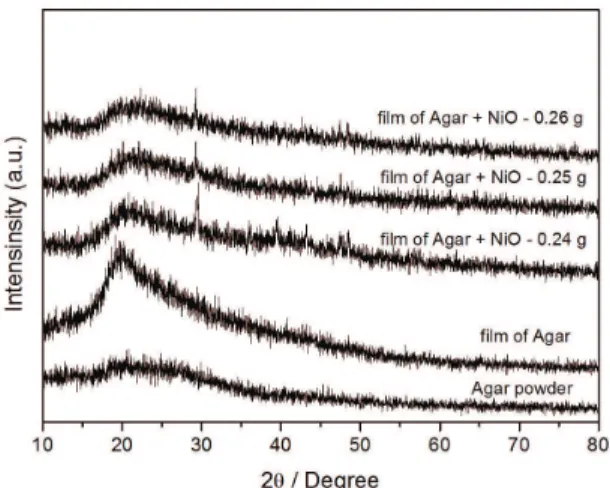
Figure 5. X-ray diffraction profiles of agar powder, agar-based electrolytes without and with different NiO nanoparticles contents.
Figure 6. SEM micrographs of agar-based electrolyte with
0.25 g of NiO nanoparticles; 1,000x.
movement of polymer chain segments and the dissociation of acetic acid. In fact, an incomplete semicircle is observed in Figure 3 that suggests the appearance of a capacitive component at high frequencies. As the blocking electrode was used in the experiment, thus conductive ions cannot easily cross the electrode/electrolyte interface[29]. The increase in the ionic conductivity with the temperature can be also interpreted as a hopping mechanism between coordinating sites, assisted probably by local structural relaxations and segmental motions of the polymer system[30-32].
Figure 4 reveals Arrhenius plots for agar-based electrolyte with 0.25 g of NiO nanoparticles in room to 70 °C temperature range.
Figure 5 shows typical X ray diffraction patterns obtained for the agar powder and agar based electrolytes with and without NiO nanoparticles. All diffractograms show broad diffuse band centered at about 2θ = 20° including the film with higher amount, i.e., 0.26 g of NiO nanoparticles. This result indicate that there is no influence on the pattern of the diffraction with addition of different concentration of NiO, maintaining the amorphous character of the films. This can be due to the presence of plasticizer in the sample. Similar behavior was already observed in the starch-based electrolytes, where an addition of plasticizer insured the amorphous character of the samples[10,15]. The good homogeneity without any phase separation and very good surface uniformity of the agar-based electrolyte was also previously reported[18].
However, Figure 6 show that the addition of NiO changed the morphology of the films, when compared with the membranes reported by Raphael et al.[18]. Small long and light files are observed on SEM image, which can be atributed to the preferential nanoparticles and or polymer accumulation.
Nevertheless, the electrolyte sample with NiO nanoparticles was translucent, as confirmed by optical transmittance spectrum of the electrolytes in the 200-1000 nm range (Figure 7) and picture on Figure 7
(inset). From this figure it can be stated an increase of
Conclusions
Polymer electrolytes based on agar and containing NiO nanoparticles were prepared and characterized by impedance spectroscopy, X-ray diffraction and UV-Vis spectrosopy. The obtained results confirmed that the NiO nanoparticles concentration in the membrane formulation influenced the ionic conductivity values achieving the best value of 5.19×10⁻⁵ S/cm at room temperature for the sample with 0.25 g of NiO. It was also stated that the increase in temperature up to 80 °C promoted an increase in the ionic conductivity to 3.32x10⁻⁴ cm–1 S/cm. Moreover, the samples were predominantly amorphous with almost uniform and homogeneous surfaces and transparency of 75 % in the visible range of the electromagnetic spectrum. Finally, all the presented results suggest that agar-based polymer electrolyte with NiO nanoparticles are promising candidates for electrochemical devices application.
Acknowledgments
The authors are pleased to acknowledge the financial support provided by the Federal University of Pelotas for laboratory equipment and research staff. The authors are also indebted CNPq, CAPES and FAPESP, for the financial support given to this research.
References
1. Wang, W. M. - “Preparation and characterization
of composite polymer electrolyte”, in: International
Meeting on Opto-Electronics Engineering and Materials Research 2012, Advanced Materials Research Shenyang China, p.17 (2012).
2. Christie, A. M.; Lilley, S. J.; Staunton, E.; Andreev, Y. G. & Bruce, P. G. - Nature, 433, p.50 (2005). PMid:15635406. http://dx.doi.org/10.1038/nature03186
3. Tarascon, J. M. & Armand, M. - Nature, 414, p.359 (2001). PMid:11713543. http://dx.doi.org/10.1038/35104644 4. Armand, M. - Solid State Ion., 69, p.309 (1994). http://
dx.doi.org/10.1016/0167-2738(94)90419-7
5. Gray, F. M. - ”Solid Polymer Electrolytes: Fundamentals and Technological Applications”, VCH-Verlag-Ges., (1991). 6. Hashmi, S. A.; Latham, R. J.; Linford, R. G. & Schlindwein,
W. S. - J. Chem. Soc. Faraday Trans., 93, p.4177 (1997).
http://dx.doi.org/10.1039/a704661h
7. Tatsumisago, M.; Shinkuma, Y. & Minami, T. - Nature, 354,
p.217 (1991). http://dx.doi.org/10.1038/354217a0 8. Petty-Weeks, S. & Polak, A. J. - Sens. Actuators, 11, p.377
(1987). http://dx.doi.org/10.1016/0250-6874(87)80077-X 9. Berthier, C.; Gorecki, W.; Minier, M.; Armand, M. B.;
Chabagno, J. M. & Rigaud, P. - Solid State Ion., 11, p.91 (1983). http://dx.doi.org/10.1016/0167-2738(83)90068-1 10. Machado, G. O.; Ferreira, H. C. A. & Pawlicka,
A. - Electrochim. Acta, 50, p.3827 (2005). http://dx.doi.
org/10.1016/j.electacta.2005.02.041
11. Mattos, R. I.; Tambelli, C. E.; Donoso, J. P. & Pawlicka, A. - Electrochim. Acta, 53, p.1461 (2007). http://dx.doi. org/10.1016/j.electacta.2007.05.061
12. Pawlicka, A.; Danczuk, M.; Wieczorek, W. & Zygadlo-Monikowska, E. - J. Phys. Chem. A, 112, p.8888 (2008).
PMid:18754600. http://dx.doi.org/10.1021/jp801573h 13. Khiar, A. S. A.; Puteh, R. & Arof, A. K. - Phys. B:
Condensed. Matter., 373, p.23 (2006). http://dx.doi. org/10.1016/j.physb.2005.10.104
14. Fuentes, S.; Retuert, P. J. & González, G. - Electrochim. Acta, 53, p.1417 (2007). http://dx.doi.org/10.1016/j. electacta.2007.05.057
15. Vieira, D. F.; Avellaneda, C. O. & Pawlicka, A. - Electrochim. Acta, 53, p.1404 (2007). http://dx.doi.
org/10.1016/j.electacta.2007.04.034
16. Avellaneda, C. O.; Vieira, D. F.; Al-Kahlout, A.; Leite, E. R.; Pawlicka, A. & Aegerter, M. A. - Electrochim. Acta, 53, p.1648 (2007). http://dx.doi.org/10.1016/j. electacta.2007.05.065
17. Koh, J. C. H.; Ahmad, Z. A. & Mohamad, A. A. - Ionics, 18,
p.359 (2012). http://dx.doi.org/10.1007/s11581-011-0631-6 18. Raphael, E.; Avellaneda, C. O.; Manzolli, B. & Pawlicka,
A. - Electrochim. Acta, 55, p.1455 (2010). http://dx.doi. org/10.1016/j.electacta.2009.06.010
19. Raphael, E.; Avellaneda, C. O.; Aegerter, M. A.; Silva, M. M. & Pawlicka, A. - Mol. Cryst. Liq. Cryst., 554, p.264
(2012). http://dx.doi.org/10.1080/15421406.2012.634349 20. Dygas, J. R.; Misztal-Faraj, B.; Florjańczyk, Z.; Krok, F.;
Marzantowicz, M. & Zygadlo-Monikowska, E. - Solid State Ion., 157, p.249 (2003). http://dx.doi.org/10.1016/ S0167-2738(02)00217-5
21. Kalita, M.; Solgala, A.; Siekierski, M.; Pawlowska, M.; Rokicki, G. & Wieczorek, W. - J. Power Sources, 173, p.765
(2007). http://dx.doi.org/10.1016/j.jpowsour.2007.05.086 22. Florjanczyk, Z.; Zygadlo-Monikowska, E.; Wielgus-Barry,
E.; Kuzwa, K. & Pasniewski, J. - Electrochim. Acta, 48,
p.2201 (2003).
23. Vieira, D. F.; Avellaneda, C. O. & Pawlicka, A. - Mol. Cryst. Liq. Cryst., 485, p.843 (2008).
24. Pawlicka, A.; Mattos, R. I.; Tambelli, C. E.; Silva, I. D. A.; Magon, C. J. & Donoso, J. P. - J. Membrane Sci., 429, p.190
(2013). http://dx.doi.org/10.1016/j.memsci.2012.11.048 25. Ciosek, M.; Sannier, L.; Siekierski, M.; Golodnitsky, D.;
Peled, E.; Scrosati, B.; Glowinkowski, S. & Wieczorek,
W. - Electrochim. Acta, 53, p.1409 (2007). http://dx.doi. org/10.1016/j.electacta.2007.03.037
26. Przyluski, J. & Wieczorek, W. - Solid State Ion., 36, p.165 (1989). http://dx.doi.org/10.1016/0167-2738(89)90163-X 27. Hu, Y.; Qian, H.; Mei, T.; Guo, J. & White, T. - Mater.
Lett., 64, p.1095 (2010). http://dx.doi.org/10.1016/j.
matlet.2010.02.023
28. Baskaram, R.; Selvasekarapandian, S.; Kuwata, N.; Kawamura, J. & Hattori, T. - Mater. Chem. Phys., 98, p.155
(2004).
29. Macdonald, J. R. - ”Impedance Spectroscopy”, Wiley, New York (1987).
30. Jaipal Reddy, M.; Sreekanth, T. & Subba Rao, U. V. - Solid State Ion., 126, p.55 (1999). http://dx.doi.org/10.1016/
S0167-2738(99)00225-8
31. Baskaran, R.; Selvasekarapandian, S.; Hirankumar, G. & Bhuvaneswari, M. S. - Ionics, 10, p.129 (2004). http://
dx.doi.org/10.1007/BF02410321
32. Subba Reddy, C. V.; Sharma, A. K. & Narasimha Rao, V. V. R. - J. Power Sources, 114, p.338 (2003). http://dx.doi. org/10.1016/S0378-7753(02)00582-7