ISSN 1517-7076 artigo e11802, 2017
Corresponding Author: Maria do Carmo Rangel Received on: 23/05/2016 Accepted on: 14/12/2016
10.1590/S1517-707620170001.0134
Evaluation of nickel and copper catalysts
in biogas reforming for hydrogen
production in SOFC
Leonardo Alves Silva1, André Rosa Martins1,2, Adriana Ballarini3, Silvia Maina3, Maria do Carmo Rangel1
1Grupo de Estudos em Cinética e Catálise, Instituto de Química, Universidade Federal da Bahia,Campus Universitário de
Ondina, Federação, 40 170-280, Salvador, Bahia, Brazil. e-mail: [email protected] 2
Instituto Federal da Bahia, Campus Porto Seguro, 45810-000, Porto Seguro, Bahia, Brazil. 3
INCAPE "Ing José Parera"; Edificio CCT CONICET Santafe "Dr. Alberto Cassano"; Recolección Ruta Nac 168, km 0 - Paraje El Pozo - (3000) Santa Fe, Argentina.
ABSTRACT
The solid oxide fuel cells (SOFC) enable the efficient generation of clean energy, fitting the current require-ments of the growing demand for electricity and for the environment preservation. When powered with bio-gas (from digesters of municipal wastes), the SOFCs also contribute to reduce the environmental impact of these wastes. The most suitable route to produce hydrogen inside SOFC from biogas is through dry reform-ing but the catalyst is easily deactivated by coke, because of the high amounts of carbon in the stream. A promising way to overcome this drawback is by adding a second metal to nickel-based catalysts. Aiming to obtain active, selective and stable catalysts for biogas dry reforming, solids based on nickel (15%) and copper (5%) supported on aluminum and magnesium oxide were studied in this work. Samples were prepared by impregnating the support with nickel and copper nitrate, followed by calcination at 500, 600 and 800 oC. It was noted that all solids were made of nickel oxide, nickel aluminate and magnesium aluminate but no cop-per compound was found. The specific surface areas did not changed with calcination temcop-perature but the nickel oxide average particles size increased. The solids reducibility decreased with increasing temperature. All catalysts were active in methane dry reforming, leading to similar conversions but different selectivities to hydrogen and different activities in water gas shift reaction (WGSR). This behavior was assigned to differ-ent interactions between nickel and copper, at differdiffer-ent calcination temperatures. All catalysts were active in WGSR, decreasing the hydrogen to carbon monoxide molar ratio and producing water. The catalyst calcined at 500 oC was the most promising one, leading to the highest hydrogen yield, besides the advantage of being produced at the lowest calcination temperature, requiring less energy in its preparation.
Keywords: fuel cell, biogas, dry reforming, hydrogen, nickel catalyst.
1. INTRODUCTION
In recent times, concerns on climate changes, as well as the growing need for energy, have promoted the de-velopment of renewable energy technologies for producing cleaner and more efficient energy [1, 2]. In addi-tion, there is a need of generating electricity locally, avoiding the risks and costs related to energy distribu-tion. The cleanest and most efficient way to generate electricity locally is by using fuel cells. These electro-chemical devices directly convert the electro-chemical energy stored in the fuel (gas or liquid) into electrical energy. Fuel cells are powered with a fuel containing hydrogen (which is electrochemically oxidized at an anode) and air (at the cathode) to produce electric power and an exhaust gas in one step, with high efficiency. This sim-plicity contrasts with the internal combustion engines in which chemical energy is first transformed into thermal energy by a combustion process and then transformed into mechanical energy and finally into elec-trical energy. The second step is the most inefficient since it is limited by the Carnot cycle [3, 4]. In addition, fuel cells do not produce significant amounts of pollutants, such as nitrogen oxides, especially when com-pared to internal combustion engines. These devices produce only water when powered with hydrogen and can be used for both stationary and portable power generation as well as in small and large scales, for several applications [3]. The versatility of fuel cells makes them suitable for uses in automobiles, computers, phones and other mobile equipment, besides in local power generation promoting the development of remote regions.
tech-nology to stationary applications such as power plants or combined heat and power generation [5-7]. These devices offer several advantages compared to other fuel cells, such as the potential to achieve higher base efficiencies and the ability to be adapted to combined heat and power applications with high efficiency, reaching up to 85%. Furthermore, they can be easily adapted to operate on different fuels, using low cost reformers [6]. Other advantages include wide range of applications, simple design, high efficiency, reliability, modularity, low levels of emissions of nitrogen oxides and sulfur and absence of noise usually associated with conventional power generation systems. SOFCs have a wide range of applications from the centralized megawatt-scale generation through to localized applications at greater 100 kW level for distribution to local domestic generation on the 10 kW scale [7].
Hydrogen is the fuel usually associated with fuel cells but it has low energy density, is volatile and flamma-ble, being difficult to handle. In addition, there are difficulties in transportation and storage, besides the high cost. The generation of hydrogen inside the fuel cell (generation on board) through the fuel reforming is then a practical and viable option to overcome these drawbacks [3]. Therefore, the SOFC has been designed to operate with different fuels such as natural gas, alcohols, gasoline and others. Because of the high operating temperatures, these fuels can be reformed and these devices become more resistant to impurities, reducing the fuel processing and manufacturing costs [3,8].
The fuel may be reformed both externally or internally the cell. In external reforming, the fuel is con-verted into hydrogen and carbon dioxide, in a reformer. In this case, the endothermic reforming and the exo-thermic electrochemical reaction are performed in different units and there is no direct heat transfer between the operating units. For the internal reforming, the steam reforming and the oxidation reaction are carried out in the same compartment. The internal reforming may be performed by a direct or indirect way. In the indi-rect internal reforming, the process is physically separated from the electrochemical reaction by a wall, which allows the heat exchange both by conduction and radiation. On the other hand, in the direct internal reform-ing, the mixture of fuel and steam is powered directly to the anode compartment, where the fuel is reformed [9]. For all these arrangements, the electrochemical reaction may be carried out with a mixture of hydrogen and carbon monoxide, while avoiding steps of hydrogen purification, such as the water gas shift reaction [10] or the preferential oxidation of carbon monoxide [11], as required for proton exchange membrane fuel cells. For the external or indirect internal reforming, the catalytic process is performed in an independent compartment from the anode one. This allows the catalysts to be selected based only on their catalytic prop-erties, without attention to the electrochemical requirements. In any of these arrangements, the steam reform-ing (with water), dried (carbon dioxide), partial (with oxygen) or autothermal (water and oxygen) can be car-ried out, using methane (natural gas), ethanol , glycerin, biogas, biomass or other fuel containing hydrogen [12-20]. For all cases, the catalysts of steam reforming [12-16, 21, 22], dry [17, 23, 24] partial [20, 25, 26] or autothermal [18, 20], based on noble metals such as platinum, palladium, ruthenium, iridium and rhodium, besides nickel, cobalt and iron, can be used.
However, by considering local production of electricity using SOFC, biogas emerges as one of the most suitable and promising alternatives for sustainable energy source, since it does not contributes to carbon dioxide emissions by an annual growth cycle. Biogas is produced during anaerobic digestion processes of biomass from municipal waste or animal and agriculture waste and consists mainly of methane and carbon dioxide [27]. The inherent advantages of this fuel include low cost and availability in different locations, avoiding transportation, besides the possibility of generating local jobs. Despite these advantages and the widespread availability, this resource is still underutilized and only few technologies have been used in de-veloping countries. However, biogas is widely used in USA for local power generation in wastewater treat-ment plants, although gas turbines were mostly used. Moreover, the efficiency of SOFC coupled to digesters for local generation of electricity has been demonstrated [28] and some systems have been already used in waste treatment plants in USA [29]. Therefore, several studies have been devoted to biogas-fed solid oxide fuel cells [27-36], aiming to improve these systems.
CH4(g) + CO2(g) 2 CO(g) + 2 H2(g) H298K = 247 kJ.mol-1 (1)
2. MATERIALS AND METHODS
2.1 Catalysts preparation
The support (aluminum and magnesium oxide) was prepared at room temperature by precipitation technique, adding an aluminum nitrate solution (2.00 mol L-1), a magnesium nitrate solution (1.00 mol L-1) and an am-monium hydroxide solution (28% v/v) to a beaker with water, using a peristaltic pump (2.0 mL min-1). Dur-ing precipitation, the pH was kept around 9. After precipitation, the colloidal solution produced was main-tained under stirring, for 24 h and centrifuged. The gel obmain-tained was rinsed with an ammonium hydroxide solution (1% w/w) to remove nitrate ions and centrifuged again. The gel was dried at 120 °C, for 24 h and then heated (10 oC min-1) under air flow (60 mL min-1) to 800 °C, being kept at this temperature for 2 h, to get the support (Sample MA800).
The catalysts were obtained by dispersing the support in a nickel nitrate (0.8519 mol L-1) and copper nitrate solution (0.2623 mol L-1), in order to obtain solids with 15% (w/w) of nickel and 5% (w/w) of copper. The solvent was evaporated under occasional stirring on a hot plate maintained at 60 °C and the solid was dried at 120 °C, for 24 h. It was then calcined at 500 °C for 2 h, generating the NMA500 sample. Other sam-ples were prepared following the same procedure but calcining the solids at 600 oC (NMA600 sample) and 800 °C (NMA800 sample).
2.2 Catalysts characterization
The samples were characterized by X-ray diffraction (XRD), specific surface area (Sg) and porosity meas-urements and temperature programmed reduction (TPR). The metal sites of the catalysts were examined by the model reaction of cyclohexane dehydrogenation.
The X-ray diffraction profiles were recorded in a Siemens D5005 equipment, using CuK radiation generated at 40 kV and 30 mA and a goniometer velocity of 2 degrees min-1, in the range of 2= 10 to 80 degrees. The samples were analyzed at room temperature and without prior treatment. The crystalline phases were identified by comparing the data obtained with the files of the International Centre for Diffraction Data files (ICDD). For specific surface area and porosity measurements, the adsorption and desorption of nitrogen were performed on a Micromeritics ASAP 2020 equipment. Prior the analysis, the sample (0.20 g) was heat-ed (10 °C min-1) under vacuum up to 250 °C and kept at this temperature for 4 h for the removal of humidity from the solids. During the analysis, the sample was exposed to pulses of nitrogen until a maximum increase of pressure of 925 mmHg. The temperature programmed reduction experiments were performed on a 2900 Analyzer Micromeritics equipment. The sample (around 0.200 g) was heated (10 °C min-1) under nitrogen flow (60 mL min-1) up to 160 °C and kept at this temperature for 30 min to remove water and impurities from the surface. The sample was then cooled to room temperature and heated (10 °C min-1) under flowing (60 mL min-1) of a mixture of 5% H2/N2 up to 1000 °C. During the experiments, the hydrogen consumption was monitored by a thermal conductivity detector (TCD).
The experiments of cyclohexane dehydrogenation, a model reaction for metallic sites, were performed in equipment built in our laboratory, working at 300 oC and 1 atm. The sample (0.100 g) was loaded in a quartz reactor, purged under nitrogen flow and then reduced under hydrogen flow (60 mL min-1) at 750 oC, for 2:30 h. Cyclohexane was then fed (0.0067 mL min-1) to the reactor. The effluent was analyzed each 5 min for 1 h, by on line GC-8A model Shimadzu chromatograph equipped with a flame ionization detector (FID) and a packed column.
2.3 Catalysts evaluation
The dry reforming of methane was carried out in a continuous flow reactor, kept at 700 °C and fed with 20 ml-1 of a mixture of methane to carbon dioxide molar of 1. Before reaction, the catalyst (0.2) was reduced in situ under hydrogen flow at 700 °C, for 2:30 h. Each run took 300 min., The reaction products were analyzed on line by a Star 3400 CX Varian gas chromatograph equipped with a TCD and 1006 Carboxem3 column.
3. RESULTS AND DISCUSSION
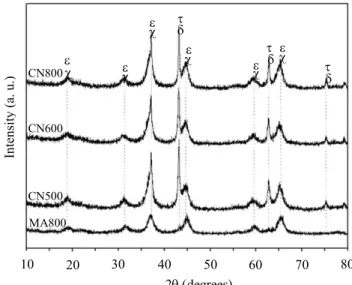
21-1152) and no peak related to alumina or magnesium oxide (periclase) was noted. This finding is agree-ment with previous works [42-44], which claim that at temperatures as high as 800 oC, the crystalline phase of magnesium aluminate spinel (MgAl2O4) is the only compound produced in the MgO-Al2O3 system, which is more thermodynamically stable than alumina.
Figure 1: X-ray diffractograms for the support and for the catalysts calcined at different temperatures. Identification of
phases: () MgAl2O4; () NiAl2O4; () NiO and () MgO.
After nickel addition, the peaks became narrower and more intense, indicating the increase of the crystalline domains and/or nickel aluminate formation (ICSD 77-1877). The peaks in 2= 43, 62 and 75 de-grees indicate the segregation of nickel oxide (ICSD 73-1523). The periclase phase of magnesium oxide (ICSD 75-1525) could not be identified because the position of the peaks coincides with those of nickel oxide. Furthermore, no peak related to copper oxide was found, suggesting that copper species are well dispersed on the support. The increase of the calcination temperature did not produce any other phase. However, one can see an increase of peak intensity with temperature, especially in the case of the sample calcined at 800 °C, indicating an increase of crystals size. Table 1 shows the average crystals diameter of nickel oxide for the catalysts, calculated from the X-ray diffractograms using the Scherrer equation by the (202) plane. As we can see, no significant difference was found for the samples calcined at 500 and 600 oC, but an increase of the average crystal size was noted for the sample calcined at 800 oC. The specific surface areas of the samples are also shown in Table 1. It can be noted that the addition of nickel and copper to the support (MA800 sam-ple) caused a decrease in the specific surface area of the solid. On the other hand, the catalysts calcined at different temperatures showed similar values (close to 100 m² g-1), indicating that the catalysts were stable in the range of 500-800 oC.
Table 1: Average crystals diameter of nickel oxide and specific surface areas of the support and of the catalysts calcined at different temperatures.
SAMPLE AVERAGE CRYSTALS DIAMETER
(NICKEL OXIDE) (nm)
SPECIFIC SURFACE AREAS
(m2 g-1)
MA800 -- 160
CN500 36 103
CN600 33 97
CN800 47 117
Figure 2 shows the curves for adsorption/desorption of nitrogen as a function of relative pressure. For all cases, isotherms with intermediate profiles between types II and IV were obtained, which are typical of macroporous solids. In addition, a loop of H4 hysteresis-type can be noted, indicating the existence of in-terparticle mesopores [45]. The temperature increase did not change significantly the isotherms profile,
indi-In
ten
sit
y
(a
.
u
.)
10 20 30 40 50 60 70 80
CN500
MA800 CN600 CN800
2degrees
cating that the textural properties of the solids were not affected by calcination temperature.
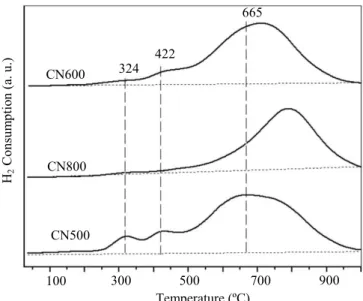
On the other hand, the calcination temperature significantly changed the reduction profiles of the cata-lysts, as shown in Figure 3. The catalyst calcined at 500 °C showed two peaks at low temperatures (324 and 422 °C), which can be assigned to the reduction of bigger particles of nickel oxide in weak interaction with the support, in accordance with previous work [39]. The lowest-temperature peak can also be associated to the reduction of copper species interacting with alumina [46, 47]. These peaks were less intense for the catalyst calcined at 600 oC and disappeared in the case of the sample calcined at 800 oC, indicating an increase of interaction of the metals with the support, rendering the segregation of nickel oxide. A broad peak at high temperatures, centered at 665 °C, was also noted for the solid calcined at 500 oC, indicating the reduction of nickel species in different interactions with the support [46]. According to several works [26, 39, 45, 48], various processes may occur at this temperature range such as the reduction of small nickel oxide particles in strong interaction with the support, nickel oxide containing aluminum species in the lattice or nickel aluminate. It can be also noted that the high temperature peak was shifted to higher temperatures as the calcination temperature was increased, indicating an increase of interaction of nickel with the support, as found in a previous work [49]. The amount of hydrogen consumed during the TPR experiments are shown in Table 2, as well as the degree of reduction of the solid, calculated from this consumption. We can see that the degree of reduction decreased as the calcination temperature increased, a fact that can be related to the increase of the strength of interaction between nickel and the support, leading to the production of nickel aluminate, which is difficult to be reduced [39].
Figure 2: Nitrogen adsorption/desorption isotherms for the support (MA800) and for the catalysts calcined at 500 (CN500), 600 (CN600) and 800 °C (CN800).
CN600
0.2 0.4 0.6 0.8 1.0
20 40 60 80 100 Ad so rb ed v o lu m e (c m 3 g -1 S
TP
)
Relative pressure (P/Po)
Relative pressure (P/Po)
MA800
0.2 0.6 0.8 1.0
20 40 60 80 100 0.4 Ad so rb ed v o lu m e (c m 3 g -1 S
TP ) 20 40 60 80 100 CN800
Relative pressure (P/Po)
Ad so rb ed v o lu m e (c m 3 g -1 S
TP
)
0.2 0.4 0.6 0.8 1.0
20 40 80 100 60 Ad so rb ed v o lu m e (c m 3 g -1 S
TP
)
0.2 0.4 0.6 0.8 1.0
Relative pressure (P/Po)
Figure 3: TPR profiles for the catalysts calcined at different temperatures.
Table 2: Expected and obtained hydrogen consumptions during the TPR experiments and reduction degree of the cata-lysts calcined at different temperatures and values of conversion during cyclohexane dehydrogenation.
SAMPLES EXPECTED
HYDROGEN CONSUMPTION
(mmol)
OBTAINED
HYDROGEN CONSUMPTION
(mmol)
REDUCTION
DEGREE (%)
CYCLOHEXANE
CONVERSION (%)
CN500 0.38093 0.30660 80 8.43
CN600 0.38359 2.5721 67 8.89
CN800 0.37186 2.2188 60 5.84
Table 2 also shows the values of conversion during cyclohexane dehydrogenation, a reaction which does not demand a special metallic structure or particle size, being a non-demanding reaction, as pointed out by Boudart and coworkers [50]. Therefore, the conversion values depend only on the number of exposed metal atoms [51] and then can be related to metal dispersion. From Table 2, it can be also observed that the catalysts calcined at 500 and 600 oC led to similar values of cyclohexane conversion, indicating that they have similar amounts of metal atoms exposed on the surface. On the other hand, the catalyst calcined at 800 o
C led to the lowest conversion, indicating that it has the lowest dispersion and then the bigger nickel parti-cles, in agreement with the X-ray diffraction results.
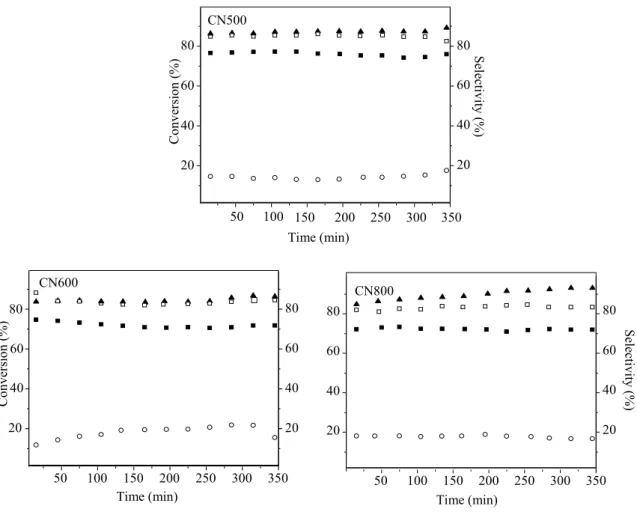
All catalysts were active in dry reforming of methane (Equation 1) and were stable during reaction, as shown in Figure 4. One can note that the values of methane conversion were slightly affected by the calcina-tion temperature, the catalysts leading to similar values regardless the calcinacalcina-tion temperature. The same ten-dency was noted for carbon dioxide conversions. However, the carbon dioxide conversions were always higher than the methane conversions, indicating to the occurrence of reverse water gas shift reaction (WGSR), which also consumes carbon dioxide (Equation 2) [49], as found previously [24]. As pointed out early [46], both copper and nickel are active in WGSR (Equação 2).
CO2(g) + H2(g) CO(g) + H2O(g) H298K = 41 kJ.mol-1 (2)
The catalyst calcined at 500 oC led to the highest value of methane conversion and showed the highest hydrogen selectivity. This can be related to its highest reduction degree of this catalyst, generation more ac-tive sites. However, the catalysts calcined at 600 and 800 oC showed similar hydrogen selectivities and the
Temperature (ºC)
100 300 500 700 900
324 422
665
H2
Co
n
su
m
p
ti
o
n
(a
.
u
.)
CN600
CN800
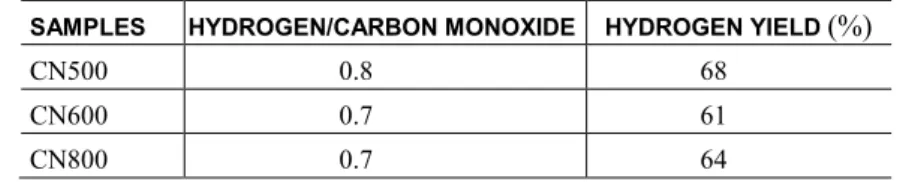
sample calcined at 600 oC led to the lowest methane conversion in spite of being the second more reducible catalyst, besides having the smallest average nickel oxide particle size. This finding suggested that different interactions occurred in this solid, decreasing the ability of nickel in breaking the C-H bonds in methane. It has been demonstrated [52] that the addition of copper to nickel can decrease the activity of nickel catalysts in methane decomposition. Moreover, it has been reported [53] that copper, with a full-filled 3d orbital, is not active in methane decomposition. However, copper is relatively rich in d electrons and then it can exert elec-tronic effects on nickel atoms, by increasing their activity for breaking the C-H bonds [52]. Therefore, the effect of copper on nickel activity largely depends on the interaction between these metals, which in turn depends on the preparation method, including the calcination temperature. In our work, it is possible that above 500 oC, the higher amounts of nickel atoms have occluded copper atoms resulting in no effect of cop-per on the breakage of C-H bonds and then on methane reforming. On the other hand, for the catalyst cal-cined at 800 oC, this effect was compensated by the formation of nickel aluminate, which is known to gener-ate very active sites for methane reforming [39]. As found by TPR, the reduction profile of this sample is typical of nickel aluminate [39, 49]. These catalysts produced the highest amount of water, indicating that they are the most active in the reverse WGSR, probably due to nickel atoms [54]. The hydrogen to carbon monoxide molar ratios were lower than 1.0 for all catalysts, as shown in Table 3. This is related to the reverse WGSR, which consumes hydrogen and produces carbon monoxide. Is can also be noted that the catalyst cal-cined at 500 oC led to the highest hydrogen yield, being the most suitable to methane dry reforming.
Figure 4: Conversion of the reactants and selectivity of the catalysts calcined at different temperatures as a function of
time during methane dry reforming. () methane conversion; () carbon dioxide conversion; () hydrogen selectivity
and () water.
CN500
20 40 60 80
20 40 60 80 CN600
CN800
50 100 150 200 250 300 350
Time (min)
Co
n
v
ersi
o
n
(
%
)
50 100 150 200 250 300 350
Time (min) 20 40 60 80
20 40 60
80 S
elec
ti
v
it
y
(%
)
Co
n
v
ersi
o
n
(
%
)
50 100 150 200 250 300 350
Time (min) 20
40 60 80
S
elec
ti
v
it
y
(%
)
Table 3: Hydrogen to carbon monoxide molar ratio and hydrogen yield obtained over the catalysts calcined at different temperatures.
SAMPLES HYDROGEN/CARBON MONOXIDE HYDROGEN YIELD (%)
CN500 0.8 68
CN600 0.7 61
CN800 0.7 64
4. CONCLUSIONS
Catalysts based on nickel (15%) and copper (5%) supported on magnesium and aluminum oxide were ob-tained by calcining the solids at 500, 600 and 800 oC, after impregnating the support with nickel and copper nitrate. All catalysts were made of nickel oxide, nickel aluminate and magnesium aluminate, copper com-pounds not being identified, regardless the calcination temperature. However, the catalysts showed different reduction profiles, the reducibility decreasing with increasing of calcination temperature. The catalysts showed similar specific surface areas but different nickel oxide average particles size, which increased with calcination temperature. The catalysts also showed different amounts of exposed metal atoms on the surface, evaluated by cyclohexane dehydrogenation. All catalysts were active in methane dry reforming, leading to similar conversions. The catalyst calcined at 500 °C showed the highest activity and hydrogen selectivity, followed by the solid calcined at 800 oC, the sample calcined at 600 oC being the least active and selective. These findings were assigned to different interactions between nickel and copper, at different calci-nations temperatures, leading to different amounts of nickel exposed on the surface and to nickel species with different catalytic activity. All catalysts were active to reverse water gas shift reaction, decreasing the hydro-gen to carbon monoxide molar ratio and producing water. The catalyst calcined at 500 oC was the most active in methane dry reforming and selective to hydrogen and the least active in reverse water gas shift reaction. Therefore, it is the most promising catalysts among the studied samples, with the advantages of being produced at the lowest calcination temperature requiring less energy in the preparation.
5. ACKNOWLEDGEMENTS
LAS and ARM thank the Permanecer programme/UFBA and to CNPq, respectively, for the scholarships. The authors thank CNPq and PETROBRAS for the financial support.
6. BIBLIOGRAPHY
[1] BILGEN, S.,“Structure and environmental impact of global energy consumption”, Renewable and Sustainable Energy Reviews, v. 38, pp. 890–902, Jul. 2014.
[2] RANGEL, M. C., CARVALHO, M. F. A., “Impact of automotive catalysts in the control of air quality”, Química Nova, v. 26, n. 2, pp. 265–277, Mar. 2003.
[3] ATIKINSON, A., BARNETT, S., GORTE, R. J., et al., “Advanced anodes for high-temperature fuel cells”, Nature Materials, v.3, pp. 17-27, Jan. 2004.
[4] SÁNCHEZ, D., CHACARTEGUI, R., MUÑOZ, A., et al., “On the effect of methane internal reforming modelling in solid state fuel cells”, International Journal of Hydrogen Energy, v. 33, pp. 1834-1844, Mar. 2008.
[5] CORDEIRO, R. C., TRINDADE, G. S., MAGALHÃES, R. N. S. H., et al., “Nanostructured Ceramic Suspensions for Electrodes and the Brazilian SOFC Network ‘REDE PaCOS”, In: Bansal, N. P., Wereszczak, A., Lara-Curzio, E. (eds), Advances in Solid Oxide Fuel Cells II: Ceramic Engineering and Science
Proceedings, v. 27, n. 5, pp. 138–152, chapter 14, Wiley Online Library, 2007.
[6] POTTER, E. N., “The Emergency of viable solid oxide fuel cell technology”, Fuel Cells Bulletin, v. 3, pp. 8-11, Nov. 2000.
[7] SINGHAL,S., “Advances in solid oxide fuel cell technology”, Solid State Ionics, v. 135, pp. 305–313, Nov. 2000.
[9] CHOUDHURY, A., CHANDRA, H., ARORA, A., “Application of solid oxide fuel cell technology for power generation-A review”, Renewable and Sustainable Energy Reviews, v. 20, pp. 430–442, Jan. 2013. [10] PEREIRA,A. L.C.,SANTOS,N.A.,FERREIRA,M.L.O.,et al., “Effect of Cobalt on the Activity of Iron-based Catalysts in Water Gas Shift Reaction”, Studies in Surface Science and Catalysis, v.167, pp.225 - 230, Mai. 2007.
[11] MOURA,J.S.,FONSECA,J.S.L,BION,N., et al., “Effect of lanthanum on the properties of copper, cerium and zirconium catalysts for preferential oxidation of carbon monoxide”, Catalysis Today, v.228, pp. 40-50, Jun. 2014.
[12] ZHANG, Y., WANG, W., WANG, Z., et al., “Steam reforming of methane over Ni/SiO2 catalyst with enhanced coke resistance at low steam to methane ratio”, Catalysis Today, v. 256, pp. 130–136, Fev. 2015. [13] SILVA NETO, A. V., SARTORATTO, P. P. C., RANGEL, M. C., “Preparation of Ni/SiO2, Ni/SiO2-CaO and Ni/SiO2-MgO Catalysts for Methane Steam Reforming”, Studies in Surface Science and Catalysis, v.167, pp.475-480, May 2007.
[14] OSORIO-VARGAS,P.,FLORES-GONZÁLEZ,N.A.,NAVARRO,R.M., et al., “Improved stability of Ni/Al2O3 catalysts by effect of promoters (La2O3, CeO2) for ethanol steam-reforming reaction”, Catalysis Today, v. 259, pp. 27–38, Jun. 2015.
[15] MOURA, J. S., SOUZA, M. O. G., BELLIDO, J. D. A., et al., “Ethanol steam reforming over rhodium and cobalt-based catalysts: Effect of the support”, International Journal of Hydrogen Energy, v. 37, pp. 3213-3224, Feb. 2012.
[16] MARTÍNEZ, L.M. T., ARAQUE, M., CENTENO, M. A., et al., “Role of ruthenium on the catalytic properties of CeZr and CeZrCo mixed oxides for glycerol steam reforming reaction toward H2 production”, Catalysis Today, v. 242, pp. 80–90, Mar 2015.
[17] FERNANDES JUNIOR, L. C. P., MIGUEL, S., FIERRO, J. L. G., et al., “Evaluation of Pd/La2O3 for Dry Reforming of Methane”, Studies in Surface Science and Catalysis, v.167, pp.499-504, May 2007. [18] ZHAO, H., GUO, L., ZOU, X., “Chemical-looping auto-thermal reforming of biomass using Cu-based oxygen carrier”, Applied Energy, v. 157, pp. 408-415, Nov. 2015.
[19] GIL,M.V.,FERMOSO,J.,PEVIDA,C., et al., “Production of fuel-cell grade H2 by sorption enhanced steam reforming of acetic acid as a model compound of biomass-derived bio-oil”, Applied Catalysis B: Envi-ronmental, v. 184, pp. 64-76, May 2016.
[20] XIE, J., SUN, X., BARRETT, L., et al., “Autothermal reforming and partial oxidation of n-hexadecane via Pt/Ni bimetallic catalysts on ceria-based supports”, International Journal of Hydrogen Energy, v. 40, pp. 8510-8521, July 2015.
[21] MOURA,J.S.,RANGEL,M.C.,SOUZA,M.O.G., “Effect of magnesium on the properties of nickel and lanthanum-based catalysts in steam reforming”, Fuel, v.87, pp. 3627-3630, Dec. 2008.
[22] CARVALHO, L. S., MARTINS, A. R., REYES, P., et al., “Preparation and characterization of Ru/MgO-Al2O3 catalysts for methane steam reforming”, Catalysis Today, v.142, pp. 52-60, Apr. 2009. [23] WANG, F., XU, L., ZHANG, J., et al., “Tuning the metal-support interaction in catalysts for highly effi-cient methane dry reforming reaction”, Applied Catalysis B: Environmental, v. 180, pp. 511-520, Jan. 2016. [24] ARAÚJO, G. C., LIMA, S. M., ASSAF, J. M., et al., “Catalytic evaluation of perovskite-type oxide LaNi1-xRuxO3 in methane dry reforming”, Catalysis Today, v.133-35, pp.129-135, Apr-Jun, 2008.
[25] ARAÚJO, G. C., LIMA, S., RANGEL, M. C., et al., “Characterization of Precursors and Reactivity of LaNi1-xCoxO3 for the Partial Oxidation of Methane”, Catalysis Today, v.107-08, pp.906-912, Oct 2005. [26] BERROCAL, G. P., SILVA, A. L. M., ASSAF, J. M., et al., “Novel supports for nickel-based catalysts for the partial oxidation of methane”, Catalysis Today, v.149, pp. 240-247, Jan. 2010.
[27] MURADOV, N., SMITH, F., T-RAISSI, A., “Hydrogen production by catalytic processing of renewable methane-rich gases”, International Journal of Hydrogen Energy, v. 33, pp. 2023–2035, Apr. 2008.
[28] SHIRATORI, Y., OSHIMA, T., SASAKI, K., “Feasibility of direct-biogas SOFC”, International Jour-nal of Hydrogen Energy, v. 33, pp. 6316-6321, Nov. 2008.
[29] MURPHY, D. M., RICHARDS, A. E., COLCLASURE, A., et al., “Biogas fuel reforming for solid o x-ide fuel cells”, Journal of Renewable and Sustainable Energy, v. 4, pp. 023106, Mar 2012.
[31] TAKAHASHI, Y., SHIRATORI, Y., FURUTA, S., et al., “Thermo-mechanical reliability and catalytic activity of Ni–Zirconia anode supports in internal reforming SOFC running on biogas”, Solid State Ionics, v. 225, pp. 113–117, Oct. 2012.
[32] MANENTI, F., PELOSATO, R., VALLEVI, P., et al, “Biogas-fed solid oxide fuel cell (SOFC) coupled to tri-reforming process: Modelling and simulation”, International Journal of Hydrogen Energy, v. 40, 14640-14650, Nov. 2015.
[33] ARESPACOCHAGA, N., VALDERRAMA, C., PEREGRINA, C., et al., “Evaluation of a pilot-scale sewage biogas powered 2.8 kWe Solid Oxide Fuel Cell: Assessment of heat-to-power ratio and influence of oxygen content”, Journal of Power Sources, v. 300, pp. 325-335, Dec. 2015.
[34] STEELE, B. C. H., HEINZEL, A., “Materials for fuel-cells technologies”, Nature, v. 414, pp 345-352, Nov. 2001.
[35] ANDRADE,M.L.,ALMEIDA,L.,RANGEL,M.C., et al., “Ni-Catalysts Supported on Gd-Doped Ceria for Solid Oxide Fuel Cells in Methane Steam Reforming”, Chemical Engineering & Technology, v. 37, pp. 343–348, Feb. 2014.
[36] VAN HERLE, J., MEMBREZ, Y., BUCHELI, O., “Biogas as a fuel source for SOFC co-generators”, Journal of Power Sources, v. 127, pp. 300–312, Mar. 2004.
[37] SHIRATORI, Y., SASAKI, K., “NiO–ScSZ and Ni0.9Mg0.1O–ScSZ-based anodes under internal dry reforming of simulated biogas mixtures”, Journal of Power Sources, v. 180, pp. 738–741, Jun. 2208. [38] PAKHARE, D., SPIVEY, J., “A review of dry (CO2) reforming of methane over noble metal catalysts”, Chemical Society Reviews, v. 43, pp. 7813-7837, Feb. 2014.
[39] LIMA, S. P. DE, VICENTINI, V., FIERRO, J. L. G., et al., “Effect of aluminum on the properties of lanthana-supported nickel catalysts”, Catalysis Today, v.133-35, pp. 925-930, Apr-Jun. 2008.
[40] AWADALLAH, A. E., ABOUL-ENEIN, A. A., ABOUL-GHEIT, A. K., “Various nickel doping in commercial Ni–Mo/Al2O3 as catalysts for natural gas decomposition to COx-free hydrogen production”, Renewable Energy, v. 57, pp. 671–678, Sep. 2013.
[41] HERMES, N.A., LANSARIN, M.A., PEREZ-LOPEZ, O.W., “Catalytic Decomposition of Methane Over M–Co–Al Catalysts (M= Mg, Ni, Zn, Cu)”, Catalysis Letters, v. 141, pp. 1018–1025, May 2011. [42] GADALLA, A. M. BOWER, B., “The role of catalyst support on the activity of nickel for reforming methane with CO2”, Chemical Engineering Science, v. 43, n.11, pp. 3049-3062, 1988.
[43] VOLLWEILER, L., JOST, H., HAUSNER, H., “, Key Engineering Materials, v.132-136, pp. 1814-1817, Apr.1997.
[44] REVERÓN, H., GUTIÉRREZ-CAMPOS, D., RODRÍGUEZ, R. M., et al., “Chemical synthesis and thermal evolution of MgAl2O4 spinel precursor prepared from industrial gibbsite and magnesia powder”, Materials Letters, v. 56, pp. 97-101, n.1-2, Sep.2002.
[45] ROUQUEROL, F., ROUQUEROL, J., SING, K., Adsorption by Powders and Porous Solids: Principles, Methodology and Applications, London, Academic Press, 1998.
[46] FUENTES, E. M. COSTA, A. F., SILVA, T. F., et al., “A comparison between copper and nickel-based catalysts obtained from hydrotalcite-like precursors for WGSR”, Catalysis Today, v.171, pp. 290-296, Aug. 2011.
[47] MOURA, J. S., SILVA, L. A., RANGEL, M. C., et al., “Synthesis and characterization of pervskite in LaNi1-xCuxO3 in hydrogen purificarton through PaCOS”, Revista Matéria, v. 15, n. 3, pp. 472–479, 2010. [48] CAVANI, F. TRIFIRO, F., VACCARI, A., “Hydrotalcite-type anionic clays: Preparation, properties and applications”, Catalysis Today, v. 11, n. 2, pp. 173-301, Dec. 1991.
[49] METTE, K., KÜHL, S., TARASOV, A., et al., “Redox dynamics of Ni catalysts in CO2 reforming of methane”, Catalysis Today, v. 242, pp. 101-110, Mar. 2015.
[50] BOUDART, M., ALDAG, A., BENSON, J. E., et al., “On the Specific Activity of Platinum Catalysts”, Journal of Catalysis, v. 6, pp. 92–99, Aug.1966.
[51] RANGEL, M. C., PARERA, J. M., CARVALHO, L. S., et al., “n-Octane Reforming over Alumina Supported Pt, Pt-Sn and Pt-W Catalysts”, Catalysis Letters, v. 64, p.171-178, 2000.
[53] RODRIGUEZ, N.M., KIM, M. S., BAKER, R. T.K. “Deactivation of copper-nickel catalysts due to changes in surface composition”, Journal of Catalysis, v. 140, n. 1, pp. 16–29, Mar. 1993.