Identify Current Deficiencies in Public Private Partnership
Practices and Areas which Resist PPP Being an Attractive
Investment Model in Infrastructure Developments
–
Case Study
from Sri Lanka
W. S. L. Perera
(Department of Civil Engineering, University of Moratuwa, Sri Lanka)
ABSTRACT
Public- Private Partnerships is becoming a popular investment model since late 1980s and 1990s in the world. PPPs in the delivery of public services have become a phenomenon which is spreading around the globe and generating great interest among governments, investors and other key project stakeholders. Public- Private Partnerships avoid the often negative effects of either exclusive public ownership or outright privatization. This is seen as a win-win situation for both public and private entities where they undertake large scale projects. This balanced approach is especially welcomed in public services which touch on every human being‟s basic needs & economic development of a country.
Basically in this research, it is attempted to address three main objectives, which are to identify the current Public- Private Partnerships coverage on infrastructure projects in Sri Lanka, to identify current deficiencies in Public- Private Partnerships practices and areas which resist Public- Private Partnerships being an attractive investment model in infrastructure developments in Sri Lankan context and to propose an improved Public- Private Partnerships framework/model that can be used effectively and address the identified problems in infrastructure developments in Sri Lanka.
Based on a structured questionnaire, data collection has been done using a selected sample. Then, the data set has been evaluated using Likert Scale and giving weights for that and the total percentage of score.
Lack of the knowledge and deficiencies of the PPP framework are main issues in PPP practice in Sri Lanka. Thus, it is not much popular investment model to infrastructure development at the moment. Further the government should change their role from developer and operator to facilitator to improve the PPP practice in Sri Lanka
Keywords: Infrastructure development, Public- Private Partnerships
I.
INTRODUCTION
Infrastructure development has been the most important factor in any country that could lead
the country‟s socio-economic standards to a higher
level. In a country‟s perspective, infrastructure can be divided into two sections namely social and economic [1]. For examples ports, airports, highways, water resources, telecommunications, energy generation, transmission and distribution, urban transport and railway are categorized under economic infrastructures and users are expected to pay for these services. Public health services, education-primary and secondary, public buildings, urban development, roads, police stations and courts fall under social infrastructures and by offering these facilities to the public, there is no direct income to the government.
The rate of infrastructure development or the volume of infrastructure development in a country can be mentioned as directly impact to the countries rate of economic development. Therefore most governments look at the possibilities of
sustainable mechanisms of funding infrastructure projects.
In an increasingly competitive global environment, all governments in around the world are focusing on new ways to fund the projects, develop infrastructure and deliver excellent public service. Public-private partnerships (PPP or P3's) are becoming a common tool to bring together the strengths of both (public and private) sectors. In addition to maximizing efficiencies and innovations of private enterprise, PPP's can provide much needed capital to finance government programs and projects, thereby freeing public funds for core economic and social programs.
Public-Private Partnerships has become a popular investment model since late 1980s and 1990s in the world [2], [3]. PPPs in the delivery of public services have become a phenomenon which is spreading across the globe and generating great interest. On the other hand, why is PPPs, now attracting such interest? Overall answer is that PPPs avoid the often negative effects of either exclusive public ownership or altogether privatization on the
other hand. This is a win-win situation for both public and private entities. This balanced approach is especially welcomed in public services which touch on every human being‟s basic needs & economic development of a country.
Developed countries such as United Kingdom, New Zealand, Australia, Japan and other European countries are benefiting PPPs investment model and used this model to develop their economic infrastructures effectively [4]. Especially Asian region countries such as India, China, Thailand and Malaysia currently engaging with PPPs more than other regional developing countries.
Recently, Sri Lankan government has made considerable approach towards this investment method by changing the core government funded infrastructure development projects [5]. The existing practice of the government financing infrastructure projects tends to widen the budget deficit and increase outstanding government debt. Therefore the development of economic infrastructure through PPPs has been recognized as a key development strategy, as well as to release the budget of the burden of financing. Accor ding to the annual report PPPs need to be promoted in developing infrastructure facilities to maintain a more sustainable debt level [5].
Based on the above problem, following three objectives were selected as roots for the findings of this study. The first objective is to identify the current PPP coverage on infrastructure projects in Sri Lanka. The second one is to identify current deficiencies in PPP practices and areas which resist PPP being an attractive investment model in infrastructure developments in Sri Lanka and proposals to improve PPP framework which could be adopted during infrastructure developments in Sri Lanka in future.
II.
PUBLIC PRIVATE PARTNERSHIP
(PPP)
PPP has a combination of possible relationships among public and private sector entities in the context of infrastructure development and other service provision. [2]. Further PPP is defined as an innovative method used by the public sector to create a contract with the private sector, who bring their capital and their ability to deliver projects on time and on budget, while the public sector retains the responsibility to provide these services to the public in a way that benefits the public and delivers economic development and an improvements in the quality of life [6].
Effective PPPs highlight that the public and the private entities each have its own advantages, relative to the conventional procurement method [2]. In PPPs, public sector involvement is recognized as transfer of assets, capital investment through tax
revenue, provide social responsibility, environmental awareness, local knowledge and giving political support for the project. The private sector‟s involvement is mainly identified as subsidizing investment with clear goal of profit, to make use of their expertise in management, operation and innovation. Furthermore private sector involvement can also be a factor to increase efficiency in
investment and operations in infrastructure
development.
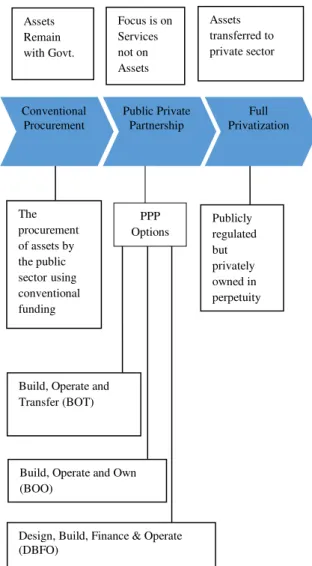
PPP options are lying in between the two extremes of conventional procurement and the full privatization. Based on that, all the possible combinations among those two extremes are counted to be PPPs [4].
As illustrated in Fig. 1, there are number of PPP options, varying based on its responsibility transferring, project ownership handling, time frame and facilities granted by respective governments to private parties, that could be adopted in varyingly from project to project.
Figure 1: Financing of Infrastructure Project through Traditional Method Vs PPPs Models
(Source: [4]) The
procurement of assets by the public sector using conventional funding
Assets Remain with Govt.
Focus is on Services not on Assets
Assets transferred to private sector
Build, Operate and Transfer (BOT)
Build, Operate and Own (BOO)
Design, Build, Finance & Operate (DBFO)
Publicly regulated but privately owned in perpetuity PPP
Options Conventional
Procurement
Public Private Partnership
The following options are available for the PPP facilitation for infrastructure.
BOT Build, Operate & Transfer
BOO Build, Own & Operate
BOOT Build, Own, Operate & Transfer
BTO Build, Transfer & Operation
DBFT Design, Build, Finance & Transfer DBFO Design, Build, Finance & Operate
III.
INFRASTRUCTURE
DEVELOPMENT IN SRI LANKA
The government has invested 6% of GDP in total, in the year 2010, 5% of GDP was allocated for economic infrastructure development and the rest (1% of GDP) for social infrastructure development [7]. Table 1 shows the amount of investment for infrastructure development.Table 1: Government Investment in Infrastructure
Year Economic Social Total
R
s.
b
n
% o
f
GDP
R
s.
b
n
% o
f
GDP
R
s.
b
n
% o
f
GDP
2001 54.9 3.9 14.6 1.0 69.5 4.9
2002 51.7 3.4 15.7 1.0 67.4 4.4
2003 58.7 3.2 19.2 1.1 77.9 4.3
2004 61.3 2.9 29.0 1.4 90.3 4.3
2005 77.5 3.2 60.4 2.5 137.9 5.7
2006 106.8 3.6 48.4 1.6 155.2 5.3
2007 141.2 3.9 55.0 1.5 196.2 5.5
2008 168.9 3.8 60.2 1.4 229.1 5.2
2009 256.4 5.3 53.9 1.1 310.3 6.4
2010 280.8 5.0 56.2 1.0 337.0 6.0
Source: CBSL Annual Report, 2010 [7]
The government focused on all areas of economic infrastructure such as development of roads, energy, water supply and sanitation, ports and aviation, transport and rural infrastructure.
Several major infrastructure development projects started during the last few years were nearing completion by the end of 2010. The construction work of phase I of Norochcholai coal power plant and phase I of Hambantota port development project were completed in 2010 while the Southern Expressway and the Upper Kotmale hydro power project were nearing completion [7]. The development of the road infrastructure is vital for regional development. The government has funded several road projects to develop the road network all around the country.
In Sri Lanka, the traditional procurement
methods have been commonly used for
infrastructure development. Funds are sourced from loans or grants. After 1997 private sector involvement is there for power sector and later port
construction and telecom sector also adopted. Private sector involvement for implementation in BOT/BOO type projects are very less during the past two decade [8].
Over the last fifteen years, there has been only 15 projects with total investment of US $ 1651.9 million were made as PPP projects in Sri Lanka [9]. Sri Lanka was placed behind in terms of investment and number of projects, compared to the other regional countries like India, Pakistan and Bangladesh.
IV.
METHODOLOGY
4.1.Method of Data Collection
There are two types of data gathering sources are used for this study. Those are Primary Data and Secondary Data.
4.1.1 Primary Data
Following are the three major methods to do the primary data collection; [10]
Observation
Interviewing
Questionnaire
With the above approaches, this research will follow the Questionnaire.
4.1.2 Questionnaire
Public- Private Partnerships are not popular in Sri Lanka. Therefore on PPPs projects which were carried out during the last two decades, there were very limited numbers of people involved. As a result of that, there is a lack of knowledge about this area in Sri Lanka. Due to these practical difficulties, Questionnaire method was selected with limited responses as a primary data collection method. One of the main advantages of the Questionnaire is that it provides uniform information, which assures the comparability of data.
4.1.3 Secondary Data
Because of lack of knowledge of the people for PPPs, Secondary Data collection methods were used to gather data. This information includes other countries as well as data related to Sri Lanka. There are occasions where the data has already been collected by someone else and need only to extract the required information for the purpose of the study. Outlined below are the secondary sources that have been grouped into categories.
Government or semi-government
Earlier Research - For some topics, an enormous number of research studies that have already been done by others can provide with the required information.
Personal records - Some people write historical and personal records that may provide the information needed. For this research, data were collected through workshops organized by relevant organizations in Sri Lanka and from the views of the speakers those how participated at the workshops.
Mass media - Reports published in newspapers, magazines and so on can be considered as mass media. PPP related publications were used to collect data.
4.1.4 Target Data Sample
The target data sample for this research is a mixture of primary and secondary data. As outlined under the objectives above, to study the current PPP coverage on infrastructure development projects in Sri Lanka, the Central Bank annual Report (2000 to 2009) and the Board of Investment publications were used.
There are other sources of secondary data, such as World Bank reports, ADB reports, Commonwealth Secretariat Development reports that have been used as sources.
When comes to the second and third objectives, it requires data from primary sources as well as secondary sources to study the current deficiencies. The primary source of data sample in this context is very limited as we are looking for expert judgment on the existing practice.
After using secondary data, a questionnaire was prepared for collecting primary data.
4.2 Analysis of Data
Based on theoretical framework of study, the questionnaire was designed with the following three sections.
Background of PPP
PPP Framework (Policy, Legal, Investment and
operational)
Current PPP coverage in Sri Lanka-Sectors
Likert scale has been used for analysing the data set which was obtained through the questionnaire. This scale was developed based upon the assumption that each statement on the scale has equal attitudinal value‟, „importance‟ or weight in terms of reflecting an attitude towards the issue in question. The procedure for constructing a Likert scale is as follows.
First step is constructing statements that are reflective of the attitudes towards the main issue in question. Statements should be worded to reflect both positive and negative attitudes towards the
issue; that is, they should be for, as well as against, the issue [11].
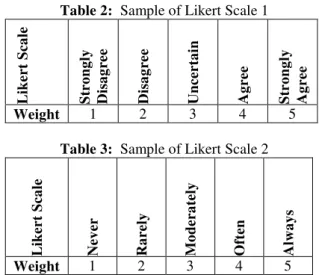
Second Step is analysing the responses by assigning a weight - a numerical value to the
responses. Numerical values were assigned
differently to positive and negative statements, for positive statement the response indicating the most favourable attitude was to be given the highest score. Example as follows.
Table 2: Sample of Likert Scale 1
L
ikert
Sca
le
Str
o
ng
ly
Dis
a
g
re
e
Dis
a
g
re
e
Uncer
ta
in
A
g
re
e
Str
o
ng
ly
A
g
re
e
Weight 1 2 3 4 5
Table 3: Sample of Likert Scale 2
L
ikert
Sca
le
Nev
er
Ra
re
ly
M
o
dera
tely
O
ft
en
Alwa
y
s
Weight 1 2 3 4 5
Third step is calculating each respondent‟s attitudinal score by adding numerical value assigned in respondent statement. After that it was compared
all respondents‟ scores for each item. [11]
After that total score has been calculated. Finally percentages have been calculated with respect to the total allocation for each section. Equation 1: Percentage Score
Percentage Score has evaluated as follows. If the Score within;
40% - 50% - week;
50%-60% - almost ok;
60%- 70% - good;
70% -80% - best; and
Over 80% - very best
V.
OBSERVATIONS AND RESULTS
Following results present based on thequestionnaire. Sample consisted of twenty
respondents‟ answers. They have some knowledge of infrastructure and procurement of projects and about PPP.
Total allocation for each section Total Score x 100
5.1.General Background of Public Private Partnership for Infrastructure Development
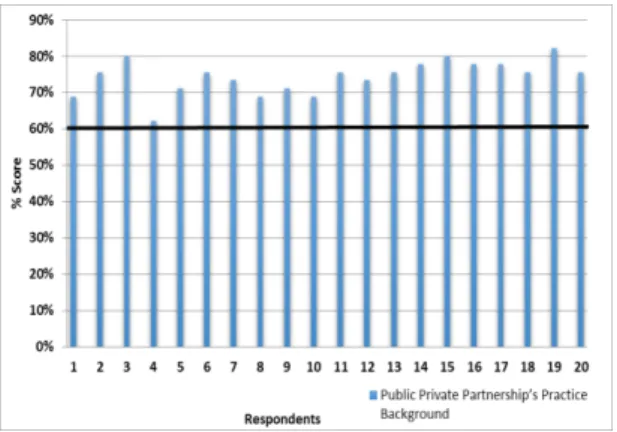
Following graph in Fig. 2, illustrates the general knowledge of the respondents regarding PPP. The overall results are within 60% to 80% range. Therefore this gives an indication that the data set used here in the following sections are valid
on the basis that the respondents‟ participation for
this survey has acceptable knowledge level on PPP for infrastructure development. On the other hand they accepted the PPP is a useful investment method for infrastructure development.
Figure 2: Background of PPPs Practice
Fig. 3 illustrates the private sector involvement to reduce budget deficit. Out of twenty responds, nineteen responds were given a score over 60% for the statement where the private sector involvement reduces the budget deficit. Further, emphasizing large scale fiscal deficit has limited the
governments‟ capacity to meet growing
infrastructure needs.
Figure 3: Responds for Private sector involvement to reduce budget deficit
5.2.Current PPP coverage in Sri Lanka
According to the question, “what are the
key sectors adopt in PPPs in Sri Lanka?” most of the respondents‟ answers were Power plants, Ports and Telecommunication sectors. According to the graph shown in Fig. 4, 60% to 90% responds have said, PPP is an important practice for Sri Lanka for its upcoming infrastructure projects. According to the questionnaire, PPP has not been a popular
investment model for infrastructure development so far due to lack of knowledge in PPP. Three respondents gave the score within 50% to 60%.
Figure 4: Current Situation in Sri Lanka
Fig. 5 shows respondents‟ knowledge and
the views of PPP framework in Sri Lanka. 75% of the respondents gave a 60% to 75% score. 25% of the respondents gave less than 60%. Therefore the knowledge and view of the PPP framework is good.
Figure 5: PPP framework
VI.
RESULTS AND DISCUSSION
6.1.Current PPP Coverage in Sri LankaThe sectors that adapt the PPP can be identified as the port, power generation, industrial parks and telecommunication sectors [8]. Results from the questioner have also highlighted the above sectors. According to the Central Bank annual report 2009, the government has recently engaged in the Colombo South Harbour Project through PPP method.
hub and develop the country into a strategically important economic centre in the region [11]. To fast track the implementation of infrastructure projects to ensure that their maintenance and management is done in a sustainable manner and to reduce the weight on the government budget, it is important that the private sector participation is also promoted. One option available for this is to encourage Public-Private Partnerships (PPPs) in identified infrastructure projects. In order to attract the private sector investments towards infrastructure projects, it is essential for the government to clearly identify the specific projects in which the private sector can participate and to create a helpful environment for the private sector to actively engage in providing infrastructure facilities.
6.2.Current Deficiencies in PPP
According to the results, most of the responses suggested government/public sector should not invest in the infrastructure development projects all the time. But most of the time the government funds and donor /lone funds are used to invest in infrastructure projects. It can be identified clearly from the results, because most of respondents work with government or donor funded projects. If the government invests hugely in infrastructure projects, the budget deficit would also go up. This is depicted in Fig. 3.
When investing on the infrastructure projects, private sector targets their profits, but in countries like Sri Lanka, there is an uncertainty for the private sector to make profits in some sectors. However the sectors like port, power generation, telecom & water supply may be profitable as the customer demand is very high for those sectors. When the private sector invest on infrastructure projects, they might have to face higher risks. For example, in the highway sector there is risk to collect toll within the concession period. Therefore private sector requests longer concession period for highways [4]. There is a common acceptance within the industry that private sector management is better than public sector, therefore customer services are also better in private sector than public sector. Furthermore the private sector can recover their costs by offering a good customer service. If the government invest on huge infrastructure projects like expressways/highways, government needs to find more funds upfront for the budget. It is a disadvantage of the traditional procurement method.
Lack of proper guideline for PPP projects is one of the main issues for the infrastructure development projects. This is one of the main deficiencies in the PPP projects in Sri Lanka. Based on the results shown in Fig. 5, it can be concluded that the workers in the infrastructure sector do not have proper knowledge for PPPs and the guidelines.
Lack of knowledge is also have a considerable effect to the PPP project investments. There are two methods used to procure a PPP project in Sri Lanka. One is singing up for a memorandum of understanding (MoU) first and doing the work after that mutual understanding of the two parties signing the agreement. This method has disadvantages to the county. Results from the questionnaire also highlighted this. Most of the time for PPP projects, MoUs are used in Sri Lanka [4]. Competitive bidding process is used less frequently. Those two methods are dependent on number investors. If the country has a considerable number of investors, the government can decide to go for competitive bidding.
Results in the Fig. 5 shows that the PPP framework in the Sri Lankan context is not in a satisfactory situation. One of the deficiencies in the legal framework is lack of availability of the model concession agreement which is shown in the results. The investment promotions have to be improved to attract investors to the country. Duty free importation facilities have already been introduced by the BOI of Sri Lanka, but the government has to support for viability gap funding, introducing long concession periods, government involvement for land acquisition and environmental clearance process. Lack of knowledge of the investment promotions also affects the PPP projects adversely [3].
VII.
CONCLUSIONS AND
RECOMMENDATIONS
7.1.ConclusionsThe basic objectives of the research are to identify the current PPP coverage on infrastructure projects in Sri Lanka, to identify the current deficiencies in PPP practices and areas which resist PPP being an attractive investment model in infrastructure developments in Sri Lankan context and to propose an improved PPP framework/model. This will effectively address the identified problems and could be adopted during infrastructure developments in Sri Lanka.
The current deficiencies in PPP practice in the country need to be overcome to develop the PPP practice and make that practice beneficial to the counties‟ economy. In 2007 annual report published
by Central Bank of Sri Lanka the “Development of
economic infrastructure through PPP has been identified as a key development strategy, so as to relieve the budget of the burden of financing”. While
changing the role of India Government from the developer and the operator to the facilitator [4], they have achieved their goals. Then they have further developed the PPP practices though practical experience which they had to face. Therefore Sri Lankan government should also change their role from a developer and an operator to a facilitator. 7.2.Recommendations
Recommendation for this project is to implement the identified solutions for deficiencies in PPPs practices are as follows;
Sri Lankan government/public sector
should be changed the role from the developer and the operator to a facilitator, improve model contracts for each sector by improving the knowledge of the workers in the public sector about the PPP practices.
Government/Public sector should
streamline the PPPs approval mechanism and improve PPPs guidelines. Sri Lanka already has their PPP unit under Board of Investment. Through that unit, it gives advising, developing concession models, improve guidelines and finding investors for pipe line projects. Not only that the government has to improve viability gap funding for the infrastructure projects but also introduce long concession periods, give tax holidays, tax incentives and duty free importation of high capacity and modern construction equipment.
There are three main advantages that motivate the governments to enter into PPPs for infrastructures are:
1. To attract private capital investment (often to
either supplement public resources or release them for other public needs)
2. To increase efficiency and use available
resources more effectively.
3. To reform sectors through a reallocation of
roles, introduce incentives, improve the accountability, customer service and employee morale, increase the project financing and transfer the technology & train the workers.
Therefore the overall view of this research is to emphasise the importance of the Public Private
Partnerships as an investment model for
infrastructure development in Sri Lanka.
VIII.
ACKNOWLEDGEMENTS
I wish to express my sincere gratitude to the Department of Civil Engineering, University of Moratuwa, for giving me the opportunity to undertake this research study for the fulfilment of my Master of Business Administration in Project Management degree.I would like to render my thanks to Dr. L. Ekanayake for giving me this opportunity to carry out our postgraduate project under his supervision and helping and advising to make this project a success. Finally, we express our gratitude to Prof. A. Perera, and Dr. Halwathura of the same Department for their encouragement during the progress presentation and excellent co-ordination.
IX.
REFERENCES
[1]. Transportation Division, United Nations
Economic and Social Commission for Asia
and the Pacific (UNESCAP), Public
Private Partnerships in Infrastructure Development a Primer, 2008.
[2]. Asian Development Bank (ADB). Public
Private Partnership Hand Book, 2008. http://www.adb.org/Documents/Handbooks /Public-Private-Partnership/Public-Private-Partnership.pdf
[3]. G. A. Hodge, C. Greve and A. E.
Boardman, International Hand book on
Public Private Partnership, 3, Edward Elgar Publishing, 2010. DOI: 10.4337/ 9781849804691http://www.elgaronline.co m/view/9781848443563.00010.xml
[4]. Board of Investment, Sri Lanka, Public
Private Partnerships Awareness Workshop, 2009.
[5]. Central Bank of Sri Lanka, Annual Report
2007, 2007, 13- 51.
[6]. United Nations, Guidebook on Promoting
Good Governance in Public-Private Partnerships, United Nation Economic Commission for Europe. New York and Geneva, 2008.
[7]. Central Bank of Sri Lanka, Annual Report
2010 2010, 56- 57.
[8]. Board of Investment, Sri Lanka,
Public-Private Partnership
Unit.http://www.boi.lk/ppp/project_page.sh
tml [Accessed February, 2008]
[9]. Research and Intelligent Unit, PPP
arrangements and its advantages for Sri
Lanka, 2007.
http://www.riunit.com/news.php
[10]. R. Kumar, Research Methodology a
Step-by-Step Guide for Beginners (Dorling Kindersley (India) Pvt. Ltd., 2009).
[11]. Central Bank of Sri Lanka, Annual Report