CAPTURE FISHERY IN NORTHERN TODOS OS SANTOS BAY,
TROPICAL SOUTHWESTERN ATLANTIC, BRAZIL
Lucy Satiko Hashimoto Soares1*, Juliana Pierrobon Lopez1, Elizabeti Yuriko Muto1 and Roberto Giannini2
1Instituto Oceanográfico, Universidade de São Paulo
(Praça do Oceanográfico, 191, São Paulo, SP, Brasil, 05508-120)
2Alpina Briggs Defesa Ambiental S.A.
(Rua Tiguassu, 154, 09970-310 Diadema, SP, Brasil)
*Correspoding author: [email protected]
A
B S T R A C TInformation on marine and estuarine capture fishery activity in northern Todos os Santos Bay, northeastern Brazil, based on daily data collected between September 2003 and June 2005 is presented. Small-scale artisanal fishery in this area includes the use of traditional vessels both non-motorized and non-motorized for locomotion, being carried out mainly by canoe or on foot, and involves many different kinds of gear, including gillnet, hook and line, seine nets, and traps. A total of 113 taxa were grouped into 77 resources, including 88 fish, 10 crustaceans, and 15 mollusks. Data on nominal catches of fish, crustaceans and mollusks are presented by month and location. A total of 345.2 tonnes of fishery resources were produced (285.4 tonnes of fish, 39.2 tonnes of fresh invertebrates, and 20.6 tonnes of processed invertebrates). Temporal variation in the fish catch was associated with the life cycle of the species or with the hydrographic conditions. The first-sale value of this catch amounted to around US$ 615,000.00, fishes representing 71.3% of it. A table of the average price of each fishery resource is presented. The results produced in this study may be considered a reference for future monitoring programs of fishery resources in the area.
R
E S U M OInformações sobre a atividade pesqueira extrativa da região norte da Baía de Todos os Santos, Bahia, nordeste do Brasil são apresentadas, baseadas em coleta diária de dados, realizada entre setembro de 2003 e junho de 2005. Trata-se de uma atividade extrativa artesanal, na qual são utilizadas embarcações tradicionais para o deslocamento ao local da extração. Em cada pescaria foram utilizadas várias artes, tais como rede de espera, linha e anzol, rede de cerco, armadilhas. Foram identificadas 113 categorias taxonômicas de peixes (88), crustáceos (10) e moluscos (15), arranjadas em 77 tipos de pescados comercializados. A produção total no período foi de 345,2 t (285.4 t de peixes, 39,2 t de invertebrados frescos e 20,6 t de invertebrados processados). Variações espaço-temporais da produção total desses pescados podem estar relacionadas à sazonalidade das condições meteorológicas, oceanográficas ou biológicas. A partir do preço da primeira comercialização, foi obtido um valor da primeira venda de R$ 1 279 881,63, sendo 71,3% referentes à produção de peixes. Uma tabela de preço médio de cada recurso pesqueiro é fornecida. Contextualizando os dados pretéritos disponíveis, este trabalho pode ser considerado como uma referência para o futuro monitoramento da pesca na área.
Descriptors: Coastal fishery; Artisanal fishery; Fishing gear; Sale value; Northeast Brazil.
Descritores: Pesca costeira; Pesca artesanal; Arte de pesca; Preço de comercialização; Nordeste do Brasil.
I
NTRODUCTIONTodos os Santos Bay (12.61-13.13°S / 38.45-38.82°W), one of the most important waterways in Brazil (1,100 km²), is a complex ecosystem with brackish and marine waters, small internal bays, many islands, reefs, rivers, estuaries, mangroves, and rain forest, and has been a protected environmental area since June, 05 1999 in accordance with state law n° 7595 (GOVERNO DA BAHIA, 2007). Thirteen towns, including Salvador (capital of Bahia State), the ports of Salvador and Aratu, the Aratu naval base,
According to Wake’s review (2005) on the ecological impacts of oil refineries on the aquatic environment, there have been many studies concerning the lethal toxicity of refinery effluent, but few studies on the sub-lethal effects. The author pointed out the need for sub-lethal effect studies, especially because the refinery effluents are cleaner now and are more likely to be having sub-lethal rather than lethal effects. The author also pointed out the need for field studies to document the sub-lethal effects of pollutants on the growth and recruitment of aquatic organisms.
While it may be difficult to document individual effects on particular species, it might be possible to examine existing data streams to infer effects due to pollutants. For example, the variability of the fishery production may be a measure of the sub-lethal effects of the oil effluent on the community or population, through the analysis of the variability in species diversity and abundance.
In this context, the aim of this study is to characterize the fishery activities in the area under the influence of the oil refinery and the oil terminal, between September 2003 and June 2005. The catch compositions, theirvariation from locality to locality and over the months, and the different fishery techniques employed are described. This investigation was conducted within the scope of the “Environmental Monitoring Program of the Estuarine Area near the RLAM Refinery” coordinated by Cenpes/Petrobras in partnership with IOUSP – Instituto Oceanográfico da Universidade de São Paulo (Oceanographic Institute of the University of São Paulo). The purpose of this program was to describe the estuarine region around the oil refinery RLAM in terms of the physical, chemical, and biological aspects of the water and the sediment.
Fishing in the northern portion of Todos os Santos bay, as well as the fisheries on the coast of the state of Bahia, could be described as a typical small-scale artisanal fishery (DIAS-NETO; DORNELLES, 1996), providing food and livelihood for the local community. Although the northern sector of Todos os Santos bay is not considered an important region for the fish trade, this activity is an alternative source of income for the poorer sectors of the community, either temporarily or part-time (ALMEIDA, 1996, unpublished); SILVA, 1996, unpublished); GIANNINI, 2000 (unpublished).
According to the Madre de Deus city hall, depending on the political-economical context, fishery resources can serve as both food supplement and source of income (GIANNINI, 2000 (unpublished). Local fishery resources from estuaries, mangroves, inter-tidal zones, and reefs are exploited. They have been sold locally within the communities or by traders in the larger neighboring towns such as Salvador, the
capital of the state and an international tourist center (GIANNINI, 2000, unpublished).
The assessment, monitoring, and enforcement of the fishery resources and fishery activities are very important for conservation and management. However, according to Giannini (2000, unpublished)), the information on fisheries required for a detailed diagnosis was not available for the Madre de Deus island area or for the state of Bahia as a whole. In addition to the gaps in basic and applied studies, the few research results available are grey literature. This is true of the Brazilian coastal artisanal fisheries as a whole, which need studies on stock assessment as a support for the national policy (VASCONCELLOS et al., 2007).
M
ATERIAL ANDM
ETHODSData on daily total catch were obtained by tabulating data forms from local fishermen as well as from 16 monitoring visits by researchers carried out at six fishing landing sites or fishing grounds, between September 2003 and June 2005. One additional site was included in the second year (September 2004 – June 2005) (Fig. 1). Those sites may be considered as capture locations due the limited operational range of the traditional vessels involved.
The local fishermen were trained for collecting scientific data on the forms, supplemented by their fishing knowledge. The fieldwork was supervised by a researcher and coordinated by the fishing association of Madre de Deus municipality working with a team of seven local fishermen, trained to collect data. During the sampling period, these fishermen were first trained, and then meetings were held monthly or every two months to monitor, evaluate, and review the form filling and to correct the identification of the organisms, for the purpose of maintaining confidence in the data.
Data registered on the forms were: name of the fisherman or fisherwoman; location, date and time of the fishing activity; name and type of the vessel; type of fishing gear employed; name, biomass, and first sale value of each resource.
Fig. 1. Map of northern Todos os Santos bay, Brazil showing the six fishing landing sites or fishing grounds.
Table 1. Metric unit conversion of the local sale units of the fishery resources in northern Todos os Santos bay, Brazil
bucket (8 l) a hundred rope (n=10) a dozen can (18 l) liter
CRUSTACEANS
Ghost crab 1.3 kg
Land crab 1.1 kg 2.0 kg
Mangrove crab 1.2 kg 1.2 kg
Swimcrab 0.2 kg* 0.6 kg 0.6 kg 0.5 kg*
MOLLUSKS
American yellow cockle 6.5 kg 0.1 kg* 17 kg
Ark 0.33 kg* 1 kg*
Brazilian chank 0.33 kg* 1 kg*
Conch, melongena 1.1 kg*
Mussel 0.33 kg* 0.1 kg* 1 kg* 0.07 kg*
Oyster, penshell 0.4 kg* 1.2 kg*
Stout tagelus 0.1 kg* 1 kg* 0.1 kg*
Thick lucine 0.83 kg* 0.1 kg* 0.1 kg*
West Indian pointed venus 0.33 kg* 1 kg*
FISH
Common snook 6 kg
Herrings, anchovies 12 kg
Miscellaneous fish 12 kg
Mojarras 8 kg
Shrimp eel 3 kg
* processed product
A list of local names and taxonomic identification of fishes, crustaceans, and mollusks was prepared. Organisms were identified by the authors of the present paper according to specific taxonomy guides (FIGUEIREDO, 1977; FIGUEIREDO; MENEZES, 1978, 1980, 2000; MENEZES; FIGUEIREDO, 1980, 1985; RIOS, 1994; MELO,
R
ESULTSObservations during the monitoring visits to the study area indicated a lack of cooling and freezing facilities on the boats, in the fish market of Madre de Deus, and in the three fishery organizations, demonstrating the poor infrastructure of fishing activities. The fishery catch is transported to the landing sites by boat and sold on the spot, on the street, or in the market. Thus, fishing activity is limited by distance due to the availability of boats, and the transit time due to the perishability of the products. Catch data, based on 24,218 forms, showed that fishing activity was performed by 1,429 fishermen and fisherwomen, most of them (90%) only working at one landing site. Fishing grounds were reached mainly by canoes (61%), small boats (9%), or on foot (21%); however, these vessels are only used for locomotion, not as fishing platforms. The canoes (3-5 m. long) are wooden vessels, propelled with paddles, some of them with an auxiliary sail, usually operated by one or two fishermen. The boats (4-6 m. long) are fitted with a low-power inboard engine (11 HP or less), and usually operated by two or three fishermen. Fishing activity takes place in the near-shore waters due to the range of the traditional artisanal vessels, and also along the intertidal zones, during the morning (59%).
A total of 47 fishing gear names were registered, classified according to the type of fishing for which they were used, in addition to free diving. A brief description of each gear or set of gear is presented in Table 2. One to five kinds of gear were used in each fishing activity, characteristic of multiple gear fishing. Gathering by hand or with simple hand implements (spoon, axe, hatchet, and shovel) was the most frequent method employed (occurrence of 31%), mainly for gathering bivalve species on foot in the intertidal zones of two sites (Caípe and Cação). Other common fishing techniques were fixed gillnet (passive gear) and handline and longline fishing (active gear). Line fishing was mainly used in Bom Jesus and Maria da Guarda islands, and fixed gillnets in Paramana and Passé. A local kind of encircling net known as abalo, a kind of passive-active gear, was mainly used in Passé and Madre de Deus Island; in this method of capture, the paddle is hit on the water (or on the bottom of the boat) to make a noise and to frighten the fish towards the surrounding net and thus get entangled in it. In addition, a range of net types was applied, including beach seine nets, traps, cast nets, luring, and encircling nets. Free diving was usually performed by only one fisherman (averaging two-minute duration) for hand-capture of some mollusks (fighting conch - peguari or ark - sambá) and lobsters, or for hunting lobsters and some fishes with a spear.
Table 2. Types of fishing gear used by artisanal fishers in northern Todos os Santos bay, Brazil.
English name Portuguese name Comments Occurrence (%)*
Beach seine Rede de arrasto A long net which is dragged parallell to the shoreline by two
fisherman. Used to catch shrimps and small fishes. 6.03
Cast nets Tarrafa A circular net with varied mesh size operated by a fisherman from the
boat or from the shore. 2.23
Diving Mergulho Sometimes harpoon is also used. 6.64
Encircling
gillnets Abalo
Noise is used to force fish to gill or entangle themselves in the netting
surrounding them. 13.68
Encircling
gillnets Rede de cerco
Nets made of monofilament nylon strand used to encircling schools
of fish. Operated by small boats. 0.03
Fixed gill nets
Rede de espera (arraeira, caçoeira, lincheira, paruzeira, rede de caçonete,
sororoqueira, tainheira)
Fish are gilled or enmeshed in the net. 14.57
Gathering Ferramenta manual Gathering by hand or with simple hand implements 31.02
Handline Linha de mão All fishery carried out by monofilament nylon strand operated by
hand. 16.01 **
Longline Espinhel, grozeira Consists of a mainline 50 to 100 m in lenght, whith 100 to 200 hooks.
Luring Atrator luminoso Light attraction for fishing swimcrab and fish. 4.37
Traps Armadilha (gaiola, manzuá,
jereré, ratoeira)
Cages or baskets made of various materials (wood, metal, bamboo) set with baits. The "jereré" is a saclike net used in shallow waters or from the boat.
10.65
Total of filled forms 23061
* Multiple answers
Species
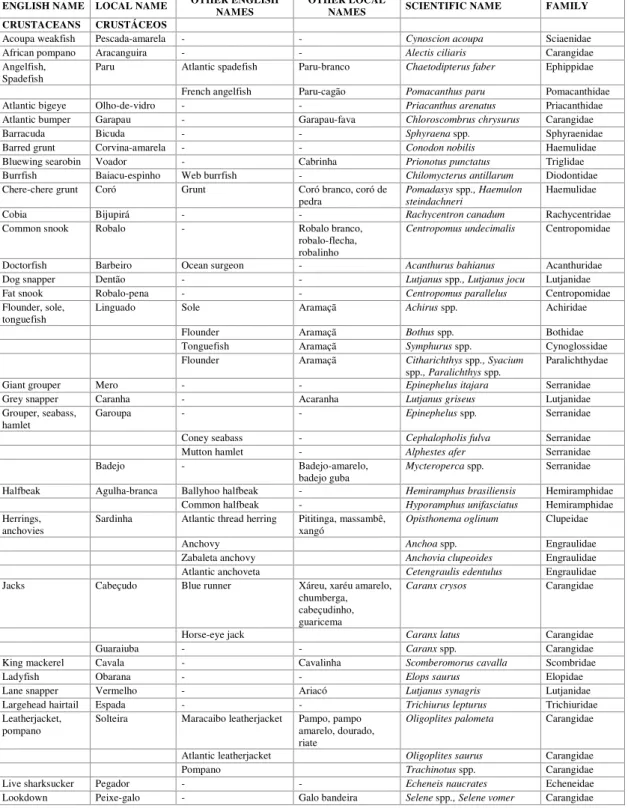
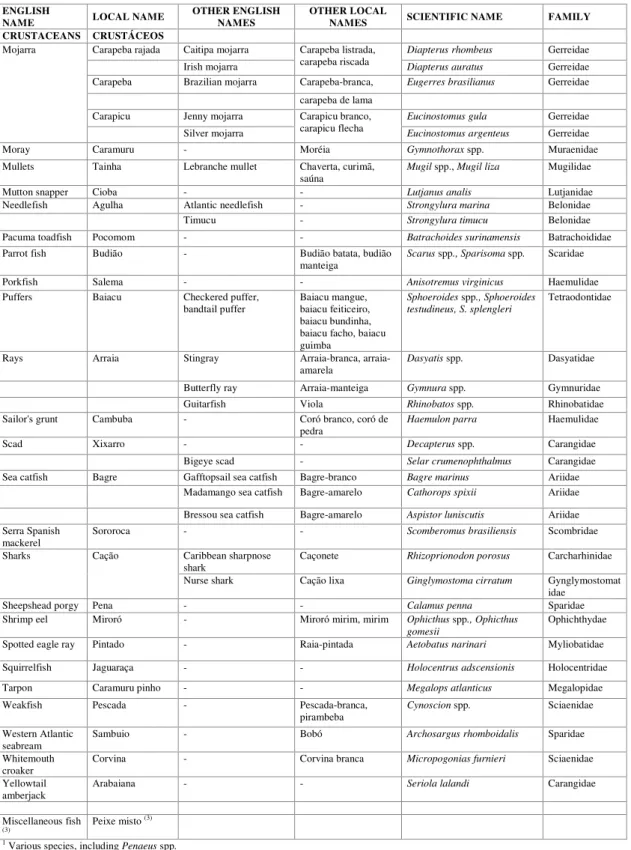
An estimate of 113 taxa (species or genera), grouped into 77 aggregated fishing resources, including 88 fishes, 10 crustaceans, and 15 mollusks, was made for the study area (Table 3). These include pelagic, bentho-pelagic, benthic, intertidal, and coral-reef species. The resources of high catch biomass were small pelagic fishes, such as herrings (Clupeidae) and anchovies (Engraulidae), several species of mullet (Mugilidae), and several species of ray and skate. Other species are included among the representative bentho-pelagic resources: jack (Carangidae), mackerel (Scombridae), and weakfishes (Sciaenidae); and among the benthic or demersal resources: catfish, shrimp, swimming–crab, ghost crab, land crab, oyster, snappers (Lutjanidae), and seabream (Sparidae).
Catches
A total of 345.2 tonnes of fishery resources was produced during the monitoring period (22 months), composed of 285.4 tonnes of fishes, 39.2 tonnes of fresh invertebrates, and 20.6 tonnes of processed invertebrates.
Monthly, the total fish production ranged from 8 tonnes (February 2005) to 19 tonnes (February 2004) (Fig. 2). The highest production occurred in the first quarter (summer) of 2004; the fourth quarter (spring) of 2003 and 2004 showed the same trend, with a decrease in production between October and November, and an increase in December. The most frequently captured fish were rays, mullet, herrings and anchovies. Other representative resources were catfish, horse-eyed, jack (cabeçudo), lane snapper (vermelho), weakfishes (pescada), serra Spanish mackerel (sororoca), and western Atlantic sea-bream (sambuio). The production of rays was primarily responsible for the monthly variation in total production. There was an alternation between the production of mullet, and that of herrings and anchovies. The production of mullet was higher during the fourth quarter (spring) of 2003 and first quarter (summer) of 2004, the production of herrings and anchovies was higher from the second (fall) to fourth (spring) quarters of 2004 (Fig. 2). During the study period, the highest production occurred in Bom Jesus, and the lowest in Caípe (Fig. 3), with biomass variation of the most important fish.
Table 3. Species composition of fishery resources (scientific and common names) caught between September 2003 and June 2005, in northern Todos os Santos bay, Brazil.
ENGLISH NAME LOCAL NAME OTHER ENGLISH NAMES OTHER LOCAL NAMES SCIENTIFIC NAME FAMILY CRUSTACEANS CRUSTÁCEOS
Ghost crab Caranguejo - - Ucides cordatus Ocypodidae
Land crab Guaiamu Giant land crab - Cardisoma guanhumi Gercacinidae
Lobster Lagosta Spiny loster Lagosta verde Palinurus spp. Palinuridae
Mangrove crab Aratu Mangrove root crab - Goniopsis cruentata Grapsidae
Mangrove tree crab - Aratus pisonii Sesarmidae
Shrimp1 Camarão - - - Penaeidae
Small shrimp Camarão
pequeno
Atlantic seabob - Xiphopenaeus kroyeri Penaeidae
Swimcrab2
Siri Blotched swimming crab Portunus spinimanus Portunidae
Dana swimcrab Callinectes danae Portunidae
Shelling crab Callinectes ornatus Portunidae
Blunttooth swimcrab
Siri bóia, siri branco, siri canxaga, siri regateira, siri mangue
Callinectes bocourti Portunidae
MOLLUSKS MOLUSCOS
American yellow cockle
Rala-côco - - Trachicardium muricatum Cardiidae
Ark Sambá Incongruous ark - Anadara brasiliana Arcidae
Brazilian chank Tapu - - Turbinella laevigata Turbinellidae
Conch, melongena Peguari Fighting conch - Strombus pugilis Strombidae
Giant hairy melongena - Pugilina morio Melonginidae
Mussel Sururu - Sururu-de-coroa Mytella spp.,
Mytella charruana
Mytilidae
Octopus Polvo - - Octopus spp. Octopodidae
Oyster, penshell Ostra Pacific cupped oyster Ostra de mangue Crassostrea spp.,
Crassostrea rhizophorae
Ostreidae
Half-naked penshell Ostra de palma Atrina seminuda Pinnidae
Squid Lula - - Loligo spp. Loliginidae
Stout tagelus Mapele - - Tagelus plebeius Solecurtidae
Thick lucine Lambreta - - Lucina pectinata Lucinidae
West Indian pointed venus
Table 3. Continuation.
ENGLISH NAME LOCAL NAME OTHER ENGLISH NAMES OTHER LOCAL NAMES SCIENTIFIC NAME FAMILY CRUSTACEANS CRUSTÁCEOS
Acoupa weakfish Pescada-amarela - - Cynoscion acoupa Sciaenidae
African pompano Aracanguira - - Alectis ciliaris Carangidae
Angelfish, Spadefish
Paru Atlantic spadefish Paru-branco Chaetodipterus faber Ephippidae
French angelfish Paru-cagão Pomacanthus paru Pomacanthidae
Atlantic bigeye Olho-de-vidro - - Priacanthus arenatus Priacanthidae
Atlantic bumper Garapau - Garapau-fava Chloroscombrus chrysurus Carangidae
Barracuda Bicuda - - Sphyraena spp. Sphyraenidae
Barred grunt Corvina-amarela - - Conodon nobilis Haemulidae
Bluewing searobin Voador - Cabrinha Prionotus punctatus Triglidae
Burrfish Baiacu-espinho Web burrfish - Chilomycterus antillarum Diodontidae
Chere-chere grunt Coró Grunt Coró branco, coró de
pedra
Pomadasys spp., Haemulon steindachneri
Haemulidae
Cobia Bijupirá - - Rachycentron canadum Rachycentridae
Common snook Robalo - Robalo branco,
robalo-flecha, robalinho
Centropomus undecimalis Centropomidae
Doctorfish Barbeiro Ocean surgeon - Acanthurus bahianus Acanthuridae
Dog snapper Dentão - - Lutjanus spp., Lutjanus jocu Lutjanidae
Fat snook Robalo-pena - - Centropomus parallelus Centropomidae
Flounder, sole, tonguefish
Linguado Sole Aramaçã Achirus spp. Achiridae
Flounder Aramaçã Bothus spp. Bothidae
Tonguefish Aramaçã Symphurus spp. Cynoglossidae
Flounder Aramaçã Citharichthys spp., Syacium
spp., Paralichthys spp.
Paralichthydae
Giant grouper Mero - - Epinephelus itajara Serranidae
Grey snapper Caranha - Acaranha Lutjanus griseus Lutjanidae
Grouper, seabass, hamlet
Garoupa - - Epinephelus spp. Serranidae
Coney seabass - Cephalopholis fulva Serranidae
Mutton hamlet - Alphestes afer Serranidae
Badejo - Badejo-amarelo,
badejo guba
Mycteroperca spp. Serranidae
Halfbeak Agulha-branca Ballyhoo halfbeak - Hemiramphus brasiliensis Hemiramphidae
Common halfbeak - Hyporamphus unifasciatus Hemiramphidae
Herrings, anchovies
Sardinha Atlantic thread herring Pititinga, massambê,
xangó
Opisthonema oglinum Clupeidae
Anchovy Anchoa spp. Engraulidae
Zabaleta anchovy Anchovia clupeoides Engraulidae
Atlantic anchoveta Cetengraulis edentulus Engraulidae
Jacks Cabeçudo Blue runner Xáreu, xaréu amarelo,
chumberga, cabeçudinho, guaricema
Caranx crysos Carangidae
Horse-eye jack Caranx latus Carangidae
Guaraiuba - - Caranx spp. Carangidae
King mackerel Cavala - Cavalinha Scomberomorus cavalla Scombridae
Ladyfish Obarana - - Elops saurus Elopidae
Lane snapper Vermelho - Ariacó Lutjanus synagris Lutjanidae
Largehead hairtail Espada - - Trichiurus lepturus Trichiuridae
Leatherjacket, pompano
Solteira Maracaibo leatherjacket Pampo, pampo
amarelo, dourado, riate
Oligoplites palometa Carangidae
Atlantic leatherjacket Oligoplites saurus Carangidae
Pompano Trachinotus spp. Carangidae
Live sharksucker Pegador - - Echeneis naucrates Echeneidae
Table 3. Continuation.
2 Soft crab
3 Small fish of various species
ENGLISH
NAME LOCAL NAME
OTHER ENGLISH NAMES
OTHER LOCAL
NAMES SCIENTIFIC NAME FAMILY CRUSTACEANS CRUSTÁCEOS
Carapeba rajada Caitipa mojarra Diapterus rhombeus Gerreidae
Irish mojarra
Carapeba listrada, carapeba riscada
Diapterus auratus Gerreidae
Carapeba Brazilian mojarra Carapeba-branca, Eugerres brasilianus Gerreidae
carapeba de lama
Carapicu Jenny mojarra Eucinostomus gula Gerreidae
Mojarra
Silver mojarra
Carapicu branco,
carapicu flecha Eucinostomus argenteus Gerreidae
Moray Caramuru - Moréia Gymnothorax spp. Muraenidae
Mullets Tainha Lebranche mullet Chaverta, curimã,
saúna
Mugil spp., Mugil liza Mugilidae
Mutton snapper Cioba - - Lutjanus analis Lutjanidae
Needlefish Agulha Atlantic needlefish - Strongylura marina Belonidae
Timucu - Strongylura timucu Belonidae
Pacuma toadfish Pocomom - - Batrachoides surinamensis Batrachoididae
Parrot fish Budião - Budião batata, budião
manteiga
Scarus spp., Sparisoma spp. Scaridae
Porkfish Salema - - Anisotremus virginicus Haemulidae
Puffers Baiacu Checkered puffer,
bandtail puffer
Baiacu mangue, baiacu feiticeiro, baiacu bundinha, baiacu facho, baiacu guimba
Sphoeroides spp., Sphoeroides testudineus, S. splengleri
Tetraodontidae
Rays Arraia Stingray Arraia-branca,
arraia-amarela
Dasyatis spp. Dasyatidae
Butterfly ray Arraia-manteiga Gymnura spp. Gymnuridae
Guitarfish Viola Rhinobatos spp. Rhinobatidae
Sailor's grunt Cambuba - Coró branco, coró de
pedra
Haemulon parra Haemulidae
Scad Xixarro - - Decapterus spp. Carangidae
Bigeye scad - Selar crumenophthalmus Carangidae
Sea catfish Bagre Gafftopsail sea catfish Bagre-branco Bagre marinus Ariidae
Madamango sea catfish Bagre-amarelo Cathorops spixii Ariidae
Bressou sea catfish Bagre-amarelo Aspistor luniscutis Ariidae
Serra Spanish mackerel
Sororoca - - Scomberomus brasiliensis Scombridae
Caribbean sharpnose shark
Caçonete Rhizoprionodon porosus Carcharhinidae
Sharks Cação
Nurse shark Cação lixa Ginglymostoma cirratum Gynglymostomat
idae
Sheepshead porgy Pena - - Calamus penna Sparidae
Shrimp eel Miroró - Miroró mirim, mirim Ophicthus spp., Ophicthus
gomesii
Ophichthydae
Spotted eagle ray Pintado - Raia-pintada Aetobatus narinari Myliobatidae
Squirrelfish Jaguaraça - - Holocentrus adscensionis Holocentridae
Tarpon Caramuru pinho - - Megalops atlanticus Megalopidae
Weakfish Pescada - Pescada-branca,
pirambeba
Cynoscion spp. Sciaenidae Western Atlantic
seabream
Sambuio - Bobó Archosargus rhomboidalis Sparidae
Whitemouth croaker
Corvina - Corvina branca Micropogonias furnieri Sciaenidae
Yellowtail amberjack
Arabaiana - - Seriola lalandi Carangidae
Miscellaneous fish
(3) Peixe misto
(3)
1
Various species, including Penaeus spp.
2
Soft crab
3
Fig. 2. Monthly fish production during the years 2003 – 2005, in northern Todos os Santos bay, Brazil.
0 10 20 30 40 50 60 70 80 90
Bom Jesus Cação Caípe Madre de Deus Maria Guarda Paramana
to
n
n
e
s
Fig. 3. Total fish production per site, during September 2003 – June 2005, in northern Todos os Santos bay, Brazil.
The total catch of fresh crustaceans ranged from 0.6 tonne in September 2003 and January 2005 to 3 tonnes in February 2004 (Fig. 4). The highest values were registered in the first (summer) and second (fall) quarters of 2004. There were noticeably lower catches toward the second half of the time series. Catches of shrimps and ghost crabs were primarily responsible for that trend. Total production of processed crustaceans, i.e., the swimming-crabs, was lower than that of the fresh ones, and did not show any trend, amounting approximately to 0.4 tonne monthly during the studied period (Fig. 5). In contrast to the crustacean production, the larger part (87%) of the catch of mollusks was processed. The highest values were found during the third (winter) and fourth (spring) quarters of 2003, and the lowest, during the second (fall) and third (winter) quarters of 2004 (Fig. 6). This trend was due to the production of the West Indian oyster, pointed Venus (papa-fumo), and fighting conch (peguari). The American yellow cockle (rala-coco), the main fresh mollusk resource, showed the highest value during the fourth quarter (spring - October) of 2003 and the third quarter (winter - August) of 2004 (Fig. 7).
0 0,1 0,2 0,3 0,4 0,5 0,6 S e p -0 3 O c t-0 3 N o v -0 3 D e c -0 3 J a n -0 4 F e b -0 4 M a r-0 4 A p r-0 4 M a y -0 4 J u n -0 4 J u l-0 4 A u g -0 4 S e p -0 4 O c t-0 4 N o v -0 4 D e c -0 4 J a n -0 5 F e b -0 5 M a r-0 5 A p r-0 5 M a y -0 5 J u n -0 5 to n n e s swimcrab others
Fig. 5. Monthly processed crustacean production during the years 2003 – 2005, in northern Todos os Santos bay, Brazil.
Fig. 6. Monthly processed mollusks production during the years 2003 – 2005, in northern Todos os Santos bay, Brazil.
Fig. 7. Monthly fresh mollusks production during the years 2003 – 2005, in northern Todos os Santos bay, Brazil.
0 0,05 0,1 0,15 0,2 0,25 S e p -0 3 O c t-0 3 N o v -0 3 D e c -0 3 J a n -0 4 F e b -0 4 M a r-0 4 A p r-0 4 M a y -0 4 J u n -0 4 J u l-0 4 A u g -0 4 S e p -0 4 O c t-0 4 N o v -0 4 D e c -0 4 J a n -0 5 F e b -0 5 M a r-0 5 A p r-0 5 M a y -0 5 J u n -0 5 to n n e s
others
Table 4. First sale value of fish resources (US$/ kg) and total catch (kg) in northern Todos os Santos bay, Brazil.
Fish US$/kg Total Catch (kg)
Acoupa weakfish 2.54 425.5
African pompano 2.35 190.5
Angelfish and Spadefish 1.47 2424.5
Atlantic bigeye 2.04 358.5
Atlantic bumper 1.01 3949.5
Barracuda 2.04 1176.0
Barred grunt 2.03 143.0
Bluewing searobin 0.94 389.3
Brazilian mojarra 1.41 5410.8
Burrfish 1.34 63.5
Caitiba mojarra, Irish mojarra 1.85 1039.8
Chere-chere grunt 1.06 5791.1
Cobia 2.71 1251.0
Common snook 3.05 6317.2
Doctorfish 1.12 93.8
Dog snapper 3.07 2258.4
Fat snook 3.18 2033.0
Flounder, sole, tonguefish 1.50 939.2 Gafftopsail sea catfish 0.84 9838.7
Giant grouper 2.65 454.5
Grey snapper 2.83 709.0
Grouper, seabass, hamlet 1.82 243.0
Halfbeak 1.54 424.5
Herring, anchovies 0.82 25620.9
Jacks 2.16 13102.0
Jenny mojarra, Silver mojarra 1.03 1536.2
King mackerel 2.11 2132.3
Ladyfish 1.38 460.0
Lane snapper 2.70 9698.7
Largehead hairtail 1.14 1567.0
Leatherjacket and pompano 2.29 3817.4
Lebranche mullet 1.76 29642.6
Live sharksucker 0.85 13.5
Lookdown 2.69 527.5
Miscellaneous fish 0.78 929.3
Miscellaneous sea catfish 1.26 3643.8
Moray 1.58 2652.2
Mutton snapper 2.59 782.0
Needlefish 1.44 647.8
Pacuma toadfish 1.36 926.1
Parrot fish 1.47 2220.0
Porkfish 2.88 15.0
Puffers 1.51 1471.2
Rays 1.21 72538.0
Sailor's grunt 1.26 4470.5
Scad 1.17 600.0
Serra Spanish mackerel 1.93 9441.5
Sharks 2.20 2400.0
Sheepshead porgy 2.24 487.3
Shrimp eel 1.11 2891.5
Spotted eagle ray 1.89 9926.0
Squirrelfish 0.80 9.0
Tarpon 1.63 147.0
Unidentified grouper 2.63 102.6
Unidentified jack 1.69 338.0
Weakfish 2.12 8027.2
Western Atlantic seabream 1.42 8232.9
Whitemouth croaker 1.97 2911.0
Yellowtail amberjack 1.73 45.0
Average = 1.56 269 897.3
Table 5. First sale value of crustaceans and mollusks (US$/ kg) and total catch (kg) in northern Todos os Santos bay, Brazil.
Fresh Processed
First value (US$/kg)
Total catch (kg)
First value (US$/kg)
Total catch (kg)
Crustacean
Ghost crab 1.46 9506.9 3.96 49.2
Land crab 1.83 2673.4 4.00 6.0
Lobster 5.53 1782.4
Mangrove crab 1.43 619.2 3.74 145.1
Shrimp 3.90 8528.1
Small shrimp 2.16 804,0
Soft crab 3.68 553.1 4.80 0.6
Swimcrab 2,00 6804.4 4.40 6363.9
Average 2.56 4.38
Mollusks
American yellow
cockle 0.27 1201.1 3.01 211.6
Ark 1.50 24,0 4.84 2267.4
Brazilian chank 3.75 54.9
Conch, melongena 4.82 2041.1
Mussel 0.72 98.5 3.51
Octopus 4.43 13,0 1569.1
Oyster, penshell 1.98 12,0 3.22 2400.3
Squid 4.01 237.8
Stout tagelus 3.46 3.1 6.41 14.4
Thick lucine 0.65 38.5 6.59 528.8
West Indian pointed
venus 1.71 7.0 3.35 1794.9
Average 1.16 4.07
D
ISCUSSIONWorldwide the marine fisheries primarily exploit the continental shelves and coastal waters (LONGHURST; PAULY, 2007), which have long been heavily impacted by human activity. Todos os Santos bay is a populous area which has suffered the corresponding anthropogenic impact of fishing activities, and since 1949 has been under the impact of oil effluents, after the establishment of an oil refinery and oil terminal. Overall in the coastal areas of the world the decline of fishery stocks has been caused primarily by overfishing and environmental degradation, though, according to the concept of Pauly (1988), it is closely linked to poverty. For example, in eight Asian countries (Bangladesh, India, Indonesia, Malaysia, the Philippines, Sri Lanka, Thailand, and Vietnam) and developing countries such as Brazil, the major contributor to this decline is overfishing, followed by environmental degradation (STOBUTZKI et al., 2006).
assessment and monitoring may be carried out, the information on the status and trends of fisheries should be provided opportunely, in accordance with the strategy recommended by FAO (2003). There are many gaps in catch databases and our knowledge of the population dynamics of the stocks in the study area as a result of the priority accorded to the economic vision of the national fisheries policy prior to the end of the 80’s. The environmental view of fishing, which regards fishery resources as components of ecosystems, was implemented between 1991 and 1995 (DIAS-NETO, 2002, (unpublished); DIAS-NETO; MARRUL-FILHO, 2003), conjointly with the economic view. Beyond that, the available fishery information from the area has been presented as grey literature or in Government statistical bulletins (IBAMA, 2003, 2005). The main difficulty is the lack of systematic time series data on catch production.
The fisheries in the study area are typically artisanal and small-scale, being carried out with a large variety of techniques, as is generally true of the fishing on the coast of Bahia state (total of 1,188 km, including bays and estuaries; 13% of the Brazilian coast) (IBAMA, 2003; IBAMA, 2007). A consequence of this complexity is that, due to the variety of gear used as well as to the great variety of species that compose the stocks, the assessment of catch production and of fishing effort are challenging tasks. This is typical of the worldwide scenario of artisanal fisheries and few countries have been successful in implementing adequate data collection and monitoring multispecies stocks under these conditions (VASCONCELLOS et al., 2007).
Some difficulties, such as the common names of the resources and generally low literacy among the fishermen, were encountered during the study. This is typical of artisanal fisheries in developing countries (OBURRA et al., 2002) and of fishermen living in poorer conditions. In some cases several common names are used for one particular species or many species may be grouped under one common name. The richness of the common names of Brazilian fish species has been the subject of an extensive article, and the authors concluded that it poses a problem for catch statistics because any attempt to assess the relative impact of different resources will be rendered unsatisfactory by the incomplete understanding of the nomenclature involved (FREIRE; PAULY, 2005). We attempted to cope with this problem by revising all the data on the forms carefully during the monitoring visits, but much still remains to be done. A satisfactory solution to the problem of the common names of the resources would be a collection of references to each resource, listing both the common and the scientific names.
The total proportion of the catches of fish, crustaceans and mollusks showed a similar tendency
to that of those registered between 2002 and 2006 for the Bahia state coast. Also, the lists of the species caught and of the top fishery resources (sardine and anchovy, mullet, and shrimp) are similar to those available in the literature (CEPENE, 2003, 2005, 2007; IBAMA, 2008). The production was dominated by demersal species, following the tendency of the Brazilian capture marine fisheries (FAO, 2005), and also the tendency of small-scale fisheries worldwide, e.g. in Asia (STOBUTZKI et al., 2006) and in Tanzania (JIDDAWI; OEHMAN, 2002). A resource peculiar to the Brazilian fishery market is the ghost crab (Ucides cordatus), one of the main mangrove swamp resources in northeastern Brazil, the stocks of which have been managed by the government since 1989 (MOTA, 2005).
The intra-annual variability of the fish total catch (mainly ray and skate) showed similar trends in the study area to those on the whole of the coast of Bahia state during 2002, the highest production occurring during summer and spring (BAHIA PESCA, 2003). Different trends were observed depending on the resource category or local conditions, which may be associated with many factors such as oceanographic, meteorological, biological, and socio-economic conditions, or even oil pollution. The study area is evidently subject to a meteorological seasonal cycle. In the estuary, there is a hydrographic summer-winter cycle, with prevailing marine conditions during the summer and estuarine conditions during the winter (PETROBRAS/FUSP/IOUSP, 2005, unpublished). Possibly this variability could be linked to fluctuations in the abundance of some resources, as in the case of sardine catches during fall and winter months or the catches of mullet, shrimps, crabs, and fighting conch (peguari) during the spring and summer months. Studies on population dynamics are needed for us better to understand the interactions between the populations and the environment, which may explain the great variations in abundance. However, no basic information on the population dynamics of the main species of the study area is yet available in the literature.
oil refinery wastes can produce a severe, negative impact on the aquatic environment. Nevertheless, as things stand, a comparative and critical analysis of the data does not allow one to relate the decrease in the fishery resource production to the oil pollution, because different sampling designs and methodologies have been used to obtain the catch data in the available studies. In view of the lack of a robust database for purposes of comparison, we propose that our results should be used as a reference point for future monitoring of the marine fisheries of the Madre de Deus and nearby regions, with a view to improving responsible harvesting of the wild fish stocks. It serves as an initial baseline contribution to separating the effects of fishing from those of pollution and natural climatic variability.
Our first recommendation is that fisheries statistics should be improved in order to characterize the population dynamics of the fish species and to assess the environmental impact on those dynamics. We also recommend the maintenance of the monitoring of the fish species on a daily basis by the oil companies such as to cover other areas free of oil pollution to serve as control areas. The oil companies should be invited to contribute to a funding source for the purpose of establishing baseline monitoring of fisheries along the Brazilian coast so that we might thus better assess the impact of refineries, terminals, pipelines, off-shore platforms and land wells on the marine environment.
Although complex and challenging, the ideal design for assessing oil pollution impacts would be a BACI (Before/After Control/Impact) design (UNDERWOOD, 1991, 1992; SMITH, 2002). Starting from our baseline, the monitoring of the gathering of shellfish should be distinguished from that of other fishing activities. For the shellfish gathering, Cação and Caípe could be considered as replicated impacted sites, and Maria da Guarda Island and Bom Jesus as control sites. For the other fishing activities, mainly for fish capture, we propose Madre de Deus Island, Paramana and Passé as replicated impacted sites, and the same control sites as those for shellfish gathering.
Abundance of resources in terms of catch per unit effort (CPUE) should be calculated in terms of fisherman/day for each kind of gear and fishing locality in order to assess the status of individual stocks and communities. Population parameters (e.g. growth, mortality) and biological cyclic events (e.g. spawning season, larval time span) should be addressed for detecting short-term (pulse) or long-term (press) impacts (UNDERWOOD, 1991) on the resources. Initially, we propose that population studies should focus on the most abundant and economically important species: the bivalves Crassostrea
rhizophorae and Anomalocardia brasiliana for
shellfish gathering; the fishes Opisthonema oglinum and Mugil curema for other fishing activities.
The inventory of the common and scientific names of the resources needs to be improved to assess the relative impact on the different resources. Also of paramount importance is the monitoring of the socio-economic dynamics of the fishing communities.
A
CKNOWLEDGEMENTSThis work was conducted within the scope of the “Environmental Monitoring Program of the Estuarine Area near RLAM Refinery” coordinated by CENPES/PETROBRAS in partnership with IOUSP – Instituto Oceanográfico da Universidade de São Paulo (the Oceanographic Institute of the University of São Paulo). The authors are grateful to the local fishermen and to the three fishery organizations of northern Todos os Santos Bay, Bahia, Brazil. The authors would like to thank Donald Kobayashi and an anonymous referee who worked hard to improve the manuscript through their helpful comments and suggestions.
R
EFERENCESBAHIA PESCA S.A. Boletim estatístico da pesca marítima e estuarina do Estado da Bahia-2002. Salvador: Governo do Estado da Bahia. 2003. 25 p.
CASPERS, H. Changes in the benthos at a sewage Dumpsite in the Elbe estuary. In: CAPUZZO, J.; KESTER, D. (Ed.). Oceanic processes in marine pollution. Malabar, Florida: Robert E. Krieger Publishing Company, 1987. p. 201-230.
CEPENE. Boletim estatístico da pesca marítima e estuarina do Nordeste do Brasil 2002. Brasília, DF: Ministério do Meio Ambiente, Instituto Brasileiro do Meio Ambiente e dos Recursos Naturais Renováveis, Centro de Pesquisa e Gestão de Recursos Pesqueiros do Litoral Nordeste, 2003. 209 p.
CEPENE. Boletim estatístico da pesca marítima e estuarina do Nordeste do Brasil 2004. Brasília, DF: Ministério do Meio Ambiente, Instituto Brasileiro do Meio Ambiente e dos Recursos Naturais Renováveis, Centro de Pesquisa e Gestão de Recursos Pesqueiros do Litoral Nordeste, 2005. 15 p.
CEPENE. Boletim estatístico da pesca marítima e estuarina do Nordeste do Brasil 2005. Brasília, DF: Ministério do Meio Ambiente, Instituto Brasileiro do Meio Ambiente e dos Recursos Naturais Renováveis, Centro de Pesquisa e Gestão de Recursos Pesqueiros do Litoral Nordeste. 2007. 211 p.
CONCHAS DO BRASIL. Conchas do Brasil. <http://www.conchasbrasil.org.br> . 2008 (July to December).
DIAS-NETO, J; DORNELLES, L. C. C. Diagnóstico da pesca marítima do Brasil. Brasília, DF; IBAMA, 1966. (Coleção Meio Ambiente. Série Estudos Pesca, 20. 163 p. ).
ESCHMEYER, W. N.; FONG, J. D. Species of fishes by
family/subfamily. On-line version
2008/ichthyology/catalog/SpeciesByFamily.html. 2008 (July to November).
FAO. Review of the state of world marine fishery resources. Rome: Food and Agriculture Organization of the United Nations. FAO Fisheries Technical Paper 457. <www.fao.org.> July 28, 2006). 2005.
FAO. Strategy for improving information on status and trends of capture fisheries. Rome: Food and Agriculture Organization of the United Nations. Fishery Department. FAO Corporate Document Repository. <www.fao.org.> July, 28, 2006). 2003.
FIGUEIREDO, J. L. Manual de peixes marinhos do sudeste do Brasil. I. Introdução. Cações, raias e quimeras. São Paulo: Museu de Zoologia, Universidade de São Paulo, 1977. 104 p.
FIGUEIREDO, J. L.; MENEZES, N. A. Manual de peixes marinhos do sudeste do Brasil. II. Teleostei (1). São Paulo: Museu de Zoologia, Universidade de São Paulo, 1978. 110 p.
FIGUEIREDO, J. L.; MENEZES, N. A. Manual de peixes marinhos do sudeste do Brasil. III. Teleostei (2). São Paulo: Museu de Zoologia, Universidade de São Paulo, 1980. 89 p.
FIGUEIREDO, J. L.; MENEZES, N. A. Manual de peixes marinhos do sudeste do Brasil. VI. Teleostei (5). São Paulo: Museu de Zoologia, Universidade de São Paulo. 2000. 116 p.
FREIRE, K. M. F.; PAULY, D. Richness of common names of Brazilian marine fishes and its effect on catch statistics. J. Ethnobiol., v. 25, n. 2, p. 279– 296, 2006. GOVERNO DA BAHIA. Secretaria do Meio Ambiente e
Recursos Hídricos. <www.seia.gov.ba.br.> (February, 16 2007). 2007.
IBAMA. Estatística da pesca 2000. Brasil, Grandes regiões e unidades da federação. Brasília, DF: Ministério do Meio Ambiente, Instituto Brasileiro do Meio Ambiente e dos Recursos Naturais Renováveis, 2003. 16 p. IBAMA. Estatística da pesca 2004. Brasil, Grandes regiões
e unidades da federação. Brasília, DF: Ministério do Meio Ambiente, Instituto Brasileiro do Meio Ambiente e dos Recursos Naturais Renováveis. 2005. 98 p. IBAMA. Estatística da pesca 2005. Brasil, Grandes regiões
e unidades da federação. Brasília, DF: Ministério do Meio Ambiente, Instituto Brasileiro do Meio Ambiente e dos Recursos Naturais Renováveis, 2007. 108 p. IBAMA. Monitoramento da atividade pesqueira no litoral
nordestino–Projeto Estatpesca. Boletim da Estatística da Pesca Marítima e Estuarina do Nordeste do Brasil – 2006. Tamandaré, 2008. 385 p.
ITIS. Integrated Taxonomic Information System on-Line Database. <http://www.itis.gov.> 2008 (JULY TO NOVEMBER)
JIDDAWI, N. S.; OEHMAN, M. C. Marine fisheries in Tanzania. Ambio, v. 31, n.7, p. 518-527, 2002. LONGHURST, A.; PAULY, D. Ecologia dos oceanos
tropicais. Ed. atualizada. FREIRE, K. M. F.; PAULY, D. Tradução. SACCARDO, S.A.; YAMAGUTI, N.;
SOARES, L. S.; TAVARES, I. D. São Paulo: EDUSP. 2007. 419 p.
MELO, G. A. S. de. Manual de identificação dos Brachyura (caranguejos e siris) do litoral brasileiro. São Paulo: Plêiade/FAPESP, 1996. 604 p.
MELO, G. A. S. de. Manual de identificação dos Crustacea Decapoda do litoral brasileiro: Anomura, Thalassinidea, Palinuridea, Astacidea. São Paulo: Plêiade/FAPESP, 1998. 551 p.
MENEZES, N. A.; BUCKUP, P. A.; FIGUEIREDO, J. L.; MOURA, R. L. Catálogo de espécies de peixes marinhos do Brasil. São Paulo: Museu de Zoologia, Universidade de São Paulo, 2003. 160 p.
MENEZES, N. A.; FIGUEIREDO, J. L. Manual de peixes marinhos do sudeste do Brasil. IV. Teleostei (3). São Paulo: Museu de Zoologia, Universidade de São Paulo. 1980. 95 p.
MENEZES, N. A.; FIGUEIREDO, J. L. Manual de peixes marinhos do sudeste do Brasil. V. Teleostei (4). São Paulo: Museu de Zoologia, Universidade de São Paulo, 1985. 105 p.
MOTA, R. I. A pesca do caranguejo-uçá nas regiões norte e nordeste. In: OLIVEIRA, G. M. (Org.). Pesca e aqüicultura no Brasil, 1991-2000: produção e balança comercial. Brasília, DF: Ibama, 2005. p. 65-68. OBURRA, D. O.; WELLS, S.; CHURCH, J.; HORRILL, C.
Monitoring of fish and fish catches by local fishermen in Kenya and Tanzania. Mar. Freshwat. Res., v. 53, n. 2, p. 215-222, 2002.
PAULY, D. Fisheries research and the demersal fisheries of Southeast Asia. In: GULLAND, J. A. (Ed.). Fish population dynamics. 2nd ed. London: John Wiley. 1988.
RIOS, E. C. Seashells of Brazil. Rio Grande: Editora da Fundação da Universidade de Rio Grande, 1994. 492 p. SMITH, E. P. BACI design. In: EL-SHAARAWI, A. H.;
PIEGORSCH, W. W. (Ed.). Encyclopedia of Environmetrics. v. 1. Chichester: John Wiley & Sons. p.141-148, 2002.
STOBUTZKI, I. C.; SILVESTRE, G. T.; GARCES, L. R. Key issues in coastal fisheries in South and Southeast Asia. Fish. Res., v. 78, p. 109–118, 2006.
UNDERWOOD, A. J. Beyond BACI: experimental designs for detecting human environmental impacts on temporal variations in natural populations. Austr. J. mar. Freshwat. Res., v. 42, p. 569–587, 1991.
UNDERWOOD, A. J. Beyond BACI: the detection of environmental impacts on populations in the real, but variable, world. J. experiment. mar. Biol. Ecol., v. 161, p.145–178, 1992.
VASCONCELLOS, M.; DIEGUES, A. C.; SALES, R. R. Limites e possibilidades na gestão da pesca artesanal costeira. In: COSTA, A.L. (Org.). Nas redes da pesca artesanal. Brasília, DF: IBAMA, 2007. p. 15-84. WAKE, H. Oil refineries: a review of their ecological
impacts on the aquatic environment. Estuar. coast. Shelf Sci., v. 62, n.1-2, 2005.
Sources of Unpublished Material
Todos os Santos. Relatório Técnico Final. Projeto 5. Salvador-Bahia, 1996. 61 p.
DIAS-NETO, J. Gestão do uso de recursos pesqueiros marinhos no Brasil. Dissertação (Mestrado), Univeridade de Brasília, DF., 2002. 164 p.
GIANNINI, R. Análise da atividade pesqueira na região da Ilha de Madre de Deus, BA. São Paulo: FUNDESPA. 2000. 45 p.
PETROBRAS/FUSP/IOUSP. Programa de Monitoramento Ambiental na Área de Influência da Refinaria Landulpho Alves – PROMARLAM. Relatório Final. São Paulo, 2005.
PETROBRAS/PANGEA. Diagnóstico sócio-ambiental das comunidades pesqueiras de São Francisco do Conde, Madre de Deus e Candeias. Relatório Final. Salvador, BA. 2004. 89 p.
SILVA, S. A. H. (Coord.). Estudo de aspectos etnobiológicos em populações sob influência da Petrobras. In: AGUIAR, M. C. P. de; ALMEIDA, V. G. (Coord.). Programa de monitoramento dos ecossistemas ao norte da Baía de Todos os Santos. Relatório Técnico Final. Tomo X. Salvador, Bahia, 1996. 96 p.