1Instituto de Geociências, Universidade de São Paulo – USP, São Paulo (SP), Brasil. E-mail: [email protected]
*Corresponding author.
Manuscript ID: 20160121. Received: 10/26/2016. Approved: 01/03/2017. ABSTRACT: he Late Cretaceous Búzios Island alkaline massif in-trudes Precambrian charnockites and consists dominantly of syenitic rocks that are cut by a large number of dikes, mostly NE-trending, and representing two distinct suites, a felsic one and a maic-ul-tramaic one. Alkali feldspar is the most abundant mineral; other constituents are clinopyroxene, commonly replaced by amphibole/ biotite, and opaques. Accessory minerals include occasionally rare phases bearing Zr, Ti, Nb and Rare Earth Elements (REE). he felsic dikes may also have nepheline (sodalite). he maic-ultramaic suite, in particular the lamprophyres, shows a primary mineral assemblage with olivine, clinopyroxene and amphibole in addition to a ground-mass having glassy material and carbonates (ocelli). he Búzios rocks are chemically evolved, mostly of potassic ainity and mainly be-long to the miaskitic series. Variation diagrams for major and trace elements show a bimodal distribution, suggesting an origin from diferent magmatic pulses. he rocks are interpreted as having been derived by fractional crystallization processes from a basanitic paren-tal magma. he SiO2-undersaturated and SiO2-oversaturated asso-ciations present in the massif are apparently not linked to a single magmatic source, and in the petrogeny residual system two trends are evident: the irst one towards the phonolitic minimum and the second one towards the rhyolitic minimum, possibly pointing to am-phibole fractionation.
KEYWORDS: Igneous petrology; Alkaline rocks; Geochemistry.
RESUMO: O maciço alcalino da Ilha dos Búzios, do Cretáceo Su-perior, é intrusivo em charnockitos precambrianos e consiste predomi-nantemente de rochas sieníticas cortadas por grande número de diques, orientados preferencialmente para NE, representando duas suítes dis-tintas: félsica e máica-ultramáica. Feldspato alcalino é o mineral mais abundante; outros constituintes são clinopiroxênio, comumente substi-tuído por anibólio/biotita, e opacos. Minerais acessórios incluem ocasio-nalmente fases raras contendo Zr, Ti, Nb e elementos terras raras (ETR). Os diques félsicos podem possuir também nefelina (sodalita). A suíte máica-ultramáica, particularmente os lampróiros, apresenta uma as-sembleia mineralógica primária com olivina, clinopiroxênio e anibólio, além de massa fundamental com material vítreo e carbonatos (ocelli). As rochas de Búzios são quimicamente evoluídas, de iliação claramente potássica e pertencem sobretudo à série miaskítica. Diagramas de va-riação para elementos maiores e traços mostram distribuição bimodal, sugerindo a origem a partir de diferentes pulsos magmáticos. As rochas são interpretadas como derivadas por cristalização fracionada a partir de magma parental de composição basanítica. As associações insaturadas e supersaturadas em SiO2 presentes no maciço não estão aparentemente ligadas a uma fonte magmática única, sendo evidentes duas tendências distintas no sistema petrogenético residual: a primeira no sentido do mínimo fonolítico, e a segunda no do mínimo riolítico, possivelmente indicando fracionamento de anibólio.
PALAVRAS-CHAVE: Petrologia ígnea; Rochas alcalinas; Geoquímica.
Geochemistry and petrology of the
Búzios Island alkaline massif, SE, Brazil
Geoquímica e petrologia do maciço alcalino da Ilha dos Búzios, SE, Brasil
Celso de Barros Gomes1*, Francisco Rubens Alves1, Rogério Guitarrari Azzone1,
Gaston Eduardo Enrich Rojas1, Excelso Ruberti1
INTRODUCTION
Coastal islands composed mainly of alkaline rocks are found along the shoreline of the state of São Paulo, in Southeastern Brazil, forming stocks and a great number of dikes of variable compositions and dimensions. he well-known occurrences are São Sebastião (the largest island encompassing three sye-nitic bodies: São Sebastião, Serraria, and Mirante), Búzios, Vitória, and Monte de Trigo (Fig. 1), all aligned along a NE trend parallel to the regional structure represented by the Santos fault and related tectonically to the Southeastern Brazilian Continental Rifting (Riccomini et al. 2005). hese alkaline centers are included in the Serra do Mar Province (cf. Almeida 1983) or, speciically, in the northern sector of the Serra do Mar Province (cf. Riccomini et al. 2005), and were emplaced
into the Precambrian crystalline basement (Ribeira belt, 790-510 Ma, cf. Heilbron et al. 2008).
Geological information on such alkaline occurrences dates back to the last century — as São Sebastião (Freitas
1947; Hennies & Hasui 1968, 1977; Bellieni et al. 1990; Garda 1995; Lima & Schorscher 1999), Búzios (Björnberg
& Ellert 1955; Alves 1997), Vitória (Motoki & Gomes 1984; Motoki 1986; Motoki et al. 1987), and Monte de Trigo
(Coutinho & Melcher 1973) —, but more recently these islands, especiallly Monte de Trigo, have become the subject of systematic works dealing mainly with their mineralogy,
geochemistry and petrology, like São Sebastião (Augusto & Vlach 2004; Enrich et al. 2005), Búzios (Alves & Gomes 2001), Vitória (Motoki et al. 2015), and Monte de Trigo
(Enrich 2005; Enrich et al. 2009, 2016).
K/Ar determinations on mineral concentrates (biotite and amphibole) and whole rocks allowed Alves (1997) to suggest for the Búzios syenitic rocks an average age of 81.4±2.6 Ma
(Late Cretaceous) and a younger value of 79.0±2.4 Ma for the associated dikes. he author also reported a Rb/Sr isochron (errochron) including various petrographic types of the mas-sif that indicated an age of 78.0±2.2 Ma, with Ro=0.70500.
Several available ages given by diferent analytical methods for the neighbouring alkaline intrusions range from 90 to 80 Ma, lying mostly in the 86-81 Ma interval (Amaral et al.
1967; Sonoki & Garda 1988; Bellieni et al. 1990;
Montes-Lauar et al. 1995; Alves & Gomes 2002; Enrich et al. 2005, 2009; Sato et al. 2008). Age values in this range also
char-acterize other alkaline occurrences present in the southern part of the São Paulo state, such as Cananeia (83.6 Ma, Spinelli & Gomes 2008), Ponte Nova (87.6 Ma, Azzone
et al. 2009) and Tunas (84.7±1.2 Ma, Siga Jr. et al. 2007).
his paper provides a general picture of the alkaline magmatism of Búzios Island, emphasizing the geochemis-try and mineral chemisgeochemis-try of the rocks and contributing to a better understanding of the formation and evolution of the alkaline massif.
Monte de Trigo Island
São Sebastião
Island
Búzios Island
Vitória Island
10 km
N 0°
20°S 40°W 80°W
Quaternary sediments Late Cretaceous alkaline bodies
Precambrian Ribeira Belt ATLANTIC OCEAN
45 Wo
24 So
GEOLOGICAL ASPECTS
he Búzios alkaline massif, which includes Búzios Island and a very small nearby island named Somítica, is irregular and extends more than 3 km N-S and 5 km E-W (Fig. 2). he main island covers an area of approximately 7.5 km2
and lies approximately 30 km from the continent. It is com-posed mostly of syenites totalling more than 90% of the entire area, with coarse-grained Precambrian charnockites with dark green colour and oriented feldspars occurring as country rocks in its NW and SW sections. Other basement rocks (gneisses and amphibolites) crop out locally as small intercalations and xenoliths or form banded structures.
Dikes are widespread, intruding either country rocks or syenites, and can be assembled into two distinct suites, fel-sic one and maic-ultramaic one. hey are predominantly NE-trending, subvertical, around 10 centimeters to a few meters wide, and sometimes extend more than 100 meters in length. Cross-cutting bodies with diferent compositions
that form multiple intrusions are also noted. he many dikes seem to indicate the presence of various magmatic stages, although the ield relationships involving the diferent types and the syenitic rocks are not clear.
Xenoliths are usually found in the contact zone between the syenites and country rocks, with the most common type represented by charnockites and maic lithologies. In addi-tion, quartz-illed, irregular, miarolitic cavities with dimen-sions of centimeters are present in many places, frequently in association with syenitic rocks.
he syenites and associated microsyenitic rocks can be grouped into the following suites: the irst one bears only trace amounts of quartz, and the second one is more enriched in the mineral (up to 5%). hese latter petrographic types occur commonly in the NW and SW parts of the island asso-ciated with charnockites. Scarce lithologies having higher quartz content (granophyric varieties) are also recognized. In Le Maitre’s (1989) quartz, alkali feldspar, plagioclase, feldspathoid (QAPF) classiication diagram, the syenites
contacts
lineaments Sul
Syenites Charnockites
Microsyenites lnferred
Xenoliths
Structural
Dikes
N
ATLANTIC OCEAN Ponta do Lenço
Ponta do Arpoador
Enseada de Guanxuma
Ponta das Pitangueiras
Ponta do Meio
Porto Sul
Ponta Sul
Saco Grande
Ponta Leste Porto do Meio
Somítica Island
Ponta Sudeste Ponta do Gerobá Ponta do Mandubí
45°07'30"
23°47'30"
45°07'30"
0.5 km Pontinha
generally plot in the alkali feldspar syenite and quartz-alkali feldspar syenite ields, with a clear prevalence of the former rocks. he syenites are dominantly coarse-grained, with a massive aspect, light to dark gray in color, and equigranu-lar to inequigranuequigranu-lar in texture. Fine-grained varieties are also classiied as alkali feldspar microsyenites or quartz-al-kali feldspar microsyenites. More rarely, they lie in the alquartz-al-kali feldspar (micro) granite ield. hese rocks show light color and equigranular to seriate texture, are occasionally por-phyritic and are of light color; in a few cases, they can be typically aplitic in texture.
Felsic dikes are variable in composition and consist of rocks SiO2-undersaturated (nepheline/sodalite mycrosyenites and sodalite phonolites) to SiO2-saturated (microsyenites and trachytes) and SiO2-oversaturated (rhyolites). he saturated types are especially widespread over the whole island. he SiO2-rich varieties mostly occur intruding the charnock-ites, whereas the SiO2-poor types commonly have syenites as country rocks. On the other hand, the maic-ultramaic dikes are represented by alkaline rock types such as alkali basalts, basanites, tephrites, trachybasalts, and lamprophyres (dominantly camptonites following Le Maitre 1989). In rocks
of this assemblage, the texture is usually holocrystalline, ine-grained to aphanitic, and microporphyritic to porphy-ritic; and the color varies from light gray to black. Diabase dikes with tholeiitic ainity predate the alkaline activities and were also found in the island cutting the charnockites and presenting textural re-equilibration probably due to the intrusion of the alkaline magmas.
A detailed and complete mineralogical and petro-graphic description of the Búzios alkaline rocks is given in Alves (1997), with a more concise version published by Alves and Gomes (2001).
MINERALOGY
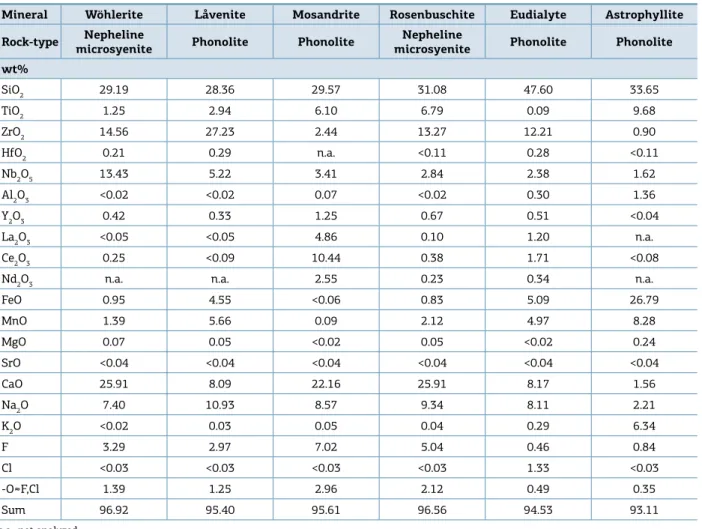
Chemical analyses of feldspars, clinopyroxenes, amphi-boles, micas, and opaques and diagrams relating cationic concentrations and ratios of distinct elements in some minerals are listed in Alves (1997) (for the data source and analytical conditions, access the site: http://www.teses.usp. br/teses/disponiveis/44/44135/tde-18092015-174733/ pt-br.php). Analyses of rare minerals (see Table 1) were
Table 1. Representative WDS analyses of Zr-, Ti-, Nb-, and REE-rich silicate minerals of agpaitic dikes from Búzios Island.
Mineral Wöhlerite Låvenite Mosandrite Rosenbuschite Eudialyte Astrophyllite
Rock-type Nepheline
microsyenite Phonolite Phonolite
Nepheline
microsyenite Phonolite Phonolite wt%
SiO2 29.19 28.36 29.57 31.08 47.60 33.65
TiO2 1.25 2.94 6.10 6.79 0.09 9.68
ZrO2 14.56 27.23 2.44 13.27 12.21 0.90
HfO2 0.21 0.29 n.a. <0.11 0.28 <0.11
Nb2O5 13.43 5.22 3.41 2.84 2.38 1.62
Al2O3 <0.02 <0.02 0.07 <0.02 0.30 1.36
Y2O3 0.42 0.33 1.25 0.67 0.51 <0.04
La2O3 <0.05 <0.05 4.86 0.10 1.20 n.a.
Ce2O3 0.25 <0.09 10.44 0.38 1.71 <0.08
Nd2O3 n.a. n.a. 2.55 0.23 0.34 n.a.
FeO 0.95 4.55 <0.06 0.83 5.09 26.79
MnO 1.39 5.66 0.09 2.12 4.97 8.28
MgO 0.07 0.05 <0.02 0.05 <0.02 0.24
SrO <0.04 <0.04 <0.04 <0.04 <0.04 <0.04
CaO 25.91 8.09 22.16 25.91 8.17 1.56
Na2O 7.40 10.93 8.57 9.34 8.11 2.21
K2O <0.02 0.03 0.05 0.04 0.29 6.34
F 3.29 2.97 7.02 5.04 0.46 0.84
Cl <0.03 <0.03 <0.03 <0.03 1.33 <0.03
-O≈F,Cl 1.39 1.25 2.96 2.12 0.49 0.35
Sum 96.92 95.40 95.61 96.56 94.53 93.11
performed in a Jeol JXA-8600 electron microprobe at the Geoanalítica, at University of Sao Paulo (USP) facility, using an accelerating voltage of 15 kV, a beam current of 20 nA and a combination of well-analyzed natural and synthetic standards.
Feldspars
Alkali feldspar, mainly represented by micro- to mesoperthite of distinct and complex textural patterns, is the most important constituent of the Búzios rocks. he mineral is abundant in all of the lithologies, except for the maic and lamprophyric rocks, in which it occurs interstitially or within the ocelli as a very pure potassic
phase. Alkali feldspar usually shows a low anorthite (An) content and a heterogeneous composition that grades
continuously along the orthoclase (Or)-albite (Ab) side of the Or-Ab-An ternary diagram or is grouped mainly at its Ab corner (Figs. 3A and 3B). In dikes, the mineral is found as microcrysts to phenocrysts of either albite or sanidine, or even as exsolution lamellae. Plagioclase is almost restricted to the maic-ultramaic dikes, forming crystals widely variable in composition (An75-30), with the matrix phases generally more enriched in Ab compared to the larger grains (Fig. 3C).
Clinopyroxenes
hese minerals are present as large crystals in medium- to coarse-grained rocks, as microcrysts to phenocrysts in ine-grained varieties, or as groundmass phases in some felsic to maic-ultramaic dikes. he composition is highly variable,
Ab Or
An
Ab Or
An
Ab Or
An
A
B
C
Figure 3. Chemical analyses of Búzios feldspars in the Ab-Or-An diagram (ater Alves 1997). Symbols: (A) open
square, syenite; (B) open circle, trachyte; open triangle, nepheline (sodalite) microsyenite and phonolite; (C) full
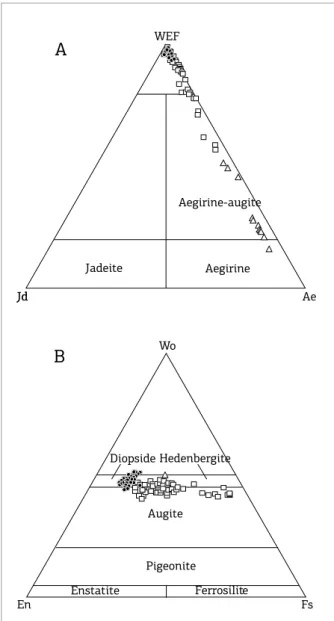
ranging from more calcic to calcic-sodic to sodic types in the WEF (wollastonite, entatite, ferrossilite) — Jd (jadeite, NaAlSi2O6) — Ae (aegirine, NaFe3+Si
2O6) (cf. Morimoto
et al. 1988) triangular diagram (Fig. 4A). In the classical Wo (wollastonite, Ca2Si2O6) — En (enstatite, Mg2Si2O6) — Fs (ferrossilite, Fe2Si2O6) diagram (Fig. 4B), they are rep-resented exclusively by diopside in maic-ultramaic dikes and by diopside-hedenbergite grading to aegirine-augite in mostly syenitic rocks. An aegirinic composition character-izes the felsic dikes (Fig. 4A). Zoning is a common feature of the clinopyroxenes, as indicated by chemical changes and
variable pleochroism. A decrease in Mg and a concomitant increase in Fe and Na contents is noticed from cores to rims of crystals. his negative correlation is also a characteristic feature of clinopyroxenes from the three Búzios rock suites, whereas a negative correlation between Mg and Ti is partic-ularly common in minerals from the maic-ultramaic suite (Alves 1997). On the whole, these chemical variations relect the transition of clinopyroxenes of diopsidic composition to minerals more enriched in the acmite molecule. Regarding the pleochroism, a lighter green color is a common feature of the nuclei of zoned crystals, whereas a darker green is typical of its margins.
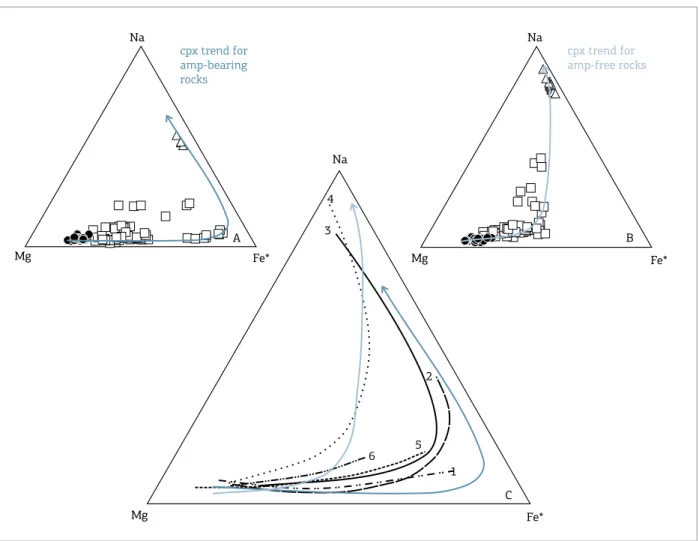
Figure 5 shows the crystallization trends of clinopy-roxenes from Búzios and other alkaline occurrences from Southeastern Brazil. Two distinct trends for the Búzios minerals are distinguished. he irst trend exhibits a con-tinuous increase in the Fe* (Fe2++Mn+Fe3+-Na)
concentra-tion, with Na almost constant during the decrease of Mg content, followed by a Na enrichment in low Mg- clinopy-roxenes; it is commonly associated with amphibole-bearing rocks (Fig. 5A). he second trend, represented by the rims of zoned crystals from syenitic rocks and by samples from felsic dikes, displays a strong enrichment in Na and minor variations in the Mg/Fe* ratio; it is usually associated with amphibole-free rocks (Fig. 5B). he irst trend presents similarities with those of minerals from the São Sebastião Island (Bellieni et al. 1990), the Morro Redondo (Brotzu et al. 1989) and the Morro de São João (Brotzu et al. 2007) alkaline intrusions (Fig. 5C). On the other hand, the second trend approaches the pattern displayed by rocks from the Mantiqueira Mountain complexes of Passa Quatro (Brotzu
et al. 1992) and Itatiaia (Brotzu et al. 1997), as also shown in Figure 5C. Variable oxidizing conditions during crys-tallization could account for the diference in Fe2+
enrich-ment relative to Fe3+ and Na enrichment in clinopyroxenes
(Marks et al. 2008).
Amphiboles
hese minerals are widespread in Búzios rocks and usu-ally formed after the breakdown of clinopyroxenes. In some samples, particularly of maic and lamprophyric dikes, they constitute a primary phase and represent the principal maic mineral in these rocks. Generally, the amphiboles are joined by biotite that occurs along the borders of their crystals or occupies the cleavage planes. he evolution of these min-erals is similar to that of the clinopyroxenes, grading in syenitic rocks from more magnesian towards more iron-rich compositions, with the amphiboles mostly classiied as Mg- and Fe-hornblende, respectively (cf. Leake 1997). he enrichment in Fe is also accompanied by a progressive increase in Na content. In a few samples, the amphiboles are
Wo WEF
B
A
En Jd Jd
Fs Ae
Hedenbergite
Augite
Pigeonite
Enstatite Ferrosilite Jadeite
Diopside
Aegirine Aegirine-augite
Figure 4. Chemical analyses of Búzios clinopyroxenes
(A) in the WEF-Jd-Ae diagram of Morimoto et al.
(1988) and (B) in the classical Wo-En-Fs system
(ater Alves 1997). Symbols: (A) open square, syenite;
(B) open circle, trachyte; open triangle, nepheline (sodalite) microsyenite and phonolite; (C) full circle,
Fe-barroisite, edenite or hastingsite in composition. In felsic dikes, the mineral corresponds to katophorite (highest Fe contents) and riebeckite in more Na-rich varieties, whereas in maic-ultramaic ones, it falls dominantly into the kae-surtite ield and contains high Ti and Al concentrations.
Micas
Micas are present in all lithologies of the massif, but less frequently in felsic dikes. Except in the lamprophyric rocks, the minerals are of secondary origin and variable color and occur closely associated with clinopyroxenes and amphiboles. he chemical composition shows high Ti and wide varia-tions in Al contents and Fe/Fe+Mg ratios, although in most of the cases the minerals may be called biotite. he more
magnesian varieties are related to maic-ultramaic dikes and contain higher AlIV and Ti concentrations, approaching the
eastonite-siderophylite series (Fig. 6). In general, Si and AlIV
cationic proportions are insuicient to ill the tetrahedral site, with the position being completed by Fe3+or Ti4+, as it has
been noted in several alkaline occurrences from Southeastern Brazil (see, for instance, Morbidelli et al. 1995).
Quartz
his mineral is present in variable amounts as individual crystals or as interstitial aggregates. SiO2-oversaturated sye-nitic rocks have amphibole as the main maic mineral and quartz in association with alkali feldspar, forming a typical granophyric texture.
5 2 3
6
1 4
Mg
Na
Fe* cpx trend for amp-free rocks
A
Mg
Na
Fe* Mg
Na
Fe* cpx trend for amp-bearing rocks
B
C
Figure 5. (A) Cristallization trend of Búzios clinopyroxenes for amphibole-free lithotypes. (B) Cristallization trend
of Búzios clinopyroxenes for amphibole-bearing lithotypes. Symbols: (A) open square, syenite; (B) open circle,
trachyte; open triangle, nepheline (sodalite) microsyenite and phonolite; (C) full circle, maic-ultramaic rocks. (C) Comparison of the diferent Búzios clinopyroxene trends with the main evolutionary trends for clinopyroxenes
of alkaline complexes from southeastern Brazil. Fe* = (Fe2++Mn+Fe3+-Na). References: 1. São Sebastião Island
(Bellieni et al. 1990); 2. Vitória Island (Motoki 1986); 3. Monte de Trigo Island (Enrich 2005); 4. Passa Quatro
(Brotzu et al. 1992) and Itatiaia (Brotzu et al. 1997); 5. Morro Redondo (Brotzu et al. 1989); 6. Morro de São João
(Brotzu et al. 2007). Dark blue line, clinopyroxene trend for Búzios amphibole-bearing rocks; light blue line:
Al
Mg
Eastonite
Phogopite
Siderophilite
Annite
Fe
Figure 6. Chemical analyses of Búzios micas in the
Al-Mg-Fe diagram (ater Alves 1997). Symbols: (A) open
square, syenite; (B) open circle, trachyte; open triangle, nepheline (sodalite) microsyenite and phonolite; (C)
full circle, maic-ultramaic rocks.
Feldspathoids
his mineral group contains nepheline as the most abun-dant constituent, but sodalite and analcite are also recog-nized. he latter phase is present in the groundmass or as
ocelli in lamprophyric rocks, with the mineral occurring in
close contact with glass and secondary minerals (carbon-ates and zeolites). Cancrinite is the main alteration product of nepheline and occupies the boundaries of its crystals or occurs concentrated along its fractures. Alves (1997) reported nepheline crystals with minor quartz (Q6-7) and main nephe-line (Ne73-74) endmembers, indicating equilibrium tempera-ture higher than 775ºC for the mineral (Hamilton 1961).
Olivines
Olivines are scarce and almost restricted to the lampro-phyric rocks, forming megacrystals or aggregates in asso-ciation with clinopyroxene, plagioclase, phlogopite, and opaques. he few data available in Alves (1997) point to a composition in the crysolite ield (Forsterite: 76-84 mol%) and CaO content lower than 0.38 wt%.
Fe-Ti oxide minerals
These minerals are represented by magnetite that is highly variable in TiO2 (syenitic rocks, 0.40–7.78 wt%; maic-ultramaic dikes, 17.05–24.25 wt%) and found as isolated grains or coexisting with ilmenite lamellae (TiO2 in syenitic rocks, 44.05–52.23 wt%; maic dikes, 47.37– 50.13 wt%) (Alves 1997). Magnetite is widespread in Búzios lithotypes, whereas ilmenite occurs more frequently
in syenitic rocks. Temperature calculations by the author using Buddington and Lindsley’s (1964) geothermome-try suggested values between 580 and 680ºC and –log fO2 ~18–21 for the syenites; for the maic dikes, the results are between 870 and 960ºC and –log fO2 ~11–13.
Accessory minerals
he main accessory minerals are titanite, apatite, zir-con, allanite and luorite.Additionaly, an assemblage of mostly silicate minerals bearing Zr, Ti, Nb, and Rare Earth Elements (REE) is identiied in association with nepheline (sodalite) microsyenite and phonolite dikes of agpaitic ainity as indicated in Table 1. he whole set of minerals includes låvenite, mosandrite, rosenbuschiteandwöhlerite,which are Na-, Ca- and F-rich sorosilicates with variable amounts
of Zr, Nb, Ti and REE (e.g., Merlino & Perchiazzi 1988; Christiansen et al. 2003; Bellezza et al. 2009); eudialyte,
a Zr-, Fe-, Mn-, Ca-, Na- and Cl-rich cyclosilicate (e.g., Johnsen et al. 2003; Schilling et al. 2011); and
astrophyl-lite, a Ti-, Fe-, Mn- and K-rich heterophyllosilicate (e.g., Piilonen et al. 2003). Other rare accessory to
post-mag-matic minerals of the felsic dikes are britholite-(Ce), aenig-matite, pyrochlore, fergusonite-(Y), synchysite-(Ce) and bastnäsite-(Ce). Several of them are also typical of similar rocks from the nearby alkaline massif of Monte de Trigo Island (Enrich 2005; Enrich et al., 2016).
GEOCHEMISTRY
he chemical analyses of the Búzios rocks are taken after Alves (1997) (for the data source, access the site: http://www.teses.usp.br/teses/disponiveis/44/44135/tde-18092015-174733/pt-br.php) and plotted in the Total-alkali–silica (TAS) classiication diagram (cf. Le Maitre 1989; Fig. 7). Two rock assemblages are easily distinguished, with the irst group composed of lithologies more enriched in SiO2 (syenites and felsic dikes) and the second one consisting of less enriched types (maic-ultramaic dikes), including basic to ultrabasic rocks. he irst set can also be divided into syenites to nepheline (sodalite) syenites (trachytes to phonolites) and alkaline granites (rhyolites), the latter lithotypes showing chemical similarities with the basement charnockites. A potassic ainity is indicated for mostly rocks in Middlemost’s (1975) K2O vs. Na2O
Based on values for the agpaitic index (A.I.=Na2O+K2O/ Al2O3, molar ratio), most of the Búzios lithologies are clas-siied as belonging to the miaskitic series. However, some nepheline syenites and especially peralkaline phonolites exhibit typical agpaitic features (cf. Sörensen 1960), as suggested by chemical evidences (A.I.>1.0) and the pres-ence of exotic mineral phases bearing large-ion lithophile element (LILE), high ield strength elements (HFSE) and REE (Enrich et al. 2007a,b).
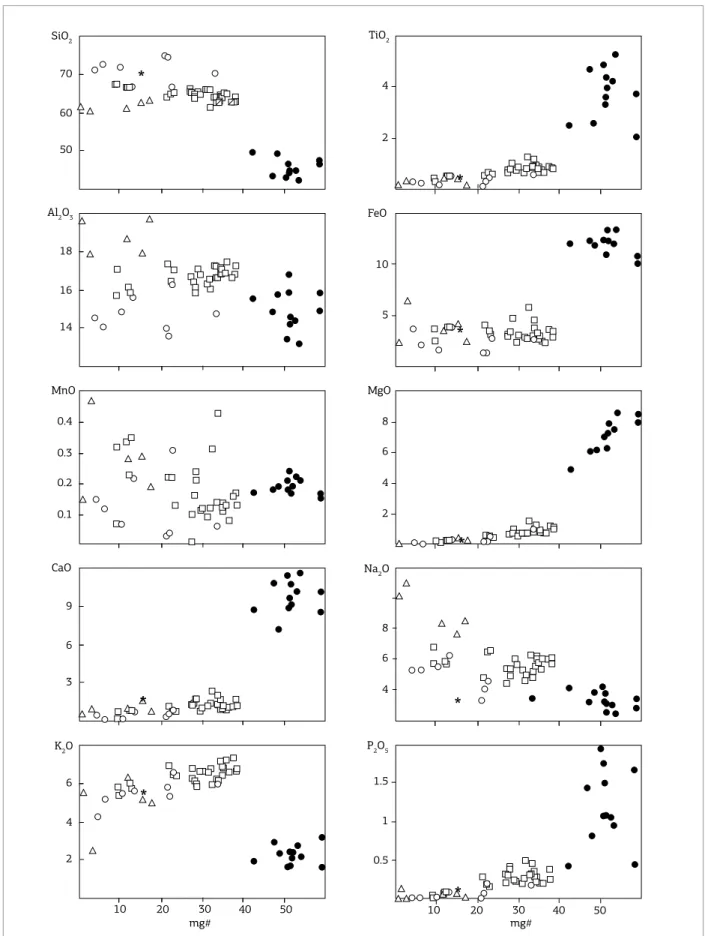
Variation diagrams (Figs. 9 to 10) for major and trace elements against Mg# [MgOmol./(MgOmol.+FeOTmol.)*100] show again the bimodal distribution of the elements and the existence of well-defined negative correlations
for SiO2, Na2O, Rb, Nb, Zr, La, Ce, and Nd, and pos-itive ones for TiO2, FeOT, MgO, CaO, P2O5, Cr, Ni, Ba, and Sr.
he distribution of incompatible elements normalized to the primitive mantle (cf. McDonough and Sun 1995) for the Búzios rocks is displayed in Figure 11. Positive anomalies are indicated for Nb, La-Ce, Nd, and Zr, and pronounced negative spikes occur for Ba, Sr, and Ti. he positive anom-aly for Ba and the negative one for Zr also characterize the maic dikes, and the felsic dikes both undersaturated and supersaturated in silica show approximately the same behav-ior. On the whole, these patterns are very similar to those described in other alkaline rocks from Southeastern Brazil,
Na
2
O + K
2
O (wt%)
SiO2 (wt%)
*
40 50 60 70
3 6 9 12 15
25%
50%
65%
FC Afs
Nph
Aeg
Di Mag,
Ilm
Ol
Pl
Picro-basalt
Basalt Basalt-andesite
Andesite Dacite
Rhyolite Trachyte
Trachy-andesite Tephrite-phonolite
Phonolite
Phonotephrite
Tephrite + Basanite Foidite
Trachy-andesite basaltic
Trachy-basalt
Figure 7. TAS (Na2O+K2O vs. SiO2, in wt%) diagram (cf. Le Maitre 1989) for the Búzios rocks (ater Alves 1997).
Symbols: open square, syenite; open circle, trachyte and rhyolite dikes; open triangle, nepheline (sodalite)
microsyenite and phonolite dikes; full circle, maic-ultramaic dikes; cross, mangerite host rock; asterisk, average composition of charnockitic rocks from the Ubatuba area (cf. Neumann 1993). Dark blue dashed line: models of fractional crystallization performed using the MELTS algorithm for initial liquid compositions calculated based on the basanite 326a compositions. The numerals on these lines refer to the percentage of fractionation of solid
phases of the system. The conditions inferred for those models are Tinitial ~1200ºC, P=1 kbar, fO2= QFM. The data
particularly the major syenitic occurrences from the Serra do Mar Province (Enrich et al. 2005).
PETROLOGY
he plutonic and hypabyssal syenitic rocks from Búzios are highly evolved as judged by their Mg# (<0.38) and very low Cr and Ni contents (<11 and <21 ppm, respectively). Even the maic-ultramaic dikes are evolved rocks (Mg#<0.65, Ni<235 ppm).
he bimodal alkaline magmatism found in the Buzios Island massif, with syenitic and felsic ine-grained rocks prevailing over maic-ultramaic lithologies, is probably
linked to fractional crystallization processes from paren-tal basic alkaline magmas. Fractional crysparen-tallization from a parental magma of basanitic composition has been pro-posed as the main evolution process for Early (Juquiá, Beccaluva et al. 1992; Ponte Nova, Azzone et al. 2016) and
Late (Lages, Traversa et al. 1996; Monte de Trigo Island, Enrich 2005; Morro Redondo, Brotzu et al. 1989; Passa
Quatro, Brotzu et al. 1992; Piratini, Barbieri et al. 1987; São Sebastião Island, Bellieni et al. 1990) alkaline
occur-rences from Southern Brazil.
he MELTS thermodynamic models of fractional crys-tallization (Ghiorso & Sack 1995; Asimow & Ghiorso 1998) were applied to evaluate the possible relationships of basanite dikes and the syenitic rocks from the Búzios
Na2O (wt%) K2
O (wt%)
2
2 2 6
5
Highly potassic
Potassic
Sodic
4 6 8 10
Afs
Nph
Di
Ol Pl Aeg
25%
50% 65%
*
Figure 8. Búzios rocks in the K2O vs. Na2O Middlemost’s (1975) diagram (ater Alves 1997). Symbols: open square,
syenite; open circle, trachyte and rhyolite dikes; open triangle, nepheline (sodalite) microsyenite and phonolite dikes;
full circle, maic-ultramaic dikes; cross, mangerite host rock; asterisk, average composition of charnockitic rocks from the Ubatuba area (cf. Neumann 1993). Dark blue dashed line: models of fractional crystallization performed using the MELTS algorithm for initial liquid compositions calculated based on the basanite 326a compositions.
The numerals on these lines refer to the percentage of fractionation of solid phases of the system. Mineral poles
70
18
0.4
0.2
9
6 60
16
0.3
0.1
6
4 50
14
3
2
10 20 30 40 50 10 20 30 40 50
2
5
4
4 2
0.5 SiO2
Al2O3
MnO
CaO
mg# mg#
Na2O
K2O P2O5
TiO2
FeO
MgO 4
8
8 6
6
1 10
1.5
*
*
*
*
*
*
*
*
Figure 9. Variation diagrams of major elements against Mg# for the Búzios rocks (ater Alves 1997). Symbols:
open square, syenite; open circle, trachyte and rhyolite dikes; open triangle, nepheline (sodalite) microsyenite and
*
*
1502000
1500
1000
500
4500
3600
2700
1800
900
10 20 30 40 50 10 20 30 40 50
100
50 Cr
*
220110 Rb
Sr
Zr
mg# mg#
Ni
Ba
Nb
Y 60
2400
1600
1000
210
140
70 30
800
500
250 750
La Ce
*
*
480
160 320
600
300
*
*
Figure 10. Variation diagrams of trace elements against Mg# for the Búzios rocks (ater Alves 1997). Symbols:
open square, syenite; open circle, trachyte and rhyolite dikes; open triangle, nepheline (sodalite) microsyenite and
0.1 1 10 100 1000
Rb Ba K Sr Nb La Ce Nd Ti Zr Y
Sample/Primitiv
e
M
an
tle
1 2 3 4 5
Figure 11. Primitive mantle-normalized trace elements patterns (cf. McDonough & Sun 1995) for the Búzios rocks
(ater Alves 1997). Legends: 1. Maic-ultramaic dikes; 2. syenites; 3. phonolites; 4. rhyolites; 5. mangerite host rock.
Island massif (Table 2). hese models also indicate the evolutionary trends of the assumed basanite parental melt and the crystallization sequences. he initial composition selected for the models corresponds to that of dike 326a, which is thought to represent a primitive non-cumulus liquid in the intrusion. Although other dikes show a more primitive composition, they are considered to represent a melt bearing an important volume of megacrysts, which could be assigned as antecrysts (Menezes et al. 2015); hence,
they are not a good indication of the parental magma com-position. he initial T (~1200–1150ºC) of the assumed parental magma was estimated based on the pyroxene saturation thermometer (Putirka 2008). A low-pressure condition (P=1 kbar) was also indicated for most Búzios rocks, as suggested by the AlVI contents (usually <0.1 a.f.u.)
and the calculated cell volumes (VCell>440 Å3, following
Nimis, 1995) of the clinopyroxenes. he fO2 bufer ixed for these models was the QFM, compatible with petro-graphic observations and similar to the one adopted by Trumbull et al. (2003) and Menezes et al. (2015). Low levels of H2O (1.0 wt%) and CO2 (0.2 wt%) were assumed based on petrographic evidences.
he early-crystallized minerals in the applied MELTS models are olivine, spinel and clinopyroxene, whereas apa-tite and plagioclase represent other fractionated phases.
he trend of the modelled liquid indicates a progressive decrease in the amounts of MgO, TiO2 and CaO and, sub-ordinately, an increase in concentrations of SiO2, Al2O3 and alkalis (K2O and Na2O; Figs. 7 and 8). To reach a syenite composition starting from the basanite would require the fractionation of ~7 wt% olivine, ~24 wt% clinopyroxene, ~22 wt% plagioclase, ~13 wt% spinel, and ~3 wt% apatite (~65% fractionation of solid phases; Table 2). Although outcrops of gabbroic cumulates that could corroborate the fractionation models are lacking in Búzios, it should be noted that these types of rocks crop out on the neighboring islands of Monte de Trigo (Enrich et al. 2005, 2009) and São Sebastião (Bellieni et al. 1990) and are also very common
in several other alkaline districts from Southeastern Brazil, such as Jacupiranga, Juquiá and Pariquera-Açu (Morbidelli
et al. 2000; Gomes et al. 2011) and Ponte Nova (Azzone
et al. 2013, 2016).
It is also important to note the clear compositional gap shown in the variation diagrams of the Búzios rocks, especially for major elements (Fig. 9), pointing to the
absence of compositions between 50 and 60 wt% SiO2
with intermediate compositions to low crustal levels (e.g., hompson et al. 2001). Alternatively, it could be the result of two distinct parental magmas, a maic and a felsic one (e.g., Legendre et al. 2005). his latter hypothesis usually leads to the mixture of maic and felsic melts. However, there is no description of ield, petrographic or chemi-cal evidences of magma mixing in the area (Alves 1997; Alves & Gomes 2001).
In the petrogeny residual system (Fig. 12, after Hamilton & Mackenzie 1965), the Búzios felsic rocks are compatible with major fractionation of alkali feldspar and plot diferently
with respect to the low-pressure Ab-Or thermal barrier. A trend towards the phonolitic minimum characterizes the SiO2-undersaturated association (felsic dikes of nepheline/ sodalite-bearing rocks), whereas a trend towards the rhyolitic minimum is associated with the SiO2-oversaturated rocks (felsic dikes of rhyolites). According to Alves (1997), the irst trend seems to be related to the normal evolution of the sye-nitic magma. Mineral vectors on the Na2O vs. K2O diagram (Fig. 8) also indicate the alkali feldspar fractionation from a syenitic magma towards a phonolite liquid and suggest that some syenites are alkali feldspar cumulates. he second trend
Table 2. Summary of thermodynamic fractional crystallization models developed using the MELTS algorithm (Ghiorso and Sack, 1995) from a basanitic liquid compositionally similar to sample 326a. The starting composition
is found under isobaric conditions (1 kbar) and with fO2 conditions equal to the QFM bufer. Abbreviations: Ap,
apatite; Cpx, clinopyroxene; Ol, olivine; Pl, plagioclase; Spl, spinel group.
Steps 1 2 3 4 5 6 7 8 9 10 11 12 13 14 15
T (oC) 1176 1156 1136 1116 1096 1076 1056 1036 1016 996 976 956 936 916 896
Fractionated
solids (f%) 0.0 1.5 3.2 7.5 24.1 34.1 41.7 48.6 53.7 57.7 61.0 63.8 66.3 68.4 70.4
MELT compositions
SiO2 43.52 43.59 43.73 44.98 47.91 50.60 52.63 54.39 55.82 56.99 57.98 58.81 59.49 60.04 60.48
TiO2 4.31 4.37 4.41 3.95 2.75 2.04 1.64 1.40 1.22 1.08 0.96 0.86 0.78 0.72 0.66
Al2O3 14.08 14.29 14.53 14.93 16.27 17.57 18.04 17.91 17.68 17.38 17.03 16.67 16.31 15.95 15.59
Fe2O3 2.21 2.23 2.24 2.10 1.74 1.45 1.24 1.07 0.93 0.81 0.71 0.63 0.55 0.47 0.41
FeO 10.18 10.08 9.90 8.77 6.93 5.69 4.73 3.92 3.27 2.74 2.31 1.94 1.62 1.35 1.12
MnO 0.17 0.17 0.16 0.17 0.20 0.23 0.26 0.28 0.31 0.32 0.34 0.35 0.37 0.38 0.39
MgO 7.17 6.65 6.09 5.45 4.15 3.23 2.61 2.14 1.80 1.52 1.30 1.12 0.97 0.84 0.74
CaO 10.54 10.69 10.87 11.21 9.88 8.21 7.02 6.11 5.38 4.78 4.28 3.86 3.50 3.21 2.96
Na2O 3.08 3.13 3.18 3.33 4.01 4.59 5.03 5.39 5.68 5.89 6.05 6.17 6.25 6.30 6.31
K2O 2.06 2.09 2.12 2.22 2.70 3.11 3.51 3.96 4.37 4.76 5.14 5.50 5.86 6.21 6.55
P2O5 1.49 1.51 1.54 1.61 1.88 1.53 1.32 1.19 1.10 1.03 0.99 0.96 0.94 0.95 0.96
H2O 0.99 1.00 1.02 1.07 1.30 1.47 1.64 1.84 2.04 2.23 2.41 2.59 2.78 2.96 3.16
CO2 0.20 0.20 0.20 0.21 0.26 0.30 0.34 0.38 0.43 0.47 0.51 0.55 0.58 0.62 0.67
Total 100.00 100.00 99.99 100.00 99.98 100.02 100.01 99.98 100.03 100.00 100.01 100.01 100.00 100.00 100.00
% of solid phases (in equilibrium with each step)
Cpx 0.66 12.39 6.86 3.1 1.13 0.6 0.32 0.17 0.11 0.08 0.06 0.05
Ol 1.46 1.52 1.23 0.09 0.06 0.31 0.54 0.4 0.33 0.29 0.23 0.18 0.14 0.11
Spl 0.16 2.45 4.06 2.07 1.39 1.05 0.71 0.5 0.35 0.27 0.21 0.16 0.13
Pl 2.3 3.81 3.18 2.74 2.41 2.14 1.93 1.77 1.94
Ap 0.14 1 0.57 0.38 0.25 0.17 0.13 0.1 0.07 0.05 0.04
% of accumulated fractionated phases from previous steps
Cpx 0.65 13.04 19.89 22.98 24.11 24.71 25.03 25.19 25.3 25.38 25.43
Ol 1.46 2.98 4.21 4.29 4.36 4.67 5.2 5.6 5.93 6.22 6.45 6.63 6.77
Spl 0.16 2.61 6.66 8.73 10.11 11.16 11.87 12.36 12.7 12.97 13.17 13.33
Pl 2.29 6.1 9.29 12.03 14.43 16.57 18.5 20.26
could be the result of moderate water pressures adequate to promote the oversaturation of the magma in lower tempera-ture zones (e.g., at the margins of the intrusion), leading to the destabilization of the clinopyroxene and formation of amphibole and/or biotite, with SiO2 in excess. Studying the Itatiaia massif, which also contains SiO2-undersaturated and SiO2-oversaturated rocks, Brotzu et al. (1997) suggested that
a fractionation process dominated by silica-poor and alka-li-rich amphibole is a possible way to straddle the Ab-Or join in the Qz-Ne-Ks diagram. he authors postulated that variations in mineral composition, mainly of amphibole, of the least diferentiated syenites excluded the possibility of a direct link between the two suites, and proposed for such lithologies a genesis from distinct maic parental magmas showing diferent degrees of SiO2 saturation. his conclu-sion could also be applied to the Búzios rocks.
The bridging of the thermal barrier may also be explained by AFC processes (DePaolo 1981). In some
850
850
850
850 900
950 1000
900 800
800
750
800 SiO2
NaAlSiO4 KAlSiO4
Ab
Or
Lc
Nepheline
Kalsilite Leucite
Leucite Na, K-feldspar
*
PH2O=1 kbar
Figure 12. The Búzios rocks plotted in the normative Qz-Ne-Ks residual system at PH20=1 kbar (ater Hamilton
and MacKenzie 1965). Isotherms and cotectic lines ater Hall (1987). Symbols: open square, syenite; open circle,
trachyte and rhyolite dikes; open triangle, nepheline (sodalite) microsyenite and phonolite dikes; asterisk, average
composition of charnockitic rocks from the Ubatuba area (cf. Neumann 1993).
alkaline intrusions from Southeastern Brazil, such as Itatiaia (Brotzu et al. 1997) and Cananeia (Spinelli & Gomes 2009), silica-oversaturated syenitic rocks occurring as small dikes appear to have been inluenced by crustal contamination or AFC processes, as mainly indicated by the high 87Sr/86Sr initial ratios (>0.705, cf. Ruberti et al.
2005). Unfortunately, no isotopic data are available for the Búzios rhyolitic rocks. Crustal assimilation processes are believed to play an important role in the genesis of other alkaline intrusions of Southern Brazil, as suggested by Motoki (1986) and Motoki et al. (2015) for the
neigh-boring Vitória Island and the Cabo Frio massif, as well as by Azzone et al. (2016) for the maic-ultramaic
com-plex of Ponte Nova.
be part of a single magmatic sequence formed by fractional crystallization or represent diferent pulses of undersatu-rated alkaline magmas.
FINAL REMARKS
Geological evidence indicates that Precambrian forma-tions of the Ribeira Belt were probably intruded by diferent pulses of alkaline magma on Búzios Island. he emplace-ment of these magmas, and also of other alkaline rocks on the neighboring islands, is clearly controlled by regional tectonics, as already suggested by Almeida (1983) and Riccomini et al. (2005).
Similar to other alkaline centers from Southeastern Brazil (Morbidelli et al., 1995), which show the presence of volcanic structures and lithotypes (e.g., Itatiaia, Piratini, Poços de Caldas, Tunas) or of cumulate rocks occupying shallow stratigraphic positions (e.g., Jacupiranga), the sye-nitic magmatic activity in Búzios was developed under low-pressure conditions.
he Búzios alkaline rocks can be placed into two main assemblages. he irst and most abundant group includes plutonic felsic types, mostly alkali feldspar syenites and minor amounts of quartz-alkali feldspar syenites. Also belonging to this association are dikes, widely variable in composi-tion, with microsyenites and trachytes as the main petro-graphic types. he second assemblage consists of maic to ultramaic rocks that occur as small lamprophyric dikes (alkali basalts, basanites, tephrites, and trachybasalts). In contrast to Monte de Trigo and São Sebastião Islands, and like Vitória Island, Búzios does not have outcrops of plutonic alkaline basic rocks.
Mineralogically, the Búzios lithologies have alkali feld-spar (mesoperthite), clinopyroxenes (diopsidic to aegirinic in composition), amphiboles (Mg-hornblende evolving towards more calcic-sodic types), micas (Mg-biotites to Fe-biotites), opaques (magnetite and ilmenite), and quartz as princi-pal phases, with feldspathoids (nepheline and subordinate sodalite) occasionally present in ine-grained syenites, and plagioclase in more basic rocks. In the lamprophyric vari-eties, the amphibole is kaersutite, olivine occurs, and the biotite is Ti-rich. In addition to ore phases, the accessory mineralogy of the syenitic rocks includes apatite, titanite, zircon, luorite, and rare Ti-Zr-REE silicate phases, while zeolites and carbonates are the more common alteration products. Also notable is the presence of globules and ocelli
of variable mineralogical composition (analcite, glass and/or carbonates) in the lamprophyric rocks.
Excluding the lamprophyric rocks, textural evidence indi-cates that, after the formation of opaques, clinopyroxenes
are the irst maic minerals to be crystallized in the magma. hey occur as isolated crystals or are clearly surrounded by amphibole/biotite grains in the more advanced stages of mag-matic crystallization. Alkali feldspar appears to have been formed simultaneously with both maic minerals.
Zoning is particularly common in the clinopyroxenes, with the central areas of the crystals exhibiting lighter green-ish colours. Changes in color relect the variations in the chemical composition as follows: the increase in Fe and Na contents and the concomitant decrease in Mg from the cores to the rims of the crystals.
he chemical analyses of the Búzios rocks show a com-positional gap in SiO2 content (between 50 and 60 wt%), which corresponds to the interval between syenites and maf-ic-ultramaic dikes. his bimodal distribution is also sug-gested for other major elements, particularly FeO, MgO, CaO, and K2O. Overall, the rocks are typically potassic, although some dikes can be chemically classiied as sodic, peralkaline and agpaitic in composition.
he fractional crystallization of gabbroic cumulates from a basanite melt is considered to be responsible for the for-mation of the syenite magma of the island. MELTS mod-els indicate the fractionation of ~7 wt% olivine, ~24 wt% clinopyroxene, ~22 wt% plagioclase, ~13 wt% spinel, and ~3 wt% apatite (~65% fractionation of solid phases) to reach the syenite compositions.
Similar to other Brazilian alkaline districts (e.g., Itatiaia), Búzios has SiO2-undersaturated and SiO2-oversaturated rocks represented by felsic dikes of phonolitic and rhyolitic com-position, respectively. In the normative Qz-Ne-Ks petrogeny residual diagram, these compositions exhibit distinct behavior, trending towards the eutectic phonolitic minimum and the rhyolitic minimum, respectively. he irst trend is possibly associated with the normal evolution of the syenitic magma, with extensive fractionation of alkali feldspar. On the other hand, the trend towards the granitic eutectic may be due to alkali feldspar fractionation or to fractionation of amphi-bole, or it may be the result of AFC processes, a hypothesis that cannot be discarded because the almost total absence of isotopic data for the Búzios rocks.
ACKNOWLEDGEMENTS
Almeida F.F.M. 1983. Relações tectônicas das rochas alcalinas mesozoicas da região meridional da Plataforma Sul-Americana.
Revista Brasileira de Geociências, 13:139-158.
Alves F.R. 1997. Contribuição ao conhecimento geológico e
petrográico das rochas alcalinas da Ilha dos Búzios, SP. PhD Thesis,
Instituto de Geociências, Universidade de São Paulo, 274 p. Alves F.R. & Gomes C.B. 2001. Ilha dos Búzios, Litoral Norte do
Estado de São Paulo: aspectos geológicos e petrográicos. Geologia
USP, Série Cientíica, 1:101-114.
Alves F.R. & Gomes C.B. 2002. Idades das rochas alcalinas do Litoral do Estado de São Paulo: a Ilha dos Búzios. In: XLI Congresso Brasileiro de Geologia, João Pessoa, Anais, p. 535.
Amaral G., Bushee J., Cordani U.G., Kawashita K., Reynolds J.H. 1967. Potassium-argon ages of alkaline rocks from southern Brazil.
Geochimica et Cosmochimica Acta, 31:117-142.
Asimow P.D. & Ghiorso M.S. 1998. Algorithmic Modiications
Extending MELTS to Calculate Subsolidus Phase Relations. American
Mineralogist, 83:1127-1131.
Augusto T. & Vlach S.R.F. 2004. Ocorrência e quimismo de minerais dos grupos da chevkinita e do pirocloro em rocha sienítica da Ilha de São Sebastião. In: XLII Congresso Brasileiro de Geologia, Araxá, CD-ROM.
Azzone R.G., Enrich G.E.R., Gomes C.B., Ruberti E. 2013. Trace element
composition of parental magmas from maic-ultramaic cumulates determined by in situ mineral analyses: the Juquiá maic-ultramaic
alkaline-carbonatite massif, SE Brazil. Journal of South American
Earth Sciences, 41:5-21.
Azzone R.G., Montecinos Munoz P., Enrich G.E.R., Alves A., Ruberti E., Gomes C.B. 2016. Petrographic, geochemical and isotopic evidence
of crustal assimilation processes in the Ponte Nova alkaline maic-ultramaic massif, SE Brazil. Lithos, 260:58-75.
Azzone R.G., Ruberti E., Enrich G.E.R., Gomes C.B. 2009. Geologia e
geocronologia do maciço alcalino máico-ultramáico Ponte Nova
(SP-MG). Geologia USP, Série Cientíica, 9:23-46.
Barbieri M., Beccaluva L., Brotzu P., Conte A., Garbarino C., Gomes C.B., Loss E.L., Macciotta G., Morbidelli L., Scheibe L.F., Tamura R.M., Traversa G. 1987. Petrological and geochemical studies of alkaline rocks from continental Brazil. 1. The phonolite suite from Piratini, RS. Geochimica Brasiliensis, 1:109-138.
Beccaluva L., Born H., Brotzu P., Coltorti M., Conte A.M., Garbarino C., Gomes C.B., Loss E.L., Macciotta G., Morbidelli L., Ruberti E., Siena F., Traversa G. 1992. Fractional crystallization and liquid immiscibility processes in the alkaline-carbonatite complex of Juquiá (São Paulo State, Brazil). Journal of Petrology, 33:1371-1404.
Bellezza M., Merlino S., Perchiazzi N. 2009. Mosandrite: structural and crystal-chemical relationships with rinkite. The Canadian Mineralogist, 47:897-908.
Bellieni G., Montes-Lauar C.R., De Min A., Piccirillo E.M., Cavazzini
G., Meli A.J., Pacca I.G. 1990. Early and Late Cretaceous magmatism
from São Sebastião Island (SE-Brazil): geochemistry and petrology.
Geochimica Brasiliensis, 4:59-83.
Björnberg A.J.S. & Ellert R. 1955. Observações geológicas e
petrográicas sobre a Ilha dos Búzios. Anais da Academia Brasileira
de Ciências, 27:169-182.
Brotzu P., Barbieri M., Beccaluva L., Garbarino C., Gomes C.B., Macciotta G., Melluso L., Morbidelli L., Ruberti E., Sígolo J.B. 1992. Petrology and geochemistry of the Passa Quatro alkaline complex, MG-RJ-SP, Brazil.
Journal of South American Earth Sciences, 6:237-252.
REFERENCES
Brotzu P., Beccaluva L., Conte A.M., Fonseca M., Garbarino C., Gomes C.B., Leong R., Macciotta G., Mansur R.L., Melluso L., Morbidelli L., Ruberti E., Sígolo J.B., Traversa G., Valença J.G. 1989. Petrological and geochemical studies of alkaline rocks from continental Brazil. 8. The syenitic intrusion of Morro Redondo, RJ. Geochimica
Brasiliensis, 3:63-80.
Brotzu P., Gomes C.B., Melluso L., Morbidelli L., Morra V., Ruberti E. 1997. Petrogenesis of coexisting SiO2-undersaturated to SiO2 -oversaturated felsic igneous rocks: the alkaline complex of Itatiaia, southeastern Brazil. Lithos, 40:133-156.
Brotzu P., Melluso L., Bennio L., Gomes C.B., Lustrino M., Morbidelli L., Morra V., Ruberti E., Tassinari C.C.G, D’Antonio M. 2007. Petrogenesis of the Early Cenozoic potassic alkaline complex of Morro de São João, southeastern Brazil. Journal of South American
Earth Sciences, 24:93-115.
Buddington A.F. & Lindsley D.H. 1964. Iron-titanium oxide minerals and synthetic equivalents. Journal of Petrology, 5:310-357. Christiansen C.C., Johnsen O., Makovicky E. 2003. Crystal chemistry of the rosenbuschite group. TheCanadian Mineralogist, 41:1203-1224. Chayes F. 1977. The oceanic basalt-trachyte relation in general and in the Canary Islands. American Mineralogist, 62:666-671.
Coutinho J.M.V. & Melcher G.C. 1973. Levantamento geológico e
petrográico na Ilha do Monte de Trigo (Litoral Norte de São Paulo,
Brasil). Revista Brasileira de Geociências,3:243-256.
DePaolo D.J. 1981. Trace element and isotopic efects of combined
wallrock assimilation and fractional crystallization. Earth Planetary
Science Letters, 53:189-201.
Enrich G.E.R. 2005. Petrogênese da suíte alcalina da Ilha Monte de
Trigo, SP. PhD Thesis, Instituto de Geociências, Universidade de São
Paulo, 229 p.
Enrich G.E.R., Azzone R.G., Ruberti E., Gomes C.B. 2005. Itatiaia, Passa Quatro and São Sebastião Island, the major alkaline syenitic complexes from the Serra do Mar region. In: Comin-Chiaramonti P., Gomes C.B. (eds.). Mesozoic to Cenozoic alkaline magmatism in the
Brazilian Platform. Edusp/Fapesp, São Paulo, p. 419-442.
Enrich G.E.R., Ruberti E., Azzone R.G., Gomes C.B. 2016. Eudyalite-group minerals from the Monte de Trigo Island alkaline suite (Brazil): chemical composition and petrological implications. Brazilian
Journal of Geology46:411-426.
Enrich G.E.R., Ruberti E., Gomes C.B. 2009. Geology and geochronology of Monte de Trigo island alkaline suíte, southeastern Brazil. Revista
Brasileira de Geociências, 39:67-80.
Freitas R.O. 1947. Geologia e petrologia da Ilha de São Sebastião.
Boletim da Faculdade de Filosoia, Ciências e Letras da Universidade
de São Paulo, 85:1-244.
Garda G.M. 1995. Os diques básicos e ultrabásicos da região
costeira entre as cidades de São Sebastião e Ubatuba, Estado de
São Paulo. PhD Thesis, Instituto de Geociências, Universidade de
São Paulo,156 p.
Ghiorso M.S. & Sack R.O. 1995. Chemical mass transfer in magmatic processes. IV. A revised and internally consistent thermodynamic model for the interpolation and extrapolation of liquid-solid equilibria in magmatic systems at elevated temperatures and pressures. Contributions to Mineralogy and Petrology, 119:197-212. Gomes C.B., Ruberti E., Comin-Chiaramonti P., Azzone R.G. 2011. Alkaline magmatism in the Ponta Grossa Arch, SE Brazil: a review.
Hall A. 1987. Igneous petrology. Longman Scientiic Technical, 573 p. Hamilton D.L. 1961. Nepheline as crystallization temperature indicators. Journal of Geology, 69:321-329.
Hamilton D.L. & MacKenzie W.S. 1965. Phase equilibrium studies in the system NaAlSiO4 (nepheline)-KAlSiO4 (kalsilite)-SiO2-H2O.
Mineralogical Magazine, 34:214-231.
Heilbron M., Valeriano C.M., Tassinari C.C.G., Almeida J., Tupinambá, M., Siga Jr., O., Trouw R.A.J. 2008. Correlation of Neoproterozoic terranes between the Ribeira Belt, SE Brazil, and its African counterpart: comparative tectonic evolution and open questions.
In: Pankhurst R.J., Trouw, R.A.J., Brito Neves B.B., De Wit M.J. (eds.). West Gondwana: Pre-Cenozoic correlations across the South
Atlantic region. Geological Society of London, Special Publications,
294:211-237.
Hennies W.T. & Hasui Y. 1968. Geocronologia das rochas eruptivas da Ilha de São Sebastião, SP. In: XXII Congresso Brasileiro de Geologia, Belo Horizonte, Anais, p.145-148.
Hennies W.T. & Hasui Y. 1977. Contribuição ao reconhecimento da geologia da Ilha de São Sebastião. In: I Simpósio de Geologia Regional, São Paulo, Atas, p.199-209.
Johnsen O., Ferraris G., Gault R.A., Grice J.D., Kampf A.R., Pekov I.V. 2003. The nomenclature of eudyalite-group minerals. TheCanadian Mineralogist, 41:785-794.
Le Maitre R.W. 1989. A classiication of igneous rocks and glossary of
terms. Blackwell Science Publication, Oxford.
Leake B.E. 1997. Nomenclature of amphiboles. Report of the Subcommittee on Amphiboles of the International Mineralogical Association Commission on New Minerals and Mineral Names.
European Journal of Mineralogy,9:623-651.
Legendre C., Maury R.C., Carof M., Guillou H., Cotton J., Chauvel
C., Bollinger C., Hémond C., Guille G., Blais S., Rossi P., Savanier D. 2005. Origin of exceptionally abundant phonolites on Ua Pou Island (Marquesas, French Polynesia): partial melting of basanites followed by crustal contamination. Journal of Petrology, 46:1925-1962. Lima G.A. & Schorscher J.H.D. 1999. Complexo gábrico estratiforme da Ponta da Pacuíba, Ilha de São Sebastião, São Paulo. In: 6.º Simpósio de Geologia do Sudeste, São Pedro, Boletim de Resumos,p. 65. Marks M.A.W., Schilling J., Coulson I.M., Wenzel T., Markl G. 2008. The alkaline-peralkaline Tamazeght complex, High Atlas Mountains, Morocco: mineral chemistry and petrological constraints for derivation from a compositionally heterogeneous mantle source.
Journal of Petrology, 49:1097-1131.
McDonough W.F. & Sun S. 1995. The composition of the Earth.
Chemical Geology, 120:223-253.
Menezes S.G., Azzone R.G., Enrich G.E.R., Ruberti E., Cagliarani R.,
Gomes C.B., Chmyz L. 2015. The antecryst compositional inluence
on Cretaceous alkaline lamprophyre dykes, SE Brazil. Brazilian
Journal of Geology, 45:79-93.
Merlino S. & Perchiazzi N. 1988. Modular mineralogy in the cuspidine group of minerals. The Canadian Mineralogist, 26:933-943. Middlemost E.A.K. 1975. The basalt clan. Earth Science Reviews,
11:337-364.
Montes-Lauar C.R., Pacca I.G., Meli A.J., Kawashita K. 1995.
Late Cretaceous alkaline complexes, southeastern Brazil: paleomagnetism and geochronology. Earth and Planetary Science
Letters, 134:425-440.
Morbidelli L. Gomes C.B., Beccaluva L., Brotzu P., Conte A.M., Ruberti E., Traversa G. 1995. Mineralogical, petrological and geochemical aspects of alkaline and alkaline-carbonatite associations from Brazil. Earth-Science Reviews,39:135-168.
Morbidelli L., Gomes C.B., Brotzu P., D’Acquarica S., Garbarino C., Ruberti E., Traversa G. 2000. The Pariquera-Açu K-alkaline complex and southern Brazil lithospheric mantle source characteristics.
Journal of Asian Earth Sciences, 18:129-150.
Morimoto N., Fabries J., Ferguson A.K., Ginzburg I.V., Ross M., Seifert F.A., Zussmann J., Aoki A., Gotardi G. 1988. Nomenclature of pyroxenes. American Mineralogist, 73:1123-1133.
Motoki A. 1986. Geologia e petrologia do maciço alcalino da Ilha de
Vitória, SP. PhD Thesis, Instituto de Geociências, Universidade de
São Paulo, 245 p.
Motoki A. 2000. Nepheline syenite magma superheating of the Vitória Island syenitic intrusive rock body, São Paulo, Brazil. In: 31st International Geology Congress, Rio de Janeiro,
Abstracts, CD-ROM.
Motoki A. & Gomes C.B. 1984. Caracterização geológica e petrográica
do maciço alcalino da Ilha de Vitória, SP. In: XXXIII Congresso Brasileiro de Geologia, Rio de Janeiro, Anais, 9:4392-4399.
Motoki A., Gomes C.B., Dutra C.V. 1987. Assimilação de rochas encaixantes pelo magma nefelina sienítico do maciço alcalino da Ilha de Vitória, SP. In: 1.º Congresso Brasileiro de Geoquímica, Porto Alegre, v. 1, p. 375-397.
Motoki A., Sichel S.E., Vargas T., Melo D.P., Motoki K.F. 2015. Geochemical behaviour of trace elements during fractional crystallization and crustal assimilation of the felsic alkaline magmas of the state of Rio de Janeiro, Brazil. Anais da Academia Brasileira de
Ciências, 87:1959-1979.
Neumann R. 1993. Contribuição à petrologia das rochas
charnockíticas de Ubatuba, leste do Estado de São Paulo. MSc
Dissertation, Instituto de Geociências, Universidade de São Paulo, 86 p.
Nimis, P. 1995. A clinopyroxene geobarometer for basaltic systems based on crystal-structure modeling. Contributions to Mineralogy
and Petrology,121: 115-125.
Nimis P. 1995. A clinopyroxene geobarometer for basaltic systems based on crystal-structure modeling. Contributions to Mineralogy
and Petrology, 121:115-125.
Piilonen C., Mcdonald M., Lalonde E. 2003. Insights into astrophyllite-group minerals. II. Crystal chemistry. TheCanadian Mineralogist,
41:27-54.
Putirka K.D. 2008. Thermometers and barometers for volcanic systems. Reviews in Mineralogy & Geochemistry, 69:61-120. Riccomini C., Velázquez V.F., Gomes C.B. 2005. Tectonic controls of the Mesozoic to Cenozoic alkaline magmatism in central-southeastern Brazilian Platform. In: Comin-Chiaramonti P., Gomes C.B. (eds.). Mesozoic to Cenozoic alkaline magmatism in the Brazilian
Platform. Edusp/Fapesp, São Paulo, p. 31-55.
Ruberti E., Gomes C.B., Comin-Chiaramonti P. 2005. The alkaline magmatism from the Ponta Grossa Arch. In: Comin-Chiaramonti P., Gomes C.B. (eds.). Mesozoic to Cenozoic alkaline magmatism in the
Brazilian Platform. Edusp/Fapesp, São Paulo, p. 473-522.
Sato E.N., Vlach, S.R.F., Basei M.A.S. 2008. Zircon and baddeleyite U-Pb dating (TIMS) of Mesozoic alkaline rocks from the São Sebastião Island, southeastern Brazil. In: 33rd International
Geological Congress, Oslo, Abstracts, CD-ROM.
Schilling J., Wu F.-Y., McCammon C., Wenzel T., Marks M.A.W., Pfaf
K., Jacob D.E., Markl G. 2011a. The compositional variability of eudialyte-group minerals. Mineralogical Magazine, 75:87-115. Siga Jr. O., Gomes C.B., Sato K., Passarelli C.R. 2007. O maciço alcalino de Tunas, PR: novos dados geocronológicos. Geologia USP, Série
Sonoki I.K. & Garda G.M. 1988. Idades K-Ar de rochas alcalinas do Brasil Meridional e Paraguai Oriental: compilação e adaptação às novas constantes de decaimento. Boletim IG-USP, Série Cientíica, 19:63-85. Sörensen H. 1960. On the agpaitic rocks. In: XXI International Geological Congress, Norway, Part XIII, p. 319-327.
Spinelli F.P. & Gomes C.B. 2009. A ocorrência alcalina de Cananeia, litoral sul do Estado de São Paulo: petrologia e geoquímica. Revista Brasileira de Geociências, 39:304-323.
Thompson G.M., Smith I.E.M., Maipas J.G. 2001. Origin of oceanic phonolites by crystal fractionation and the problem of the Daly gap: an example from Rarotonga. Contributions to Mineralogy and Petrology, 142:336-346.
Traversa G., Barbieri M., Beccaluva L., Coltorti M., Conte A.M., Garbarino C., Gomes C.B., Macciotta G., Morbidelli L., Ronca S.,
Scheibe L.F. 1996. Mantle sources and diferentiation of alkaline
magmatic suite of Lages, Santa Catarina, Brazil. European Journal
of Mineralogy, 8:193-208.
Trumbull R.B., Buhn B., Romer R.L., Volker F. 2003. The petrology of basanite-tephrite inclusions in the Erongo Complex and implications for a plume origin of Cretaceous alkaline complexes in Namibia.
Journal of Petrology, 44:93-111.