Introduction
Gradual increment on practice variability:
effects on structure learning and skill parametrization
CDD. 20.ed. 152.3
http://dx.doi.org/10.1590/1807-55092016000300781
Marcelo Silva JANUÁRIO* Herbert UGRINOWITSCH* Guilherme Menezes LAGE* Márcio VIEIRA* Rodolfo Novellino BENDA*
*Escola de Educação Física, Fisioterapia e Terapia Ocupacional, Universidade Federal de Minas Gerais, Belo Horizonte, MG, Brasil.
Th e quality and speed of motor learning can be improved by factors frequently addressed in the process of teaching and learning of motor skills. Among such factors we can mention the knowledge of results1, modelling and demostration2,
goal-setting2, in addition to practice, which has been
acknowledged as one of the most infl uential factors3.
Practice has a key role in the acquisition of skilled behavior, which displays as remarkable features consistency and fl exibility4. A feature of this practice
is that it should not be a mere repetition of a specifi c solution to a problem, but the repetition of the process of solving motor problems5-6 which leads
the learner to the selection of the most appropriate responses to each motor problem.
In this process, the way the practice is scheduled infl uences the acquisition of motor skills7-12. Practice
has been scheduled in constant, blocked, serial and random fashion3, 10-11. A varied practice schedule
has been regarded as more effective as constant practice13-15, as random and serial practice have been
acknowledged as more eff ective than blocked practice in the learning of motor skills10, 16-18. Conversely,
contrasting results have been found, challenging the superiority of the varied practice over constant practice and the advantage of random and serial practice over blocked practice19-24. As a result of such controversy,
the combination of constant and varied practice was employed7-8, 20 with favorable results on the acquisition
of motor skills, particularly in the initial stages of
Abstract
Traditionally, on the learning of motor skill practice has been scheduled in constant, blocked, serial or random fashion. A superiority of variable over constant practice has been suggested as well as random and serial practices over blocked practice. Recently a specifi city of the type of practice has been observed: constant practice helps the formation of a movement structure, especially in the early learning, and the variable practice improves parameterization. This study investigated different practice schedules and their combinations in a sequence that provides a gradual increment of variability (constant, blocked, and random) in the acquisition of motor skills. Participants were divided into four groups (n = 10): CCC (constant), BBB (blocked), RRR (random) and CBR (constant-blocked-random). The experiment consisted of an acquisition phase and a transfer test. In the acquisition phase the task comprised pressing a numeric keyboard in a given sequence (2, 8, 6, 4) with the index fi nger, with fi xed relative timing among presses (22.2%, 44.4% and 33.3%) and specifi c total times (700, 900 and 1100 ms) determined by the experimental design. The test results showed a superiority of CBR and RRR groups in the absolute error measure, of CCC and BBB groups in the relative error measure, and CCC, BBB and CBR groups in the variability of relative error measure. These results evidence the practice schedules that provided smaller variability led to the learning of a movement structure, whereas the ones that provided greater variability culminated in the improvement in parameterization.
learning. Such occurrence can be explained by the repetition of practice conditions which results in the acquisition of a more consistent motor skill relative to blocked, serial and random practices7-8, 20-21, 24. A feature
of those studies is the introduction of associations between the eff ects of diff erent practice schedules and their outcomes, as structural characteristics and parameters of the learned motor skill.
Lai and Shea20 have shown superiority of constant practice in the learning of relative timing, a measure used to infer the formation of a cognitive structure or a skill structure related to the motor skill. Additionally, the absolute timing measure has been employed to evaluate the improvement of motor skill parameter specifi cation and performance accuracy. Furthermore, Shea et al.21 revealed an advantage of constant and blocked practice over random and serial practice schedules in the formation of the skill structure. Conversely, serial and random practice groups have shown superior motor skill parameter specifi cation. Th ese results indicate that practice schedules that provide greater consistency in a trial-by-trial basis, i.e. constant and blocked practice, favor the formation of a skill structure, whereas those who set greater variability from one trial to another, that is, the serial and random practice schedules, support the specifi cation of parameters in motor skills.
Considering the preceding evidence, few studies investigated the combination of diff erent practice schedules, aiming to fi nd which one would result in concurrent improvement of both motor skill structure and parameter specifi cation, which represents a more profi cient learning7-8. Th e results of these studies have shown that the combination of constant practice followed by random or blocked practice led to superior performance in relative and absolute timing in retention and transfer tests. Th ese fi ndings suggest a hierarchy in which initial constant practice gives greater emphasis to the formation of a skill structure, and subsequently varied practice improves the capability of skill parameterization of the learner7-8. In other words, the practice should combine schedules that initially provide greater consistency from trial
Method
Sample
to trial with subsequent practice schedules which generate greater variability7-8, 21, 25. However, few studies have investigated the combination of practice schedules in the acquisition of motor skills26-27. Th ere are few studies that combine constant, blocked and random practice in the same schedule, although such combination could assist in the learning process as the intertrial variability is increased in along with the learning of the practiced skill26.
Regarding blocked practice, Shea et al.21 found that this schedule alone favors the learning of a movement structure, whereas when combined with constant practice, Lage et al.8 found benefi ts not only in the formation of a motor skill structure, but also in parameterization capability. Possibly these results can be explained considering the blocked practice introduces both the aforementioned predictability features as well as the contextual interference eff ect. Facing such evidence, the following questions arise: what are the eff ects of the combination of constant-blocked-random practice in the acquisition of motor skills? Can the blocked practice, in the central position of the continuum between the constant practice and variability with high contextual interference (random practice), contribute to the learning of the structure and parameterization of the motor skill practiced?
Therefore, the objective of this study was to investigate the eff ects of constant, blocked and random practice schedules, and their combination (constant-blocked-random) in the learning of motor skills. Th is study presents three hypotheses: 1) the constant and blocked practice groups will present better performance in the structure measure in the transfer test when compared to random practice group; 2) the random practice group will outperform the constant and blocked practice groups in the parameterization measure20 in the transfer test; and 3) the group that practices in the constant-blocked-random sequence will present superior performance in the transfer test in the structural measure20 when compared to the random practice group and in the parameterization measure20 when compared to constant and blocked practice groups.
Forty volunteers undergraduate students of both sexes, self-declared right-handed, aged M = 24.5 years,
Experimental design
Apparatus and task Procedures
Th e instrument employed was similar the one used by Lai and Shea20, Lai et al.7 and Lage et al.8
in their studies. Th e apparatus was composed of a numeric keypad, a microcomputer and a software specially developed for task control and data storage. Th e task in the acquisition phase consisted of typing keys in a specifi c sequence (2, 8, 6, 4) on the numeric keypad with the index fi nger of the right hand, with set time-bound goals: relative timing between the keys (22.2%, 44.4% and 33.3% of total time); and absolute timing (700, 900 or 1100 ms) according to the experimental group. Th e task allows ascertaining the acquisition of a spatiotemporal movement pattern, with specifi c measures for structure formation (relative timing) and parameterization capability (absolute timing). In the transfer test, the absolute timing target was 1300 ms for all groups.
Th e experiment comprised an acquisition phase (90 practice trials) according to the assigned group schedule, and the transfer test (10 trials) carried out 24 hours after the acquisition phase. Th e volunteers were randomly distributed in four practice groups (n = 10): 1) constant (CCC); 2) blocked (BBB); 3) random (RRR) and 4) constant-blocked-random (CBR). Th e practice was varied with respect to time goals in absolute timing in random and blocked practice groups, with 700, 900 and 1100 ms total time goals, and 900 ms target in all practice trials in the constant practice group. Participants of the CBR group underwent 30 trials of constant practice, 30 trials of blocked practice and 30 trials of random practice in the acquisition phase, with an interval of three minutes after every 30 trials to change the software’s task presentation sequence. Participants in the CCC, BBB and RRR also had a 3 minute break every 30 trials. Th e four practice groups received knowledge of results (KR) on the absolute time and relative timing in all trials of the acquisition phase (100%). Th e transfer test consisted of 10 practice trials in the same task with an absolute time goal of 1300 ms, diff erent from the ones presented in the acquisition phase, without KR.
Data collection was carried out individually in a specifi c room for the purpose. All participants gave written informed consent. Verbal instructions and a demonstration of the task were presented, followed by an explanation of the KR presented by the task software. After sitting comfortably in front of the computer, the participants set the video monitor and keyboard to their liking. Information about the target relative timing was displayed throughout the acquisition phase in the PC screen, and at the start of each trial information on the absolute target time was also displayed to participants. In the fi rst experimental phase, the task consisted of performing a sequence of movements typing the numbers 2, 8, 6 and 4 of a standard computer numeric keypad, with absolute timing goal of 900 ms for the CCC group and 700, 900 and 1.100 ms for the BBB, RRR and CBR groups. Th e relative timing goal between each key press was 22.2% of the absolute time from the 2 to the 8 key, 44.4% of the absolute time from the 8 to the 6 key and 33.3% of the absolute timing from the 6 to the 4 key. After a “go” message displayed on the computer screen by the task software, the participant typed the aforementioned number sequence. Finally, the KR was provided on the screen and encompassed the following information: absolute (total) time, percentage error in each of the three relative timings and the sum of the relative timing errors.
Statistical procedures
Data were organized in 10 blocks of trials, comprehending nine blocks of the acquisition phase (block 1 through block 9) and the transfer test block (TT). Th e results were analyzed concerning relative error (skill’s structural measure) and absolute error (parameter and performance accuracy measure) in the acquisition phase and transfer test. Th e standard deviation of each subject between trials in these measures was selected as a measure of variability.
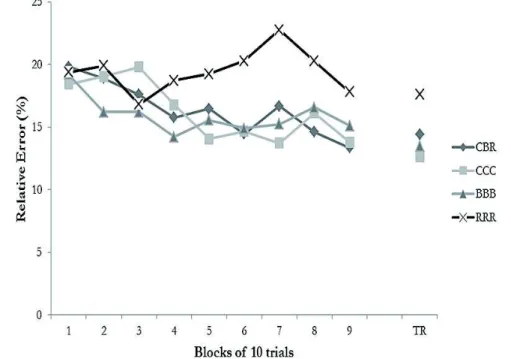
FIGURE 1 - Mean relative error in acquisition phase and transfer test.
Results
Transfer test Almost all groups showed error reduction
throughout practice, except for the RRR group, which maintained error in high levels (FIGURE 1). Nevertheless, the statistical analysis revealed no
signifi cant diff erence between groups [F(3, 36) = 2.13, p = 0.114] nor interaction between groups and blocks [F(24, 288) = 1.03, p = 0.425]. Nonetheless, Relative Error (RE)
Acquisition
The statistical analyses showed significant diff erences between groups [F(3, 36) = 3.03, p = 0.041], while the LSD test revealed smaller error of CCC e BBB groups relative to RRR group (p < 0.05). a diff erence between blocks was detected [F(8, 288) = 2.39, p = 0.017], which was located by the LSD test between the fi rst and the last blocks of trials (p < 0.05).
Absolute Error (AE)
Acquisition
Transfer test
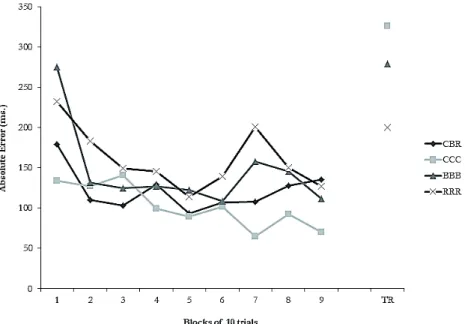
Statistical analysis indicated a significant diff erence between groups [F(3, 36) = 3.31, p = 0.031], and the LSD test unveiled lower error for CBR and RRR groups relative to CCC group. The groups showed a reduction in error
throughout practice (FIGURE 2). Statistical analysis revealed no signifi cant interaction between groups and blocks [F(24, 288) = 1.18, p = 0.258]. Diff erences were also found for the blocks factor [F(8, 288) = 6.24, p = 0.0001], and the LSD test showed higher error in the fi rst relative to the last
FIGURE 2 - Mean absolute error in acquisition phase and transfer test.
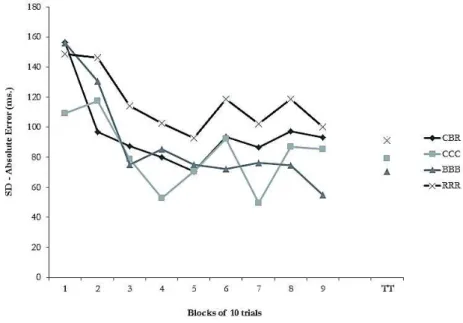
Groups showed reduction in relative error variability from the beginning to the end of the practice phase (FIGURE 3). Notwithstanding, the statistical analysis revealed no significant diff erences for blocks [F(8, 288) = 1.66, p = 0.1], nor interaction between groups and blocks [F(24, 288) = 0.55, p = 0.9]. A diff erence between groups
Relative error standard deviation
Acquisition
Transfer test
The analysis unveiled significant differences between groups [F(3, 36) = 3.44, p = 0.027], and the LSD test shown lesser error variability of CCC, BBB e CBR groups compared to RRR group. was found [F(3, 36) = 13.38, p = 0.001], and the LSD test revealed that the RRR group displayed greater error variability in relation to CCC, BBB e CBR groups (p < 0.05).
Discussion
FIGURE 4 - Mean of the standard deviation of the absolute error in acquisition phase and transfer test.
The current study aimed to investigate the eff ects of constant, blocked and random practice schedules, and the gradual increase in the intertrial variability of practice (constant-blocked-random combination), in the learning of motor skills.
Th e results demonstrated that the organization of practice aff ects both the learning of the skill structure and its parameterization.
Th e fi rst hypothesis tested was that groups of constant practice and in blocks would show better learning of the skill structure (relative timing measure). Results confi rmed the hypothesis, as the practice schedules that enforced a more consistent response in the acquisition phase led to better performance in the skill structure measure during the test. In the relative error measure, the CCC and BBB groups performed with a lower error than the RRR group. Th ose results support the fi ndings of Shea et al.21 in which CCC
Groups showed reduction in absolute error variability with practice (FIGURE 4). Th e statistical analysis revealed no diff erences between groups [F(3, 36) = 3.33, p = 0.09] neither interaction between groups and blocks [F(24, 288) = 0.45, p = 0.99]. Absolute error standard deviation
Acquisition
Transfer test
No diff erences between groups were found [F(3, 36) = 2.66, p = 0.063] (FIGURE 4).
Nonetheless, a signifi cant diff erence was found between blocks [F(8, 288) = 4.86, p = 0.0001], and the LSD test showed greater variability of the fi rst relative to the last block of trials (p < 0.05).
e BBB groups also showed superior performance in the relative error measure. Lai and Shea20 also found
in their study a better performance of the constant practice group in the relative error measure in testing, when compared to the varied practice group. Th e authors concluded the formation of a movement skill structure (in their rationale the generalized motor program) was achieved due to factors that benefi t the response stability during the acquisition the motor skill. Lage et al.8 argues that the opportunity to
remain steady during the practice trials, aff orded by some practice conditions, may favor the acquisition of a movement structure. Th erefore, these practice conditions allow the learner to direct attention to the relative timing structure during practice.
relative timing structure. Th is ensues due to the absence of parameter variation in the constant group, allowing the participants to focus their attention in relative timing during practice. The superior performance of blocked practice in the relative timing measure can be explained by the smaller parameter variation in that practice condition, which allows the learners to direct attention to the relative dimensions of the task. Th e present study results, altogether with Lai and Shea20 and Shea et al.21 studies, suggest the
constant and blocked practice conditions promote greater stability in response execution over the acquisition of motor skills compared to random practice conditions, leading to the learning of the movement skill structure. Hence the results of the current study are in line with the notion that factors that increase consistency during practice promote the learning of a movement skill structure20-21.
Our second hypothesis predicted that the random practice group would present superior performance in the parameterization measure compared to CCC and BBB groups (absolute time and performance accuracy). Th e results partially confi rm the hypothesis, since the RRR group exhibited superior performance in the absolute error measure in the test only when compared to the CCC group. Th ese results are in accordance with Shea et al.21 study, in which random
practice, aff ording greater response variability during acquisition, conducted to a more effi cient learning of the capacity of specifying parameters than constant practice. A possible explanation for the superior performance of the RRR group regarding the absolute error is the eff ective contribution of the contextual interference eff ect present in this practice schedule.
Th e current results demonstrate the eff ect of the contextual interference eff ect in the absolute error measure, since the CCC group was statistically more precise in acquisition compared to RRR group. In the transfer test the RRR group was more accurate than CCC group, supporting the eff ect of the contextual interference.
Concerning the explanation of the contextual interference eff ect generated by the varied practice schedules, two hypothesis have been proposed: the elaboration hypothesis, stated by Shea and Morgan10
and Shea and Zimny18, which suggests the high
contextual interference leads to a better elaboration of the memory representation over the skill variation features. During high contextual interference practice, the learner is compelled to vary the processing strategies, resulting in the formation of a stronger memory trace, less environmentally dependent of the
initial practice conditions. As stated by Corrêa28, the
contextual interference eff ect generates numerous and varied memory processes, resulting in two types of
skill representation in memory. Th e fi rst one features a greater distinction, due to the comparisons made by the learner during task execution. Th e second results from the greater elaboration following the diff erent strategies of codifi cation brought about by this kind of practice. Th ose events lead to a more meaningful memorization process, tentatively more lasting and probably easier to remember when performing the same task at a later time.
Another explanation that aims to explain the superiority of high contextual interference practices is the forgetting or reconstruction hypothesis, proposed by Lee and Magill16 and Lee et al.17 Th e authors
hypothesize that the interference generated by high contextual interference practice schedules results in greater variability between trials and thus might result in forgetfulness of the action plan, leading the learner to be driven to reconstruct the action plan at every trial. Such process wouldn’t take place in constant practice, since the learner may use the same action plan on consecutive trials. Consequently, the action plan reconstruction process can account for the learning gains. According to Lee and Magill16
the partial or complete forgetfulness that leads to the reconstruction of the action plan at every trial results in the strengthening of the active processes, which
allows for a more eff ective learning.
When comparing the performance of BBB and RRR groups in the absolute error measure, the results did not show a typical contextual interference eff ect. In particular, the RRR group did not show superior performance in testing compared to BBB group. A possible explanation for the absence of a signifi cant diff erence between blocked and random groups is the moderate contextual interference present in the former practice schedule. In blocked practice, unlike constant practice, there also is a change in task after a number of trials. Th us, the learners were led to vary the processing strategies, even if in a lesser extent than the CBA and AAA groups. At any rate, the variation introduced in blocked practice induced learners to reach similar performance to the random practice group.
Regarding the third hypothesis, the CBR group did not surpass the RRR group in relative timing performance. Th is result indicates the CBR group reached intermediate levels of learning, being comparable to CCC and BBB groups. One possible explanation is that the CBR group was not subject to the same level of stability of CCC and BBB groups in the acquisition phase. Porter and Magill27
conducted a study that showed that the combined group practice that initiated practice in a blocked schedule, followed by serial and random practice, showed superior performance in absolute error in the transfer test when compared to a random practice group. However, this group, which also provided a gradual increase in the variability of practice, did not show superior performance when compared to the blocked practice group in the transfer test. We stress that in the present study the combined practice group was composed of the constant, blocked and random practice schedules, whereas in the study by Porter and Magill27,
the combined practice group was constituted by blocked, serial and random practice schedules. Despite the combined practice group in this study starting in a schedule that allows for greater consistency during the acquisition, this did not favor the relative timing performance. Th e current results suggest that it may be necessary to provide additional consistency during acquisition trials.
Regarding the absolute error measure, CBR and RRR groups showed better performance than the CCC group in the transfer test, indicating that these groups reached a more effi cient learning parameter specifi cation of the task. Moreover, there was no signifi cant diff erence between the BBB group and the CBR and RRR groups, indicating that the BBB group showed an intermediate performance in absolute time. An explanation for the performance of CBR and RRR groups in absolute error is the eff ective contribution of the contextual interference eff ect in these practice schedules.
Notwithstanding, the results also suggest that the combination of constant-blocked-random practices, in which there is a gradual increase in the practice variability, resulted in a similar level of variability as the random practice group. Contrary to what was expected the CBR group did not show the expected performance in the relative timing measure. A possible explanation is the presence of random practice at the end of the acquisition. Th e random practice resulted in increased variability in response execution in the fi nal phase of acquisition,
leading to a reduction of the level of stability in the CBR group. Another factor that may have contributed to the learning of the response parameter specifi cation in the CBR group was the eff ect of contextual interference present in blocked practice. It seems that this eff ect, albeit low, added to the high contextual interference eff ect in this random practice, contributed to the learning of the response parameter specifi cation. Furthermore, results suggest that this quantity of constant practice in the combination group was not enough for individuals to reach the learning of a movement structure; constant practice was performed in only 33% of trials.
Results of the present study also suggest that intermediate levels of practice variability, present in blocked practice, may lead to the learning of a movement task structure. Th e current results support the “challenge point” hypothesis29. According
to this hypothesis, the contextual interference level can infl uence the functional diffi culty of the task. According to the authors, a low contextual interference practice schedule reduces the functional diffi culty of the task, which facilitates learning for beginners in the task. Th e blocked practice, which features low contextual interference, reduced the task’s functional level of diffi culty, allowing beginners to reach the learning of a movement structure. On the other hand, the CBR group allowed learners to become more skilled during practice. Th is is due to the group starting with a practice schedule that reduced the functional level of diffi culty of the task, and then allowed learners to benefit from the contextual interference effect present in blocked and random practice to learn how to specify the parameters of task response. As stated by Guadagnoli et al.30 experienced learners benefi t
from random practice, while inexperienced learners benefi t from blocked practice.
The results of the present study may also be supported by the hypothesis of “desirable diffi culties” proposed by Bjork31-32. It seems that the
intermediate levels of practice variability experienced by the BBB group provided a desirable level of diffi culty for learners. According to the author, the desirable diffi culty refers to the practice conditions that lead to the learner’s engagement in a process of eff ort during practice that allows the achievement of good performance in retention and transfer.
As previously discussed, blocked practice together with the random practice contributed to the increase of the response variability during acquisition. Th us, if the benefi t of the blocked practice was directed to increased variability, then the amount of constant practice may have been insuffi cient to promote the learning of a movement structure.
Importantly, these fi ndings indicate that novice learners can benefi t from a practice schedule that
promotes greater response consistency during acquisition to the learning of a movement structure and afterwards a practice schedule that provides greater response variability for learning the parameter specifi cation. Regarding the combined practice group, we suggest further studies to be carried out varying the amount of practice that provides greater response stability and those that provide greater response variability.
Resumo
Aumento gradual da variabilidade de prática: efeito na aprendizagem da estrutura e na parametrização da habilidade
Tradicionalmente, na aprendizagem de habilidades motoras a prática tem sido estruturada de forma constante, em blocos, seriada ou aleatória. Tem sido proposta a superioridade da prática variada sobre a prática constante bem como da prática aleatória e seriada sobre a prática em blocos. Atualmente tem sido observada uma especifi cidade do tipo de prática: a prática constante auxilia na formação de uma estrutura de movimento, especialmente no início da aprendizagem e a prática variada na melhora da parametrização. O presente estudo investigou diferentes regimes de prática e a sua combinação numa sequência que fornece um aumento gradual de variabilidade (constante, blocos e aleatório) na aqui-sição de habilidades motoras. A amostra foi distribuída em quatro grupos (n = 10): CCC (constante), BBB (blocos), AAA (aleatório) e CBA (constante-blocos-aleatório). O experimento foi dividido em fase de aquisição e teste de transferência. Na fase de aquisição a tarefa foi pressionar teclas numéricas do teclado de um computador em uma sequência (2, 8, 6, 4) com o dedo indicador, com tempo relativo entre os componentes especifi cado (22,2%, 44,4% e 33,3%) e com os seguintes tempos totais (700, 900 e 1100 ms) estabelecidos conforme o delineamento experimental. Os resultados do teste demonstraram superioridade dos grupos CBA e AAA na medida de erro absoluto, dos grupos CCC e BBB na medida de erro relativo e dos grupos CCC, BBB e CBA na medida de variabilidade de erro relativo. Tais resultados demonstram que os regimes de prática que forneceram menor variabilidade conduziram ao aprendizado de uma estrutura de movimento, enquanto que as que forneceram maior variabilidade resultaram na melhora da capacidade de parametrização.
PALAVRAS-CHAVE: Estrutura de prática; Combinação de prática; Estrutura de movimento; Parametrização.
References
1. Benda RN. Sobre a natureza da aprendizagem motora: mudança e estabilidade. Rev Bras Educ Fís Esporte. 2006;20:43-5. 2. Magill RA. Aprendizagem motora: conceitos e aplicações. São Paulo: Edgard Blucher; 2000.
3. Schmidt RA, Wrisberg CA. Aprendizagem e performance motora. Porto Alegre: Artmed; 2001.
4. Lage GM. Efeito de diferentes estruturas de prática na aprendizagem de habilidades motoras [dissertação]. Belo Horizonte (MG): Universidade Federal de Minas Gerais, Escola de Educação Física, Fisioterapia e Terapia Ocupacional; 2005. 5. Bernstein NA. Th e co-ordination and regulation of movements. Oxford: Pergamon; 1967.
6. Tani G. Crianças e movimento: o conceito de prática na aquisição de habilidades motoras. In: Krebs RJ, Copetti F, Beltrame TS, Ustra M, organizadores. Perspectivas para o desenvolvimento infantil. Santa Maria: Edições SIEC; 1999. p.57-64. 7. Lai Q, Shea CH, Wulf G, Wright DL. Optimizing generalized motor program and parameter learning. Res Q Exerc
8. Lage GM, Alves MAF, Oliveira FS, Palhares LR, Ugrinowitsch H, Benda RN. Th e combination of practice schedules:
eff ects on relative and absolute dimensions of the task. J Hum Mov Stud. 2007;52:21-35.
9. Meira Junior CM, Tani G, Manoel EJ. A estrutura da prática variada em situações reais de ensino-aprendizagem. Rev Bras Cien Movimento. 2001;9:55-63.
10. Shea JB, Morgan RL. Contextual interference eff ects on the acquisition, retention and transferer of a motor skill. J Exp Psychol Hum Learn. 1979;5:179-87.
11. Magill RA, Hall KG. A review of the contextual interference eff ect in motor skill acquisition. Hum Mov Sci. 1990;9:241-89.
12. Ugrinowitsch H, Manoel EJ. Interferência contextual: manipulação de aspecto invariável e variável. Rev Paul Educ Fis. 1996;10:48-58.
13. Barreiros JMP. Variability of practice and contextual interference in children and adults. Mot Hum. 1992;8:5-15. 14. Margolis JF, Christina RW. A test of Schmidt’s schema theory of discrete motor skill learning. Res Q Exerc Sport.
1981;52:474-83.
15. Moxley SE. Schema: the variability of practice hypotheses. J Mot Behav. 1979;11:65-70.
16. Lee TD, Magill RA. Th e locus of contextual interference in motor skill acquisition. J Exp Psychol learn. 1983;9:730-46. 17. Lee TD, Magill RA, Weeks DJ. Infl uence of practice schedule on testing schema theory predictions in adults. J Mot
Behav. 1985;17:283-99.
18. Shea JB, Zimny ST. Context eff ects in memory and learning movement information. In: Magill RA, editor. Memory and control of action. Amsterdam: North Holland; 1983. p.345-66.
19. Kerr R. Practice variability: abstraction or interference. Percept Mot Skills. 1982;54:219-24.
20. Lai Q, Shea CH. Generalized motor program (GMP) learning: eff ects of frequency of knowledge of results and practice variability. J Mot Behav. 1998;30:51-9.
21. Shea CH, Lai Q, Wright DW, Immink M, Black C. Consistent and variable conditions: eff ects on relative and absolute timing. J Mot Behav. 2001;33:139-52.
22. Van Rossun JHA. Schmidt’s schema theory: the empirical base of variability of practice hypothesis - a critical analysis. Hum Mov Sci. 1990;9:387-435.
23. Del Rey P, Whitehurst M, Wughalter E, Barnwell J. Contextual interference and experience in acquisition and transfer. Percept Mot Skills. 1983;57:241-2.
24. Corrêa UC, Ugrinowitsch H, Benda RN, Tani G. Eff ects of practice schedule on the adaptive process of motor learning. Rev Port Cien Desp. 2010;10:158-71.
25. Giuff rida CG, Shea JB, Fairbrother JT. Diff erential transfer benefi ts of increased practice for constant, blocked, and serial practice schedules. J Mot Behav. 2002;34:353-65.
26. Lage GM, Alves AF, Oliveira FS, Palhares LR, Ugrinowitsch H, Benda RN. O efeito da interferência contextual na aprendizagem motora: contribuições científi cas após três décadas da publicação do primeiro artigo. Rev Bras Cienc Mov. 2011;19:107-19.
27. Porter JM, Magill RA. Systematically increasing contextual interference is benefi cial for learning sport skills. J Sports Sci. 2010;28:1277-85.
28. Corrêa UC. Interferência contextual: contribuições à aprendizagem motora. In: Pellegrini AM, organizadora. Coletânea de estudos: comportamento motor I. São Paulo: Movimento; 1997. p.129-58.
29. Guardagnoli MA, Lee TD. Challenge point: a framework for conceptualizing the eff ects of various practice conditions in motor learning. J Mot Behav. 2004;36:212-24.
30. Guardagnoli MA, Holcomb WR, Weber TJ. Th e relationship between contextual interference eff ects and performance expertise on the learning of a putting task. J Hum Mov Stud. 1999;37:19-36.
31. Bjork RA. Memory and metamemory considerations in the training of humanbeigns. In: Metcalfe J, Shimamura A, editors. Metacognition: knowledge about knowing. Cambridge: MTT; 1994. p.185-205.
ADDRESS Marcelo Silva Januário Escola de Educação Física, Fisioterapia e Terapia Ocupacional Universidade Federal de Minas Gerais Av. Pres. Antônio Carlos, 6627 31270-901 - Belo Horizonte - MG - BRASIL e-mail: [email protected]
Submitted: 09/15/2013 1a. Review: 09/24/2013 2a. Review: 04/02/2015 Accepted: 05/13/2015
Authors tank to CNPq for its support.