Printed in Brazil - ©2007 Sociedade Brasileira de Química 0103 - 5053 $6.00+0.00
Short RShort RShort RShort RShort R
eporteporteporteporteport
*e-mail: [email protected]
Cohalogenation of Alkenes with DMF: an Easy Vicinal Haloformyloxylation Reaction
Adriana V. A. de Souza, Gabriela F. Mendonça, Rafael B. Bernini and Marcio C. S. de Mattos*
Instituto de Química, Universidade Federal do Rio de Janeiro, CP 68545,
21945-970 Rio de Janeiro-RJ, Brazil
A reação de alquenos com o ácido tricloro-isocianúrico ou N-bromo-sacarina ou I2 / Fe2(SO4)3 na presença de DMF, seguida de tratamento em meio aquoso, leva à formação dos respectivos
β-halo-formatos com alta regio- e estereosseletividade.
The reaction of alkenes with trichloroisocyanuric acid or N-bromosaccharin or I2 / Fe2(SO4)3 in the presence of DMF followed by aqueous work-up led to the corresponding β-haloformate in high regio- and stereoselectivity.
Keywords: addition reaction, alkenes, halogenation, esters, β-haloformyloxylation
Introduction
The vicinal functionalization of alkenes is an important
process in synthetic organic chemistry and several
methodologies are described in the literature.
1Among them,
the so-called “cohalogenation” (halogenation of an alkene
in the presence of a nucleophilic solvent) is an attractive
tool to produce vicinal halo-functionalized compounds
regioselectively, which are useful intermediates for diverse
organic transformations.
2A proposed mechanism goes
through formation of a halonium ion intermediate followed
by ring opening promoted by the nucleophilic solvent.
2Thus,
DMF can act as a nucleophile in the cohalogenation
reaction
3and so the halonium ion intermediate can be
attacked by the oxygen of DMF to produce an iminium ion,
which upon hydrolysis gives a vicinal haloformate
4(Scheme 1). In spite of its synthetic potential, this reaction
has received little attention, being the vicinal
haloformyl-oxylation of alkenes achieved using DMF / HCl and an
oxidizing agent
4or DMF /
N
-halosuccinimides.
5-7Alternative sources of electrophilic halogen species
(halenium ions) are of great interest from both mechanistic
and green synthesis points of view.
8Trichloroisocyanuric
acid (TCCA, Figure 1) is a stable and inexpensive solid
frequently found in a large number of commercial products
for swimming pool disinfection.
9,10N
-bromosaccharin
(NBSac, Figure 1) is a stable solid, easily prepared from
saccharin
11and much more reative than its analogue
NBS.
12On the other hand, I
2
/ Fe(III) salts are mild reagents
for iodination of alkenes
13that avoid the utilization of
oxidizing reagents and heavy-metal salts.
14During our investigation on cohalogenation reactions,
15we had shown that TCCA, NBSac, and I
2/ Fe
2(SO
4)
3are
efficient sources of electrophilic chlorine,
16bromine,
17and
iodine
18species, respectively, that react with alkenes in
the presence of diverse oxygenated solvents to give vicinal
halofunctionalyzed structures (halohydrins,
β
-haloethers,
and
β
-haloacetates).
Herein we communicate our results on the
cohalogenation of alkenes with TCCA, NBSac, and I
2/
Fe
2(SO
4)
3in the presence of DMF to produce vicinal
haloformates.
Results and Discussion
The reactions of representative alkenes
(cyclohexene, styrene,
α
-methylstyrene, and 1-octene)
with the sources of electrophilic halogens in DMF
afforded, after work up, the
β
-haloformates in 42-82%
isolated yields, as shown in Table 1. The reactions were
carried out stirring together the alkene with TCCA or
NBSac or I
2/ Fe
2(SO
4)
3in DMF for 1.5 h at room
temperature, followed by addition of water and the
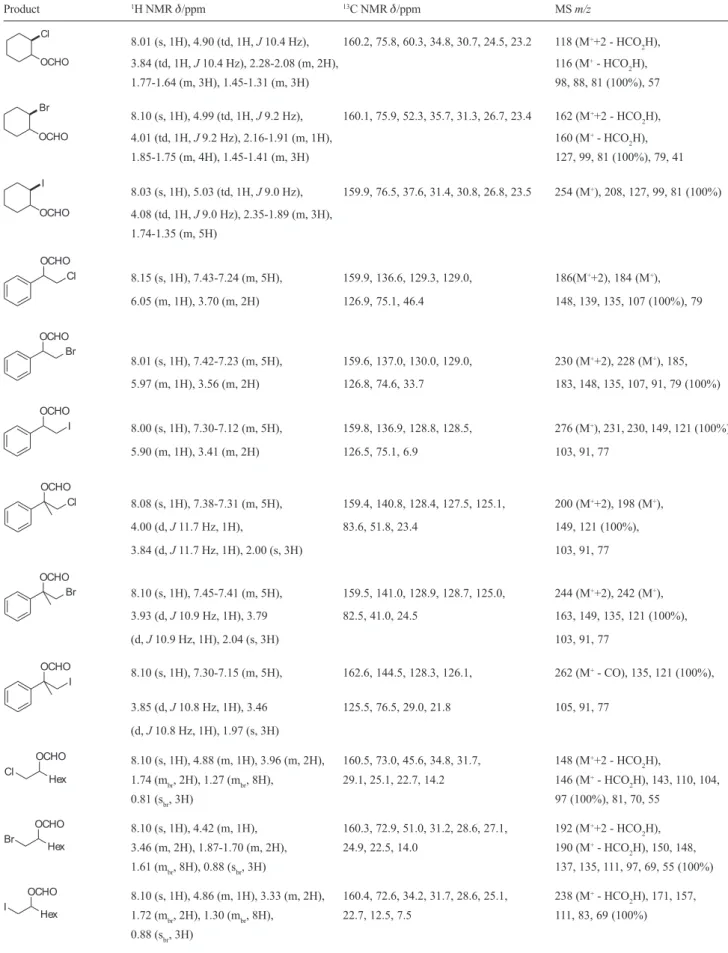
products were analyzed by HRGC and characterized by
spectroscopic methods (Table 2).
The orientation in the reaction follows the
Markovnikoff pattern, with the expected exception
19of
the aliphatic monosubstituted 1-octene that afforded a
regioisomeric mixture of
β
-haloformates in which the
secondary formate predominated (2-5:1). The process is
also stereoselective, with cyclohexene yielding
exclusively the
trans
-isomer, as can be seen (Figure 2)
by the high values of the coupling constants
20for adjacent
hydrogens of the haloformates derived from cyclohexane.
No diol, arising from Prèvost-Woodward reaction,
21was detected on the crude reaction mixture, but variable
amounts of the corresponding halohydrins were observed,
specifically in the cases of the iodoformate derived from
α
-methylstyrene (16% yield from
α
-methylstyrene) and
the chloroformate derived from 1-octene (20% yield from
1-octene), that could explain the low yields of
β
-haloformates obtained in these cases. The formation
of the halohydrins could be rationalized by hydrolysis of
the haloformate or its precursors during the work up.
6Alternatively, its formation by addition of water to the
halonium ion seems to be improbable because, although
we have used DMF without further purification and in
an open flask, no loss of stereoselectivity in the reactions
of cyclohexene (arising from small amounts of water
22)
was detected either.
Conclusions
In summary, we have developed a convenient route
to vicinal haloformates from alkenes. The reaction
conditions are mild, the work up process is very simple,
the reagent employed are stable, cheap, and readily
available and, furthermore, there is no need of special
techniques and conditions.
Experimental
General
NBSac was prepared from saccharin, KBr and
oxone
®, as early described.
11Trichloroisocyanuric acid
Figure 1. Structures of TCCA and NBSac.Figure 2. Coupling constants.
Table 1. Products obtained from Cohalogenation of alkenes with DMF
Alkene Product X Yield / (%)a
Cl 69
Br 82
I 70
Cl 80
Br 74
I 62
Cl 57
Br 78
I 42
Cl 49b
Br 76b
I 70c
aIsolated yield based on the alkene. bObtained predominantly (ca. 2:1) with
Table 2. Selected analytical data for products obtained
Product 1H NMR δ/ppm 13C NMR δ/ppm MS m/z
8.01 (s, 1H), 4.90 (td, 1H, J 10.4 Hz), 160.2, 75.8, 60.3, 34.8, 30.7, 24.5, 23.2 118 (M++2 - HCO 2H),
3.84 (td, 1H, J 10.4 Hz), 2.28-2.08 (m, 2H), 116 (M+ - HCO 2H),
1.77-1.64 (m, 3H), 1.45-1.31 (m, 3H) 98, 88, 81 (100%), 57
8.10 (s, 1H), 4.99 (td, 1H, J 9.2 Hz), 160.1, 75.9, 52.3, 35.7, 31.3, 26.7, 23.4 162 (M++2 - HCO 2H),
4.01 (td, 1H, J 9.2 Hz), 2.16-1.91 (m, 1H), 160 (M+ - HCO 2H),
1.85-1.75 (m, 4H), 1.45-1.41 (m, 3H) 127, 99, 81 (100%), 79, 41
8.03 (s, 1H), 5.03 (td, 1H, J 9.0 Hz), 159.9, 76.5, 37.6, 31.4, 30.8, 26.8, 23.5 254 (M+), 208, 127, 99, 81 (100%)
4.08 (td, 1H, J 9.0 Hz), 2.35-1.89 (m, 3H), 1.74-1.35 (m, 5H)
8.15 (s, 1H), 7.43-7.24 (m, 5H), 159.9, 136.6, 129.3, 129.0, 186(M++2), 184 (M+),
6.05 (m, 1H), 3.70 (m, 2H) 126.9, 75.1, 46.4 148, 139, 135, 107 (100%), 79
8.01 (s, 1H), 7.42-7.23 (m, 5H), 159.6, 137.0, 130.0, 129.0, 230 (M++2), 228 (M+), 185,
5.97 (m, 1H), 3.56 (m, 2H) 126.8, 74.6, 33.7 183, 148, 135, 107, 91, 79 (100%)
8.00 (s, 1H), 7.30-7.12 (m, 5H), 159.8, 136.9, 128.8, 128.5, 276 (M+), 231, 230, 149, 121 (100%),
5.90 (m, 1H), 3.41 (m, 2H) 126.5, 75.1, 6.9 103, 91, 77
8.08 (s, 1H), 7.38-7.31 (m, 5H), 159.4, 140.8, 128.4, 127.5, 125.1, 200 (M++2), 198 (M+),
4.00 (d, J 11.7 Hz, 1H), 83.6, 51.8, 23.4 149, 121 (100%),
3.84 (d, J 11.7 Hz, 1H), 2.00 (s, 3H) 103, 91, 77
8.10 (s, 1H), 7.45-7.41 (m, 5H), 159.5, 141.0, 128.9, 128.7, 125.0, 244 (M++2), 242 (M+),
3.93 (d, J 10.9 Hz, 1H), 3.79 82.5, 41.0, 24.5 163, 149, 135, 121 (100%),
(d, J 10.9 Hz, 1H), 2.04 (s, 3H) 103, 91, 77
8.10 (s, 1H), 7.30-7.15 (m, 5H), 162.6, 144.5, 128.3, 126.1, 262 (M+ - CO), 135, 121 (100%),
3.85 (d, J 10.8 Hz, 1H), 3.46 125.5, 76.5, 29.0, 21.8 105, 91, 77 (d, J 10.8 Hz, 1H), 1.97 (s, 3H)
8.10 (s, 1H), 4.88 (m, 1H), 3.96 (m, 2H), 160.5, 73.0, 45.6, 34.8, 31.7, 148 (M++2 - HCO 2H),
1.74 (mbr, 2H), 1.27 (mbr, 8H), 29.1, 25.1, 22.7, 14.2 146 (M+ - HCO
2H), 143, 110, 104,
0.81 (sbr, 3H) 97 (100%), 81, 70, 55
8.10 (s, 1H), 4.42 (m, 1H), 160.3, 72.9, 51.0, 31.2, 28.6, 27.1, 192 (M++2 - HCO 2H),
3.46 (m, 2H), 1.87-1.70 (m, 2H), 24.9, 22.5, 14.0 190 (M+ - HCO
2H), 150, 148,
1.61 (mbr, 8H), 0.88 (sbr, 3H) 137, 135, 111, 97, 69, 55 (100%)
8.10 (s, 1H), 4.86 (m, 1H), 3.33 (m, 2H), 160.4, 72.6, 34.2, 31.7, 28.6, 25.1, 238 (M+ - HCO
2H), 171, 157,
(commercial grade, 98%), and other chemicals and
solvents were used as received. The
1H and
13C NMR
spectra were recorded on a Bruker AC-200 (200MHz
and 50MHz, respectively) spectrometer in CDCl
3solution with TMS as internal standard.
High-resolution GC was performed on a HP-5890-II gas
chromatograph with FID using a 30 m (length),
0.25mm (ID), and 25
µ
m (phase thickness) RTX-5
capillary column and H
2(flow rate 50 cm s
-1) as carrier
gas (split: 1:10). Mass spectra were obtained on a
Hewlett-Packard HP 5896-A HRGC-MS using electron
impact (70 eV).
Preparation of
β
-chloroformates
To a stirred solution of the alkene
(5 mmol) in DMF
(50 cm
3), TCCA (2.5 mmol) was added at room
temperature in small portions. After 1.5 h, water (10 cm
3)
was added and the solution was extracted with CH
2Cl
2(20 cm
3). The organic layer was washed with satd
NaHSO
3, water and then dried (anhyd Na
2SO
4). After
rotaevaporation of the solvent, the product was purified
by radial chromatography on a Chromatotron
®. Spectral
data of the products are shown in Table 2.
Preparation of
β
-bromoformates
Same as above, NBSac (7.5 mmol) used instead of
TCCA.
Preparation of
β
-iodomoformates
Same as above, I
2(7.5 mmol) and Fe
2(SO
4)
3(6.0
mmol) used instead of TCCA.
Acknowledgments
A.V.A.S. and R.B.B. thank PIBIC-UFRJ; G.F.M. and
M.C.S.M. thank CNPq.
References
1. Recent examples: Singh, S.; Singh, B.; Ind. Eng. Chem. Res. 2007, 46, 983; Taber, D. F.; Liang, J.-I.; J. Org. Chem. 2007, 72, 431; Minakata, S.; Yoneda, Y.; Oderaotoshi, Y.; Komatsu, M.; Org. Lett. 2006, 8, 967; Yeung, Y.-Y.; Gao, X.; Corey, E. J.; J. Am. Chem. Soc. 2006, 128, 9644; Urankar, D.; Rutar, I.; Modec, B.; Dolenc, D.; Eur. J. Org. Chem. 2005, 2349; Muñiz, K.; New J. Chem. 2005, 29, 1371; Pan, Z. L.; Liu, X. Y.; Liu, W. M.; Liang, Y. M.; Synthesis 2005, 437.
2. Rodriguez, J.; Dulcere, J.-P.; Synthesis 1993, 1177; Sanseverino, A. M.; da Silva, F. M.; Jones Jr., J.; de Mattos, M. C. S.; Quim. Nova 2001, 24, 637; da Silva, F. M.; Jones Jr., J.; de Mattos, M. C. S.; Curr. Org. Synth. 2005, 2, 393.
3. De Roocker, A.; De Radzitzki, P.; Bull. Soc. Chim. Belges 1970, 79, 531; Lasne, M. C.; Masson, S.; Thuillier, A.; Bull. Soc. Chim. Fr. 1973, 1751.
4. Kim, J. N.; Kim, H. R.; Ryu, E. K.; Synth. Commun. 1992, 22, 2521; Kim, H. R.; Kim, J. N.; Park, H. J.; Ryu, E. K.; Bull. Korean Chem. Soc. 1997, 18, 110.
5. NCS: Micev, I.; Christova, N.; Panajotova, B.; Jovtscheff, A.; Chem. Ber. 1973, 106, 606.
6. NBS: Dalton, D. R.; Smith Jr., R. C.; Jones, D. G.; Tetrahedron 1970, 26, 575.
7. NIS: Hamm, S.; Hennig, L.; Findeisen, M.; Müller, D.; Welzel, P.; Tetrahedron 2000, 56, 1345.
8. Almeida, L. S.; Esteves, P. M.; de Mattos, M. C. S.; Synthesis 2006, 221; Moghaddan, F. M.; Boeini, H. Z.; Synlett 2005, 1612; Filimonov, V. D.; Krasnokutskaya, E. A.; Lesina, Y. A.; Russ. J. Org. Chem. 2003, 39, 875; Sanseverino, A. M.; de Mattos, M. C. S.; Synthesis 1998, 1584.
9. Hiegel, G. A.; Nalbandy, M.; Synth. Commun. 1992, 22, 1589; Wengert, M.; Sanseverino, A. M.; de Mattos, M. C. S.; J. Braz. Chem. Soc. 2002, 13, 700.
10. For reviews on the utilization of TCCA in organic synthesis see: Tilstam, U.; Weinmann, H.; Org. Process Res. Dev. 2002, 6, 384; Barros, J. C.; Synlett 2005, 2115; Kolvani, E.; Ghorbani-Choghamarani, A.; Salehi, P.; Shirini, F.; Zolfigol, M. A.; J. Iran. Chem. Soc. 2007, 4, 126.
11. de Souza, S. P. L.; da Silva, J. F. M.; de Mattos, M. C. S.; Synth. Commun. 2003, 33, 935.
12. For a review on the utilization of NBSac in organic synthesis see: de Souza, S. P. L.; da Silva, J. F. M.; de Mattos, M. C. S.; Quim. Nova 2006, 29, 1061.
13. de Mattos, M. C. S.; Sanseverino, A. M.; J. Chem. Res. (S) 1994, 440; Sanseverino, A. M.; da Silva, F. M.; Jones Jr., J.; de Mattos, M. C. S.; J. Braz. Chem. Soc. 2000, 11, 381.
14. For reviews on the utilization of I2 in organic synthesis see: Banerjee, A. K.; Vera, W.; Mora, H.; Laya, M. S.; Bedoya, L.; Cabrera, E. V.; J. Sci. Ind. Res. 2006, 65, 299; Togo, H.; Iida, S.; Synlett 2006, 2159.
15. For our recent works on cohalogenation reactions see: Almeida, L. S.; Esteves, P. M.; de Mattos, M. C. S.; Synlett 2007, 1687; Tozetti, S. D. F.; de Almeida, L. S.; Esteves, P. M.; de Mattos, M. C. S.; J. Braz. Chem. Soc. 2007, 18, 675; Villegas, R. A. S.; Santo Jr., J. L. E.; de Mattos, M. C. S.; de Aguiar, M. R. M. P.; Guarino, A. W. S.; Catal. Commun. 2007, 8, 97; de Almeida, L. S.; Esteves, P. M.; de Mattos, M. C. S.; Synlett 2006, 1515; de Mattos, M. C. S.; Bernini, R. B.; Heterocycl. Commun. 2006, 12, 411. 16. Mendonça, G. F.; Sanseverino, A. M.; de Mattos, M. C. S.;
Synthesis 2003, 45.
17. de Souza, S. P. L.; da Silva, J. F. M.; de Mattos, M. C. S.; J. Braz. Chem. Soc. 2003, 14, 832.
19. Sanseverino, A. M.; de Mattos, M. C. S.; Synth. Commun. 1998, 28, 559; Villegas, R. A. S.; de Aguiar, M.R. M. P.; de Mattos, M. C. S.; Guarino, A. W. S.; Barbosa, L. M.; Assumpção, L. C. F. N.; J. Braz. Chem. Soc. 2004, 15, 150.
20. Lambert, J. B.; Shurvell, H. F.; Lightner, D. A.; Cooks, R.G.; Organic Structural Spectroscopy, Prentice Hall: New Jersey, 1998, p. 73.
21. Prévost, C.; Comp. Rend. Acad. Sci. 1933, 196, 1129; Woodward, R. B.; Brutcher Jr., V. R.; J. Am. Chem. Soc. 1958, 80, 209.
22. Campi, E. M.; Deacon, G. B.; Edwards, G. L.; Fitzroy, M. F.; Giunta, N.; Jackson, W. R.; Trainor, R.; J. Chem. Soc. Chem. Commun. 1989, 407.