Natural Hazards and Earth System Sciences, 5, 495–498, 2005 SRef-ID: 1684-9981/nhess/2005-5-495
European Geosciences Union
© 2005 Author(s). This work is licensed under a Creative Commons License.
Natural Hazards
and Earth
System Sciences
Quantitative expression on drought magnitude and disaster intensity
L. H. Feng1and X. C. Zhang2
1Department of Geography, Zhejiang Normal University, Jinhua 321004, China 2Institute of Remote Sensing, Zhejiang Normal University, Jinhua 321004, China
Received: 16 December 2004 – Revised: 19 April 2004 – Accepted: 9 June 2005 – Published: 19 July 2005
Abstract. According to the calculation of wind scale and earthquake magnitude, this paper puts forward the concept of drought magnitude and disaster intensity and lays out a new method by quantitative calculation. Drought magni-tude is the quantitative index that describes the scale of a drought, and disaster intensity of drought is the quantitative index to describe the loss caused by a drought. Both indices have many theoretical and practical advantages with defin-able concepts and simple applications; therefore they are of important practical significance.
1 Introduction
Different researchers have different thoughts on drought and drought disaster from different angles, and they give differ-ent definitions on drought and drought disaster so that there are more than 10 indices of drought used regularly both at home and abroad. These include meteorological drought in-dex, hydrological drought inin-dex, agricultural drought index and economic drought index (Zhang, 1997).
In fact, drought and drought disaster are two different con-cepts in science. By analyzing the variety of drought def-initions, we come to the conclusion that drought is a cli-matic phenomenon where less than normal precipitation oc-curs within a specified period of time (Sauchyn et al., 2003; Sevinc and Zekai, 2003). It is a natural phenomenon, and drought itself doesn’t equal disaster. Only when drought causes damage to human social and economic activity does it become drought disaster, just as an earthquake in a place without human beings is just a natural phenomenon without disaster.
To understand and communicate the information of drought in a specific area on a timely basis, two quantitative indices are needed, drought magnitude and disaster inten-sity, as well as a quantitative calculation method. Of course, Correspondence to: L. H. Feng
the calculated drought magnitude and disaster intensity must be capable of reflecting the true drought situation and eas-ily communicating the information. Therefore, two princi-ples for calculation of drought magnitude and disaster inten-sity must be followed: (1) the selected characteristic quan-tity must reflect the nature of the situation; (2) the magnitude calculated must be easy to remember. This paper attempts to conduct a specific analysis of this issue.
2 Enlighten from wind speed and earthquake indices
Comparatively, the quantitative indices wind scale and earth-quake magnitude are used to reflect the scale of typhoons and earthquakes, and another quantitative index, earthquake intensity, is used to measure the disaster severity of earth-quakes. Therefore the wind force of typhoon No. 0216 (Sin-laku) which landed in Cangnan, Zhejiang Province, China, 7 September 2002 can be described as force 12. The earth-quake in Tangshan, China on 28 July 1976 can be described as a magnitude 7.8, and the disaster severity (earthquake in-tensity) can be defined as degree 11. However, the drought along the middle and down streams of the Yangtze River and the Yellow-Huai River Plain in 1978 can only be qualitatively described as “catastrophic drought” with “heavy losses” for the magnitude and the disaster severity respectively. There-fore, to parallel wind scale and earthquake magnitude, this study proposes two quantitative indices, drought magnitude and disaster intensity, to measure the magnitude and disaster situation of drought and a new method by quantitative calcu-lation.
496 L. H. Feng and X. C. Zhang: Quantitative expression on drought magnitude and disaster intensity forceF and wind speedV (m/s) can be expressed
approx-imately as:
F=1.12V2/3. (1)
To calculate magnitude of earthquakes, American scholar C. F. Richter and B. Gutenberg (1935) chose the substantial characteristic value, the energy released by an earthquake, which could best reflect its magnitude, to establish the fol-lowing relationship between earthquake magnitude M and energyE(j) (Xu and Zhou, 1982):
lgE=11.8+1.5M. (2)
It is widely recognized that the simpler the number desig-nated to a magnitude, the easier for it to be remembered and disseminated. For instance, the wind speed of a ty-phoon isV=32.7∼36.9 m/s, and the energy of an earthquake isE=6.3×10¹⁶j. These numeric values are too big and com-plicated for ordinary people, and even professionals have dif-ficulty in understanding and remembering them. However, when wind speed V=32.7∼36.9 m/s is converted to wind force F=12, and E=6.3×10¹⁶j is converted to earthquake magnitudeM=8, they are widely accepted. One of the im-portant reasons is that complicated numbers are converted into simple and meaningful value. In fact, wind speed and energy, wind scale and earthquake magnitude are all numer-ical codes, the important difference between them is that the later is a simple and easy concept.
The calculation of wind speed and earthquake magnitude gives us a model for a simple quantitative calculation method to express drought magnitude and disaster intensity.
3 Quantitative expression of the magnitude of drought
As mentioned previously, our definition of drought is a climatic phenomenon where less than normal precipitation occurs. Taking into account this definition and principle Eq. (1), we hold that the substantial characteristic values which best reflect the magnitude of drought are two ele-ments of drought, namely lack of precipitation and duration of drought, as they are the indicators of drought scale and ex-tent of destruction. The common notion that drought along the Yangtze and Yellow-Huai Rivers in 1978 was more se-vere than that of Henan Province in 1942, it mainly refers to the precipitation levels of the former being less than the lat-ter, and the time of the former being longer compared with that of the latter. Therefore, this paper proposes precipitation and duration as the characteristic values for the calculation of drought magnitude.
Principle (2) implies that the simpler the number desig-nated to a drought magnitude, the easier for it to be remem-bered and disseminated. Taking into consideration Princi-ple (2) and the 13 wind scales and 9 earthquake scales, this study adopts ten numbers from 1 to 10 to describe the mag-nitude of drought.
From the formula structure of wind scale and earthquake magnitude, the relationship between characteristic value and
magnitude is expressed by power function or logarithmic function. In order to have a similar structure in formula between drought magnitude and wind scale and earthquake magnitude, this paper adopts the following logarithmic func-tion for calculafunc-tion:
N=algKT +b. (3)
WhereN is drought magnitude (magnitude); K is anoma-lous percentage of precipitation (%);T is the length of time of drought (d); and a, b are undetermined parameters. In Eq. (3), K is positive: K=(Ri− ¯R)/R¯×100%, Ri is the
precipitation during the drought,R¯ is the average precipita-tion over many years. Generally,T uses the time period when precipitation falls below a certain standard, or the time inter-val between two rains. It is determined in accordance with the actual measured data from weather stations or historical records (Local Records etc.).
To distribute the calculated drought magnitudes within the range of 1–10, through intensive analysis of the distribu-tion of anomaly percentage of precipitadistribu-tionKas well as the durationT of both domestic and foreign droughts, we pro-pose that whenK=70% andT=90d,N= magnitude 6; when K=20% andT=30d,N= magnitude 2. When put into Eq. (3):
6=alg 70×90+b 2=alg 20×30+b ,
the results area≈4 andb≈−9. Therefore
N=4 lgKT −9. (4)
Meanwhile, we propose that whenN≥8, it’s a catastrophic drought; when 6≤N <8, it’s a severe drought; when 4≤N <6, a medium drought; and whenN <4, a mild drought.
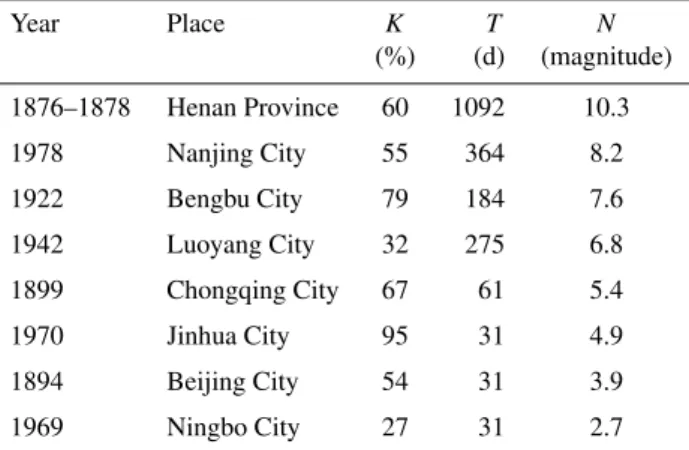
Table 1 shows the two measurements of droughts as well as their magnitudes calculated from Eq. (4). From the ta-ble we can see that there was a severe drought of magni-tude 6.8 in Luoyang City, Henan Province during January to September 1942, and a catastrophic drought of magnitude 8.2 in Nanjing City in 1978. In the second, third, and fourth years of Guangxu of the Qing Dynasty (1876∼1878), there was drought in three successive years in provinces such as Henan, Hebei and Shanxi, with the worst being in 1877 af-fecting 308 counties. “Severe drought was all around Henan that year and there was no harvest in summer or autumn; bare land covered thousand li, and the hunger made people eat each other”. According to the assumption ofK=60%, the drought magnitude would beN=10.3 (catastrophic drought). Statistic shows that drought magnitude in the world is nor-mally less than magnitude 10.
4 Quantitative expression of disaster intensity of drought
L. H. Feng and X. C. Zhang: Quantitative expression on drought magnitude and disaster intensity 497
Table 1.Two elements of some droughts and their magnitudes.
Year Place K T N
(%) (d) (magnitude)
1876–1878 Henan Province 60 1092 10.3
1978 Nanjing City 55 364 8.2
1922 Bengbu City 79 184 7.6
1942 Luoyang City 32 275 6.8
1899 Chongqing City 67 61 5.4
1970 Jinhua City 95 31 4.9
1894 Beijing City 54 31 3.9
1969 Ningbo City 27 31 2.7
define a drought disaster as: it is an event during which the precipitation has remained extremely scarce for a relatively long period (a few months to several years) so as to cause difficulty in meeting people’s demands in life and produc-tion. Defining the disaster intensity of drought is similar to establishing the drought magnitude, and the afore-mentioned two principles shall be followed.
The disaster caused by a drought can be finally summa-rized into property loss. Where property loss includes both direct and indirect economic loss. Since it is difficult to es-timate indirect economic loss, only direct economic loss is considered to calculate the disaster intensity of drought. In-formation on direct economic loss is easily acquired and can be used as the characteristic values to reflect the severity of drought disaster. The formula structure is:
G=algD+b. (5)
WhereGis the index expressing the severity of drought dis-aster, namely disaster intensity (degree); D is direct eco-nomic loss (104yuan);aandbare undefined parameters.
To distribute the calculated drought disaster intensity within the range of 1–10, through intensive analysis of drought disasters, we propose that when D=10 billion, G=degree 8; whenD=0.1 billion,G=degree 4. Putting these into Eq. (5), we get
8=alg 1 000 000+b 4=alg 10 000+b ,
the result of which isa=2 andb=−4. Then
G=2 lgD−4. (6)
In the meantime, we propose that whenG≥8, it is a catas-trophic disaster; when 6≤G<8, it is a severe disaster; 4≤G<6 equals a medium disaster; andG<4 signifies a mi-nor disaster.
In the drought of Jinhua City, Zhejiang Province, China in 1990, there was a direct economic loss of 143 million yuan. According to the calculation from Eq. (6), the disaster in-tensity of the drought isG=4.3, or a medium disaster. The
1978 drought in China resulted in a direct economic loss of 14.6 billion yuan, raising the disaster intensity to degree 8.3, a catastrophic disaster. Statistic shows that the disaster in-tensity of drought in the world is normally less than degree 10.
5 Discussion
From the relationship between drought magnitude and disas-ter intensity, generally speaking, the higher the drought mag-nitude is, the larger the disaster intensity is. For example, in 1978, a catastrophic drought, with a magnitude 8.2, hap-pened in Nanjing and the drought disaster intensity of that year in China reached degree 8.3, causing also immensely vast disaster. However, they are not always in proportion because their relationship is affected by population density, economic development, and the population’s capability to mitigate damage. Therefore, droughts of the same magni-tude result in different disaster intensities in different areas.
Drought index is commonly used for countries to disclose their drought situations. AZindex is adopted in China Cli-matic Drought and Flood Journal (Ju et al., 1998):
Zi=
6 Cs
C
s
2 ϕi +1
1/3
− 6
Cs
+Cs
6 . (7)
WhereCs is a skewness coefficient, ϕi is a standard
vari-able. From this we can divide the drought in various areas in a year into four classes: (1) normal (−0.84≤Z<0.84); (2) slight drought (−1.44≤Z<−0.84); (3) medium drought (−1.96≤Z<−1.44); (4) severe drought (Z<−1.96).
From Eq. (7) we see that the structure of thisZ-index for-mula is relatively complex, with large amounts of calcula-tion. In comparison, the Eqs. (4) and (6) raised in this paper have the following advantages:
498 L. H. Feng and X. C. Zhang: Quantitative expression on drought magnitude and disaster intensity (2) The equations of drought magnitude and disaster
inten-sity are simple and are easy to calculate.
(3) The numeric values of drought magnitude and disaster intensity are simple, easily understood and remembered by ordinary people.
(4) The three values are substantial characteristic values that best reflect the drought magnitude and the disaster severity, and they are easy to acquire after a drought. (5) Drought magnitude unifies the technical terms of
mag-nitude in measuring natural variations such as drought, typhoon, earthquakes, and wave.
(6) Drought magnitude can provide certain theoretical bases for drought division.
(7) The disaster intensity of drought can guide the fight against disaster both at home and abroad.
(8) In drought forecasting, drought magnitude and disaster intensity can be used to alert and forecast the drought magnitude and the disaster situation in advance. (9) Drought magnitude and disaster intensity can help
peo-ple associate and presume the magnitude and the disas-ter situation of an on-going drought according to their memory.
6 Conclusion
This paper has put forward the concepts of drought magni-tude and disaster intensity, and laid out a new method by quantitative calculation. Drought magnitude is the quantita-tive index that describes the scale of a drought, and disaster intensity of drought is the quantitative index to describe the scale of loss caused by a drought. There are many theoret-ical and practtheoret-ical advantages to describe the magnitude and the disaster situation of a drought by using the two indices respectively.
Drought magnitude and disaster intensity are two simple and easy quantitative indices with definable concepts and simple applications on judging drought magnitude and dis-aster situation. The recent increase of loss in drought makes it more important than ever to quantify drought magnitude and severity of disaster. These quantitative indices can be useful for proliferating the knowledge of drought in order to fight against disasters.
Edited by: M.-C. Llasat Reviewed by: N. B. Gutman
References
Adnan, H. A.: Drought identification and characterization in Jor-dan, J. Arid. Env., 53, 585–606, 2003.
Bonaccorso, B. and Bordi, I.: Spatial variability of drought: an anal-ysis of the SPI in Sicily, Water Re. Ma., 17, 273–296, 2003. Ju, X. S., Zou, X. K., and Zhang Q.: The method of the climatic
drought-flood index and its analysis, J. Nat. Dis., 7, 51–57, 1998. Sauchyn, D. J., Stroich, J., and Beriault A.: A paleoclimatic con-text for the drought of 1999–2001 in the northern Great Plains of North America, Geograph. J., 169, 158–167, 2003.
Sevinc, S. and Zekai, S.: Spatio-temporal drought analysis in the Trakya region, Turkey, Hydrol. Sci. J., 48, 809–820, 2003. Wu, H. G. and Zhang, Z. M.: Meteorology, China Water
Conser-vancy and Hydropower Publication House, 22–24, 1986. Xu, G. M. and Zhou, H. L.: Principle of Earthquake, Science
Pub-lication House, 325–352, 1982.