EFFECTIVENESS OF SPEECH THERAPY
IN THE TREATMENT OF VOCAL FOLD POLYPS
Efetividade da fonoterapia no tratamento do pólipo em pregas vocais
Daniela de Vasconcelos (1), Adriana Oliveira de Camargo Gomes (1),
Cláudia Marina Tavares de Araújo (1)
(1) Universidade Federal de Pernambuco – UFPE – Recife
(PE), Brasil.
Conlict of interest: non-existent
processes may collaborate to the appearance of polyp, such as gastroesophageal relux, aspiration of aggressive chemical substances or intense respiratory activities10. The main vocal symptoms
presented are hoarseness and breathiness, besides vocal fatigue7,11.
The treatment normally adopted for this type of vocal fold lesion is surgical12 despite pre-surgical
vocal speech therapy being considered eicient in aiding the regression of the edema associated to polyp and sub-adjacent areas, thus reducing the area of intervention during surgery10. Speech
therapy is indicated after surgery with the purpose of adapting the vocal behavior in order to avoid the relapse of the lesion13. However, some recent
studies highlight the importance of speech therapy as a primary treatment of polyp, with results of complete or partial regression of the lesion, followed by the indication of surgery in situation persistent
INTRODUCTION
In speech therapy clinic, more speciically in voice area, the most common laryngeal lesions are organofunctional lesions in vocal folds, especially nodules and polyps, whose etiological factors are directly related to inappropriate vocal behavior through bad use or abuse use of the voice1.
Vocal fold polyps are lesions of benign mass, generally unilateral, which can be classiied into sessile or pendunculated in relation to form, or into gelatinous (translucent), ibrous (organized) and angiomatous (hemorrhagic)2-8 in relation to histo
-logical characteristics9. However, other irritation ABSTRACT
The aim of this study was to verify the efectiveness of speech therapy in the treatment of vocal fold polyps by reviewing existing literature. Literature search was conducted through PublicMedline platform and the Scopus, Science Direct, Cumulative Index to Nursing and Allied Health Literature and Web of Science databases, followed by critical pre-selection and deep analysis of the articles. There were included original articles in which the speech therapy was used as treatment for vocal polyp, no publication date or language restrictions. There were excluded studies addressing just other treatments for vocal polyp and also articles in which the speech therapy was used only after laryngeal surgery. A total of 905 articles were found. However, after the selection stages, only nine articles were chosen to be part of the sample. The selected articles were fully analyzed, registered through previously developed protocol. The articles analyzed in this study showed poor methodology and lack of standardization regarding the speech therapy protocols and procedures used. It was consisted mostly by retrospective case series. The sample of studies reviewed presented variation in the number of participants, the type of lesion and type of polyp. The predominant type of intervention in the studies was the direct and indirect speech therapy associated, which demonstrated efectiveness in the treatment of polyps on the vocal folds. Speech therapy for the treatment of vocal fold polyps demonstrated efectiveness between 30% and 100% of the analyzed studies, with better results in small and recent polyps.
of vocal fold polyps through bibliographic research with updated scientiic evidence.
METHODS
This literature review sought to answer the following guiding question: Is speech therapy efective in the treatment of vocal polyp?
The bibliographic research was conducted through PublicMedline – PubMed platform, besides the Scopus, Science Direct, Cumulative Index to
Nursing and Allied Health Literature - CINAHLand
Web of Science databases from September to October 2014. The Cochrane database was also consulted to conirm the inexistence of systematic review article on the topic.
Medical Subject Headings (MeSH) descriptors and free terms in english language (all ields) relevant to the research were used. The free term vocal polyp was used in quotation marks and individ-ually crossed with the following descriptors, with the boolean marker AND: speech therapy, therapeutics, treatment outcomes and voice training (MeSH); treatment, vocal therapy and vocal technique (all ields) (Figure 1).
As inclusion criteria, all the original articles that used speech therapy as treatment for vocal polyp lesion and dissatisfaction regarding the resulting
vocal quality8,9,14-16.
Despite the increasing number of publications and presentations of case studies in national and international scientiic events on initial speech therapy as the treatment of vocal fold polyp, the routine medical approach is still surgical inter-vention, which requires the application of general anesthesia, besides being liable to complications during or after the intervention8,12,14-24.
The consensus of referring patients with vocal fold nodule to speech therapy resulted in more qualiied publications of scientiic studies and proof of its efectiveness12. On the other hand, patients
with vocal fold polyps previously referred to speech therapy are individuals with no surgical indication due to other health problems or that rejected surgery due to personal opinions15,16. This limitation of
thera-peutic indication compromises the development of new direct techniques, as well as analyses of the characteristics of possible clinical evolutions in the vocal treatment of polyp. This greatly hinders the consecration of its eicacy as a treatment of vocal fold polyp.
The objective of this study was to verify the efectiveness of speech therapy in the treatment
VOCAL POLYP
AND
SPEECH THERAPY
THERAPEUTICS
TREATMENT OUTCOMES
VOICE TRAINING VOCAL
TECHNIQUE VOICE THERAPY
TREATMENTS
After identiication in the databases, the articles were initially selected by title and reading of the abstract according to the inclusion and exclusion criteria. After reading the abstract, in the case of doubts, the complete text of the article was read and its inclusion agreed between the reviewers. The repeated articles were disregarded. Also, all articles referenced by the elected articles that met the inclusion criteria after initial selection by title and later by summary were considered (Figure 2).
The inal articles were evaluated in relation to methodological quality, use of statistical analysis and accuracy of the results through book report protocol elaborated by the authors, with the purpose found in the search were considered, without
restrictions in relation to the characteristics of the participants and/or lesion, publication date or language. Articles that exclusively addressed surgical treatment or treatment with medication as well as those only presenting speech therapy after surgery were excluded from the search. Chapters of books, dissertations, theses, literature reviews, case studies, reviews and editorials were not considered. Two reviewers participated in the study conducting the search at the same time, observing identical crossings previously elaborated according to the objective of the study.
TOTAL IDENTIFIED: 905 PubMed: 46 Medline: 28 Web of Science: 41
CINAHL: 09 Science Direct: 473
Scopus: 308
EXCLUDED BY TITLE:
712
PubMed: 33
Medline: 10 Web of Science: 33
CINAHL: 05 Science Direct: 417
Scopus: 214
EXCLUDED BY ABSTRACT: 91
PubMed: 02 Medline: 05 Web of Science: 02
CINAHL: 00 Science Direct: 30
Scopus: 52
EXCLUDED BY TEXT: 31
PubMed: 00 Medline: 08 Web of Science: 02
CINAHL: 01 Science Direct: 00
Scopus: 20
ELECTED: 71 ADDED: 03
FULLY ANALYZED: 09 SCREENING
ELIGIBILITY IDENTIFICATION
TOTAL EXCLUDED: 834
INCLUDED REPEATED: 65
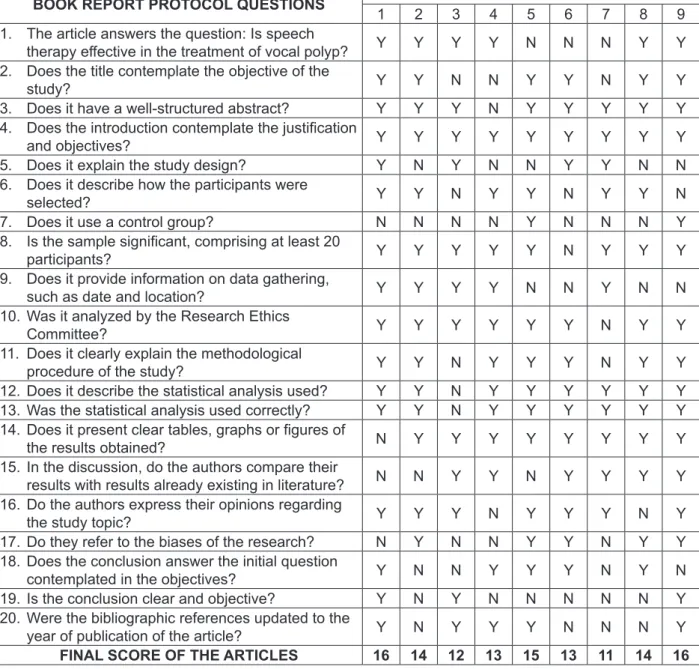
statistical analysis, results, discussions, method-ological problems, conclusion and references. The methodological quality of the articles varied from 11 to 16 according to the critical analysis through the book report protocol used (Figure 3).
After this process, the articles were completely analyzed observing the previously elaborated protocol containing the following variables: author, year, location (country), type of study, sample, of discerning the relevance, reliability and validity of
the studies for this review.
The book report protocol consisted of 20 questions, with possibility of positive and negative answers regarding the content of each study, evaluated through an analog scale of zero to 20 according to the number of positive answers presented. The questions contemplated title, abstract, introduction, method, ethical aspects,
BOOK REPORT PROTOCOL QUESTIONS ARTICLES
1 2 3 4 5 6 7 8 9
1. The article answers the question: Is speech
therapy efective in the treatment of vocal polyp? Y Y Y Y N N N Y Y
2. Does the title contemplate the objective of the
study? Y Y N N Y Y N Y Y
3. Does it have a well-structured abstract? Y Y Y N Y Y Y Y Y
4. Does the introduction contemplate the justiication
and objectives? Y Y Y Y Y Y Y Y Y
5. Does it explain the study design? Y N Y N N Y Y N N
6. Does it describe how the participants were
selected? Y Y N Y Y N Y Y N
7. Does it use a control group? N N N N Y N N N Y
8. Is the sample signiicant, comprising at least 20
participants? Y Y Y Y Y N Y Y Y
9. Does it provide information on data gathering,
such as date and location? Y Y Y Y N N Y N N
10. Was it analyzed by the Research Ethics
Committee? Y Y Y Y Y Y N Y Y
11. Does it clearly explain the methodological
procedure of the study? Y Y N Y Y Y N Y Y
12. Does it describe the statistical analysis used? Y Y N Y Y Y Y Y Y
13. Was the statistical analysis used correctly? Y Y N Y Y Y Y Y Y
14. Does it present clear tables, graphs or igures of
the results obtained? N Y Y Y Y Y Y Y Y
15. In the discussion, do the authors compare their
results with results already existing in literature? N N Y Y N Y Y Y Y
16. Do the authors express their opinions regarding
the study topic? Y Y Y N Y Y Y N Y
17. Do they refer to the biases of the research? N Y N N Y Y N Y Y
18. Does the conclusion answer the initial question
contemplated in the objectives? Y N N Y Y Y N Y N
19. Is the conclusion clear and objective? Y N Y N N N N N Y
20. Were the bibliographic references updated to the
year of publication of the article? Y N Y Y Y N N N Y
FINAL SCORE OF THE ARTICLES 16 14 12 13 15 13 11 14 16
Legend: Y – Yes; N – No; Articles: 1 – Cohen SM, Garrett CG.2007; 2 – Yun YS, Kim MB, Son YI.2007; 3 – Klein AM, Lehmann M, Harpner ER, Johns MM.2009; 4 – Cho KJ, Nam IC, Hwang YS, Shim MR, Park JO, Cho JH et al.2011; 5 – Rodríguez-Parra MJ, Adrián JA, Casado JC.2011; 6 – Schindler A, Mozzanica D, Ginocchio P, Maruzzi M, Ottaviani AF.2012; 7 – Nakagawa H, Miyamoto M, Kusuyama T, Mori Y, Fukuda H.2012; 8 – Schindler A, Mozzanica F, Maruzzi P, Atac Murat, Cristofaro V, Ottaviani F.2013; 9 – Adrián JA, Rodríguez-Parra MJ.2015.
to satisfactory vocal improvement (adapted voice). Under these conditions, laryngeal surgery can be considered unnecessary. The critical analysis of the articles was elaborated by the main author, according to the variables observed in Table 1 and presented in the literature review.
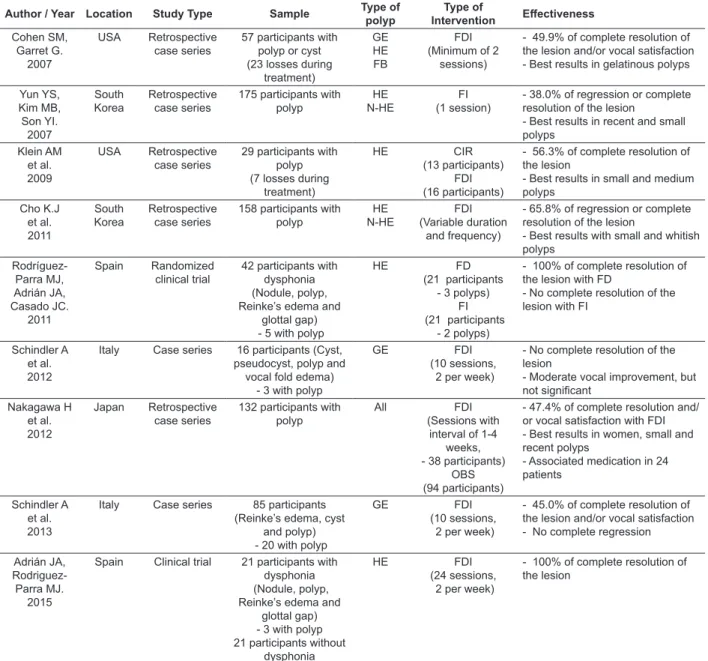
classiication of the polyp, type of intervention (direct or indirect) and efectiveness of the speech therapy, as shown in Table 1.
Were considered the efectiveness of speech therapy in the treatment of vocal fold polyp the complete resolution of the lesion or regression of the lesion in more than half of its initial size associated
Table 1 – Results of the studies according to variables analyzed
Author / Year Location Study Type Sample Type of
polyp Type of Intervention Efectiveness Cohen SM, Garret G. 2007 USA Retrospective case series
57 participants with polyp or cyst (23 losses during
treatment)
GE HE FB
FDI (Minimum of 2
sessions)
- 49.9% of complete resolution of the lesion and/or vocal satisfaction - Best results in gelatinous polyps
Yun YS, Kim MB, Son YI.
2007
South
Korea Retrospective case series
175 participants with polyp
HE N-HE
FI (1 session)
- 38.0% of regression or complete resolution of the lesion
- Best results in recent and small polyps Klein AM et al. 2009 USA Retrospective case series
29 participants with polyp (7 losses during
treatment)
HE CIR
(13 participants) FDI (16 participants)
- 56.3% of complete resolution of the lesion
- Best results in small and medium polyps
Cho K.J et al. 2011
South
Korea Retrospective case series
158 participants with polyp HE N-HE FDI (Variable duration and frequency)
- 65.8% of regression or complete resolution of the lesion
- Best results with small and whitish polyps Rodríguez-Parra MJ, Adrián JA, Casado JC. 2011 Spain Randomized
clinical trial 42 participants with dysphonia (Nodule, polyp, Reinke’s edema and
glottal gap) - 5 with polyp
HE FD
(21 participants - 3 polyps)
FI (21 participants
- 2 polyps)
- 100% of complete resolution of the lesion with FD
- No complete resolution of the lesion with FI
Schindler A et al. 2012
Italy Case series 16 participants (Cyst,
pseudocyst, polyp and vocal fold edema)
- 3 with polyp
GE FDI
(10 sessions, 2 per week)
- No complete resolution of the lesion
- Moderate vocal improvement, but not signiicant Nakagawa H et al. 2012 Japan Retrospective case series
132 participants with polyp
All FDI
(Sessions with interval of 1-4
weeks, - 38 participants)
OBS (94 participants)
- 47.4% of complete resolution and/ or vocal satisfaction with FDI - Best results in women, small and recent polyps
- Associated medication in 24 patients
Schindler A et al. 2013
Italy Case series 85 participants
(Reinke’s edema, cyst and polyp) - 20 with polyp
GE FDI
(10 sessions, 2 per week)
- 45.0% of complete resolution of the lesion and/or vocal satisfaction - No complete regression
Adrián JA, Rodriguez-Parra MJ.
2015
Spain Clinical trial 21 participants with
dysphonia (Nodule, polyp, Reinke’s edema and
glottal gap) - 3 with polyp 21 participants without
dysphonia
HE FDI
(24 sessions, 2 per week)
- 100% of complete resolution of the lesion
enabled the higher number of participants in the sample, enabling the execution of a more consistent statistical analysis and determination of the charac-teristics of the polyps that best respond to speech therapy, especially in relation to the size and/or age (time of existence) of the lesion.
Regarding the methodology quality of the articles, it is emphasized that, besides the score variation from 11 to 16, according to the book report protocol used (Figure 3), other methodological issues were identiied such as lack of assessment of the vocal characteristics8,11, failure in the deinition
of the research groups11,14,15, lack of information
on speech therapy as the type of techniques used8,11,15,29, treatment period8,11,15,29 or session
duration8,11,15,29,30, besides the use of non-validated
and/or non-standardized protocols8,11,14-16,27,30,31
and diferent speech therapy approach among the participants of a same research group11,27-31.
Although polyp being one of the most frequent benign lesions in vocal folds4, the case series studies
or clinical trials showed a limited number of partici -pants, which varied from three to twenty27,28,30,31.
Despite the phonotraumatic etiology in the vocal nodule, whose initial therapeutic indication is speech therapy, referring patients with vocal polyp to speech therapy before surgical procedure is a restricted practice of some otorhinolaryngologists12,
which hinders the recruitment of participants for the development of prospective researches.
Besides the variation in the number of partici-pants, the sample of the analyzed studies were diferent in terms of content, with majority consisting of benign lesions in vocal folds8,27,28,30,31. Only four
studies exclusively assessed patients with vocal polyp in their diferent types14-16,29. Hemorrhagic
polyp was present in almost all except for two articles of the same authorship30,31, whose
partici-pants only had gelatinous polyp. It is recorded that the highest occurrence of polyps in hemorrhagic stage was already expected since it was considered the most frequent type of vocal polyp5. However, it
was not possible to determine the type of polyp that best responds to speech therapy because some studies only addressed one type of polyp15,27,28,30,31.
Other used nomenclature diference in which more than one type was grouped (hemorrhagic and non-hemorrhagic)14,29 or did not specify the results
per type of polyp16.
Another important aspect is the classiication diference in terms of size of the lesions in the analyzed studies. Although estimating basically three sizes (small, medium and large), the authors classiied them diferently. Therefore, the small polyp, for example, was considered punctiform15,16,
with size corresponding up to 1/8 of the vocal fold14
LITERATURE REVIEW
The possibility of speech therapy indication in the treatment of vocal fold polyp is relatively recent. The irst articles about the topic appeared a little over a decade ago, from two diferent studies. The irst suggested speech therapy as initial treatment for nodules and polyps9 and the second identiies
the discrepancy of its primary indication by otorhi -nolaryngologists (91% for nodules and 30% for polyps)12. Furthermore, there is the observation
of spontaneous resolution of some polyps, during the preparation period for surgery13. As a result,
the studies analyzed in this review had the direct or indirect objective of verifying the efectiveness of speech therapy in the treatment of benign vocal fold lesions, speciically the vocal polyp.
Despite the development on the topic in Europe, USA and Asian countries, the publications in Brazil are limited to case studies presented at congresses or published in book chapters, even though at an increasing number17-23.
The types of studies used in the analyzed articles are mostly case series. It is emphasized that they are considered as irst source of evidence for the devel-opment of new treatment lines, as recommended by the evidence-based practice25. However, this type of
research is not enough to establish the eicacy of a treatment26, thus there is a need for greater
scien-tiic reinement that can prove more thoroughly the efectiveness of speech therapy in the treatment of vocal fold polyp.
The two clinical trials articles analyzed27,28
originated from a single research, however with diferent objectives and methodological procedures. The sample of these studies, which consisted of only three patients with vocal fold polyp, showed 100% complete regression of the lesion observed in the laryngeal assessment after speech therapy. However, the authors were prudent in conirming the efectiveness of speech therapy as treatment for this type of lesion for being considered a surgical therapeutic approach. They preferred to state that “The positive response to speech therapy does not seem to be determined by the type of vocal pathology since it occurred in dysphonias that require surgery (angiomatous polyps) and in those that do not require surgical intervention (nodules)” (p.26)28.
The retrospective design of some of the analyzed articles8,14-16,29, with search for information
diferences, it was observed that majority of the studies described the use of vocal hygiene education9,14-16,27-31, modiication of the vocal
behavior14,15,30,31, elimination of strong vocal attack27-31,
relaxation27,28 and respiratory support9,16,27-31 as
direct speech therapy approach. However, it is emphasized that the most cited technique in the studies was the yawn-sigh27-31, probably because
it provides smooth speech and reduces hyperfunc-tional phonation behavior32 present in people with
vocal polyp.
Another factor that corroborates the diicult comparison between the studies is the lack of standardization of assessment and therapy protocols used, marked by the methodological diferences between them. The American Speech-Language-Hearing Association (ASHA), in a document that
deines the principles of the practice based on evidence for clinical decision making and promotion of the quality of clinical services, published in 2005, orients the adoption of standardized and validated instruments (protocols and comparative
measures)33. The use of standardized assessment
protocols was equally defended in the two clinical trials included in this review27,28.
In spite of the comparison of the efectiveness of speech therapy in the treatment of vocal fold polyp in majority of the articles that make up the corpus of this study, their results were very diverse, varying from 38% to 100% efectiveness. It is emphasized that the efectiveness of speech therapy in complete regression of vocal polyp or partial regression of the lesion associated to vocal adaptation was considered in this review. The polyp that is small in size and of recent occurrence responded the best to speech therapy.
The analyzed articles showed very speciic methodologies, diferent from one another, hindering the detailed analysis of their results and reliable comparison. The important variations of sample, instruments used for assessment and therapeutic approaches prevented the comparative analysis through meta-analysis.
Furthermore, in order for speech therapy in the treatment of vocal fold polyp to be conirmed, new researches with more methodological accuracy need to be developed, including clinical trials and longitudinal studies. These studies can outline which characteristics of polyp or the vocal quality of the patient can represent best results, resizing the therapeutic approach used.
or with a size up to 1/4 of the vocal fold29. Despite
the classiication used, four studies identiied the best response to speech therapy in small polyps14-16,29.At the same time, ive studies did not assess the size of the polyp8, 27,28,30,31.
The superior response of small polyps to speech therapy can be justiied by the fact that small lesions generally mean recent lesions, in which the histo -logical development stage of the predominantly edematous lesion has greater capacity of regression or absorption.
Regarding the type of intervention applied, the use of combined direct and indirect speech therapy was predominant8,15,16,28-31 since these are inter
-connected in clinical practice and are essential in speech treatment in patients with organofunctional lesions. The study that used the types of intervention in diferent situations showed comparative approach between the two models of speech therapy27, or
evaluated the possibility of regression of the lesion only from the modiication of vocal behavior, which refers to indirect speech therapy14.
Despite being presented as a comparative study between direct and indirect speech therapy, the randomized clinical study included in this review27
used a number of vocal health recommendations during the treatment as procedure in direct speech therapy. Therefore, it can be concluded that the diference between the two groups of this study is exclusively justiied by the use of direct vocal techniques in only one of them.
However, despite the predominant use of the associated form of direct and indirect speech therapy, the studies presented diferent treatment frequency and duration. Furthermore, there was no standardization including among the subjects of a same research, as reported in some studies8,16,29,
preventing the comparison between the interven-tions. It is also emphasized that the continuous orientation regarding vocal health during the thera-peutic process probably plays a more educational role when compared to a single orientation moment, according to the approach of the analyzed study14.
The lack of standardization also corresponded to the use of speech techniques in direct speech therapy. Few articles describe the techniques that were used in the treatment27,29-31. However, the
authors stated that the techniques varied according to the individual needs of the participants, in relation to aspects such as choice of technique16,27,29,
severity of the hoarseness 29 or vocal behavior
REFERENCES
1. Nunes RB, Behlau M, Nunes MB, Paulino JG. Clinical diagnosis and histological analysis of vocal nodules and polyps. Braz J Otorhinolaryngol. 2013;79(4):434-40.
2. Martins RHG, Defaveri J, Domingues MAC, Silva RA. Vocal polyps: clinical, morphological, and immunohistochemical aspects. J Voice. 2011;25(1):98-106.
3. Neves BMJ, Neto JG, Pontes P. Diferenciação histopatológica e imunoistoquímica das alterações epiteliais no nódulo vocal em relação aos pólipos e ao edema de laringe. Rev Bras Otorrinolaringol. 2004;70(4):439-48.
4. Cielo CA, Finger LS, Rosa JC, Brancalioni AR. Lesões organofuncionais do tipo nódulos, pólipos e edema de Reinke. Rev CEFAC. 2011;13(4):735-48. 5. Marcotullio D, Magliulo G, Pietrunti S, Suriano M. Exudative laryngeal diseases of Reinke’s space: a clinicohistopathological framing. J Otolaryngol.
[serial online]. 2002 dec [accessed 2015 mar 1];31(6):376-80. Available from: http://www.ncbi. nlm.nih.gov/pubmed/12593551.
6. Jeong W, Lee SJ, Lee WY, Chang H, Ahn S. Conservative management for vocal fold polyps. JAMA Otolaryngol Head Neck Surg. 2014;140(5):448-52.
7. Dursun G, Karatayli-Ozgursoy S, Ozgursoy O, Tezcaner Z, Coruh I, Kilic M. Inluence of the macroscopic features of vocal fold polyps on the quality of voice: a retrospective review of 101 cases. ENT-Ear Nose Throat J [serial online]. 2010 mar [accessed 2015 feb 26];89(3):E12-7. Available from: http//www.ncbi.nlm.nih.gov/pubmed/20229464. 8. Cohen SM, Garret CGG. Utility of voice therapy in the management of vocal fold polyps and cysts. Otolaryngol Head Neck Surg. 2007;136(5):742-6. 9. Jonhs, MM. Update on the etiology, diagnosis, and treatment of vocal fold nodules, polyps, and cysts. Curr Opin Otolaryngol Head Neck Surg. 2003;11:456-61.
RESUMO
O objetivo dessa revisão de literatura foi veriicar a efetividade da fonoterapia no tratamento do pólipo em pregas vocais, a partir de levantamento bibliográico. Foi realizada pesquisa bibliográica na plata-forma PublicMedline e nas bases de dados Scopus, Science Direct, Cumulative Index to Nursing and Allied Health Literature e Web of Science, seguindo etapas de seleção e análise crítica dos artigos.
Foram incluídos artigos originais que utilizaram a fonoterapia como tratamento para o pólipo vocal, sem restrições de data de publicação ou língua. Foram excluídos artigos que abordassem exclu-sivamente outros tratamentos para pólipo vocal e os que utilizaram a fonoterapia somente após a cirurgia laríngea. Foram encontrados inicialmente 905 artigos. Após as etapas de seleção, restaram nove artigos na composição inal da amostra. Foram então analisados na íntegra, cadastrados por meio de protocolo previamente elaborado que contemplou autor, ano, local, tipo de estudo, amostra, classiicação do pólipo, tipo de intervenção e principais resultados. Os artigos analisados apresen-taram fragilidade metodológica e ausência de padronização quanto aos protocolos e procedimentos fonoaudiológicos utilizados. Foram constituídos em sua maioria por série de casos retrospectiva. A amostra dos estudos variou em relação à quantidade de participantes, tipo de lesão e tipo de pólipo. A fonoterapia para o tratamento do pólipo em pregas vocais demonstrou efetividade entre 38% e 100% nos estudos analisados, com melhores resultados em lesões pequenas e recentes.
DESCRITORES: Doenças da Laringe; Fonoterapia; Treinamento da Voz; Resultado de Tratamento CONCLUSION
Based on this literature review, it can be deduced that the publications on the topic showed poor methodology and lack of standardization regarding the assessment and speech therapy protocols used.
21. Przysiezny PE, Möller LG, Rispoli DZ, Pletsch F, Polanski F, Cunha RM. Pólipos vocais e fonoterapia: relatos de casos. Braz J Othorhinolaryngol. 2006;supl72(5):172.
22. Ragazzo R, Marques E, Baptistella J, Musumeci PC, Bezerra TFP, Rehder MI. Pólipo vocal: relato de caso de regressão através de fonoterapia. Braz J Othorhinolaryngol. 2005;supl;59.
23. Vasconcelos D, Vasconcelos SJ, Cerqueira RS. Pólipo de prega vocal: fonoaudiologia em cena. Rev Soc Bras Fonoaudiol. 2011;16(Supl):84.
24. Corvo MAA, Inacio A, Mello MBC, Eckley CA, Duprat AC. Complicações extralaríngeas das cirurgias por laringoscopia direta de suspensão. Rev Bras Otorrinolaringol. 2007;73(6):727-32. 25. Albrecht J, Werth VP, Bigby M. The role of case reports in evidence-based practice, with suggestions for improving their reporting. J Am Acad Dermatol. 2009;60(3):412-8.
26. Vieira VP, Atallah AN. Tratamento dos distúrbios da voz baseado em evidências. Diagn Tratamento. 2009;14(1):19-21.
27. Rodríguez-Parra MJ, Adrián JÁ, Casado JC. Comparing voice-therapy and vocal-hygiene treatments in dysphonia using a limited multidimentional evaluation protocol. J Commun Disord. 2011;44:615-30.
28. Adrián JA, Rodríguez-Parra MJ. Evaluación del tratamento logopédico em la rehabilitación de la difonía em adultos: seguimento de los efectos grupales y las variaciones individuales. Rev Logoped Foniatr Audiol. 2015;35:17-29.
29. Cho KJ, Nam IC, Hwang YS, Shim MR, Park JO, Cho JH et al. Analysis of factors inluencing voice quality and therapeutic approaches in vocal polyp patients. Eur Arch Otorhinolaryngol. 2011;268:1321-7.
30. Schindler A, Mozzanica F, Maruzzi P, Atac M, De Cristofaro V, Ottaviani F. Multidimentional assessment of vocal changes in benign vocal fold lesions after voice therapy. Acta Otorhinolaryngol Ital. 2013;40:291-7.
31. Schindler A, Mozzanica F,Ginocchio D, Maruzzi P, Atac M, Ottaviani F. Vocal improvement after voice therapy in the treatment of benign vocal fold lesions. Auris Nasus Larynx. 2012;32:304-8.
32. Casper JK, Murry T. Voice therapy methods in dysphonia. Otolaryngol Clin N Am. 2000;33(5):983-1002.
33. ASHA: American Speech-Language-Hearing Association [Internet]. Rockville: American
Speech-Language-Hearing Association; c1997-2015.
Evidence-Based Practice in Communication Disorders. [cited 2005]. Available from: http//www. asha.org/policy /PS2005-00221/
10. Behlau M, Madazio G, Pontes P. Disfonias organofuncionais. In: Behlau M, organizadora. Voz: o livro do especialista. Rio de Janeiro: Revinter, 2001. p. 306-9.
11. Toran KC, Lal BK. Objective voice analysis for vocal polyps following microlaryngeal phonosurgery. Kathmandu Univ Med J. 2010;8(30):185-9.
12. Sulica L, Behrman A. Management of benign vocal fold lesions: a survey of current opinion and practice. Ann Otol Rhinol Laryngol. 2003;112(10):827-33.
13. Cecatto SB, Costa KS, Garcia RID, Haddad L, Júnior FVA, Rapoport PB. Pólipos de pregas vocais: aspectos clínicos e cirúrgicos. Rev Bras Otorrinolaringol. 2002;68(4):534-8.
14. Yun YS, Kim MB, Son YI. The efect of vocal hygiene education for patients with vocal polyp. Otolaryngol Head Neck Surg. 2007;137(4):569-75. 15. Klein AM, Lehmann M, Hapner ER, Johns MM. Spontaneous resolution of hemorrhagic polyps of the true vocal fold. J Voice. 2009;23(1):132-5. 16. Nakagawa H, Miyamoto M, Kusuyama T, Mori Y, Fukuda H. Resolution of vocal fold polyps with conservative treatment. J Voice. 2012;26(3):107-10. 17. Fomin DS, Pela SM. Reabsorção de pólipo de prega vocal em cantor proissional: Relato de caso. Braz J Othorhinolaryngol. 2010;supl76(5):541. 18. Goslin DN, Silva AC, Schettini Jr. W, Baraldo A, Gomes A, Cruz GG et al. Resolução espontânea de pólipo hemorrágico em prega vocal. Braz J Othorhinolaryngol. 2010;supl76(5):571.
19. Nunes RB, Souza AMV. Involução de pólipo de prega vocal após tratamento clínico e fonoterápico: um estudo de caso. Rev Bras Fonoaudiol. 2008;supl13:1318.
20. Paula MAP, Rehder MI. Atuação multidisciplinar em um caso de pólipo de prega vocal. In: Behlau M (Ed): O melhor que ví e ouví II – Atualização em laringe e voz. Rio de Janeiro: Revinter, 2000. p.243-51.
http://dx.doi.org/10.1590/1982-0216201517614215 Received on: September 15, 2015
Accepted on: October 03, 2015
Mailing address:
Daniela de Vasconcelos
Avenida Dezessete de Agosto nº 500, apartamento 101, Casa Forte
Recife – PE – Brasil CEP: 52060-590