out using a pre-test and post-test with control group. The research sample was selected using purposive sampling method among cancer patients in Fars province boarding centers in 2018. After screening, 30 patients with cancer (12 to 18 years old) were randomly assigned into two groups of experimental and control. Data collection tool was Beck’s Depression Inventory. For the experimental group, 12 sessions of an hourly baccalaureate were held at a time interval of 6 weeks and two sessions each week. During the sessions, communication was established between the researcher and the children, using stories and presenting activities in the form of stories; opportunities and opportunities for engaging and activating the child’s executive actions. 12 sessions of one-hour story therapy were held for the experimental group during 6 weeks and two sessions each week. During the sessions, opportunities for engaging and activating the child’s executive actions were provided while communicating between the researcher and the children using the story and providing activities in the form of stories. Post-test was performed after the end of the storytelling period on two groups of experimental and control. According to the results of this study, the depression scores decreased in the post test in the experimental group. Therefore, the hypothesis of research based on the effectiveness of story therapy on the reduction of depression in patients with cancer is confirmed.
Keywords: Reading story. Storytelling. Depression.
Cancer. Children.
Resumo: Este estudo foi realizado com o objetivo
de investigar a eficácia da narração de histórias na redução da depressão de pacientes oncológicos em 2018. O presente estudo, como pesquisa
semiexperimental, foi realizado utilizando um pré-teste e pós-teste com grupo controle. A amostra de pesquisa foi selecionada usando método de amostragem intencional entre pacientes com câncer em centros de embarque da província de Fars em 2018. Após a triagem, 30 pacientes com câncer (12 a 18 anos) foram aleatoriamente designados em dois grupos de controle experimental. A ferramenta de coleta de dados foi o Inventário de Depressão de Beck. Para o grupo experimental, 12 sessões de um bacharelado por hora foram realizadas em um intervalo de tempo de 6 semanas e duas sessões por semana. Durante as sessões, foi estabelecida comunicação entre o pesquisador e as crianças, utilizando histórias e apresentando atividades na forma de histórias; oportunidades e oportunidades para engajar e ativar as ações executivas da criança. Foram realizadas 12 sessões de terapia de uma hora para o grupo experimental durante 6 semanas e duas sessões por semana. Durante as sessões, as oportunidades para envolver e ativar as ações executivas da criança foram fornecidas durante a comunicação entre o pesquisador e as crianças usando a história e fornecendo atividades na forma de histórias. O pós-teste foi realizado após o término do período narrativo em dois grupos de experimentais e controle. De acordo com os resultados deste estudo, os escores de depressão diminuíram no pós-teste no grupo experimental. Portanto, a hipótese de pesquisa baseada na eficácia da terapia da história sobre a redução da depressão em pacientes com câncer é confirmada.
Palavras-chave: História de leitura. Contar histórias.
Depressão. Câncer. Crianças.
Shiraz University of Medical Science, Persian Language and Literature, Shiraz Paramedical School, Iran. E-mail: [email protected] Corresponding author, Shiraz University of Medical Science, Persian
Language and Literature, Estahban Paramedical School, Iran. E-mail: [email protected]
Khosrow Ghasemian Mohammad Amin Ehsani Estahbanati
A EFICÁCIA DA NARRATIVA NA
REDUÇÃO DA DEPRESSÃO EM
PACIENTES COM CÂNCER
THE EFFECTIVENESS OF
STORYTELLING ON REDUCING
DEPRESSION IN CANCER PATIENTS
1
2
1
Introducti on
Depression is considered as one of the most prevalent and most disabling psychiatric disorders that people with physical illnesses and diseases, such as cancer, suff er it and depression disorder is most common psychiatric illness. Pati ents with depression become more disable than stressful pati ents with cancer (Davidson &Meltzer-Brody, 2006) and people with depression in comparison with the cancer pati ents who suff er from physical illnesses and pains (Powers, Cross, Fani & Bradly, 2015). According to the results of diff erent studies, cancer strongly predicts a wide range of mental disorders independently of other psychological aspects (Berenbaum, Boden, Baker, Dizen, Thompson & Abramowitz, 2006). In contrast, people who suff er from cancer may not be able to manage their negati ve emoti ons and have less mental health (Barrett , Gross, Christensen & Benvenuto, 2001; Kang & Shaver, 2004; Kashdan, Ferssizidis, Collins & Muraven, 2010). Anxiety and depression are considered as key factors which have signifi cant eff ect on mental health directly and indirectly through illnesses such as cancer (Boden, Bonn-Miller, Kashdan, Alvarez & Gross, 2012). Since, the years that go along with the disorder in people’s lives can be measured using common tools (Disability – adjusted Life years (DALY)), so depression is the fourth most common cause of going away of life of people with illness compared to other medical diseases and mental disorders and other illnesses and is predicted to be the second cause of this problem in 2020 (Muray & Lopez, 2016). The dimensions and therapeuti c characteristi cs of depression are related to almost all pati ents with psychiatric disorders in various clinical situati ons due to the prevalence of depression. Nowadays, the positi ve psychology approach with the mott o of human talents and abiliti es has att racted much att enti on of researchers from various fi elds of psychology. This approach is implemented aimed to identi fy the structures and practi ces that provide well-being and happiness for human and is considered as one of the new therapy methods of storytelling and reading story.
Storytelling leads to emoti onal, emoti onal and mental health growth of children. Recently, many studies have been carried on the importance of storytelling for children and it has proven that it has a signifi cant eff ect on mental development of them. Therefore, psychologists and educati onal experts advise parents to tell story for their children from the very early years. A story is a literary text that has secondary educati onal and therapeuti c applicati ons (Asghari Nekah, 2003).
The special uses of story in treatment are confi rmed by studying the theories, studies, and clinical experiences. Cook, Taylor & Silverman (2004) have used storytelling techniques for children and conclude that many clinical fi ndings suggest is that story therapy can be used and useful in cogniti ve-behavioral therapies for children. Stories in story therapy can be considered as an important source of change and improvement in children’s problems and disorders by providing opportuniti es, creati ng a context for emoti onal discharge and imitati on, and raising the child’s percepti on (Crawford, Brown & Crawford, 2004; Frederberg & Wilt, 2010) .
Nowadays, the story therapy approach is used to treat children with special needs, including children with cancer, and there are has studies to prove the usefulness of this approach. In 2016, Khodadost (2016) during a study enti tled “the eff ect of Storytelling in reducing the anger and aggression of children” concluded that the mean scores of aggression and its dimensions in the experimental group were signifi cantly diff erent from the control group in the post-test, which this diff erence means the decrease in aggression, therefore, it can be concluded that the use of storytelling plays a key role in reducing aggression and anger.
Faranak Forouzanfar (2017) during a study enti tled “The Eff ecti veness of storytelling on Children’s Social Skills” concluded that storytelling, in additi on to the eff ecti veness of storytelling on social skills can also be used in the teaching and promoti on of emoti onal expression, self-care and empathy which are considered as social skills. Given the theoreti cal foundati ons and the experience of depression in pati ents with cancer and considering this issue that cancer pati ents during this period experience diff erent levels of anxiety due to environmental and individual problems and there is a direct relati onship between these experiences and their beliefs and thoughts. Research in this fi eld is very important. Psychology fi rst focused on negati ve emoti ons, such as anxiety and depression in comparison with positi ve emoti ons; therefore, the present study investi gates the eff ecti veness of storytelling in reducing the depression of cancer pati ents.
Aft er the end of the storytelling period, post-test was performed on two groups of experimental and control.
Literature review
In works such as the eff ect of storytelling on decreasing the anxiety and disturbance of preschool children (Sahardakht, 1395), the study of the eff ecti veness of storytelling on reducing the anxiety and aggression and depression in cancerous children (Zahra Zamimi, 1395), the eff ecti veness of storytelling on depression and aggression Preschool Children (Qashqai, 1395), The Eff ect of Story Therapy on Reducing Anxiety and Improving Sleep Apnea in Children With Chemotherapy Levels (Ajourlou, 1395), The Eff ect of Story Therapy on Improving Social Adjustment in Children with Conduct Disorder (Asgharzadeh Salmasi, 2011) There are some valuable subjects about the various aspects of the storytelling eff ects of But so far, no work has been found to examine the eff ecti veness of stories (storytelling) in reducing the depression of cancer pati ents in Shiraz.
Method
This study as a semi experimental research was carried out using a pre-test and post-test method with a control group. The sample was selected using purposive sampling method among cancer pati ents in Fars province boarding centers in 2018. Aft er screening, 30 cancer pati ents (12 to 18 years old) were randomly assigned into two groups of experimental and control groups. Data collecti on toll was Beck’s Depression Inventory. For the experimental group, 12 sessions of an hourly baccalaureate were held at a ti me interval of 6 weeks and two sessions each week. During the sessions, communicati on was established between the researcher and the children, using stories and presenti ng acti viti es in the form of stories; opportuniti es and opportuniti es for engaging and acti vati ng the child’s executi ve acti ons.
The Beck Depression Inventory Second Editi on (BDI-II): In 1996, Depression Inventory was designed and developed by Beck. It was introduced to examine quanti tati vely the amount of depression and distress of individuals and it includes 21 items and covers all elements of depression based on cogniti ve theory. According to the results of Beck et al. this questi onnaire has a high internal consistency (Cronbach’s alpha coeffi cient is 0.91) (Beck et al. 1996). It has reported that test-retest reliability of this scale during one week is 0.93. Fetti et al. reported that the Cronbach’s alpha is 0.91 and its test-retest reliability is 0.94 (Fetti et al., 2005). Many psychometric studies have been carried out on its psychometric properti es due to the importance of this tool in the diagnosis of clinical interventi on. One of the most important studies is the meta-analysis that was carried out in 1988 by Beck, Steer, and Garbeen. Beck et al aft er investi gati ng the studies which use this tool conclude that its coeffi cient of validity was varied from 0.48 to 0.86 in terms of the interval between implementati on ti mes and the type of populati on tested. In 1996, Beck et al has reported that the validity coeffi cient of test-retest during one week is 0.93. Many studies have also been carried out on the validity of the Beck Depression Inventory. The mean correlati on of Beck’s Depression Inventory with the Hamilton Rati ng Scale for Depression (HRSD), Zung Self-Rati ng Depression Scale and the Wiggins Content Scale ofDepression (DEP) of the Minnesota Multiphasic Personality Inventory (MMPI), The multi ple sclerosis depression rati ng scale and SCL-90 is more than 0.60. In our country, many studies have also been carried out that measure the psychometric properti es of this tool. Among these studies, we can menti on the study of Tashakori and Mehriar in 1994, which its reliability coeffi cient in Iran was equal to 0.78. In other studies such as study conducted by Partoy in 1974, Wahhabzadeh in 1979 and Chegini in 2002, it has reported that the reliability of Beck’s questi onnaire is high and varied from 0.70 to 0.90.
Results
First, the normality of the variable was investi gated. The Kolmogorov-Smirnov test and the Kurtosis and skewness indices were used to determine the distributi on of data (normal). Results are reported in Table 1.
If the signifi cance level obtained for each variable is greater than 0.05, it can be concluded that the distributi on of that variable is normal and therefore there is no problem in using parametric tests. About Kurtosis and skewness indices, some stati sti cians prefer the interpretati on of ±1 about Kurtosis and skewness, or both (Mirz et al., 2012).
Table 1: Kurtosis and skewness values and Kolmogorov - Smirnov test
Variable Kolmogorov-Smirnov test skewness kurtosis The stati sti cs Z Signifi cant
Kolmogorov- Smirnov
depression 0.163 0.196 -0.233 0.623
According to the results of the Kolmogorov-Smirnov test, the research variable has a normal distributi on and the distributi on of these variables can be considered normal. The signifi cance level of the Kolmogorov-Smirnov test for the research variable is greater than the value of 0.05 (P <0.05), therefore the variable is normal. Investi gati ng the values of Kurtosis and skewness shows that given that the values of skewness for all variables are obtained between -1 to +1, and also the Kurtosis values for a variable varied between -1 to +1, it can be concluded that the variable is normal or close to normal. In the following, the results of descripti ve analysis of the eff ect of story therapy on the depression of cancer pati ents are presented in Table 2.
Table 2: Descriptive statistics of depression index
Variable Test Average The standard deviati on
Experimental Group Pre - test 25.78 2.469
Post - test 18.94 2.738
Control group Pre - test 24.94 3.169
Post - test 24.37 3.195
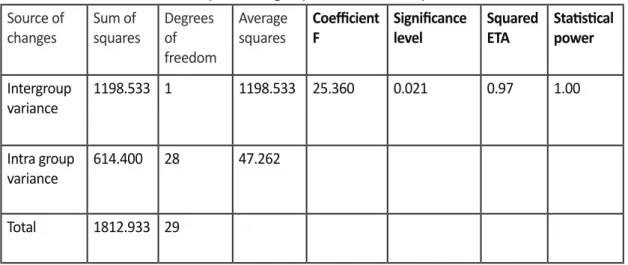
Table 2, shows the mean and standard deviati on of the depression variable separately for each of the groups. According to the results, the depression scores decreased in the post test in the experimental group. It should be noted that the depression questi onnaire respond each item from zero to three based on a four-opti on Likert scale. In this test, the minimum score is zero and the maximum is 63. The individual’s score is obtained directly by calculati ng the sum of the individual’s scores in each of the items. The following scores can be used to indicate the overall level of depression: 0 to 13: no depression or the lowest depression rate is observed; 14 to 19: mild depression; 20 to 28: moderate depression; and 29 to 63: severe depression. Covariance analysis was used in order to investi gate the research hypothesis based on the eff ecti veness of story therapy on decreasing depression in cancer pati ents in the experimental and control groups, (Table 3). Table 3: Results of covariance analysis in two groups of control and experiment
Source of
changes Sum of squares Degrees of freedom
Average
squares Coeffi cient F Signifi cance level SquaredETA Stati sti cal power Intergroup
variance 1198.533 1 1198.533 25.360 0.021 0.97 1.00
Intra group
variance 614.400 28 47.262
Total 1812.933 29
According to the results of Table 3, the level of signifi cance is 0.021 in the inter-group variable, and this value is smaller than the signifi cance level of the criterion (P≤0.05)) and also because the F-value obtained is 25.360 and greater than the table value with degrees of freedom of 29 and 1,
therefore, the hypothesis of research “the eff ecti veness of story therapy on reducing depression in pati ents with cancer”, is confi rmed. Also, the eff ect or diff erence (ETA) is equal to 0.96, that is, reduced depression in the post test of the experimental group is related to the eff ect of the story therapy with a probability of 97%. The stati sti cal power is equal to 1.00, in other words, the research hypothesis is confi rmed if the present study is repeated 1000 ti mes.
Discussion and conclusion
According to the results of this study, the depression scores have decreased in the post test in the experimental group. Therefore, the research hypothesis “the eff ecti veness of the story therapy on reducing depression in cancer pati ents” is confi rmed. In the explanati on of the fi ndings of this study, it should be noted that the language of the storytelling is based on the nature of human beings and the interest in the stories and their hearing. Because children are closer to nature, they love story and storytelling and are aff ected by it and can be used as an educati onal and therapeuti c technique. So, during this study, in the fi rst step, it has tried to focus on the att racti ve process of stories, and the techniques and skills of storytelling and communicati ng with children uti lizing the capacity of story therapy. Also, in the stories, implicitly and indirectly, the inhibiti on of the hero of the story, as well as his pati ence in achieving success and ignoring the immediate and immediate rewards to achieve bett er and longer rewards has been addressed. At the end of the treatment sessions with repeti ti on and practi ce as well as imitati ng children from their favorite characters in the stories, we could acti vate the components of children’s pati ence and happiness and reduce the depression in comparison with pre-treatment period signifi cantly. Stories can also have a signifi cant eff ect on social, emoti onal, and moral educati on, and transfer many regulati ons, social norms, and life-style guidelines. The stories tell how to deal with problems, solve them and many behavioral patt erns in diff erent social and age groups. If the parents or therapists have ability to understand the child’s secret thoughts or identi fy their hidden feelings, even if their interpretati ons are correct, but the child looses the opportunity to achieve the feeling of a successful encounter with his/her problem by listening to the story in succession and thinking about it. For this reason, the narrati ve approaches emphasize psychotherapy and the stories play an important and eff ecti ve role in the behavior and the facts of children. Stories provide unexpected and amazing soluti ons and at the same ti me achievable and positi ve for children, yet positi ve and positi ve. The use of literature, story and story therapy is the result of the eff orts of researchers and therapists. Some problems of children emoti onal and behavioral problems are due to the lack of knowledge and lack of social skills, correct verbal patt ern, community-friendly behaviors, communicati on skills and making friend, accountability, etc., therefore teaching these skills to these children may partly prevent the occurrence of these problems. Psychologists and therapists of the child can show more seriousness in using stories in childhood and adolescent treatment interventi ons and parents and teachers should focus on the wider use of targeted stories in educati onal programs for children, especially this also has its own positi on in educati onal traditi on of our culture.
References
Asghari Motahah, Seyyed Mohsen. (2003). Report on the applicati on of stories as a tool and technique in counseling and childhood, the Journal of Excepti onal Educati on. August and September, pp. 22-19.
Asgharzadeh Salmasi, Farzaneh et al. (2011). The Eff ect of Stage Therapy on Improving Social Adjustment in Children with Conduct Disorder, Journal of Educati onal Sciences, Vol. 4, No. 14, Summer 2011, pp. 24-1.
Barrett , R. A. (2001). Att enti on-defi cit hyperacti vity disorder: A handbook for diagnosis and treatment. (3th ed). New York: Guilford Press.
Berenbaum, R., Boden, M., Baker, M., Dizen, H., Thompson, C. W., Abramowitz, S. M., & Swanson, J. M. (2006). Parent and Teacher SNAP-IV Rati ngs of Att enti on Defi citHyperacti vity Disorder Symptoms: Psychometric Properti es and Normati ve Rati ngs From aSchool District Sample. Assessment, 15,
317-328.
Boden, J., Bonn-Miller, S., Kashdan, T., Alvarez, J., & Gross, K. A. (2012). An assessment of the diagnosti c uti lity of executi ve functi on assessments in the identi fi cati on of ADHD in children.journal child psychology and psychiatry , 33, 125 - 141.
Bright Arthur. (2006). Storytelling, How to use the story to help children solve life problems. Tehran: Growth bud.
Cook, J. W., Taylor, L. A. & Silverman, P. (2004). The Applicati on of Therapeuti c Storytelling Techniques With Preadolescent Children: A Clinical Descripti on With Illustrati ve Case Study. Cogniti ve and Behavioral Practi ce , 2, 243-248.
Crawford, R., Brown, B., & Crawford, P. (2004). Storytelling in therapy.CUHK PrimaryEducati on ,2, 37-45.
Davidson, M. C., Amso, D., Anderson, L. G., & Diamond, A. (2006). Development of cogniti ve control and executi ve functi ons from 4 to 13 years: Evidence from manipulati ons of memory, inhibiti on, and task switching. developmental neuropsychology , 18, 275-290.
Ehsani Estahbanati , Mohammad amin. (2017). The Eff ecti veness of Nima Poetry on Cancer Death Anxiety Summary, Arti cles of the Nati onal Conference on Persian Contemporary Poetry Research, Yasouj University, December 22-21, p. 14.
Ajorlu, Mary et al. (2016). The Eff ect of Stage Therapy on Reducing Anxiety and Improving Sleep Habits in Children With Chemotherapy Levels, Journal of Psychology of Health, No. 18, Summer 1395, pp. 107-87.
Friedberg, R. D. & Wilt, L. H. (2010). Metaphors and Stories in Cogniti ve Behavioral Therapy with Children.Journal Rat-Emo Cogniti ve-Behavior Therapy, 28,100–113.
Kang, E. J., Shaver, L., Daley, D., & Remington, B. (2004). Are Planning, Working Memory, an Inhibiti on Associated With Individual Diff erences in Preschool ADHDsymptoms?Journal of developmental Neuropsycholog, 21, 255–272.
Kashdan, A., Ferssizidis, J., Collins, J., Muraven, V., Savion-Lemieux, T., Barr, R. G., Olicoeur, C., & Douglas, V. I. (2010). Executi ve functi ons and methylphenidateresponse in subtypes of att enti ondefi cit/ hyperacti vity disorder. Biologicalpsychiatry, 57, 1452-1460.
Mashayekhi, Karim. (2009). The eff ecti veness of storytelling for the treatment of depression and other mental disorders in children. Second Iranian Congress of Art Therapy, 2009, December 8-5. Muray, R., Lopez, B., & Crawford, P. (2016). Storytelling in therapy.CUHK PrimaryEducati on ,2, 37-45. Pereirkh, Venus et al. (2009). Stories A Tool for Reducing the Psychological Problems of Children, Tehran: Librarian
Powers, M., & Cross, J. (2015). Executi ve functi ons, self-regulati on, and learned opti mism in paediatric rehabilitati on: a review and implicati ons for interventi on. Journal of Pediatric rehabilitati on, 5, 51-70.
Qashqai, Soghri. (2016). Eff ecti veness of storytelling on depression and aggression of preschool children, Journal of Basic Principles of Mental Health, Year 18, Tir and Aug, 1395, pp. 238-234.
Rahmandoost, Mostafa. (2002). Storytelling, the importance of its path. Tehran: Growth.
Rajabpour Farkhani, Somayeh et al. (2011). The Eff ecti veness of Story Therapy in Reducing Behavioral Disorders in Elementary School Students. Thinking and Child, Insti tute for Human Sciences and Cultural Studies, Second Year, No. 1, Fall and Winter 1931, pp. 35-19.
Sahar Dukht, Mohammad et al. (2016). The Eff ect of Stati c Therapy on Reducing the Anxiety and Strangling of Preschool Children, the Fourth Nati onal Conference on Sustainable Development in Educati on and Psychology, Social and Cultural Studies, Higher Educati on Insti tuti on of Mehr Arvand, June 26, 1959, pp. 9-1.
Seyyedi, Seyyedeh Tahereh. (2003). The use of storytelling in the treatment of behavioral, emoti onal and aggressive problems. Quarterly Journal of Excepti onal Educati on, No. 23, pp. 43-35.
Taj Abadi, Reza et al. (2013). The Eff ect of Storytelling and Story Therapy on Depression in Children. Tabriz University of Medical Sciences and Health Services.
Yousefi Loyeh, Masoomeh. (2006). The Eff ect of Stage Therapy on Emoti onal Problems (Anxiety) of Primary School Children, Master’s Thesis, Islamic Azad University, Tehran Branch.
Zaimi, Zahra et al. (2016). The Eff ecti veness of Story Therapy on Reducing Anxiety and Aggression and Depression in Cancer Children, Psychology and Educati onal Sciences, Winter, 1395, No. 10, pp. 68-59.
Recebido em 29 de abril de 2019. Aceito em 24 de junho de 2019.