DEMOCRACIES
Rethinking the role of corruption and institutional trust Carsten Q. Schneider
Abstract This article analyses the role of corruption and institutional trust in the process of the consolidation of Latin American democracies. Corruption not only violates the basic democratic principles of equality, transparency, and fairness, but it is also believed to foster the likelihood of a democratic breakdown by
undermining the legitimacy of the democratic system in general, and the trust in its core institutions in particular. When compared with consolidated democracies, both level of corruption and institutional distrust are significantly higher in almost all Latin American countries. However, there is no evidence that the Latin
American citizens’ trust in the policy-implementing institutions (police, judiciary, public administration) is more negatively influenced by corruption than it is the case for citizens in consolidated democracies. These findings cast some doubts on the assumption that attitudes should form part of the concept of CoD. Instead, they might better be conceptualized as independent phenomena potentially influencing the persistence of democracy.
Keywords Consolidation of democracy, institutional trust, corruption, Latin America.
Introduction
Over the last few ye ars, the re la ti ons hip bet we en de mo cracy and Rechtssta at / es ta do de de re cho has at trac ted in cre a sing scho larly in te rest.1 In par ti cu lar, so ci al
sci en tists who deal with the to pic of the con so li da ti on of de mo cracy (CoD) high light the im por tan ce of the rule of law, here de fi ned as the equal and fair ap pli ca ti on of exis ting laws (O’Donnell, 1998) for the per sis ten ce and qua lity of de mo cracy. This ar ti cle fo cu ses on a spe ci fic vi o la ti on of the prin ci ple of rule of law, na mely cor rup ti on, and analy ses some of its po ten ti al im pli ca ti ons for CoD.
The La tin Ame ri can re gi on cons ti tu tes a va lu a ble sam ple of coun tri es for in ves ti ga ting the to pic of cor rup ti on and rule of law in the pro cess of CoD. First, this re gi on was al most com ple tely cap tu red by the third wave of de mo cracy (Hun ting ton, 1991). In ad di ti on, events sin ce the be gin ning of this last wave of
SOCIOLOGIA, PROBLEMAS E PRÁTICAS, n.º 42, 2003, pp. 65-90
1 Throug hout this ar ti cle, the terms rule of law and Rechtssta a tlich ke it are used synony mously. For the sub tle dif fe ren ces bet we en them, see La uth/Pic kel/Wel zel (2000).
de mo cra ti za ti on, which were in line with ear li er ex pe ri en ces with de mo cracy, lead us to con clu de that the lack of a sta ble rule of law plays an im por tant role for ex pla i ning the dif fi cul ti es in es ta blis hing li be ral de mo cra tic re gi mes in La tin Ame ri ca (Wey land, 1998).
In the the o re ti cal part of this pa per, the to pics of cor rup ti on and trust in po licy-im ple men ta ti on ins ti tu ti ons (PII) (Ga bri el and Vet ter, 1999) will be lo ca ted in the bro a der con text of CoD. After that, a hypot he sis will be for mu la ted which sta tes that the age of a de mo cra tic system af fects the type of in for ma ti on that ci ti zens use to as sess the trust wort hi ness of PII. More spe ci fi cally, it is con ten ded that the lon ger a de mo cracy sur vi ves, the less im por tant the ci ti zens’ eva lu a ti on of the ex tent of cor rup ti on be co mes for the ir trust in PII.
The em pi ri cal sec ti on is sub di vi ded into a des crip ti ve and an analy ti cal part. First, the ex tent of cor rupt be ha vi ors in both groups of coun tri es will be dis cus sed, using data from Trans pa rency Inter na ti o nal (TI). Se cond, two im por tant as pects of de mo cra tic le gi ti macy will be des cri bed, na mely the ci ti zens’ per cep ti on of cor rup ti on and the ir trust in the so-cal led po licy-im ple men ta ti on ins ti tu ti ons (PII) ju di ci ary, po li ce, and ad mi nis tra ti on. Data on the se is su es is ta ken from the World Va lue Sur vey 1995/98 and the La ti no ba ro me tros 1995, 1996, 1997, and 1998.2
Fol lo wing the des crip ti ve sec ti on, the ques ti on of whet her ci ti zens’ trust in PII in the young La tin Ame ri can de mo cra ci es de pends more on the ins ti tu ti ons’ de mo cra tic per for man ce than do such per cep ti ons in the more con so li da ted de mo cra ci es el sew he re will be ad dres sed. This hypot he sis test will be per for med by es ti ma ting dif fe rent cor re la ti on co ef fi ci ents. The pa per con clu des with a sum mary and a bri ef dis cus si on of the im pli ca ti ons of the em pi ri cal fin dings for the fu tu re of de mo cracy in La tin Ame ri ca and the way CoD should be con cep tu a li zed.
A theoretical perspective on the consolidation of democracy (CoD), rule of law, and institutional trust
Dif fe rent di men si ons of CoD and the rule of law
The lon ger ago the tran si ti on to de mo cracy took pla ce, the more the sci en ti fic and po li ti cal in te rest shifts away from the how and why of the se tran si ti ons and, ins te ad, fo cu ses more on the per sis ten ce and qua lity of the new de mo cra ci es.3 This de ba te 2 LATINOBARÓMETRO is a pu blic opi ni on sur vey con duc ted ye arly sin ce 1995, re pre sen ting the opi ni ons, at ti tu des, be ha vi or and va lu es of 17 coun tri es in La tin Ame ri ca, ap pro xi ma tely 400 mil li on inha bi tants in La tin Ame ri ca. The sur vey LATINOBARÓMETRO is pro du ced by the NGO LATINOBARÓMETRO a non pro fit or ga ni za ti on ba sed in San ti a go de Chi le and di rec ted by Mar ta La gos. (www.la ti no ba ro me tro.org).
3 For Schmit ter/Gu i lhot (2000) it is an ‘epis te mo lo gi cal shift’ that ta kes pla ce when the fo cus of in te rest shifts from de ci si ons in the case of tran si ti on stu di es to ru les in the pha se of consolidation.
has been la be led the con so li da ti on of de mo cracy (CoD). Unfor tu na tely, the re is lit tle con sen sus on the exact me a ning of this term and its con cep tu a li za ti on.
In ac cor dan ce with the ma ins tre am li te ra tu re, CoD is de fi ned in terms of a high li ke li ho od of the per sis ten ce of a de mo cracy (i.e. Prze wors ki, 1991; Di a mond, 1994; Linz and Ste pan, 1996). Hen ce, a de mo cracy is con so li da ted if it is ex pec ted to per sist.4
The lack of a con sen sus on a ba sic de fi ni ti on, along with the com plex na tu re of the phe no me non has gi ven rise to dif fe rent con cep tu a li za ti ons of CoD. Some aut hors ig no re the com ple xity of CoD and apply sim ple in di ca tors, such as, for ins tan ce, the sur vi val for 12 ye ars (Ga si o rows ki and Po wer, 1998), the hol ding of two con se cu ti ve free and fair elec ti ons, or two pe a ce ful shifts in go vern ment (Hun ting ton, 1991). Other aut hors, ins te ad, take the com plex na tu re of CoD in the ir con cep tu a li za ti ons into ac count. Ho we ver, in the ir em pi ri cal stu di es they pro ce ed in a di sag gre ga ted but eclec tic man ner.5 For exam ple, Va len zu e la (1992) fo cu ses
ex clu si vely on the for mal, or ins ti tu ti o nal di men si on of CoD, and in this way high lights the im por tan ce of the so-cal led aut ho ri ta ri an en cla ves in the cons ti tu ti ons to the ne glect of ot her con cep tu ally re le vant as pects of CoD. Yet ot hers, like Prze wors ki (1991), Di Pal ma (1990), or Hi gley and Bur ton ( 1998) con cen tra te on the be ha vi or of the core po li ti cal ac tors (al most ex clu si vely the po li ti cal eli tes and not the mas ses), whe re as Di a mond (1998), Klin ge mann (1998), or Fuchs and Rol ler (1998) pla ce the at ti tu des (of the mas ses, but not of the eli tes) at the cen tre of the ir study of CoD.
Only few aut hors such as Linz and Ste pan, (1996) and Mer kel (1996) have at temp ted to in te gra te the se three core CoD di men si ons (i.e. ins ti tu ti ons, be ha vi or, at ti tu des) into some kind of mul ti le vel mo dels of CoD. Such a con cep tu a li za ti on of CoD sug gests that a de mo cra tic po li ti cal system is con so li da ted if:
— the for mal ru les are in ac cor dan ce with de mo cra tic prin ci ples (ins ti tu ti o nal di men si on),6
— tho se ru les are fol lo wed by the re le vant po li ti cal ac tors (be ha vi o ral di men si on), — the se ru les are sup por ted by a ma jo rity of the ci ti zens (at ti tu di nal di men si on).7
It is im por tant to not that such mul ti le vel con cep tu a li za ti ons of con so li da ti on es ta blish a clo se re la ti ons hip bet we en ins ti tu ti ons, be ha vi or, and at ti tu des qua de fi ni ti o nem.
In this ar ti cle, the idea of dif fe rent di men si ons of CoD is em plo yed and its un derl ying as sump ti on of highly in ter-cor re la ted di men si ons put to an em pi ri cal test. That is, the be ha vi o ral and at ti tu di nal di men si ons are des cri bed and the ir
4 A use ful over vi ew of the dif fe rent de fi ni ti ons of CoD used in the li te ra tu re can be found in Sched ler ( 1998) and Wal dra uch (1996).
5 See Munck (1996) and Encar na ción (2000) on this po int.
6 No ti ce that not all of the se ru les are ex clu si vely fi xed in a cons ti tu ti on but can also be laid down in laws as is the case for most of the coun tri es’ elec to ral ru les.
7 Stu di es of po li ti cal cul tu re in the tra di ti on of Almond/Ver ba (1963) show that the le gi ti macy of de mo cracy is a ba sic in di ca tor of the per sis ten ce, i.e. the le vel of con so li da ti on of a de mo cracy (see Di a mond 1998, Eas ton 1965, Fuchs 1996).
re la ti ons hip with one anot her is analy zed. The prin ci pal as pect to be in ves ti ga ted is the one of rule of law. Incre a singly, this to pic is iden ti fi ed as a key is sue of CoD (O’Donnell, 2000). Through the pers pec ti ve of the rule of law ap pro ach, the con cept of CoD can be re for mu la ted as fol lows: (a) the fair and equal ap pli ca ti on of (de mo cra tic) norms has to be le gally laid down (ins ti tu ti o nal di men si on); (b) tho se ac tors en ti tled to take col lec ti vely bin ding de ci si ons8 have to fol low the prin ci ple of
a fair and equal ap pli ca ti on of exis ting norms (be ha vi o ral di men si on); (c) the ci ti zens have to po si ti vely eva lu a te the prin ci ple of the rule of law and how it is put into prac ti ce by the po li ti cal eli te9 (at ti tu di nal di men si on). De mo cra ci es that ful fill the se
con di ti ons can be re gar ded as con so li da ted in the area of the rule of law. The fol lo wing sec ti on will bri efly ela bo ra te the ways in which cor rup ti on might pro du ce a ne ga ti ve im pact on CoD.
Corruption in the context of CoD
The lar ge num bers of ways in which the rule of law can be vi o la ted (Men dez, O’Donnell and Pi nhe i ro, 1999) cons ti tu tes a ma jor obs ta cle to ope ra ti o na li ze this con cept. One so lu ti on to this pro blem con sists in fo cu sing on just one type of vi o la ti on of the rule of law. It can be ar gued that the phe no me non of cor rup ti on is an ap pro pri a te and fru it ful way of ope ra ti o na li zing the vi o la ti on of the rule of law — es pe ci ally in the con text of CoD, be ca u se “[…] the re is per haps no more com mon and pro found obs ta cle to the con so li da ti on of new de mo cra ci es than wi des pre ad cor rup ti on […] by hol ders of sta te po wer at all le vels” (Sched ler, Di a mond and Platt ner, 1999: 1).
Cor rup ti on can be de fi ned as the “mi su se of a pu blic of fi ce through the vi o la ti on of exis ting norms and the si mul ta ne ous ac cep tan ce of da ma ging col lec ti ve in te rests” (Schmidt 1995: 522, [trans la ti on CQS]); see also Sand holtz and Ko etz le, 1998: 4 in the bi bli o graphy we only have Sand holtz and Ko etz le, 2000 or Wey land, 1998: 109)10 The im por tant po int to un der li ne is that cor rup ti on, by
de fi ni ti on, cons ti tu tes an il le gal be ha vi or, re gard less of whet her or not a gi ven prac ti ce is more-or-less so ci ally ac cep ted.11 In the con text of this pa per, it is of cen tral
im por tan ce that each form of cor rupt be ha vi or is a vi o la ti on of the rule of law.
8 Col lec ti vely bin ding de ci si ons are not only ta ken by the mem bers of the go vern ment and the par li a ment. In ad di ti on, the ju di ci ary, the pu blic ad mi nis tra ti on and the po li ce have to be men ti -o ned. In the pre sent chap ter, all ac t-ors be l-on ging t-o -one -of the se ins ti tu ti -ons are la be led as ‘ -political eli te’.
9 "De pen ding of the out co me of the eva lu a ti on (…), the re is eit her po si ti ve or ne ga ti ve fe ed back for the com mu nity’s le gi ti macy con vic ti ons and va lue com mit ments. This fe ed back sta bi li zes or ero des the com mu nity con sen sus on its de mo cracy, and for this re a son has im por tant consequences for the con so li da ti on of a de mo cracy. “ (Fuchs/Rol ler 1998: 42).
10 An over vi ew of the dif fe rent de fi ni ti ons of cor rup ti on can be found in Lan cas ter/ Mon ti no la (1997).
11 In this chap ter, the func ti o nal in ter pre ta ti ons of cor rup ti on are not ta ken into ac count. The se approaches hold that cer ta in forms of cor rup ti on as sist in ma king a po li ti cal system more effective (see e.g. Bay ley 1989 or Nye 1989).
The idea that cor rup ti on is il le gal ap pli es to every kind of po li ti cal system. No ti ce that it does not mat ter if cor rup ti on ta kes pla ce in a de mo cracy or an au to cracy - in both types of po li ti cal re gi mes a rise in cor rup ti on im pli es a de cli ne of the rule of law. Ho we ver, in the case of de mo cra ci es, cor rup ti on can not be re du ced to its le gal im pli ca ti ons. In ad di ti on to its il le gal na tu re, cor rup ti on vi o la tes the fun da men tal nor ma ti ve prin ci ples of de mo cracy, na mely the equa lity of its ci ti zens and the trans pa rency and open ness of the de mo cra tic pro cess of de ci si on-ma king (Sand holtz and Ko etz le, 1998). As sta ted, “[…] be yond its im pact on the func ti o ning of me cha nisms and ins ti tu ti ons, cor rup ti on, by stri king at the very ro ots of de mo cracy, com pri ses the va lu es of the system. Cor rup ti on subs ti tu tes pri va te in te rests for the pu blic in te rest, un der mi nes the rule of law, and de ni es the prin ci ples of equa lity and trans pa rency” (Del la Por ta and Meny, 1997: 5).
Hen ce, in de mo cra ci es, cor rup ti on vi o la tes both the nor ma ti ve prin ci ples and the le gal norms. Furt her mo re, cor rup ti on can be in ter pre ted as a vi o la ti on of the con di ti ons for mu la ted in the be ha vi o ral di men si on of CoD. Thus, it fol lows by de fi ni ti on that the hig her the le vel of cor rup ti on, the lo wer the in ten sity of the rule of law, the wor se the de mo cra tic per for man ce and, hen ce, the lo wer the le vel of CoD. In short, a wor se de mo cra tic per for man ce is ta ken as an in di ca tor for a shor ter ex pec ted per sis ten ce of de mo cracy.
Ho we ver, the de fac to cor rupt be ha vi or is not the only as pect of cor rup ti on which is re le vant for CoD. As men ti o ned ear li er, in or der to be per sis tent, a de mo cracy ne eds to be le gi ti ma te in the eyes of its ci ti zens. If it is true that de mo cra ci es gain the ir le gi ti macy through the ac com plish ment of the ir pro ce du ral norms12 (Klin ge mann, 2000: 268), then it can be ex pec ted that a high le vel of
cor rup ti on (be ha vi o ral di men si on), has a ne ga ti ve im pact on the sup port and le gi ti macy of de mo cracy (at ti tu di nal di men si on).13 No ti ce that this as sump ti on of an
au to ma tic cor res pon den ce bet we en the de mo cra tic per for man ce (be ha vi o ral di men si on) and the ci ti zens’ at ti tu des is bu ilt into the mul ti le vel con cepts of CoD. It is im por tant to in ves ti ga te whet her this the o re ti cal as sump ti on can be sus ta i ned with em pi ri cal fin dings. Hen ce, the em pi ri cal part of this pa per not only fo cu ses upon the cor rupt be ha vi or of the eli tes, the ci ti zens’ per cep ti on of such be ha vi or, and the trust in a cer ta in type of po li ti cal ins ti tu ti ons. It will also be exa mi ned if, in fact, the re is a strong re la ti ons hip bet we en cor rup ti on and ins ti tu ti o nal trust.
12 Eco no mic and po li ti cal per for man ces are ma cro-in di ca tors, i.e. they are at tri bu tes of the who le po li ti cal system. On the ba sis of the de fac to per for man ces, each ci ti zen de ve lops an in di vi du al per cep ti on of the per for man ce. Hen ce, this in di ca tor is lo ca ted at the mi cro-le vel, the same as the ci ti zens’ trust in ins ti tu ti ons. It is pla u si ble to ex pect that the trust in ins ti tu ti ons (mi cro-le vel) is more in flu en ced by the in di vi du al per cep ti on of per for man ces (mi cro-le vel) than by sta tis tics on the GDP or the de fac to le vel of cor rup ti on (ma cro-le vel). For an em pi ri cal test of this as sump ti on, see Mish ler/Rose (1998: 23, 27).
13 Of cour se, cor rup ti on is not the only fac tor that in flu en ces de mo cra tic le gi ti macy. In par ti cu lar, eco no mic per for man ces seem to be im por tant for the le gi ti macy and the trust in ins ti tu ti ons. Ho we ver, so me how sur pri singly, Klin ge mann/Hof fer bert (1998) could show that the im pact eva lu a ti ons of de mo cra tic per for man ces is gre a ter than ci ti zens’ eva lu a ti ons of eco no mic performances. Di a mond (1998: 35) also finds a high cor re la ti on bet we en de mo cra tic per for man ce, on the one hand, and sa tis fac ti on with de mo cracy and ins ti tu ti o nal trust, on the ot her.
Trust in policy-implementing institutions and corruption
Ge ne rally spe a king, trust in po li ti cal ins ti tu ti ons, as with trust in fel low ci ti zens is a ma jor as pect of li be ral de mo cra tic the ory. Trust as sists po li ti cal systems to fos ter the ir le gi ti macy and the ir ca pa city to de li ver ef fec ti ve and co he rent po li ci es. Well-func ti o ning ins ti tu ti ons cre a te trust and vice ver sa. From this it be co mes cle ar that the to pic of trust in ins ti tu ti ons is es pe ci ally im por tant for new de mo cra ci es and the ir strug gle for per sis ten ce and a mi ni mum of de mo cra tic qua lity (Mish ler and Rose, 1998). “Thus, im pro ving le vels of trust (or at le ast re du cing le vels of dis trust) is part of the chal len ge of le gi ti ma ting, and thus con so li da ting, de mo cracy” (Di a mond, 1999: 206).
A dis cus si on of the sta te of the rule of law and cor rup ti on draws at ten ti on to a spe ci fic kind of ins ti tu ti on. The se can be la be led the ‘po licy-im ple men ting ins ti tu ti ons’ (PII) sin ce the ir main role is “[…] to con vert col lec ti vely bin ding de ci si ons into con cre te me a su res and to ad just dis pu tes bet we en ci ti zens or bet we en the sta te and ci ti zens (Ga bri el and Vet ter, 1999: 215, [trans la ti on CQS]). In more con cre te terms, PII, which in clu de the pu blic ad mi nis tra ti on, the po li ce, and the courts of jus ti ce, can be con tras ted with po licy-de sig ning ins ti tu ti ons such as the go vern ment and the par li a ment.14
Due to the ir role of im ple men ting for mal norms into da ily prac ti ce, it be co mes cle ar that PII play a cen tral role for the re a li za ti on of the rule of law. To this, one can add that ci ti zens’ in di vi du al ex pe ri en ces with cor rup ti on oc cur more through in te rac ti ons with PII than through in te rac ti ons with ot her kinds of ins ti tu ti ons like the pre si dent or mem bers of the par li a ment, be ca u se, as Rose and Shin note: “For the gre at mass of the po pu la ti on, cor rup ti on at the top is far less im me di a te than cor rup ti on at the bot tom of pu blic ad mi nis tra ti on […]” (Rose and Shin, 1999: 13). This le ads to the as sump ti on that the ci ti zens’ per cep ti ons of cor rup ti on are ma inly — though not ex clu si vely — ge ne ra ted by the ir per so nal ex pe ri en ces with PII.15 This as sump ti on im pli es that the ex tent of ins ti tu ti o nal trust
hin ges upon the ins ti tu ti o nal per for man ce. It should be no ted that this ins ti tu ti o nal hypot he sis is con tes ted by a more cul tu rally ba sed ap pro ach, the se cond ma jor the ory in ex pla i ning ins ti tu ti o nal trust (Mish ler and Rose, 1998).
14 Fac tor analy sis shows that ci ti zens in sur veys make a dif fe ren ce bet we en the se two groups of ins ti tu ti ons (see Pic kel/Walz ( 1995: 147) and Ga bri el/Vet ter (1999: 200)).
15 Obvi ously, cor rup ti on is not li mi ted to ac tors in si de the po licy im ple men ting ins ti tu ti ons. What is even more, cor rup ti on scan dals in vol ving top-rank of fi ci als in go vern ment and par li a ment most li kely re ce i ve a much hig her at ten ti on in the me dia and, thus, do have an im pact on both the citizens’ per cep ti on of cor rup ti on and (sup po sedly) the ir trust in po li ti cal ins ti tu ti ons. What exactly this im pact is, if, for ins tan ce, the re is a cer ta in thres hold for the amount of scan dals abo ve which the ci ti zens do not to le ra te cor rup ti on any more, or if at ten ti on to and to le ran ce of corruption fol low cycli cal pat tern can hardly be as ses sed with the kind of lar ge N cross-na ti o nal study per for med in this pa per. In or der to analy ze whet her ti ming and se quen ces of cor rup ti on scan dals play a cru ci al role, more in-depth case stu di es and/or bet ter time-se ri es data are ne e ded. Ne vert he less, the lack of in for ma ti on about ti ming and se quen ce of cor rup ti on scan dals in sin gle coun tri es does not chal len ge the fin dings in this pa per be ca u se it can be as su med that the occurrence of such scan dals is ran domly dis tri bu ted both in si de and bet we en the two country-groups.
In the light of cul tu ral the o ri es, ins ti tu ti o nal trust is seen as the re sult of an early pro cess of so ci a li za ti on. Thus, trust in ins ti tu ti ons is exo ge nous. It is said to vary in re la ti on to the trust that ci ti zens have in the ir fel low ci ti zens. In con trast to this, ins ti tu ti o nal the o ri es cla im that the de gree of ins ti tu ti o nal trust is the re sult of the ci ti zens’ re flec ti on on the ac tu al per for man ce of the same ins ti tu ti ons. Hen ce, in this the o re ti cal fra me work trust in ins ti tu ti ons is in ter pre ted as be ing en do ge nous, i.e. it is sup po sed to vary with re gard to the per for man ce of the se ins ti tu ti ons. Con se quently, “an in cre a se in po pu lar trust in re pre sen ta ti ve ins ti tu ti ons re qui res an in cre a se in the ir trust wort hi ness” (Rose and Shin, 1999: 19).
In the fol lo wing, the ins ti tu ti o nal the ory of ins ti tu ti o nal trust is ap pli ed.16 As
men ti o ned abo ve, the se the o ri es ex pla in the va ri a ti on in ins ti tu ti o nal trust with the va ri a ti on of ins ti tu ti ons’ per for man ce — in clu ding both the syste mic and the de mo cra tic per for man ce. Fac tors such as eco no mic growth, unem ploy ment rate, so ci al, and in ner se cu rity are sub su med un der the ca te gory of syste mic per for man ce. In con trast, de mo cra tic per for man ce, nar rowly de fi ned, can be un ders to od as the com pli an ce of the de mo cra tic pro ce du ral ru les of the game by the po li ti cal eli tes and, by do ing so, gua ran te e ing the res pect of the fun da men tal fre e doms and of the prin ci ples of equa lity, open ness and trans pa rency of the de mo cra tic pro cess (Fuchs, 1998: 10f). As can be seen, the term de mo cra tic per for man ce is clo sely re la ted to the con cept of the rule of law (O’Donnell, 1998) and the pro blem of cor rup ti on is lo ca ted at the in ter sec ti on of both con cepts, as it re du ces both the de gree of de mo cra tic per for man ce and of the rule of law.
Both syste mic and de mo cra tic per for man ce has an im pact on ins ti tu ti o nal trust. Ho we ver, a cru ci al dif fe ren ce bet we en the two types of per for man ces is made when new and mostly uns ta ble de mo cra ci es are com pa red with old and con so li da ted de mo cra tic systems. The ar gu ment is ba sed on the as sump ti on that the age of a de mo cracy, i.e. the length of time a de mo cracy has been in pla ce in a gi ven country, has an im pact on the sour ces of ins ti tu ti o nal trust (Mish ler and Rose, 1998).
Fol lo wing the hypot he sis, it is as su med that the lon ger a de mo cra tic ex pe ri en ce has las ted, the more in cli ned ci ti zens are to take the exis ten ce of ba sic fre e doms and the res pect for de mo cra tic prin ci ples such as equa lity, trans pa rency and open ness for gran ted. As a con se quen ce, de mo cra tic per for man ce is ex pec ted to lo o se im por tan ce for the ge ne ra ti on of ins ti tu ti o nal trust, and syste mic per for man ce be co mes the ma jor sour ce of ins ti tu ti o nal trust. In con trast, the aut ho ri ta ri an pre de ces sor to de mo cracy and its ne glect of ba sic fre e doms is still em bed ded in the me mory of the ma jo rity of ci ti zens in the new de mo cra ci es. As a con se quen ce, the se ci ti zens are be li e ved to put more emp ha sis on the res pect of de mo cra tic fre e doms and rights when eva lu a ting the trust wort hi ness of de mo cra tic ins ti tu ti ons.
16 The tes ting of both the o ri es would go far be yond the sco pe of the pre sent pa per. Addi ti o nally, it is not at the core of the re se arch ques ti on po sed here. Only ins ti tu ti o nal the o ri es of ins ti tu ti o nal trust al low for the pos si bi lity of de li be ra tely in flu en cing the le gi ti macy and the per sis ten ce and con so li da ti on of de mo cracy — for ins tan ce through eit her abs ta i ning from cor rupt be ha vi ors or figh ting cor rup ti on more ri gidly.
Trans fer ring the se as sump ti ons to the pre sent re se arch pro blem, the fol lo wing hypot he sis can be made: Ci ti zens’ trust in PII (po li ce, pu blic ad mi nis tra ti on, ju di ci ary) hin ges upon the de mo cra tic per for man ce of the se ins ti tu ti ons, me a su red in terms of cor rup ti on. The more cor rup ti on, the lo wer the trust in PII. Ta king into ac count that La tin Ame ri can de mo cra ci es are mostly young de mo cra ci es, the fol lo wing hypot he sis can be de ri ved: The as so ci a ti on bet we en the ci ti zens’ per cep ti on of cor rup ti on and the ir trust in po licy im ple men ting ins ti tu ti ons is hig her in the young La tin Ame ri can than in the old and con so li da ted de mo cra ci es.
Be fo re tes ting this hypot he sis, it is worth des cri bing the le vel of cor rupt eli te be ha vi or, the ci ti zens’ per cep ti on of cor rup ti on, and the ir trust in PII in La tin Ame ri ca in the se cond half of the 1990s and to com pa re it with the data for con so li da ted de mo cra ci es.
Empirical results
Indi ca tors
The re are only a few lar ge N com pa ra ti ve stu di es on cor rup ti on. One ob vi ous re a son for this is the clan des ti ne cha rac ter of cor rup ti on and the sub se quent pro blems of fin ding va lid data for a bro ad ran ge of coun tri es. Ho we ver, for some ye ars, Trans pa rency Inter na ti o nal (TI), a Ger man NGO, has made its Cor rup ti on Per cep ti on Index (CPI) ava i la ble to the pu blic.17 In it, the le vel of cor rup ti on in
coun tri es from all over the world is as ses sed on the ba sis of ques ti on na i res for bu si ness pe o ple, risk analysts, jour na lists, and the pu blic (Trans pa rency Inter na ti o nal, 1999: 2). The sca le ran ges from 0 (very cor rupt) to 10 (hardly cor rupt). From 1996 on wards, data has been ava i la ble on an an nu al ba sis and in the most re cent in dex around 90 coun tri es are in clu ded.18
Data for me a su ring the per cep ti on of cor rup ti on and for the trust in ins ti tu ti ons is ta ken from two dif fe rent sur veys:19 first, the La ti no ba ro me tro sur vey
for the ye ars 1995, 1996, 1997, and 1998 (www.la ti no ba ro me tro.org) and, se cond,
17 Lan cas ter/Mon ti no la (2001) of fer a bro ad over vi ew of the exis ting at tempts to cre a te lar ge N in di ces on cor rup ti on. The se aut hors cle arly fa vor the in dex pro du ced by TI, ava i la ble un der http://www.trans pa rency.org/.
18 it has to be po in ted out that TI does not me a su re the de fac to amount of cor rupt be ha vi or but the per cep ti ons about cor rup ti ons held, by and lar ge, by country ex perts and bu si ness pe o ple from out si de the res pec ti ve country. Such an es ti ma te of cor rup ti on is far from per fect. Ho we ver, it seems to be the clo sest so ci al sci en tists can get no wa days to as sess the le vel of cor rup ti on comparatively for a lar ge set of coun tri es. This ex pla ins why the in dex pro du ced by TI has become the most wi dely used in so ci al sci en ces over the last few ye ars.
19 "If po pu lar sup port le gi ti mi za ti on is a core com po nent of de mo cra tic con so li da ti on then mass-le vel sur vey data on po pu lar sup port for de mo cracy pro vi de an in dis pen sa ble me a su re of pro gress to ward de mo cra tic con so li da ti on“ (Di a mond 1998: 8).
the World Va lue Sur vey (WVS) from 1995-98 (http://wvs.isr.umich.edu/). The La ti no ba ro me tro pro vi des the data for the La tin Ame ri can ca ses whe re as the WVS is used for the con so li da ted de mo cra ci es.
In the La ti no ba ro me tro, the ques ti ons for me a su ring the trust in ins ti tu ti ons sta te:
Ple a se look at this card and tell me how much con fi den ce you have in each of the fol lo wing groups, ins ti tu ti ons or per sons men ti o ned on the list: (1) a lot, (2) some, (3) a lit tle or (4) no con fi den ce? The Ju di ci ary, The Pu blic Admi nis tra ti on, The Po li ce.
In the World Va lue Sur vey, the ques ti on sta tes:
I am go ing to name a num ber of or ga ni za ti ons. For each one, could you tell me how much con fi den ce you have: is it (1) a gre at deal of con fi den ce, (2) qui te a lot, (3) not very much con fi den ce or (4) not at all? The Le gal System, The Ci vil Ser vi ce, The Po li ce.
In the La ti no ba ro me tro, the per cep ti on of cor rup ti on is me a su red with the fol lo wing ques ti on:
From the list of is su es that I am go ing to read out to you do you think they have (1) in cre a sed a lot or (2) a lit tle, or have (3) re ma i ned the same or have (4) de cre a sed a lit tle or (5) a lot in the last 5 ye ars?: Cor rup ti on
For the World Va lue Sur vey, it sta tes:
How wi des pre ad do you think bri be-ta king and cor rup ti on is in this country? (1) Almost no pu blic of fi ci als are en ga ged in it?, (2) A few pu blic of fi ci als are en ga ged in it, (3) Most pu blic of fi ci als are en ga ged in it, (4) Almost all pu blic of fi ci als are en ga ged in it.
The items for me a su ring the ins ti tu ti o nal trust in both sur veys are si mi lar and the re fo re ea sily com pa ra ble. Ho we ver, this is not the case for the cor rup ti on per cep ti on items. In the La ti no ba ro me tro, the ques ti on as ked re fers to the de ve lop ment of cor rup ti on over the last few ye ars whe re as in the WVS res pon dents are as ked to eva lu a te the pre sent si tu a ti on of cor rup ti on in the ir country. Com pa ring the text of both items, one might con clu de that the ques ti on as it is sta ted in the La tin Ame ri can ca ses le ads to hig her va lu es of cor rup ti on per cep ti on. Thus, whe ne ver the per cep ti on of cor rup ti on in La tin Ame ri ca is com pa red with the one in con so li da ted de mo cra ci es, the dif fe ren ces in the item text and the sub se quently in tro du ced bias in fa vor of the con so li da ted de mo cra ci es has to be ta ken into ac count.
Levels of corruption in Latin America and in consolidated democracies
The Cor rup ti on Per cep ti on Index (CPI) ena bles us to in ves ti ga te whet her in the se -cond half of the 1990s the La tin Ame ri can de mo cra ci es were more cor rupt than the con so li da ted de mo cra ci es. This ques ti on re fers to the be ha vi o ral di men si on of CoD.
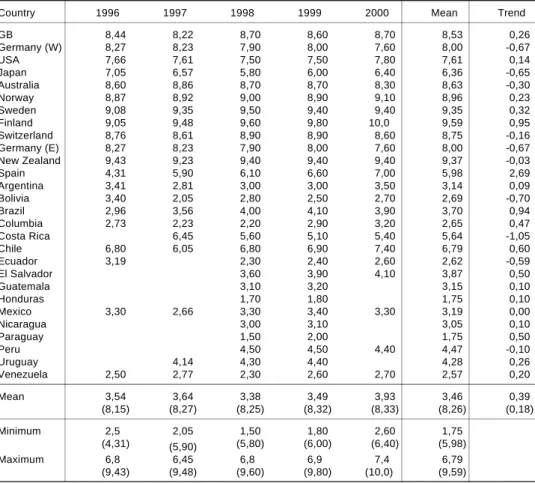
Ta ble 1 re ve als a cle ar dif fe ren ce bet we en the group of La tin Ame ri can coun tri es, on the one hand, and the con so li da ted de mo cra ci es, on the ot her. The mean va lue of cor rup ti on for La tin Ame ri ca for the se cond half of the 1990s is 3,46 com pa red to 8,26 for the es ta blis hed de mo cra ci es. The lat ter group is re la ti vely
Country 1996 1997 1998 1999 2000 Mean Trend
GB 8,44 8,22 8,70 8,60 8,70 8,53 0,26 Germany (W) 8,27 8,23 7,90 8,00 7,60 8,00 -0,67 USA 7,66 7,61 7,50 7,50 7,80 7,61 0,14 Japan 7,05 6,57 5,80 6,00 6,40 6,36 -0,65 Australia 8,60 8,86 8,70 8,70 8,30 8,63 -0,30 Norway 8,87 8,92 9,00 8,90 9,10 8,96 0,23 Sweden 9,08 9,35 9,50 9,40 9,40 9,35 0,32 Finland 9,05 9,48 9,60 9,80 10,0 9,59 0,95 Switzerland 8,76 8,61 8,90 8,90 8,60 8,75 -0,16 Germany (E) 8,27 8,23 7,90 8,00 7,60 8,00 -0,67 New Zealand 9,43 9,23 9,40 9,40 9,40 9,37 -0,03 Spain 4,31 5,90 6,10 6,60 7,00 5,98 2,69 Argentina 3,41 2,81 3,00 3,00 3,50 3,14 0,09 Bolivia 3,40 2,05 2,80 2,50 2,70 2,69 -0,70 Brazil 2,96 3,56 4,00 4,10 3,90 3,70 0,94 Columbia 2,73 2,23 2,20 2,90 3,20 2,65 0,47 Costa Rica 6,45 5,60 5,10 5,40 5,64 -1,05 Chile 6,80 6,05 6,80 6,90 7,40 6,79 0,60 Ecuador 3,19 2,30 2,40 2,60 2,62 -0,59 El Salvador 3,60 3,90 4,10 3,87 0,50 Guatemala 3,10 3,20 3,15 0,10 Honduras 1,70 1,80 1,75 0,10 Mexico 3,30 2,66 3,30 3,40 3,30 3,19 0,00 Nicaragua 3,00 3,10 3,05 0,10 Paraguay 1,50 2,00 1,75 0,50 Peru 4,50 4,50 4,40 4,47 -0,10 Uruguay 4,14 4,30 4,40 4,28 0,26 Venezuela 2,50 2,77 2,30 2,60 2,70 2,57 0,20 Mean 3,54 (8,15) 3,64 (8,27) 3,38 (8,25) 3,49 (8,32) 3,93 (8,33) 3,46 (8,26) 0,39 (0,18) Minimum 2,5 (4,31) 2,05 (5,90) 1,50 (5,80) 1,80 (6,00) 2,60 (6,40) 1,75 (5,98) Maximum 6,8 (9,43) 6,45 (9,48) 6,8 (9,60) 6,9 (9,80) 7,4 (10,0) 6,79 (9,59)
No tes: The sca le ran ges from 0 (very cor rupt) to 10 (hardly cor rupt). The va lu es in the co lumn “trend” are cal cu la ted by sub trac ting the first from the last data po int for each country. Hen ce, ne ga ti ve va lu es in di ca te an in cre a se of cor rup ti on over time. Va lu es in pa rent he ses in di ca te the mean, the mi ni mum and the ma xi mum va lu es for the group of con so li da ted de mo cra ci es.
ho mo ge ne ous, Spa in dis pla ying as the most cor rupt con so li da ted de mo cracy.20
The group of La tin Ame ri can coun tri es is ho mo ge ne ous, as well. Ho we ver, this fin ding is a re sult of the fact that al most all of them are lo ca ted at the lo wer half of the TI in dex.
The main ex cep ti on from this pat tern is Chi le with a mean va lue of 6,79 and a slightly po si ti ve ten dency over the past 5 ye ars. In Bo li via (2,69), Ve ne zu e la (2,57), Hon du ras, and Pa ra guay (both 1,75) the le vel of cor rup ti on is wor se — the lat ter two coun tri es oc cup ying one of the lo west po si ti ons when com pa red with the most cor rupt sta tes in the world. The only po si ti ve fin ding from ta ble 1 in terms of CoD in La tin Ame ri ca is that the al re ady very high le vel of cor rup ti on does not seem to be get ting wor se over time. Ho we ver, some of the coun tri es have to be ex clu ded from this ad mit tedly very weak sign of hope. The se in clu de Bo li via, Cos ta Rica and Ecu a dor as the se coun tri es show a cle ar in cre a se in cor rupt prac ti ces in the se cond half of the 1990s.
In terms of the mul ti le vel mo del of a con so li da ted de mo cracy, it can be sta ted that the de mo cra ci es in La tin Ame ri ca cle arly come short of the stan dards set by the con so li da ted de mo cra ci es on the be ha vi o ral di men si on of CoD. The mas si ve amount of cor rupt prac ti ces cle arly vi o la tes the core prin ci ple of the rule of law and, thus, en dan gers the per sis ten ce and the qua lity of de mo cracy.
Description of corruption perception in Latin America
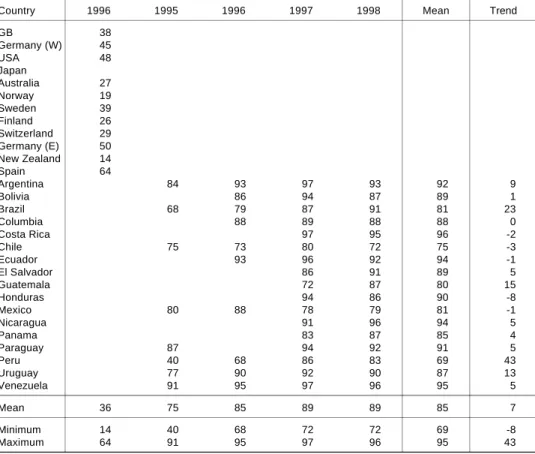
As men ti o ned ear li er, the de fac to cor rupt be ha vi or of the po li ti cal eli tes (be ha vi o ral di men si on) is not the only re le vant as pect for eva lu a ting the le vel of CoD — at le ast not, if we adopt a mul ti le vel mo del of con so li da ted de mo cra ci es in which the ci ti zens’ at ti tu des mat ter by de fi ni ti on. The fol lo wing in ves ti ga tes dif fe rent as pects of de mo cra tic le gi ti macy lin ked to the to pic of cor rup ti on, thus me a su ring the at ti tu di nal di men si on of CoD. After de a ling with the per cep ti on of cor rup ti on, the ci ti zens’ trust in the so-cal led po licy im ple men ting ins ti tu ti ons (PII) is shown, which is yet anot her at ti tu di nal as pect of CoD. Ta ble 2 shows the ex tent to which the ci ti zens in La tin Ame ri ca per ce i ve the ir po li ti cal systems to be cor rupt. Data is ava i la ble for the pe ri od from 1995 to 1998. As a po int of re fe ren ce, ta ble 2 also con ta ins data for the con so li da ted de mo cra ci es in 1996.
The mean for all La tin Ame ri can coun tri es over the who le pe ri od is 85%, in di ca ting that more than three quar ters of the La tin Ame ri can po pu la ti on per ce i ve the ir po li ti cal systems to be cor rupt. Coun tri es such as Argen ti na, Cos ta Rica, Ni ca ra gua, and Ve ne zu e la are abo ve this high mean va lue, with more than 90% of the ci ti zens de cla ring the ir po li ti cal system cor rupt. Almost all of the coun tri es show a ri sing trend in cor rup ti on per cep ti on. Peru is es pe ci ally in te res ting as the mean va lue over the pe ri od of four ye ars is 69%. Ho we ver, hid den be hind this
20 Ho we ver, the de cli ning ten dency of cor rup ti on in Spa in should be no ted. Addi ti o nally, with a mean of 5.98 over the pe ri od 1996-2000, Spa in is cle arly less cor rupt than al most all coun tri es in La tin Ame ri ca.
re la ti vely mo dest va lue in the La tin Ame ri can con text is a dra ma tic in cre a se from 40% in 1995 to 83% in 1998. A si mi larly re mar ka ble in cre a se can be ob ser ved in the Bra zi li an case. In only four ye ars, the va lue of cor rup ti on per cep ti on has in cre a sed by 23 per cent po ints to a le vel of 91% in 1998. Chi le shows the best re sults in terms of cor rup ti on per cep ti on in the La tin Ame ri can con text; ho we ver, even in this country ap pro xi ma tely two thirds of the po pu la ti on be li e ve that the ir po li ti cal eli te is cor rupt. Sur pri singly, the va lue for Uru guay (87%) is qui te high, sin ce this is one of the few third wave de mo cra ci es in La tin Ame ri ca which is ge ne rally con si de red as be ing clo se to CoD.
The ab so lu te va lu es for La tin Ame ri ca ta ken as such are al re ady alar ming. Ho we ver, the ne ga ti ve im pact on CoD be co mes even more evi dent when the La tin Ame ri can data is com pa red with the data for con so li da ted de mo cra ci es. Even if the
Country 1996 1995 1996 1997 1998 Mean Trend
GB 38 Germany (W) 45 USA 48 Japan Australia 27 Norway 19 Sweden 39 Finland 26 Switzerland 29 Germany (E) 50 New Zealand 14 Spain 64 Argentina 84 93 97 93 92 9 Bolivia 86 94 87 89 1 Brazil 68 79 87 91 81 23 Columbia 88 89 88 88 0 Costa Rica 97 95 96 -2 Chile 75 73 80 72 75 -3 Ecuador 93 96 92 94 -1 El Salvador 86 91 89 5 Guatemala 72 87 80 15 Honduras 94 86 90 -8 Mexico 80 88 78 79 81 -1 Nicaragua 91 96 94 5 Panama 83 87 85 4 Paraguay 87 94 92 91 5 Peru 40 68 86 83 69 43 Uruguay 77 90 92 90 87 13 Venezuela 91 95 97 96 95 5 Mean 36 75 85 89 89 85 7 Minimum 14 40 68 72 72 69 -8 Maximum 64 91 95 97 96 95 43
No tes: Per cen ta ge of res pon dents sta ting that cor rup ti on in the ir country has in cre a sed “a lot” or “a lit tle”. Va lu es in co lumn “trend” are cal cu la ted by sub trac ting the first from the last data po int for each country. Hen ce, ne ga ti ve va lu es in di ca te an in cre a se of cor rup ti on per cep ti on over time, ex pres sed in per cen ta ge po ints. See page 9f. for the dif fe ren ces in wor ding the ques ti ons in the La ti no ba ro me tro and the WVS.
slightly dif fe rent sti mu lus for me a su ring cor rup ti on in the La ti no ba ro me tro and the WVS per cep ti on is ta ken into ac count, one can not but con clu de that the gap bet we en the two country groups is enor mous: In the group of the con so li da ted de mo cra ci es, around one third of the po pu la ti on be li e ves that all or most of the ir po li ti cal eli tes are cor rupt. As men ti o ned, the res pec ti ve va lue for La tin Ame ri ca is 85%.
Trust in policy-implementation institutions in Latin America
As men ti o ned ear li er, the trust of ci ti zens in the ir po li ti cal ins ti tu ti ons is an im por tant fe a tu re in the pro cess of con so li da ting de mo cra ci es, sin ce “ins ti tu ti o nal trust has sig ni fi cant po si ti ve ef fects on sup port for the cur rent re gi me and on re jec ti on of aut ho ri ta ri an al ter na ti ves, and this po si ti ve ef fect ap pe ars to be li ne ar” (Di a mond, 1999: 206). The fol lo wing sec ti on pre sents the trust that the La tin Ame ri can ci ti zens have in the ir PII. Whe re ver data is ac ces si ble, the va lu es for the con so li da ted de mo cra ci es will be shown as a po int of re fe ren ce.
Ta ble 3 in di ca tes that in La tin Ame ri ca over the se cond half of the 1990s only about one third of the po pu la ti on ex pres ses very strong or strong trust in the ju di ci ary.21 In ad di ti on to this dra ma tic fi gu re, most coun tri es show a down ward
trend in trust in the ju di ci ary des pi te the al re ady very low va lu es. For ins tan ce, in Argen ti na, trust in PII has drop ped by 15 per cen ta ge po ints from an exis ting low of 34% in 1995 to 19% in 1998. Anot her exam ple is Peru, with a loss in trust of 10 per cen ta ge po ints in only four ye ars, fal ling to a va lue of 16% of its ci ti zens trus ting the ju di ci ary in 1998. Cos ta Rica (mean 50%) and Uru guay (mean 53%) are the coun tri es with the hig hest re cord of ci ti zens’ trust in the ju di ci ary, Cos ta Rica, in ad di ti on, be ing the only country with a cle ar in cre a se of trust. Chi le, a country ge ne rally con si de red ha ving good chan ces for re a ching CoD, ran ges only slightly abo ve the La tin Ame ri can mean of trust in the ju di ci ary and, thus, per forms wor se than coun tri es such as Bra zil or Hon du ras.
The va lu es for trust in the po li ce in La tin Ame ri ca are si mi lar to the ones for the ju di ci ary. The mean va lue for all coun tri es du ring the pe ri od 1995-1998 is 34%. In Argen ti na, aga in, a dra ma tic de cli ne in trust in the po li ce can be ob ser ved, fal ling 17 per cen ta ge po ints from 36% in 1995 to 19% in 1998, the lo west va lue for the who le re gi on. Other coun tri es with a strong de cli ne in trust are Peru (mi nus 16 per cen ta ge po ints) and the Cen tral Ame ri can Sta tes Hon du ras (mi nus 18 per cen ta ge po ints), Ni ca ra gua (mi nus 13 per cen ta ge po ints), and El Sal va dor (mi nus 13 per cen ta ge po ints). Chi le and Uru guay are two coun tri es in which trust
21 In ad di ti on to the per cen ta ge of pe o ple trus ting the ir PII, ta ble 3 in di ca tes the mean and the tendency of trust in the ju di ci ary and the po li ce over time for each country. Furt her mo re, an index of trust in PII is shown: it is cons truc ted by ad ding the trust an in di vi du al has in the po li ce
and the ju di ci ary. It ran ges from 2 (very strong trust in both ins ti tu ti ons) to 8 (no trust at all, eit her
in the po li ce, or in the ju di ci ary). No ti ce that the in dex of trust in PII shown in ta ble 4 is slightly dif fe rent. It is ba sed on the sum of in di vi du al trust in the po li ce, the ju di ci ary and the pu blic administration and it ran ges from 3 (very strong trust in all three ins ti tu ti ons) to 12 (no trust at all, eit her in the po li ce and the ju di ci ary, or in the pu blic ad mi nis tra ti on).
Country PII 1995 1996 1997 1998 Mean Trend Argentina Judiciary 34 23 21 19 24 -15 Police 36 25 16 19 24 -17 Administration 27 19 PII 11 12 1 Bolivia Judiciary 25 27 27 26 2 Police 18 20 27 22 9 Administration 22 PII 15 18 3 Brazil Judiciary 39 41 44 41 41 2 Police 33 28 32 25 29 -8 Administration 28 27 PII 31 25 -6 Columbia Judiciary 32 46 29 36 -3 Police 24 44 32 33 8 Administration 20 PII 38 22 -16
Costa Rica Judiciary 43 57 50
Police 35 34 34 Administration PII 35 33 -2 Chile Judiciary 40 36 42 36 39 -4 Police 63 47 53 56 55 -7 Administration 42 38 PII 40 35 -5 Ecuador Judiciary 31 30 22 28 -9 Police 35 34 27 32 -8 Administration 27 PII 27 17 -10 El Salvador Judiciary 46 36 41 Police 53 40 47 Administration PII 46 29 -17 Guatemala Judiciary 28 28 28 Police 26 26 26 Administration PII 29 19 -10 Honduras Judiciary 53 41 47 Police 53 35 44 Administration PII 48 33 -15 Mexico Judiciary 33 19 27 29 27 -4 Police 28 12 26 27 23 -1 Administration 39 19 PII 15 20 5 Nicaragua Judiciary 39 24 31 Police 41 28 34 Administration PII 33 18 -15
in the po li ce re ma ins cons tant over time, though re ma i ning at a mo dest le vel with 55% and 46%, res pec ti vely.
Data for trust in the pu blic ad mi nis tra ti on is only ava i la ble for 1995 and 1996. For this pe ri od it can be shown that only 28% of the La tin Ame ri can ci ti zens trust the ir bu re a u cracy. Ve ne zu e la ranks lo west with 20%. On the ot her end, the ci ti zens in Chi le and Uru guay, aga in, show the hig hest le vel of trust in the ir pu blic ad mi nis tra ti on in La tin Ame ri ca. Ho we ver, even in the se coun tri es the le vel of trust ne ver ex ce eds 45%. Furt her mo re, even though data is only ava i la ble for two con se cu ti ve ye ars, some coun tri es show a sharp de cli ne: for ins tan ce, in Me xi co (from 39% to 19%) and aga in in Argen ti na (from 27% to 19%).
Country PII 1995 1996 1997 1998 Mean Trend
Panama Judiciary 34 28 31 Police 48 39 43 Administration PII 34 24 -10 Paraguay Judiciary 34 32 35 34 1 Police 30 37 43 36 13 Administration 19 PII 24 29 5 Peru Judiciary 26 25 18 16 21 -10 Police 41 30 28 25 31 -16 Administration 30 26 PII 17 13 -4 Uruguay Judiciary 55 55 56 48 53 -7 Police 47 43 48 48 46 1 Administration 40 37 PII 45 40 -5 Venezuela Judiciary 29 27 37 29 31 0 Police 25 17 27 23 23 -2 Administration 22 18 PII 28 21 -7 Mean Judiciary 36 31 37 32 34 -4 Police 38 28 36 33 34 -5 Administration 31 25 PII 30 24 -6 Minimum Judiciary 26 19 18 16 21 Police 25 12 16 19 22 Administration 19 18 PII 11 12 Maximum Judiciary 55 55 56 57 53 Police 63 47 53 56 55 Administration 42 38 PII 48 40
No tes: Per cen ta ge of res pon dents sta ting a lot or some trust in ju di ci ary, po li ce, and pu blic ad mi nis tra ti on (sco res 1 and 2 on a 4-po int-sca le of ins ti tu ti o nal trust). Row “Index of trust in PII”: Per cen ta ge of res pon dents sco ring 2-4 on the sca le ran ging from 2-8. The va lu es in the co lumn ‘trend’ are cal cu la ted by sub trac ting the first from the last data po int for each country. Hen ce, ne ga ti ve va lu es in di ca te a de cre a se of ins ti tu ti o nal trust, ex pres sed in per cen ta ge po ints.
The va lu es for the so-cal led in dex of trust in PII are de cli ning as well. The La tin Ame ri can mean for 1997 is 30%, com pa red to only 24% in 1998. Bra zil, Ecu a dor, El Sal va dor, and Ni ca ra gua are par ti cu larly hit by the si mul ta ne ous de cli ne on the in di vi du al ba sis of trust in both the ju di ci ary and the po li ce. In ot her words, in the se coun tri es, the num ber of tho se ci ti zens who dis trust any form of PII is high. In con trast to this, in ot her coun tri es with both low le vels of trust in po li ce and ju di ci ary, the in ter sec ti on of in di vi du als who dis trust both the po li ce and the ju di ci ary is lo wer.
All of the data pre sen ted in Ta ble 3 show an enor mous and wi des pre ad dis trust in the po li ce, the ju di ci ary, and the pu blic ad mi nis tra ti on in La tin Ame ri can coun tri es. Chi le and Uru guay are the coun tri es which per form best and, not sur pri singly, the se are the two coun tri es ge ne rally seen as the most pro mi sing de mo cra ci es in terms of CoD. As shown by the evi den ce, less than half of the res pon dents dis play some le vel of trust in the ir PII. Me xi co, Argen ti na, and Bo li via are the coun tri es with the worst re cord of ins ti tu ti o nal trust: for the most part, more than three quar ters of the ci ti zens ex press the ir dis trust in po li ce, ju di ci ary, and ad mi nis tra ti on. The se va lu es in di ca te a cle ar lack of le gi ti macy of the res pec ti ve po li ti cal systems. This fin ding be co mes even more evi dent when the data is com pa red to the fi gu res for con so li da ted de mo cra ci es.
The mean va lu es in Ta ble 4 cle arly show that the ci ti zens in con so li da ted de mo cra ci es have sig ni fi cantly more trust in each of the three PII than in La tin Ame ri ca. The lar gest dif fe ren ce can be ob ser ved in the case of the po li ce. Around two thirds of the ci ti zens in the con so li da ted de mo cra ci es trust the po li ce com pa red to only 28% in La tin Ame ri ca. More than half of the res pon dents in the group of es ta blis hed de mo cra ci es de cla re that they trust the ir ju di ci ary — in La tin
Country Judiciary Administration Police PII
Germany (W) 54 48 71 33 USA 37 51 71 31 Japan 80 38 78 42 Australia 35 38 76 24 Norway 70 51 86 46 Sweden 63 45 81 41 Finland 69 34 86 39 Switzerland 68 50 70 41 Germany (E) 33 41 52 15 New Zealand 47 29 81 27 Spain 47 42 62 29 Mean 55 (31) 42 (25) 74 (28) 34 (15) Minimum 33 (19) 29 (18) 52 (12) 15 (8) Maximum 80 (55) 51 (38) 86 (47) 46 (30)
No tes: See no tes for ta ble 3. Num bers in brac kets are the va lu es for La tin Ame ri ca ta ken from ta ble 3. The in dex of trust in PII shown in ta ble 4 in clu des the trust in all three PII. It ran ges from 3 (very strong trust in all three PII) to 12 (no trust at all, ne it her in the ju di ci ary, nor the po li ce, nor the ad mi nis tra ti on). The per cen ta ge of
res pon dents sco ring from 3 to 6 is shown.
Ame ri ca it is about one third and only 25% trust the ir pu blic ad mi nis tra ti on. The in dex of trust in PII also re ve als the lar ge dif fe ren ce bet we en the two country groups. In La tin Ame ri ca only 15% of the ci ti zenry has even a mo dest le vel of trust in all PII si mul ta ne ously, whe re as in the con so li da ted de mo cra ci es the re are at le ast 34%. The re sults in di ca te that the le vel of trust in PII in the se cond half of the 1990s in La tin Ame ri ca is at a very low le vel — both in ab so lu te terms and in com pa ri son with con so li da ted de mo cra ci es. Furt her mo re, many ca ses even dis play a down ward trend.
In sum ming up the des crip ti on of the cor rup ti on, the cor rup ti on per cep ti on and trust in PII, it can be sta ted that the re is a huge gap bet we en La tin Ame ri ca and the group of con so li da ted de mo cra ci es in all three are as. This is em pi ri cal sup port for the ini ti al as sump ti on that the La tin Ame ri can de mo cra ci es do not be long to the group of con so li da ted de mo cra ci es. This sta te ment is true if one sha res the view that high le vels of cor rup ti on of the eli tes (be ha vi o ral di men si on) and ins ti tu ti o nal dis trust of the ci ti zens (at ti tu di nal di men si on) dis qua li fi es a de mo cracy from be ing con so li da ted.
If the se in di ca tors are ap pli ed, only a few La tin Ame ri can de mo cra ci es come clo se to the stan dard set by the con so li da ted de mo cra ci es. First are Chi le and Uru guay. Chi le is one of the le ast cor rupt coun tri es in La tin Ame ri ca, Chi le ans per ce i ve the ir de mo cracy as less cor rupt than the ir La tin Ame ri can fel low ci ti zens do and the ir trust in PII is one of the hig hest in that re gi on. In Uru guay, the va lu es for ins ti tu ti o nal trust are also high. Ho we ver, the country ran ges com pa ra ti vely high in terms of cor rup ti on and, as a con se quen ce, Uru gua yans be li e ve that the ir po li ti cal system is very cor rupt.
On the lo wer end of the CoD “sca le” are im por tant coun tri es such as Argen ti na, Bra zil, Peru, and Co lum bia. All of the se de mo cra ci es ran ge very low on at le ast one di men si on of CoD des cri bed abo ve. In Argen ti na, Bra zil, and Peru the low le vel and the de cli ning trend of ci ti zens’ ins ti tu ti o nal trust is re mar ka ble. In Co lum bia, the most se ri ous pro blem that can be ob ser ved from this study is the huge ex tent of cor rup ti on. In gros so modo, La tin Ame ri can de mo cra ci es show de fi cits in the rule of law and in le gi ti macy.
The next sec ti on de als with the hypot he sis on the im pact of de mo cra tic per for man ces on the le vel of ins ti tu ti o nal trust. On the one hand, if the hypot he sis is con fir med, a vi ci ous cir cle for La tin Ame ri ca with ne ga ti ve con se quen ces for the per sis ten ce and qua lity of de mo cracy may re sult. Incre a sing le vels of cor rup ti on (i.e. low le vels of de mo cra tic per for man ce) might lead to in cre a sing ins ti tu ti o nal dis trust which, if it lasts long enough, could ca u se even lo wer le vels of de mo cra tic per for man ce. On the ot her hand, if the re is no subs tan ti vely sig ni fi cant re la ti ons hip bet we en ins ti tu ti o nal trust and cor rup ti on, such a fin ding would chal len ge the mul ti le vel mo dels of con so li da ted de mo cra ci es sin ce they are fun da men tally ba sed on the as sump ti on of a high as so ci a ti on bet we en be ha vi or and at ti tu des.
Comparing the association between corruption and institutional trust in Latin America and consolidated democracies
The hypot he sis to be tes ted sta tes that the age and the sta bi lity of a de mo cra tic system has an im pact on the kind of sour ces of ins ti tu ti o nal trust. The more time has pas sed sin ce the tran si ti on from an au to cra tic form of go vern ment to a (sta ble) de mo cra tic system, the less im por tant po li ti cal fre e doms and ci vil li ber ti es be co me for ci ti zens and, thus, they not base the ir trust in the de mo cra tic per for man ce of the po li ti cal ins ti tu ti ons to the ex tent that they did in the ear li er pha se of de mo cracy. If this as sump ti on is cor rect, one should find a stron ger as so ci a ti on bet we en cor rup ti on per cep ti on and trust in PII in the case of La tin Ame ri can ci ti zens than in the case of the ci ti zens in con so li da ted de mo cra ci es. The fol lo wing sec ti on tests the hypot he sis em pi ri cally by in ves ti ga ting the cor re la ti on bet we en dif fe rent me a su res of cor rup ti on, its per cep ti on, and the trust in PII both on the ma cro — and the mi cro-le vel.
Correlation between corruption perception and institutional trust on the macro-level
Cor rup ti on, its per cep ti on, and ins ti tu ti o nal trust can be seen as an at tri bu te of a who le country (ma cro-le vel) or as a cha rac te ris tic of in di vi du als (mi cro-le vel). Be fo re in ves ti ga ting the cor re la ti ons on the mi cro-le vel, this sec ti on bri efly analy zes the strength of the as so ci a ti on bet we en cor rup ti on and ins ti tu ti o nal trust in La tin Ame ri ca and con so li da ted de mo cra ci es on the ma cro-le vel.
First, the va lu es of Bra va is-Pe ar sons r show that the de gree of cor rup ti on me a su red by TI and the ci ti zens’ per cep ti on of the ex tent of cor rup ti on are sig ni fi cantly cor re la ted in both country groups (La tin Ame ri ca: r: -0.749, sig. -le vel: 0.02, N=9, con so li da ted de mo cra ci es: r: -0.803, sig.-le vel; 0.003, N=11, ne ga ti ve sign due to co ding of va ri a bles). This in di ca tes that the ci ti zens are able to cor rectly per ce i ve the le vel of cor rup ti on in the ir own country as it is eva lu a ted by out si de ob ser vers. Put the ot her way round, this fin ding sup ports the cla im that the TI in dex is in fact re flec ting to a cer ta in de gree what is go ing on in terms of cor rup ti on in a wide ran ge of coun tri es.22
Ho we ver, no sig ni fi cant cor re la ti on can be found bet we en cor rup ti on me a su red by TI and its per cep ti on, on the one hand, and the trust in PII, on the ot her. As can be seen in ta ble 5, the re are only two and a half ex cep ti ons to this fin ding: In con so li da ted de mo cra ci es, the ci ti zens’ cor rup ti on per cep ti on and the trust in the po li ce cor re la te sig ni fi cantly in such a way that in case of more cor rup ti on the trust in the po li ce is lo wer. Ho we ver, at the same time, the re are no sig ni fi cant cor re la ti ons
22 No ti ce though that part of the cor re la ti on might be due to the fact that in cer ta in ca ses TI in cor -po ra tes sur vey data into the ir ove rall country sco res.
bet we en the cor rup ti on in dex of TI and the trust in any of the PII. On the con trary, in the group of La tin Ame ri can coun tri es, the TI in dex cor re la tes sig ni fi cantly with the per cen ta ge of ci ti zens ha ving strong and some trust in the ir pu blic ad mi nis tra ti on. In ad di ti on, if we ac cept a so mew hat more re la xed sig ni fi can ce le vel of. 1, the re is also a sig ni fi cant cor re la ti on bet we en the TI in dex and the ci ti zens’ trust in the po li ce. In both ca ses the signs of the co ef fi ci ents take the ex pec ted di rec ti on. At the same time, ho we ver, no sig ni fi cant as so ci a ti on can be found bet we en the ag gre ga te cor rup ti on per cep ti on and any of the ag gre ga te me a su res of trust in PII.
It should be no ted that the se re sults are only of li mi ted re le van ce for tes ting the hypot he sis. The low num ber of ca ses may ac count for the lack of the sig ni fi cant co ef fi ci ents — even more so sin ce the va ri an ce of cor rup ti on (and its per cep ti on) in the case of La tin Ame ri ca, the same as of the TI-va lu es in the case of the con so li da ted de mo cra ci es is very low. For tu na tely, the pro blem of low N and low va ri an ce can be bypas sed if the cor re la ti on bet we en cor rup ti on per cep ti on and ins ti tu ti o nal trust is es ti ma ted on the mi cro le vel. Here, the va ri an ce and the N (at le ast 1,000 for sin gle coun tri es) are much hig her.
Correlation between corruption perception and institutional trust on the micro level In this sec ti on, the cor re la ti on bet we en the ci ti zens’ per cep ti on of cor rup ti on and the ir trust in the three dif fe rent PII is analy zed. The aim is to test the hypot he sis that the cor re la ti on in La tin Ame ri ca is stron ger than in the group of con so li da ted de mo cra ci es.
Usu ally when sur vey data is used, it is as su med that the data is me a su red on the in ter val le vel. Fol lo wing the ma ins tre am prac ti ce, the as so ci a ti on bet we en cor rup ti on per cep ti on and ins ti tu ti o nal trust is cal cu la ted by using Bra va is-Pe ar sons r. The re sults are do cu men ted in ta ble 6. In or der to check whet her the hypot he sis is va lid, the two va lu es in each row have to be com pa red. First of all, ta ble 6 in di ca tes that all co ef fi ci ents cal cu la ted on the ba sis of the po o led data are sig ni fi cant. It should be
‘Some and a lot of trust in’
judiciary administration police
A B A B A B
Citizens’ perceiving ‘some and a lot of corruption’ -0.134 (0.695) -0.408 (0.242) -0.504 (0.114) 0.325 (0.359) -0.427 (0.190) -0.740 (0.014) TI 0.314 (0.410) 0.125 (0.715) 0.740 (0.023) -0.09 (0.793) 0.613 (0.079) 0.479 (0.136)
No tes: A = La tin Ame ri ca, N= 9 to 11; B = con so li da ted de mo cra ci es, N= 10 to 11; Bold num bers = sig ni fi cant Bra va is-Pe ar son’s r at 0.1 le vel (2-ta i led); num ber in brac kets = sig ni fi can ce le vel (2-ta i led).
Table 5 Insti tu ti o nal trust cor re la ted with cor rup ti on (TI) and ci ti zens’ cor rup ti on per cep ti on on the ma cro-le vel, 1996
no ted, ho we ver, that this is not sur pri sing as the N is re la ti vely high (abo ve 10,000). Hen ce, the re le vant in for ma ti on for the hypot he sis test is con ta i ned in the dif fe ren ce of strength of the as so ci a ti on bet we en the two country groups.
The dif fe rent co ef fi ci ents will now be com pa red. In La tin Ame ri ca, the cor re la ti on bet we en cor rup ti on per cep ti on and trust in the ju di ci ary is 0.111, com pa red to 0.235 in the case of the con so li da ted de mo cra ci es. The res pec ti ve co ef fi ci ents in the case of trust in the ad mi nis tra ti on are 0.140 (La tin Ame ri ca) com pa red to 0.173 (con so li da ted de mo cra ci es) and for the po li ce 0.131 to 0.190. The weak as so ci a ti on bet we en cor rup ti on and trust in La tin Ame ri ca be co mes even more evi dent when we look at the in dex of trust in PII. In La tin Ame ri ca, Bra va is-Pe ar sons r is 0.160 and in the con so li da ted de mo cra ci es it is 0.275.
In con trast to the ex pec ta ti on for mu la ted in the ini ti al hypot he sis, the as so ci a ti on bet we en trust in any PII and cor rup ti on per cep ti on is found to be con sis tently we a ker in the new La tin Ame ri can de mo cra ci es than in the ol der con so li da ted ones. We ob ta in the same subs tan ti al re sult if we first cal cu la te the cor re la ti ons for each country se pa ra tely and then com pu te the mean cor re la ti on va lue for each of the two country groups (ju di ci ary 0.108 vs. 0.216; ad mi nis tra ti on 0.105 vs. 0.196; po li ce 0.086 vs. 0.148; PII in dex 0.128 vs. 0.257). Hen ce, in the case of all in di ca tors of ins ti tu ti o nal trust, the mean as so ci a ti on with cor rup ti on per cep ti on is hig her in the con so li da ted de mo cra ci es than in the La tin Ame ri can ones. In ad di ti on to this, the re are some La tin Ame ri can coun tri es in which no sta tis ti cally sig ni fi cant cor re la ti on can be found at all.23
Trust in Latin America Consolidated democracies
Judiciary 0.111 0.235 (0.108) (0.215) Administration 0.140 0.173 (0.100) (0.178) Police 0.131 0.190 (0.086) (0.148) PII 0.160 0.275 (0.128) (0.257)
No tes: In or der to the re sults equi va lent, the co ef fi ci ents for La tin Ame ri ca are mul ti pli ed by -1. All co ef fi ci ents are sig ni fi cant at the 0.01 le vel (2-ta i led). La tin Ame ri ca N≈14.000, con so li da ted de mo cra ci es N≈11.000. Num bers in brac kets in di ca te the mean cor re la ti on co ef fi ci ents of the sin gle coun tri es in each group (each N≈1000). Table 6 Asso ci a ti on (Bra va is-Pe ar sons r) bet we en cor rup ti on per cep ti on and ins ti tu ti o nal trust on the mi cro
le vel, 1996
23 This is the case for Uru guay (all four in di ca tors of trust) and Ve ne zu e la (ju di ci ary and administration). In Spa in, a con so li da ted de mo cracy, the cor re la ti on bet we en trust in po li ce and cor rup ti on is not sig ni fi cant eit her. Ho we ver, sin ce Spa in is the youn gest of the con so li da ted democracies in the sam ple, this fin ding can be seen as furt her evi den ce for re jec ting the hypothesis.
All of the em pi ri cal fin dings in di ca te a we a ker as so ci a ti on bet we en the per cep ti on of cor rup ti on and the trust in PII of ci ti zens li ving in La tin Ame ri ca com pa red to tho se in con so li da ted de mo cra ci es. Hen ce, the ini ti al hypot he sis can not be em pi ri cally con fir med. In ot her words, it does not seem to be the case that the re is a de cli ning im por tan ce of de mo cra tic per for man ce for bu il ding ins ti tu ti o nal trust in more es ta blis hed a de mo cra tic po li ti cal system vis-à-vis young de mo cra ci es.
Ho we ver, one could ob ject to this fin ding for met ho do lo gi cal re a sons. The sca le for me a su ring the per cep ti on of cor rup ti on in La tin Ame ri ca con ta ins 5 ca te go ri es but in the case of the con so li da ted de mo cra ci es only 4. One could ar gue that this might ca u se a syste ma tic re duc ti on of the cor re la ti on co ef fi ci ent for La tin Ame ri ca, es pe ci ally if the ad di ti o nal as sump ti on is made that the sur vey data used is not me a su red at the in ter val but at the or di nal sca le le vel.24 Con se quently, the lo wer
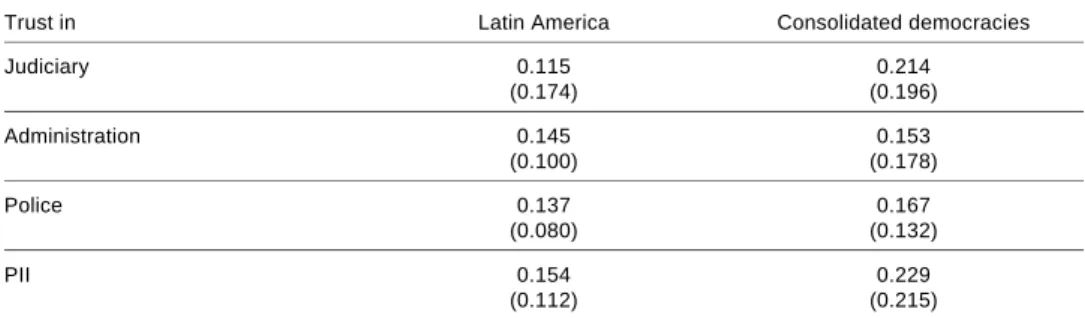
as so ci a ti on bet we en trust and cor rup ti on would be a fact ba sed on tech ni cal rat her than subs tan ti al dif fe ren ces bet we en the data for the two country groups. A pre li mi nary res pon se to this is that this de fla ti on-ef fect ca u sed by the hig her num ber of ca te go ri es it self de cre a ses when the num ber of ca ses ri ses. Hen ce, sin ce the N is re la ti vely lar ge, the de fla ting ef fect can be ex pec ted to be very low. Ho we ver, ta king this met ho do lo gi cal ob jec ti on se ri ous and tes ting for the ro bust ness of the re sults, the same as so ci a ti ons as abo ve are re-cal cu la ted, this time using Tau-b as the me a su re of cor re la ti on. Tau-b is a me a su re for or di nal sca le le vel va ri a bles and, thus, at le ast equally ap pro pri a te for sur vey data as is Bra va is-Pe ar sons r.
If the ap pli ca ti on of Tau-b le ads to a smal ler dif fe ren ce bet we en the La tin Ame ri can and the con so li da ted de mo cra ci es, then it can be as su med that the num ber of ca te go ri es has in flu en ced the strength of Pe ar son’s r in fa vor of the lat ter country group. Ho we ver, if the as so ci a ti on for La tin Ame ri ca still is we a ker, then ad di ti o nal and stron ger evi den ce for re jec ting the ini ti al hypot he sis is found.
Trust in Latin America Consolidated democracies
Judiciary 0.115 0.214 (0.174) (0.196) Administration 0.145 0.153 (0.100) (0.178) Police 0.137 0.167 (0.080) (0.132) PII 0.154 0.229 (0.112) (0.215)
Note: See no tes to ta ble 6.
Table 7 Asso ci a ti on (Tau-b) bet we en cor rup ti on per cep ti on and ins ti tu ti o nal trust on the mi cro le vel, 1996
24 Hol ding that sur vey data is me a su red at the or di nal sca le le vel, se ems to be as pla u si ble as assuming a me tric sca le le vel.
Com pa ring the co ef fi ci ents in ta ble 7 with tho se in ta ble 6 re ve als that, in de ed, the dif fe ren ce bet we en La tin Ame ri ca and the con so li da ted de mo cra ci es de cre a ses when Tau-b is used. Ho we ver, the as so ci a ti ons are still con sis tently we a ker in La tin Ame ri ca — re gard less of whet her it is cal cu la ted on the ba sis of the po o led data or on the country le vel.
The ini ti al hypot he sis of this analy sis sta ted that the per cep ti on of the de mo cra tic per for man ce in uns ta ble de mo cra ci es has a gre a ter im pact on the ci ti zen’s trust in po li ti cal ins ti tu ti ons than it has in con so li da ted de mo cra ci es. The em pi ri cal re sults pre sen ted abo ve do not show any evi den ce for this hypot he sis. On the con trary, in the es ta blis hed de mo cra ci es the as so ci a ti on bet we en the cor rup ti on per cep ti on and the trust in the ju di ci ary, the po li ce, and the ad mi nis tra ti on is con sis tently hig her than in the young de mo cra ci es in South and Cen tral Ame ri ca. Furt her mo re, even when ta king the dif fe rent sti mu li for me a su ring the cor rup ti on per cep ti on into ac count, the re sults still do not pro vi de any evi den ce for as su ming that in La tin Ame ri ca the is sue of cor rup ti on in flu en ces the cre a ti on of trust more than it does in con so li da ted de mo cra ci es.
Ho we ver, it could be ar gued that in both country groups the strength of as so ci a ti on bet we en ins ti tu ti o nal trust and cor rup ti on is far from be ing overw hel ming. This could be ta ken as evi den ce to ques ti on the as sump ti on on which mul ti le vel mo dels of con so li da ted de mo cra ci es are ba sed — na mely, a clo se re la ti ons hip bet we en be ha vi or and at ti tu des, which, as a con se quen ce, re qui res that the lat ter di men si on is a de fi ni to ri al part of the con cept of CoD. The fin dings in this pa per sug gest that this the o re ti cal as sump ti on has to be furt her em pi ri cally tes ted and may be the o re ti cally ret hought.
It is not an exag ge ra ti on to con clu de that La tin Ame ri ca shows a re mar kably low re cord in terms of res pect for the rule of law. The le vel of rule of law-like be ha vi or of the po li ti cal eli tes is low. Inde ed, it is even clo se to the world-wide bot tom-line; the ci ti zens con si der the ir po li ti cal systems to be cor rupt and the ir trust in tho se po li ti cal ins ti tu ti ons that are res pon si ble for enac ting an ef fec ti ve Rechtssta at are very low. At the same time and des pi te the afo re men ti o ned re sults, cor rup ti on does not play the ex pec ted im por tant role in the pro cess of for ming trust in po licy im ple men ting ins ti tu ti ons.
Conclusion
This pa per de alt with the to pic of cor rup ti on as a spe ci fic form of vi o la ting the prin ci ple of the rule of law and pla ced the analy sis in the bro a der con text of CoD. Star ting out with a mul ti le vel mo del of CoD, the ba sic as sump ti on was that cor rup ti on is a two fold pro blem for the per sis ten ce and qua lity of de mo cra ci es. First, cor rup ti on vi o la tes the nor ma ti ve and le gal prin ci ples of de mo cracy and, thus, vi o la tes tho se cri te ria for a con so li da ted de mo cracy for mu la ted in the be ha vi o ral di men si on. Se cond, cor rup ti on le ads to lo wer de mo cra tic le gi ti macy and, thus, vi o la tes the at ti tu di nal cri te ria for CoD.
For La tin Ame ri ca it was shown that the le vels of cor rup ti on along with the dis trust in the PII ju di ci ary, po li ce, and ad mi nis tra ti on have been in cre a sed over the se cond half of the 1990s. By com pa ring the La tin Ame ri can de mo cra ci es with some con so li da ted ones, it be ca me evi dent that the va lu es for CoD in La tin Ame ri ca are at a very low le vel. Ho we ver, furt her analy sis sho wed that the as so ci a ti on bet we en the ci ti zens’ cor rup ti on per cep ti on and the ir ins ti tu ti o nal trust is lo wer in La tin Ame ri ca than in ol der de mo cra ci es. In ot her words, in La tin Ame ri ca, dif fe rent le vels of cor rup ti on do not have the same im por tan ce for ins ti tu ti o nal trust as they have in sta ble de mo cra ci es. Ne vert he less, even in con so li da ted de mo cra ci es the as so ci a ti on bet we en ins ti tu ti o nal trust and cor rup ti on per cep ti on is rat her low.
The last fin dings have se ve ral im pli ca ti ons for how we con cep tu a li ze CoD, which role we at tri bu te to cor rup ti on in ge ne ral, and what ex pec ta ti ons we have about the furt her pro cess of the con so li da ti on of La tin Ame ri can de mo cra ci es. As to the ques ti on of how to con cep tu a li ze CoD, the fin dings sug gest that we think more ca re fully about the sta tus of at ti tu des in the pro cess of CoD. Should they re ally be in clu ded into the very con cept of CoD, at tri bu ting them — by de fi ni ti on — a cen tral role, as it is done by mul ti le vel con cepts of con so li da ted de mo cra ci es? Due to the fin ding of a weak re la ti ons hip bet we en cor rup ti on and ins ti tu ti o nal trust, it se ems to be more fru it ful to furt her in ves ti ga te em pi ri cally the im pact of at ti tu des on CoD-re le vant be ha vi or, i.e. to con vert at ti tu des from be ing a de fi ni to ri al part of CoD into an in de pen dent va ri a ble.
As to the role of cor rup ti on in the con so li da ti on pro cess in ge ne ral, and the fu tu re of de mo cracy in La tin Ame ri ca in par ti cu lar, the fin dings are am bi guous. On the one hand, the lack of a con nec ti on bet we en cor rup ti on and ins ti tu ti o nal trust is po si ti ve sin ce the re does not seem to be a vi ci ous cir cle at work that starts with high cor rup ti on, i.e. low de mo cra tic per for man ce ca u sing low ins ti tu ti o nal trust, which then, in turn, le ads to even lo wer de mo cra tic per for man ce. On the ot her hand, a weak as so ci a ti on bet we en cor rup ti on and trust in ins ti tu ti ons also im pli es that a sig ni fi cant re duc ti on of cor rupt be ha vi or can not be ex pec ted to con tri bu te sig ni fi cantly to the ci ti zens’ trust in the ir po li ti cal ins ti tu ti ons.
At this po int, one can only spe cu la te as to why La tin Ame ri cans do not link the to pic of cor rup ti on to the one of ins ti tu ti o nal trust in the same way as ci ti zens of es ta blis hed de mo cra ci es: Eit her, ci ti zens have gi ven up and con ver ted to cyni cism (i.e. they have lost the be li ef in the ir eli tes’ ca pa city and ho nest will to put the ba sic de mo cra tic prin ci ples of equa lity and fre e dom into prac ti ce), or, in ter pre ting the fin dings in the light of Ingle hart’s the ory of post mo der nism (Ingle hart, 1997), it could be con clu ded that the eco no mic and so ci al pro blems in La tin Ame ri ca are far too se ri ous as to be pre oc cu pi ed by such to pics as cor rup ti on and the rule of law. From this an gle, ta king cor rup ti on into ac count when eva lu a ting po li ti cal ins ti tu ti ons ap pe ars to be a ‘lu xury’ re ser ved for the ci ti zens in we althy coun tri es. Re gard less of which of the two spe cu la ti ons co mes clo ser to re a lity, both have ne ga ti ve im pacts on the pros pects for CoD in La tin Ame ri ca. Ne it her cyni cism and re sig na ti on, nor a lack of sen si ti vity for ‘soft’ po li ti cal is su es is help ful when the aim is to streng then the prin ci ple of the rule of law and, the re fo re, to se cu re the per sis ten ce and qua lity of the young de mo cra ci es in La tin Ame ri ca.