Spectroscopic characterization of a no
v
el 2
/[4Fe
/4S] ferredoxin
isolated from
Desulfo
v
ibrio desulfuricans
ATCC 27774
Pedro M. Rodrigues
1, Isabel Moura, Anjos L. Macedo, Jose´ J.G. Moura
*
REQUIMTE, Departamento de Quı´mica, Centro de Quı´mica Fina e Biotecnologia, Faculdade de Cieˆncias e Tecnologia, Universidade Nova de Lisboa,
PT-2859-516 Monte de Caparica, Portugal
Received 17 March 2003; accepted 23 May 2003
In honor of Prof. J.J.R. Frau´sto da Silva
Abstract
A novel iron/sulfur containing protein, a ferredoxin (Fd), was purified to homogeneity from the extract of Desulfovibrio
desulfuricans American type culture collection (ATCC) 27774. The purified protein is a 13.4 kDa homodimer with a polypeptide chain of 60 amino acids residues, containing eight cysteines that coordinate two [4Fe/4S] clusters. The protein is shown to be air sensitive and cluster conversions take place. We structurally characterize a redox state that contains two [4Fe/4S] cores. 1D and 2D 1
H NMR studies are reported on form containing the clusters in the oxidized state. Based on the nuclear Overhauser effect (NOE), relaxation measurements and comparison of the present data with the available spectra of the analogous 8Fe Fds, the cluster ligands were specifically assigned to the eight-cysteinyl residues.
# 2003 Elsevier B.V. All rights reserved.
Keywords: Iron/sulfur cluster; 2/[4Fe/4S] clusters; Ferredoxin; Metalloprotein; Paramagnetic protein; Nuclear magnetic resonance;Desulfovibrio
desulfuricansATCC 27774
1. Introduction
Iron/sulfur (Fe/S) proteins are a class of proteins
containing prosthetic groups composed of iron and
sulfur atoms, known as iron/sulfur clusters[1/4].
Ferredoxins (Fd) are small and acidic iron/sulfur
proteins that can be used as ‘‘model’’ compounds in the
investigation of electronic, magnetic and structural
properties of the iron/sulfur clusters in complex
en-zymes. They are classified according to the type of [Fe/
S] aggregates. Three type of centers can be found: [2Fe/
2S] centers originating from Fds isolated of plants and
animals, and [3Fe/4S]/[4Fe/4S] typically derived from
bacteria. In sulfate reducing bacteria (SRB) four distinct
types of Fds can be found based on the iron/sulfur
cluster(s) content: 3Fe Fds containing one [3Fe/4S];
4Fe Fds containing one [4Fe/4S]; 7Fe Fds containing a
[3Fe/4S] and a [4Fe/4S]; and 8Fe Fds containing two
[4Fe/4S]. The cluster iron ions, Fe
3
and Fe2
, are tetrahedrally coordinate by sulfur atoms. Its binding to the polypeptide chain is made by a cysteic sulfur atom
[5/9]or, sometimes, by an oxygen or nitrogen atom[10].
In the late years, spectroscopic techniques (X-ray crystallography, X-ray absorption, EPR, NMR, EN-DOR, CD, MCD, Mo¨ssbauer, optical absorption and
Raman resonance), have been of main importance in the
biological characterization of the iron/sulfur centers,
providing detailed description of their structures and
electronic and magnetic properties.
Besides its important role in electron transfer
reac-tions [1/4,11], iron/sulfur clusters are now known to
participate in the activation of substrates [12/14],
stabilization of radicals and structures [15,16],
protec-Abbreviations: 1H NMR, proton nuclear magnetic resonance;
NOE, nuclear Overhauser effect; NOESY, nuclear Overhauser
enhanced spectroscopy; Fd, ferredoxin; Dd, Desulfovibrio
desulfuricans; ATCC, American type culture collection.
* Corresponding author. Tel.:/351-21-294 8382; fax:/351-21-294
8550;http://www.dq.fct.unl.pt/bioin.
E-mail address: [email protected](J.J.G. Moura).
1
Present address: FCMA, CCMAR, Universidade do Algarve,
Campus de Gambelas, 8000-810 Faro, Portugal.
www.elsevier.com/locate/ica
0020-1693/03/$ - see front matter#2003 Elsevier B.V. All rights reserved.
tion of proteins from enzyme attacks [17], storage of
iron and sulfur [18], sensors of iron, dioxygen,
super-oxide ion (O2
) and possibly nitric acid[19/23]and are
involved in the expression of genes [24].
A new Fd has been isolated and purified from
Desulfovibrio desulfuricans American type culture
col-lection (ATCC) 27774 bacteria. The purified protein is quite unstable in the presence of oxygen. It is a dimer of 13.4 kDa molecular mass, that exhibits an optical
spectrum typical of iron/sulfur proteins. The amino
acid sequence composed of approximately 60 amino acids residues, includes eight cysteines, and show a great homology with the ones of other 7Fe and 8Fe Fds,
namely theDesulfomicrobium baculatum Norway 4 Fd
(DmbFd) [25], Clostridium pasteurianum ferredoxin
(CpFd) [26] and Pseudomonas nautica ferredoxin
(PaFd)[27]. Based on this homology, as well as in the
solution structure of CpFd [28], the 3D crystal
struc-tures of Peptococcus aerogenes ferredoxin (PaFd) [29],
Clostridium acidiurici (Cau) [30] and DmbFd [25],
together with the 1H 1D and nuclear Overhauser
enhanced spectra (NOESY 2D NMR) of Cp and
Dd27 Fds, the clusters ligands were specifically assigned.
2. Experimental
2.1. Organism
D. desulfuricans ATCC 27774 was grown in a media
described by Liu and Peck [31]. Cell free extract was
suspended in Tris/HCl 10 mM, pH 7.6 buffer and cells
lyzed in cellular pression apparatus ‘‘French Press’’, at
9000 Psi. The extract was centrifuged at 19 000/g for
30 min and then at 18 000/g for 75 min.
2.2. Protein purification
Due to oxygen sensitivity all the buffers were
pre-viously degassed and kept under continuous N2 flux
when handled. Protein collecting was also done in
previously degassed flasks and under continuous N2
flux. Cell-free extract was first applied onto a DEAE-52
column (35 by 3.5 cm) equilibrated in 10 mM Tris/HCl
buffer (pH 7.6). Bound proteins were eluted with a 600
ml linear gradient of 10/400 mM Tris/HCl buffer (pH
7.6). The Fd containing fractions, eluted between 380 and 400 mM, were concentrated by Amicon YM-5 ultra
filtration and equilibrated with 10 mM Tris/HCl buffer
(pH 7.6). Fd fraction was then applied onto a pre-packed Source-Q XK-26 column coupled to a HiLoad 26/10 ‘‘Fast flow column’’, both from Amersham
Biosciences and previously equilibrated with 10 mM
Tris/HCl buffer (pH 7.6). Bound proteins were eluted
with a 400 ml non-linear gradient (3 ml min1
) of 10/
400 mM Tris/HCl buffer (pH 7.6). The Fd containing
fractions eluted at 400 mM were concentrated as
previously described above. Fd was further purified by
gel filtration on a pre-packed Superdex 75 HR 10/30 column coupled to a HiLoad 26/10 ‘‘Fast flow column’’,
both from Amersham Biosciences and previously
equili-brated with 50 mM Phosphate buffer (pH 7.6) contain-ing 150 mM NaCl. Fd fractions were judge to be pure according to the 17.5% poliacrylamide SDS Page electrophoreses gel. These fractions were concentrated
as previously described and stored at /208C underN2
in 10 mM Tris/HCl (pH 7.6) buffer.
2.3. Spectroscopy
2.3.1. Ultraviolet/visible
Ultraviolet/visible (UV/Vis) absorption spectra were
measured at room temperature in the absence of oxygen using a Shimadzu UV-265 spectrophotometer and an anaerobic 1 cm quartz cell.
2.3.2. Electron paramagnetic resonance
EPR spectra were carried out on a Bruker EMX 8/2.7 spectrometer equipped with a continuous flux cryostat from Oxford instruments. Samples were prepared with
pure protein concentrated to 150 mM, in 100 mM
phosphate buffer, pH 8.0. Sample reduction was done by addition of sodium dithionite.
2.3.3. Nuclear magnetic resonance
NMR spectra were recorded in a 400 MHz ARX Bruker spectrometer, equipped with a temperature unit
control. Chemical shiftsvalues were quoted in parts per
million relative to 3-trimethylsilyl-(2,2,3,3-2H4)
propio-nate. T1 values were determined by the inversion
recovery method [32]. Phase-sensitive NOESY [33,34]
spectra were recorded with short mixing times, 2/10 ms,
with 1024t2 points and 256t1 blocks and 3000/4000
scans per block. Repetition timesvaried from 75 to 100
ms. Samples were prepared with pure protein, equili-brated with 100 mM Phosphate buffer, pH 8.0 and
exchanged four times with 99.9% 2H2O. Final protein
concentration was 2 mM. Sample reduction was accom-plished by adding directly to the degassed NMR tube (nitrogen atmosphere) aliquots of sodium dithionite
prepared in 2H2O, pH 8.0. Slow sample reoxidation
was attained by introduction of controlled amounts of air, using gas-tight Hamilton syringes.
2.4. Molecular weight determination
The molecular weight of Dd27Fd was determined by
gel filtration on pre-packed Superdex 75 HR 10/30 column coupled to a HiLoad 26/10 ‘‘Fast flow column’’,
both from Amersham Biosciences and previously
serum bovine albumin (67 kDa), ovalbumin (43 kDa),
quimiotripsin (25 kDa), ribonuclease (13.7 kDa) and
Desulfovibrio gigas Rubredoxin (6 kDa).
2.5. Protein and iron quantification
Dd27Fd was quantified using the BCA method (BCA protein assay reagent kit, Pierce), according to
manu-facturer specifications, usingP. nautica Fd as standard.
Iron quantification was done by a chemical method using 2,4,6-tripiridil-s-triazine (TPTZ), as described by
Fisher and Price[35].
2.6. Amino acid sequence determination
Amino acid sequence determination was performed on an automatic sequencer (Applied Biosystem 477A), coupled to an amino acid analyzer (Applied Biosystem 120A) according to the experimental procedures
de-scribed by Edman[36]and Laursen[37].
3. Results and discussion
The fact that the amount of protein isolated under aerobic conditions was merely residual, led to a change in the purification process to anaerobic conditions. The
UV/Vis spectrum of pure native Dd27Fd presents
absorption maxima at 275, 315 and 390 nm and a ratio Abs390 nm/Abs275 nm/0.59. It was observed (data not
shown) that the characteristic Fe/S charge transfer at
390 nm fades away after exposition of the protein to oxygen.
The polypeptide chain contains 60 amino acid resi-dues, eight of them are cysteinyl residues: Cys11, 14, 17, 21, 41, 44, 47 and 51, responsible for the coordination of
the two [4Fe/4S] clusters. From the comparison of its
amino acid sequence with other 7Fe and 8Fe Fds (Fig.
1), it is observed that the characteristic pattern in the
cysteinyl ligand region is maintained [38] and indicate
that Cys11, 14, 17 and 51 are cluster I ligands, and Cys21, 41, 44 and 47 binds cluster II. Similarity is found
to the already characterized 8Fe Fds from Pa (53%
similarity), Cp (47% similarity), Cau (47% similarity)
and Cv (27% similarity), to which a 3D structure is
already available, and also to Dmb (80% similarity),
with a stronger analogy to this last one, what was expectable since they are both proteins from the same organism but different strains. The sequences were
compared using theBIOEDITsequence alignment editor
[39]. A glutamic acid residue is present after the last
cysteinyl residue (Cys 51) in the sequence of Dd27 Fd,
replacing a well conserved proline, a typical residue in
the amino acid sequence of 8Fe Fds. Another exception
is observed for the 7Fe Fd fromDa [38].
The native Dd27Fd was found to be a homodimer
based in the molecular weight of 13.4 kDa, determined
by gel filtration, and a value of with 6.4 kDa for the
monomer, from the amino acid sequence. A molar
absortivity (o) of 28 700 M1 cm1 at 390 nm was
calculated for the native protein, using the protein
quantification assay. The number of iron atoms per monomer obtained was 7.6, confirming the presence of
2/[4Fe/4S] clusters, or a mixture of [3Fe/4S]/[4Fe/
4S] and 2/[4Fe/4S], as it will be discussed with the
information obtained from the spectroscopic data.
3.1. NMR spectroscopy
We analyzed different oxidation states of the Fd: the
native state, as obtained after anaerobic purification
(Dd27nat), the reduced state (Dd27red) after the
addi-tion of dithionite to the native protein, and the
reoxidized state (Dd27ox) produced after reoxidation
with air of the reduced sample.
The low-temperature EPR spectra of both the
Dd27nat andDd27red (not shown) indicate the presence
of [4Fe/4S] and [3Fe/4S] clusters. In the native state an
anisotropic signal centered at g/2.01 was observed,
characteristic of a [3Fe/4S] in the oxidized /1 state,
S/1/2 [38,40]. In the reduced state a rhombic signal
was observed, with g values of 2.07, 1.94 and 1.89,
assigned to the [4Fe/4S] centers in the reduced state/1,
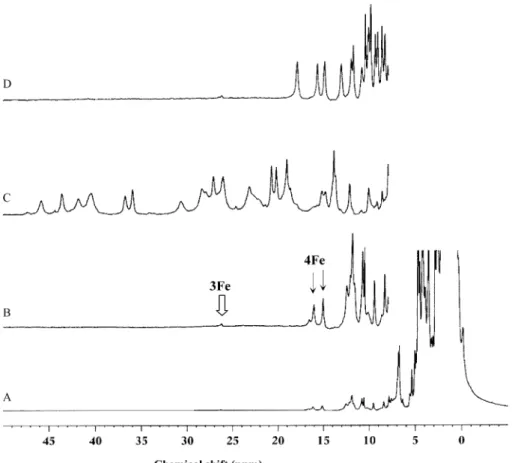
with S/1/2 [41]. The 1D
1
H NMR spectra of the
Dd27Fd in the native (A, B), reduced (C) and reoxidized
(D) states are presented in Fig. 2. The spectrum of
Dd27nat Fd show resonances at low field. Resonance at
approximately 26 ppm presents a chemical shift and a
Curie temperature dependence typical of a b-CH2
proton of a cysteinyl ligand of [3Fe/4S] center [42].
Fig. 1. Amino acid sequence alignment of several Fds containing 2/[4Fe/4S] or [3Fe/4S]/[4Fe/4S] clusters. The cysteinyl cluster ligands are
marked in gray: the firsts three cysteins (or two, in 7Fe Fds) and the last one in the sequence binds cluster I; the other four binds cluster II. 8Fe Fds:
Cau,Clostridium acidurici[51],Cv,Chromatiumvinosum[46],Pa,P. aerogenes[26],Cp,C. pasteurianum[26],Dmb,D. baculatumNorway 4[25],
The two resonances in the 16 ppm region (labeled 4Fe in
Fig. 2(B)) are characteristic of b-CH2 protons of
cysteinyl ligands of [4Fe/4S] centers in the oxidized
state and they show anti-Curie temperature depen-dences. The area ratios of these resonances suggest that the 3Fe cluster is present as 25%, compared with 4Fe centers. These assignments are supported the analogy with the NMR spectra and the temperature
dependences of the 7Fe Fd from Desulfurolobus
am-bivalens[43]and Fds I and II from the sulfate reducerD.
gigas (Dg) that contain one [4Fe/4S] and one [3Fe/4S]
centers, respectively [42,44]. In agreement, the EPR
measurements indicate that the amount of 3Fe centers is substoichiometric.
The 1D 1H NMR spectrum of Dd27red Fd show
resonances shifted to lower field, indicating an increase
of paramagnetism due to reduced [4Fe/4S] centers with
S/1/2 (Fig. 2(C)). The temperature dependence of
these resonances (not shown) revealed a mixture of
Curie and anti-Curie behavior, characteristic of proteins
containing one or two [4Fe/4S] clusters in the reduced
state[42,45,46]. This state is not stable for a long period
of time, in the experimental working NMR conditions and tends to return to an oxidized state.
After reoxidation (Fig. 2(D)) the low field region of
the 1D 1H NMR spectrum of Dd27ox Fd shows the
presence of [3Fe/4S] centers (resonance at ca. 26 ppm)
but with lower intensity compared with the native
sample, indicating that redox cycling rebuilds 4Fe cores. The set of well-defined resonances in the spectral region between 7 and 20 ppm is quite homologous to those presented by other 8Fe Fds in the oxidized state, as
compared with CauFd [45] and CpFd [46]. The
tem-perature dependence followed by these resonances has
anti-Curie type behavior (except for resonance at 26
ppm) (Fig. 3).
Fig. 2. 1D1H NMR spectra at 400 MHz ofDd27Fd (with water peak suppression). (A) Full spectrum of the anaerobically purified protein (Dd27nat
Fd); (B) expanded low field region ofDd27nat Fd; (C) dithionite reduced state (Dd27red Fd) and (D) reoxidized state (Dd27ox Fd).
Fig. 3. Low field region of the 1D1H NMR spectrum, at 400 MHz, of
Dd27ox Fd, and temperature behavior of resonances labeled from A
3.2. Assignment of the iron/sulfur cluster cysteinyl
ligand protons of Dd 27ox Fd
The NOESY spectra of Dd27ox Fd, acquired with
two different mixing times, are shown in Fig. 4. These
spectra allow the assignment of seven of the eightb-CH2
protons of the cysteinyl ligands that coordinate the two
[4Fe/4S] clusters, as well as some of thea-CH protons
(Table 1). The anti-Curie temperature dependence and the fast relaxation times detected allowed to assign the
resonances of Dd27ox Fd to the b-CH2 and a-CH
protons of the cysteines that coordinate the clusters. Resonances A, N and J are correlated. Considering
cross peak intensities, the T1values and the temperature
dependence behavior, it is possible to assign both Hb
and Hafrom the same cysteinyl residue. Resonance B is
correlated with two other resonances at 4.8 and 7.5 ppm,
assigned to protons Hb and Ha, respectively. It is also
possible to observe correlations between resonances C
and K, D and M, E and 7.8 ppm, F and 7.3 ppm and G
and O, all assigned to the pair of Hbprotons from each
of the coordinating cysteinyl residues. To resonances H
and I it was not possible to observe any correlation.
The specific assignment of these resonances to the a
-CH andb-CH2protons of the cysteines that coordinate
the Cluster I and II was made, considering the
homol-ogy between the polypeptide chain ofDd27Fd,DmbFd,
CpFd andPaFd (Fig. 1), the solution structure ofCpFd
[47]and X-ray structure ofPaFd[48]and the homology
between the 3D structures ofPaFd andDmbFd[25]. 1D
and 2D NOESY 1H NMR information published for
Cp Fd was also used. All the information is gather
together inTable 1.
3.3. Angular dependence of the paramagnetic resonances
NMR studies on [4Fe/4S]
3
model compounds and
in proteins containing [4Fe/4S]
2
clusters, established that the isotropic interaction of the protons situated at the closest carbon to the iron atom is a function of the
dihedral angleu, defined by the four atoms H/C/S/Fe
[45,49]. Using the equationd/asin2(u)/bcos(u)/c, a
graphic representation of the paramagnetic shifts from
Fig. 4. 2D1H NOESY NMR spectra at 400 MHz, from lower field region ofDd27ox Fd, in2H
2O (pH 7.6), 300 K. Resonances are labeled
A to O. (1) 5 ms mixing time; (2) 10 ms mixing time.
Fig. 5. Best fitting for equationd/asin2(u)/bcos(u)/c(a/12.2,b//3.9 andc/3.232) that relates the hyperfine chemical shifts of theb-CH2
protons of the coordinate cysteinyl residues ofCauFd obtained by NMR, with the corresponding dihedral angles Fe-Sg-Cb-HbfromCauFd,
obtained from its X-ray structure. Theb-CH2protons of the coordinate cysteinyl residues ofDd27Fdox are indicated, excluding theb-CH2protons
theb-CH2protons of the cysteinyl residues ofCauFdox,
versus the dihedral angles obtain from its X-ray
structure was done [45]. The b-CH2 protons of the
coordinate cysteinyl residues ofDd27Fdoxare indicated,
with exception for one of theb-CH2protons of cysteine
11, to which the chemical shift is unknown. The best
fitting for the equation originated values of a/12.2,
b//3.9 and c/3.232 (Fig. 5). A positive a value
means that the spin delocalization mechanism is
essen-tially p, however, the b value different from zero
suggests that the spin delocalization mechanism should
not be neglected [49]. Assuming the sameu values for
Dd27ox Fd andCauFdox, the chemical shifts of theb
-cysteinyl protons ofDd27ox Fd can be analyzed, after
subtracting 2.8 ppm for the diamagnetic contribution. A
good agreement is observed for all the protons with a
slightly deviation for one of the signals of Cys44 (and
Cys17). A similar deviation has been already observed
for the correspondent Cys40 in CvFd [41]. This
dis-turbance seems to arise, not from a global change in the
electronic structure of the [4Fe/4S]
2
cluster, but instead from a local one in neighborhood of cysteine 40, since all the other chemical shifts associated with the
other ligands of the same aggregate maintain itsvalues
practically unchanged.
The Fd isolated fromD. desulfuricans ATCC 27774 is
sensitive to oxygen. The amino acid sequence contains
cysteines, in number and position, capable to
accom-modate 2/[4Fe/4S] clusters. The cluster instability
results in cluster damaged. This fact made the analysis of the NMR data more complex due to the presence of
[3Fe/4S] clusters. It was also shown that cluster
interconversion may occur under reducing conditions.
The proton cysteinyl resonances due to the oxidized tetranuclear sites show remarkable differences when the
native anaerobic purified preparation (Dd27nat) and the
reoxidized sample (Dd27ox) are compared. An identical
observation has also been documented for DgFd I, a
protein that contains one [4Fe/4S], where the spectrum
of the native form purified under aerobic conditions,
differs from the spectrum of the same protein purified in
the absence of oxygen [52]. Moreover, inDd27 Fd, the
replacement of the strategic proline by a glutamic
residue, in cluster II proximity, may have consequences
in subtlevariations of dihedral angles, which may reflect
in cluster spin delocalization.
Acknowledgements
This work was supported by PRAXIS XXI and JNICT and COST.
References
[1] W. Lovenberg (Ed.), Iron/Sulfur Proteins. Biological Principles,
vol. I, II, III, Academic Press, New York, London, 1973. [2] T.G. Spiro (Ed.), Iron/Sulfur Proteins, Wiley, New York, 1982.
[3] R.L. Switzer, BioFactors 2 (1989) 77. [4] H. Beinert, FASEB J. 4 (1990) 2483.
[5] K. Fukuyama, H. Matsubara, T. Tsukihara, Y. Katsube, J. Mol. Biol. 210 (1989) 383.
[6] C.D. Stout, J. Mol. Biol. 205 (1989) 545. Table 1
Spectral NMR parameters at 300 K, pH 8.0 and specific assignment of the resonances of theb-CH2anda-CH protons that coordinate the [4Fe/4S]
clusters I and II inDd27ox
Resonance Protons d(ppm) T1(ms) Assignment
Cluster Specific assignment
A b-CH 18.0 3.5
N b-CH 8.8 9.6 II Cys 44
J a-CH 10.0 14.0
B b-CH 15.8 4.5
b-CH 4.8 n.d II Cys 47
a-CH 7.5 n.d
C b-CH 15.0 4.3
K b-CH 9.5 9.8 I Cys 14
D b-CH 13.2 4.8
M b-CH 9.2 8.9 I Cys 17
E b-CH 12.1 5.2
b-CH 7.8 n.d I Cys 51
F b-CH 11.9 7.8
b-CH 7.3 n.d II Cys 21
G b-CH 10.9 3.2
O b-CH 8.4 9.7 II Cys 41
I b-CH 10.2 5.5 I Cys 11
H a-CH 10.5 22.1
[7] G.H. Stout, S. Turley, L.C. Sieker, L.H. Jensen, Proc. Natl. Acad. Sci. USA 85 (1988) 1020.
[8] C.R. Kissinger, E.T. Adman, L.C. Sieker, L.H. Jensen, J. LeGall, FEBS Lett. 244 (1989) 447.
[9] K. Fukuyama, T. Hase, S. Matsumoto, T. Tsukihara, Y. Katsube, N. Tanaka, M. Kakudo, K. Wada, H. Matsubara, Nature 286 (1980) 522.
[10] R.H. Holm, in: R. Cammack, A.G. Sykes (Eds.), Advances in
Inorganic Chemistry,vol. 38, Academic Press, pp. 281/322.
[11] M.K. Johnson, in: R.B. King (Ed.), Encyclopedia of Inorganic Chemistry, vol. 4, Wiley, 1994, pp. 1886/1915.
[12] H. Beinert, M.C. Kennedy, C.D. Stout, Chem. Rev. 96 (1996)
2335.
[13] E.C. Duin, M.E. Lafferty, B.R. Crouse, R.M. Allen, I. Sanyal, D.H. Flint, M.K. Johnson, Biochemistry 36 (1997) 11811. [14] J.B. Broderick, R.E. Duderstadt, D.C. Fernandez, K.
Wojtus-zewski, T.F. Henshaw, M.K. Johnson, J. Am. Chem. Soc. 119 (1997) 7396.
[15] J.B. Howard, D.C. Rees, Chem. Rev. 96 (1996) 2965.
[16] J.H. Golbeck, D.A. Bryant, Curr. Top. Bioenerg. 16 (1991) 83. [17] J.A. Grandoni, R.L. Switzer, C.A. Makaroff, H. Zalkin, J. Biol.
Chem. 264 (1989) 6058.
[18] R.K. Thauer, P. Scho¨nheit, Iron/sulfur complexes of ferredoxin
as a storage form of iron inClostridium pasteurianum, in: T.G. Spiro (Ed.), Iron/Sulfur proteins, Wiley-Interscience, New York,
1982, pp. 329/341.
[19] T.A. Rouault, D.J. Haile, W.E. Downey, C.C. Philpott, C. Tang, F. Samaniego, J. Chin, I. Paul, D. Orloff, J.B. Harford, Biometals 5 (1992) 131.
[20] W. Hentze, L.C. Ku¨nh, Proc. Natl. Acad. Sci. USA 93 (1996) 8175.
[21] H. Beinert, P. Kiley, FEBS Lett. 382 (1996) 218.
[22] P. Gaudu, B. Weiss, Proc. Natl. Acad. Sci. USA 93 (1996) 10094. [23] E. Hidalgo, J.M.J. Bollinger, T.M. Bradley, C.T. Walsh, B.
Demple, J. Biol. Chem. 270 (1995) 20908.
[24] M.L. Michaels, L. Pham, Y. Nghiem, C. Cruz, J.H. Miller, Nucleic Acids Res. 18 (1990) 3841.
[25] L. Blanchard, F. Payan, M. Qian, R. Haser, M. Noailly, M. Bruschi, F. Guerlesquin, Biochim. Biophys. Acta 1144 (1993) 125. [26] S.D.B. Scrofani, R.T.C. Brownlee, M. Sadek, A.G. Wedd, Inorg.
Chem. 34 (1995) 3942.
[27] M. Bruschi, C.E. Hatchikian, Biochimie 64 (1982) 503.
[28] I. Bertini, A. Donaire, B.A. Feinberg, C. Luchinat, M. Piccioli, H. Yuan, Eur. J. Biochem. 232 (1995) 192.
[29] E.T. Adman, L.C. Sieker, L.H. Jensen, J. Biol. Chem. 248 (1973) 3987.
[30] E.D. Due`e, E. Fanchon, J. Vicat, L.C. Sieker, J. Meter, J.M. Moulis, J. Mol. Biol. 243 (1994) 683.
[31] M.C. Liu, H.D. Peck, Jr, J. Biol. Chem. 256 (1981) 13159. [32] R.L. Vold, J.S. Waugh, M.P. Klein, D.E. Phelps, J. Chem. Phys.
48 (1968) 3831.
[33] S.R. Macura, R.R. Ernst, Mol. Phys. 40 (1980) 95.
[34] A. Kumar, R.R. Ernst, K. Wu¨thrich, Biochem. Biophys. Res. Commun. 95 (1980) 1.
[35] D.S. Fischer, D.C. Price, Clin. Chem. 10 (1964) 21. [36] P. Edman, G. Begg, Eur. J. Biochem. 1 (1967) 80. [37] R.A. Laursen, Eur. J. Biochem. 20 (1971) 89.
[38] J.J.G. Moura, A.L. Macedo, P.N. Palma, in: J. LeGall, H.D. Peck, Jr (Editors), Methods in Enzymology, 1994, p. 243 (Chapter 12).
[39] T.A. Hall, BIOEDITsequence alignment editor (Computer
soft-ware), Department of Microbiology, North Caroline State
Uni-versity, 1997/2001.
[40] B.H. Huynh, J.J.G. Moura, I. Moura, T.A. Kent, J. LeGall, A.V. Xavier, E. Munck, J. Biol. Chem. 255 (1980) 3242.
[41] J.G. Huber, J. Gaillard, J.-M. Moulis, Biochemistry 34 (1995) 194.
[42] A.L. Macedo, N. Palma, I. Moura, J. LeGall, V. Wray, J.J.G. Moura, Magn. Res. Chem. 31 (1993) S59.
[43] D. Bentrop, I. Bertini, C. Luchinat, J. Mendes, M. Piccioli, M. Teixeira, Eur. J. Biochem. 236 (1996) 92.
[44] A.L. Macedo, I. Moura, J. LeGall, B. Huynh, J.J.G. Moura, Inorg. Chem. 32 (1993) 1101.
[45] I. Bertini, F. Capozzi, C. Luchinat, M. Piccioli, A.J. Vila, J. Am. Chem. Soc. 116 (1994) 651.
[46] I. Bertini, F. Briganti, C. Luchinat, A. Scozzafava, Inorg. Chem.
29 (1989) 1874.
[47] I. Bertini, A. Donaire, B.A. Feinberg, C. Luchinat, M. Piccioli, H. Yuan, Eur. J. Biochem. 232 (1995) 192.
[48] E.T. Adman, L.C. Sieker, L.H. Jensen, J. Biol. Chem. 248 (1973) 3987.
[49] J.M. Mouesca, G. Rius, B. Lamotte, J. Am. Chem. Soc. 115 (1993) 4714.
[50] A.L. Macedo, S. Besson, C. Moreno, G. Fauque, J.J.G. Moura, I. Moura, Biochem. Biophys. Res. Commun. 229 (1996) 524. [51] J. Meyer, J.M. Moulis, N. Scherrer, J. Gagnon, J. Ulrich,
Biochem. J. 294 (1993) 622.
[52] A.L. Macedo, in: Estudos estruturais em ferredoxinas. Aplicac¸a˜o de RMN multidimensional a sistemas paramagne´ticos. Ph.D. thesis, Universidade Nova de Lisboa, Lisboa, Portugal,
![Fig. 1. Amino acid sequence alignment of se v eral Fds containing 2 / [4Fe / 4S] or [3Fe / 4S] / [4Fe / 4S] clusters](https://thumb-eu.123doks.com/thumbv2/123dok_br/16476010.732029/3.892.186.693.939.1042/fig-amino-acid-sequence-alignment-eral-containing-clusters.webp)