Universidade Técnica de Lisboa
Instituto Superior de Economia e Gestão
Individual Research Project in Management
Outsourcing Delivery Centers - a
decision making model
Author:
Elsa da Glória Bernardo Fernandes
Supervisors:
Mário Caldeira (ISEG)
Alexandre Gil (IBM)
Acknowledgments
I would like to thank IBM for sponsoring this dissertation, and in particular to my internal supervisor at IBM, Alexandre Gil – Manager of Server Systems Operations in Portugal – for his extensive experience and orientation through this dissertation, he gave me many useful suggestions.
I would like to thank my supervisor at ISEG, Professor Mário Caldeira, for his orientation and assistance in guiding me through this study.
I would also like to thank Professor Rui Brites, he has been an endless source of support in guiding me through the Data Analysis.
Abstract
The objectives that push enterprises towards outsourcing may be very simple or very complex, but there is a common thread among all, the need to cut costs, increase efficiency and focus on the core business of the enterprise. Currently outsourcing has gained such visibility that it is considered strategic and the option to transfer all or part of a company business area to an external entity plays an extremely important role in the internal strategic plan of each company. More recently we can see that it is not only companies that look to achieve more advantages and to increase business value in their business through outsourcing but it is also the suppliers that provide those outsourcing services that are now trying to accomplish the same advantages and objectives. What these suppliers are undertaking is even more ambitious because they are trying to change the way they conduct the outsourcing business with the implementation of Delivery Centers. A common concern of clients when IT services are relocated to an outsourcing provider is usually that those services are being delivered from remote countries, with a different culture, time zones, with language barriers and difficulties in business travel. All of these differences can be major obstacles to communication and therefore can diminish the perceived quality of service. To shed light on this issue, the current study examines the reasons that motivate suppliers to change the way they are outsourcing business with the introduction of DC’s, the challenges and the risks they face, and the impact of such change. This study used a cross-sectional and exploratory case. The data were collected using key informant interviews and questionnaires. The study results indicate that a relation exists between outsourcing and DC’s objectives and that cost savings is the key factor. The introduction of DC’s on the outsourcing business affected negatively the local people and also the service quality.
Table of Contents
1. Introduction ... 8
1.1. Overview... 8
1.2. Statement of the Problem... 9
1.3. Purpose of the Study... 10
1.4. Research Question... 11
2. Review of the Literature... 13
2.1. Historical Perspective of Outsourcing... 13
2.2. Historical Perspective of IBM’s Outsourcing – IBM Global Services Unit ... 14
2.3. Drivers of Outsourcing ... 15
2.4. Outsourcing and Delivery Centers ... 16
3. Research Methodology ... 22
3.1. Unit of Analysis and Data Collection... 23
3.2. Population and Purposive Sampling... 25
3.3. Semi-Structured Interview Checklist ... 28
3.4. Human Subject Protection and Data Confidentiality ... 29
4. Results ... 30
4.1. Data Collection... 30
4.2. Data Analysis ... 34
5. Conclusions, Limitations and Future Research ... 68
5.1. Conclusions... 68
5.2. Limitations ... 73
5.3. Future Research... 74
6. Bibliography... 76
7. Appendixes ... 81
7.1. Semi-Structured Interview Checklist ... 81
7.2. E-mail sent to the local Key people... 82
7.3. E-mail sent to Brno – Czech Republic DC Key people ... 83
7.4. Reinforcement E-mail sent to Brno – Czech Republic DC Key people... 84
7.5. DC Questionnaire ... 85
7.7. Validity of the information collected on questions of Section II ... 89
Table of Figures
Figure 1. Delivery Centers Methodology... 19Figure 2. key element of IBM’s globally integrated capabilities strategy ... 20
Figure 3. IBM Title/Role of respondents ... 32
Figure 4. Number of working years in IBM... 33
Figure 5. Objectives and expectations of outsourcing from IBM point of view... 36
Figure 6. Objectives and expectations of outsourcing from IBM point of view of local Respondents... 38
Figure 7. Objectives and expectations of outsourcing from IBM point of view of DC Respondents... 38
Figure 8. Objectives and expectations of outsourcing from IBM point of view by Importance Classification... 40
Figure 9. Objectives and expectations of outsourcing from IBM point of view of local Respondents by importance classification ... 41
Figure 10. Objectives and expectations of outsourcing from IBM point of view of DC Respondents... 41
Figure 11. Objectives and expectations of outsourcing from Customer point of view .. 42
Figure 12. Objectives and expectations of outsourcing from Customer point of view of local Respondents ... 43
Figure 13. Objectives and expectations of outsourcing from Customer point of view of DC Respondents ... 43
Figure 14. Objectives and expectations of outsourcing from Customer point of view by Importance Classification... 44
Figure 15. Objectives and expectations of outsourcing from Customer point of view of local Respondents by importance classification ... 45
Figure 16. Objectives and expectations of outsourcing from Customer point of view of DC Respondents by importance classification ... 45
Figure 17. Objectives and expectations of DC’s from IBM point of view ... 46
Figure 18. Objectives and expectations of DC’s from IBM point of view of the local Respondents... 48
Figure 19. Objectives and expectations of DC’s from IBM point of view of the DC Respondents... 48
Figure 20. Objectives and expectations of DC’s from IBM point of view by importance classification ... 49
Figure 21. Objectives and expectations of DC’s from IBM point of view of the local Respondents by importance classification ... 50
Figure 22. Objectives and expectations of DC’s from IBM point of view of the DC’s Respondents by importance classification ... 50
Figure 23. Relation between outsourcing and DC’s objectives and expectations... 51
Figure 24. Relation between outsourcing and DC’s Objectives and expectations by local Respondents... 53
Figure 25. Relation between outsourcing and DC’s Objectives and expectations by DC
Respondents... 53
Figure 26. Impact of DC’s on service quality ... 54
Figure 27. Impact of DC’s on service quality by local Respondents ... 56
Figure 28. Impact of DC’s on service quality by DC Respondents... 56
Figure 29. Impact of DC’s on local people ... 57
Figure 30. Impact of DC’s on the local people by local Respondents... 59
Figure 31. Impact of DC’s on the local people by DC Respondents... 59
Figure 32. Problems and barriers of DC’s implementation ... 61
Figure 33. Problems and barriers of DC’s implementation by local Respondents... 63
Figure 34. Problems and barriers of DC’s implementation by DC Respondents... 63
Figure 35. Impact of DC’s on the Outsourcing Business... 65
Figure 36. Impact of DC’s on the Outsourcing Business by local Respondents... 67
Figure 37. Impact of DC’s on the Outsourcing Business by DC Respondents... 67
Figure 38. IBM Title/Role of local respondents... 88
Figure 39. IBM Title/Role of Brno DC respondents ... 88
Figure 40. Number of working years in IBM of local Respondents... 89
Figure 41. Number of working years in IBM of Brno DC Respondents ... 89
Table of Tables
Table 1. Description of questions items and scale... 28Table 2. Invitees vs. Respondents... 31
Table 3. Objectives of outsourcing from IBM perspective information validity ... 90
Table 4. Objectives of outsourcing from IBM perspective by local Respondents information validity ... 90
Table 5. Objectives of outsourcing from IBM perspective by DC Respondents information validity ... 90
Table 6. Key objectives of outsourcing from IBM perspective information validity... 91
Table 7. Key objectives of outsourcing from IBM perspective by local Respondents information validity ... 91
Table 8. Key objectives of outsourcing from IBM perspective by DC Respondents information validity ... 91
Table 9. Objectives of outsourcing from Customer perspective information validity ... 92
Table 10. Objectives of outsourcing from Customer perspective by local Respondents information validity ... 92
Table 11. Objectives of outsourcing from Customer perspective by DC Respondents information validity ... 92
Table 12. Key objectives of outsourcing from Customer perspective information validity... 92
Table 13. Key objectives of outsourcing from Customer perspective by local Respondents information validity... 93
Table 14. Key objectives of outsourcing from Customer perspective by DC Respondents information validity... 93
Table 16. Objectives of DC’s from IBM perspective by local Respondents information validity... 94 Table 17. Objectives of DC’s from IBM perspective by DC Respondents information validity... 94 Table 18. Key objectives of DC’s from IBM perspective information validity... 94 Table 19. Key objectives of DC’s from IBM perspective by local Respondents
information validity ... 94 Table 20. Key objectives of DC’s from IBM perspective by DC Respondents
information validity ... 95 Table 21. Relation between outsourcing and DC’s objectives information validity ... 95 Table 22. Relation between outsourcing and DC’s objectives by local Respondents information validity ... 95 Table 23. Relation between outsourcing and DC’s objectives by DC Respondents information validity ... 95 Table 24. Impact of DC’s on service quality information validity... 96 Table 25. Impact of DC’s on service quality by local Respondents information validity
... 96 Table 26. Impact of DC’s on service quality by DC Respondents information validity 97 Table 27. Impact of DC’s on local people information validity... 97 Table 28. Impact of DC’s on local people by local Respondents information validity.. 97 Table 29. Impact of DC’s on local people by DC Respondents information validity.... 98 Table 30. Problems of DC’s implementation information validity ... 98 Table 31. Problems of DC’s implementation by local Respondents information validity
... 99 Table 32. Problems of DC’s implementation by DC Respondents information validity99 Table 33. Impact of DC’s on the Outsourcing Business information validity ... 99 Table 34. Impact of DC’s on the Outsourcing Business by local Respondents
information validity ... 100 Table 35. Impact of DC’s on the Outsourcing Business by DC Respondents information validity... 100
1.
Introduction
1.1.
Overview
Outsourcing is not a new concept if we analyze it in the sense of the classical dilemma that organisations come across in their daily activities when they are confronted with the decision of whether to buy or to make an item or a service1 at a given time. The decision of whether “to buy”, involves the obtaining something from a supplier who provides the completed item or service rather than buying the components and manufacturing them in-house. In respect to the literature, outsourcing is defined from many different perspectives. For some, outsourcing is the process of transferring the responsibility for a specific business function from an employee group to a non-employee group (Zhu, Hsu et al. 2001). For others is allotting work to suppliers and distributors to provide needed services and materials and to perform those processes that the organisation does not perform itself (Krajewski and Ritzman 2002).
While in the past outsourcing was primarily limited to the procurement of non-core components and services, today the tendency to outsource has expanded to include virtually every activity of a firm, core components and non-core components, business processes, information technology processes, manufacturing, distribution activities and customer support activities (Chamberland 2003) (Gottfredson, Puryear et al. 2005) (Holcomb and Hitt 2007) (Insinga and Werle 2000) (Kakabadse and Kakabadse 2000) (Niezen and Weller 2006) (Venkatraman 2004). Today's hyper-competitive
1
Services in the IT world, can have different meanings, such as, consulting, systems operations, networking services, strategic outsourcing, learning services, storage and wireless services, etc. (For example, IBM’s different services can found at http://www935.ibm.com/services/us/en/it services/servicesatoz.html)
environment, characterized by constant change, market unpredictability, and the pressure to reduce costs and cycle times, attached with the globalization trend, has provided further impetus to the growth of outsourcing (D'Aveni, Canger et al. 1995).
The growth of outsourcing has led outsourcing strategies to become an increasingly important component of firm success (Gottfredson, Puryear et al. 2005) (Kakabadse and Kakabadse 2000) (Talluri and Narasimhan 2004), and it is generally accepted that provides certain advantages that are not available to a company’s internal departments. These advantages can have many dimensions: economies of scale, process expertise, access to capital, access to expensive technology, availability of resources, etc. The combination of these dimensions creates the cost savings inherent in outsourcing.
The business press is replete with examples of manufacturing firms that have been successful when choosing outsourcing by reducing costs, improving speed and responsiveness, reducing cycle times, improving innovativeness and quality, increasing flexibility and agility, and improving overall competitiveness (Chamberland 2003) (Chan and Pollard 2003) (Garaventa and Tellefsen 2001) (Kakabadse and Kakabadse 2000) (Sislian and Satir 2000) (Venkatraman 2004).
1.2.
Statement of the Problem
In the last years the importance of outsourcing has increased exponentially and that has provoked an explosion in the number of studies and research about the topic, such as the motivation factors for outsourcing and its strategic decision, advantages, risks and disadvantages, consequences, success and failure factors, etc, but there has been no
significant investigation or study regarding what is happening with the way the suppliers are working.
Traditionally organisations considered outsourcing to rapidly improve performance and reduce operating costs. In the present, organisations are using strategic and transformational outsourcing to seek improved business focus, mitigate risks, build sustainable competitive advantage, and extend technical capabilities and free resources for core business purposes (Bartell 1998). Competitive advantages can be gained when the most appropriate business processes are performed more effectively and efficiently by external suppliers (Lankford and Parsa 1999).
Those competitive pressures are also forcing outsourcing suppliers to look objectively and critically at the way they do their business and to adapt and become more competitive. It has been mentioned that some of the advantages in opting for outsourcing is to gain from the economies of scale from the suppliers, process expertise, expensive technology and resources, etc, and those are the same advantages that the suppliers are using for their own benefit. It has also been mentioned that the combinations of all of these dimensions creates the cost savings inherent in outsourcing and that is also another advantage that the suppliers pursue.
1.3.
Purpose of the Study
The purpose of this dissertation is to explore the main reasons and factors that influence outsourcing suppliers to change the way in which they are working. The justification for studying the problem is the lack of scholarly research debating whether the same factors that lead the organisations to go to outsourcing are the same that force now the suppliers
to go to delivery centers. In this research we will study one supplier, IBM, namely in respect to its reasons and factors that are contributing to the internal movement of some of its outsourcing services to delivery centers2 (DC’s) which are being created specifically for that purpose. In the last few years, IBM has made an enormous investment in such DC’s. Argentina, Poland, India, Czech Republic, etc, are some of the countries where these DC’s are located, created with the purpose of housing large buildings and infrastructure needed to support hundreds of people, organised by teams where every team has a catalogue of services exclusively to provide strategic outsourcing services. Additionally, this study will attempt to determine the advantages, disadvantages and consequences of such a move.
1.4.
Research Question
This present research will investigate some areas of IBM’s Outsourcing based on the perceptions and experiences of key people that have being involved in the process of transferring strategic outsourcing services to the DC’s. The key people consist of IT people, team leaders and managers. The areas under investigation are related with the following factors: cost reduction; economies of scale; technological factors, skills and knowledge or intellectual capital. Advantages and disadvantages, service quality, local people motivation and impact of the move will be under scrutiny, besides the problems encountered previously and after the move, such as language barrier and skills or lack of it or of procedures.
2
IBM Service delivery centers have its core activities focus in providing strategic outsourcing services, like remote server and application support, networking services and end user customer support.
To cover all of these areas, a checklist will be complied and surveys will be conducted with those key people to help gain an understanding of the factors and reasons that are influencing IBM outsourcing and investment in the DC’s and to identify all the advantages and disadvantages that are perceived in relation to the movement of some outsourcing delivery services.
Research Question
What are the drivers, challenges and impacts of Delivery Centers in the Outsourcing Business?
To better answer the research question, this research examines the following sub-questions:
1. Is the cost savings a factor that has influenced DC’s implementation?
2. Can the centralization of strategic outsourcing services on the DC’s add economies of scale in this sector?
3. The achievements of better intellectual capital, skills and knowledge have contributed in any way to this decision?
4. Is the service quality being affected by the transferring of services to the DC’s?
5. Does this strategic decision has any impact in the motivation of the local people?
6. What were the problems encountered? Was language a barrier?
2.
Review of the Literature
2.1.
Historical Perspective of Outsourcing
Research and academic studies have developed in recent years to encompass a variety of sophisticated perspectives about outsourcing. In the beginning, researchers focused mainly on a “make or buy” strategy (Buchowicz 1991) (Buck-Lew 1992) (Welch and Nayak 1992). In the 1960’s time-sharing of IBM Mainframes, allowed multiple users to simultaneously access a central mainframe through remote terminals and as such was a popular method of outsourcing (Lee, Huynh et al. 2003) and represented one of the first IT outsourcing deals. During the 1970’s there was another kind of outsourcing, when organisations started to hire contract programmers mainly because the cost of application development was very high (Lee, Huynh et al. 2003). During the 1980’s the scope of outsourcing grew to other areas, such as payroll, data processing and accounting services, but it was only in 1989 with the outsourcing decision of Eastman Kodak’s to outsource its IT operations to IBM that the outsourcing became a focus for the organisations (Loh and Venkatraman 1992)3. It was this agreement between Eastman Company and IBM by which IBM designed, built and managed a new data-center for Kodak in Rochester, N.Y. that encouraged IBM to provide more and different outsourcing services. Following Kodak’s decision, there were many other organizations such as Xerox, delta Airlines, Continental Bank, etc, that also decided to outsource their IT activities (Dibbern, Goles et al. 2004). Since that time we can find a huge number of outsourcing deals in the available literature on the subject.
3
2.2.
Historical Perspective of IBM’s Outsourcing – IBM Global Services
Unit
Three different stages characterize IBM’s evolution into a services-led business, the early-1990s, the mid-1990s and late-1990s and beyond (IBM Corporate Archives 2002) (IBM 2002).
During the early nineties, and after confronting a high risk of being dismantled in 1993, IBM kept itself intact (in order to act as an integrator business model), established its future around networks, hardware and software, and acquired resources to better position the company in a world in which services were becoming more important for the success of a company.
In the middle of the last decade, IBM formed a unified, single and global organisation to develop and deliver services. This new unit, called IBM Global Service (IGS), formed in 1995 with the purpose to deliver seamless integrated solutions to customers worldwide. This decision forced IBM to rationalize and shrink its huge service offerings down to a small number that were consistent globally. To fulfil this strategy, IGS services were reorganized around clear lines of business mapped to customer needs and concerns, aligning IGS capabilities, skills and practices around three major areas: innovation and integration, infrastructure support and strategic outsourcing.
In more recent years, IGS has expanded its services portfolio and that was a natural consequence of the incremental use of the Internet in commerce. Furthermore, by aligning its resources, skills, knowledge and capabilities closely to customer demands, allowed IGS to become a services-led business, and IBM’s to be a major outsourcing service provider for customers in a wide range of industries.
2.3.
Drivers of Outsourcing
Organisations are motivated to outsource for a variety of reasons. Economies of scale and scope are the most commonly mentioned factors for outsourcing (Chalos 1995). Organisations are able to reduce fixed investments costs, gain advantages of the scale and scope using the provider’s capabilities, resources, skills and intellectual capital. According to Thondavadi and Albert (2004), “the decision to outsource non-core business processes is driven by the need to reduce cost, gain access to cost-effective talent pool, focus on core business processes, increase speed to market, and improve service quality”.
The most famed explanation is cost savings (Earl 1996) (Lacity and Hirschhein 1993) (Patane and Jurison 1994) (OutsourcingInstitute 1998). As part of the decision process, organisations will compare their internal IT costs to that of an outsourcing supplier (Gartner 2002). In the literature, there are a considerable number of studies that present different models and theories that have been used to assess economic factors of outsourcing, and the most mentioned is the Williamson’s transaction cost economics, “TCE” (Lacity and Willcocks 1995). TCE approaches the decision to outsource as an economic matter, concluding that an organisation should contract out if the combined production and transaction costs of a supplier or market are less than to produce the same internally.
There are other factors, such as strategic benefits and resource management that can influence the organisation decision to go for outsourcing (Lacity and Willcocks 2000). Strategic benefits include refocusing the organisations focus on its core components by outsourcing non-core components (Earl 1996) (OutsourcingInstitute 1998) and resource
management benefits are the capabilities and intellectual capital, technology and resources and skills of the supplier (OutsourcingInstitute 1998).
The research firm DiamondCluster International (2002) conducted a global IT outsourcing study to answer questions, such as, (a) what is really going on in executive suites where outsourcing decisions are being made, (b) who is at the table, (c) what are their expectations, and (d) what have they learned from their outsourcing experience. In this study, the researchers were able to identify four key reasons for pursuing outsourcing. In order of importance, the four key drivers identified were the following: (a) gaining access to excellent capabilities, (b) reducing or controlling costs, (c) lack of appropriate internal skill sets, and (d) company philosophy of outsourcing non-core activities (DiamondCluster, 2002).
All of the mentioned factors can be grouped in the following main factors that contribute to the attractiveness of outsourcing – strategic, economic and technological (Grover, Cheon et al. 1994) (Willcocks and Lacity 1995). Strategic factors are basically gaining competitive advantage and focus on core components. Economic factors include cost reduction, economies of scale, scope and performance and technological factors include access of intellectual capital, resources, and technology4.
2.4.
Outsourcing and Delivery Centers
In the literature there are a few articles regarding DC’s, referring to the increasing number of the same in several countries or in regards to the specific type of services that
4
they provide. As their numbers increase, and as their importance grows, so too will the number of papers and articles that can be found in the common business literature. IBM can be considered responsible for this emerging phenomenon because it is a part of its strategy in the outsourcing business to incorporate the DC’s as an important success factor in differentiation.
IBM’s employee Ilario Musio stated (Gotel, Joseph et al. 2009) that these delivery centers serve as outsourcing partners with the advantage of being within the same corporation and that the main benefits are, shorter project set-up times due to internal contracting, standard infrastructure and communication channels, consistent methodologies and processes, increased security and confidentiality and protection of proprietary knowledge.
DC’s were established in 2004 as a cornerstone of IBM’s long-term strategy. The original vision was the creation of an operating model based on integrated job roles, supported by automated technology, structured into logical support groups of no more than 400 people, operating in a high-density, 'factory' environment, all running in low-cost Global Resourcing sites. Additionally, only fully transformed accounts and services, running a very narrowly-defined range of tools, would be operated from the DC’s, with each account being managed from just one DC. Nowadays, a number of the original design concepts have changed as a consequence of the rate and pace of European IT transformation. There is no longer any DC-unique technologies; DC-based job roles largely reflect the standard competency roles; single accounts are routinely spread across multiple DC’s and though there is a strong drive to standardise the tooling, today multiple toolsets often co-exist within the same functional space.
Operating in more than 170 countries, IBM undertakes a meticulous process of analyzing cost, business environment, availability of knowledge and risk to select the locations that offer the finest environment to meet customer needs. Today IBM’s Delivery Centers are located in strategic and diversified locations, such as India, China, Argentina or Brazil, besides others. Each of these locations is then constituted by different installations that are placed in different key cities, normally in small towns with a elevated academic environment. The academic environment is very important consideration because it arms DC’s with a huge number of resources, people with a desire to learn and build a curriculum with practical experience and knowledge for a relatively small income.
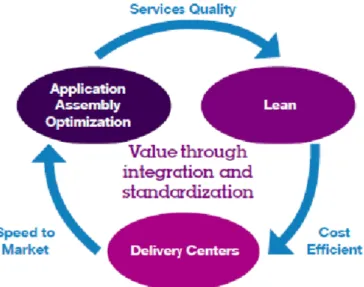
The foundation of these Delivery Centers relies on a common governance framework and standardized methods, tools and processes to provide delivery excellence (IBM Globally Integrated Capabilities) (IBM 2009). Another important key factor of differentiation is the methodologies used for consistency and continuous process improvement, based on unmatched Application Assembly Optimization delivery approach and Lean processes:
Figure 1. Delivery Centers Methodology
(Globally Integrated Capabilities, Capabilities without borders, 2009) (IBM 2009)
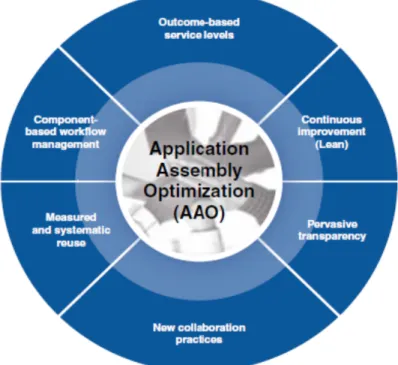
� A key element of IBM’s globally integrated capabilities strategy namely,
Application Assembly Optimization (AAO) applies a factory floor assembly model and automation principles to the discipline of geographically distributed software development and management. AAO provides revenue growth, faster time to market, increased value, and cost savings throughout the application development lifecycle. The measurement framework for application assembly optimization is a dynamic system with automation, extensibility and flexibility in mind.
Figure 2. key element of IBM’s globally integrated capabilities strategy
(Application Assembly Optimization, A distinct approach to global delivery, 2010) (IBM 2010)
Through AAO, the delivery team:
- Accelerates response to business needs.
- Improves visibility to IT delivery performance. - Improves metrics.
- Reduces time-to-value and time-to-market. - Improves productivity and quality.
(Application Assembly Optimization, A distinct approach to global delivery, 2010) (IBM 2010)
� Lean is an industry-proven methodology that delivers value through operational
excellence. It is a set of principles that drive overall business philosophy towards continuous process improvement and elimination of waste. Lean results in less rework due to fewer defects. It can help reduce IT budget and enable faster delivery of services. Each AAO process is developed using a Lean approach and is regularly reviewed to provide continuous operational excellence
(Globally Integrated Capabilities, Capabilities without borders, 2009) (IBM 2009)
It is clear the relation of the outsourcing and the DC’s phenomenon but it is not clear that one influences or has influenced the other. As it is not clear that the reasons and factors that push the suppliers for the creation and implementation of DC’s are the same as the organisations moving forward to outsourcing.
3.
Research Methodology
As discussed previously, currently, there is lack of research regarding the creation of DC’s as a major success factor of outsourcing suppliers, regarding its reasons and contributing factors, or even obstacles, problems or any other specification. That way, there is no theoretical base or model that can be used as a starting point for this study. The inexistence of other studies involving the evolution of the outsourcing business and the impact of it in the way that customers and suppliers maintain outsourcing deals as a mutual success factor represents a big hole. As highlighted in section 2, Review of the Literature, there are several studies on outsourcing and a few references on delivery centers but there are only a few that relates one with the other. This study will try to introduce this discussion and will potentially generate other discussions and future complementary studies.
Due to the investigative purpose of this study and the research question and sub-questions, and its nature of “how, why and what”, it will be used an exploratory case study approach (Saunders, Lewis et al. 2009). Other reasons could be appointed that justifies the use of an exploratory case study, as follow:
There is little or no prior research of the phenomenon or topic under investigation, as in the present case;
The phenomenon under investigation in this study is complex and not yet understood;
The exploratory case study is used in studies with the objective of clarify a decision or group of decisions, and to answer questions like, why the decision was made, how it was implemented and what was the result of it, as in the present case;
Other characteristic of an exploratory case study is its flexibility and adaptability to changes and this being an unexplored phenomenon it could need some adjustment as a result of new insights or data;
The population under examination is small and restricted;
For last, the exploratory case study has demonstrated in the past to be very robust and efficient, and is being used successfully in several other studies with respected results (Saunders, Lewis et al. 2009).
3.1.
Unit of Analysis and Data Collection
This study will be based on IBM’s outsourcing and so it is IBM’s outsourcing that will be regard as the unit of analysis for this study. Inside the IBM’s outsourcing organisation, the focus will be composed of a group of key people that were, and some still are, involved in the process of strategic services transferring to DC’s and those will be the individuals that will contribute to this study.
Data will be collected in two ways. Locally, data will be collected from semi-structural interviews using a checklist (Appendix 7.1) and the interviews will be conducted to those key professional people that have experience in this research field. At the same time, it will be distributed by IBM’s internal e-mail, a questionnaire (Appendix 7.5) based on the same checklist used on the interviews, to the key people working on the
principal DC, Brno, in Czech Republic5. The e-mail will be sent individually to each of the key people to guarantee identity confidentiality.
Those interviews and questionnaires have the objective of studying the phenomenon that surrounds DC’s creation and the transferring of outsourcing services to it and aimed to capture the local and DC’s perspective, and they will be conducted in a short period of time, and so it will be a cross-sectional study (Saunders, Lewis et al. 2009). The checklist used on the local interviews will serve as a guide to make sure that all pertinent topics that were previously established are covered during the interview. The choice of semi-structured interviews rather than structured interviews was employed because it offers sufficient flexibility to approach the different respondents differently, while still covering the same areas of data collection.
Besides the interviews and questionnaire, the fieldwork included also participant observation and analysis of documentary sources about IBM outsourcing organisation. Documents were collected such as articles, journals, text books, conference reports, company reports, company newsletters and others to complement as well as to compensate for the limitations of the interview and questionnaire methods. Observation generated insight and better understanding on the phenomenon under analysis and documentary evidence acts as a method to cross validate information gathered from the interviews and questionnaires, given that sometimes what people say is different from what people do.
5
The Integrated Delivery Center of Brno is one of the biggest and most diverse IBM centers of its kind worldwide. Its core activities focus on providing strategic outsourcing services remote server and application support, networking services and end customer support.
There are over 2400 IT professionals working at the center, who form a uniquely diversified team consisting of up to 70 different nationalities. The IDC Brno staff provides services to over 600 clients from around the world, ranging from leading world banks, major international corporations, phone operators, to pharmaceutical companies. (http://www.grafton.cz/files/projects/cz/ibm/)
3.2.
Population and Purposive Sampling
The selection of the key people to approach from the list of people working in IBM’s outsourcing organisation will be based on a number of criteria. First criteria, is that the appropriate participants of this case study must be accessible, and agreeable to participate in this research.
Second criteria, they were or still are involved in the process that surrounds DC’s decision, were or are part important in the process of definition and implementation of services transfer to DC’s.
Last, but most important, the participants in this case study must have the potential to provide useful information that will help understand the phenomenon under investigation. The phenomenon of DC’s in Portugal is still in its infancy, only now it is beginning to show some signs of maturity, and that represents an additional difficulty in the participants selection, as they must have some experience involving the transfer of services to the DC’s.
Other criteria that could be used are the information regarding the potential layoffs and restructuring of the local organisation, which normally accompanies these phenomenon’s. But as a rule, this kind of decisions does not involve the all organisation, generally involving only the chief officers and not lower than the mid-level manager. So, applying this criterion could implicate having a very small population, and that is the reason for its inapplicability.
Having established the selection criteria, the group of key people that will be interviewed and questioned will correspond to a non-representative sampling, i. e., they are information rich and they present the researcher an insight or a clearly description of the phenomenon under investigation. This approach corresponds to a purposeful
sampling approach, and it is immensely valuable in determining which of the IBM’s outsourcing organisation people can positively contribute to this research and can help clarify the topic of this study.
Before the interviews, it will be distributed by IBM’s internal e-mail a request for participation to the local people (Appendix 7.2) and then, at each interview, detailed information about the purpose of this study will be given, as so the potential benefits and the level of participation required from the interviewees. Other important information given at this point will be the anonymity and confidentiality of the participants. The same information will be distributed by IBM’s internal e-mail as a request for participation (Appendix 7.3) with the questionnaire to the Brno DC people. The interviews and questionnaire will be focused based on specific questions or topics previously elaborated but allowing sufficient flexibility, permitting the interviewer to ask open-ended questions that will consent the interviewee to provide as detailed information as possible. The questions will focus on the participant individual experiences and opinions with the phenomenon under investigation.
The purpose for the open-ended questions is to describe, explain, interpret and then build a correspondent theory, and so, it will be an inductive approach (Saunders, Lewis et al. 2009). Other purpose of having open-ended questions is to guarantee that the interviewer is more involved and that way ensured that their own biases were not introduced into the results.
Regarding the length of the interviews, it will not be established previously, allowing the participants to have time to explain theirs involvement, roles and experiences. The testimonial will be written in paper and then transcribed to computer or will be written directly in computer. Each interviewee will agreed with what is being written by the
interviewer and give its approval, that to minimize further follow-ups. At the conclusion of each interview, it will be asked to participants to be available for follow-up should further clarifications be necessary.
Limitations and Assumptions
1. Sample size – Studying only one organisation, IBM’s outsourcing, and applying the selection criteria previously referred will reduce the number of high-quality participants. However, as many people are involved in the DC’s phenomenon, the assumption will be that the sample size of participants will be enough to get accurate results.
2. Sensitivity of data – As the requested data in the interviews and questionnaires has sensitivity data in nature, there may be inhibition from the participants in providing expected information and that can affect this analysis. Confidential interviews and questionnaires will give them the opportunity to share their experiences and to explain how they see the phenomenon under investigation. Their experiences and opinions on this topic will be crucial to shape and to organize the knowledge about it.
3. Ambiguity of data and results (bias) – Having the researcher working in the same organisation and in the same business area under investigation as the outsourcing could influence the study results. Impartiality and objectivity will be a must and a fundamental objective of the researcher. Another positive factor that will certainly contribute to the required impartiality and objectivity of the study is the researcher detachment with the transferring process of services to DC’s, with the decision process or even with the implementation phase that followed the decision.
3.3.
Semi-Structured Interview Checklist
The checklist instrument that will be used for the interviews and also on the questionnaires will be divided in two sections. Section I, will consist of questions regarding participant role involving the topic under investigation. This section will determine participant role and involvement with the research phenomenon and will allow the categorization of respondents to see if there are any relationships between them. Section II, will consist in open-ended questions, the content of which will be in sync with the hypothesis and research question and sub-questions stated in chapter 1 and 3. The responses to section I can be previously coded in advance, based on the characteristics of the purposive sampling, while section II coding will occur only after data collection and patterns determination.
The following table shows the mapping between the investigative questions and the Checklist questions.
Topic under
investigation Question Items Scale
Checklist Questions General Demographic Questions Questions 1a & 1b
Outsourcing Objectives from IBM
perspective 2-Items Questions 2a & 2b
Outsourcing
Outsourcing Objectives from Customer
perspective 2-Items Questions 2c & 2d
DC's Objectives from IBM perspective 2-Items Questions 3a & 3b Outsourcing
& Dc's
Relation between Outsourcing and DC's
Objectives 1-Item Question 3c
Impact on Service Quality 1-Item Question 4a
Impact on Local People 1-Item Question 4b
Barriers on DC's implementation 1-Item Question 4c DC's Impact
& Results Impact on the Outsourcing Business 1-Item Question 4d Table 1. Description of questions items and scale
3.4.
Human Subject Protection and Data Confidentiality
This dissertation will be conducted with IBM’s sponsoring, and will follow IBM’s conduct guidelines regarding human subject protection and data confidentiality. IBM has agreed to participate in this research and has provided a supervisor that will help orienting this study.
The researcher team consists solely on the researcher and the interviews and questionnaires will be confidential and anonymous. Participation or non-participation in this research will have no affect on any person’s career and there will be no incentive offered to respondents other than their participation.
4.
Results
This chapter first discusses the details of the data gathering phase. Then the results of the analysis of the data collected from the interviews and questionnaires based on the semi-structured checklist presented in Appendixes section.
4.1.
Data Collection
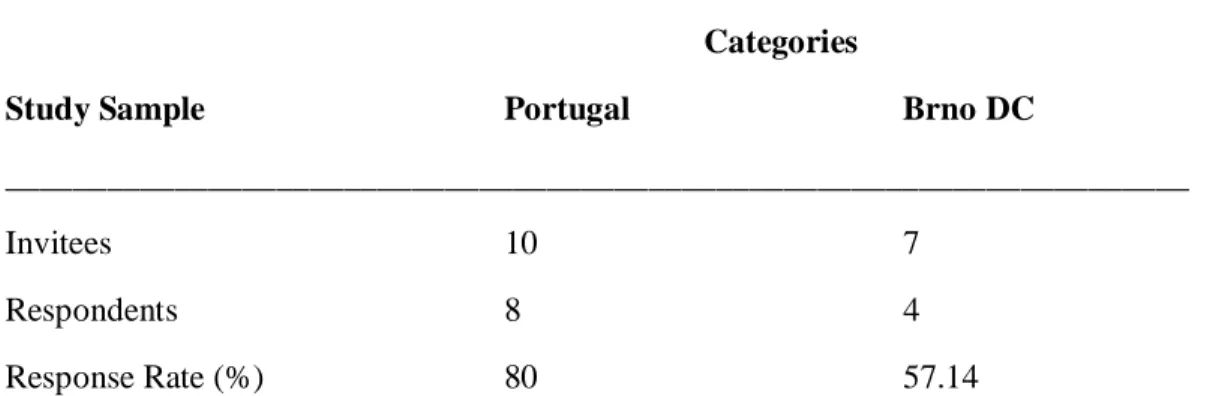
Seventeen IBM key employees were invited to participate in this research project and twelve did participated. The list of IBM Key employees was previously discussed internally with the IBM supervisor and was finally closed with the contribution of some of the people interviewed. The group of people that were invited to participate in this research includes team members responsible for execution and those responsible for implementation. The decision owners were not invited as they are in the higher levels of hierarchy and normally do not participate in the implementation and therefore do not possess the knowledge and the experience to be considered relevant for this study. The team members responsible for execution and for implementation on the other hand, did not participated in the decision process and so, they can have different opinions regarding the decision, but have the knowledge and experience in the subject under discussion. All the invitees were first contact by personalized e-mail, requesting their participation and explaining the objectives. They were then informed that the current research was previously approved internally and that their contribution was extremely valuable (Appendix 7.2 & 7.3). Additional measures taken to improve the response rate were then made with a second personalized e-mail sent reinforcing the importance of their participation (Appendix 7.4). Some of the people interviewed showed fear and was a little afraid of the implications of their participation on this research as probably they
would say something that was against the common opinions or against some internal policy. At the beginning of the interview was clarified that IBM was sponsoring this research and that all the information collected and also the respondent’s identity will remain confidential and only the statistics findings will be documented.
Although the overall response rate was not as hoped, it was determined that further invitations would probably not be productive, so the data collected were analyzed for the research.
The following table itemizes the number of invitees and respondents per category with their respective response rate.
Categories
Study Sample Portugal Brno DC
______________________________________________________________________
Invitees 10 7
Respondents 8 4
Response Rate (%) 80 57.14
Table 2. Invitees vs. Respondents
Section I of the checklist used on the interviews and also on the questionnaires contained demographic questions which were used to provide a general sense of the respondent group dynamics with respect to IBM title and role and years of service at IBM.
IBM Title/Role: The majority of the respondents in the sample are Managers (58.33%). The remaining respondents (41.67%) have also positions were they are decision makers and some have also teams to orient but do not have the “Manager” role. The Manager, or normally called People Manager, has people reporting to him in a hierarchy view and has an independent department. Each department can have different teams, and normally each team has its own Team Leader. The Team Leader does not have people reporting to him/her but he/she is responsible for that specific team. Sometimes he/she has also management responsibilities but not in a hierarchy structure. Inside each team or department, there are different Focal Points. The Focal Point is a particular person that responds for a particular topic or project or even account. The following figure describes the IBM title of each respondent.
0 1 2 3 4 5 6 7
Manager
Team Leader
Focal Point
Figure 3. IBM Title/Role of respondents
Regarding validity of the information collected, all the answers were valid as each of the twelve respondents answered this question (100% valid answers and 0% missing).
Looking at the distribution by location, 71.43% of the Managers are local and only 28.57% come from Brno Delivery Center. All the Focal Points are local and all the Team Leaders are located at Brno DC (See Appendix 7.6 for additional details).
Numbers of years in IBM: Out of twelve respondents, six (50%) reported that they are in IBM for less than six years. 25% of the remaining respondents work in IBM for a period of six to ten years and the other 25% respondents work in IBM for over than ten years. The following figure describes the number of years in IBM of the respondent’s sample.
0 1 2 3 4 5 6
Less than 6 years Between 6 and 10 years More than 10 years
Figure 4. Number of working years in IBM
This can be explained by some recent acquisitions in the Outsourcing Business. It was out of the scope of this research the investigation of outsourcing contracts but the increase in the number of acquisitions on the last years, forced IBM to get more people. Another factor that could explain the abovementioned results could be the fact that each new Outsourcing Business acquisition brings people from the customer to IBM, as direct transfer or with the creation of joint-ventures.
Regarding validity of the information collected, all the answers were valid as each of the twelve respondents answered this question (100% valid answers and 0% missing).
Looking at distribution by location, 66.67% of the respondents that work in IBM for less than six years are local, 66.67% of the respondents that have between six and ten years working for IBM and more than ten years are local. (See Appendix 7.6 for additional details).
4.2.
Data Analysis
The following section provides the analysis and results on the information received from the respondents regarding section II of the Checklist. The coding concepts and categories were developed using the research question and sub-questions and the review of the interview transcripts, field notes and questionnaires answers. All of the data collected was then analyzed line by line in the sequence in which they were collected. Specific phrases, words and terms were marked and labeled using the MAXQDA qualitative software for content analysis (MAXQDA). Then they were examined again and grouped in concepts and categories (Corbin and Strauss 2008). As the codes were being created, the purpose of coding was constantly taken in consideration so the number of codes did not increase to a huge number and consequently became unmanageable. MAXQDA allowed the transcripts contents to be marked, colored and tagged for further analysis (Lewins and Silver 2007). This supported the analysis of the linkages between the categories and the development of explanations for the phenomenon under investigation. The following is an example of a quote and how it was coded:
“Revenue and cost model. IBM has responsibilities to their shareholders and outsourcing is something that can generate revenue because of the simple factor that it can manage the factor cost” (Local Manager).
This quote represents two processes in the research model: revenue and cost savings. The interviewee was saying that the objectives and expectations of the outsourcing from IBM perspective were revenue and also cost savings as one is consequence of the other.
Each statement collected was evaluated and coded in this manner to develop the results of this research. The result data extracted from the MAXQDA, such has the categories frequency, was then analyzed with Microsoft Excel.
Objectives and expectations of outsourcing from IBM point of view
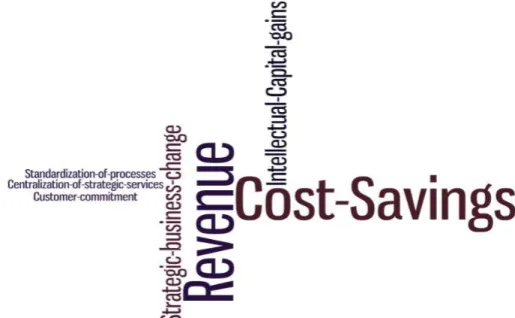
Question one from the section II of the checklist, belongs to the group of questions regarding the Outsourcing Business and it gathered the information regarding participant’s opinion about the objectives and expectations of outsourcing from IBM point of view. The following figure provides the details.
Figure 5. Objectives and expectations of outsourcing from IBM point of view
The abovementioned results show that the majority of the respondents consider revenue as one of the objectives and expectations of IBM regarding the outsourcing business. As one of the respondents firmly pointed out:
“Revenue is fundamental” (Local Focal Point).
Another mentioned:
“Revenue is more important than the cost savings” (Local Manager).
The second factor referred to was cost savings and the third mentioned factor was a strategic business change. Regarding the last one, one of the Respondents affirmed:
“Strategic change in the business paradigm. …In general, the outsourcing and the services component allowed IBM to establish a global position in the global and transversal support in the different IT areas, having in mind the objective to increase the business, leaving outside the hardware. …Services are better to increase margins
than hardware; And because of globalization, the margins are becoming even lower” (Local Manager).
And another:
“Move from the commodities business to guarantee constant and healthy revenue; and maintain a list of customers that in other way could leave IBM” (Local Manager). As noted above, outsourcing was an opportunity for IBM, a strategic move to a new way of doing business. There were three other factors mentioned as follow, standardization of processes and services, intellectual capital gains and economy of scale, but as mentioned before the financial factors aligned with the business change were the principal motivators that compelled IBM in respect to outsourcing.
Regarding the validity of the information collected, one of the Respondents did not answer this question mentioning lack of experience in the subject. The validity of the information collected is present at Appendix 7.7.
Objectives and expectations of outsourcing from IBM point of view by location
Analyzing the data collected separately by location (local and Brno DC) we have some differences on the results, as following two figures describe.
Figure 6. Objectives and expectations of outsourcing from IBM point of view of local Respondents
Figure 7. Objectives and expectations of outsourcing from IBM point of view of DC Respondents
Based on the information collected by location, revenue was only identified as an IBM objective by the local Respondents as all the DC Respondents did not identified it as an expectation of IBM from the Outsourcing Business. Local Respondents also identified objectives of economy of scale and intellectual capital gains and DC Respondents did not. In the other hand, DC Respondents identified that IBM has the expectation of standardize processes and services with outsourcing and local Respondents did not.
Likely this is result of the different realities that these two locations have. The local people are part of the Outsourcing Business and see it as a whole. DC people only have contact with specific areas on some of the outsourcing contracts and so they cannot see it as a whole, having only in mind Delivery Center reality. As one of the DC Respondents pointed out:
“Possibility to increase efficiency and effectiveness of services (automation, innovation); provides a long term and cheap business platform with high valued deliverables” (DC Team Leader).
Is almost what is expected from the DC’s itself.
Regarding the validity of the information collected, the Respondent that did not answer this question comes from the DC. The validity of the information collected is present at Appendix 7.7.
Objectives and expectations of outsourcing from IBM point of view - Importance classification
Question two from the section II of the checklist questioned the Respondents regarding the importance classification of the previous identified objectives and expectations of outsourcing from IBM point of view. All the Respondents identified several objectives and this question has the objective to identify which of the identified factors is the most important. The following figure provides the details.
Figure 8. Objectives and expectations of outsourcing from IBM point of view by Importance Classification
The most important factors for IBM regarding outsourcing that were identified by the participants were revenue and cost savings and both have exactly the same importance.
“Revenue and cost model, are associated” (Local Manager).
Two other strong motivators also with same importance classification are intellectual capital gains and strategic business change.
Regarding the validity of the information collected one of the Respondents did not answered this question mentioning lack of experience in the subject. The validity is present at Appendix 7.7.
Objectives and expectations of outsourcing from IBM point of view by location - Importance classification
Analyzing the data collected separately by location (local and Brno DC) we have some differences on the results, as following two figures describe.
Figure 9. Objectives and expectations of outsourcing from IBM point of view of local Respondents by importance classification
Figure 10. Objectives and expectations of outsourcing from IBM point of view of DC Respondents
Questioned the respondents regarding the most important factors for IBM regarding the Outsourcing Business, they answered that revenue and cost savings are the most important factors for both locations. Regarding the validity of the information collected, the Respondent that did not answered this question comes from the DC. The validity of the information collected is present at Appendix 7.7.
Objectives and expectations of outsourcing from Customers point of view
Third question from the section II of the checklist questioned the Respondents regarding the objectives and expectations of outsourcing from the Customers point of view. The following figure provides the details.
Figure 11. Objectives and expectations of outsourcing from Customer point of view
The abovementioned results show that the majority of the respondents consider cost savings as one of the factors that push Customer for outsourcing:
“Costs. Customers have also responsibilities to their shareholders” (Local Manager).
“Cost Savings is the most important factor” (Local Focal Point).
“To receive a high quality service with lower cost” (DC Manager).
A secondary motivation for outsourcing considering Customer perspective was intellectual capital gains:
“This way, costumers can have access to skills that in other way they couldn’t” (Local Focal Point).
“Intellectual capital transferred from the client to the supplier normally allows to make more with less” (Local Manager).
Regarding the validity of the information collected, one of the Respondents did not answered this question mentioning lack of experience in the subject. The validity of the information collected is present at Appendix 7.7.
Objectives and expectations of outsourcing from Customers point of view by location
Analyzing the data collected separately by location (local and Brno DC) we have some differences on the results, as following two figures describe.
Figure 12. Objectives and expectations of outsourcing from Customer point of view of local Respondents
Figure 13. Objectives and expectations of outsourcing from Customer point of view of DC Respondents
Based on the information collected by location, Respondents from both locations consider that cost savings is one of the motivators to outsourcing from Customer perspective. The intellectual capital gains factor is only mentioned by the local Respondents and DC Respondents mention factors like economy of scale and service quality.
Regarding validity of the information collected, the Respondent that did not answered this question comes from the DC. The validity of the information collected is present at Appendix 7.7.
Objectives and expectations of outsourcing from Customers point of view - Importance classification
The fourth question of section II of the checklist questioned the Respondents regarding the importance classification of the previous identified objectives and expectations of outsourcing from the Customers point of view. All the Respondents identified several objectives and this question has the objective to identify which of the identified factors is the most important. The following figure provides the details.
Figure 14. Objectives and expectations of outsourcing from Customer point of view by Importance Classification
The results undoubtedly show that the participants identified cost savings as the most important motivator for outsourcing from Customer standpoint.
“Cost is the most important factor. You know the cost that you will pay when the service is transferred (when it’s done internally its value is subjective)” (Local Manager).
Regarding the validity of the information collected, two of the Respondents did not answered this question mentioning lack of experience in the subject and the other answered in an ambiguously way. The validity of the information collected is present at Appendix 7.7.
Objectives and expectations of outsourcing from Customers point of view by location - Importance classification
Analyzing the data collected separately by location (local and Brno DC) we have some differences on the results, as following two figures describe.
Figure 15. Objectives and expectations of outsourcing from Customer point of view of local Respondents by importance classification
Figure 16. Objectives and expectations of outsourcing from Customer point of view of DC Respondents by importance classification
DC Respondents classify with the same importance the following factors, cost savings and gains of intellectual capital and Local Respondents referred almost only cost savings.
Regarding the validity of the information collected, the two Respondents that did not answered this question comes from the DC location. The validity of the information collected is present at Appendix 7.7.
Objectives and expectations of DC’s from IBM point of view
The next group of questions introduces the Delivery Center topic to the previous topic under discussion, the outsourcing. First question of this group inquires the Respondents regarding their opinion on the objectives and expectations of the Delivery Centers from IBM point of view. The following figure provides the details.
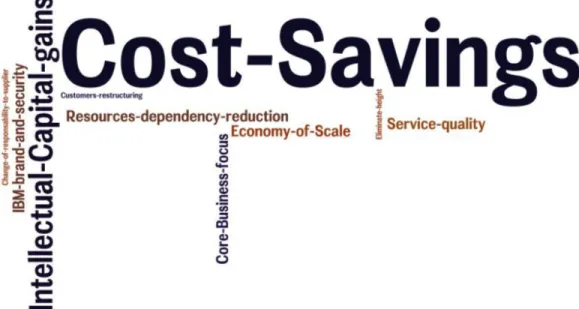
The abovementioned results show that the majority of the respondents consider that again the key factor that motivated IBM to move to the Delivery Centers is cost savings.
“Costs; is the strategy to centralize services in locations where the rates are lower, allowing having a good price/quality relation” (Local Manager).
“DC’s are competitive because they live of resources rotation, allowing rates reduction but in the other hand it affects quality” (Local Manager).
“Cost savings without doubts because of the locations where the DC’s are created” (Local Manager).
“Costs; Everything related with costs. Customer requests to lower margins result in centralization in just one team” (Local Focal Point).
“From money perspective, DCs costs are lower in every aspect” (DC Team Leader). “Concentrate skills to gain efficiency in costs and standardize the delivery” (DC Manager).
Regarding the validity of the information collected, all the Respondents answered this question. The validity of the information collected is present at Appendix 7.7.
Objectives and expectations of DC’s from IBM point of view by location
Analyzing the data collected separately by location (local and Brno DC) the answers are very similar, considering cost savings is the factor that was more referred by both locations, as following two figures describe.
Figure 18. Objectives and expectations of DC’s from IBM point of view of the local Respondents
Figure 19. Objectives and expectations of DC’s from IBM point of view of the DC Respondents
The secondary factor also mentioned by both locations is intellectual capital gains.
“Better synergies are created on the DC’s because it’s where the more valuable skills are located” (Local Manager).
“They have access to many IBM tools, and they don’t have difficult to use them and we have. They have processes and we fail. We work without processes, every person works individually and the intellectual capital is also individual” (Local Manager).
“Having every one at the same place creates synergies, and they have analysis processes, SLA’s, etc” (Local Focal Point).
“DCs are providing a huge capacity for knowledge and resources which can be easily moved and transformed across projects” (DC Team Leader).
Two other factors were also referred, the standardization of processes and services by both location participants and optimization mostly by the local participants.
“The objective was the standardization of services; offer and service standardization implies economy of scale” (Local Manager).
“To standardize processes of tasks provided to customers, resulting in cost saving from mitigation of misunderstandings and related problems” (DC Team Leader).
“Short time objectives: Cost reduction. Long time objectives: quality improvement and resources optimization” (Local Focal Point).
The validity of the information collected is present at Appendix 7.7.
Objectives and expectations of DC’s from IBM point of view - Importance classification
The next question of section II of the checklist questioned the Respondents regarding the importance classification of the previous identified objectives and expectations of the DC’s from IBM point of view. All the Respondents identified several objectives and this question has the objective to identify which of the identified factors is the most important. The following figure provides the details.
Figure 20. Objectives and expectations of DC’s from IBM point of view by importance classification
Again, the results of this question show that cost savings is the principal key factor that influenced IBM to move to the Delivery Centers from participant’s opinion.