Abstract—Community integration is a construct that an
increasing body of research has shown to have a significant impact on the wellbeing and recovery of people with psychiatric problems. However, there are few studies that explore which factors can be associated and predict community integration. Moreover, community integration has been mostly studied in minority groups, and current literature on the definition and manifestation of community integration in the general population is scarcer. Thus, the current study aims to characterize community integration and explore possible predictor variables in a sample of participants with psychiatric problems (PP, N=183) and a sample of participants from the general population (GP, N=211).
Results show that people with psychiatric problems present above average values of community integration, but are significantly lower than their healthy counterparts. It was also possible to observe that community integration does not vary in terms of the socio-demographic characteristics of both groups in this study. Correlation and multiple regression showed that, among several variables that literature present as relevant in the community integration process, only three variables emerged as having the most explanatory value in community integration of both groups: sense of community, basic needs satisfaction and submission. These results also shown that those variables have increased explanatory power in the PP sample, which leads us to emphasize the need to address this issue in future studies and increase the understanding of the factors that can be involved in the promotion of community integration, in order to devise more effective interventions in this field.
Keywords—Community integration, mental illness, predictors.
I. INTRODUCTION
OR centuries, mental illness have been misunderstood and people with psychiatric problems have been deprived of social contact, received painful and ineffective treatments [1]. Nowadays, thanks to the developments and evolution in mental health care in psychiatry and sociocultural aspect, people with psychiatric problems have increased opportunities to recover and develop a social life like healthy individuals [2].
J.C. and M.S. are with the Department of Educational Sciences, Azores University (e-mail: [email protected], [email protected])
C.B.C is with the Department of Educational Sciences, Azores University and CINEICC, Faculty of Psychology and Educational Sciences, University of Coimbra, Portugal (Correspondence should be addressed to: Departamento de Ciências da Educação, Universidade dos Açores, Apartado 1422, PT-9501-801 Ponta Delgada, Portugal; (phone: (+351)296650155; e-mail: [email protected]).
C.M. is with the Department of Educational Sciences, Azores University and CINEICC, Faculty of Psychology and Educational Sciences, University of Coimbra, Portugal. (e-mail: [email protected])
Thus, the more recent approaches to mental health in community settings emphasize the importance of psychosocial factors in the recovery of individuals with mental illness, highlighting the integration of these individuals in the community [3].
The concept of community integration of people with mental illness stands on the premise of common citizenship, defending that people with psychiatric problems should have the same rights [4] and should be involved in social life like any other members of the community [5]. In general terms, community integration of people with mental illness can be defined as the extent to which individuals live, participates and socializes in their own community [6], maintaining significant interpersonal relationship and exchanges in non-clinical environments [7].
The literature in this field emphasizes the community integration by Wong and Solomon [6], who created a broad definition that encompasses physical, social and psychological dimensions, including in their definition of community integration the individual’s capacity to carry out daily live activities in the community (physical integration), seek interaction with other members of their community without mental illness (social integration) and have feelings of belonging in their communities (psychological integration) [6], [8].
Community integration of people with mental illness depends on the characteristics of the community. A community that favors integration should be inclusive, have awareness about the differences and be characterized by a non-discriminatory posture towards people with psychiatric problems and other populations that are generally marginalized [5]. However, [9] considers that little is known about the potential community integration in existing communities where people with severe mental illness tend to live, and few studies compare the integration of people with mental illness with other members of their community.
In addition to their characteristics, it is important to highlight the positive influence of community integration in the recovery process [3], [10], wellbeing [7] and quality of life [11] of people with mental illness. Given the importance of community integration in mental health and the scarcity of studies in this field, it becomes pertinent to explore this issue.
Characterization and Predictors of Community
Integration of People with Psychiatric Problems:
Comparisons with the General Population
J. Cabral, C. Barreto Carvalho, C. da Motta, M. Sousa
F
Factors Influencing the Community Integration of People with Psychiatric Illness
Little is known about the factors (individual, community and social support) that allows a successful integration of people with severe mental illness in the community [6]. Some studies point out to factors that can catalyze or inhibit the community integration, but these studies are generally applied in specific context, with small sample sizes, and therefore, of limited generalizability. The sociodemographic and socioemotional factors that exert some influence in the community integration of people with mental illness, according to the literature, are presented below.
A less recent study [12], [13] has shown that the age of individuals with mental illness can influence the degree of community integration, in which younger individuals tend to be more integrated. In a study by Abdallah and colleagues (2009), elderly patients with schizophrenia presented low levels of integration when compared to the elderly from the general population. In addition, females presented more integration [14], which may be related to the associations between the independence and the female gender, as suggested by [15].
Leff and Warner emphasize the importance that employment can have in terms of individual’s recovery, but in terms of their integration, because the working environment provides opportunities to foster new friendships, to better structure daily routines, increase self-esteem and provides and income that prevents situations of poverty. However, these advantages are often denied to people with severe mental illness by less sympathetic employers [16]. These authors also recognize the increased difficulties of people with mental illness in the access to employment, especially where unemployment rates are high. Abdallah and colleagues [14] also identified a relationship between economic status and community integration, suggesting that improvements in financial situation can foster the integration of people with psychiatric problems.
The type of habitation is another factor that influences the community integration of people with mental illness. Living in inadequate conditions can decrease the possibility to maintain other resources, such as meaningful activities and relationships [17]. On the other hand, a place of residence that is closer to normalized environment has been pointed out as fundamental to community integration in the literature in the field of mental health [6], [18], [19].
Wong and Solomon [6] also emphasize the contextual characteristics such as neighborhood characteristics, the proximity to normalized contexts or non-institutional settings, distance and accessibility to community resources that can facilitate the expansion of social networks and integration of the mentally ill [6], [10], [14]. Finally, despite the interactions between psychiatric patients and other members of the communities being one of the main factors that are essential to community integration, few studies report these interactions or the perceptions of the intervenient in this regard [20].
The Role of Social-Emotional Factors in Community Integration of People with Psychiatric Problems
The severity of the psychiatric illness and degree of disruption of patients’ behavior was also identified as strong predictors of patient’s acceptance in their community [5], [21]. Several studies [14], [22] point out to the positive associations between low levels of psychopathological symptoms and community integration, in consonance to the results of [14], which demonstrated that abnormal behaviors are associated with decreased community integration.
The stigma related to mental illness can also result in behaviors of social distancing and discrimination that can have a long-lasting negative effect on the social and psychological wellbeing of people labeled with severe mental illness [23]. Therefore, stigma is referred as a significant obstacle to community integration [10], [24], particularly because mental illness are considered more invalidating and the stigma associated with mental health can often surpass the stigma related to other conditions [25], [26]. In addition, stigma conditions fundamental aspects of integration, such as damage in the family or interpersonal relationship, increased isolation and less access to employment [24], [27], [28].
Shame is essentially tied to self-stigma and reactions to stigma, as pointed out by [29]–[32]. Feelings of shame associated with mental illness are another factor that difficult not only the access to mental health care and can decreases the quality-of-life of patients and families, but also the integration of the mentally ill [33]
Independence and autonomy are also regarded as favorable to integration, and several studies suggest that habitation and services that foster independence promote more integration in a community [15]. Independence also contributes to individual’s subjective wellbeing [34]. In these studies, autonomy is defined as perceptions of control over the individual’s life circumstances, where “control” refers to achieving certain goals in which individuals attribute the results to their actions and not by mere chance [34]
Abdallah and colleagues [14] observed a significant relationship between satisfaction and control individuals exert over their own lives, congruous with findings by [15], who demonstrated that the choice opportunities and less rigid routines were associated with increased community integration in people with psychiatric problems. Thus, it is arguable that independence and control that people with psychiatric problems are two determinant factors in community integration, both related to the concept of empowerment, regarded as fundamental in the integration of those individuals [34], [35]. Thus, several psychosocial programs for people with severe mental illnesses fosters the empowerment, and acknowledge the positive repercussions that empowerment can have in the social lives of these individuals [36].
The sense of community is another factor that seems to influence community integration. This concept is defined by feelings of belonging, in which individuals perceive themselves as a significant part integrating a larger collectivity and a network of independent relations and mutual support,
which one can rely and depend upon [37], [38]. Townley and Kloos [19], [39] also refer that these sense of community are beneficial to recovery and wellbeing, to the extent that it encourages individuals with mental illness to get involved in important matters of their communities and provide a stable and reliable social structure [8], [39], [40].
Submissive behavior and the capacity of individuals with psychiatric problems to satisfy their basic psychological seem to be two factors involved in community integration, however, current literature does not provide clear evidence of how these variables influence community integration. The central aspect involved in submissive behavior is the perception of inferiority in relation to others, that leads to conflict avoidance, and avoiding showing one’s needs and desires, which are consequently not met [41], [42]. These behaviors are often present in depressed individuals [43] and serve as a maintenance factor of decreased well-being, performance and possibly to the integration of these individuals in their communities. Thus, it becomes pertinent to study the possible implications of submissive behaviors in community integration. According to Self-determination theory, psychological needs are motivational aspects that lead individuals to pursue satisfaction and wellbeing [44], [45]. The three basic psychological needs refer to the need for autonomy (desire to partake in activities where individuals having the opportunity to choose and engage); the need for competence (desire to interact effectively with the environment, fulfilling challenging tasks and activities) and the need to relate (desire to establish a connection with others or a given social context and developing feelings of belonging) [45], [46]. Molix and Nichols [47] advocate that individuals that individuals who enjoy their communities have increased wellbeing and that those communities provide the means necessary to individuals to fulfill their basic psychological needs. Taking into consideration the characteristics of this model, it is possible to argue that individuals who have their basic psychological needs met not only will have an increased wellbeing, but also higher levels of community integration, due to satisfying those needs implicate the development of several aspects favorable to the community integration of the mentally ill. However, to the best of our knowledge, there are currently no research about this topic and this issue needs more extensive research in future studies of the community integration of people with psychiatric problems.
Community Integration of People with and without Psychiatric Problems
Several authors emphasize that community integration of people with mental illness is only possible if they can have the same benefits and social opportunities as the rest of the members of their society [5], [8], considering that effective integration implies that people with psychiatric problems can establish the same relationships, be included in the same contexts and get involved in the social life like healthy individuals, and not in a protected way in clinical environments [5], [7], [48]. However, to the best of our
knowledge, there are few studies that define the “normal” community integration experienced by the general population or a point of reference that allows the comparison with the integration of individuals with limitations such as mental illness. The gap in research with non-clinical populations does not allow a comprehensive understanding of whether it is possible that people with limitations can be integrated in the same fashion as the general population. These aspects justify the need to develop further studies in this field, especially focused on the characterization of community integration and predictive variables in clinical and non-clinical samples [9], [14], which can allow the development of programs to foster community integration that suit the needs and characteristics of each group. In an attempt to address these issues, the current study was carried out in a sample of people with and without psychiatric problems aiming at: (1) the characterization of community integration in terms of socio-demographic variables; (2) the comparison of degree of community integration of both samples; and (3) to explore possible predictors of community integration of people with and without psychiatric problems.
II. METHODS
A. Participants and Procedures
A convenience sample of 183 subjects diagnosed with mental illness participated in this study. Participants were men and women with 18 years old or older, residents for a period longer than 3 years in the Autonomous Region of the Azores-Portugal. All participants were being followed by a psychologist or physician in outpatient settings of regional health services at the time of evaluation, and all participants gave their informed consent before participating in the study.
B. Statistical Analysis
Statistical analyses were performed with SPSS version 20.0 (IBM Corp., 2011). Descriptive statistic, bivariate correlation analysis, ANOVA and independent-sample Student t-tests were calculated to characterize community integration and to look for differences in community integration, according to gender, age group, civil status and years of education. Stepwise multiple regressions were calculated to obtain a significant model that allows the prediction of community integration (criterion variable) in function of several predictive variables (sense of community, satisfaction of basic psychological needs, life satisfaction, mental wellbeing, external shame, stigma and attitudes towards mental health problems, submissive behaviors, and depressive symptoms). Test assumptions were verified prior to analysis (normality of distribution with graph analysis and error independence with Durbin-Watson statistics). An alpha level of 0.05 was adopted in all analyses.
C. Measures
Community integration scale for adults with psychiatric problems (CIS-APP [49]) is a self-report instrument comprising 34 items that measure the community integration in adults (18 or older) with psychiatric problems. Items are
rated in a scale ranging from 0 (“I have no opinion about it”) to 4 (“Completely agree”), in which higher scores indicate higher levels of community integration. Instructions include a brief definition of community, so that all respondents are provided with a uniform and consensual definition of community. Higher scores indicate higher levels of community integration. The CIS-APP was based on the model by Wong and Solomon (2002) and has been validated for the Portuguese population by Cabral and colleagues [49] in clinical and non-clinical samples. The scale has 5 dimensions for community integration (Dimension 1- Physical Community Integration- Independence and use of community resources; Dimension 2- Physical Community Integration- Community participation and leisure activities; Dimension 3- Psychosocial Community Integration- Social network dimension and characteristics; Dimension 4- Psychosocial Community Integration- Emotional connection and Dimension 5- Psychosocial Community Integration- Community Support). The total scale presented good internal consistency (Cronbach’s alpha = 0.90).
Sense of community index- Version 2 (SCI-2 [50]) was developed to be used in different communities, and it is advisable that the type of community targeted is defined prior to administration (in the current study, “community” refers to the parish in which the participant live). This measure has an initial question to aid data interpretation when necessary (How important is it to you to feel a sense of community with other community members?). The SCI-2 is composed of 24 items answered on a Likert-type scale ranging from 0 (“not at all”) to 3 (“completely”). The scale has 4 subscales “reinforcement of needs”, “member status”, “influence” and “shared emotional connections”. Higher scores in this scale and subscales indicate higher levels of integration in the community. The SCI-2 was revised and studied in a large sample, with both the total scale and the subscales revealing good reliability (α = 0.94 for the total scale, and between 0.79 and 0.86 for the subscales) [50]. In the current sample, internal consistency was of 0.94.
Basic Need Satisfaction in General Scale (BNSG-S [51], Portuguese version [52]) is a self-report instrument, comprised of 21 items, that assess the Basic Need Satisfaction in General Scale of self-determination theory. This instrument consists of three subscales that correspond to the three basic needs of competence, autonomy and relatedness. Items are responded in a scale ranging from 1 (“Not at all true) to 7 (“Very true”). Nine of the 21 items are negatively formulated and were reversed scored prior to analyses. Both the original and the Portuguese version of the scale presented good internal consistency (Cronbach’s alpha = 0.89 and 0.86, respectively) [51], [52].
Attitudes towards mental health problems (ATMHP [32]; Portuguese version [53]) comprises 35 items assessing different aspects of attitudes and shame referring to mental health problems. The response options range from 0 (“Do not agree at all”) to 3 (“Completely agree”), and is divided into five sections. Higher scores in this scale indicate more negative attitudes towards mental health problems.
Preliminary analysis showed that all subscales presented good internal consistency, with Cronbach’s alpha ranging from 0.85 to 0.97 for Asian and non-Asian students, respectively [32]. The Portuguese version of the scale presented good internal consistency (Cronbach’s alpha =0.94) [53].
Other as Shamer Scale (OAS [54]) is a self-report scale assessing external shame, the negative perceptions each person has about how others sees them, or in other words, the extent to which one is regarded as inferior, flawed or unattractive by others. This scale comprise 18 items rated in a Likert-type response scale ranging from 0 (“Never”) to 4 (“Almost always”). Higher scores indicate higher levels of external shame. Both the original and the Portuguese version of the scale presented good internal consistency (Cronbach’s alpha = 0.92 and 0.91, respectively) [54]. In the current sample, internal consistency was of 0.96.
Submissive Behaviour Scale (SBS [43]). This scale has 16 items assessing the frequency of submissive behaviors. Each behavior is rated on a Likert-like frequency scale ranging from 0 (never) to 4 (always). Higher scores indicate increased frequencies of submissive behaviors. Both the original and the Portuguese version of the scale presented good internal consistency (Cronbach’s alpha = 0.89 and 0.90, respectively) [43]. In the current sample, internal consistency was of 0.83.
Beck Depression Inventory-II (BDI-II [55]; Portuguese version [56]) The BDI-II is a widely used measure to assess depressive symptomatology: affective, cognitive, motivational, delusional, physical and functional (sleep, appetite, weight and libido) symptoms, according to DSM-IV main diagnosis criteria for Major depressive episode. It comprises 21 sets of statements referring to depressive symptoms, ordered by degree of severity (nonexistent, mild, moderate, and severe). Both the original and the Portuguese version of the scale presented good internal consistency (Cronbach’s alpha = 0.91 and 0.92, respectively) [55], [56]. In the current sample, internal consistency was of 0.94.
III. RESULTS
A. Sample Characteristics
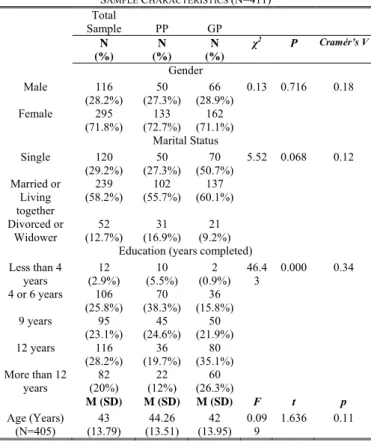
The current sample included 411 participants, with ages between 19 and 81 years old (M=43, SD=13.78). Concerning gender, 116 were males (28.2%) and 295 were females (71.8%). Most participants were married or living together 239 (58.2%) and were from lower socioeconomic status 245 (59.8%) (see Table I). In this sample, 228 participants were from the general population and 183 presented psychiatric problems. The group comparisons showed that both groups are equivalent concerning gender, marital status and age. Significant differences were observed concerning education, where participants with psychiatric problems presented significantly less years of education than their healthy counterparts.
TABLE I SAMPLE CHARACTERISTICS (N=411) Total Sample PP GP N (%) N (%) N (%) χ2 P Cramér’s V Gender Male 116 (28.2%) (27.3%) 50 (28.9%) 66 0.13 0.716 0.18 Female 295 (71.8%) (72.7%) 133 (71.1%) 162 Marital Status Single 120 (29.2%) 50 (27.3%) 70 (50.7%) 5.52 0.068 0.12 Married or Living together 239 (58.2%) (55.7%) 102 (60.1%) 137 Divorced or Widower 52 (12.7%) 31 (16.9%) 21 (9.2%) Education (years completed) Less than 4 years (2.9%) 12 (5.5%) 10 (0.9%) 2 46.43 0.000 0.34 4 or 6 years 106 (25.8%) (38.3%) 70 (15.8%) 36 9 years 95 (23.1%) 45 (24.6%) 50 (21.9%) 12 years 116 (28.2%) 36 (19.7%) 80 (35.1%) More than 12 years (20%) 82 (12%) 22 (26.3%) 60 M (SD) M (SD) M (SD) F t p Age (Years) (N=405) (13.79) 43 (13.51) 44.26 (13.95) 42 0.099 1.636 0.11
B. Characterization and Frequency of Community Integration in the Sample of Patients and the Sample from General Population
Concerning CIS-APP total scores on community integration in both groups, participants from the patients sample presented values between 47-93 (50.8%), while most participants from the general population scored between 94-140 (13.7%) (see Table II).
TABLE II
CHARACTERIZATION OF COMMUNITY INTEGRATION CIS-APP Total PP (n=183) GP (n=228) 0-46 1 (0.5%) _____ 47-93 93 (50.8%) 60 (26.3%) 94-140 89 (48.6%) 168 (73.7%) TABLE III INDEPENDENT-SAMPLE T TEST (N =411) CIS-APP PP (n=183) GP (n=228) M SD M SD t p Dimension 1 27.79 6.38 30.78 4.85 5.236 0.000 Dimension 2 11.80 3.84 14.35 3.03 7.323 0.000 Dimension 3 28.24 6.81 31.05 5.61 4.498 0.000 Dimension 4 11.38 3.32 12.24 2.93 2.745 0.006 Dimension 5 14.52 5.22 15.67 5.14 2.223 0.027 Total 93.73 19.67 104.08 93.73 5.740 0.000 Note: Dimension 1= Physical Community Integration- Independence and
use of community resource; Dimension 2= Physical Community Integration- Community participation and leisure activities; Dimension 3= Psychosocial Community Integration- Social network dimension and characteristics;
Dimension 4= Psychosocial Community Integration- Emotional connection; Dimension 5= Psychosocial Community Integration- Community Support.
C. Group Comparisons on Community Integration
Regarding the scores on each dimension and the total scale, it is possible to observe that participants from the general population score significantly higher than the sample of participants with psychiatric problems [t(409)=-5.907; p=0.000] (see Table III). These differences show that participants with psychiatric problems have much inferior community integration at all levels when compared with individuals with no psychiatric problems.
D. Characterization of Community Integration – Sociodemographic Aspects of the Sample of Patients
Independent sample t-tests and analyses of variances (ANOVA) were calculated in order to explore the differences in sociodemographic variables, such as gender, age, marital status, education in the sample of patients. Concerning gender, comparisons of the total scores of the CIS-APP showed statistically significant differences [t(181)= -1.969; p= 0.05]. Females presented higher scores on community integration (M=95.47; SD=18.39) in comparison to males (M=89.10; SD=19.84). Regarding each dimension, no statistically significant differences were found (p> 0.05), except for the Dimension 1 (Physical Community Integration- Independence and use of community resources) [t(181)= -4.082; p=0.00], in which females also score significantly higher (M=28.92; SD=5.94) than males (M=24.78; SD=6.57).
No statistically significant differences were found between the four age groups (18-33; 34-49; 50-65 and 66-88 years old) in the total score and each dimension of CIS-APP [F (3)= 1.144; p=0.33]. The same was true concerning marital status, where no significant differences were found between single, married/civil union, and divorced or widowers on the scores of the total CIS-APP [F(2)= 1.257; p=0.287] and each subscale.
No statistically significant differences were found regarding education on the total scores of the CIS-APP [F(4)= 1.343; p=0.519] and dimensions 1; 2 and 5 (p> 0.05). However, differences were found in dimensions 3 and 4. Post-hoc analyses (Tukey test) showed that individuals with up to 6 years of education presented significantly higher scores (M= 29.47; SD= 5.98) than individuals with 12 or more years of education (M=25.16; SD=7.00) on the dimension 3 (Psychosocial Community Integration- Social network dimension and characteristics). Results on dimension 4 (Psychosocial Community Integration- Emotional connection) show that participants with 4-6 years of education (M=12.11; SD=3.22) also score significantly higher than participants with 12 or more years of education (M= 9.88; SD=3.11).
E. Characterization of Community Integration – Sociodemographic Aspects of the Sample of the General Population
Independent sample t-tests and analyses of variances (ANOVA) were calculated in order to explore the differences in sociodemographic variables, such as gender, age, marital status, education in the sample of participants from the general population.
Concerning gender, comparisons of the total scores of the CISAPP showed statistically significant differences [t(226)= -2.142; p= 0.03]. Females presented higher scores on community integration (M=105.53; SD=14.41) in comparison to males (M=100.53; SD=19.29). Regarding each dimension, no statistically significant differences were found (p> 0.05), except for the dimension 1 (Physical Community Integration- Independence and use of community resources) [t(226)= -2.015; p= 0.05] (Females M=31.19; SD=4.29 and Males M=29.77; SD=5.94); dimension 4 (Psychosocial Community Integration- Emotional connection) [t(226)= -3.395; p= 0.00] (Females M=12.65; SD=2.65 and Males M=12.23; SD=3.34) and dimension 5 (Psychosocial Community Integration- Community Support) [t(226)= -2.471; p= 0.01] (Females M=16.20; SD=4.92 and Males M=14.36; SD=5.46), where females scored significantly higher than males.
Similar to the sample of patients, no statistically significant differences were found between the four age groups (18-33; 34-49; 50-65 and 66-88 years old) in the total score and each dimension of CIS-APP [F(3)= 1.732; p=0.161], except for dimension 1 (Physical Community Integration- Independence and use of community resources) [F (3)= 5.799; p=0.001]. Post-hoc tests show that participants with 18-33 years old score significantly lower (M=29.04; SD=5.75) than participants with 34-49 years old (M=32.11; SD=3.41).
Concerning marital status, no significant differences were found between single, married/civil union, and divorced or widowers on the scores of the total CIS-APP [F(2)= 0.811; p=0.446]. Concerning the CIS-APP subscales, significant differences were also found for dimension 1 (Physical Community Integration- Independence and use of community resources) [F (2)= 5.161; p=0.006]. Post-hoc tests indicate that this difference is significant between singles (M=29.29; SD=6.29), who tend to score lower than participants who are married or live in a civil union (M=31.35; SD=3.99).
No statistically significant differences were found between educational level on the CIS-APP total scores [F(4)= 0.492; p=0.741] and each subscale(p> 0.05). The only exception was dimension 1 (Physical Community Integration- Independence and use of community resources). Tukey post-hoc tests show that participants between 9-12 years of education score significantly lower (M= 29.19; SD= 5.70) than participants with higher education (12 or more years) (M=32.35; SD=4.05).
F. Correlations between Community Integration and Socio-Emotional Variables in the Sample of Patients
Pearson correlation coefficients were calculated to address the associations of community integration of people with psychiatric problems and several socio-emotional variables. Results showed positive and moderate correlations between the total scores of the CIS-APP and sense of community (SCI-2) and the satisfaction of basic needs (BNSG-S). Weak and negative correlations were found between CIS-APP and attitudes towards mental health problems (ATMHP), external shame (OAS), submissive behavior (SBS) and depression (BDI-II) (see Table IV).
TABLE IV
CORRELATIONS BETWEEN CIS-APP TOTAL AND SOCIO-EMOTIONAL VARIABLES (N=183)
SCI-2 BNSG-S ATMHP OAS SBS BDI-II
CIS
APP 0.570** 0.574** -0.246** -0.370** -0.370** -0.253** ** p < .001 (2-tailed)
Note: CIS-APP- Community integration scale for adults with psychiatric
problems; SCI-2- Sense of community index- Version 2; BNSG-S- Basic Need Satisfaction in General Scale; ATMHP- Attitudes towards mental health problems; OAS- Other as Shamer Scale; SBS- Submissive Behaviour Scale;
BDI- Beck Depression Inventory-II.
G. Correlations between Community Integration and Socio-Emotional Variables in the Sample from the General Population
Pearson correlation coefficients were calculated to address the associations of community integration of participants from the general population. Results yielded a similar pattern of positive and moderate correlations between CIS-APP total scores and SCI-2 and BNSG-S and weak negative associations with OAS, SBS and BDI-II. The only exception was the lack of significant correlation between community integration and attitudes towards mental health problems (Table V).
TABLE V
CORRELATIONS BETWEEN CIS-APP TOTAL AND SOCIO-EMOTIONAL VARIABLES (N=228)
SCI-2 BNSG-S ATMHP OAS SBS BDI-II
CIS
APP 0.365** 0.388** -0.126 n.s. -0.272** -0.272** -0.238** ** p < .001 (2-tailed); n.s.=non-significant
Note: CIS-APP- Community integration scale for adults with psychiatric
problems; SCI-2- Sense of community index- Version 2; BNSG-S- Basic Need Satisfaction in General Scale; ATMHP- Attitudes towards mental health problems; OAS- Other as Shamer Scale; SBS- Submissive Behaviour Scale;
BDI- Beck Depression Inventory-II.
H. Socio-Emotional Predictors of Community Integration in the Sample of Patients
Stepwise linear multiple regression analysis was performed to explore the predictive value of socio-emotional variables (sense of community, satisfaction of basic psychological needs, stigma and attitudes towards mental health problems, external shame, submissive behavior and depression) to explain community integration of patients with mental illness. Thus, scores on SCI-2; BNSG-S; ATMHP; OAS; SBS; BDI II were entered as predictors and total scores of CIS-APP was entered as criterion variable. A significant model was found including BPNG; SCI-2 e SBS, that explains 46.2% of the total variance of CIS-APP [F(3, 179) = 53,022; p =0.000; Ra2=
0.462]. Standardized regression coefficient showed that SCI-2 (β = 0.399; t(179) = 6.59; p = 0.000); BNSG-S (β = .332; t(179) =
4.91; p = .000), SBS (β = .142; t(179) = -2.29; p = 0.000) were
significant predictors of community integration (CIS-APP). I. Socio-Emotional Predictors of Community Integration in the Sample from General Population
Stepwise linear multiple regression analysis was performed to explore the predictive value of socio-emotional variables (sense of community, satisfaction of basic psychological needs, stigma and attitudes towards mental health problems, external shame, submissive behavior and depression) to
explain community integration of patients with mental illness. For this purpose, scores on SCI-2; BNSG-S; ATMHP; OAS; SBS; BDI II were entered as predictors and total scores of CIS-APP was entered as criterion variable. A significant model was found which explains 23.7% of CIS-APP variability [F(3, 224) = 24.501 p =0.000; Ra2= 0.237].
Standardized regression coefficient showed that SCI-2 (β = 0.302; t(244) = 5.066; p = .000), BNSG-S (β = 0.257; t(224) =
3.823; p = .000), SBS (β = -0.137; t(224) = -2.089; p = 0.038)
were significant predictors of community integration in participants from the general population (CIS-APP).
IV. DISCUSSION
Community integration is a construct that has been gaining increased attention for the potential impact on the wellbeing and recovery of people with psychiatric problems. However, few studies have focused on the factors that are associated or predict community integration in psychiatric patients and healthy individuals. Considering that this unawareness is a limitation that hinders more in-depth studies on community integration, the current study has focused on the exploration of issues related to community integration, in samples comprising people with and without psychiatric problems.
We started by comparing sociodemographic characteristics of both groups, observing that people with psychiatric problems tended to present lower education. These results are in consonance with findings that refer that the limitations imposed by psychiatric problems can pose significant obstacles to schooling, entering the labor market and maintaining employment and, consequently, the socioeconomic status [16]. Results on the characterization of community integration of both groups showed that most participants from both samples presented scores above the average score of the scale. However, the greater percentage of participants that scored higher on the CIS-APP scale were from the general population. These data are consistent with group comparisons that indicated that individuals with psychiatric problems presented inferior degree of community integration than individuals without psychiatric problems. Moreover, as referred by the literature [14], [22], psychiatric problems can affect the integration of individuals because the symptoms of psychiatric disorders may interfere with the capacity to engage in social activities [16]. Despite the group of people with psychiatric problems presenting lower scores in comparison to their healthy counterparts, most participants from that group presented above-average scores, suggesting that their communities have favorable characteristics to the integration of individuals with limitations [5]. However, the fact that a community is more integrative may not be enough to prevent the limitations caused by psychiatric problems from somehow affecting the community integration of those individuals.
In the analyses aiming at the characterization of community integration in terms of sociodemographic variables, it was possible to observe that the degree of community integration of patients only differed in terms of gender and education; while all sociodemographic variables (gender, age, marital
status and education) differed in the sample from the general population. The differences observed in some of the dimensions of community integration points out the fact that some aspects of integration is not processed in the same way in people with psychiatric problems and people without this kind of problems, especially regarding aspects that implicate autonomy and access to community resources. However, in general, the differences referred to the dimensions of CIS-APP and not on the total scale, demonstrating that the sociodemographic variables do not exert a significant influence on community integration as a whole. The exception is gender, in which women from both groups presented endorsed more integration in the community than males. These gender differences were also found in a study by [14], emphasizing that women have a better integration, that may be due to women tending to be more independent [15]. In the Azorean culture, women’s autonomy is generally fostered from early age, in which women assume an increasingly active role in daily activities, resolution and management of domestic and personal affairs, which encompass mobility in the community and access to community resources. These sociocultural aspects seem to have reflected in the findings of the current study in the observed differences between men and women regarding Physical Community Integration, independence and use of community resources.
On the participants from the general population, most differences found in sociodemographic characteristics referred to Physical Community Integration- Independence and use of community resources, which relates to more basic aspects of integration, namely autonomy in performing daily tasks and the capacity of individuals to access the resources offered by the community. These results may be due to normative developmental factors (it is common for younger and single people to be less independent than older or married individuals) that can be hindered in people with psychiatric problems, where these differences have not emerged. It is arguable that, while sociodemographic variables are important to the integration of people from the general population, certain characteristics and incapacities caused by psychiatric problems can result in individuals presenting more homogenous and less community integration regardless of their sociodemographic characteristics. In other words, it is possible that even individuals with the potential to have a considerable degree of community integration may have added difficulties due to specific factors related to their illness, such as difficulty in achieving higher education, being professionally competitive and, as a consequence, have more obstacles in the access to community resources [16]. In addition, the differences found in terms of years of education on both samples may support this hypothesis, but this complex matter should be further explored in future studies aiming at the relationship between these specific variables in larger and more diverse samples. Nevertheless, these results raise the question of whether the community integration process is similar in individuals with and without psychiatric problems, since people with mental illness present characteristics and limitations, an over-protection by family members, that clearly
hinders autonomy and the capacity to access the community resources [14], [16].
Correlation analysis of community integration with socio-emotional variables presented identical associations between variables on both groups: more community integration was associated with an increased sense of community and satisfaction of basic needs, and decreased feelings of external shame, submissive behavior and depression. Results are congruous with current literature, in which several authors point out to the sense of community and basic psychological needs satisfaction being related to successful community integration [39], [40], [44], [45]. On the other hand, shame and stigma associated with mental illness [26], [30], [32]; submission [41]–[43] and psychopathological symptoms [14], [16] are factors that difficult community integration.
Regarding attitudes towards mental health problems and community integration, the lack of association on the sample from the general population and the negative correlation in the sample of patients with psychiatric problems is expected results. Stigma and negative attitudes towards mental health problems negatively influence the integration of the mentally ill [33]. On the other hand, the attitudes towards mental health problems do not relate or interfere with the integration of individuals who do not have psychiatric problems in the community.
In addition, all of the aforementioned associations were weaker on the group from the general population, which may indicate that the sociodemographic or other variables may be more relevant to the community integration of the general population. Data also suggest that the variables that influence the integration of patients may differ from non-patients, highlighting the need to carry out studies that can further clarify this issue.
The last goal of the study was to explore possible predictors of community integration on both samples. On both groups, sense of community, satisfaction of basic needs and submission were significant predicts of community integration, with those variables presenting increased explanatory value on the variance of community integration on sample with psychiatric problems. These results show that, despite both samples have common variables that explain integration; the increased explanatory value on the integration of people with psychiatric problems raises the question of whether other variables may better explain the integration of people from the general population. Future studies should aim at exploring this issue, especially due to the importance to the success of programs to foster community integration.
The sense of community was the predictor with more explanatory value on community integration of both groups. This not only reinforces that the sense of community is an important factor in the integration of any individual, but also show that the sense of community, which implies involvement, sense of interdependence and relation with other members of the community [8], [39], [40], has a more determinant role in fostering the community integration process than other variables.
In both groups, the satisfaction of basic needs was the second predictor with more explanatory power on integration, showing that this is a significant factor involved in community integration, despite this relationship not being referred in the literature. These results may be regarded in the light of self-determination theory, which proposes that individuals must act in order to satisfy their basic psychological needs (autonomy, competence, relationship) that are essentially achieved by seeking to effectively interact with others and the environment [46]. It is possible to infer that individuals that seek to satisfy their basic psychological needs favor their integration in the community.
Finally, submission appeared as the third variable that explained integration on both groups. Submission may have a significant and negative impact on community integration to the extent that a main feature of submissive behavior is the perception of individuals as inferior relatively to others, leading individuals to avoid seeking to satisfy their needs or express their feelings [41]–[43]. Thus, submissive individuals tend to behave in a way that does not favor the development and engagement in cooperative relationships that are of fundamental importance to the integration process [6]. Because submissive behaviors are more often present in people with psychiatric problems, it was expectable that this variable would be more determinant on the sample with psychiatric problems [43].
Interestingly, the remaining variables (attitudes towards mental health problems, shame, and depression) did not appear as significant predictors of community integration. It is possible to infer that these variables conceptualized as catalyzing or inhibiting integration did not seem to have this function to the samples from the current study. This may be due to the characteristics of the sample or to contextual variables, since the sample of this study was collected in a region with predominantly rural characteristics. In more rural areas, it is common that people know and interact with each other more often, and establish neighborly relationships and of mutual help, which can increase the sense of community and sociocultural aspects that favor community integration of all members [6], [5], [14].Thus, there is also a need to aim future research at exploring the influence of these variables and different variables that may have a significant role in the explanation of community integration.
The study is not free from limitations, and those limitations should be taken into account in futures studies. The samples in this study were not representative, and generalization of results should be done with care. In addition, self-report questionnaires can be permeable to social desirability. Despite these limitations, the current study presents relevant information that help increase the understanding of community integration and points out new research venues on the field.
V. CONCLUSION
The current study indicates the most individuals with psychiatric problems present satisfactory community integration in all dimensions of integration and as a whole.
The comparisons of community integration of individuals with and without psychiatric problems showed that individuals from the general population presented increased community integration and confirming the increased difficulties in the integration felt by individuals with psychiatric problems. In this sense, future research or programs that foster community integration should focus on the influence of psychopathological symptoms on the social lives of individuals.
The results point out to the local communities being favorable to community integration of individuals with psychiatric problems, and future studies should aim at exploring the characteristics of these communities. Thus, it would be fruitful to increase knowledge about the characteristics that are favorable and unfavorable to community integration, in order to invest in the first and minimize the latter. It would also be relevant to carry out similar studies in different communities for future comparison or and to study different factors, social or environmental that may be involved in community integration. It is also important to refer that the current study’s innovation was to explore the characteristics of community integration and their predictors on samples with and without psychiatric problems. Little is known about the potentialities to community integration that exist in the communities where people with mental illness live[9], and few studies compare integration of people with psychiatric problems with other members of the same community.
Lastly, it is important to highlight the importance of investing in research on the integration of people with mental illness, because this knowledge allows to develop more consistent and conscious interventions aiming at increasing community integration, that may lead to a better quality of life and recovery of those individuals [3], [10], [11].
ACKNOWLEDGMENT
The authors would like to thank the participants, and the staff from the institutions that collaborated in this research in the data collection on the sample of patients: Psychiatric services from Hospital Divino Espírito Santo (SP-HDES); Vila do Porto Health Unit, Instituto para o Desenvolvimento Social dos Açores (IDSA), Associação Regional de Reabilitação e Inserção Sócio-Cultural dos Açores (ARRISCA), Associação para a promoção de saúde mental (ANCORAR) and private mental health services.
REFERENCES
[1] J. V. Ruiloba, Introducción a la psicopatología y la psiquiatría, 5th ed. Barcelona: Masson, 2002.
[2] A. F. Espinosa, Psiquiatria. Rio de Janeiro: McGraw-Hill, 1998. [3] N. Jacobson and D. Greenley, “What is recovery? A conceptual model
and explication,” Psychiatr. Serv., vol. 52, no. 4, pp. 482–485, 2001. [4] J. A. Racino, “Community living for adults with developmental
disabilities: A housing and support approach,” J. Assoc. Pers. With Sev.
Handicap., vol. 20, no. 4, pp. 300–310, 1995.
[5] Y. I. Wong, D. Metzendorf, and S. Min, “Neighborhood experiences and community integration: perspectives from mental health consumers and providers,” Soc. Work Ment. Health, vol. 4, no. 3, pp. 45–59, 2006.
[6] Y. L. Wong and P. L. Solomon, “Community integration of persons with psychiatric disabilities in supportive independent housing: A conceptual model and methodological considerations,” Ment. Health Serv. Res., vol. 4, no. 1, pp. 13–28, 2002.
[7] Y.-L. I. Wong, J. Matejkowski, and S. Lee, “Social integration of people with serious mental illness: network transactions and satisfaction,” J.
Behav. Health Serv. Res., vol. 38, no. 1, pp. 51–67, Jan. 2011.
[8] T. Aubry and J. Myner, “Community integration and quality of life: A comparison of persons with psychiatric disabilities in housing programs and community residents who are neighbors,” Can. J. Ment. Heal., vol. 15, no. 1, pp. 5–20, 1996.
[9] P. T. Yanos, A. Stefanic, and S. Tsemberis, “Psychological community integration among people with psychiatric disabilities and nondisabled community members,” J. Community Psychol., vol. 39, no. 4, pp. 390– 401, May 2011.
[10] P. Jivanjee, J. Kruzich, and L. J. Gordon, “Community integration of transition-age individuals: Views of young with mental health disorders,” J. Behav. Heal. Serv. Res., vol. 35, no. October, pp. 402–418, 2008.
[11] N. C. Ware, K. Hopper, T. Tugenberg, B. Dickey, and D. Fisher, “A theory of social integration as quality of life,” Psychiatr. Serv., vol. 59, no. 1, pp. 27–33, Jan. 2008.
[12] S. P. Segal and L. Everett-Dille, “Coping styles and factors in male/female social integration,” Acta Psychiatr. Scand., vol. 61, pp. 8– 20, 1980.
[13] J. M. Kruzich, “Community integration of the mentally ill in residential facilities,” Am. J. Community Psychol., vol. 13, pp. 553–563, 1985. [14] C. Abdallah, C. I. Cohen, M. Sanchez-Almira, P. Reyes, and P. Ramirez,
“Community Integration and Associated Fators Among Older Adults With Schizophrenia,” Psychiatr. Serv., vol. 60, no. 12, pp. 1642–1648, 2009.
[15] L. Gulcur, S. Tsemberis, A. Stefancic, and R. M. Greenwood, “Community integration of adults with psychiatric disabilities and histories of homelessness,” Community Ment. Health J., vol. 43, no. 3, pp. 211–28, Jul. 2007.
[16] J. Leff and R. Warner, Inclusão Social de Pessoas com Doenças
Mentais. Coimbra: Almedina, 2008.
[17] G. Browne and M. Hemsley, “Housing and living with a mental illness: exploring carers’ views,” Int. J. Ment. Health Nurs., vol. 19, no. 1, pp. 22–9, Mar. 2010.
[18] Y.-L. Irene Wong and V. Stanhope, “Conceptualizing community: a comparison of neighborhood characteristics of supportive housing for persons with psychiatric and developmental disabilities.,” Soc. Sci.
Med., vol. 68, no. 8, pp. 1376–87, May 2009.
[19] B. Kloos and S. Shah, “A social ecological approach to investigating relationships between housing and adaptive functioning for persons with serious mental illness.,” Am. J. Community Psychol., vol. 44, no. 3–4, pp. 316–26, Dec. 2009.
[20] K. M. Boydell, B. M. Gladstone, E. Crawford, and J. Trainor, “Making do on the outside: Everyday life in the neighborhoods of people with psychiatric disabilities,” Psychiatr. Rehabil. J., vol. 23, no. 1, pp. 11–18, 1999.
[21] T. Aubry, B. Tefft, and R. F. Currie, “Predicting intentions of community residents toward neighbors with psychiatric disabilities,”
Psychosoc. Rehabil. J., vol. 18, no. 3, pp. 51–66, 1995.
[22] C. J. Silverman and S. P. Segal, “Who belongs? An analysis of ex-mental patients’ subjective involvement in the neighborhood,” Adult
Resid. Care J., vol. 8, no. 2, pp. 103–113, 1994.
[23] R. Kobau, C. Diiorio, D. Chapman, and P. Delvecchio, “Attitudes about mental illness and its treatment: validation of a generic scale for public health surveillance of mental illness associated stigma,” Community
Ment. Health J., vol. 46, no. 2, pp. 164–76, Apr. 2010.
[24] V. Moldovan, “American Journal of Attitudes of Mental Health Workers toward Community Integration of the Persons with Serious and Persistent Mental Illness,” Am. J. Psychiatr. Rehabil., vol. 10, no. November, pp. 10–30, 2007.
[25] A. H. Thompson, H. Stuart, R. C. Bland, J. Arboleda-Florez, R. Warner, R. A. Dickson, N. Sartorius, J. J. Lopez-Ibor, C. N. Stefanis, and N. N. Wig, “Attitudes about schizophrenia from the pilot site of the WPA worldwide campaign against the stigma of schizophrenia.,” Soc.
Psychiatry Psychiatr. Epidemiol., vol. 37, no. 10, pp. 475–482, 2002.
[26] W. W. S. Mak, C. Y. M. Poon, L. Y. K. Pun, and S. F. Cheung, “Meta-analysis of stigma and mental health.,” Soc. Sci. Med., vol. 65, no. 2, pp. 245–61, Jul. 2007.
[27] P. W. Corrigan and J. R. Shapiro, “Measuring the Impact of Programs that Challenge the Public Stigma of Mental Illness,” Clin Psychol Rev., vol. 30, no. 8, pp. 907–922, 2010.
[28] A. D. Henry and A. M. Lucca, “Facilitators and barriers to employment: The perspectives of people with psychiatric disabilities and employment service providers,” Work A J. Prev. Assess. Rehabil., vol. 22, no. 3, pp. 169–182, 2004.
[29] N. Rüsch, A. R. Todd, G. V Bodenhausen, M. Olschewski, and P. W. Corrigan, “Automatically activated shame reactions and perceived legitimacy of discrimination: A longitudinal study among people with mental illness,” J. Behav. Ther. Exp. Psychiatry, vol. 41, no. 1, pp. 60–3, Mar. 2010.
[30] P. Corrigan, “How stigma interferes with mental health care,” Am.
Psychol., vol. 59, no. 7, pp. 614–25, Oct. 2004.
[31] J. D. Livingston and J. E. Boyd, “Correlates and consequences of internalized stigma for people living with mental illness: a systematic review and meta-analysis.,” Soc. Sci. Med., vol. 71, no. 12, pp. 2150–61, Dec. 2010.
[32] P. Gilbert, R. Bhundia, R. Mitra, K. McEwan, C. Irons, and J. Sanghera, “Cultural differences in shame-focused attitudes towards mental health problems in Asian and Non-Asian student women,” Ment. Health. Relig.
Cult., vol. 10, no. 2, pp. 127–141, Mar. 2007.
[33] F. W. Hickling, H. Robertson-hickling, and V. Paisley, “Deinstitutionalization and attitudes toward mental illness in Jamaica : a qualitative study,” Rev Panam Salud Publica, vol. 29, no. 3, pp. 169– 176, 2011.
[34] T. Broer, A. P. Nieboer, and R. A. Bal, “Quest for client autonomy in improving long term mental health care,” Int. J. Ment. Health Nurs., vol. 19, pp. 385–393, 2010.
[35] K. M. Strack and S. E. Schulenberg, “Understanding empowerment, meaning, and perceived coercion in individuals with serious mental illness,” J. Clin. Psychol., vol. 65, no. 10, pp. 1137–48, Oct. 2009. [36] G. Nelson, J. Lord, and J. Ochocka, “Empowerment and mental health in
community: narratives of psychiatric consumer/survivors,” J.
Community Appl. Soc. Psychol., vol. 11, no. 2, pp. 125–142, Mar. 2001.
[37] D. W. McMillan and D. M. Chavis, “Sense of Community: A Definition and Theory,” J. Community Psychol., vol. 14, no. January, pp. 6–23, 1986.
[38] S. B. Sarason, The psychological sense of community: Perspectives for
community psychology. San Francisco: Jossey-Bass, 1974.
[39] G. Townley and B. Kloos, “Examining the psychological sense of community for individuals with serious mental illness residing in supported housing environments,” Community Ment. Health J., vol. 47, no. 4, pp. 436–46, Aug. 2011.
[40] G. Townley and B. Kloos, “Development of a measure of sense of community for individuals with serious mental illness residing in community settings.,” J. Community Psychol., vol. 37, no. 3, pp. 362– 380, Mar. 2009.
[41] P. Gilbert and S. Allan, “Assertiveness, submissive behavior, and social comparison,” Br. J. Clin. Psychol., vol. 33, pp. 295–306, 1994. [42] A. Akin, “Self-Compassion and Submissive Behavior,” Educ. Sci., vol.
34, no. 152, pp. 138–147, 2009.
[43] S. Allan and P. Gilbert, “Submissive behavior and psychopathology,”
Br. J. Clin. Psychol., vol. 36, no. 4, pp. 467–488, 1997.
[44] E. L. Deci and M. Vansteenkiste, “Self-determination theory and basic need satisfaction: Understanding human development in positive psychology,” Ric. di Psicol., vol. 27, pp. 23–40, 2004.
[45] E. L. Deci and R. M. Ryan, Handbook of self-determination research. New Jersey: University of Rochester Press, 2002.
[46] E. L. Deci and R. M. Ryan, Intrinsic motivation and selfdetermination in
human behavior. New York: Plenum, 1985.
[47] L. Molix and C. P. Nichols, “Satisfaction of basic psychological needs as a mediator of the relationship between community esteem and wellbeing,” Int. J. Wellbeing, vol. 3, pp. 20–34, 2013.
[48] G. R. Bond, M. P. Salyers, A. L. Rollins, C. A. Rapp, and A. Zipple, “How Evidence-Based Practices Contribute to Community Integration,”
Community Ment. Health J., vol. 40, no. 6, pp. 569–588, 2004.
[49] J. Cabral, C. Barreto Carvalho, C. da Motta, and M. Sousa, “Community Integration Scale of adults with psychiatric problems (CIS-APP-34),” no. To be published, 2005.
[50] D. M. Chavis, K. S. Lee, and J. D. Acosta, “The Sense of Community (SCI) Revised: The Reliability and Validity of the SCI-2.,” in 2nd
International Community Psychology Conference, 2008.
[51] M. M. Johnston and S. J. Finney, “Measuring basic needs satisfaction: Evaluating previous research and conducting new psychometric
evaluations of the Basic Needs Satisfaction in General Scale,” Contemp.
Educ. Psychol., vol. 35, no. 4, pp. 280–296, 2010.
[52] S. S. Sousa, J. L. P. Ribeiro, A. L. Palmeira, P. J. Teixeira, and M. N. Silva, “Estudo da basic need satisfaction in general scale para a língua portuguesa,” Psicol. Saúde Doenças, vol. 13, no. 2, pp. 209–219, 2012. [53] J. Cabral, C. Barreto Carvalho, C. da Motta, M. Sousa, and P. Gilbert,
“Attitudes towards Mental Health Problems Scale: Confirmatory Factor Analysis and validation in the Portuguese population,” Am. J. Psychiatr.
Rehabil., p. To be published, 2015.
[54] K. Goss, P. Gilbert, and S. Allan, “An exploration of shame measure: The other as Shamer scale,” Pers. Individ. Dif., vol. 17, no. 5, pp. 713– 717, 1994.
[55] A. T. Beck, R. A. Steer, and G. K. Brown, BDI-II: Beck Depression
Inventory Manual. San Antonio, 1996.
[56] M. H. Gomes-Oliveira, C. Gorenstein, F. L. Neto, L. H. Andrade, and Y. P. Wang, “Validation of the Brazilian Portuguese Version of the Beck Depression Inventory-II in a community sample,” Rev. Bras. Psiquiatr., vol. 34, no. 785, pp. 389–394, 2012.