Authors
Aníbal Ferreira1,3
Bruno Pinto2
David Navarro3 João Aniceto4 Pedro L Neves5 Pedro Ponce6,7
1 Universidade Nova de Lisboa, Nova Medical School, Lisboa, Portugal.
2 NephroCare Portugal, Fresenius Medical Care Portugal, Lisboa, Portugal.
3 NephroCare Vila Franca de Xira, Vila Franca de Xira, Portugal. 4 NephroCare Évora, Évora, Por-tugal.
5 Centro Hospitalar Universitário do Algarve, Faro, Portugal 6 NephroCare Lumiar, Lisboa, Portugal.
7 NephroCare Portugal, Lisboa, Portugal.
Submitted on: 06/27/2018. Approved on: 10/14/2018.
Correspondence to: Aníbal Ferreira.
E-mail: [email protected]
ne hemodiafiltration in real-world clinical practice: A
retros-pective study
Eficácia do oxihidróxido sucroférrico em pacientes em
hemodiafilt-ração on-line na realidade da prática clínica: um estudo retrospectivo
Introdução: A hiperfosfatemia é uma grave consequência da doença renal crônica as-sociada a risco aumentado de doença car-diovascular. O controle dos níveis séricos de fósforo dos pacientes em diálise é um desafio que requer, na maioria dos casos, o uso de quelantes de fosfato (QF). Parte da dificuldade se deve à baixa adesão ao tratamento oriunda do grande número de medicamentos receitados para esse grupo de pacientes. Objetivo: Avaliar a real eficá-cia do oxihidróxido sucroférrico (OHS) no controle dos níveis séricos de fósforo e determinar a carga de comprimidos as-sociada. Métodos: Estudo multicêntrico, quantitativo, retrospectivo, antes e depois conduzido com pacientes em hemodiafilt-ração on-line. Pacientes remanejados para OHS como parte dos cuidados de rotina foram incluídos no estudo. Tratamento com QF, número de comprimidos, níveis séricos de fósforo, reposição férrica endo-venosa e dosagens foram registrados men-salmente durante seis meses de tratamento com QF ou OHS. Resultados: Foram in-cluídos 42 pacientes no estudo. Após a mudança de QF para OHS, o número de comprimidos prescritos por dia caiu em 67%, de seis para duas unidades diárias (p <0,001). A frequência de ingestão de comprimidos caiu de três para duas vezes ao dia (p <0,001). Durante o tratamento com OHS, o percentual de pacientes com fósforo sérico ≤ 5,5 mg/dL aumentou de 33,3% no início para 45% após seis meses de tratamento. Conclusão: Durante os seis meses de seguimento com OHS, os níveis séricos de fósforo foram controlados com um terço dos comprimidos por dia em rela-ção aos tratamentos com outros QF.
R
ESUMOPalavras-chave: Oxihidróxido Sucroférri-co; Hiperfosfatemia; Fósforo; Insuficiên-cia Renal; Crônica; Hemodiafiltração.
Introduction: Hyperphosphatemia is a serious consequence of chronic kidney disease and has been associated with an increased risk for cardiovascular disea-se. Controlling serum phosphorus levels in patients on dialysis is a challenge for the clinicians and implies, in most cases, the use of phosphate binders (PB). Part of the reason for this challenge is poor adhe-rence to treatment because of the high pill burden in this patient group. Objec-tive: To assess the real-world effective-ness of sucroferric oxyhydroxide (SO) in controlling serum phosphorus levels and determine the associated pill burden. Me-thods: A multicenter, quantitative, retros-pective, before-after study was conducted with patients receiving online hemodiafil-tration. Patients who switched to SO as a part of routine care were included in the study. PB treatment, number of pills, se-rum phosphorus levels, and intravenous iron medication and dosage were col-lected monthly during the six months of treatment with either PB or SO. Results: A total of 42 patients were included in the study. After switching from a PB to SO, the prescribed pills/day was reduced 67% from 6 pills/day to 2 pills/day (p < 0.001) and the frequency of pill intake was lowe-red from 3 times per/day to 2 times per/ day (p < 0.001). During the treatment with SO, the proportion of patients with serum phosphorus ≤ 5.5 mg/dL increased from 33.3% at baseline to 45% after six months of treatment. Conclusion: During the six-month follow-up with SO, serum phosphorus levels were controlled with one third of the pills/day compared to other PB.
A
BSTRACTKeywords: Sucroferric Oxyhydroxide; Hyperphosphatemia; Phosphorus; Renal Insufficiency; Chronic; Hemodiafiltration.
INTRODUCTION
Hyperphosphatemia is a serious and common con-sequence of chronic kidney disease (CKD) and has been associated with an increased risk for cardio-vascular disease.1, 2According to the Kidney Disease:
Improving Global Outcomes (KDIGO) guidelines, the serum phosphorus levels should be as close as possi-ble to normal values to improve the clinical outcome. Restrictions for dietary phosphate intake and dialy-sis are frequently insufficient to remove excess serum phosphorus and prevent hyperphosphatemia. Hence, patients with CKD undergoing chronic dialysis fre-quently require treatment with phosphate binders (PB), such as sevelamer carbonate, calcium acetate, calcium acetate/magnesium carbonate, or lanthanum carbonate, to achieve recommended serum phospho-rus levels.3 In addition, treatment with PB has been
associated with a reduction in the all-cause mortality rate.4-6 However, patients on dialysis generally
expe-rience a high pill burden, approximately half of which is due to PB.7 A high number of prescribed pills is
associated with lower adherence to medication and worse serum phosphorus control.8
Sucroferric oxyhydroxide (SO) is a new, iron-ba-sed compound with a high phosphate binding capa-city.9 The efficacy of SO has been demonstrated in
clinical trials in patients with CKD.10-12 In phase III
studies, SO was shown to reduce serum phosphorus levels to the same extent as other PB such as seve-lamer carbonate but with a substantial reduction of pill burden.10, 11 In addition, the iron uptake in the
gastrointestinal tract has been described as minimal 9
and SO is well tolerated.9, 10, 13
SO was recently introduced in Portugal and, to our knowledge, this is the first study to investigate its beneficial effects in clinical practice. Therefore, in the present study, we assessed the real-world effectiveness of SO on reducing the serum phosphorus levels and the number of pills per day during the first six months of treatment.
METHODS
This retrospective before-after study was based on patients receiving online hemodiafiltration, treated at three dialysis units located at three geographic areas in Portugal (NephroCare units in Évora, Faro, and Vila Franca de Xira). Deidentified data were extrac-ted from patient medical records. Eligible patients
were at least 18 years old, had previously been pres-cribed a PB different from SO for at least six months, and due to maintenance of uncontrolled high serum phosphorus levels, were changed to SO therapy, when this medication was made available in Portugal. All patients from the three dialysis units that completed six months of SO therapy were included in the present evaluation. Data were collected during November 2016 for patients who received their first treatment with SO between January 2015 and April 2016. The sample size was limited by the number of patients me-eting the inclusion criteria. Medication prescription and dosage were made by attending nephrologists as a part of their routine care. The treatment periods we-re defined as an initial six-month period of twe-reatment with a PB (sevelamer carbonate, calcium acetate, or calcium acetate/magnesium carbonate), followed by a washout phase of one month, after which the pa-tients received treatment with SO for an additional six-month period. Baseline was defined as the first month of treatment with PB or SO, respectively. Data on demographic characteristics (age and sex), dry weight, and dialysis time were assessed at the begin-ning of the first month of treatment with PB. Age-adjusted Charlson comorbidity index was calculated at the beginning of the first month of treatment with PB. Previous PB treatment, number of pills, and intra-venous (IV) iron medication and dosage were collec-ted monthly duringthe six months of treatment with either PB or SO. Serum levels of ferritin, hemoglobin, calcium, phosphorus, and intact parathyroid hormo-ne (iPTH) were collected at baselihormo-ne and every month up to six months of treatment with either PB or SO. Clinical parameters were measured using standardi-zed laboratory tests.
All patients were evaluated monthly using body bio-impedance to define body composition com-partments, hydration, and muscular composition. In addition, a monthly evaluation by the clinics’ dietitian was performed for each patient. Serum albumin levels were determined every three months. No significant variation was observed in dietary habits, nutrition status, and bio-impedance results during the 12 mon-ths period.
test or Fisher´s exact test. Shapiro-Wilk test was used to assess the normality of continuous variables. To assess differences between PB and SO in hemoglo-bin, ferritin, calcium, iPTH, and phosphorus serum levels, a General Linear Mixed Model (GLMM) with treatment as fixed factor and subject and timepoint as random effects was fitted to the data. Maximum likelihood using the Nelder–Mead optimizer was used for parameter estimation. McNemar’s test was used for the comparison of baseline between proportion of subjects with phosphorus ≤ 5.5 mg/dL. All statistical analyses were conducted using R Statistical Software version 3.4.1.
This study was reviewed and approved by Institutional Review Board (NephroCare Portugal). The study was conducted in accordance with the Declaration of Helsinki.
RESULTS
A total of 42 patients distributed over three centers were included in the study. The mean age was 53.2 years and the median time on dialysis was 76.5 mon-ths. Patients were previously prescribed calcium ace-tate/magnesium carbonate (42.9%), sevelamer carbo-nate (31.0%), or calcium acetate (19.0%). For three of the patients (7.1%), data on the type of PB initially prescribed were missing. Patient demographic and ba-seline characteristics are shown in Table 1.
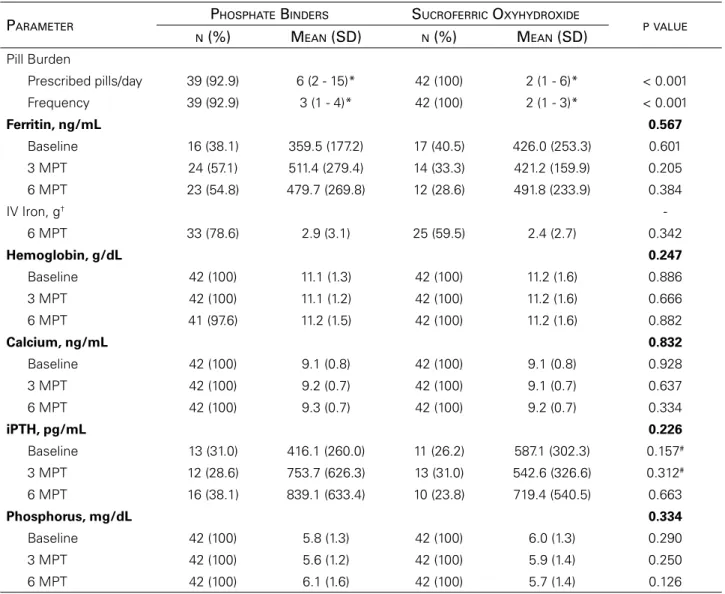
Clinical parameters measured at baseline, and at three- and six-months post-treatment with PB or SO are summarized in Table 2. Patients with a recorded PB were prescribed a median of 6 pills/day. After
switching to SO, the pill burden was reduced by 67% to 2 pills/day (Table 2). The frequency of pill intake was lowered from 3 times per/day to 2 times per/day after switching to SO (Table 2). The mean IV iron do-se decreado-sed (from 2.9 to 2.4 mg/kg per month) and a reduction in the number of patients on iron therapy (78.6% versus 59.5%) was observed after switching to SO; however, the changes were not statistically sig-nificant (Table 2). The serum levels of ferritin, hemo-globin, calcium, and iPTH was measured at baseline, and at three- and six-months post-treatment with PB or SO (Table 2). However, when comparing PB and SO at any of the timepoints there was no statistically significant differenc for any of the clinical parame-ters (Table 2). Serum phosphorus levels were also measured at baseline, and at three- and six-months post-treatment with PB or SO. Serum phosphorus le-vels changed from 5.8 mg/dL at baseline to 6.0 mg/ dL after six months of treatment with a PB. During the follow-up with SO, the serum phosphorus levels decreased from 6.0 mg/dL at baseline to 5.7 mg/dL after six months of treatment (Table 2). However, the difference between the two treatments at any of the timepoints was not statistically significant (Table 2).
The proportion of patients with a serum phos-phorus concentration ≤ 5.5 mg/dL decreased during the treatment with a PB (Figure 1). From baseline to six months post-treatment, the proportion of patients with serum phosphorus levels ≤ 5.5 mg/dL decreased from 54.8% to 35.7% (p = 0.046) (Figure 1). After switching to SO, the proportion of patients with se-rum phosphorus levels ≤ 5.5 mg/dL increased from
TABLE 1 BASELINECHARACTERISTICSFORPATIENTCOHORT.
Characteristics Patients (N = 42)
Gender, n (%)
Male 28 (66.7)
Age, mean (SD), years 53.2 (13.2)
≥ 50 yearws, n (%) 26 (61.9)
Dry weight, mean (SD), kg 70.4 (13.9)
≥ 70 kg, n (%) 22 (52.4)
Phosphate binder, n (%)
Calcium acetate/Magnesium carbonate 18 (42.9)
Sevelamer carbonate 13 (31.0)
Calcium acetate 8 (19.0)
Unknown/Not Reported 3 (7.1)
Dialysis time, median (minimum-maximum), months 76.5 (18.0 - 406.0)
33.3% at baseline to 45.2% after six months of treat-ment (p = 0.225) (Figure 1), although the change was
not statistically significant.
During treatment with a PB, the percentage of pa-tients with a reduction in serum phosphorus levels ≥
1 mg/dL increased compared to baseline, from 19.0% at two months post-treatment to 21.4% at six months post-treatment (Figure 2). The proportion of patients with a decrease in serum phosphorus levels ≥ 1 mg/dL increased during the treatment with SO, from 23.8% at two months post-treatment to 28.6% at six months post-treatment (Figure 2).
Figure 3 depicts the overall change in serum phosphorus concentrations across the study period. Overall, SO controlled the phosphorus levels in the majority of the patients throughout the study period to the same extent as other PB (Figure 3).
DISCUSSION
The aim of this study was to assess the effectiveness of SO in controlling serum phosphorus levels in pa-tients on online hemodiafiltration and determine the associated pill burden. This study showed that SO reduced the prescribed pill burden while effectively TABLE 2 COMPARISONOFCHANGESINPILLINTAKEANDCLINICALPARAMETERSATBASELINEANDATTHREE- ANDSIX-
MONTHSPOST-TREATMENT.
PARAMETER
PHOSPHATE BINDERS SUCROFERRIC OXYHYDROXIDE
PVALUE N (%) MEAN (SD) N (%) MEAN (SD)
Pill Burden
Prescribed pills/day 39 (92.9) 6 (2 - 15)* 42 (100) 2 (1 - 6)* < 0.001
Frequency 39 (92.9) 3 (1 - 4)* 42 (100) 2 (1 - 3)* < 0.001
Ferritin, ng/mL 0.567
Baseline 16 (38.1) 359.5 (177.2) 17 (40.5) 426.0 (253.3) 0.601
3 MPT 24 (57.1) 511.4 (279.4) 14 (33.3) 421.2 (159.9) 0.205
6 MPT 23 (54.8) 479.7 (269.8) 12 (28.6) 491.8 (233.9) 0.384
IV Iron, g†
-6 MPT 33 (78.6) 2.9 (3.1) 25 (59.5) 2.4 (2.7) 0.342
Hemoglobin, g/dL 0.247
Baseline 42 (100) 11.1 (1.3) 42 (100) 11.2 (1.6) 0.886
3 MPT 42 (100) 11.1 (1.2) 42 (100) 11.2 (1.6) 0.666
6 MPT 41 (97.6) 11.2 (1.5) 42 (100) 11.2 (1.6) 0.882
Calcium, ng/mL 0.832
Baseline 42 (100) 9.1 (0.8) 42 (100) 9.1 (0.8) 0.928
3 MPT 42 (100) 9.2 (0.7) 42 (100) 9.1 (0.7) 0.637
6 MPT 42 (100) 9.3 (0.7) 42 (100) 9.2 (0.7) 0.334
iPTH, pg/mL 0.226
Baseline 13 (31.0) 416.1 (260.0) 11 (26.2) 587.1 (302.3) 0.157#
3 MPT 12 (28.6) 753.7 (626.3) 13 (31.0) 542.6 (326.6) 0.312#
6 MPT 16 (38.1) 839.1 (633.4) 10 (23.8) 719.4 (540.5) 0.663
Phosphorus, mg/dL 0.334
Baseline 42 (100) 5.8 (1.3) 42 (100) 6.0 (1.3) 0.290
3 MPT 42 (100) 5.6 (1.2) 42 (100) 5.9 (1.4) 0.250
6 MPT 42 (100) 6.1 (1.6) 42 (100) 5.7 (1.4) 0.126
iPTH – intact parathyroid hormone; IV – intravenous; MPT – Months post-treatment or post-start of follow-up period, as applicable.
P values in bold represent the results of the General Linear Mixed Model (GLMM) for the overall analysis, while the remaining p values represent pairwise comparisons between the same timepoints of the study. No statistical differences were found between baseline and 3 MPT or 6 MPT. * Median (Minimum – Maximum).
† No data were available for this parameter at baseline and 3 MPT.
Figure 1. Percentage of patients that presented with phosphorus levels ≤ 5.5 mg/dL at each timepoint of the study, grouped by treatment. MPT: months post-treatment; P: phosphorus.
controlling serum phosphorus concentrations in pa-tients on online hemodiafiltration.
Patients with CKD receiving dialysis are often re-quired to take a large number of pills each day. A previous study reported that this patient group can have a median daily pill burden of 19 pills, with some patients taking more than 30 pills/day. PB accounted for up to 49% of the total daily pill burden.7 In the
present study, it was observed that the median prescri-bed pills/day was reduced with 67% after switching from a PB to SO. At the same time, the serum phos-phorus levels remained under control. These results are in line with what has been previously described in phase III studies, where Floege et al. reported that SO effectively controlled serum phosphorus levels in patients on dialysis, with a lower pill burden when compared to sevelamer carbonate.10, 11, 14 The high
pill burden associated with CKD poses a challenge for the patients and contributes to non-adherence to treatment.7, 8 Furthermore, decreased adherence to PB
has been associated with higher serum phosphorus concentrations.8
One of the strengths of this study was that it inclu-ded real-world data from difficult-to-treat patients, when at the time, no other treatment options were
available. Six months after switching to SO, the per-centage of patients with serum phosphorus levels ≤
5.5 mg/dL increased 26% compared to baseline. At the same time, there was an increase in the propor-tion of patients with a reducpropor-tion of serum phosphorus concentrations ≥ 1 mg/dL. It is possible that the lower pill burden led to higher adherence to treatment and better serum phosphorus control. In previous studies, adherence to treatment has been shown to be higher for SO compared to other PB such as sevelamer car-bonate (82.6 vs 77.2%). Furthermore, non-complian-ce with treatment appeared to be more common in patients receiving sevelamer carbonate compared to SO (21.3 vs 15.1%).11 This study showed that
tre-atment with SO controls serum phosphorus levels to the same extent as other PB but with a lower number of pills. The effect was observed after only 6 months of treatment with SO, which is promising and may potentially translate to better long-term compliance. However, this needs to be addressed in studies with a longer follow-up period.
the gastrointestinal tract after administration of SO.9
The changes in iron parameters might have been due to iron uptake from SO, however this remains to be determined.
There are also limitations of this study derived from its retrospective design. Because data were ob-tained from patients’ medical records, we were not able to verify treatment adherence. In addition, clini-cal data were missing for some patients. In particu-lar, clinical data on ferritin and iPTH levels were not available for several patients. In addition, the small number of patients may not be representative of the population of patients with CKD on online hemo-diafiltration, making it difficult to ascertain the ge-neralizability of the results. Nevertheless, this was a real-world study and we report successful phosphorus control following treatment with SO in this setting, which is consistent with results from phase II and phase III clinical studies.10-12
CONCLUSIONS
In conclusion, SO controlled the serum levels of phos-phorus in patients on hemodiafiltration to the same extent as other PB, with one third of the prescribed pill burden. A reduced pill burden may enhance the-rapeutic adherence and affect serum hyperphospha-temia in a positive manner and, hence, contribute to improved clinical outcome for patients with CKD on hemodiafiltration.
ACKNOWLEDGMENTS
The authors would like to thank OM Pharma, Alfragide, Portugal for providing financial support. We thank Scientific ToolBox Consulting for statisti-cal assistance and medistatisti-cal writing services on behalf of OM Pharma, Alfragide, Portugal.
REFERENCES
1. Floege J. Phosphate binders in chronic kidney disease: a systematic review of recent data. J Nephrol 2016;29:329-40.
2. Tomey MI, Winston JA. Cardiovascular pathophysiology in chro-nic kidney disease: opportunities to transition from disease to heal-th. Ann Glob Health 2014;80:69-76.
3. Group KDIGOKC-MW. KDIGO 2017 Clinical Practice Guideline Update for the Diagnosis, Evaluation, Prevention, and Treatment of Chronic Kidney Disease-Mineral and Bone Disorder (CKD-MBD). Kidney Int Suppl 2017;7:1-59.
4. Cannata-Andía JB, Fernández-Martín JL, Locatelli F, London G, Gorriz JL, Floege J, et al. Use of phosphate-binding agents is asso-ciated with a lower risk of mortality. Kidney Int 2013;84:998-1008. 5. Jamal SA, Vandermeer B, Raggi P, Mendelssohn DC, Chatterley T,
Dorgan M, et al. Effect of calcium-based versus non-calcium-based phosphate binders on mortality in patients with chronic kidney disease: an updated systematic review and meta-analysis. Lancet 2013;382:1268-77.
6. Di Iorio B, Bellasi A, Russo D; INDEPENDENT Study Investiga-tors. Mortality in kidney disease patients treated with phosphate binders: a randomized study. Clin J Am Soc Nephrol 2012;7:487-93.
7. Chiu YW, Teitelbaum I, Misra M, de Leon EM, Adzize T, Mehrotra R. Pill burden, adherence, hyperphosphatemia, and quality of life in maintenance dialysis patients. Clin J Am Soc Nephrol 2009;4:1089-96.
8. Wang S, Alfieri T, Ramakrishnan K, Braunhofer P, Newsome BA. Serum phosphorus levels and pill burden are inversely associated with adherence in patients on hemodialysis. Nephrol Dial Trans-plant 2014;29:2092-9.
9. Geisser P, Philipp E. PA21: a novel phosphate binder for the treat-ment of hyperphosphatemia in chronic kidney disease. Clin Ne-phrol 2010;74:4-11.
10. Floege J, Covic AC, Ketteler M, Mann JF, Rastogi A, Spinowitz B, et al.; Sucroferric Oxyhydroxide Study Group. Long-term effects of the iron-based phosphate binder, sucroferric oxyhydroxide, in dialy-sis patients. Nephrol Dial Transplant 2015;30:1037-46.
11. Floege J, Covic AC, Ketteler M, Rastogi A, Chong EM, Gaillard S, et al. A phase III study of the efficacy and safety of a novel iron-ba-sed phosphate binder in dialysis patients. Kidney Int 2014;86:638-47.
12. Wüthrich RP, Chonchol M, Covic A, Gaillard S, Chong E, Tumlin JA. Randomized clinical trial of the iron-based phosphate binder PA21 in hemodialysis patients. Clin J Am Soc Nephrol 2013;8:280-9.
13. Chong E, Kalia V, Willsie S, Winkle P. Drug-drug interactions between sucroferric oxyhydroxide and losartan, furosemide, omeprazole, digoxin and warfarin in healthy subjects. J Nephrol 2014;27:659-66.