(Annals of the Brazilian Academy of Sciences)
Printed version ISSN 0001-3765 / Online version ISSN 1678-2690 www.scielo.br/aabc
Human mobility on the Brazilian coast: an analysis of strontium isotopes
in archaeological human remains from Forte Marechal Luz sambaqui
MURILO Q.R. BASTOS1,2, SHEILA M.F. MENDONÇA DE SOUZA2, ROBERTO V. SANTOS3, BÁRBARA A.F. LIMA3, RICARDO V. SANTOS1,2 and CLAUDIA RODRIGUES-CARVALHO1
1Setor de Antropologia Biológica, Departamento de Antropologia, Museu Nacional,
Universidade Federal do Rio de Janeiro, Quinta da Boa Vista, s/n, 20940-040 Rio de Janeiro, RJ, Brasil
2Departamento de Endemias, Escola Nacional de Saúde Pública, Fundação Oswaldo Cruz,
Rua Leopoldo Bulhões, 1480, 21041-210 Rio de Janeiro, RJ, Brasil
3Departamento de Geoquímica e Recursos Minerais, Insituto de Geociências,
Universidade de Brasília, 70910-900 Brasília, DF, Brasil
Manuscript received on August 8, 2009; accepted for publication on August 16, 2010
ABSTRACT
This study investigated strontium isotopes in the dental enamel of 32 human skeletons from Forte Marechal Luz sambaqui (shellmound), Santa Catarina, Brazil, aiming at identifying local and non-local individuals. The archeolo-gical site presents pot sherds in the uppermost archeoloarcheolo-gical layers. Dental enamel was also examined from specimens of terrestrial fauna 87Sr/86Sr = 0.71046 to 0.71273
and marine fauna 87Sr/86Sr = 0.70917
. The87Sr/86Sr isotope ratio for individuals classified as locals ranged from 0.70905 to 0.71064 and was closer to the isotope ratio of the seawater than to the ratio of the terrestrial fauna, indicating a strong influence of marine strontium on the inhabitants of this sambaqui. The results indicate the existence of three non-local individuals 87Sr/86Sr = 0.70761 to 0.70835
, buried in both the level without pottery and the layer with pottery, possibly originated from the Santa Catarina Plateau, close to the municipality of Lages, or from the Curitiba Plateau. The occurrence of a slight difference between the isotope ratios of local individuals buried in the archeological layer without pottery, when compared to those in the layer with pottery, suggests a possible change in dietary patterns between these two moments in the site’s occupation.
Key words:Brazil, human mobility, isotopes, prehistory, shellmounds, strontium.
INTRODUCTION
Since the 1990s, the analysis of 87Sr/86Sr isotopes in human skeletal remains has been used extensively to identify past human mobility patterns. Based on the relationship between the isotopic composition of these remains (bones and teeth specially) and that of rocks in a given location, it is possible to distinguish individuals that grew up and died in the same region, from those who did not (Bentley et al. 2004). This is possible with dental enamel analysis, since the permanent dentition is formed during the first decade of life, and the strontium
Correspondence to: Ricardo Ventura Santos E-mail: [email protected]
deposited in the enamel remains the same for the rest of the individual’s life.
Studying ancient human mobility is crucial since, in addition to increasing the understanding of popula-tion dynamics, it sheds light on the spread of con-tagious diseases in the past (Apostolopoulos and Sön-mez 2007), as well as on the introduction of cultural elements, changes in dietary patterns, and other as-pects in the lives of ancient people (Prous 1991). Al-though various authors have studied the mobility of prehistoric populations using strontium isotopes, as mentioned above, this technique has not been system-atically explored in prehistoric Brazilian coastal popu-lations. These populations spread over a large geo-graphic area, and there is even debate over their rela-tionship and contacts with peoples from the interior (Prous 1991). Certain findings from inland sites, like zoolites (artifacts in the shape of animals, made of polished stone, typical of the coast), as well as typical plateau artifacts like pottery from the Itararé Tradition in coastal sites, contribute to the hypothesis of contact between coastal and inland populations (Beck 1971).
The current study focuses on residential mobility, aiming to detect local and non-local individuals from pre-Colombian populations on the southern coast of Brazil, based on strontium isotope analysis. As far as we know, this is the first study published in archeol-ogy of prehistoric populations on the Brazilian coast that uses this geochemical technique. We analyzed individuals buried in Forte Marechal Luz sambaqui, located on the northern coast of the state of Santa Cata-rina. The uppermost archaeological layers in this site yielded pottery sherds associated with a typical ceramic tradition from the southern Brazilian Plateau. Such evidence suggests a contact between the population that inhabited this sambaqui and inland groups. We also discuss the variations in isotope ratios between indi-viduals buried in two distinct archeological sequences (the older without evidence of pottery, and the younger with presence of pottery sherds) from Forte Marechal Luz site, with the aim of allowing inferences on dietary patterns.
SAMBAQUIS, LATER COASTAL OCCUPATIONS, AND EVIDENCE OF MOBILITY
In Brazil,sambaquisare both the most numerous coastal sites and the best known to archeologists (Lima
1999-2000, Gaspar et al. 2008). Sambaquis are cultural de-posits of varying size and stratigraphy made primarily from the accumulation of seashells, sand, or earth during pcolonial times. These constructions contain the re-mains of fishing and gathering cultures, such as utensils, weapons, adornments, food scraps, ash, charcoal from old fires, human burials and vestiges of old huts.
Coastal sambaquis date from 8,000 years BP (Ca-lippo 2004) to the first millennium AD (Lima 1999-2000), although most sambaquis dates are concentrated between 4000 BP and 2000 BP. These shellmound sites are usually located in highly productive bay and lagoon ecotones, where the mingling of salt and fresh waters supports mangrove vegetations and abundant shellfish, fish and aquatic birds (Gaspar et al. 2008). These areas of high biotic productivity allowed a high-density popu-lation for the sambaqui’s builders (Gaspar 1991, Lima 1999-2000).
The sambaqui populations were considered fisher-hunter-gatherers. However, recent studies have demon-strated the use of some plants in the diet of these groups (Scheel-Ybert 2001, Wesolowski 2007), which could suggest incipient horticulture, as well as systematic man-agement of naturally abundant plants. It has also been shown that a significant part of the sambaqui dwellers’ diet was based on fishing (Figuti 1993, De Masi 2001).
well-es-tablished coastal groups that moved inland, rather than inland populations exploring fluvial resources while moving toward the sea (Lima 1999-2000). Opposite movements, or the mobility of individuals from inland to coastal communities, are mainly suggested by the presence of ceramics on sambaquis. The presence of coastal shells in inland sambaquis, and pine starch as a food remain at coastal sambaquis (Wesolowsky 2007, Wesolowsky et al. 2010), besides the cultural trace rep-resented by the Itararé ceramics in costal sambaquis and inland villages of pottery makers, is consistent with the hypothesis of mobility.
The ceramics at the coastal sites starts about 2000 years ago, when various fisher-hunter-gatherer sites also began to emerge along the Brazilian coast. Their remains are shallow sites, with sandier sediments, with-out the characteristic accumulation of seashells and less visual impact on the coastal landscape. They are characterized by more evident accumulation of fish bones and in many cases, they seem to constitute the most recent occupational layer in typical sambaquis. These sites are frequently identified in the literature as belonging to different groups of sambaqui-builders (Prous 1991). Their occurrence generally overlaps the chronology of sambaqui sites, and the archeological evidence points to groups that were equally adapted to life at the coastal environment, both in terms of sub-sistence and material culture, differing little from the sambaqui groups. The main difference is the presence of pottery associated with these occupations, identified as belonging to the Itararé Ceramic Tradition, located mainly in the inland of Santa Catarina and Paraná, and also in the northern coast of Santa Catarina (Beck 1972, Bandeira 2004).
Therefore, the presence of ceramic traditions be-longing to the plateau groups at the coastal sites rein-forces the hypothesis of contact between inland popu-lations and sambaqui builders. In the field of bioarche-ology, a research on the possible relations between pre-historic coastal and inland groups has also been based on the study of cranial morphology using multivariate statistical methods. Neves (1988) indicated genetic dif-ferences between ceramic and pre-ceramic populations on the northern coast of Santa Catarina. According to this author, long after the initial occupation of the coast
by the sambaqui builders, some plateau populations ar-rived at the northern coast of Santa Catarina. Based on comparative analyses of craniofacial morphology, Mel-lo e Alvim and Mendonça de Souza (1984) suggested a similarity between individuals buried in Forte Marechal Luz site and contemporaneous Xokleng Indians.
STRONTIUM ISOTOPES AND THEIR ARCHEOLOGICAL APPLICABILITY
Strontium (Sr) is a chemical element that occurs in the form of four stable isotopes with different abun-dances,84Sr (0.56%),86Sr (9.87%), 87Sr (7.04%), and 88Sr (82.53%) (Faure and Powell 1972). 87Sr originates from the radioactive decay of rubidium (87Rb), which has a half life of 4.9 Ga. Meanwhile, the isotope86Sr is not radiogenic, i.e., its abundance is not altered by the radioactive decay of other elements.
Due to Rb decay, the abundance of the87Sr iso-tope in rocks and soils deriving from it varies, and de-pends on factors such as the rock age and Rb concen-tration. For example, among geological formations with the same amount of Rb, the oldest ones have more time to produce87Sr through the radioactive decay of87Rb, thus generating materials with higher87Sr/86Sr ratios as when compared to younger formations (Faure 1986).
In the weathering cycle, i.e., in the process of soil formation from rocks, the strontium isotope ratio does not change in other words, there is no isotopic fraction-ation (Faure 1986, Sillen and Kavanagh 1982). Thus, the strontium introduced into the food chain by a given food does not change significantly in its isotope ratio. Although no isotopic fractionation occurs along the food chain, the isotopic composition of strontium found in plants and animals does not have a single origin, but re-sults from a mixture of strontium of diverse origins (air, water, and soil) (Miller et al. 1993, Faure 1986).
Unlike bones, dental enamel does not undergo re-modeling over the course of life, so that the strontium present in enamel corresponds to that assimilated during the individual’s childhood and early adolescence, in the period of the enamel formation (Hillson 1996). There-fore, the strontium isotopic composition of hydroxyap-atite crystals in individuals’ dental enamel is directly re-lated to the mean strontium isotopic composition in the food and water ingested during youth and consequently to the isotopic characteristic of the region in which the individual grew up (Ericson 1986, Price et al. 1998).
Applying this reasoning to individuals found in an archeological site, it is possible to identify the migrants among the locals by comparing each individual’s tooth value to the isotopic signature of the region where the site is located (Schweissing and Grupe 2003, Wright 2005). Local individuals have strontium isotopic ratios that reflect the geological settings of the area in which they have inhabited. In contrast, non-locals more prob-ably come from regions with a distinct geology that may present either lower or higher strontium isotopic values. Thus, assuming that individuals with different isotopic values are non-locals, strontium isotopes analysis may be used to reconstruct human mobility patterns in the past (Bentley et al. 2003).
In order to identify local and non-local individuals, it is essential to know the isotopic signature of the region in which the individuals were buried. In general, the local isotopic composition can be obtained from samples of dental enamel taken from the fauna in the region where the site is located, with a preference for small and less mobile herbivores, like rodents (Price et al. 2002). This source of strontium is known as a biological source of the local isotopic signature. In addition to fauna, the geological maps of the target regions are essential for a proper understanding of the results.
The chemical interaction between water and soil and bones and teeth leads to exchanges with the micro-environment and can alter the original isotopic compo-sition of the remains, a process known as diagenesis. The adherence ofpost-mortemchemical elements to the skeletal remains is practically unavoidable (Hoppe et al. 2003, Buzon 2006), while the magnitude of its effects is related to the tissues’ porosity (Bentley et al. 2004). Al-though various studies have indicated a high occurrence
of diagenesis in bone tissues, this type of contamination has been observed to occur to a lesser degree in dental enamel tissues (Grupe et al. 1997, Montgomery et al. 1999). With the aim of eliminating the effects of sur-face diagenetic contamination, some studies have used techniques involving mechanical and chemical cleaning of samples (Price et al. 2004, Hodell et al. 2004, Buzon 2006).
MATERIALS AND METHODS
STUDYAREA
Forte Marechal Luz site is found on the slope of João Dias hill, close to the fort that named the site. Located at the São Francisco do Sul island, in northern Santa Catarina State (26◦9′56"S and 48◦31′56"W), the site was excavated by the archeologist Alan L. Bryan in 1960. At the time of the excavation, in the 1960s, the site was only a partial testimony because in the past a large portion of the deposit had been removed for road paving (Bryan 1997). Bryan classified the site as a sam-baqui, but the stratigraphic levels show a series of pre-historic occupations that extended over nearly four mil-lennia (4290±130 BP to 640±100 BP), in more or
less continuous fashion, with a few periods of aban-donment (Bryan 1993). The geology on São Francisco island is characterized by the abundant presence of marine deposits (beach sediments and coastal cordons) and mixed deposits (unconsolidated debris of fluvial-marine and lacustrine origin), represented by Quater-nary sediments that overly Proterozoic gneisses and granitic rocks (Higashi et al. 2001).
of ceramic occupations in the same region, identified as belonging to the Itararé Tradition (occupational levels VI and VII). The human burials are only found in the upper occupational levels, corresponding to two chrono-logical periods at the end of the site’s occupations. The human burials were located in layer 6B (1100±100 BP)
and occupational levels VI (880±100 BP) and VII (640 ±100 BP), according to 14C dating. Forte Marechal
Luz site may exemplify the patterns of contact and mo-bility signaled by Neves (1988) and Mello e Alvim and Mendonça de Souza (1984). The artifacts, human skele-tal remains, and fauna recovered from the excavations belong to the collection in the Biological Anthropology Division of the National Museum, Federal University of Rio de Janeiro (UFRJ), Rio de Janeiro, Brazil.
STUDYMATERIAL
After surveying the human skeletal remains, teeth pre-serving the dental enamel were separated from most of the individuals buried at Forte Marechal Luz sambaqui. Molar teeth were selected preferentially because of their larger amount of tooth enamel. In case of individ-uals without molars, the analyses were performed using premolars or incisors. A total of 32 specimens was ana-lyzed, corresponding to 32 individuals. Of these, 21 in-dividuals belonged to the occupation without ceramic (archeological layers without pottery) and 11 to the oc-cupation with ceramic (archeological layers with pot-tery). We also analyzed dental enamel samples from four specimens of archeological land fauna associated with the site, including three teeth from three peccaries ( Tay-assu albirostris) and one tooth from a paca (Cuniculus paca). A sample of cockle shell (Anomalocardia brasi-liana) removed from the same site was also analyzed.
TREATMENT OFMATERIAL ANDANALYSIS
In order to eliminate incrustations and diagenetic con-tamination, the teeth were submitted to mechanical and chemical cleaning. The dental crown surface was scraped with a number-12 scalpel in order to remove any gross material. Next, the teeth were placed sepa-rately in Teflon recipients with 5% acetic acid and left in ultrasound for 20 minutes.
The dental enamel was removed using a diamond drill (model PM-7, KG Sorensen brand), previously
tested to rule it out as a possible source of strontium contamination. Some 20 mg of enamel sample were ob-tained from one of the lateral surfaces of the dental crown for each specimen. The analyses of the 32 den-tal enamel samples followed two distinct procedures, but with the same level of accuracy. In the first pro-cedure, 10 samples of 20 mg were weighed and trans-ferred to Teflon beakers. Next, the chemical treatment began with the addition of 2ml of concentrated nitric acid (14N). The samples were digested in approxim-ately 90 minutes. Next, each sample was placed in a 2ml Eppendorf micro-tube for 10 minutes of centrifug-ing. After centrifuging it, a 1 ml aliquot of this solu-tion was transferred to a Teflon recipient and placed on a hotplate until the total evaporation of the acid phase. After the evaporation, the residue was recovered with the addition of 5ml of nitric acid (3%). The isotope ratio was determined with a multi-collector inductively coupled plasma mass spectrometer MC-ICP-MS (Nep-tune, Thermo Scientific) at the Geochronology Labor-atory of the Institute of Geosciences, University of Brasília (UnB), in Brasília.
The second procedure, which was done with the remaining 22 samples of human enamel plus 5 fauna samples, followed the same attack as the previous pro-cedure. Subsequently, strontium spike was added, the function of which is to determine the strontium concen-tration in the samples by isotopic dilution, and chroma-tographic Sr separation was performed. Isotopic compo-sition was determined by a multi-collector solid-source mass spectrometry (TIMS MAT 262, Thermo-Finnigan) at the Institute of Geosciences of UnB.
The accuracy and reproducibility of the analytical protocol in both procedures were verified by means of a standard solution of 200ppb strontium from the NIST SRM 987 reference material. During the analyses, this standard value showed little variation (from 0.71024 to 0.71030).
RESULTS
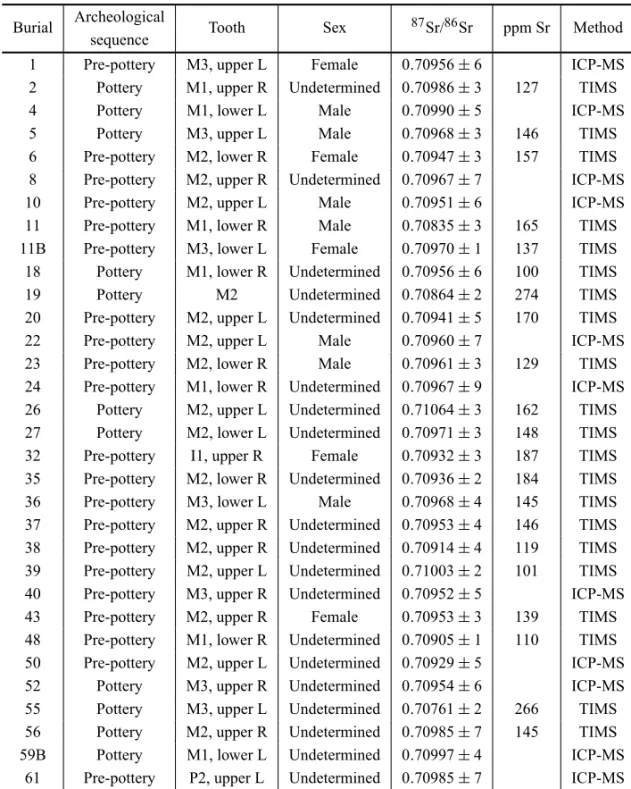
variation was observed in the values observed in this se-ries, most of the results were concentrated in a narrow range (see Table II).
The samples from the three peccaries (Tayassu pecari) and the paca (Cuniculus paca) showed values from 0.71046 to 0.71273. The cockle sample ( Ano-malocardia brasiliana) showed an isotope ratio of 0.70917 (see Table I), close to that of present-day oceans (0.7092) (Wright 2005).
TABLE I
87Sr/86Sr isotope ratios for land and marine fauna
in Forte Marechal Luz. Material analyzed with TIMS (thermal ionization mass spectrometry).
Fauna 87Sr/86Sr ppm Sr Peccary 1 0.71046±5 214
Peccary 2 0.71273±3 274
Peccary 3 0.71059±6 142
Paca 0.71114±1 850
Seashell 0.70917±3 1126
Based on the87Sr/86Sr values for the fauna sam-ples of the site, we determined the local biological ra-tio range for strontium: from 0.70917 (for the Anomalo-cardia brasilianasample) to 0.71273 (Tayassu pecari). Individuals with ratios below the range were classified as non-locals; the rest was classified as local. Some indi-viduals outside the range but close to it were included as locals. A total of three individuals, representing 9.4% of all the individuals analyzed, was considered non-locals (burials 11, 19, 55) because they present strontium iso-topic ratios below the biological range of the local sig-nature. The other 29 individuals present a restrict range of87Sr/86Sr variation, falling inside the local biological strontium ratio range and being classified as locals. Fig-ure 1 illustrates the strontium ratio distribution for the analyzed individuals and the local biological strontium ratio range.
Separating the individuals buried in the archeolog-ical layers without pottery from those with pottery, we observed a slight tendency for the strontium ratio to be higher in the individuals buried in the pottery layers (more recent occupation) when compared to the indi-viduals buried in the layers without pottery (older oc-cupation), with the difference in the isotope ratios
be-tween the occupation of the site illustrated in the box-plot (Fig. 2). Among the individuals classified as non-locals, two were buried in the ceramic occupation and one in the pre-ceramic pottery occupation.
Fig. 1 – Relationship between the strontium isotope ratios for indi-viduals from the archeological sequence with pottery (pottery-makers) and without pottery (pre-pottery-makers) and the range of the local biological signature. The lower limit set for the local biological signa-ture is also the present marine strontium ratio.
Fig. 2 – Box-plot of the strontium isotope ratios for individuals buried in the archeological sequences with and without pottery in Forte Marechal Luz site. The dashed line shows the present marine stron-tium ratio.
DISCUSSION
indi-TABLE II
87Sr/86Sr isotope ratio in individuals buried at the Forte Marechal Luz site, organized
by burial number. M (molar); P (premolar); I (incisor); L (left); R (right).
Location –
State Dating (oldest – most recent) Distance Source
municipality from FML
Urubici SC 910 BP – 330±90 BP 230 km Piazza 1966, Schmitz 1988 São Joaquim SC 1920±50 – 1117±80 BP 270 km Schmitz and Brochado 1972 Esmeralda RS 650±55 BP – 355±50 BP 330 km Ribeiro and Ribeiro 1985 Campo Largo PR 848±70 BP – 558±50 BP 130 km Chmyz 1995
Curitiba PR 940±70 BP – 660±60 BP 120 km Chmyz et al. 2003
Cananéia SP 7870±80 BP – 3170±95 BP 140 km Uchôa and Garcia 1983,Calippo 2004
viduals and the differences in the isotope ratios between those buried in the archeological layers without pottery (pre-pottery occupation) and in the archeological layers with pottery (pottery occupation).
According to the analysis of strontium isotopes in 32 individuals buried in both layers (with and with-out the presence of pottery) in Forte Marechal Luz site, three individuals were non-locals. In other words, the dental enamel analysis showed different strontium ratios from the local ratios, indicating that these indi-viduals spent the early years of their lives (when the enamel was formed) in other regions. Of these, two were buried in the layer with pottery and one in the layer without pottery. The identification of a non-local individual buried in the layer without pottery indicates that there was mobility in the site even before the intro-duction of pottery from the Itararé Ceramic Tradition, i.e., before 880±100 BP. The presence of pottery
it-self can be taken as an evidence of contact, reinforced by the identification of two non-local individuals buried in the layer with pottery.
The individuals that were considered non-locals had low strontium isotope ratios, which is characteris-tic of regions with mantle derived magmacharacteris-tic rocks, gen-erally volcanic in origin. From the geological point of view, rocks with low strontium isotope ratios are found in the basaltic plateau and in alkaline complexes in Santa Catarina, Paraná, and São Paulo. With heights gener-ally greater than 800 m and broad lateral extension, the basaltic rocks on the plateau date to the Cretaceous and present a wide variation in the strontium isotope com-position (0.705 to 0.713), revealing different degrees of crustal contamination (Mantovani et al. 1985, Marques
et al. 1999). Meanwhile, the alkaline complexes are volcanic to sub-volcanic structures with localized oc-currence and strontium isotope ratios of around 0.705 (Morbidelli et al. 1995, Walter et al. 1995, Huang et al. 1995, Ruberti et al. 2002). The alkaline complexes closest to Forte Marechal Luz are located in the munic-ipalities of Juquiá, Jacupiranga, Cananéia, Tunas, Mato Preto, Barra do Itapirapuã, and Itapurapuã.
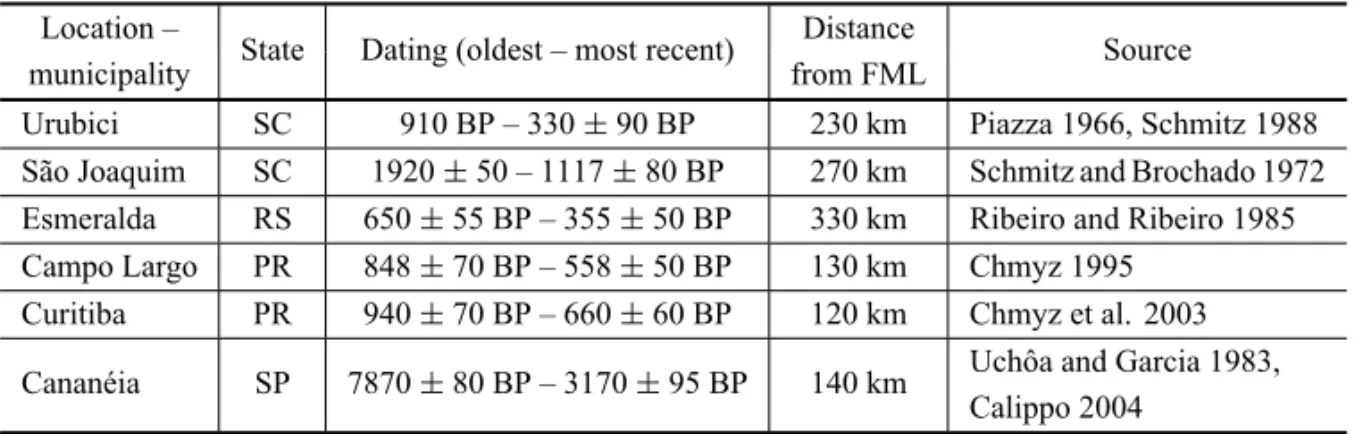
Other sites belonging to the Itararé Tradition are located at the Paraná state Plateau, at the municipality of Campo Largo, western to Curitiba (Chmyz 1995). Those sites are approximately at 130 km from Forte Marechal Luz, dating from 848 BP to 558 BP. There are also records of sites of the same ceramic tradition located in the municipality of Curitiba (Chmyz et al. 2003), approximately 120 km from Forte Marechal Luz, dating from 940 BP to 660 BP. In both cases, Forte Marechal Luz site can be associated with such occu-pations based on the chronology, the presence of pot-tery shards, and the signature of origin of the three in-dividuals that diverge from the coastal strontium ratio pattern.
The sites close to the municipality of Lages are lo-cated an average of 270 km from the Forte Marechal Luz sambaqui, and are close to or on the Santa Cata-rina Plateau, of basaltic origin, which has rocks with a low 87Sr/86Sr ratio. Nearby there are also alkaline igneous rocks with a low 87Sr/86Sr ratio. Meanwhile, the sites close to Curitiba are found near the areas with alkaline igneous rocks, and are 125 km from Forte Ma-rechal Luz, i.e., less than half the distance of the sites located on the Santa Catarina Plateau. A possible con-tact between the inhabitants of Forte Marechal Luz and the Curitiba Plateau would have been facilitated by both the shorter distance between these locations and a river basin originating in the latter and flowing into the north-ern coast of Santa Catarina, in Babitonga Bay.
A third region with rocks having a low strontium isotope ratio would be Cananéia, located in southern São Paulo State. The sedimentary plain, called the Cananéia-Iguape Coastal Plain, has one of the highest known con-centrations of sambaquis on the Brazilian coast (Uchôa and Garcia 1983). The dates obtained for the Cananéia sites (from 8000 BP to approximately 4000 BP) suggest that these occupations were not contemporaneous with the occupations analyzed at Forte Marechal Luz site. In the future, more detailed studies of the chronology of these sites located in southern São Paulo may vali-date the hypothesis of contact between the inhabitants of Forte Marechal Luz and Cananéia. At present, how-ever, it is not possible to consider Cananéia the origin of the non-local individuals at Forte Marechal Luz since in addition to the distinct chronology between the sites, no
evidence was found of pottery from the Itararé Tradition in these Cananéia sites. Table III and Figure 3 present details of the municipalities cited above.
Fig. 3 – Southern Brazil with all cited localities/municipalities. Locality 1 – Forte Marechal Luz site; 2 – Urubici-SC; 3 – São Joaquim-SC; 4 – Esmeralda-RS; 5 – Campo Largo-PR; 6 – Curitiba-PR; 7 – Cananéia-SP.
Concerning the assimilation of strontium and the difference between the two occupations, the isotope findings for the individuals classified as locals in this study indicate a strong marine influence in the origin of the strontium assimilated into the apatite molecules from the dental enamel. The87Sr/86Sr ratios obtained for local individuals are close to the ratio found in the seawater (0.7092). The isotopic proximity of the indi-viduals to the marine ratio signals the prevalence of a marine diet for those that inhabited and were buried in Forte Marechal Luz site. Nevertheless, this dietary prevalence does not rule out terrestrial sources. Ana-lyses of micro-residues from dental calculi indicate that the inhabitants of the site had in their diets plants like yams (Dioscoreasp.) (Wesolowski 2007).
TABLE III
Municipalities with sites belonging to the Itararé Tradition and sambaquis in Cananéia with low strontium isotope ratio. SC – Santa Catarina State; RS – Rio Grande do Sul State;
PR – Paraná State; SP – São Paulo State; FML – Forte Marechal Luz sit.
Burial Archeological Tooth Sex 87Sr/86Sr ppm Sr Method sequence
1 Pre-pottery M3, upper L Female 0.70956±6 ICP-MS
2 Pottery M1, upper R Undetermined 0.70986±3 127 TIMS
4 Pottery M1, lower L Male 0.70990±5 ICP-MS
5 Pottery M3, upper L Male 0.70968±3 146 TIMS
6 Pre-pottery M2, lower R Female 0.70947±3 157 TIMS
8 Pre-pottery M2, upper R Undetermined 0.70967±7 ICP-MS
10 Pre-pottery M2, upper L Male 0.70951±6 ICP-MS
11 Pre-pottery M1, lower R Male 0.70835±3 165 TIMS
11B Pre-pottery M3, lower L Female 0.70970±1 137 TIMS
18 Pottery M1, lower R Undetermined 0.70956±6 100 TIMS
19 Pottery M2 Undetermined 0.70864±2 274 TIMS
20 Pre-pottery M2, upper L Undetermined 0.70941±5 170 TIMS
22 Pre-pottery M2, upper L Male 0.70960±7 ICP-MS
23 Pre-pottery M2, lower R Male 0.70961±3 129 TIMS
24 Pre-pottery M1, lower R Undetermined 0.70967±9 ICP-MS
26 Pottery M2, upper L Undetermined 0.71064±3 162 TIMS
27 Pottery M2, lower L Undetermined 0.70971±3 148 TIMS
32 Pre-pottery I1, upper R Female 0.70932±3 187 TIMS
35 Pre-pottery M2, lower R Undetermined 0.70936±2 184 TIMS
36 Pre-pottery M3, lower L Male 0.70968±4 145 TIMS
37 Pre-pottery M2, upper R Undetermined 0.70953±4 146 TIMS
38 Pre-pottery M2, upper R Undetermined 0.70914±4 119 TIMS
39 Pre-pottery M2, upper L Undetermined 0.71003±2 101 TIMS
40 Pre-pottery M3, upper R Undetermined 0.70952±5 ICP-MS
43 Pre-pottery M2, upper R Female 0.70953±3 139 TIMS
48 Pre-pottery M1, lower R Undetermined 0.70905±1 110 TIMS
50 Pre-pottery M2, upper L Undetermined 0.70929±5 ICP-MS
52 Pottery M3, upper R Undetermined 0.70954±6 ICP-MS
55 Pottery M3, upper L Undetermined 0.70761±2 266 TIMS
56 Pottery M2, upper R Undetermined 0.70985±7 145 TIMS
59B Pottery M1, lower L Undetermined 0.70997±4 ICP-MS
61 Pre-pottery P2, upper L Undetermined 0.70985±7 ICP-MS
hunted in the inland forests in the region, on crystalline terrains. These specimens may also have reached the coast through bartering of items among different groups. Comparing the individuals buried in the archeolog-ical layer without evidence of ceramic shards and those in the layers with ceramic, we observed that the latter present a slightly higher strontium ratio than the pre-pottery individuals. This fact can be explained by the slight changes in the dietary pattern between these two
The differences in strontium ratio thus suggest that the introduction of pottery in Forte Marechal Luz site may be associated not only with the acquisition of the pottery-making technique, but also with changes in eat-ing habits, perhaps involveat-ing a behavior with more in-land forays or a more striking seasonal behavior between the coast and plateau for the local population. Bryan (1993) recorded an increase in the occurrence of land fauna in the pottery occupational levels, compared to the pre-pottery levels, which is consistent with the dif-ferences observed in the current study. Thus, the intro-duction of new individuals and new habits, including the use of plant foodstuffs acquired in geologically dif-ferent terrains, in addition to animals brought from the mountainside forests or even from the plateaus, seems to be another archeological evidence in the ceramic layers from Forte Marechal Luz shellmound.
Finally, it is important to mention the limitations of this study. Forte Marechal Luz site yielded only a few specimens of land fauna with teeth that could be used in the analysis, making the determination of the range in the local biological signature that represented the real isotopic variation in the region of the site less reliable. However, it is important to mention that the land fauna presented high strontium isotope values, higher than the mean obtained for more than 90% of the individuals, which showed a strontium ratio close to that of the strontium from the seawater and marine fauna. The other individuals, classified as non-local, showed results below the marine strontium ratio.
The fact that Forte Marechal Luz site, like other sambaquis, was formed mainly by the accumulation of Anomalocardia brasiliana shells, together with other marine mollusks (Bryan 1961, Gaspar 2000), increases the risk of diagenesis (i.e., the contamination of samples by strontium from mollusk shells) maybe jeo-pardizing the results of this analysis. The adherence of strontium leached from these shells, as well as from the soil and water, to human bone and teeth, could theoret-ically cause the homogenization of isotope ratios, i.e., the replacement of biogenic strontium by that of exter-nal origin (Horn and Müller-Sohnius 1999). In the case of the material buried in Forte Marechal Luz, such ho-mogenization would tend to shift the strontium ratios toward the marine ratio (0.7092), since the shells,
ma-rine sedimentary soil, and water present in the location have this ratio. However, considering that the values observed in the samples varied from 0.70761 (human enamel from individual 55) to 0.71273 (dental enamel from a peccary in the site), one can state that there was no homogenization of the samples, or that it was not complete. We can assume that if diagenetic contamina-tion of the material indeed occurred, it was not capable of leveling the values, i.e., of masking the different bio-genic signatures of the individuals and animals buried in the site.
FINAL REMARKS
The analyses performed in this study point to the exis-tence of residential mobility in the Forte Marechal Luz sambaqui. The individuals classified as non-locals prob-ably came from the Santa Catarina Plateau (close to the municipality of Lages) or the Paraná Plateau (close to the municipality of Curitiba). Still, we cannot rule out the possibility that they came from the southern coast of São Paulo, from sites located in the municipality of Cananéia, although there is no known contemporaneity between the sites from that region and Forte Marechal Luz site.
The presence of a non-local individual buried in the archeological layer without pottery indicates that the contact between groups occurred before pottery was in-troduced in the site. The similarity between the stron-tium isotope ratio in individuals classified as locals and the strontium ratio in the ocean indicates a strong ma-rine influence in the source of strontium for these indi-viduals. The slight difference in the isotope ratios com-paring locals individuals buried in layers without pot-tery to those buried in layers with potpot-tery suggests di-etary changes between these periods of the occupation of the site. Finally, it is important to highlight that the successful identification of non-local individuals in the current study opens up possibilities for future research using strontium isotope analysis in sambaquis.
ACKNOWLEDGMENTS
grant no. E-26/102.935/2008), for financial support. We also thank M.Sc. Jeane Grasyelle Silva Chaves and Bachelor Hadriadne Gomes de Azevedo de Sousa of Laboratório de Geocronologia of Universidade de Bra-sília for the analytical support. Dr. Andersen Liryo da Silva of Departamento de Antropologia do Museu Na-cional-UFRJ for teeth identification support, Prof. Dr. Maria Dulce Gaspar of Departamento de Antropologia do Museu Nacional-UFRJ and Prof. Dr. Claudio de Morisson Valeriano of Departamento de Geologia da Universidade Estadual do Rio de Janeiro for helpful comments on this paper.
RESUMO
O presente estudo investigou isótopos de estrôncio em esmalte dentário de 32 remanescentes humanos do sambaqui do Forte Marechal Luz, Santa Catarina, Brasil, com o objetivo de iden-tificar indivíduos locais e não-locais. O sítio arqueológico apresenta fragmentos de cerâmica em suas camadas arqueo-lógicas mais recentes. Além das amostras humanas, foram analisadas amostras de esmalte dentário de espécimes de fauna terrestre 87Sr/86Sr = 0,71046 a 0,71273 e fauna
marinha 87Sr/86Sr = 0,70917
. A razão87Sr/86Sr dos indi-víduos classificados como locais variou de 0,70905 a 0,71064, sendo próxima a razão de estrôncio existente nos oceanos e distante da razão obtida para a fauna terrestre do mesmo sí-tio, indicando uma influência marinha na origem do estrôncio dos habitantes desse sambaqui. Foram identificados de três indivíduos não locais (87Sr/86Sr = 0,70761 a 0,70835), sepul-tados em ambas camadas arqueológicas sem evidência e com evidência de cerâmica. Estes indivíduos podem ter origem no planalto catarinense, no entorno do município de Lages, ou do planalto curitibano. A ocorrência de uma pequena diferen-ça entre as razões isotópicas dos indivíduos locais sepultados nas camadas sem evidência de cerâmica, daqueles sepultados nas camadas ceramistas, sugere a possibilidade de uma mu-dança nos padrões de alimentação entre esses dois momentos de ocupação do sítio.
Palavras-chave: Brasil, mobilidade humana, isótopos, pré-história, sambaqui, estrôncio.
REFERENCES
APOSTOLOPOULOS Y AND SÖNMEZ S. 2007. Population
Mobility and Infectious Disease. New York: Springer, 319 p.
BANDEIRA DR. 2004. Ceramistas pré-coloniais da baía da Babitonga, SC: Arqueologia e etnicidade. Campinas, Uni-versidade: Estadual de Campinas, 257 p.
BARRETOCNGB. 1988. A ocupação pré-colonial do Vale
do Ribeira de Iguape, SP: os sítios concheiros do médio curso. São Paulo, Universidade de São Paulo, 339 p. BECKA. 1971. Grupos cerâmicos do litoral de Santa
Cata-rina – Fase Rio Lessa e Fase Enseada. An Mus Antropol 4: 25–29.
BECKA. 1972. A variação do conteúdo cultural dos sam-baquis – litoral Santa Catarina. São Paulo, Faculdade de Filosofia Letras e Ciências Humanas da USP, 286 p. BENTLEYRA, KRAUSER, PRICETDANDKAUFMANNB.
2003. Human mobility at the early Neolithic settlement of Vahingen, Germany: evidence from strontium isotope analysis. Archaeometry 44: 471–486.
BENTLEYRA, PRICE DTANDSTEPHANE. 2004. Deter-mining the “local” 87Sr/86Sr range for archaeological skeletons: a case study from Neolithic Europe. J Archaeol Sci 31: 365–375.
BRYAN AL. 1961. Excavation of a Brazilian Shellmound. Sci Man 1(5): 148–151.
BRYAN AL. 1993. The Sambaqui at Forte Marechal Luz,
State of Santa Catarina, Brazil. Corvallis: Center for the Study of the First Americans/Oregon State University, 168 p.
BRYAN AL. 1997. The Sambaqui do Forte Marechal Luz State of Santa Catarina, Brazil. Center of Study of the First Americans, Oregon: Oregon State University, p. 89–108.
BUDD P, MILLARD A, CHENERY C, LUCY S AND RO
-BERTSC. 2004. Investigating population movement by stable isotope analysis: a report from Britain. Antiquity 78: 127–141.
BUZON MR. 2006. Biological and ethnic identity in New
Kingdom Nubia: a case study from Tombos. Curr An-thropol 47: 683–695.
CALIPPO FL. 2004. Os sambaquis submersos de Cananéia: Um estudo de caso de arqueologia subaquática. São Pau-lo, Universidade de São PauPau-lo, 151 p.
CHMYZ I. 1995. Arqueologia de Curitiba. B. Inf. Casa Romário Martins 21(105): 5–54.
CHMYZI, BORAE, SANTOSCECCONR, SGANZERLAME
ANDVOLCOVJE. 2003. A arqueologia da área do aterro
Sanitário da região metropolitana de Curitiba, em Mandi-rituba, Paraná. Arqueologia 2: 1–138.
XI CONGRESSO DA SOCIEDADE DE ARQUEOLOGIA
BRASILEIRA, Rio de Janeiro. An XI Congr Soc Arqueol
Bras, p. 1–136.
ERICSON JE. 1986. Strontium isotope characterization in
the study of prehistoric human ecology. J Hum Evol 14: 503–514.
EVANSJ, STOODLEYNANDCHENERYC. 2006. A stron-tium and oxygen isotope assessment of a possible fourth century immigrant population in a Hampshire cemetery, southern England. J Archaeol Sci 33: 265–272.
EZZOJA, JOHNSONCMANDPRICETD. 1997. Analytical
perspectives on prehistoric migration: a case study from east-central Arizona. J Archaeol Sci 24: 447–466. FAUREG. 1986. Principles of Isotope Geology. Willey ed.,
608 p.
FAUREGANDPOWELLJL. 1972. Strontium Isotope Geol-ogy. Springer-Verlag, New York, 188 p.
FIGUTIL. 1993. O homem pré-histórico, o molusco e o sam-baqui. R Mus Arqueol Etnol USP 3: 67–80.
GASPARMD. 1991. Aspectos da organização social de um
grupo de pescadores, coletores e caçadores: Região com-preendida entre a Ilha Grande e o delta do Paraíba do Sul, Estado do Rio de Janeiro. São Paulo. Universidade de São Paulo, 374 p.
GASPARMD. 2000. Sambaqui: Arqueologia do litoral
brasi-leiro. Rio de Janreiro: Jorge Zahar Editor, 89 p.
GASPAR MD, DEBLASIS P, FISH SK AND FISH PR.
2008. Sambaqui (Shell Mound) Societies of Costal Brazil. Handbook of South American Archaeology, Springer, p. 319–335.
GRUPE G, PRICE TD, SCHRÖTER P, SÖLLNER F, JOHN
-SON CM AND BEARD BL. 1997. Mobility of Bell
Beaker people revealed by strontium isotope ratios of tooth and bone: a study of southern Bavarian skeletal remains. Appl Geochem 12: 517–525.
HIGASHIRR, DAVISONDIASR, MAFRAJRCS, COELHO
DA AND MARTINS KP. 2001. Análise do Subsolo de
Santa Catarina Visando a Implantação de Rodovias. Reu-nião Anual de Pavimentação. Florianópolis, 8 p. HILLSONS. 1996. Dental Anthropology. Cambridge:
Cam-bridge University Press, 373 p.
HODELLDA, QUINNRL, BRENNERMANDKAMENOVG. 2004. Spatial variation of strontium isotopes 87Sr/86Sr
in the Maya region: a tool for tracking ancient human migration. J Archaeol Sci 31: 585–601.
HOPPEKA, KOCHPLANDFURUTANITT. 2003. Assessing the preservation of biogenic strontium in fossil bones and tooth enamel. Inter J Osteoarchaeol 13: 20–28.
HORN P AND MÜLLER-SOHNIUS D. 1999. Comment on Grupe et al. (1997). Appl Geochem 14: 263–269. HUANG YM, HAWKESWORTH CJ, CALSTEREN P VAN
ANDMCDEMOTTF. 1995. Geochemical characteristics
and origin of the Jacupiranga carbonatites, Brazil. Chem Geol 119: 79–99.
KNUDSONKJ, PRICETD, BUIKSTRAJEANDBLOMDE. 2004. The use of strontium isotope analysis to investigate Tiwanaku migration and mortuary ritual in Bolivia and Peru (Part1). Archaeometry 46: 5–18.
LIMATA. 1999-2000. Em busca dos frutos do mar: os
pes-cadores-coletores do litoral centro-sul do Brasil. R USP, p. 270–327.
MANTOVANIMSM, MARQUESLS, SOUSAMA, ATALLA
LT, CIVETTALANDINNOCENTIF. 1985. Trace element and strontium isotope constraints on the origin and evolu-tion of Paraná continental flood basalts of Santa Catarina State (southern Brazil). J Petrol 26: 187–209.
MARQUESLS, DUPRÉBANDPICCIRILLOEM. 1999. Man-tle source compositions of the Paraná Magmatic Prov-ince (southern Brazil): evidence from trace element and Sr-Nd-Pb isotope geochemistry. J Geodynam 28: 439– 458.
MELLO E ALVIM MC DE AND MENDONÇA DE SOUZA
SMF. 1984. Os Índios Kaingang e a População do Forte Marechal Luz. An J Bras Arqueol Rio de Janeiro: Instituto Superior de Cultura Brasileira, p. 3–4.
MILLEREK, BLUMJAANDFIRIEDLANDAJ. 1993.
Deter-mination of soil exchangeable-cation loss and weathering rates using Sr isotopes. Nature 362: 438–441.
MONTGOMERY J, BUDD P, COX A, KRAUSE P AND
THOMAS RG. 1999. LA-ICP-MS evidence for the
dis-tribution of lead and strontium in Romano-British, me-dieval and modern human teeth: implications for life his-tory and exposure reconstruction. In: YOUNG SMM,
POLLARDAM, BUDDP ANDIXERRA (Eds), Metals in Antiquity, BAR International Series, Archaeopress, Oxford 792: 258–261.
MORBIDELLI L, GOMES CB, BECCALUVA L, BROTZU
P, CONTEAM, RUBERTI E ANDTRAVERSAG. 1995. Mineralogical, petrological and geochemical aspects of alkaline and alkaline-carbonatite associations from Brazil. Earth Sci Rev 39: 135–168.
NEVESWA. 1988. Paleogenética dos grupos pré-históricos do litoral sul do Brasil (Paraná e Santa Catarina). Pesquisas (Antropologia) 43: 178.
PRICETD, BURTONJHANDBENTLEYRA. 2002. The char-acterization of biologically available strontium isotope ra-tios for the study of prehistoric migration. Archaeometry 44: 117–136.
PRICE TD, GRUPEGANDSCHRÖTER P. 1998. Migration and Mobility in the Bell Beaker period in Central Europe. Antiquity 72: 405–411.
PRICETD, KNIPPERC, GRUPEGANDSMRCKAV. 2004. Strontium isotopes and prehistoric human migration: the Bell Beaker Period in Central Europe. Eur J Archaeol 7: 9–40.
PRICETD, MANZANILLALANDMIDDLETONWD. 2000. Immigration and the ancient city of Teotihuacan in Me-xico: A study using strontium isotope ratios in human bone and teeth. J Archaeol Sci 27(10): 903–913. PROUSA. 1991. Arqueologia Brasileira. Brasília: Editora
UNB, 613 p.
RIBEIRO PAM AND RIBEIRO CT. 1985. Levantamentos
arqueológicos no município de Esmeralda, RS, Brasil. R Cepa 13(15): 50–105.
RIBEIROPAM, RIBEIROCTANDSILVEIRAI. 1977. A ocor-rência de zoólitos no Planalto Meridional: Barros Cassal, RS, Brasil. R Cepa 5: 5–37.
ROHRJA. 1971. Os sítios arqueológicos do planalto catari-nense, São Leopoldo: Pesquisas 24: 56.
RUBERTI E, CASTORINA F, CENSI P, COMIN-CHIARA
-MONTI P, GOMES CB, ANTONINI P AND ANDRADE
FRD. 2002. The geochemistry of the Barra do Itapira-puã carbonatite (Ponta Grossa Arch, Brazil): a multiple stockwork. J S Am Earth Sci 15: 215–228.
SCHEEL-YBERTR. 2001. Man and vegetation in southeastern Brazil during the late Holocene. J Archaeol Sci 28: 471– 480.
SCHMITZPI. 1988. As tradições ceramistas do Planalto Sul-Brasileiro. Arqueologia do Rio Grande do Sul, Brasil – São Leopoldo: Documentos 2: 75–130.
SCHMITZ PI AND BROCHADO JP. 1972. Datos para una secuencia cultural del Estado de Rio Grande do Sul, Brasil. Gabinete de Arqueologia. Universidade Federal do Rio Grande do Sul, p. 1–20.
SCHWEISSINGMMANDGRUPEG. 2003. Stable strontium isotopes in human teeth and bone: a key to migration events of the late Roman period in Bavaria. J Archaeol Sci 30: 1373–1383.
SILLENAANDKAVANAGHM. 1982. Strontium and
paleo-dietary research: a review, Yearbk. Phys Anthropol 25: 67–90.
UCHÔADPANDGARCIACDR. 1983. Cadastramento dos sítios arqueológicos da baixada Cananéia-Iguape, litoral sul do estado de São Paulo, Brasil. R Arqueol Mus Para-ense Emílio Goeldi 1(1): 91–113.
WALTERAV, FLICOTEAUXR, PARRONC, LOUBETMAND
NAHOND. 1995. Rare-earth elements and isotopes (Sr, Nd, O, C) in minerals from the Juquiá carbonatite (Brazil): tracers of a multistage evolution. Chem Geol 120: 27–44. WESOLOWSKIV. 2007. Cáries, desgaste, cálculos dentários e micro-resíduos da dieta entre grupos pré-históricos do litoral norte de Santa Catarina: É possível comer amido e não ter cárie? Rio de Janeiro, Escola Nacional de Saúde Pública Sérgio Arouca, Fiocruz, 193 p.
WESOLOWSKIV, MENDONÇA DESOUZASMF, REINHARD
KJAND CECCANTINI G. 2010. Evaluating
microfos-sil content of dental calculus from Brazilian sambaquis. J Archaeol Sci 37: 1326–1338.
WILSONASET AL. 2007. Stable isotope and DNA evidence for ritual sequences in Inca child sacrifice. Proc Natl Acad Sci USA 104(42): 16456–16461.