228 EALR, V. 8, nº 1, p. 228-247, Jan-Jun, 2017
Universidade Católica de Brasília – UCB Brasília-DF
Economic Analysis of Law Review
Strategic Non-Entry
Rafael Pinho Senra de Morais1
Universidade do Estado do Rio de Janeiro
RESUMO
Este artigo traz uma ideia simples e uma recomenda-ção clara de política pública. A ideia é que uma em-presa produtora num dado mercado geográfico ou mercado de produto A pode preferir não entrar noutro mercado geográfico ou de produto B para mais tarde adquirir o detentor do monopólio em B sem qualquer objeção da autoridade antitruste ou de concorrência competente por B – prejudicando assim os consumi-dores em B. Apresentamos fatos estilizados para este comportamento de não-entrada seguido de posterior entrada por aquisição e construímos um modelo teóri-co de jogo teóri-compatível teóri-com tais evidências. Nosso modelo estende o modelo clássico de entrada desta-cando a rationale para o comportamento observado. A implicação direta para política pública é que as autori-dades de concorrência ou antitruste devem prestar mais atenção às fusões e aquisições propostas onde o poder de mercado só muda de mãos. A possibilidade de bloquear essas fusões – se não for demonstrado ganho de eficiência em comparação com a chamada entrada por construção ou entrada clássica – deve ser seriamente considerada, como sugere um arcabouço mais dinâmico como o nosso.
ABSTRACT
This paper brings out a simple idea and a straight policy recommendation. The idea is that a producer in a given geographic or product market A may prefer not to enter another geographic or product market B in order to acquire the monopoly power holder in B at a later date without being challenged by the anti-trust/competition authority competent for B – to the harm of consumers in B. We provide stylized facts for this non-entry plus later entry-by-acquisition behav-iour and build a game-theoretical model supporting them. Our model extends the classic entry model high-lighting the rationale for the observed behaviour. The straight policy implication is that competition/antitrust authorities should pay more attention to proposed mergers where market power only changes hands. The possibility of blocking those mergers – if no efficiency gain compared to entry by building is shown – should be seriously considered, as a more dynamic setting like ours suggests.
Palavras-chave: Antitrust, Entry games, Hostile
take-over, International Monopolization.
Keywords: Antitrust, Entry games, Hostile takeover,
International Monopolization.
JEL: L12, L41, F23 R: 21/07/2016 A:30/01/2017 P:01/08/2017
1 E-mail: [email protected]
The author thanks his student Arthur Canito Hernandez for bringing to his attention the economic issue behind this paper and for competente research assistance and the participants of the academic seminar presented at the Brazilian (CADE) in June 2016 for their insightful comments on na earlier version of this paper.
1. Introduction
his policy-oriented paper focuses on the decision of competition/antitrust authorities when faced with a proposed merger by firms active in different relevant product or geographic markets. It is the case for example when a global player not active in the local market tries to acquire a local player holding strong market power locally (and usually insignificant globally).2
Technically such a merger has a strong possibility of being cleared under no condi-tions by any competition authority worldwide since there is no increase in market power of any local player, nor an increase in market concentration. In the limit case where the local player holds a monopoly ex ante what happens is called monopoly substitution. In this scenar-io, consumers (who can afford) are charged monopoly prices for low-quality goods embedded in no innovation before the merger and it will remain so after its approval.3
This paper highlights and models a rational behaviour of potential entrants not ex-plored in the literature to the best of our knowledge: the strategic non-entry. The rationale is a very simple one: the global player could have entered profitably the local market earlier, but did not in order to facilitate the approval of a later merger and grab a higher payoff. We study the circumstances for such outcome to happen.
It is widely recognized – and encompassed in every antitrust legislation worldwide – that in general more competitive markets (i.e. more players) lead to higher economic efficien-cy and welfare. It is therefore the role of competition authorities to ensure markets operate as competitively as possible.
Competition authorities by easily approving mergers occurring after strategic non-entry provide strong – and wrong! – ex ante incentives to global players not to enter smaller markets, leaving consumers in the hands of the local producer(s), which is bought afterwards, perpetuating monopoly.4
A discussion on business activities bypassing any merger threshold seems to be a new topic, to the exception of Perez-Saiz (2015), discussed later. The literature is usually more concerned with the workload of antitrust agencies and the sizes of type-1 and type-2 errors5 in
2 We use the term “merger” or “takeover” as general ones and interchangeably throughout the paper for the sake
of simplicity. What we had in mind originally was a hostile takeover by a global player at a given product market – as the stylized facts will illustrate.
In fact, for the purposes of the argument here it could well be a pure acquisition, a merger to a single entity, or even a joint-venture or other sort of agreement between the firms. Any sort of deal that softens competition (as compared to pure competition) will do.
3 The merger can undoubtedly lead to efficiency increase or decrease (productive efficiency), leading to different
(monopoly) price levels ex ante and ex post, and thus different sizes of deadweight loss (allocative efficiency). The market structure – monopoly – remains.
4 For the sake of simplicity, we focus on a local monopoly throughout the paper. The argument is the same for a
local producer holding strong market power but not a monopolist.
5 These are common statistical terms, which here mean the approved mergers which should have been blocked
(type II error) and the rejected one which should have been cleared (type I).
EALR, V. 8, nº 1, p. 228-247, Jan-Jun, 2017 230
keeping or changing the thresholds for merger submission (as in Britto and Faria (2015)) or with the methodologies to define the relevant market in specific situations or sectors (as in Teodorowicz, Leandro and Esteves (2015)).
Although analyzing the screening of behaviours between precompetitive and anticom-petitive ones, Martins (2011) is worth mentioning as its focus is on sector associations induc-ing parallel behaviour. Our paper, however, does not claim there is cooperation between firms. On the opposite, it shows it can be unilaterally optimal to drop entry in favour of a later merger.
If instead of the late merger this paper challenges, there were entry by the global play-er in the first place, local consumplay-ers would benefit from competition, having access to a broader range of products (if differentiated), better quality and more innovative ones and low-er prices. Consumlow-er surplus would be highlow-er.
Although we mention “national market” throughout this paper, what one should have in mind is the “market definition from a geographic perspective for the given product under scrutiny”. This way, if the geographic market is smaller than the national market for the prod-uct at stake – a region, a province, a state – what we are calling “the global player” in this paper can indeed be a player only active within a country’s borders, but selling in other geo-graphic markets in that country. On the other hand, if the geogeo-graphic market goes beyond a country’s borders, what we are calling “the local producer” throughout the paper can indeed be selling in multiple countries if they belong to the same relevant market as defined by com-petition policy.
As such, the applicability of the arguments and the model in this paper goes way be-yond what it might seem at first sight, encompassing any such situation where a firm active in a market A postpones or declines entering another market B for the sake of facilitating a later merger to the producer in B. This also includes when relevant markets A and B differ in terms of product characteristics instead of geographic area.6
The paper is organized as follows. We motivate the topic in Section II, by providing some stylized facts. Section III presents an overview of entry models and models dealing with the decision on the mode of entry, while Section IV presents our theoretical model, which builds on the classic entry model. Section V summarizes the findings and concludes this pa-per.
6 Since the motivation to the paper came from geographic entry – global players buying national market power
holders – we commonly argue on the basis of different geographic markets, although the argument is exactly the same in terms of entry in a different product market.
2. Stylized Facts
According to Bloomberg7, mergers and acquisitions reached a record amount of nearly 4 trillion dollars in 2015. Consumer and retail companies struck a record amount of deals that year, totalling $457.5 billion, the highest number in at least 12 years, remarkably in the fol-lowing sectors:
“The list of acquisitions this year sounds like the spread at a barbecue. The two biggest beer companies, Anheuser-Busch InBev NV and SABMiller Plc agreed to merge in an approximately $110 billion deal. Ketchup kingpin H.J. Heinz agreed to buy Oscar Mayer hot-dog maker Kraft Foods Group Inc. And in its biggest deal since 2007, Japan Tobacco Inc. bought the interna-tional rights to Reynolds American Inc.’s Natural American Spirit division for about $5 billion.”
One can not say those are the most competitive product markets in the world: beer, brand food and cigarettes. Neither that the global players in these consistently compete against each other in the local markets. Nor that concentration in those markets is justified by high economies of scale (or scope) due to significant fixed costs or learning effects.
Before we focus in more details on the beer market – the one which motivated this paper – we shall have a quick look at the other big mergers. As will be emphasized, all those three mentioned in the extract above comply with the idea of strategic non-entry.
2.1. Heinz and Kraft Merger
In the processed food market, the merger of Kraft Foods and Heinz was worth around US$ 40 billion and resulted in the 5th largest food and beverage company in the world and the 3rd in the USA, in market value. The new company annual revenue will pass US$ 22 billion a year.
In the USA, Kraft holds around 80% of the macaroni and cheese market while Heinz detains 60% of the ketchup market, but their activities go way beyond those products. Kraft figures among the four largest US producers of mayonnaise, cottage cheese, pickles, bacon, cream, salad sauces, while Heinz does the same as concerns frozen snacks, sauces for meats and for pasta, according to a Food & Water Watch report8. They also state that: “The pro-posed merger joins two firms that manufacture a wide variety of top selling processed foods, but Kraft and Heinz do not produce many products that compete head-to-head. Unfortunately, federal antitrust authorities largely ignore these conglomerate mergers because of the lack of direct product rivalry.” To give a striking example, the proposed merger will join Kraft’s Grey Poupon mustard and Heinz Ketchup.
7 Available at:
http://www.bloomberg.com/news/articles/2015-12-22/suds-sausages-and-smokes-retail-shopping-spree-hits-a-record (accessed 01/04/2016).
8 Available at
EALR, V. 8, nº 1, p. 228-247, Jan-Jun, 2017 232
That report is more concerned about the bargaining power the merged entity will ac-quire in negotiations with supermarkets, and the probable exclusion of smaller producers, to the harm of consumers who face less and less choice. The merging firms based their claims on lower transaction costs for the supermarket when dealing with a conglomerate and lower ad-vertising costs for the merged entity when promoting mustard and ketchup together, for ex-ample. All their claims seem reasonable and reinforce our rationale in this paper. The perspec-tive of high profitability of this merger may have induced each of the so-far two independent firms not to enter the market of the other one, in order to keep such a merger as an option ac-ceptable in the eyes of the antitrust authorities.
2.2. Cigarretes
The global cigarettes market is also highly concentrated, as can be seen in the figure below, taken from CTFK (2015).
Figure 1: Tobacco company shares of global cigarette market, 2014.
The peculiar feature of this market is the geographical segmentation of China, where the worldwide largest single producer operates. However, it is a state-run firm selling 99% of its production domestically. If one drops the Chinese National Tobacco Corporation (CNTC) from the picture above, the world market concentration is much more striking. The history of all those other players include a whole series of international acquisitions.
According to CTFK (2015), Philip Morris International (PMI) has been absent from the USA market since 2008. We shall, however, focus on the Japan Tobacco Inc. (JTI) since it is the one involved in the most recent merging activity. JTI gained international expression in 1999 when it purchased the non-US operations of the multinational R.J. Reynolds for 7.8 bil-lion USD. In 2007, it purchased for 9.4 bilbil-lion GBP the producer Gallaher, a FTSE 100 busi-ness. JTI also recently acquired a tobacco company in Sudan. Finally, in 2015, JTI bought the
international rights of Reynolds. According to some analysts, JTI’s next target shall be the Imperial Tobacco Group Plc – a British company worth US$ 49,6 billions highly present in Africa and Middle East, entering by acquisitions other important geographical regions.
2.3 The Beer Market
The beer market has experienced significant changes since 1997, leading to a global market highly concentrated in the hands of four big players. From 1997 to 2010 those four players were involved in 57 acquisitions, amounting to 82 billions of euros in transations.
Of all 57, the largest was the acquisition of Anheuser-Busch by Interbrew-Ambev in 2008, resulting in the larger global player in volume sold: Anheuser-Busch Inbev. Of the 57, 21 involved AB Inbev, in a total of 56 billion euros. SABMiller and Heineken performed 15 acquisitions each in the period, in a total of 10 billion euros for the first and 9 billion for the later, while Carlsberg acquired 7 firms, spending 7 billion euros. The most relevant acquisi-tions of those players were: Bavaria by SABMiller in 2005, Baltic by Carlsberg in 2008, and FEMSA by Heineken in 2010. The following table illustrates those figures.
Figure 2: Acquisitions in the beer market in recent years.
It was mainly through those acquisitions that those four global actors entered markets where they were absent, many times to perform a monopolist or quasi-monopolist role. When SABMiller acquired Bavaria, for example, that was the dominant producer in Colombia, Peru
EALR, V. 8, nº 1, p. 228-247, Jan-Jun, 2017 234
and Ecuador, being the second largest producer in South America. The Danish Carlsberg, on the other hand, focused its acquisition activities in Asia and Western and Eastern Europe.
The following table illustrates the move towards a much more concentrated market in less than a decade.
Figure 3: The increase in the concentration measures in a decade.
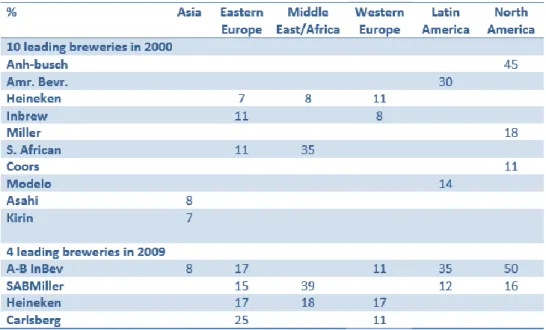
More strikingly for the purposes of this paper is the coming table and the observation that there was no true global player in 2000: only one brewery (Heineken) was present in 3 continents, and still holding low market shares in them. This means that there was a high po-tential for entry by building for any player in other continents but the main players preferred to go global by buying, after choosing the strategic non-entry option discussed in this paper.
Figure 4: Concentration by continent in the beer market: 2000 versus 2009.
Nevertheless, it should be emphasized that the relevant geographic market for beer is not a continent, but usually smaller, like each country. The numbers in the table above thus
can at first sight be misleading. The 35% market share of AB Inbev in Latin America in 2009 was concentrated in Brazil and Mexico, while SABMiller was absent from Brazil but domi-nated markets where AB Inbev was absent like Colombia and Peru.
The main brands of Anheuser-Busch Inbev and SABMiller still do not compete glob-ally, as they are sold in distinct geographic spaces, too. Budweiser is the main brand of AB Inbev; it is the 3rd most sold in the world and highly focused in the US and Canada markets. SABMiller’s main brand Snow Beer is number 1 in the world and focused in Asia, China in particular.
Previously to the recently proposed merger to SABMiller (announced in November 2015), AB Inbev had no production plant operating nor brand being sold in Africa. On the other hand, SABMiller has had in Africa its number one continent in net revenues in recent years (table below). Moreover, according to AB Inbev projections, beer consumption in Afri-ca should triple between 2014 and 2025. So, the question to be answered is: why hasn’t AB Inbev entered the African continent?!
Figure 5: Africa as the largest net revenue generating continent for SABMiller Source: SABMiller Financial Report 2016.
3. Entry Models
This section explores the two branches of the economic literature which seem more relevant for the model and discussion presented in this paper. One is a classic Industrial Or-ganization (IO) topic: entry, and the deterrence strategies by an incumbent firm. The other important branch of the literature to cover deals with multinationals’ decision on how to enter a new foreign market: through greenfield investment or through acquisition.
A third subsection deals with models where one of those two decisions – entering or not and how to enter – are intertwined with the concerns of antitrust (merger) approval.
3.1 Preemption
The theoretical economic literature on entry has its foundations on the seminal papers by Bain (1956) and Sylos-Labini (1962) and the follow-on literature challenging their crucial assumption. According to these two early papers, entry would occur whenever there is a
per-EALR, V. 8, nº 1, p. 228-247, Jan-Jun, 2017 236
spective of economic profit (as opposed to accounting profit), given the current behaviour of the incumbent firm(s). They assumed the incumbent firm’s behaviour would remain the same after entry, if entry occurred. This became known as the Bain-Sylos Postulate and was harshly challenged by the literature on preemption that followed, including Salop (1979), Dixit (1980), Bernheim (1984) among many others.
Wilson (1992) provides a remarkable review of the entry deterrence literature. He segments entry deterrence models into three categories: preemption, signalling and predation. Most of the literature – and our focus in this subsection – falls into the first category, where “the hallmark is commitment, in the form of (usually costly) actions that irreversibly strength-en the incumbstrength-ent’s options to exclude competitors”.9
Dixit (1980) in his seminal paper deals with an overinvestment in capital accumulation by the incumbent as a way to make it more cost-efficient (i.e. reduce its marginal cost), which induces the potential entrant to stay out of the market. Such capital accumulation is not profit-able per se, it becomes rational as an entry deterrence strategy.
In Bernheim (1984) the incumbents invest resources to raise each potential entrant’s cost of entry, to the expense of the incumbents’ a priori (or static) profitability. These practic-es “include: (1) lobbying for legislative barriers to entry; (2) advertising to practic-establish brand name identification; (3) choosing a nonoptimal production technology which changes the nature of the duopoly solution; (4) innovating constantly to keep entrants far down the learning curve; (5) holding excess production capacity as a threat against entrants; and (6) practicing limit pricing”.
Gilbert (1989) reviews what he calls the four schools of thought when it comes to en-try models, namely limit pricing, dynamic limit pricing, the theory of contestable markets and the market efficiency hypothesis. Still, the focus of all of them is on “reactions of existing competitors to the threat of new competition”.
Berger et al. (2004) is a very interesting empirical paper focusing on the effects of mergers and acquisitions on entry in the banking sector. Their rationale lies on the reduced competition after mergers leading to a better perspective of profits to potential entrants. They thus deal with a market where there are many players and entry happens kind of frequently, though even so it is not a quite competitive market: the banking sector. Our focus here is on a potentially competitive market – as the one for consumer goods as beer – which is monopo-lized locally due to the lack of entry. Berger et al. (2004) focus is similar to that of the theoret-ical literature mentioned: the reactions of existing competitors to the threat of new competi-tion, or, said the opposite way, the analysis of entry incentives in response to some activity of the incumbent market participants.
9 In the second category fall models where “an incumbent’s behavior can be affected by private information
about costs or demand either prior to entry (limit pricing) or afterwards (attrition)” while predation is about terprising an unprofitable response to entry as a reputation-building device towards subsequent potential en-trants.
Our focus in this paper is a different one: the lack of incentives to enter at an early date, independent of any action by the incumbent. In our paper, although entry is profitable, prospective profits can be higher by not entering the market than by entering (due to a future merger), while in this preemption literature not entering typically yields zero profit for the potential entrant.
3.2 Entry Model Decision
This more recent branch of literature – on the boundary between Economics (IO) and Management – deals with firms’ choices on how to enter a new market: by acquisition or by investment from scratch (greenfield). The focus usually lies on multinationals’ decision on how to enter a foreign market – which is the the focus of interest to us, too.
Baldwin and Gorecki (1987) uses a comprehensive data base on Canadian firms to show that entry by merger is as important as entry by plant creation, while mergers are con-centrated in industries where entry barriers are high. Mata and Portugal (2004) cite Baldwin (1995, chapter 11) to state that “acquisition should be the preferred method of entry by for-eign firms, since in this way the forfor-eign firm does not add capacity to the market. Conse-quently... acquisition entrants should be larger than foreign greenfield entrants...”. According to the authors, this should be more so in markets with strong scale economies and in those having higher concentration ratio – leading to an easiness of collusion among incumbents and more to lose to incumbents.
Gilbert and Newbery (1992) is namely the first IO paper to propose a game to deal with the entry mode decision. Its focus, however, is on defensive tactics by the potential target of a takeover in a build-or-buy decision by a potential entrant. Its rationale is the following: “by repelling a potential acquirer, the firm can direct the acquirer to another established firm and gain from the elimination of a potential competitor”. In our paper the decision modelled is the same – the build-or-buy decision – but there is no defensive tactic possible: it is a poten-tial entrant himself who prefers to postpone entry in order to become a potenpoten-tial acquirer whose takeover is acceptable to the national antitrust agency.
Harzing (2002) reviews the management literature on entry mode decision, which tra-ditionally credits transaction costs for firms’ entry mode decision, but focuses on the interna-tional strategy of the multinainterna-tional as the key determinant of the mode, understood as the de-cision to be multi-domestic versus global. Lee and Lieberman (2010) follow a similar track but credit the relatedness between the new product and the firm’s primary business domain. In our paper, we focus on the decision of an international player to enter or not a foreign market, its timing and how to do so, as an entrant or an acquirer.
As seen, this branch of literature does not focus on antitrust acceptance of a proposed merger, but rather the cost-effectiveness of a chosen entry mode. The strategic non-entry we study is on the other hand tied to antitrust approval.
EALR, V. 8, nº 1, p. 228-247, Jan-Jun, 2017 238
3.3 Strategic Non-Entry
The economic literature, when it comes to entry, has always focused on barriers to en-try and preemption. In the usual preemption models, in the first stage the incumbent can make a move – such as to build excess capacity, or create a reputation or signal it is a tough player – indicating that entry will not be profitable.
As such, on one hand, the theoretical models dealing with the interaction of an incum-bent firm and a potential entrant focus on strategies to deter that entry. The literature deals with the established firm’s pre-entry decisions and its impacts on the potential entrant’s incen-tives to effectively challenge the incumbent in its market. Our focus in this paper is sort of an opposite one: what if the potential entrant prefers not to enter the market despite no entry de-terrence move by the incumbent?
This would be so because of the antitrust authority’s behaviour: a merger from a duo-poly to a monoduo-poly is blocked while a merger leading to a monopolist substitution is typically cleared. To the best of our knowledge there is no theoretical economic model dealing with such economic issue.
A potential entrant can deliberately decide to not enter a market as a rational strategy even though the incumbent makes no explicit or implicit move – named by Salop (1979) as strategic entry barriers and innocent entry barriers – to deter entry. This potential entrant – a multinational – might neither benefit from scale economies nor be concerned about the total capacity available in its economic sector.
Rasmusen (1988) analyzes what could be called strategic entry, as opposed to the title of this paper. He studies the possibility of a firm entering an industry with the objective of being acquired subsequently, in an extension of the Dixit (1980) model. Such possibility can undermine an incumbent’s effort of entry deterrence.
In this paper, we are mainly interested in firms expanding their activity in the same product market towards different geographical markets. This is also the focus of Perez-Saiz (2015), who studies the U.S. cement industry, assuming it is a homogeneous product whose geographical market can be limited to a U.S state boundary, due namely to high transportation costs as compared to product prices. Therefore entry into a new state would require building a brand new cement plant or acquiring an existing one, if the antitrust authority allows it. Simi-larly, Wagner (1980), while studying the metal can market, also claims that “the reason for the multiplicity of plants is to be found in the high ratio of transport to production costs”.
This is precisely the sort of entry we have in mind in this paper, but also on an interna-tional scale. The following extract illustrates Wagner (1980)’s and our sort of market: “the cans tend to be made locally because of heavy transport costs despite potential production economies of scale. The maximum delivery distance for cans is usually under 100 miles.
There is a small amount of foreign trade of a specialized kind such as aerosols, heavily deco-rated boxes and exports to underdeveloped countries; but imports and exports of cans ac-counts for under 4% of turnover in all three countries and are not significant in considering the organizational structure of the industry”. We also aim at sectors where import/export, if feasible, is residual, while entering a local market through foreign direct investment or a mer-ger are more profitable options.
Deneffe and Wakker (1996) is a paper closer to ours, linking the entry mode decision to antitrust toughness. Although they deal with horizontal mergers, their results mainly focus on non-horizontal – or conglomerate – outcomes and the substitutability between buying a competitor or a firm in a non-related product market. The authors claim their results justify “the absence of the phenomenon of (horizontal) buyout following entry” as a rational firms’ decision, even if horizontal mergers control were lenient. In their model, the two firms A and B initially operate in distinct product markets.
In this paper we focus exclusively on horizontal mergers i.e. we prefer to deal only with one product market (and several geographic markets), although the rationale is exactly the same for a potential merger of A and B in different product markets. We also assume a stringent horizontal mergers control, ruling out the possibility of a buyout following entry, which provides the rationale for the strategic non-entry.
4. The Model
In this paper we aim at modelling the situation when a potential entrant – irrespective of any move by an incumbent – might have incentives to not enter a market, in order to facili-tate antitrust approval of a later acquisition.
In this section we present the very basic and classic entry model, then extend it to al-low for a takeover by the non-entrant at a later date.
4.1 The Classic Entry Model
The classic entry model is a complete and perfect information sequential game where a potential entrant has to decide in the first place if she enters or not a market.10 Deciding to enter imposes a sunk cost of size c > 0 on the potential entrant, which is player 1 in the game. Then, if there is entry, the incumbent – player 2 in the game – has to decide between fighting entry or accommodating it.11
10 This classic entry model was described in words in the very beginning of Vickers (1985) and is commonly
used (in similar structures to the game tree presented here) in most IO textbooks.
11 As such, entry deterrence, though a crucial topic, is absent in this classic model, and will also be absent in our
upcoming model. Were entry deterrence incorporated into our model, eventual non-entry could be due to entry deterrence moves by the incumbent. This is ruled out in our setting. If the potential entrant prefers not to enter the market – the “strategic non-entry” – it is solely because of the incentives to later merge with the incumbent. On top of that, allowing for entry deterrence in our model would potentially lead to more non-entry, if deterrence strategies were used by the incumbent. It would, however, not be used in the case of strategic non-entry – which is our focus – since deterrence is a costly device to the incumbent to block entry. As such, it is only implemented when entry is anticipated, which is not the case if the entrant prefers to stay out of the market to benefit from a later merger approval.
EALR, V. 8, nº 1, p. 228-247, Jan-Jun, 2017 240
For the sake of simplicity, fighting means a price war in this baseline game, meaning Bertrand competition leading the duopoly to price at marginal cost. By accommodating, the incumbent leaves some positive profit to the entrant but keeps some for itself too, which is however smaller then the monopoly profit M.12
If the potential entrant decides not to enter the market, the game ends with this player 1 earning 0 and the incumbent keeping monopoly profit. Therefore, as perfectly described in Vickers (1985), “faced with the fact of entry, it is more profitable for B to accommodate entry than to fight, but B’s profits are greater still if there is no entry”.
The following game tree describes this baseline game:
There are two Nash equilibria in this game: (Stay out, Fight) and (Enter, Accomodate). However, the first one is not subgame-perfect as fighting is not a credible threat. The only subgame-perfect Nash equilibrium, obtained through backwards induction, is (Enter, Acco-modate) and the final payoffs of this game are πE – c for the entrant and πI for the incumbent.
This classic game violates the Bain-Sylos Postulate as the incumbent changes its be-haviour – which is the pricing bebe-haviour in a Bertrand setting – if there is entry, accordingly. In other words, player 2 reoptimizes after observing player 1’s strategy and player 1 knows it.
The interesting feature is that the entrant knows monopoly pricing will not remain af-ter entry, but also anticipates that fighting all the way to marginal pricing is not a best-response by the incumbent to entry. As such the potential entrant prefers to enter, as she antic-ipates the incumbent will accommodate entry and therefore leave positive profits to the en-trant.13 There is, however, a crucial assumption in the above setting, which is that the outside option of staying out the market yields zero profit to the potential entrant.
4.2 The Strategic Non-Entry Model
12 One could think of the accommodating outcome as the one of tacit collusion, which is a Nash equilibrium in
an infinitely repeated price game with the usual trigger strategies. In that case, the payoffs in our game tree would be the present discounted value of the profits obtained in each combination of strategies.
In this subsection we build an extended version of the classic entry model above, vio-lating precisely the assumption that the game ends if there is no entry in the beginning of the game. We also incorporate explicitly antitrust merger approval concerns. The central idea is that it can be a rational choice for the potential entrant to drop a profitable entry opportunity and stay out of the market if a merger at a later date will be cleared easily this way while it will be blocked (or conditioned to major restrictions) if entry through direct investment had previously occurred.
We therefore allow for the game to continue if at a first moment the potential entrant prefers to stay out of the market. This means expanding the left-hand side of the classic entry game, represented in the game tree previously exhibited. The payoffs in the game are restrict-ed to the relevant (product and geographic) market at stake, i.e. the one where the incumbent is already active and the potential entrant is absent at time zero, before our game starts. The proposed game is as follows.
1st stage: The potential entrant (firm 1) decides to enter or to stay out of the market. 2nd stage: If there is entry, the incumbent (firm 2) has to decide to fight or to accom-modate. If there is no entry, firm 2 remains the monopolist and prices accordingly, until firm 1 plays again in the game.
3rd stage: If there was no entry and firm 2 remained the monopolist, firm 1 chooses (after an elapse of time) to merge with firm 1 (entry by buying), to enter the market by build-ing, or to neither merge nor enter from scratch.
The decision to enter the market (by building) imposes a sunk entry cost of size c on the entrant. If entry occurs instead by buying, similarly to Gilbert and Newsbery (1992), the merging parties enter a bargain and their payoffs reflect the sharing of future profits due to the concentrated market structure. However, differently from their paper, here there is no possi-bility of subsequent entry, capable of undermining the monopoly gains from entry by acquisi-tion.14 The price agreed will reflect thus only the bargaining power of the parties and the pre-entry market structure. If there is monopoly substitution, the stream of future monopoly prof-its is discounted to the current date and shared in the form of the price paid for merging. If it is a hostile takeover, the acquirer would pay half of the value of that present discounted value, if the bargaining powers were equal.
The bargaining power of each party – the incumbent and the potential entrant – de-pends on a series of factors. In particular, they depend on supply and demand of those type of merger opportunities. If there are loads of small national markets available for one single
14 Gibert and Newsbery (1992) state on that: “Each potential entrant can decide whether to acquire an existing
firm or to enter directly. The possibility of subsequent entry limits the gains from acquisition. Acquisition allows an entrant and the acquired firm to share the benefits of a market that is less concentrated than it would have been if entry of a new competitor had occurred. Subsequent entry limits the duration of these benefits. None-theless, even with subsequent entry, acquisition can remain the preferred entry path into concentrated mar-kets.”
EALR, V. 8, nº 1, p. 228-247, Jan-Jun, 2017 242
global player to enter by taking over the local producer, the global player has all the bargain-ing power and will pay the reserve price to the local producer, extractbargain-ing all the rents and leaving her indifferent between selling or not her business. The more global players compet-ing to buy a local producer, the higher will be the bargaincompet-ing power of the latter, and thus more rents will be left to her, and less attractive will be that merger to a global player – and thus lower incentives to strategic non-entry will exist.
We shall now move to describe our game tree, where we expand the left-hand side of the classic entry game tree. The right-hand branch of the game tree could also be extended in order to include the possibility of a late takeover – meaning a merger after entry has occurred. However, we do not include that explicitly as that would typically be a merger any competi-tion authority would block, and any firm knows that. In our limit case where there is a mo-nopolist in the national market in the beginning of the game, that proposed merger would be a merger (from a duopoly) to a monopoly, a hard one to clear.
Therefore, there is no merger possible in the right-hand side of our game tree, i.e. after entry has occurred. If a firm chooses to try to merge after there has been entry, it will only represent costs, with no benefits, since that merger will be blocked. In other words, trying to merge after entry will be strictly dominated. Consequently, we keep the right-hand side of the game tree unchanged.
As for the left-hand side, we assume entry by direct investment is also per se profita-ble. This is so because we pick the most favourable scenario for the potential entrant: no entry deterrence attitude plus no credible threat of fighting entry by the incumbent. 15
Having entry by building as profitable is precisely what makes the non-entry move a strategic one, and not only a rational choice. What we want to study are the circumstances under which although entering directly would be rational (i.e. profitable), there can be a pre-ferred alternative of staying out to grab a higher payoff later through merger.
The following is the game tree of our strategic non-entry plus takeover game.
15 Assuming that fighting entry is not a credible threat means that if entry actually occurs, not fighting entry
yields a higher payoff (i.e. is more profitable) than fighting entry. For those familiar with the Game Theory liter-ature, this means that fighting entry as part of a strategy is assumed to be ruled out by backwards induction , or, equivalently, it cannot be part of any Subgame Perfect Nash Equilibrium (SPNE).
The payoffs E and I are the profits of the entrant and the incumbent if the merger takes place. As mentioned before, they depend on the bargaining power of the parties, which de-pend on similar merger possibilities. In any case, both E and I are larger than zero and smaller than the monopolist’s profit M’. In fact, the bargaining powers will determine the size of E and I in a specific situation, but in a setup of monopoly substitution they add up to M’: E + I = M’. Note that M’ is smaller than the original M since M is the present value of a stream of monopoly profits starting from date zero, while M’ is that same stream starting from a later date. The dashed line denotes an elapse of time.
If the potential entrant decides for a late Entry by Building decision, firm 1 will be called to play again, deciding to fight or accommodate. However, as we shall see, this option is strictly dominated by an earlier entry and therefore we neglect this branch. For that reason those payoffs are not even written in the game tree, as it is hard to say how much they would be, but surely they will be smaller than the ones on the right-hand side of the game tree.
4.3 Solving the Non-Entry Game
We now proceed to the solution of the game by backwards induction. The first thing to be noted is that coeteris paribus there will be no late entry by building in this game. If ever the highest payoff at the last node in the left branch of the game tree were the one from entry by building, the solution to the game would be to enter at the first stage instead. This is so as we assume the game played after a late entry by building is precisely the same as the one on the right-hand side of the game tree – as there is no a priori reason for them to be different. The interesting consequence from having the same fight/accommodate choice and payoffs for a late entry is precisely that postponing entry by building only decreases the potential en-trant’s payoff. This way there is no rationale left for postponing entry, only the strategic non-entry one. If non-entry does not happen early, when there are profits to be earned in a given mar-ket, it is because it is a strategic move with an eye at a later merger.
EALR, V. 8, nº 1, p. 228-247, Jan-Jun, 2017 244
As a consequence (or a lemma), if there is no entry by building at the first stage of the game, there can only be entry afterwards by merger. Better said, if it is better to enter the game by building a plant from scratch, the sooner the potential entrant does it the better for her.
On the other hand, if the payoff E is larger than the unknown payoff from a late entry by building, firm 1 decision after solving by backwards induction will be between E (dis-counted to date zero) and πE – c.
If E discounted to date zero happens to be smaller than πE – c than the potential entrant will prefer to enter in the first place and the incumbent will accommodate entry. If, on the other hand, E discounted to date zero is larger than πE – c what happens at equilibrium is stra-tegic non-entry and a late merger. Even if there is no entry cost (c = 0), strastra-tegic non-entry can pay off.
4.4 Implications of the Results
In our setup, whenever a potential entrant chooses entry (by building), she is implaca-bly giving up on merging by assumption. If a firm wants to keep a merger as an option, it should postpone entry. However, postponing entry only makes sense if a takeover at a future date will yield a higher profit than a greenfield investment at that future date.
As seen, both entry by building or by merging are profitable, simply due to standard assumptions on market functioning. However, entry can be avoided if a merger is a more profitable option in the future.
When he reviews the literature, Perez-Saiz (2015) endorses the claim – common in the Management literature – that the main reason for entering through acquisition would be com-parative advantage, namely the entrants or global players holding more efficient technologies. Other reasons mentioned include permissiveness of the antitrust enforcement and tax laws changes. The first reason is a more fundamental one, having its roots in David Ricardo, while the other two would lead to merger waves, to be captured in empirical papers as that one. In our theoretical model we leave aside any such reason pushing for mergers in certain periods or fundamentally, leaving only the strategic non-entry motivation in the model. Any of those reasons would just strengthen our result, as they would make strategic non-entry plus a later takeover even more interesting for a potential entrant.
The main question now is what to do with such results. The bottom line or important message from the model – which is in line with the stylized facts shown – is that indeed there exist such circumstances, meaning it can be the case that entry although profitable is strategi-cally bypassed, to the harm of consumers. As a consequence, the antitrust authority has to act. The most straight policy recommendation from the present paper is that anti-trust/competition authorities should at least be more concerned about mergers just transferring market power, and thus not affecting market concentration. The simple market share analysis is incentivizing market power transfers instead of effective entry leading to effective competi-tion.
The indirect recommendation would be that reversing the burden of proof should come to the table. The absolute presumption of lack of competitive harm when the market concen-tration indexes do not change after a merger should be replaced by a relative presumption and the burden of proof should weight on the shoulders of the merging parties. In other words, showing that the C3 or C4 or the HHI is unaffected16 should not suffice to clear a merger – which is the case in monopoly substitution. The party so far absent a market should be re-quired to prove that entry by building would not be profitable, due to the predominance of scale economies, for example – or prove another already valid antitrust argument, such as that the acquired firm is a failing firm, for example.
This claim is in line with the idea of changing the relevant counterfactual, which in turn is based on the stylised facts in the real world: entrepreneurship by large firms is being reduced in order to keep the perspectives of a future merger. The adequate counterfactual on those cases should not be no-entry at all but rather entry by building, whenever such entry would be profitable.
5. Conclusion
In this paper, we have analysed the strategic behaviour of potential entrants in regard to not entering a product or geographic market in order to keep a strategic position as a poten-tial acquirer or merger partner.
We start by providing stylized facts coming from world-famous mergers, such as the recent ones in the beer market, in the cigarettes markets and the Kraft-Heinz one. Our ques-tion is why do the large beer producers buy local brewers in small countries instead of build a plant? Why did Japanese Tobacco take over international players instead of performing green-field investment or what is the real reason behind Philip Morris being absent from the U.S. market since 2008? Is it to have a future takeover in the U.S. easily cleared by the antitrust authorities? Why hasn’t ever a conglomerate like Kraft produced ketchup nor has Heinz ever competed against Kraft’s strong mayonnaise and mustard? Were those firms (and many others in other sectors) waiting for a merger possibility?
Whatever the strategic reasons behind, those mergers do usually transfer market power from one hand to another, being easily cleared by competition authorities although the lack of competition – before and after the merger – do harm consumers.
We use a classic entry model, extending it on the branch side where classically the game ends when the potential entrant does not enter the market, allowing for a later acquisi-tion or merger. We study the circumstances under which remaining a potential acquirer of the local producer provides a strategic rationale for that non-entry behaviour.
16 C3, C4 and HHI (Herfindahl-Hirschman Index) are measures of market concentration commonly used to
ana-lyze the presence of market power by merging firms. C3 is the aggregate market share of the 3 largest players in the relevant market, while C4 is the same for the 4 largest. HHI is the sum of the square of the market shares times 100 (i.e. dropping the %) of all market players. The HHI thus ranges from 0 to 10.000 and its absolute value and as well as the changes in HHI are both used as thresholds in merger analysis guidelines.
EALR, V. 8, nº 1, p. 228-247, Jan-Jun, 2017 246
We find the conditions under which such strategic non-entry occurs, to the harm of consumers, who would benefit from entry by building and competition among different play-ers. Based on those results, we claim that antitrust authority should change their approach to mergers where market power only changes hands, leaving concentration index in the relevant markets unchanged.
If the system is providing wrong incentives to the players – and “wrong” is defined in terms of economic efficiency and consumer welfare concerns – the system must be changed. Competition authorities have to pay attention to these mergers after (profitable) non-entry.
6. References
Bain, J. 1956. Barriers to New Competition. Cambridge, Mass.: Harvard University Press. Baldwin, J. (1995). The Dynamics of Industrial Competition, Cambridge: Cambridge Univer-sity Press.
Baldwin, J. and P. Gorecki (1987). Plant Creation versus Plant Acquisition: The Entry Pro-cess in Canadian Manufacturing. International Journal of Industrial Organization 5, 27–41. Berger, A., Bonime, S., Goldberg, L. and White, L. (2004). The Dynamics of Market Entry: The Effects of Mergers and Acquisitions on Entry in the Banking Industry. The Journal of
Business Vol. 77, No. 4 (October 2004), pp. 797-834.
Bernheim, B. D. (1984). Strategic Deterrence of Sequential Entry into an Industry, RAND
Journal of Economics, Vol. 15, No. 1 (Spring, 1984), pp. 1-11.
Britto, P. and Faria, R. (2015). Critérios de Notificação de Atos de Concentração: Uma Análi-se de Perdas para Diferentes Parâmetros Aplicados ao Sistema Brasileiro de Defesa da Con-corrência. Economic Analysis of Law Review, vol. 6, n. 2, p. 269-283, Jun-Dez, 2015.
Campaign for Tobacco-Free Kids (2015). The Global Cigarette Industry. Available online (accessed
01/04/2016):http://global.tobaccofreekids.org/files/pdfs/en/Global_Cigarette_Industry_pdf.pd f
Deneffe, D. and Wakker, P. (1996). Mergers, Strategic Investments and Antitrust Policy.
Managerial and Decision Economics, vol. 17,231-240 (1996).
Dixit, A. (1980). The Role of Investment in Entry Deterrence. The Economic Journal, vol. 90, n. 357, March 1980, pages 95-106.
Gilbert, R. (1989). The Role of Potential Competition in Industrial Organization. The Journal
of Economic Perspectives Vol. 3, No. 3 (Summer, 1989), pp. 107-127.
Gilbert, R. and Newbery, D. (1992). Alternative Entry Paths: The Build Or Buy Decision,
Journal of Economics & Management Strategy 1(1), 129-150.
Harzing, A. (2002). Acquisitions versus greenfield investments: International strategy and management of entry modes. Strategic Management Journal; Mar 2002; 23, 3; pages 211-227.
Lee, G. and Lieberman, M. (2010). Acquisition vs. Internal Development as Modes of Mar-ket Entry. Strategic Management Journal, 31, 2010; pages 140–158.
Mata, J. and Portugal, P. (2004). Patterns of Entry, Post-Entry Growth and Survival: A Com-parison Between Domestic and Foreign Owned Firms. Small Business Economics 22: 283– 298, 2004.
Martins, A. (2011). Prova indireta de cartel no âmbito das associações: comportamento para-lelo e plus factors. Economic Analysis of Law Review, V. 2, nº 1, p. 41-64, Jan-Jun, 2011 Perez-Saiz, H. (2015). Building new plants or entering by acquisition? Firm heterogeneity and entry barriers in the U.S. cement industry. The RAND Journal of Economics Volume 46, Issue 3, pages 625–649, Fall 2015.
Rasmusen, E. (1988). Entry for Buyout. Journal of Industrial Economics (March 1988) vol-ume 36: pages 281-300.
Salop, S. (1979). Strategic Entry Deterrence. American Economic Review, Vol. 69, No. 2, Papers and Proceedings of the Ninety-First Annual Meeting of the American Economic Asso-ciation (May, 1979), pp. 335-338.
Sylos-Labini, P. (1962). Oligopoly and Technological Progress. Cambridge, Mass.: Harvard University Press.
Teodorowicz, T.; Leandro, T. and Esteves, L. (2015). The evolution of a methodology for relevant market definition: an analysis of CADE’s jurisprudence on private higher educational markets. Economic Analysis of Law Review, vol. 6, n. 2, p. 246-268, Jun-Dez, 2015.
Vickers, J. (1985). Delegation and the Theory of the Firm. The Economic Journal Vol. 95, Supplement: Conference Papers (1985), pp. 138-147.
Wagner, K. (1980). Competition and Productivity: A Study of the Metal Can Industry in Brit-ain, Germany and the United States. The Journal of Industrial Economics, Vol. 29, No. 1 (Sep., 1980), pp. 17-35.
Wilson, R. (1982). Strategic Models of Entry Deterrence. Chapter 10 in The Handbook of
Game Theory with Economic Applications, R. Aumann and S. Hart (eds.), Amsterdam: