An Introdution to Quintessene
R. R.Caldwell
Department ofPhysis,PrinetonUniversity, Prineton,NewJersey08544 USA
Reeived7January,2000
Thereisamissingenergyprobleminosmology: thetotalenergydensityoftheUniverse,basedon
awiderangeofobservations,ismuhgreaterthantheenergydensity ontributedbyallbaryons,
neutrinos,photons, anddark matter. Deepening thismysteryare thereentobservations oftype
1asupernovaewhihsuggestthat theexpansionrateoftheUniverseisaelerating. Onepossible
resolutionistheexisteneofaosmologialonstantwhihllsthisenergygap. However,alogial
alternativeis\quintessene,"atime-dependent,spatiallyinhomogeneous,negativepressureenergy
omponent whihdrives theosmi expansion. This leturewill serve as an introdution to the
quintesseneosmologialsenario.
I Introdution
One ofthe mostimportant hallenges in osmologyis
the determination of the omposition of theUniverse.
Remarkably,reentdevelopmentssuggestthat mostof
the energy density in the Universe, beyond the dark
matter, is unaounted for or missing. Observations
of a low matter density in old dark matter (CDM)
and baryons(see [1℄ forareviewand [2℄ forreent
re-sults) fall short of the ritial value required for
spa-tial atness. However, urrent measurements of the
osmimirowavebakground(CMB)anisotropy
spe-trumstronglysupportaspatiallyatUniverse[3℄,
indi-atingashortfallinthetotalenergydensity. Toaount
forthis\missingenergy,"theosmologialonstant()
has been proposed to ll the gap [4, 5℄, and also
ex-plain theaeleratingexpansioninferred from type1a
supernovae[6,7℄. Thereisanotherlassofosmologial
models,however,whihttheurrentdatajustaswell
and areon anequalifnotstrongertheoretial ground
than |thatis,Quintessene.
Quintessene (Q) is a time-varying,
spatially-inhomogeneous, negative pressure omponent of the
osmi uid [8, 9℄. It is distint from in that it is
dynami: theQenergydensityandpressurevary with
timeandisspatiallyinhomogeneous. Aommon
exam-ple ofquintesseneisasalareldslowlyrollingdown
a potential, similar to the inatonin inationary
os-mology. Unlike,thedynamialeldansupportlong
wavelengthutuations whih leaveanimprint onthe
CMB and the large sale distributionof matter.
An-other,ritialdistintionisthatw,theratioofthe
pres-sure (p) to the energydensity (), is 1<w 0 for
theexpansionhistoryoftheUniverseforandQ
mod-elsaredierent. Thereismuhrihbehaviortoexplore
inaosmologialmodelwithquintessene.
Furthermore,fundamental physis,e.g. those
the-ories of gravity and fundamental interations beyond
the standardmodel of partile physis, provide
moti-vationfor light salarelds (e.g. [10, 11,12, 13℄),one
of whih may serve asa osmi Q eld. In this way,
quintesseneservesasabridgebetweenthe
fundamen-tal theory of nature, string theory or other, and the
observablestruture oftheUniverse.
The aim of this leture is to present a survey of
thequintesseneosmologialsenario. Thefousison
qualitativeresults,butdetailedreferenesareprovided.
BeginningwithSe. II,theobservationsleadingtothe
missing energy problem and the laims of osmi
a-elerationwill bepresented. Cosmology is urrentlya
datadrivenenterprise,anditisstartlingtondthatthe
observationsareforingtheorytohypothesizethe
exis-teneofanewenergyomponent. InSe. III,the
os-mologialonstantis disussed asa possible solution.
Howeverasimplesolutionitprovides,a presentsan
enigmanotunderstoodbyurrenttheory. Ontheother
hand,asargued in Se. IV,experienewith the tools
ommonly used to develop theories beyond the
stan-dard model of partile physisor Einstein's theory of
gravitationleadsustoproposetheexisteneofaosmi
salareldasalogialsolutiontotheurrentproblems
in osmology. The properties of quintessene and the
quintessene plus old darkmatter (QCDM) senario
will also be presentedin this setion. Various speies
ofquintessene,espeiallytrakers,willbedisussedin
evalu-Se.VII.
II Observational Bakground
Current observational data are driving osmology
in new and unexpeted diretions, leading to the
quintessenehypothesis. Thishypothesisrestsonthree
basipiees ofevidene.
First,theenergydensityinmatterwhihlustersis
well belowtheritialenergydensityrequiredtolose
the Universe:
m
< 1. This resulthas been
develop-ing overa numberof years [1℄. One way to illustrate
this resultis to onsider themass-to-lightratioon
in-reasinglylarge lengthsales. At thesale of lusters
and superlusters, thelargestobjetsin the Universe,
the mass-to-light ratio appears to turn over, reahing
avalue near M=L 200[14℄. ByOort's method, the
matterdensityis
m
=(M=L)(j=
rit
)wherejisthe
observedluminositydensity,obtaining
m
0:2 0:3.
Another method is to onsider the baryonfration in
lusters, whih is estimated to be
b =
m
0:1 0:2
[15℄. Then using the Big Bang Nuleosynthesis
on-straint
b h
2
=0:02[16℄weobtainasimilarlylowvalue,
m
0:2 0:5forreasonablevaluesofthehubble
pa-rameter,h.
10
100
1000
multipole
l
20
40
60
80
[
l
(
l
+1)C
l
/2
π
]
1/2
µ
K
QMAP
PY
MSAM
SK
CAT
RING
Figure 1. The onformal struture of the CMB is shown.
Thesurfaeoftheonerepresentstheightpathofphotons
travelingfromthesurfaeoflastsattering. Thedominant
ontributiontothetemperatureanisotropyisdueto
aous-tiosillationsinthebaryon-photonplasmaonthesaleof
thesoundhorizonatreombination.Usingtheapparentsize
ofthislengthsaleintheCMBsky,thespatialurvatureis
determinedtobesmall.
Seond, the Universe is spatially at. This has
beenarguedonthebasisofreentCMB resultswhih
show the presene of a sharp feature in the
temper-predited for a spatially at Universe [17℄. The way
thisworksisstraightforward. Thepredominantsoure
of temperature anisotropy is throughthe Sahs-Wolfe
eet,wherebyphotonslimboutofdeepgravitational
potentials on the surfae of last sattering, depited
in Fig. 1. At reombination, the deepest and largest
length-salegravitationalpotentialintowhihphotons
an fall is limited by the sound horizon. The
onse-quene is asharp peak in the anisotropy spetrum on
the angular sale orresponding to the apparent size
of the sound horizon at reombination. As aproblem
in geometri optis, the relation between the angular
saleandthesizeofthesoundhorizondependsonthe
spatialurvatureanddistanetothelastsattering
sur-fae. The preditionis that the peakshould ourat
a multipole ` 220= p
1
k
where
k
is the spatial
urvatureexpressed asafrationofthe ritialenergy
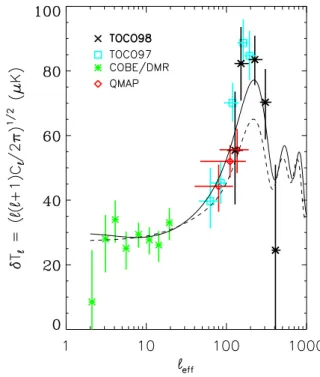
density [18℄. The loation of theobserved peak [3℄ as
shownin Fig. 2strongly supports thelaim ofa
spa-tiallyatUniverse, withj
k j1.
Figure2. TheangularpowerspetrumfromCOBE[19 ,20 ℄,
Saskatoon [21 ℄, QMAP [22℄, TOCO97 [23 ℄, and TOCO98
([3 ℄fromwhihthisgureistaken)areshown. Theriseand
fallintheanisotropyspetrum inthe range`100 300
in the TOCO98 data is the strongest evidene to date
that the spatial urvature of the Universe is small. The
osmologial models are SCDM (dashed line:
m = 1,
b
=0:05, h=0:5)andaonordanemodel[24 ℄(solid
line: m = 0:33,
b
=0:041, = 0:67, and h = 0:65.)
Theerrorbarsare 1statistial.
Thersttwopieesofinformationaloneareenough
om-rewrittenasasumruleforthefrationalenergy
densi-ties,
3
8G H
2
= k
a 2
+ X
i
1 =
k +
X
i ;
wesee that
m
<1and j
k
j 1indiate that there
mustbesomeotherterm,
?
,whihbringsthetotalup
to unity. There mustbesomeotheromponentwhih
dominatesthetotalenergydensitytoday. Butwait |
there's more.
0.1
1
redshift: z
−1
0
1
2
0.1
1
−1
0
1
2
∆
(m−M)
SCP
HZS
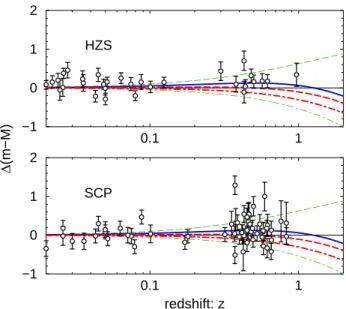
Figure3. Themagnitude-redshift relationshiptraedby
the type1asupernovaemeasuredbytheSCP[6 ℄andHZS
[7 ℄ groups is shown. The vertial axis shows the
magni-tude dierenewithrespettoanopen, empty
(aelerat-ing)Universe,representedbytheurve(m M)=0. The
top-most urve is the preditionfor a =1 model; the
bottom-mosturveis for am =1model. Theweightof
thedatastronglyrulesoutthe
m
=1Universe,andfavors
modelswith
m
=0:3andw= 1; 2=3; 1=3in
dereas-ingorder(thebluedashed,reddashed,andreddot-dashed
urves).
Third,the osmi expansionof the Universe is
a-elerating. This stunning laim is made on the basis
of themagnitude -redshiftrelationshiptraedoutby
type1asupernovae[6,7℄,asshowninFig. 3. The
pro-edure an be summarized briey. Although type 1a
SNearenotstandardandles,inthattheirintrinsi
lu-minosityisnotknown,thereappearstobeanempirial
relationshipbetweentheshapeofthesupernovaelight
urve and the luminosity. Hene, given the
luminos-ity and the observedux, the distane is determined;
the red shift is determined by the host galaxy. The
magnitude - red shift relationship then traes out an
extended Hubble diagram, beyond the linear regime,
whih issensitive tothe osmiaeleration. The
evi-isgrowingfasterthanthatdrivenbypressurelessdust.
Sinetheaelerationoftheexpansionsalefatoris
a= a
4G
3
(+3p);
theobservations demand negativepressure to be
pro-videdbyanadditionalomponent.
Puttingthesethreepieesofevidenetogether,the
intersetion indiates a low density, spatially at,
a-eleratingUniverse. Thestageissetfortheentraneof
adominantenergyomponentwithnegativepressure.
III A Cosmologial Constant?
Until a few years ago, when the CMB data began to
rystallizeandtheSNeresultswererstreported,there
was beenno ompelling reasonto onsider aspatially
at,lowmatterdensity,aeleratingUniverse. Indeed,
theoretial prejudie favored simpler models, suh as
standardCDMwith
m
=1(forinationenthusiasts)
or open CDM. The osmologial onstant was a
u-riosity,rstintroduedbyEinstein inafailedattempt
to obtain a stati solution for a dust-lled Universe.
However,theosmologialonstanthasomebakinto
vogue as a popular andidate to ll the gap between
thematterandritial densityrequiredforaat
Uni-verse,anddriveaeleratedexpansionwithitsnegative
pressure[25℄.
Theshiftoffousontohasdevelopedinresponse
to thenewobservationaldata. Yet, introduing
re-vives several diÆult questions [26℄. If there is a
os-mologialterm,aonstantenergydensityandpressure,
howdidit arise? Isitaonsequeneofquantum
grav-ity? Is it the self-gravitating energy assoiated with
zero-point quantum utuations? Naive attempts to
understand suh a typially assoiate it with
zero-pointquantum utuations,but requirean ultraviolet
ut-o,suhastheenergy saleofasymmetry
break-ing transition, to render it nite. Some quik
num-bersindiatetheenergysalemustbeexeedinglylow:
(H 2
=G) 1=4
10 3
eV.Theproblemofthehierarhyof
energysalesinpartile physisis exaerbatedbythis
reasoning.
Consider the problem of the energy sale of in
anotherway. Inorder forthe onstant energydensity
to be dominant today, it must have been anegligible
fration ofthe totalenergy densityof the Universe at
alltimesinthepast. It'sdiÆultthentoseehowsuh
anenergyomponentould haveeverbeenin
equilib-riumorontatwiththerestoftheosmiuid. Aswe
willarguelater,perhapsthisomponentdidnotalways
haveaonstant,ornearlyonstantenergydensity.
BytheprinipleofOam'sRazor,thesimplest
ex-planationforthemissingenergyomponentmaybethe
num-alaw ofphysis, andiftoobroadlyapplied it an
ob-suretheinterpretationofexperiment. Aswearguein
the next setion, a dynamial omponent is a logial
andidateforthemissingenergy.
IV Quintessene: A Dynamial
Component
The proposal of a osmi salar eld, quintessene,
strikes this author as the most logial way to model
the missing energy, at present. The most basi tool
employed to build a fundamental theory beyond the
standardmodelof partile physisorEinstein gravity
is the salar eld. The Higgs, inaton, Brans-Dike,
moduli, and dilaton elds are examplesof suh salar
eldswhihplayaritialroleinmodelsof
fundamen-tal physis. Furthermore,thereis preedentto solving
\missingenergy"problemswithanewpartileoreld,
aswastheasewiththeneutrino(asuess)anddark
matter (to be determined, but supersymmetri
parti-lesarestrongandidates). Inaddition,thewiderange
of behavior enompassed by a salar eld provides a
greaterontextinwhihtoexploreandunderstandthe
developingosmologial observations. In the limiting
ase of w ! 1, the quintessene eld is indistint
from a. As well, with asalar eld, it is simple to
model thebehaviorofotherformsofenergy,suhas a
networkoffrustratedtopologialdefets [27℄.
An important motivation for onsidering
quintessene models is to address the \oinidene
problem,"theissueofexplainingtheinitial onditions
neessary to yield the near-oinidene of the
densi-ties of matter and quintessene today. For the ase
of , as desribed earlier, the only possible option is
to nely tune the ratio of energy densities to 1 part
in 10 110
at the end of ination. Symmetry
argu-ments from partile physis are sometimesinvoked to
explain whythe osmologial onstant should bezero
[28℄ but there is no known explanation for a positive,
observable vauum density. For quintessene, beause
it an ouple to other forms of energy either diretly
or gravitationally, one an envisage the possibility of
interations whih ause the quintessene omponent
tonaturallyadjustitselftobeomparableto the
mat-ter density today. Infat, reent investigations [9, 29℄
haveintroduedthenotionof\trakereld"modelsof
quintessenewhihhaveattratorlikesolutions[30,31℄
whihproduetheurrentquintesseneenergydensity
without the ne tuning of initial onditions. Partile
physistheorieswithdynamialsymmetrybreakingor
non-perturbative eets have been found whih
gen-eratepotentialswith ultra-lightmasses whih support
negative pressure, and exhibit the \traker"
behav-ior [13, 32℄. These suggestive results lend appeal to
a partile physis basis for quintessene, as a logial
onstant.
IV.1 The QCDM Senario
The quintessene plus old dark matter (QCDM)
osmologial senario is onstruted as follows. The
spae-time is a spatially at FRW with line element
ds 2
= a 2
( d 2
+d~x 2
). The osmi uid ontains
quintessene, CDM, plus all the standard model
par-tiles intheform ofbaryons,radiation,andneutrinos.
The Universeevolvesfrom aninationary phase,
dur-ingwhihtimeaspetrumofadiabatidensity
pertur-bationsare generated,throughradiation- and
matter-dominated phases, until the present
quintessene-dominatedera.
Ω
Λ
Ωm
QUINTESSENCE
FLAT MODELS
1
0
0
1
-1
0
w
Figure4. Quintesseneintroduestheequationofstate,w,
tothe spaeofosmologial parameters. Themost
impor-tantquantitiesforharaterizingaQCDMmodeliswand
thematterdensity,
m
=1
Q .
IV.2 Bakground Evolution Equations
Theevolutionofaosmisalareldisobtainedby
the following set of equations. Starting from the
La-grangian for a self-interating salar eld, the eld is
brokenintoabakground,homogeneousportionQand
an inhomogeneousperturbation ÆQ. The equationsof
motionforthebakgroundeld inanexpandingFRW
spae-timearesimplyobtained:
L= 1
2
Q
Q V(Q) ! Q
00
+2 a
0
a Q
0
= V
;Q :
Here, theprime indiates the derivativeswith respet
to onformal time. Oneneed only speify apotential
to evolvetheequations and obtaintheenergy density
andpressure,
= 1
2 _
Q 2
+V; p= 1
2 _
Q 2
V:
Hene, a potential energy dominated salar eld will
oftheequationofstateasafuntionofthesalefator,
w(a). Thentheenergydensityanbereonstrutedas
(a)= Q rit exp 3 Z 1 a
[1+w(a)℄dlna
;
and the pressureis simply p = w. It is possible to
reonstrutthepotentialandeldevolutionforagiven
equationof state[34,33℄:
V(a) = 1
2
[1 w(a)℄(a)
Q(a) = Z
d ~a p
1+w( ~a )
~ aH( ~a)
p
( ~a) :
The equivalenew(a) $V(Q[a℄) immenselysimplies
thesimulationofquintessene.
Figure 5. The utuations in quintessene are important
on largesales. Asademonstration, the CMB anisotropy
is omputed for a smooth omponent, where ÆQ is
arti-iallysettozero inamodelwith
m
=0:3andw= 1=3;
the utuationsÆQwhihwouldnormally anelwiththe
strong,latetimeintegratedSahs-WolfetermsintheCMB,
are absent, leadingtoa dramatiallydierene anisotropy
spetrum. TheutuationsdistinguishQfrom,and
pro-videinsightintothemirophysialpropertiesofQ.
IV. 3 Flutuation Evolution Equations
Thespatial utuationsfollowthe evolution
equa-tion ÆQ 00 +2 a 0 a ÆQ 0 +(V ;QQ r 2 )ÆQ= 1 2 h 0 Q 0
where h is the traeof thesynhronous gaugemetri
perturbation. (See [35℄ fordetails of the perturbation
theory.) ThisequationisamenabletoFourier
deompo-sitionoftheutuations. Weseethat thequintessene
reats to the external gravitational eld of, say, dark
matter and baryons throughh. The nature of the
re-sponse isdeterminedbyV
, whih haraterizesthe
eetive mass, m
Q =
p
V
, or the Compton
wave-length of the eld, =1= p
V . Againthere is a
simpliationusingtheequationofstate:
a 2 V ;QQ = 3 2 (1 w) " a 00 a a 0 a 2 7 2 + 3 2 w # + 1
1+w
w 02
4(1+w) w 00 2 +w 0 a 0 a
(3w+2)
Bymakingthehangeofvariablesto f
ÆQ=ÆQ= p
1+w
thenthew 00
termdropsoutofthe evolutionequation,
sothatwandw 0
needonlybespeied. Weseethatfor
aslowlyvaryingequationofstate,jw 0
j=(1+w)a 0 =a, then V ;QQ / H 2
and the Compton wavelength of the
quintesseneeld isapproximatelytheHubblehorizon
radius,
Q
H
1
. From the above equations, this
meansthat utuationsÆQonsalessmaller thanthe
Hubble sale dissipate, so the eld is a smooth,
non-lustering omponent there. Any initial utuations
in the quintessene eld are damped out rapidly. On
salesgreaterthan H 1
, theeld is unstableto
grav-itational ollapse, and long wavelength perturbations
develop. This meansthequintessenerespondsto the
largesale utuations in the CDM and baryons. As
shownin Fig. 5,thequintesseneutuationsplayan
importantroleinthelargeangleCMBanisotropy
spe-trum.
V Traker Quintessene
Trakers represent a partiular lass of quintessene
modelswhih avoidtheproblemof netuningthe
ini-tial onditions of the salar eld in order to obtain
thedesiredenergydensityandequationofstateatthe
present time [9, 29℄. The traker is a salar eld Q
whihrollsdownapotentialV(Q),asshowninFig. 6,
aordingtoanattrator-likesolutiontotheequations
of motion. The solution is an attrator in the sense
that averywiderange of initial onditionsfor Q and
Q 0
rapidly approah aommon evolutionary trak, so
that the osmology is insensitive to the initial
ondi-tions. Traking has an advantagesimilar to ination
in that a wide range of initial onditions is funneled
into thesame nal ondition. The initial energy
den-sity of the quintessene,
Q j
i
, an vary by nearly100
orders of magnitude without altering the osmi
his-tory. In partiular, the aeptable initial onditions
inludeequipartitionafterination|nearlyequal
en-ergydensityin Qasin theother 100-1000degreesof
freedom(e.g. Q j i 10 3
). Furthermore,the
osmol-ogyhasdesirable properties. Theequation ofstate of
Qvariesaordingtotheequationofstateofthe
domi-nantomponentoftheosmologialuid. Asdisplayed
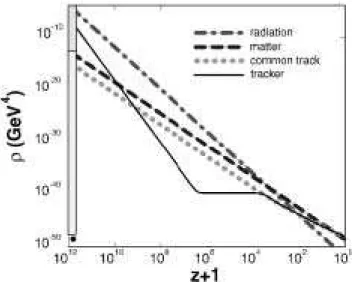
in Fig. 7, when the Universe is radiation-dominated,
thenwislessthanorequalto1=3and
Q
dereasesless
rapidlythantheradiationdensity. WhentheUniverse
ismatter-dominated,thewisnegativeand
Q
dereases
lessrapidly thanthematterdensity. Theonsequene
beomesthe dominant omponent. At this point, the
Hubbledampingoftheeldevolutionbeomes
impor-tant, Qslowsto arawland w! 1as
Q
!1and
theUniverseis drivenintoan aeleratingphase. The
fat that
Q
is not seento beompletely dominating
yet, or that
m
is measured to be at least 0:2,
pro-videsanaturallowerboundtothetrakerquintessene
equationofstate: w 0:8.
Figure 6. The harateristi shape of the potential for
trakerandreeperquintessenemodelsisshown;forthese
runaway salar elds, the potential is high and steep at
smallQandfallso,approahingzeroasQbeomeslarge.
Starting from a widerange of initial onditions, an
inter-playbetweentheHubbledampingandtheurvatureofthe
potentialdrivestheeldevolutiontowardsaommon
evolu-tionarytrak,inwhihtheequationofstateisalwaysmore
negativethan thebakground. Inevitably, theeld omes
todominate theosmologialuid,drivingaelerated
ex-pansion. One the eld reahes the freeze-out point, the
rolling eld is ritially damped by the Hubble expansion
asw! 1and
Q !1.
Trakingoursforanypotentialforwhihw<w
B ,
where w
B
is the equation of state of the bakground
uid (e.g. radiation ormatter), V 00
V=(V 0
) 2
> 1
andisnearlyonstant,d( 1)=dt( 1)H. One
traking begins, the equation of state is given by the
handyformula
w w
B
2( 1)
1+2( 1) :
Two examples of traking potentials are V =
M 4
[exp(M
pl
=Q) 1℄ where M
pl
is the Plank mass,
and V = M 4+
=Q
with > 0. For = 1, = 2
whih yieldsw (w
B
2)=3 <w
B
sothat sooner or
laterthetrakerwillometodominate. Ineahase,M
isafreeparameterwhihisxedbythemeasuredvalue
of
Q
. Hene,thesemodelseahhaveonefree
parame-ter,justasfortheosmologialonstant. Thetraker,
however, hasa muh moreplausible origin in partile
physis,asthepotentialsourinstringandM-theory
models assoiated with moduli elds or fermion
on-densates (perturbative eets make at diretion
po-in equipartition. For these reasonsthe laim is made
thatquintesseneisonequalifnotstrongertheoretial
groundthantheosmologialonstant.
Another speies of quintessene losely related to
thetrakeristhereeper. Thisorrespondstothease
inwhihtheinitialenergydensityinQafterinationis
muhgreaterthantheradiationenergydensity. For
ei-therofthepotentialsdesribedabove,thisorresponds
to starting at a small value of Q, veryhigh up in V.
Theonsequentevolutionissuhthattheeldrapidly
rolls down the potential, out to a very large value of
the eld, at QM
pl
. Theeld evolutionisritially
damped; Qstill moves, but is nowreeping down the
potential. Assuh,theequationofstateisverynearly
w 1andthereeperbehavesverymuhlikea
os-mologialonstant.
Figure7. Theenergydensityversusredshift foratraker
eldisshown. Startingwithinitialonditionsanywherein
the vertial box at left, inluding the yellow regionwhih
representsequipartition, to thesingularlytunedblak dot
asrequiredfor,thetrakereld(blakline)rapidlyjoins
the ommonevolutionarytrak (orange dashedline). The
traker quintessene rapidly overtakes the radiation (red)
andmatter(blue)and omestodominatethe Universeby
today. Thered shift z =10 12
has beenarbitrarily hosen
astheinitialtime. (Figureprovidedby[29 ℄.)
VI Conordane and Quintessene
We now fous on the observational onstraints on
QCDM osmologial models. These results were
ex-plored in depth in [24℄, where an exhaustive study
of the onstraints was presented, obtaining a set of
quintessenemodelsin onordanewithobservation.
TheQCDMosmologialsenarioanbe
harater-izedbythefollowingveparameters: thequintessene
equation of state w; the matter density parameter
m
, where a at model is assumed so that
m =
1
Q
; the baryon density parameter,
b
Hub-100hkm/s/Mp;thepowerlawindex ofthespetrum
ofprimordialdensityutuationsinthematterand
ra-diation,
n
s
. Intheaseoftrakerquintessene,theequation
ofstatehangesslowlywithtime,buttheobservational
preditions are well approximated by treating w as a
onstant,equalto
~ w
Z
da
Q
(a)w(a)= Z
da
Q (a):
Through out this disussion, we will evaluate the
boundsforaonstantw,butthesameonstraintshold
fortheequivalentQCDMmodelwithw.~
Wenowsummarizethemostimportantonstraints,
breakingthem upbyredshift.
VI.1 Low Redshift
Hubble Constant: The Hubble onstant has been
measuredthroughnumeroustehniquesovertheyears.
Although there has been a marked inrease in the
preision of extragalati distane measurements, the
aurate determination of H has been slow. The
H
0
Key Projet [36℄, whih aimed to measure the
Hubble onstant to an auray of 10%, urrently
nds H = 73 6(stat) 8(sys)km/s/Mp; the
method of type 1a supernovae gives H = 63:1
3:4(internal)2:9(external)km/s/Mp[37℄;typial
val-ues obtainedfrom gravitationallens systemsare H
50 70km/s/Mp with up to 30% errors [38, 39℄.
Other measures an belisted, but learly onvergene
hasnotbeenreahed,althoughsomemethodsaremore
prone to systemati unertainties. Based on these
di-versemeasures,ouronservativeestimateforthe
Hub-ble onstantisH=6515km/s/Mpwith2
uner-tainty.
Ageof theUniverse: Reentprogressin thedating
of globular lusters and the alibration of the osmi
distaneladderhasrelaxedthelowerboundontheage
of theUniverse. Weadoptt
0
9:5Gyrasa95%lower
limit[40,41℄.
Baryon Density: Reent observations of the
deu-terium abundane by Burles and Tytler [16℄ yield
D=H = 3:40:3(stat)10 5
. If this value reets
the primordial abundane, then Big Bang
nuleosyn-thesis [42℄ with three light neutrinos gives
b h
2
=
0:0190:002wherethe1errorbarsallowforpossible
systematiunertainty.
Baryon Fration: Observations of the gas in
lus-ters have been used to estimate the baryon fration
(ompared to the total mass) to be f
gas
= (0:06
0:003)h 3=2
[15℄. The stellar fration is estimated to
belessthan20%ofthegasfration,sothatf
stellar =
0:2h 3=2
f
gas
. Next,simulationssuggestthatthebaryon
fration in lusters is lessthan the osmologialvalue
byabout10%[43℄representingadepletioninthe
abun-Hene,theosmologialbaryonfrationf
b =(
b =
m )
isestimatedtobef
b
=(0:0670:008)h 3=2
+0:013at
the1 level. Using the observedbaryondensityfrom
BBN,weobtaintheonstraint
m =
0:019h 2
0:067h 3=2
+0:013
( 10:32)
atthe2level. Forh=0:65thisorrespondstoavalue
of
m
=0:320:1.
8
: The abundaneof x-raylusters at z =0
pro-vides a model dependent normalization of the mass
powerspetrum atthe anonial8h 1
Mp sale. The
interpretation of x-ray luster data for the ase of
quintessenemodels hasbeenarried out in detailby
WangandSteinhardt[44℄,inwhihasetheonstraint
isexpressedas
8
m
= (0:5 0:1)0:1
= 0:21 0:22w+0:33
m
+0:25
= (n
s
1)+(h 0:65)
where the error bars are 2. This tting formula is
validfortherangeofparametersonsidered here.
Perhapsthetwomostimportantonstraintsonthe
masspower spetrum at this time are theCOBE [19℄
limit on large sale power and the luster abundane
onstraint whih xesthe poweron 8h 1
Mp sales.
Together, they x the spetral index and leave little
room to adjust the power spetrum to satisfy other
tests.
VI.2 Intermediate Redshift
Supernovae: Type 1a supernovae are not
stan-dard andles, but empirial alibration of the light
urve - luminosity relationship suggests that the
ob-jetsanbeusedasdistaneindiators. Therehasbeen
muhprogressintheseobservationsreently,andthere
promises to be more. Hene, a denitive onstraint
basedon these resultswould be premature. However,
weexaminethereentresultsoftheHigh-ZSupernova
SearhTeam(HZS:[7℄)andtheSupernovaCosmology
Projet(SCP:[6℄)toonstraintheluminositydistane
-redshiftrelationshipinquintesseneosmologial
mod-els. Wehaveadopted the following dataanalysis
pro-edure: weusethesupernovadatafortheshapeofthe
luminosity-redshiftrelationshiponly,allowingthe
al-ibration, and therefore the Hubble onstant, to oat;
we exise all SNe at z < 0:02 to avoid possible
sys-tematisdue to loal voids and overdensities; for SNe
at z > 0:02, we assume a further unertainty, added
in quadrature, orresponding to apeuliar veloity of
300 km/s in order to devalue nearby SNe relative to
themoredistantones (fortheSCP data,aveloityof
300 km/s has already been inluded). There is
sub-stantial satter in the supernovae data; the satter is
sowidethat nomodel wehavetestedpasses a 2
C,arguedin[6℄asbeingmorereliable,aniterangeof
modelsdopassthe 2
test,omparabletotherange
ob-tainedbythe 2
testusingtheHZSdataset. Togauge
theurrentsituation,wewillreportboth 2
testsand
maximum likelihood tests; to be onservative, we use
the largestboundary(the 2
test based onHZS data
usingMLCSanalysis)forouronordaneonstraint.
Lensing Statistis: The statistis of multiply
im-agedquasars,lensedbyinterveninggalaxiesorlusters,
anbeusedtodeterminetheluminositydistane -red
shift relationship, and thereby onstrain quintessene
osmologialmodels. There exists along literatureof
estimates of the lensing onstraint on models (e.g.
spanning[45℄to[46℄). Inoneapproah,theumulative
lensing probability for a sample of quasars is used to
estimate the expeted number of lenses and
distribu-tion of angular separations. Using the Hubble Spae
Telesope Snapshot Survey quasar sample [47℄ found
four lenses in 502soures, Maoz and Rix [48℄ arrived
at the limit
0:7 at the 95% CL. In a series of
studies, similar onstraints have been obtained using
optial[49℄and radiolenses[46℄. Wagaand
ollabora-tors[50,51℄havegeneralizedtheseresults,ndingthat
the onstraint weakens for larger values of the
bak-ground equation of state, w > 1. In ourevaluation
of the onstraint based on the HST-SSS data set, we
nd that the 95% ondene level region is
approxi-mately desribed by
Q
0:75+(1+w) 2
, until the
inequality is saturated at w = 1=2, onsistent with
the results of Waga. In priniple, this test is a
sen-sitiveprobeof the osmology; however,it is
susepti-ble toanumberof systematierrors(foradisussion,
see [52, 53℄). Unertainties in the luminosity funtion
for soure and lens, lens evolution, lensing ross
se-tion,anddustextintion foroptiallenses,threatento
rendertheonstraintsompatiblewith orevenfavor a
low density universe over
m
= 1. Taking the above
into onsideration, none of the present onstraintson
quintessene due to the statistis of multiply imaged
quasars are prohibitive: models in onordane with
the low-z onstraints are ompatible with the lensing
onstraints.
VI.3 High Redshift
One of the most powerful osmologial probes is
theCMB anisotropy,an imprintof the reombination
epohontheelestialsphere. Thelargeangle
tempera-tureanisotropypattern reordedbyCOBE[19℄anbe
usedtoplae twoonstraintsonosmologialmodels.
COBEnorm: TheobservedamplitudeoftheCMB
power spetrum is used to onstrain the amplitudeof
the underlying density perturbations. We adopt the
methodofBunnandWhite[54℄tonormalizethepower
spetrum to COBE. As we use a modied version of
CMBFAST[55℄toomputetheCMBanisotropy
spe-tra, this normalization is arried out automatially.)
We have veried that this method, originally
devel-oped for and open CDM models, an be applied to
thequintesseneosmologialmodelsonsideredinthis
work [34℄. Of ourse, there is unertainty assoiated
with the COBE \normalization": the 2 unertainty
in rms quantities is approximately 20% (see footnote
#4 in [54℄), whih onservatively allowsfor statistial
errors,aswellasthesystematiunertaintyassoiated
with the dierenes in the galati and elipti frame
COBEmap pixelizations,andpotentialontamination
byhigh-latitudeforegrounds[56℄.
n
s
: COBE hasbeenfound to beonsistentwith a
n
s
=1:20:3spetralindex[57,58℄, butthisassumes
theonlylargeangularsaleanisotropyisgeneratedvia
the Sahs-Wolfe eet on the last sattering surfae.
This neglets the baryon-photon aousti osillations,
whih produe a rise in the spetrum, slightly tilting
thespetrumobservedbyCOBE.Ingeneral,the
spe-tralindexdeterminedbyttingthelargeangularsale
CMBanisotropyofaquintessenemodel,whihisalso
modied byalate-time integratedeet,to theshape
ofthespetrumtendstooverestimatethespetraltilt.
For example, analysis of a lass of CDM models [59℄
(CDMandSCDM,asubsetofthemodelsonsidered
here)ndsaspetraltiltn
s
=1:10:1. We
onserva-tivelyrestritthespetralindexoftheprimordial
adia-batidensityperturbationspetrum,withP(k)/k ns
,
tolie intheintervaln
s
2[0:8;1:2℄. Notethatination
generially preditsn
s
1, with n
s
slightly lessthan
unity preferred by inaton potentials whih naturally
exit ination.
Small Angle CMB: Dramati advanes in
osmol-ogy are expeted in the near future, when the MAP
andPlanksatellitesreturnhighresolutionmapsofthe
CMB temperatureand polarizationanisotropy. When
themeasurementsareanalyzed,weanexpetthatthe
bestdeterminedosmologialquantitieswillbethehigh
multipole C
`
moments, suhthat any proposedtheory
must rst explain the observed anisotropy spetrum.
At present, however, there is ample CMB data whih
anbeusedtoonstrainosmologialmodels.
We take a onservative approah in applying the
small angular sale CMB data as amodel onstraint.
Ourintentionistosimplydeterminewhihquintessene
modelsareonsistentwiththeensembleofCMB
exper-iments,ratherthantodeterminethemostlikelyorbest
tting model. At the time of this leture, the results
from severalexperimentshadeither beenreently
pre-sentedorshortlyexpeted, so that adetailed analysis
wouldhavebeenpremature.
VI.4 Conordane Results
Wehaveevaluatedtheosmologialonstraintsfor
thesetofquintessenemodelsoupyingtheve
dimen-sionalparameterspae: w;
m ;
b ;h;n
s
. Theresults
are best represented by projeting the viable models
Theonordaneregionduetothesuiteof lowred
shift onstraints, inluding the COBE normalization
and tilt n
s
, are displayed in Figs. 8, 9. Eah point
in the shaded region represents at least onemodel in
theremainingthreedimensionalparameterspaewhih
satisestheobservationalonstraints.
Figure 8. Theprojetion oftheonordaneregiononthe
m
h plane, on the basis of the low red shift
observa-tional onstraintsonly, is shown. Theobservations whih
dominatetheloationoftheboundaryarelabeled.
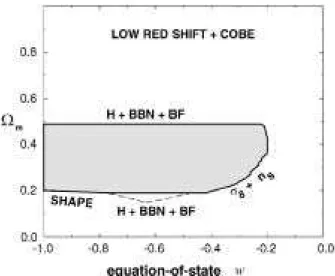
Figure 9. Theprojetion oftheonordaneregiononthe
m wplane,onthebasisofthelowredshift andCOBE
observationalonstraintsonly,is shown. Theobservations
whihdominatetheloation ofthe boundaryarelabelled.
If awiderrange for thebaryondensity is allowed,suhas
0:006 <
b h
2
<0:022, the shape ofthe mass power
spe-trum(notdisussedhere: see[24℄)and
8
onstraint
deter-minetheloationofthelow
m
boundary,andthe
onor-daneregionextendsslightlyasshownbythelightdashed
line.
In Fig. 8, the boundariesin the
m
diretion are
as a funtion of h, while h is only restrited by our
onservativeallowedrangeandtheageonstraint. The
age does not impat the
m
h onordane region,
sinefor the allowed valuesof
m
and h, there is
al-waysamodelwithasuÆientlynegativevalueofwto
satisfytheageonstraint. Relaxing eithertheBBNor
BFonstraintwouldraisetheupperlimitonthematter
densityparametertoallowlargervaluesof
m
. This
re-quiresa simultaneous redutionin thespetralindex,
n
s
, in order to satisfy both the COBE normalization
andlusterabundane.
InFig. 9, the upperand lowerbounds on
m are
againdeterminedbytheombinationofBBN,BF,and
h. Thelowerbound on
m
dueto theombinationof
the BBN and BF onstraintsan be relaxed if we
al-lowa moreonservativerange for the baryondensity,
suh as 0:006 <
b h
2
<0:022 [60, 61℄. However, the
onstraintsdueto
8
andtheshapeofthemasspower
spetrum take up the slak, and the lower boundary
oftheonordaneregionisrelativelyunaeted. The
lowerboundon
m
nearw= 1isdeterminedinpart
by the shape of the mass power spetrum (see [24℄);
themasspowerspetruminamodelwithlow
m and
strongly negative w is a poor t to the shape of the
APMdata,basedona 2
-test. Thisonstrainton
mod-elsnearw= 1isrelaxedifweallowanti-bias(b<1),
although b < 1is strongly disfavored ona theoretial
basis. Attheotherend,forw 0:6,thelowerbound
on
m
is determined by the ombination of the
up-perbound onthespetralindex, andthex-rayluster
abundaneonstrainton
8
. Ifwefurther restritthe
biasto b <1:5, a smallgroup ofmodelsat the upper
rightornerwith w 0:2 and
m
0:4 willfail the
shapetest.
We see that models oupying the fration of the
parameter spae in the range 1 w 0:2 and
0:2
m
0:5areinonordanewiththebasisuite
ofobservations,suggestingalowdensityuniverse. Itis
importanttonotethatthesetofviablemodelsspansa
widerangeinw;theonordaneregionisnotlustered
aroundw= 1,or,but allowsuhdiverse behavior
as w 1=3. However, the ase w = 0, whih an
resultfrom thesalingexponentialpotential[30, 31℄is
learly in ontradition with observation: the
m
re-quiredbythex-raylusterabundaneonstraintis
in-ompatiblewiththematterdensityparameterallowed
by the BF and BBN onstraints. Hene, the models
withw=0exploredbyFerreiraandJoye[62℄arenot
viable.
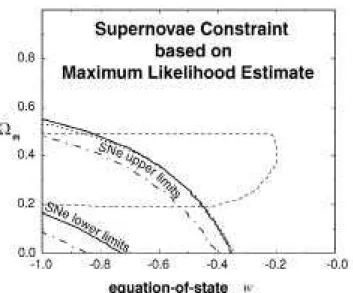
Themostpotentofthe intermediateredshift
on-straintsisduetotype1asupernovae,whihwepresent
in Fig. 10. In addition to the SCP results, the HZS
at-(MLCS)andtemplatetting;heneweshowthreeSNe
results. Carrying outa maximum likelihood analysis,
all three give approximately the same result for the
loation of the 2 bound, favoring onordant
mod-els with low
m
, and very negative w. Based on a
maximumlikelihoodanalysisSCPhavereportedalimit
w 0:6 at the 1 level. A 2
analysis of the same
datagivesasomewhatdierentresult: theFitCSCP
dataandtheHZSdatasetsgiveomparable,although
weaker,resultstothe likelihood analysis. Inthespirit
of onservativism, we have used the weakest bound
whihweanreasonablyjustify. Hene,forthe
onor-daneanalysis,weusethe2ontourresultingfrom a
2
test.
Figure10. The2 maximumlikelihoodonstraintsonthe
m
w plane, dueto the SCP(solid), HZSMLCS(short
dashed), and HZS template ttingmethods(dot-dashed).
Thelight,dashedlineshowsthelowredshiftonordane
region.
Wehaveevaluatedthehighredshiftonstraintdue
to the selet ensemble of CMB anisotropy
measure-ments. Based on a 2
test in ÆT
l
, the set of
onor-dantmodelsprojeteddowntothe
m
hand
m w
planesisunhangedfromthelowredshiftonordane
regionateventhe1 level. This\null"resultfromthe
CMBshouldnotbetoosurprising;theurrent
observa-tionaldata isapableonlyofdiserningariseandfall
inpowerin theC
`
spetrumaross`100 300. The
resultsare unhangedif weinlude additionalurrent
CMBresults, orusea 2
testin ln(ÆT 2
l
)[63℄. Rather,
we must wait for near-future experiments whih have
greater ` overage, e.g. BOOMERANG, MAT, and
MAXIMA, whih are expeted to signiantly redue
theunertainties.
Sine the submission of this manusript, the data
experimentshavebeenreleased. However,neither
sig-niantlyhangesourresults.
Figure11. Thedarkshadedregionistheprojetionofthe
onordaneregiononthe
m
wplanewiththelow,
inter-mediate, andhigh redshiftobservationalonstraints. The
dashed urve shows the 2 boundary as evaluated using
maximumlikelihood,whihisthesameasFig. 10.
Thus far we have applied the low red shift
on-straints in sequene with one of the other
intermedi-ateorhighredshiftonstraints. It isstraightforward
to seehowtheombinedsetofonstraintsrestritthe
quintesseneparameterspae. Takingthelowredshift
onstraintregion,whihisshapedprimarilybytheBF,
BBN,H, and
8
onstraints,the dominantbounds on
the
m
wplanearethenduetoSNeandlensing. The
SNe drives the onordane region towards small
m
andnegativew; thelensingrestritslowvaluesof
m .
Puttingthesealltogether,anultimateonordanetest
ispresentedin Fig. 11. Ifthepresentobservationsare
reliable, we may onlude that these models are the
most viableamong the lass of osmologialsenarios
onsideredherein.
Towhatdegreedourrentunertaintiesinthe
Hub-bleparameter,thespetraltiltandotherosmi
param-etersobstruttheresolutionin w? Tojudgethisissue,
wehaveperformedanexeriseinwhihwexh=0:65,
b h
2
=0:019,andwehoosethespetraltilttoinsure
thattheentralvaluesoftheCOBEnormalizationand
thelusterabundaneonstraintarepreiselysatised.
InFigs. 12 and 13,weshowhow dierentonstraints
restrittheparameterplanes. Noterstthelong,white
onordaneregionthatremainsin the
m
wplane,
whihisonlymodestlyshrunkenomparedtothe
on-ordane region obtained when urrent observational
errors are inluded. The region enompasses both
and a substantial range of quintessene. Hene,
eahindividualonstraintatstoruleoutregionsofthe
plane. Theolorornumbersineahpathrepresentthe
numberofonstraintsviolatedbymodelsinthatpath.
Itislearthatregionsfarfrom theonordaneregion
are ruled out by many onstraints. Both gures also
show that the boundaries due to theonstraints tend
to runparallel totheboundaryoftheonordane
re-gion. Hene, shifts in the values or the unertainties
in these measurementsare unlikely to resolvethe
un-ertainty in w by ruling out one side or the other |
either theonstraintswillremainastheyare,in whih
ase the entire onordane region is allowed, or the
onstraintswillshiftto ruleouttheentireregion.
Figure 12. Theonordaneregion(white) resultingif we
artiially set bh 2
= 0:019 and x the spetral tilt to
preisely maththe entral valuesofCOBE normalization
andlusterabundanemeasurements.Theurvesrepresent
the onstraintsimposedby individual measurements. The
urvesdividetheplaneintopatheswhihhavebeen
num-bered(andolored)aordingtothenumberofonstraints
violatedbymodelsinthatpath.
The traker models are a partiularly important
lass of quintessene models, as disussed earlier,
be-ause they avoid the ultra-ne tuning of initial
on-ditions required by models with a osmologial
on-stantorother(non-traking)quintessenemodels. An
additional important feature of these models is that
theypreditadeniterelationshipbetweenthepresent
dayenergy densityand pressure, whih yields alower
boundontheonstant,eetiveequationofstate,near
e
w 0:75 [29℄. Note that the eetive or averaged
equation of state asdesribed earlier is about 10 per
entlargerthanthevalueofwtoday. InFig. 14weadd
this bound to the lowred shift onstraints, obtaining
the onordane region for trakerquintessene. This
region retainstheoreofourearlierlowredshift
on-reepereldhasan equationofstatew= 1,marked
in Figs. 14, and is eetivelyindistinguishablefrom a
osmologialonstanttoday.
Figure13. Theonordaneregion (white)resultingif we
artiially set h = 0:65 and
b h
2
= 0:019 preisely and
xthespetraltilt topreiselymaththeentralvaluesof
COBEnormalizationandlusterabundanemeasurements.
Theurvesrepresenttheonstraintsimposedbyindividual
measurements. The urves divide the plane into pathes
whihhavebeen numbered (andolored) aording to the
numberofonstraintsviolatedbymodelsinthatpath.
Figure 14. The onordane region based on COBE and
low red shift tests for traker quintessene is shown. The
thinblak swath along w = 1shows the allowed region
Figure15. Theoverallonordaneregionbasedlow,
inter-mediate,andhighredshifttestsfortrakerquintesseneis
shown. Thethinblak swathalong w= 1shows the
al-lowedregionfor reeperquintesseneand. Theequation
ofstate is time-varying;the absissais theeetive
(aver-age) w. The dark shadedregion orresponds to the most
preferredregion(the2maximumlikelihoodregion
onsis-tentwiththetrakeronstraint),
m
0:330:05,eetive
equation-of-statew 0:650:10andh=0:650:10and
areonsistentwithspetralindexn=1.Thenumbersrefer
tothe representativemodelsthatappearinTableIof [24 ℄
and thatare referened frequentlyinthetext. Model 1is
thebesttCDMmodelandModel2isthebesttQCDM
model.
In Fig. 15 we ombine allurrentobservations on
traker models. Sine these are arguably the
best-motivatedtheoretially,weidentifyfromthisrestrited
region a sampling of representative models with the
most attrative region for quintessene models being
m
0:330:05, eetive equation of state w
0:650:07 and h = 0:650:10 and are onsistent
withspetralindexn
s
=1indiatedbythedarkshaded
regionin Fig. 15. Thesemodelsrepresentthebest
tar-gets for future analysis. The hallenge is to prove or
disprovetheeÆayofthesemodels and,ifproven,to
disriminateamongthem.
VII Future Tests
Theurrentobservationaldataappeartoindiatevery
unusual, interesting phenomena. If this trend
ontin-ues,asmoreexperimentsmeasuretheCMB,largesale
struture, and the like, we will then ndthe evidene
supportingnew,verylowenergyphysis. Inthe
follow-ing, Ihaveonstrutedanoutline ofalogial
progres-sionforexperiments.
VII.1 Rene the Basi Parameters
Therstorderofbusiness istorenethe
measure-mustverifythatthematterdensityislow,
m
<1,that
the spatial urvature is negligible, j
k
j 1,and that
there is amissing energy problem. Themeasurement
oftheHubbleonstantmustalsobefurther rened.
0
1
10
redshift: z
0.0
0.2
0.4
0.6
dN/(dz d
Ω
) x (n
o
/H
o
3
)
Ω
M
=0.3,
Ω
Q
=0.7, w=−1/2
Ω
M
=0.3,
Ω
Λ
=0.7
Ω
M
=0.3,
Ω
K
=0.7
Ω
M
=1
Figure 16. The dierential volume -redshift relationship
foraseriesofmodelsisshown. TheDEEPsurvey[65 ℄will
measure the dierentialvolume outto z 1. Giventhat
the Universe is spatially at, this test will beable to pin
downtheequationofstate,w.
The experiments most likely to aomplish these
goalsinthenearfuture are: MAP,whih willmeasure
the CMBand extrat informationabout
m h
2
,
b h
2
,
andn
s
;thewideeldsurveysoflargesalestrutureby
theSDSSand2dF,andthesmalleld x-rayprobesby
Chandraand XMM, ombinedwill revealinformation
aboutthelargesaledistribution of matter,giving
in-sightinto
m
;stronggravitationallensingsystemsand
S-Zlusters will help pin down the valueof h. These
resultswillbeinhandwithinseveralyears,andshould
themissingenergyproblempersist,therewillbea
num-berofexitingideastotest.
VII.2 Determine the Cosmi Evolution
Given thatthe missing energyproblem is real, the
next logial step will be to haraterize the equation
ofstate,measuringwandw,_ todeterminewhetherthe
darkenergyis,Q,orother. Forfundamentalphysis,
orQrepresentsnew,ultra-lowenergyphenomena
be-yondthestandardmodel. Ifrmlyestablishedby
ob-servations,thedisoverywillgodowninhistoryasone
of the greatestlues to the ultimate theory. The fat
that the darkenergyanbe probedobservationallyis
anunimaginablegift,sinemostuniedtheoriesentail
ultra-highenergies,farbeyond laboratoryaess.
A test of the traker quintessenesenario an be
made by determining the hange in the equation of
state. If theequationof stateanbemeasuredat the
ob-thespeialpropertythattheequationofstatebeomes
more negative at late times: w ! 1as
Q
! 1. A
measurementofdw=dt>0wouldargueagainsttraker
quintessene.
Probesofosmi evolutionarethemostdiretway
to determinew. Hene,observations ofthemagnitude
- red shift relationship using type 1a supernovae are
ideal. TheongoingeortsoftheSCPandHZSgroups
shouldimprovetheSNeonstraintsonw,ifthe
under-standingofsystematieetsandthetheoretial
mod-eling oftype1a SNeimprove. Anotherapproah isto
usethevolume-redshiftrelationship,aswiththerate
of stronggravitationallensingornumberounts. The
Deep ExtragalatiEvolutionaryProbe[65℄should be
abletopindownwto1%bystudyingtheevolutionof
the apparentnumbersof darkmatter halos asa
fun-tionoftheirirularveloity,providedseletioneets
arewellontrolledand
m ;
Q
areknown.
VII.3 Determine the Mirophysis
One the basi properties of the dark energy are
determined,
Q
andw, wean begin toask questions
aboutthe mirophysis|what isit? Whatluesan
it reveal about the struture of the Universe and the
natureofphysiallaws? Longwavelengthutuations,
manifestinverylargesalestrutureandtheCMB,are
theluestothemirophysisofquintessene.
10
0
10
1
10
2
10
3
multipole
l
−0.1
0.0
0.1
0.2
0.3
0.4
0.5
0.6
C
TL
/[C
TT
C
LL
]
1/2
Λ
Q (w=−1/3)
Ω
M
=0.3, H=65
Figure 17. Theross-orrelation of the CMBtemperature
anisotropywiththeweaklensingonvergeneofthe
temper-atureeld. Thedierenebetweenthesignalsfor aand
Qmodel,asshown,givesluestothebehaviorofthe
grav-itational potentialatlatetimesandonthelargestsales.
Thebest approah in this ase is to make full sky
mapsthat traeosmi strutureonthelargestsales.
These maps anbeross-orrelated to isolatethelate
time, large sale features unique to quintessene.
Al-though osmi variane blurs information on large
lengthsales,ross-orrelationansharpenthepiture.
Taking the CMB for example, a given multipole
mo-ment an only be measured to C C= p
2`+1 due
to osmi variane, and at low ` the unertainty is
worse. However,rossorrelation andramatially
re-due this unertainty. Consider the ross-orrelation
oeÆientbetweentwoelds onthesky,suhas CMB
temperature anisotropyand thex-ray bakground, or
theweak lensingonvergene of thetemperatureeld
[66, 67℄. When the ross-orrelation is strong, when
(C AB
` )
2
C AA
` C
BB
`
, then the osmi varianeis
dra-matially redued, even on large angular sales, even
forthequadrupole. Hene,astrongross-orrelationis
probablythebesttooltopindownthemirophysisof
thequintessene.
VII.4 Test the Framework
The missing energy problem and the quintessene
hypothesis,and mosturrentosmologialmodels, are
prediatedonthevalidityofEinstein'sgeneral
relativ-ity,andtheexisteneofolddarkmatterwitha
spe-trumofadiabatiperturbationsgeneratedbyination.
Atthesametimethataneortisdiretedtowards
mea-suring osmi parameters, it is neessaryto test that
GRisvalidonthelargestsales,andtoprobeforlong
rangeforesassoiatedwiththemissingenergy
ompo-nent. Bytesting the framework we anhope to make
onnetionsto fundamental physis.
Detetionofatimeorspatialvariationin oupling
onstants,suhasorG,would indiatedramatially
new physis. In models of fundamental physis, suh
as M-theory, these eld ouplings in four dimensions
oftenappear asmoduli elds desribingthe evolution
ofhigherdimensions. Hene,ameasurementof _
G,say,
wouldreinforequintessentialideasofadynamial,
in-homogeneousenergyomponent.
If the quintessene eld is oupled to the Rii
salar, there will be observable onsequenes if Q is
rolling suÆiently fast. The onstraints on
salar-tensor theories of gravity apply, and the osmi
evo-lutionandlongwavelengthutuationswilldierfrom
the standard QCDM senario. (For reent work, see
[68,69,70℄).
If the quintessene eld is oupled to the
pseu-dosalarF
~
F
of eletromagnetism as suggestedby
someeetiveeld theoryonsiderations [71℄, the
po-larizationvetorofapropagatingphotonwillrotateby
anangle that is proportionalto the hange of the
eldvalueQalongthepath. CMBpolarizationmaps
anpotentiallymeasurethefromredshift1100to
now[72℄anddistantradiogalaxiesandquasarsan
pro-videinformationoffromredshiftafewtonow[71℄.
If these two observations generate non-zero results,
theyanprovideuniquetestsforquintesseneandthe
trakerhypothesis, beause traker elds start rolling
early (say, before matter-radiation equality) whereas
mostnon-trakingquintesseneelds startrollingjust
Theprospetsfordeisivelytestingthequintessene
hypothesis in the immediate future are exellent.
Whether these ideas are vindiated or not, we will
surelydisoverexiting,newphysis.
Referenes
[1℄ V.Trimble,ARA&A25,423(1987).
[2℄ R.G.Carlbergetal.,ApJ462,32(1996).
[3℄ A.D.Milleretal.,ApJ542,L1 (1999).
[4℄ L. M. Kraussand M. S. Turner, Gen. Rel. Grav. 27,
1137(1995).
[5℄ J. P. Ostriker and P. J. Steinhardt, Nature 377, 600
(1995).
[6℄ S.Perlmutteretal.,ApJ517,565(1998).
[7℄ A.G.Riessetal.,AJ116,109(1998).
[8℄ R.R.Caldwell,R.Dave,andP.J.Steinhardt,PRL80,
1582(1998).
[9℄ I.Zlatev,L. Wang,and P.J.Steinhardt,PRL82,896
(1998).
[10℄ I.Aeketal.,Nul.Phys.B256,557(1985).
[11℄ C.HillandG.G.Ross,Nul.Phys.B311,253(1988).
[12℄ P.Binetruy,M.K.Gaillard,andY.-Y.Wu,Nul.Phys.
B481,109(1996).
[13℄ A.Masiero,M. Pietroni,and F.Rosati, Phys.Rev.D
61023504(2000).
[14℄ N.A.Bahall,L.M.Lubin,andV.Dorman,ApJ447
L81(1995).
[15℄ A.E.Evrard,MNRAS292,289(1997).
[16℄ S.BurlesandD.Tytler,ApJ507,732(1997).
[17℄ L.KnoxandL.Page,astro-ph/0002162(2000).
[18℄ M. Kamionkowski, D. N. Spergel, N. Sugiyama, ApJ
426,L57 (1994).
[19℄ C.L.Bennettetal.,ApJ464,L1(1996).
[20℄ M.Tegmark,Phys.Rev.D55,5895(1997).
[21℄ C. B. Nettereld, M. J. Devlin, N. Jarosik, L. Page,
and E.J.Wollak,ApJ474,47(1997).
[22℄ M. J. Devlin, A. deOliveira-Costa, T. Herbig, A. D.
Miller, C. B. Nettereld, L. Page, and M. Tegmark,
ApJ509,L73(1998).
[23℄ E.Torbet,M.J.Devlin,W.Dorwart,T.Herbig,M.R.
Nolta,A.D.Miller,L.Page,J.Puhalla,and H.Tran,
ApJ521L79(1999).
[24℄ L.Wang,R.R.Caldwell,J.P.Ostriker,andP.J.
Stein-hardt,astro-ph/9901388(1999).
[25℄ N. Bahall, J. P. Ostriker, S. Perlmutter, and P. J.
Steinhardt,Siene284,1481(1999).
[26℄ S.Weinberg,Rev.Mod.Phys.61,1(1989).
[27℄ D.N.SpergelandU.-L.Pen,ApJ491,L67(1996).
[28℄ T.Banks,hep-th/9601151(1996).
[29℄ P.J.Steinhardt,L.Wang,andI.Zlatev,Phys.Rev.D
[30℄ B. Ratraand P.J.E. Peebles,Phys.Rev.D37,3406
(1988).
[31℄ P.J.E.PeeblesandB.Ratra,ApJ325L17(1988).
[32℄ P.Binetruy,Phys.Rev.D60,063502(1999).
[33℄ R. R.Caldwelland P. J.Steinhardt,inProeeding of
the Non-Sleeping UniverseConferene, ed. by T.Lago
andA.Blanhard(KluwerAademi,1998).
[34℄ R. Dave, PhD. Thesis, University of Pennsylvania
(1998).
[35℄ C.-P.Ma andE.Bertshinger,ApJ455,7(1995).
[36℄ W.L. Freedmanet al.,inIAUSymp. 183,
Cosmolog-ialParameters andthe Evolution oftheUniverse, ed.
K.Sato,astro-ph/9801080,(1998).
[37℄ M.Hamuyetal.,AJ112,2398(1996).
[38℄ E.E.Faloetal.,ApJ484,70(1997).
[39℄ P.L.Shehteretal.,ApJ475,L85(1997).
[40℄ B.Chaboyeretal.,ApJ494,96(1998).
[41℄ M.SalarisandA.Weiss,A&A335,943(1998).
[42℄ D. N. Shramm and M. S.Turner, Rev. Mod. Phys.
70,303(1998).
[43℄ L.Lubinetal.,ApJ460,10(1996).
[44℄ L.WangandP.J.Steinhardt,ApJ508,483(1998).
[45℄ E. L. Turner, J.P. Ostriker, and J. R.Gott III,ApJ
284,1(1984).
[46℄ E. E. Falo, C. S.Kohanek, and J. A. Munoz, ApJ
494,47(1998).
[47℄ D.Maozetal.,ApJ409,28(1993).
[48℄ D.MaozandH.-W.Rix,ApJ416,425(1993).
[49℄ C.S.Kohanek,ApJ 453,545 (1995); ApJ466, 638
(1996).
[50℄ L.F.Bloomeld-TorresandI.Waga,MNRAS279,712
(1996).
[51℄ I.WagaandA.P.M.R.Mieli,Phys.Rev.D59,1035
(1999).
[52℄ S.Malhotra,J.Rhoads,andE.Turner,MNRAS288,
138(1997).
[53℄ Y.-C.ChengandL.M. Krauss,ApJ514,25(1999).
[54℄ E.F.BunnandM.White,ApJ480,6(1997).
[55℄ U.SeljakandM.Zaldarriaga,ApJ469,437(1996).
[56℄ K.M.Gorskietal.,ApJ114,1(1998).
[57℄ K.M.Gorskietal.,ApJ464,L11(1996).
[58℄ G.Hinshawetal.,ApJ464L25(1996).
[59℄ S.Hanoketal.MNRAS294,L1(1998).
[60℄ S.Levshakov,astro-ph/9808295(1998).
[61℄ K. Olive, G. Steigman, and T. Walker,
astro-ph/9905320 (1999).
[62℄ P.G.FerreiraandM.Joye,Phys.Rev.Lett.79,4740
(1997);Phys.Rev.D58,023503(1998).
[64℄ P.D.Mauskopfetal.,astro-ph/9911444(1999).
[65℄ J.A.NewmanandM.Davis,astro-ph/9912366(1999).
[66℄ U. Seljak and M. Zaldarriaga, astro-ph/9811123
(1998).
[67℄ H.PeirisandD.N.Spergel,astro-ph/0001393(2000).
[68℄ L.Amendola,astro-ph/9906073,9908023(1999).
[69℄ F.Perrotta, C.Baigalupi, S.Matarrese, Phys.Rev.
D61,023507(2000).
[70℄ L. Parker and A. Raval, gr-q/9908013, 9908069
(1999).
[71℄ S.Carroll,Phys.Rev.Lett.81,3067(1998).
[72℄ A.Lue, L. Wang, and M. Kamionkowski, Phys.Rev.