Brazilian Journal of Physics, vol. 34, no. 3A, September, 2004 777
Coulomb Nuclear Interference with Deuterons
in even Palladium Isotopes
M. R. D. Rodrigues
1, C. L. Rodrigues
1, T. Borello-Lewin
1, L. B. Horodynski-Matsushigue
1,
J. L. M. Duarte
1, and G. M. Ukita
1,2 1Instituto de F´ısica, Universidade de S˜ao Paulo, Caixa Postal 66318, CEP 05389-970, S˜ao Paulo, SP, Brazil
2
Faculdade de Psicologia, Universidade de Santo Amaro,
Rua Professor En´eas da Siqueira Neto, 340, CEP 04829-300, S˜ao Paulo, SP, Brazil
Received on 11 September, 2003
Angular distributions for the inelastic scattering of 13.0 MeV deuterons on104,106,108,110
Pd were measured with the S˜ao Paulo Pelletron-Enge-Spectrograph facility in the range of120
≤θlab≤640. A Coulomb-Nuclear
Interference analysis, employing the Distorted Wave Born Approximation with the Deformed Optical Model as transition potential, under well established global optical parameters, was applied to the first quadrupolar excitations. The values ofC=δC
L/δLN, the ratio of charge to isoscalar deformation lengths, and of(δNL)
2
were extracted through the comparison of experimental and predicted cross section angular distributions. The ratios of reduced charge to isoscalar transition probabilities, B(EL) to B(ISL) respectively, are related to the square of
the parameter C and were thus obtained with the advantage of scale uncertainties cancellation. For104
Pd, and preliminary for108Pd, the respective values of C = 1.18(3) and C = 1.13(4) reveal an enhanced contribution of the protons relative to the neutrons to the excitation, while a smaller effect is found for106
Pd, C = 1.06(3) and for110Pd, C = 1.07(3), in comparison with the value C = 1.00 expected for homogenous collective excitations.
1
Introduction
Inelastic scattering is known to be a powerful tool for study-ing collective states. In particular, the Coulomb-Nuclear Interference (CNI), using a probe with isoscalar character, allows for the simultaneous extraction of the isoscalar and electric reduced transition probabilities, B(ISL) and B(EL), respectively. In theA ∼100transitional mass region, due to the relevant role played by the neutrons, an a-priori as-sumption of the dominance of simple homogenous collec-tive effects (relacollec-tive contributions of protons and neutrons of about Z/N) is not indicated and a direct access to the reduced isoscalar transition probability B(ISL) (mass), be-sides B(EL), is demanded. The S˜ao Paulo Nuclear Spec-troscopy with Light Ions Group developed a research line that uses CNI in the inelastic scattering of isoscalar probes, in particular deuterons, by nuclei, with the aim of follow-ing the evolution of the collective behavior throughout iso-topic chains [1, 2]. The adopted procedure applies the de-formed optical potential model (DOMP) with global optical parameters as the nuclear transition potential in the analysis of the inelastic scattering. It is to be noted that, for the first quadrupolar excitation, the majority of the microscopic form factors do not differ substantially from the macroscopic ones in the important tail region. Through this macroscopic CNI analysis in the DWBA approach,(δN
L)2, the square of mass
deformation length, is extracted as a scale factor from the fit of the predicted cross sections to the experimental data of the inelastic scattering reaction and, analyzing the
charac-teristic changes in the angular distribution shape, the value of the ratio between charge (δC
L) and mass (δNL)
deforma-tion lengths, C, is also obtained. These quantities can be put in correspondence with the value of B(ISL) and of the ra-tio B(EL)/B(ISL), for which, therefore, a scale uncertainty cancellation occurs, favoring more accurate results. Further-more, for deuterons there are global optical potential param-eter sets, which were extensively tested, allowing for a good control of the free parameters in the analyses.
The present work applies the CNI method to the inelas-tic scattering of deuterons on even palladium isotopes. Data were obtained for the104,106,108,110Pd(d, d′)Pd (2+
1)
reac-tions at 13.0 MeV in the Pelletron Laboratory, using nuclear emulsion plates on the focal plane of the Enge Split Pole Spectrograph. For these excitations, no results of B(IS2) had been formerly reported in the literature.
2
Experimental Procedure
Data for the inelastic scattering of deuterons of 13.0 MeV by
104,106,108,110Pd were obtained, using the
Pelletron-Enge-Spectrograph system. The deuteron beam was extracted from a “MC-SNICS” ion source, provided with a solid ti-tanium deuteride cathode. The beam was focused on the target after passing defining slits of 1.2 mm width and 3.0 mm height (spectrograph object). An adequate profile of the beam is important for a good quality of the data.
778 M. R. D. Rodrigueset al.
104,106,108Pd (98.98%, 98.53%,99%), with thicknesses
be-tween 20 and 35 µg/cm2, were produced in S˜ao Paulo by the electron bombardment method. Only rather small amounts of the usual contaminations by C, N, O, Si, S, K e W were diagnosed in these targets and also in the110Pd target (64µg/cm2) produced formerly in Germany by a sput-tering procedure.
The scattered deuterons were momentum analyzed by the Enge Magnetic Spectrograph and detected in nuclear emulsion plates (Fuji G6B, 2G and 7D, 50µm thick), which covered 25 cm along the focal plane of the spectrograph. The greatest advantage of nuclear emulsion is that this de-tector does not respond to the abundant background, mostly X andγrays from (n, γ) reactions in the spectrograph iron core after deuteron break-up. Spectra were taken at judi-ciously chosen scattering angles in a range of120≤θ
lab≤
640, in order to characterize the CNI in the angular
distribu-tion corresponding to the first quadrupolar excitadistribu-tion. After processing, the exposed plates were scanned in strips of 200 µm across the plates. An energy resolution of 7 keV was achieved. For instance, Fig. 1 displays portions of deuteron spectra showing the peaks associated with the2+1 state for 106Pd and 110Pd each at two scattering angles. It can be
seen the strong influence of elastic tail at150as well as the
low background at greater angles. At330 the elastic peaks
of the contaminants C, N, O are near to the peak of interest.
6 7 8 9 10
101
102
103 21
+
106
Pd(d,d') - Ed=13.0 MeV
θLab= 15.00
8 9 10 11 12
101
102
103 21
+
θLab= 66.20
6 7 8 9 10 11
101
102
103
110
Pd(d,d') - Ed= 13.0 MeV
2
1 +
O C
N
θLab= 33.00
C
o
unts/0.2
x
10
m
m
2
Distance along focal plane (cm)
6 7 8 9 10 11
101
102
103 21
+ θLab= 55.0 0
Figure 1. Portions of the spectra of inelastic scattering of deuterons of 13.0 MeV on106,110
Pd, showing the peak associated with the 2+
1 state and the elastic scattering peaks on O, N and C, where near
to the one of interest.
The total number of projectiles corresponding to each spectrum was obtained with the help of a calibrated current integrator connected to an aligned Faraday cup with electron suppression. The beam direction was continuously moni-tored. The relative normalization of the spectra was thus obtained, while the absolute normalization of the cross sec-tions was referred to optical model predicsec-tions for the elastic scattering of deuterons on the same target, measured under similar conditions. The elastic spectra were measured at lab-oratory scattering angles in the range of300≤θ
lab≤780.
3
Analysis
The excitation of the first quadrupolar state in
104,106,108,110Pd was interpreted in terms of the distorted
wave Born approximation (DWBA) - deformed optical potential model (DOMP). The parameters of Perey & Perey [3], were chosen, both, for the absolute normalization of the elastic cross section, and for the generation of the dis-torted incident and outgoing waves in the reaction analysis and also for the transition potential to the collective state. These parameters are being systematically used by the S. Paulo Group in the CNI studies with deuterons, in this mass region. The DWBA-DOMP calculations were performed with the code DWUCK4 [4] with the usual corrections to account for non-locality effects.
The DWBA-DOMP description of the experimental cross section is:
σexp(θ) =ασDW BA−DOM P(θ).
In the fit of each experimental angular distribution, through the factor α, the square of the mass deformation length is obtained, while the characteristic shape is related to the parameter C.
In Fig. 2, the curves associated with the values ofCf itted
are results of linked parameters fitting, since C andδN
L are
correlated. Due to the cross section not being a linear func-tion of C, the procedure chosen for theχ2minimization was
the iterative method of Gauss [5], that presents a rapid con-vergence. From the values of C, it is possible to calculate the ratio:
B(EL)
B(ISL) =e2
δC
L
δN
L
2
rC
rm
2L−2
=e2C2rC
rm
2L−2
. where, rC andrm are, respectively, the characteristic
re-duced radii of the charge and the mass distributions of the nucleus. In this work, the equivalent sharp cutoff radiirC=
1.22 fm andrm= 1.16 fm [7], respectively, were used.
The reduced isoscalar transition probability was therein related toδN
L, using the Bernstein [6] definition, through:
B(ISL) = δN
L
23Z
4πRLm−1
2
. withRm=rmA1/3.
Under further assumptions [1], the modulus of the ratio between the quadrupolar moments of the neutron and proton distributions,| Mn/Mp |, an indicator of the isospin
char-acter of the nuclear transition, can be obtained through the relation:
Mn
Mp
=
A Z
B(IS2)
B(E2)/e2 −1 =
A
Z.
1
C.
rm
rC −1.
The comparison between|Mn/Mp|andN/Z (expected
to be approximately equal for a homogeneous collective ex-citation) is another manner to characterize the role played by the neutrons relative to the protons in the2+1 excitations.
4
Some Results and Discussion
In the analysis of 104,106,110Pd, the experimental data for
Brazilian Journal of Physics, vol. 34, no. 3A, September, 2004 779
C andδN
2 when compared with the predicted angular
distri-butions, as shown in Fig. 2. In order to illustrate the sen-sibility of the method, two curves associated with values of
C ∼=Cf itted±0.2, are also represented in Fig. 2, with the
respective value ofχ2.
10 20 30 40 50 60 70 80 90 10-1
100
10 20 30 40 50 60 70 80 90 10-1
10 20 30 40 50 60 70 80 90 100
θc.m.(deg.)
104
Pd(d,d') Ed= 13.0 MeV
2
1 +
E
exc= 0.55581(4) MeV
C
fitted= 1.18(3)χχχχ 2= 27
C = 1.00χ2
= 61
C = 1.40χ2
= 93
d
σ
/d
Ω
(f
m
2/s
r)
106
Pd(d,d') Ed= 13.0 MeV
2
1 +
E
exc= 0.51185(3) MeV
Cfitted= 1.06(3) χχχχ 2
= 22
C = 0.90 χ2
= 38
C = 1.30 χ2
= 82
110
Pd(d,d') E
d= 13.0 MeV
2
1 + E
exc= 0.3738(3) MeV
Cfitted= 1.07(3)χχχχ 2
= 20
C = 0.90 χ2= 44
C = 1.30 χ2
= 70
Figure 2. Experimental inelastic scattering angular distributions of deuterons of 13.0 MeV on104,106,110Pd, associated with the2+ 1
states.
In order to evaluate the adequacy of the method em-ployed to extract the two correlated parameters, C andδN
L,
and respective statistical uncertainties obtained, a direct sta-tistical test was performed through a Monte Carlo simula-tion of 5,000 new data sets. This procedure provides equiv-alent results, for Gaussian data distributions. Each new data set was generated starting from the measured data set, by randomly choosing values around each point from Gaussian distributions with the given standard deviation. So theχ2
min
was determined and then the respective C and δN L values
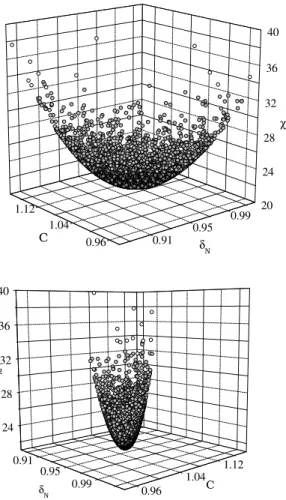
were obtained. Two different views of theχ2 surface
as-sociated with the2+1 106Pd in the space determined by the
(C,δN
L) plane is seen in Fig. 3. Theχ2 contour lines
ob-tained are almost perfect ellipses, in very good agreement with outcomes of the Gauss approximation.
0.91 0.95
0.99
0.96 1.04
1.12 20
24 28 32 36 40
0.91 0.95
0.99 24
28 32 36 40
0.96 1.04
1.12
C
χ2
δN
χ2
C δN
Figure 3. Two different views of theχ2
surface associated with the 2+
1 106
Pd in the space determined by the (C,δN
L) plane obtained
from a Monte Carlo simulation.
The values of C andδN
2 extracted through the inelastic
scattering of deuterons of 13.0 MeV on104Pd,106Pd and
110Pd, for the2+
1 states, are presented in Table 1. The
pre-liminary results for108Pd are also included. The uncertain-ties shown are only the statistical ones. The values of the ratiosB(E2)/B(IS2)e2, ofB(IS2)(b2)and of|Mn/Mp|
obtained are also shown in Table 1. The uncertainties indi-cated were calculated by simple propagation.
TABLE 1. Results obtained in this work for Pd isotopes, through the analysis of CNI.
Nucleus C δN
2 B(E2)/B(IS2) B(IS2) |Mn/Mp| N/Z
(m) (e2) (b2)
104Pd 1.18(3) 1.00(2) 1.54(8) 0.356(13) 0.82 1.26
106Pd 1.06(3) 0.95(2) 1.23(8) 0.326(12) 1.07 1.30
108Pd 1.13(4) 1.41(9) 0.98 1.35
780 M. R. D. Rodrigueset al.
For104Pd and preliminary for108Pd, the extracted C val-ues clearly reveal a non-homogeneous behavior, with an en-hanced contribution of the protons relative to the neutrons to the first quadrupolar excitation, while a less pronounced effect is found for106,110Pd, although the values of C are also slightly higher than 1.00 for both.
Figure 4 shows the values of theB(E2)/B(IS2)e2
ra-tios, extracted in this work for the four even isotopes of Pd analyzed, in comparison with the results obtained by the S˜ao Paulo group in theA ∼100region, with the CNI method-ology applied to the inelastic scattering of isoscalar pro-jectiles, for further consideration. The isotopes94Mo and
98Mo were studied using deuterons as projectiles [1], while 100,102,104Ru were investigated through inelastic scattering
of alpha particles [2]. Comparing the nuclei studied in the present work with their isotones in the Ru chain, formerly investigated, it is to be noted that the nucleus102Ru [2], in the same manner as the isotone104Pd does, reveals a more important contribution of protons than of neutrons to the first quadrupolar excitation. Following the Ru chain, although a rather intense non-homogeneity also in favor of the protons is presented by104Ru, this behavior is in strong contrast to its isotone106Pd, for which the non-homogeneity is diluted. Following the evolution of B(E2)/B(IS2)e2 ratios along
the isotopic chains, it is seen that for the even Ru isotopes there is a growth as N increases, while for the even Pd iso-topes a different behavior emerges.
50 52 54 56 58 60 62 64 66
0,8 1,0 1,2 1,4 1,6 1,8 2,0 2,2
B
(E
2
)/B
(IS
2) (e
2 )
N
Pd Ru Mo
Figure 4. Ratios B(E2)/B(IS2)e2
for 104,106,110
Pd, present work, in comparison with the ones obtained for100,102,104
Ru [2] and94,98
Mo [1].
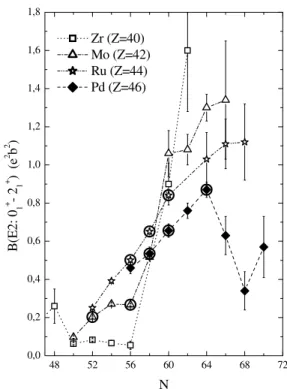
Figure 5 shows the evolution of the B(E2)(e2b2) values,
taken from the comprehensive survey by Raman [8]. The nuclei studied recently by the S˜ao Paulo group are circled in the figure for easier identification. It is seen that, be-tween94Mo, on one side, and104Ru and110Pd, on the other, the B(E2)(e2b2) values increase by more than a factor of 4,
demonstrating the well known tendency to deformation, ver-ified in this mass region forN ∼ 60. As shown by Fig. 4, the values of theB(E2)/B(IS2)e2ratio vary from around
1.2 e2(106,110Pd and100Ru) to approximately 1.6 e2(104Pd and104Ru), therefore the neutron contribution to the first quadrupolar excitations generally lags behind the proton one in the three isotopic chains investigated forN ∼ 60. No
monotonic behavior is evident for this ratio, pointing out that, in this long established region of shape transitions, neu-trons may be responsible for some interesting effects outside the simple collective interpretation.
48 52 56 60 64 68 72
0,0 0,2 0,4 0,6 0,8 1,0 1,2 1,4 1,6 1,8
Zr (Z=40) Mo (Z=42) Ru (Z=44) Pd (Z=46)
B(
E2
:
01
+ -2
1
+ )(
e
2 b 2 )
N
Figure 5. Evolution of the B(E2)(e2b2
) values for even-even nuclei in the regionA∼100.
Acknowledgements
This work was partially supported by Fundac¸˜ao de Am-paro `a Pesquisa do Estado de S˜ao Paulo (FAPESP).
References
[1] G. M. Ukita, T. Borello-Lewin, L. B.
Horodynski-Matsushigue, J. L. M. Duarte, and L. C. Gomes, Phys. Rev.
C64, 014316 (2001).
[2] L. C. Gomeset al., Phys. Rev. C54, 2296 (1996).
[3] C. M. Perey and F. G. Perey, At. Data and Nucl. Data Tables
17, 1 (1976).
[4] P. D. Kunz, computer code DWUCK4, University of Col-orado, 1974.
[5] P. R. Bevington, Data Reduction and Error Analysis for the Physical Sciences (McGraw Hill, New York, 1969).
[6] A. M. Bernstein, V. R. Brown, and V. A. Madsen, Phys. Lett.
71B, 48 (1977);103B, 255 (1981).
[7] H. S. Chung and W. D. Myers, Nucl. Phys. A 513, 283
(1990).