Short Report
J. Braz. Chem. Soc., Vol. 19, No. 5, 1048-1052, 2008. Printed in Brazil - ©2008 Sociedade Brasileira de Química 0103 - 5053 $6.00+0.00
*e-mail: [email protected]
Steroidal Glycoalkaloids and Molluscicidal Activity of
Solanum asperum
Rich. Fruits
Tania M. S. Silva,*
,aCelso A. Camara,
bKristerson R. L. Freire,
cThiago G. da Silva,
cMaria de F. Agra
cand Jnanabrata Bhattacharyya
caNúcleo Complexo Produtivo de Saúde, Instituto Multidisciplinar em Saúde, Campus Avançado Anísio Teixeira,
Avenida Olívia Flores, 3000, Candeias, 45055-090 Vitória da Conquista-BA, Brazil
bDepartamento de Química, Universidade Federal Rural de Pernambuco, R. Dom Manoel de Medeiros, s/n,
Dois Irmãos, 52171-900 Recife-PE, Brazil
cLaboratório de Tecnologia Farmacêutica, Universidade Federal da Paraíba, CP 5009,
58051-970 João Pessoa-PB, Brazil
O fracionamento bio-monitorado do extrato alcaloídico dos frutos verdes de Solanum asperum
forneceu um novo alcalóide esteroidal, denominado solanandaina, juntamente com a solasonina e a solamargina. Tanto o extrato alcaloídico como os glicoalcalóides isolados apresentaram potente atividade moluscicida.
Bioassay-guided fractionation of the alkaloidal extract of the green fruits of Solanum asperum
afforded a new compound, solanandaine along with solasonine and solamargine. The total crude alkaloids as well as the isolated pure alkaloids exhibited significant molluscicidal activity.
Keywords: Solanum asperum, glycoalkaloid, solanandaine, solasonine, solamargine, molluscicidal
Introduction
Solanum L. (Solanaceae) is distributed mainly throughout the tropical and subtropical regions of the world and is the largest and most complex genus of the family Solanaceae. In Brazil, Solanum is represented by about 350 species.1 In this region, many species of Solanum are
widely used in popular medicine and are commonly known as ‘yubeba’, the word derived from Tupi Guarani that refers to the prickles found on the stems of several of the species.1 Some common and wide-spread Solanum species
of Brazil had shown2,3 considerable molluscicidal activity
demonstrated by several members of the genus investigated earlier.4,5Thus, we have been studying various species of Solanum growing in our country3,6-10 with the expectation
that the extracts of plants of this genus might be useful in the control of Biomphalaria glabrata, the intermediate host of Schistosoma mansoni, the parasite that causes human schistosomiasis in Brazil. In our previous bioassays, the crude MeOH extract of the unripe fruits of S. asperum
Rich showed3,11activity in studies with Artemia salina
(LC50= 420.5 g mL-1) and Biomphalaria glabrata (LC 50=
25.5 g mL-1). Bioassay-guided fractionation indicated
that the activity was concentrated in the alkaloid fraction. Thus, the alkaloid fraction upon CC on Sephadex LH-20 followed by PTLC on Silica gel afforded a new compound, solanandaine, C45H73O16N (1) mp 262-263 °C, [ ]D29-60.0
(MeOH, c = 1.0 mg mL-1) along with solasonine (2)
and solamargine (3). In this work, we wish to report the isolation, characterization and the molluscicidal activity of the alkaloids of S. asperum unripe fruits.
Results and Discussion
Silva et al. 1049 Vol. 19, No. 5, 2008
Solanandaine (1) was obtained from MeOH, mp 262-263 °C; [ ]D29-60.0 (MeOH, c= 1.0 mg mL-1). The structure of (1)
was determined mainly on the basis of positive ion HREIMS and LC-MS along with one and two dimensional 1H and 13C
NMR spectral analyses. The assignments of the carbon and proton resonances were made on the basis of HBBD, DEPT,
1H-1H COSY, HSQC, HMBC and NOESY experiments.
The positive ion HREIMS of solanandaine showed a peak atm/z 884.4964 [M + H]+ corresponding to the molecular
formula, C45H73O16N (calculated for C45H74O16N, 884.4929). The positive ion LC-MS showed, in addition to the one at
m/z 884 (M +1), significant peaks at m/z 738 (M+H – 146), 592 (738 – 146), 430 (592 – 162) and 154. Solanandaine, therefore, contains three hexose units. The sequential loss of 146, 146 and 162 daltons indicate that solanandaine has a rhamnosyl-rhamnosyl-glucosyl side chain attached to an aglycone moiety. There are three typical anomeric proton signals in the 1H NMR spectrum of solanandaine. The
one at GH4.93 (J 7.0 Hz) is certainly due to a -D-hexose.
The1H and 13C NMR chemical shifts (Table 1) are fully
compatible with a -D-glucose structure for this hexose unit. The other two anomeric signals are broad singlets at GH
5.84 and 6.38, typical of -L-rhamnose unities. The HSQC spectrum shows that the three signals at GC 100.6, 102.4
and 103.2 are due to the corresponding anomeric carbons of the three sugars unities in the glycoside chain.
1H NMR spectrum of solanandaine (Table 1) showed
among others the presence of five CH3 signals, two of which are doublets at GH 1.61 (3H, J 6.1 Hz) and 1.75 (3H, J 6.2 Hz), supporting the presence of two deoxyhexose units like rhamnose and other three are 3H signals at GH
0.86 (s), 1.04 (s) and 1.08 (d, 7.0 Hz). Thus, the aglycone moiety contains only three CH3 groups which suggest that it is not solasodine. The 1H NMR spectrum also
showed a signal at GH5.30, characteristic of the CH-6 of 5-spirosolanes. The proton decoupled 13C NMR spectrum
of solanandaine (Table 1) shows the presence of 45 signals for 45 carbons in the molecule. In addition to supporting the presence of five CH3 groups, the spectrum also shows two CH2signals (DEPT) at GC 61.6 and 66.4, typical of
two CH2OH groups. Therefore, apart from the one in the glucose unit, there must be an additional CH2OH group in the aglycone moiety of solanandaine. The absence of one CH3group compared to solasodine and the appearance of a CH2OH group instead strongly suggests the aglycone moiety of solanandaine to be solaparnaine.12The MS
peak at m/z 154.16 daltons more than the corresponding peak in solasodine at m/z 138 is characteristic of an oxygenated ring F, like that in solaparnaine. 13C NMR
spectrum of solanandaine further shows a signal at GC
78.4 for C-3, which is considerably downfield relative
to the corresponding shift at ~71.50 in solasodine or solaparnaine (Table 1). This suggests the presence of sugar substitution at that position of the aglycone. This is further supported by the resulting upfield shifts of C-2 and C-4 toGC 30.5 and 39.3, respectively, in solanandaine
relative to solasodine or solaparnaine.1
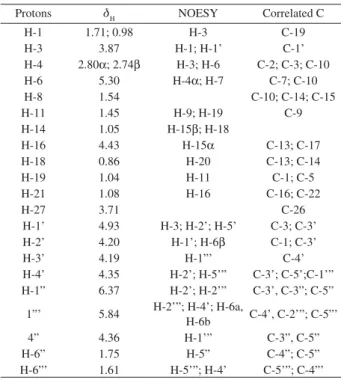
Table 2 shows HMBC and NOESY correlations of the protons and carbons of solanandaine. The proton signal atGH3.87 for H-3 has a cross peak with GC100.6 (C-1´)
and the signal at GH4.93 (d, J 7.0 Hz) for H-1´ shows a cross peak with GC78.4 (C-3) thereby confirming that a
-D-glucose unit is indeed substituted at that position. The NOESY spectrum supports this structure. In addition, it shows cross peaks of glycosidic linkages between GH4.21 (H-2´) and GH6.38 (H-1´´) as well as between GH 4.35 (H-4´)
and GH5.84 (H-1´´´). This is also supported by HMBC correlations (Table 2). Thus, there are two -L-rhamnose units attached to C-2´and C-4´ and an inner -D-glucose unit which, in turn, is attached to C-3 of the aglycone unit of solanandaine.
Therefore, the structure of solanandaine must be 3-O-[ -L-rhamnosyl-(1 2)-[ -L-rhamnosyl-(1
4)--D-glucopyranosyl]-solaparnaine (1). The key HMBC correlations are shown on structure 1. Subsequent acid hydrolysis of solanandaine in the usual way furnished solaparnaine (4). Solasonine (2) and solamargine (3) were identified by comparison of their physical and spectral data with those published in the literature.13,14
Solanum species are known to produce a great variety of steroidal saponins and glycoalkaloids. The potato glycoalkaloids may have evolved in nature to protect the plant against phytopathogens and other hostile environments.15,16 In our previous studies we had found that
several species of Solanum, including the unripe fruits of S. asperum have potentially significant molluscicidal activity.2,3
The crude alkaloid fraction obtained from the active total MeOH extract as well as the pure alkaloids isolated were tested for the molluscicidal activity (Table 2). Individually, the glykoalkaloids solanandaine (1) (LC50=73.1 g mL-1),
solasonine (2) (LC50=47.0 g mL-1) and solamargine (3)
(LC50=26.3 g mL-1), were found to be less active than the
total MeOH (LC50=25.5 g mL-1) 3 and the crude alkaloidal
extracts (LC50=9.7 g mL-1) of S. asperum (Table 3). The
Steroidal Glycoalkaloids and Molluscicidal Activity of Solanum asperum Rich. Fruits J. Braz. Chem. Soc.
1050
indicate that the activity may be related to both glycosidic and aglycone moieties of the Solanum glycoalkaloids. Earlier, the molluscicidal activity of solasonine and solamargine in a mixture was studied17 against Lymnaea cubensis and Biomphalaria glabrata. The toxicity was more pronounced for L. cubensis (100% mortality, 10 ppm) and
B. glabrata (100% mortality, 25 ppm). In the present work, we studied the activity of the individual glycoalkaloids in the bioassay with B. glabrata upon which the LC50 values were calculated. The molluscicidal activity seen in some
Solanum species is generally attributed to the presence of glycoalkaloids, with other classes of secondary metabolites, including alkamines, having litte if any such activity.17
Besides solasonine and solamargine, others glycoalkaloids of Solanum as tomatine17 and solamarine18 presents
molluscicidal activity.
Experimental
General
Melting points were determined on a Koefler hot stage and are uncorrected. Optical rotation was measured with a Bellingham & Stanley Ltd., Model ADP220 polarimeter. The infrared absorption spectra were recorded in KBr pellets, using a Bomem/MB-102 spectrophotometer operating in the 4000–400 cm–1 range. The LC-MS was
obtained in positive electrospray mode using a Quattro LC–Micromass (Waters) and HREIMS were obtained by electron impact on a VG Autospec spectrometer. TLC was done using silica gel Kieselgel 60 (E. Merck) and spots were visualized by Dragendorff reagent. 1H and 13C NMR
spectra were obtained using a Bruker Advance 500 (500 Hz for 1H and 125 MHz for 13C) Spectrometer as well as a
Jeol Eclipse+ 400 spectrometer operating at 400 MHz in pyridine-d5. Sephadex LH-20 (Sigma) was employed for gel permeation chromatography.
Plant material
Fruits of S. asperum were collected in the State of Paraíba, Brazil, in September 2005 from a secondary vegetation of the Atlantic forest area at the campus of the Universidade Federal da Paraíba, in the municipality of João Pessoa, at 130 to 160 m elevation. The plant was identified by Dr. Maria de Fátima Agra (LTF-UFPB). Voucher specimen (Agra 1243) is deposited at the Prof. Lauro Pires Xavier (JPB) Herbarium, Universidade Federal da Paraíba, João Pessoa, Brazil.
Extraction and isolation
Fresh fruits of S. asperum (740.0 g) were extracted with H2O:HOAc (8:2) in a blender and filtered through a bed of Celite. The acid aqueous filtrate was basified with NH4OH and left standing overnight. The gelatinous precipitate (10.1 g) formed was collected by filtration to give a mixture of glycoalkaloids. The alkaloid mixture was then chromatographed over Sephadex LH-20 using MeOH as eluent and fifteen fractions were collected. Fractions 3-10 showed the presence of alkaloids. Fraction 4 (850.0 mg) with three alkaloids was further purified by PTLC in silica gel plates and eluted with CH2Cl2:MeOH:NH3 (9:2:0.5) to furnish solanandaine (1, 120.0 mg), solasonine (2, 450.0 mg) and solamargine (3, 172.0 mg).
Solanandaine (1): white powder (MeOH); mp 262 -263 °C; [ ]D29-60.0 (MeOH, c= 1.0 mg mL-1); IR (KBr)
3450, 2940, 1625, 1071, 1045, 980 cm-1;1H NMR and 13C
NMR (pyridine-d5, 500 MHz and 125 MHz, respectively), see Tables 1 and 2. Positive-ion HREIMS m/z 884.4964 (calculated for C45H74O16N, [M + H]+, 884.4929).
Molluscicidal tests
Molluscicidal activity of the crude alkaloid fraction and the individual glycoalkaloids was measured according to
Silva et al. 1051 Vol. 19, No. 5, 2008
the method described3 using laboratory-bred B. glabrata as
the target snails. The samples were dissolved in three drops of Cremophor emulsifier (BASF, Ludwigshafen, Germany) and dechlorinated water to give stock solutions containing 100 g mL-1 of each of the samples of crude alkaloid
extracts and pure glycoalkaloids. For the preliminary bio-assays, each stock solution was either left undiluted
Table 1. 1H NMR (500 MHz) and 13C NMR (125 MHz) spectral data of solanandaine (1)in pyridine-d
5. Chemical shifts are in G ppm and coupling constants (J= Hz) are given in parenthesisa
Carbon GC GH Carbon GC GH
1 37.8 a)1.71; b)0.98 Glu
2 30.5 a)2.09; b)1.88 1’ 100.6 4.93 (d, 7.0)
3 78.4 3.87 (m) 2’ 78.1 4.21
4 39.3 a)2.80; b)2.74 3’ 78.2 4.19
5 141.1 4’ 78.9 4.35
6 122.2 5.30 (br, s) 5’ 77.2 3.63 (br, d, 9.2)
7 32.7 1.86 6’ 61.6 a)4.21; b)4.07
8 31.9 1.54 Rha
9 50.6 0.89 1” 102.4 6.38 (s)
10 37.4 2” 72.8 4.83 (br, s)
11 21.4 1.45 3” 73.0 4.62 (dd, 9.3; 3.0)
12 40.4 a)1.69; b)1.11 4” 74.4 4.36 (t, 9.6)
13 41.0 5” 69.9 4.94 (br, d, 9.4)
14 57.0 1.05 6” 19.0 1.75 (d,6.2)
15 32.9 a)2.08; b)1.45 Rha
16 79.1 4.43 (m) 1’” 103.2 5.84 (s)
17 63.8 1.81 2’” 72.8 4.68 (br, s)
18 16.8 0.86 (s) 3’” 73.0 4.53 (dd, 9.3, 3.0)
19 19.7 1.04 (s) 4’” 74.2 4.34 (t, 9.4)
20 42.0 1.97 (m) 5’” 70.7 4.89 (m)
21 16.0 1.08 (d, 7.0) 6’” 18.8 1.61 (d, 6.1)
22 99.3
23 34.6 a)1.78; b)1.67
24 26.1 1.84
25 40.5 2.05
26 44.4 a)3.33; b)3.09
27 66.4 3.71 (m)
Superimposed1H signals are described without multiplicity.
Table 2. Significant HMBC and NOESY correlations for solanandaine (1)
Protons GH NOESY Correlated C
H-1 1.71; 0.98 H-3 C-19
H-3 3.87 H-1; H-1’ C-1’
H-4 2.80 ; 2.74 H-3; H-6 C-2; C-3; C-10
H-6 5.30 H-4 ; H-7 C-7; C-10
H-8 1.54 C-10; C-14; C-15
H-11 1.45 H-9; H-19 C-9
H-14 1.05 H-15 ; H-18
H-16 4.43 H-15 C-13; C-17
H-18 0.86 H-20 C-13; C-14
H-19 1.04 H-11 C-1; C-5
H-21 1.08 H-16 C-16; C-22
H-27 3.71 C-26
H-1’ 4.93 H-3; H-2’; H-5’ C-3; C-3’
H-2’ 4.20 H-1’; H-6 C-1; C-3’
H-3’ 4.19 H-1”’ C-4’
H-4’ 4.35 H-2’; H-5’” C-3’; C-5’;C-1’”
H-1” 6.37 H-2’; H-2’” C-3’, C-3”; C-5”
1”’ 5.84 H-2’”; H-4’; H-6a,
H-6b C-4’, C-2’”; C-5”’
4” 4.36 H-1’” C-3”, C-5”
H-6” 1.75 H-5” C-4”; C-5”
H-6”’ 1.61 H-5’”; H-4’ C-5’”; C-4”’
Table 3. Lethal concentrations and molluscicidal activity of crude extracts and pure alkaloids to kill 90%, 50% and 10% of Biomphalaria glabrata
exposed at 24 h experiment
Concentration g mL-1 / (nM)
Samples Tested LC90 LC50 LC10
MeOH Extract* 44.1 25.1 7.0
Alkaloidal fraction 17.33 9.7 2.9
Solanandaine (1) (112.8)99.7 73.1 (82.7) 46.4 (52.5)
Solasonine (2) 72.0 (82.9) 47.0 (53.1) 22.0 (25.3)
Solamargine (3) 63.6 (73.3) 26.3 (30.3) 8.1 (9.33)
Steroidal Glycoalkaloids and Molluscicidal Activity of Solanum asperum Rich. Fruits J. Braz. Chem. Soc.
1052
or further diluted with dechlorinated water to give test solutions containing 100, 50 and 10 g mL-1 of the samples.
Subsequently, five different test solutions, ranging in concentration from 10 to 100 g mL-1 were prepared. For
each assay, 10 adult snails (measuring 8–12 mm diameter) were exposed to 250 mL of each test solution in a glass beaker for 24 h at room temperature. After this period, each test solution was replaced with dechlorinated water. Snail mortality was then recorded over the following 24 h period, and compared with the positive controls (cupric carbonate at 50 g mL-1) and negative controls
(extract-free dechlorinated water containing the same amount of Cremophor as the stock solutions). All assays were run in duplicate. The concentrations that kill 90% (LC90), 50% (LC50) and 10% (LC10) of the treated snails (survived in the negative control cultures) were estimated by probit analysis, using the Origin 6.0
Acknowledgments
The authors thank IMSEAR-CNPq, CAPES and PIBIC-UFPB for financial support. JB thanks CAPES for generous support of Visiting Professorship. TMSS thanks Prof. Edilberto R. Silveira and Daniel E. Uchoa (CENAUREM – Centro Nordestino de Aplicação e Uso de RMN) and Prof. Raimundo Braz-Filho (UENF-RJ) for kindly recording the NMR data, and Socrates Golzio (LTF-UFPB) for kindly recording the LC-MS data.
Supplementary Information
Supplementary data of the isolated compounds as
13C and 1H NMR spectra are available free of charge at
http://jbcs.sbq.org.br, as PDF file.
References
1. Agra, M. F.; Bhattacharyya, J. In Solanaceae. IV, Advances in Biology and Utilization; Nee, M.; Symon, D. E.; Lester, R. N.;
Jessop, J. P. eds.; Royal Botanic Gardens: Kew,U.K., 1999, pp. 341–343.
2. Silva, T. M. S.; Camara, C. A.; Agra, M. F.; Carvalho, M. G.; Frana, M. T.; Brandolini, S. V. P. B.; Paschoal, L. S.; Braz-Filho, R.;Fitoterapia2006,77, 449.
3. Silva, T. M. S.; Batista, M. M.; Camara, C. A.; Agra, M. F.;
Ann. Trop. Med. Parasitol.2005,4, 419.
4. Hostettmann, K.; Kizu, H.; Tomimori, T.; Planta Medica1982,
44, 34.
5. Marston, A.; Hostettmann, K.; Phytochemistry1985,24, 639. 6. Silva, T. M. S.; Braz-Filho, R.; Carvalho, M. G.; Agra, M. F.;
Biochem. System. Ecol.2002,30, 1083.
7. Silva, T. M. S.; Braz-Filho, R.; Carvalho, M. G.; Agra, M. F.;
Biochem. System. Ecol.2002,30, 479.
8. Silva, T. M. S.; Nascimento, R. J. B.; Camara, C. A.; Agra, M. F.; Braz-Filho, R.; Carvalho, M. G.; Biochem. System. Ecol.
2004,32, 513.
9. Esteves-Souza, A.; Silva, T. M. S.; Alves, C. C. F.; Carvalho, M. G.; Braz-Filho, R.; Echevarria, A.; J. Braz. Chem. Soc. 2002,
13, 838.
10. Silva, T. M. S.; Costa, R. A.; Oliveira, E. J.; Barbosa-Filho, J. M.; Agra, M. F.; Camara, C. A.; J. Braz. Chem. Soc. 2005,16, 1467.
11. Silva, T. M. S.; Nascimento, R. J. B.; Batista, M. M.; Agra, M. F.; Barbosa-Filho, J. M.; Camara, C. A.; Rev. Bras. Farmacogn. 2006,17, 35.
12. Bhattacharyya, J.; Heterocycles1985,23, 3111. 13. Puri, R.; Wong, T. C.; J. Nat. Prod.1994,57, 587. 14. Fukuhara, K.; Kubo, I.; Phytochemistry 1991,30, 685. 15. Friedman, M.; Rayburn, J. R.; Bantle, J. A.; Food Chem. Toxicol.
1991,29, 537.
16. Friedman, M.; J. Agric. Food. Chem.2006,54, 8655. 17. Alzerreca, A.; Hart, G.; Toxicol. Lett.1982,12, 151.
18. Wanyonyi, A. W.; Chlabra, S. C.; Mkoji, G.; Eilert, U.; Njue, W. M.; Phytochemistry2002,59, 79.
Received: June 21, 2006
Supplementary Information
J. Braz. Chem. Soc., Vol. 19, No. 5, S1-S11, 2008. Printed in Brazil - ©2008 Sociedade Brasileira de Química 0103 - 5053 $6.00+0.00*e-mail: [email protected]
The Steroidal Glycoalkaloids and Molluscicidal Activity of
Solanum asperum
Rich. Fruits
Tania M. S. Silva,*
,aCelso A. Camara,
bKristerson R. L. Freire,
cThiago G. da Silva,
cMaria de F. Agra
cand Jnanabrata Bhattacharyya
caNúcleo Complexo Produtivo de Saúde, Instituto Multidisciplinar em Saúde, Campus Avançado Anísio Teixeira,
Avenida Olívia Flores, 3000, Candeias, 45055-090 Vitória da Conquista-BA, Brazil
bDepartamento de Química, Universidade Federal Rural de Pernambuco, R. Dom Manoel de Medeiros, s/n,
Dois Irmãos, 52171-900 Recife-PE, Brazil
cLaboratório de Tecnologia Farmacêutica, Universidade Federal da Paraíba, CP 5009,
58051-970 João Pessoa-PB, Brazil
Figure S1. 1H NMR (400 MHz, Pyridine-d
The Steroidal Glycoalkaloids and Molluscicidal Activity of Solanum asperum Rich. Fruits J. Braz. Chem. Soc.
S2
Figure S2. 13C NMR (100 MHz, Pyridine-d
5) spectrum of solanandaine (1).
Figure S3. 13C NMR spectrum (100 MHz, Pyridine-d
Silva et al. S3 Vol. 19, No. 5, 2008
Figure S4. 13C NMR spectrum (100 MHz, Pyridine-d
5) expansion downfield of solanandaine.
Figure S5. COSY spectrum (1H NMR: 400 MHz, Pyridine-d
The Steroidal Glycoalkaloids and Molluscicidal Activity of Solanum asperum Rich. Fruits J. Braz. Chem. Soc.
S4
Figure S6. COSY spectrum (1H NMR: 400 MHz, Pyridine-d
5) expansion upfield of solanandaine (1).
Figure S7. HMQC spectrum (1H NMR: 400 MHz, 13C NMR: 100 MHz, Pyridine-d
Silva et al. S5 Vol. 19, No. 5, 2008
Figure S8. HMBC spectrum (1H NMR: 400 MHz, 13C NMR: 100 MHz, Pyridine-d
5) of solanandaine (1).
Figure S9. HMBC spectrum (1H NMR: 400 MHz, 13C NMR: 100 MHz, Pyridine-d
The Steroidal Glycoalkaloids and Molluscicidal Activity of Solanum asperum Rich. Fruits J. Braz. Chem. Soc.
S6
Figure S10. HREIMS (70 eV) spectrum of solanandaine (1).
Figure S11.1H NMR (500 MHz, Pyridine-d
Silva et al. S7 Vol. 19, No. 5, 2008
Figure S12.13C NMR (125 MHz, Pyridine-d
5) spectrum of solanandaine (1) and solamargine (3) mixture.
Figure S13.13C NMR spectrum (125 MHz, Pyridine-d
The Steroidal Glycoalkaloids and Molluscicidal Activity of Solanum asperum Rich. Fruits J. Braz. Chem. Soc.
S8
Figure S14.13C NMR spectrum (125 MHz, Pyridine-d
5) expansion downfield of solanandaine (1) and solamargine (3) mixture.
Silva et al. S9 Vol. 19, No. 5, 2008
Figure S16. DEPT spectrum (Q = 135°, 125 MHz, Pyridine-d5) expansion upfield of solanandaine (1) and solamargine (3) mixture.
The Steroidal Glycoalkaloids and Molluscicidal Activity of Solanum asperum Rich. Fruits J. Braz. Chem. Soc.
S10
Figure S18. COSY spectrum (1H NMR: 500 MHz, Pyridine-d
5) of solanandaine (1) and solamargine (3) mixture.
Figure S19. HSQC spectrum (1H NMR: 500 MHz, 13C NMR: 125 MHz, Pyridine-d
Silva et al. S11 Vol. 19, No. 5, 2008
Figure S20. HMBC spectrum (1H NMR: 500 MHz, 13C NMR: 125 MHz, Pyridine-d
5) of solanandaine (1) and solamargine (3) mixture.
Figure S21. NOESY spectrum (1H NMR: 500 MHz, Pyridine-d