Interactions between antidepressants and
antihypertensive and glucose lowering drugs
among patients in the HIPERDIA Program,
Coronel Fabriciano, Minas Gerais State, Brazil
Interações entre antidepressivos e medicamentos
e anti-hipertensivos e hipo-glicemiantes em
pacientes do Programa HIPERDIA em
Coronel Fabriciano, Minas Gerais, Brasil
1 Curso de Farmácia, Centro Universitário do Leste de Minas Gerais, Coronel Fabriciano, Brasil.
Correspondence P. V. Coelho
Curso de Farmácia, Centro Universitário do Leste de Minas Gerais.
Rua Polônia 172, Timóteo, MG 35182-260, Brasil. [email protected]
Paula Vieira Coelho 1 Carla de Arêdes Brum 1
Abstract
The aims of this study were to investigate the prevalence and to describe the most frequent po-tential interactions between antidepressants and antihypertensive and glucose lowering drugs in the HIPERDIA Program at two primary care units in Coronel Fabriciano, Minas Gerais State, Brazil. Data were collected through the patient registry in the HIPERDIA Program and the local psy-choactive drug dispensing system. Interactions were classified as due to pharmacokinetic and/ or pharmacodynamic mechanisms. Prevalence of antidepressant use in the HIPERDIA Program was 4.37% (29 of patient 663 records). Of the HIPERDIA patients in treatment with antidepres-sants, 19 were exposed to 47 interactions, 23.4% of which involving pharmacokinetic, 61.7% phar-macodynamic synergy, and 15.9% simultaneous pharmacokinetic and pharmacodynamic mech-anisms. Complications can arise from drug-drug interactions, a situation that can escape the at-tention of prescribing health professionals.
Drug Interactions; Antihypertensive Agents; Hy-poglycemic Agents; Antidepressive Agents
Introduction
Polytherapy is a useful tool for treating coexis-tent diseases, but drug combination may reduce efficacy and/or favor the appearance of adverse reactions with different degrees of severity 1. Bra-zil is the fifth country in the world in consump-tion of medicines and the first in Latin America, and the Oswaldo Cruz Foundation estimates 24 thousand deaths per year from poisoning with medication 2. New drugs, new indications, and new interactions appear daily, and drug-drug in-teractions are thus an everyday issue in medical practice 3.
Irrational use of medicines is a major pub-lic health problem worldwide. According to es-timates, incorrect prescription leads to costs involving 50 to 70% of government funds ear-marked for drugs 4. Meanwhile, when used cor-rectly, medicines are the most cost-effective ther-apeutic resource 5.
Due to the high incidence of simultaneous hypertension, diabetes, and depression, it is common to find patients that use antidepres-sants and antihypertensive and glucose lowering drugs concurrently. This polytherapy requires in-creased knowledge of these drug classes, particu-larly in relation to drug-drug interactions. “Due to the pathophysiological characteristics of these clinical entities and the complexity and narrow therapeutic index of these drugs, severe complica-tions can be triggered by their interaccomplica-tions if they are selected or managed inadequately” 7 (p. 135).
In order to promote better quality of life for patients with diabetes and/or hypertension and allow monitoring of drug dispensing, the Brazilian Ministry of Health developed the HIPERDIA Pro-gram. The program’s objective is to register and monitor patients with hypertension and diabetes captured by the National Plan for Reorganization of Care for Arterial Hypertension and Diabetes Mellitus in all the outpatient units of the Unified National Health System (SUS), generating infor-mation for local, Municipal, State, and Ministry of Health administrators (HIPERDIA: System for Registering and Monitoring Individuals with Hypertension and Diabetes; http://hiperdia. datasus.gov.br).
Numerous studies on medication errors, including drug-drug interactions, are currently underway worldwide, analyzing the medication systems in various hospitals and systematically assessing the errors. A hospital study by Cassiani et al. 8 suggests that factors contributing to medi-cation errors include lack of concern by health staff towards the treatment plan adopted by pre-scribers. The authors found a striking lack of drug information centers and revision of medical pre-scriptions by pharmacists and nurses to evaluate the treatment, excessive doses, and drug-drug interactions 8. Wiltink 1 highlights the pharma-cist’s importance in controlling and evaluating the prescribed drugs, since interactions pose a permanent risk that deserves investigation.
Serious adverse events (SAEs) are the sixth most common cause of death in hospitalized patients in the United States, while the most fre-quent form of SAE results from drug-drug inter-actions 3. This emphasizes the need for studies on prescriptions to identify and establish the prevalence of drug-drug interactions that can cause disorders for patients and expenses for the health system.
In this study, we analyze data for patients in the HIPERDIA Program in primary care units in the neighborhoods of Caladinho and Centro in Coronel Fabriciano, Minas Gerais State, Brazil, and from the electronic registry of psychoactive drugs to identify possible drug-drug interactions
involving antidepressants and antihypertensive and glucose lowering drugs during treatment.
Materials and methods
The sample selection included a representative number of patients for an error less than 5%, based on the total number of patients registered in the HIPERDIA Program in the primary care units in the neighborhoods of Caladinho and Centro in the city of Coronel Fabriciano. System-atic random sampling was used to select indi-viduals for the sample.
The representative sample was calculated ac-cording to Barbetta 9:
(1) n0 = 1/E02 (2) n = N x n0 / N + n0
Where: n0: approximation for sample size; E0: tolerable sampling error = 0.05 or 5%; N: popula-tion size; n: sample size (number of elements); (1): sample size (n0) as a function of the tolerable sampling error; (2): correction of the sample cal-culation as a function of n0.
Based on the above calculation, we analyzed the records of 663 patients in the HIPERDIA Pro-gram in Coronel Fabriciano, 316 of whom were from the 1,082 patients registered in the Caladin-ho health unit and 347 from the 769 patients in the Centro health unit on the day of the data col-lection.
Data were collected on the patients’ age, gen-der, and antihypertensive and glucose lowering medication in January 2007. In Coronel Fabri-ciano, data on health unit users are decentral-ized, i.e., each program (HIPERDIA, Psychoactive Drug Dispensing System) records the data on the medicines dispensed for that purpose. Data con-version to electronic format began in 2007, but the amount of data available in the system is still low.
Information on patients in the HIPERDIA Program (name, age, gender, current medication, dose) is recorded manually in a notebook known as the “records ledger”, containing only the in-formation concerning the medicines. This study included patients registered in the HIPERDIA Program since December 2003 and attending the primary care units in the Caladinho and Centro neighborhoods.
Fabricia-no, including for patients treated at the primary care units analyzed in the current study.
For purposes of simplification, this study uses “record” to refer to the data collection site for patients in the HIPERDIA Program and in the Psychoactive Drug Dispensing System.
The drug-drug interactions were classified as
pharmacokinetic, when one of the drugs poten-tially interfered in the absorption, distribution, metabolism, and excretion of another, or phar-macodynamic, as when drugs with similar or op-posite effects are administered jointly 10,11.
The data were presented as proportions, means, standard deviations (SD), and confidence intervals. Data analysis used Microsoft Office Ex-cel, version 2007 (Microsoft Corp., USA).
Results and discussion
Of the 663 records that were analyzed, 66.37% were from women and 33.63% from men, with a median age of 60 years (range: 18 to 101).
The sample consisted of 523 individuals (78.9%) with hypertension, 32 (4.8%) with dia-betes, and 108 (16.3%) with both diabetes and hypertension. These data suggest a relatively
low rate for diabetes alone, compared to that of patients with both diabetes and hypertension, confirming the tendency for diabetics to develop cardiovascular disorders. According to the 2002 consensus of the Brazilian Society of Diabetes, arterial hypertension is present in 50% of pa-tients with type 2 diabetes mellitus and appears in late form in patients with type 1 diabetes, as renal function decreases 12.
In all, 1,483 drugs were prescribed for treat-ment of hypertension, diabetes, and depression on 663 patient records, resulting in a mean of 2.24 (SD = 1.13) drugs per individual, ranging from 1 to 6 medicines per patient. This figure is lower than the national mean, which is 5 drugs by one-third of individuals older than 60 years 13,14, and can be identified as one of the reasons for the relatively low drug-drug interaction rate found in this study. The patients were taking a mean of 3.7 (SD = 2.27) pills per day.
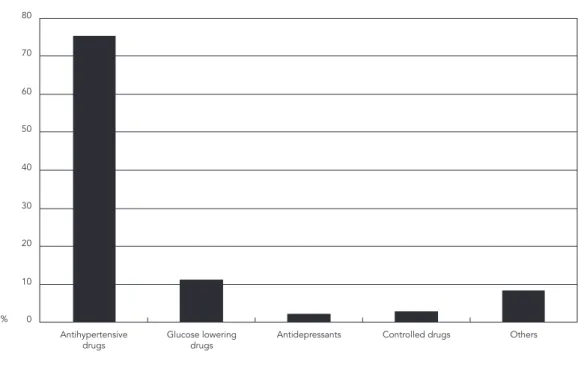
Analysis of the medicines used according to therapeutic class showed: 75.46% antihyperten-sive drugs, 11.19% glucose lowering drugs, and 2.23% antidepressants. Figure 1 summarizes the data.
Table 1 lists the drugs identified and shows the diuretic hydrochlorothiazide as the most
Figure 1
Relative frequency of therapeutic classes found in patient records in the HIPERDIA Program.
0 10 20 30 40 50 60 70 80
%
Antihypertensive
Table 1
Relative frequency of prescribed medications.
Drugs Absolute frequency Relative frequency (%)
Antihypertensive drugs
Hydrochlorothiazide 339 22.86
Captopril 334 22.52
Propranolol 146 9.84
Nifedipine 107 7.22
Furosemide 63 4.25
Methyldopa 45 3.03
Digoxin 35 2.36
Enalapril 11 0.74
Atenolol 9 0.61
Propatylnitrate 7 0.47
Amlodipine 6 0.40
Chlorthalidone 6 0.40
Amiodarone 3 0.20
Verapamil 3 0.20
Spironolactone 2 0.13
Amiloride 1 0.07
Carvelidol 1 0.07
Isosorbide 1 0.07
Subtotal 1,119 75.46
Glucose lowering drugs
Glibenclamide 52 3.51
Insulin 52 3.51
Metformin 51 3.44
Gliclazide 4 0.27
Chlorpropamide 3 0.20
Glimepiride 3 0.20
Rosiglitazone 1 0.07
Subtotal 166 11.19
Antidepressants
Fluoxetine 13 0.88
Amitriptyline 9 0.61
Imipramine 6 0.40
Nortriptyline 3 0.20
Mirtazapine 1 0.07
Paroxetine 1 0.07
Subtotal 33 2.23
(continues)
frequently prescribed antihypertensive, corre-sponding to 22.86% of all the drugs prescribed, followed by captopril (22.52%) and propranolol (9.84%). These data are not entirely consistent with the 3rd Brazilian Consensus on Arterial Hy-pertension 15, which establishes the drugs of choice for initial treatment of arterial hyper-tension as diuretics in monotherapy, follow by beta-blockers, calcium channel antagonists, giotensin-converting enzyme inhibitors, and
an-giotensin II antagonists. Despite the guidelines, the treatment choice should be based on the patient’s predominant physiopathogenic condi-tions, individual condicondi-tions, associated diseases, socioeconomic conditions, and the capacity of the medication to interfere in cardiovascular morbidity and mortality 15.
Table 1 (continued)
Drugs Absolute frequency Relative frequency (%)
Antidepressants
Fluoxetine 13 0.88
Amitriptyline 9 0.61
Imipramine 6 0.40
Nortriptyline 3 0.20
Mirtazapine 1 0.07
Paroxetine 1 0.07
Subtotal 33 2.23
Controlled drugs
Diazepam 12 0.81
Clonazepam 10 0.67
Bromazepam 4 0.27
Haloperidol 3 0.20
Biperidene 2 0.13
Carbamazepine 2 0.13
Phenobarbital 2 0.13
Thioridazine 2 0.13
Chlorpromazine 1 0.07
Diltiazem 1 0.07
Phenytoín 1 0.07
Levodopa 1 0.07
Levomepromazine 1 0.07
Subtotal 42 2.83
Other
Acetyl salicylic acid (ASA) 70 4.72
Other 53 3.57
Subtotal 123 8.29
by metformin, with 3.44%. The similarity in the prescription rates for these drugs may suggest equal preference in medical prescription. A study by Pereira et al. 16 in 2005 showed a preference for monotherapy with glibenclamide.
Fluoxetine was the most widely prescribed antidepressant (40.63% of the antidepressant prescriptions, followed by amitriptyline (28.13%), imipramine (21.88%), nortriptyline (6.25%), and paroxetine (3.11%) respectively.
The group of “controlled” medications in-cluded those covered by Ministry of Health Rul-ing 344/98 17, excluding the antidepressants that were used by the patients in the sample.
The most widely described drug in the “oth-ers” group was acetylsalicylic acid 100mg (ASA). This group also included other drug classes like anticoagulants, antacids, anti-inflammatory drugs, herbal drugs, and lipid lowering drugs.
Table 1 provides the drugs in each group, in-dicating their absolute and relative frequencies.
Antidepressants had been prescribed in com-bination with antihypertensive and glucose low-ering drugs in 29 of the 663 records (4.37%). This does not necessarily mean that the 29 patients
had a diagnosis of clinical depression, since the record does not provide the patients’ clinical di-agnosis for other diseases, but the proportion is similar to that found in the SHEP study (Systolic Hypertension in the Elderly), which found asso-ciated clinical depression in 4.8% of 4,508 elderly patients with systolic hypertension 18.
Nineteen of the 29 records showed a total of 47 potential drug interactions. Not all of the re-cords showed potential interactions, but those that did had a mean of 2.37 interactions (ranging from 1 to 5). This can be explained by the capac-ity of antidepressants to interact with other drugs through pharmacokinetic and pharmacodynam-ic mechanisms. Although relatively few patients were exposed to interactions, this figure is worri-some, since the interactions that were identified mostly occur through synergy and can increase the hypotensive and glucose lowering effects. In addition, the mean number of interactions is problematic, since such interactions can trigger severe side effects in patients.
with potential interactions were also found, but were not described, since their frequencies were not significant; however, they are important and require attention by health staff, especially phar-macists.
The classification of interactions between an-tidepressants and antihypertensive and glucose lowering drugs according to mechanism of ac-tion indicated that 23.4% could occur through pharmacokinetic mechanisms and the major-ity (61.7%) through pharmacodynamic mecha-nisms, all of which involving drug-drug syner-gies, which could cause serious side effects such as severe hypotension or hypoglycemic attack. In 14.9% of cases, the interactions could occur through the two mechanisms simultaneously.
The suggested causes for explaining the ex-istence of prescriptions with drugs involving potential interactions includes the complexity of these medicines, lack of information in the public healthcare services on their interactions and adverse effects, and lack of effective imple-mentation of a pharmaceutical care model. In addition, the municipality lacks a single, unified patient registry.
Pharmaceutical care encompasses patient follow-up and evaluation of drug usage and ther-apeutic efficacy 19 and is included in the field of comprehensive treatment measures under the Unified National Health System 20. Thus, phar-macists play a crucial role in primary care units, since they are responsible for assessing and in-terpreting prescriptions and should identify any contraindications and potential interactions. In addition, if necessary they should contact the prescribing physician to clarify any problems that have been detected 21.
Patient data are still decentralized in the municipality. Therefore, the prescribing health
professional lacks access to patient informa-tion, which could otherwise reduce the risk of prescribing drugs that might lead to interaction. One possible solution would be the implemen-tation of an electronic system with the patient’s complete record, which could be accessed by at-tending physicians from their offices or clinics. However, although electronic data systems can contribute to adequate treatment and identifica-tion of potential interacidentifica-tions, they do not take individual patient conditions into account and thus do not rule out the need for assessment of patient conditions and participation by pharma-cists in public primary healthcare services.
Another factor that can influence the exis-tence of prescriptions with potential drug inter-actions is physicians’ knowledge of such interac-tions. This study did not investigate whether the simultaneous prescription of drugs with poten-tial for interaction was due to the physician’s lack of knowledge. This highlights the need for drug information services in order for health profes-sionals to assess the risk/benefit ratio when pre-scribing. Such care should be taken in order to prevent adverse reactions to medicines, contrib-ute to treatment adherence, and improve quality of life for patients in the HIPERDIA Program.
Conclusion
In conclusion, 4.37% of the 663 patients in the HIPERDIA Program used antidepressants, of which 19 were exposed to 47 interactions due to pharmacokinetic (23.4%), pharmacodynamic synergy (61.7%), and simultaneous pharmacoki-netic/ pharmacodynamic mechanisms (15.9%).
This study thus contributed with pharmaco-epidemiological information on the prevalence
Table 2
Relative frequency of prescribed medications.
Antidepressant Drug class, HIPERDIA Program Absolute Relative Description of interaction
frequency frequency (%)
Fluoxetine Diuretics (Furosemide Hydrochlorothiazide) 9 19.15 Increased risk of hyponatremia 22
Imipramine β-blockers (Propranolol. Atenolol) 5 10.64 Increased hypotensive effects due to
desensitization of β-adrenergic receptors 22
Fluoxetine Angiotensin-converting enzyme 5 10.64 Risk of development of hyponatremia and inhibitors (Captopril. Enalapril) precipitation of adverse effects from ACE
inhibitors (dry cough) 22
Fluoxetine β-blockers (Propranolol. Atenolol) 4 8.51 Decreased metabolism of β-adrenergic blockers
with increases in their adverse effects 22
of potential drug-drug interactions in patients under the HIPERDIA Program that take antide-pressants, since studies are scarce in the litera-ture on prevalence of drug interactions.
The interactions detected in treatment of patients in the HIPERDIA Program that are on antidepressants emphasize the important role of pharmacists in the health team, to conduct an
assessment of the prescription before dispensing medicines to patients, as well as to monitor them throughout treatment through pharmaceutical care, in order to prevent adverse reactions and suggest necessary changes, thereby improving patients’ quality of life and reducing costs from drug-drug interactions.
Resumo
O objetivo do estudo foi investigar a prevalência e des-crever as possíveis interações de medicamentos mais freqüentes entre antidepressivos e anti-hipertensivos/ hipoglicemiantes do programa HIPERDIA de duas uni-dades básicas de saúde do Município de Coronel Fa-briciano, Minas Gerais, Brasil. A coleta de dados foi re-alizada mediante consulta ao caderno de cadastro dos pacientes usuários do programa de HIPERDIA e pela consulta ao sistema de dispensação de psicotrópicos do município. As interações foram classificadas segun-do o mecanismo farmacocinético e farmacodinâmico. A prevalência do uso de antidepressivos em pacientes do HIPERDIA foi de 4,37% (29 de 663 cadastros ana-lisados). Dos pacientes do HIPERDIA em tratamento com antidepressivos, 19 estão expostos a 47 interações, 23,4% delas ocorrem por mecanismos farmacociné-ticos, 61,7% por mecanismos farmacodinâmicos de sinergismo e 15,9% interagem das duas formas simul-taneamente. Complicações podem ser provocadas por interações entre fármacos e os profissionais prescrito-res podem não estar atentos a tal fato.
Interações de Medicamentos; Anti-Hipertensivos; Hi-poglicêmicos; Antidepressivos
Contributors
P. V. Coelho and C. A. Brum participated in the writing, revision, and correction of the article.
Acknowledgments
References
1. Wiltink EH. Medication control in hospitals: a practical approach to the problem of drug-drug interactions. Pharm World Sci 1998; 20:173-7. 2. Morais J. A medicina doente. Super Interessante
2001; 15:48-58.
3. Marcolin MA, Cantarelli MG, Garcia-Junior M. Drug interactions among clinical and psychiatric drugs. Rev Psiquiatr Clín (São Paulo) 2004; 31:70-81. 4. Marin N, Luiza VL, Osório-de-Castro CGS, Macha-do-dos-Santos S. Assistência farmacêutica para gerentes municipais. Rio de Janeiro: Organização Pan-Americana da Saúde/Organização Mundial da Saúde; 2003.
5. McIsaac W, Naylor CD, Anderson GM, O’Brien BJ. Reflections on a month in the life of the Ontario Drug Benefit Plan. Can Med Assoc J 1994; 150: 473-7.
6. Messias E. Depressão e seus efeitos sobre o corpo. Psiquiatria On-line 2003; 8(4). http://www.polbr. med.br/arquivo/mess0403.htm.
7. Sucar DD. Interação medicamentosa de venlafaxi-na com captopril. Rev Bras Psiquiatr 2000; 22:134-7. 8. Cassiani SHB, Miasso AI, Silva AEBC, Fakin FT,
Oliveira RC. General aspects and number of phas-es of the medication system in four Brazilian hos-pitals. Rev Latinoam Enferm 2004; 12:781-9. 9. Barbetta PA. Estatística aplicada às ciências
so-ciais. 5a Ed. Florianópolis: Editora da Universidade Federal de Santa Catarina; 2003.
10. Lisboa SML. Interações e Incompatibilidades Me-dicamentosas. In: Gomes MJVM, Reis AMM, orga-nizadores. Ciências farmacêuticas: uma aborda-gem em farmácia hospitalar. São Paulo: Editora Atheneu; 2000. p. 147-63.
11. Nies AS, Spielberg SP. Princípios da terapêu-tica. In: Hardman JG, Limbird LE, organizadores. Goodman & Gilman: as bases farmacológicas da terapêutica. 10a Ed. Rio de Janeiro: McGraw-Hill; 2001. p. 31-44.
12. Sociedade Brasileira de Diabetes. Consenso da Sociedade Brasileira de Diabetes: diagnóstico e classificação do diabetes mellitus e tratamento do diabetes mellitus do tipo 2. http://www.diabetes. org.br/politicas/consensos.php (accessed on 14/ Oct/2007).
13. Stuck AE, Beers MH, Steiner A, Aronow H, Ruben-stein LZ, Beck JC. Inappropriate medication use in community-residing older persons. Arch Intern Med 1994; 154:2195-200.
14. Pollow RL, Stoller EP, Forster LE, Duniho TS. Drug combinations and potential for risk of adverse drug reaction among community-dwelling elderly. Nurs Res 1994; 43:44-9.
15. Kohlmann Jr. O, Guimarães AC, Carvalho MHC, Chaves Jr. HC, Machado CA, Praxedes JN. III Con-senso Brasileiro de Hipertensão Arterial. http:// www.sbn.org.br/Diretrizes/cbhaap.htm (accessed on 14/Oct/2007).
16. Pereira LRL, Andrade RCG, Pereira JGC, Marchetti JM. Avaliação de prescrições de medicamentos pa-ra pacientes com diabetes mellitus atendidos por uma unidade básica de saúde. Rev Ciênc Farm Bá-sica Apl 2005; (26):199-203.
17. Brasil. Portaria nº. 344, de 12 de maio de 1998. Aprova o regulamento técnico sobre substâncias e medicamentos sujeitos a controle especial. Diário Oficial da União 1998; 19 mai.
18. Wassertheil-Smoller S, Applegate WB, Berge K. Change in depression as a precursor of cardiovas-cular events. Arch Intern Med 1996; 156:553-61. 19. Agência Nacional de Vigilância Sanitária. Portaria
nº. 3.916. Aprova a Política Nacional de Medica-mentos. Diário Oficial da União 1998; 10 nov. 20. Fundação Nacional de Saúde. Lei nº. 8.080. Dispõe
sobre a promoção, proteção e recuperação da saú-de, a organização e o funcionamento dos serviços correspondentes, e da outras providências. Diário Oficial da União 1990; 20 set.
21. Brandão A. Resolução nº. 357/2001: a nova Bíblia do farmacêutico. Pharm Bras 2001; 25:4-12. 22. Tatro DS. Drug interaction facts. San Carlos: Facts
and Comparisons; 2003.
Submitted on 10/Mar/2008