CARLOS J. O. TREJO-PECH [email protected] Professor at The University of Tennessee, Department of Agricultural and Resource Economics – Knoxville – TN, USA
SUSAN WHITE [email protected] Professor at University of Maryland, Robert H. Smith School of Business – College Park – MD, USA
ARTICLES
Submitted 06.27.2016. Approved 01.16.2017
Evaluated by double blind review process. Scientiic Editor: Martin Jayo
THE USE OF CASE STUDIES IN UNDERGRADUATE
BUSINESS ADMINISTRATION
Uso de estudos de caso em cursos de graduação em Administração de Empresas
El uso de casos en Administración de Empresas a nivel de licenciatura
ABSTRACT
We develop constructs to evaluate the factors inluencing the degree of students’ acceptance of cases. In our proposed framework, student acceptance is afected by the case selection, intensity of faculty use, training, course type and level, level of instructor expertise, teaching atmosphere, and the faculty’s beliefs about the usefulness of the case method. Our sample includes faculty teaching quantitative or qualitative courses across several disciplines in undergraduate business administration. Responses to a survey are analyzed using factor analysis and regression. The quantitative analysis is complemented by interviews with a subset of expert faculty using a two-round modiied Delphi technique. This study may be limited by the fact that it measured faculty perceptions of the degree of students’ acceptance of cases, rather than student acceptance directly. Future research might survey students or use students’ courses evaluations to validate or contradict our results.
KEYWORDS |Case teaching in business, undergraduate management education, factor analysis, quan-titative and qualitative research, modiied Delphi technique.
RESUMO
Desenvolvemos construtos para avaliar os fatores que influenciam o grau de aceitação dos alunos em rela-ção aos estudos de casos. Na configurarela-ção proposta, a aceitarela-ção dos alunos é afetada pela selerela-ção do caso, intensidade de seu uso pelos docentes, formação, tipo e nível do curso, nível de especialidade do instru-tor, atmosfera de ensino, e crenças dos docentes com relação à utilidade do método de estudo de caso. Nossa amostra inclui docentes de cursos quantitativos ou qualitativos em várias disciplinas em nível de graduação na área de administração de empresas. As respostas à pesquisa foram analisadas utilizando-se análise fatorial e regressão. A análise quantitativa é complementada por entrevistas com um subconjunto de docentes especialistas, utilizando-se uma técnica Delphi de dois ciclos modificada. Este estudo pode ser limitado pelo fato de haver mensurado percepções de docentes quanto ao grau de aceitação de alunos em relação a estudos de casos, e não a aceitação dos alunos diretamente. Futuros estudos podem pesquisar alunos ou utilizar avaliações dos alunos com relação aos cursos para validar ou refutar nossos resultados.
PALAVRAS-CHAVE |Ensino de caso em negócios, graduação em Administração de Empresas, análise fatorial, pesquisa quantitativa e qualitativa, técnica Delphi modificada.
RESUMEN
Desarrollamos constructos para evaluar los factores que influyen en el nivel de aceptación de los estudiantes en relación a los casos de estudio. En el marco conceptual que proponemos, la aceptación del estudiante se determina por la selección de los casos, la intensidad de uso por parte de los profesores, el entrenamiento, el tipo y nivel del curso, la experiencia de los profesores, la atmósfera de enseñanza, y la convicción del cuerpo docente sobre la utilidad del método de casos. Nuestra muestra incluye profesores de cursos cualitativos y cuantitativos de varias asignaturas de la licenciatura de administración de empresas. Las respuestas de la encuesta se analizan a través de análisis factorial y análisis de regresión. El análisis cuantitativo se comple-menta con entrevistas a profesores expertos; y una parte de la muestra, mediante el método Delphi modificado en dos rondas. Una posible limitación del estudio es el hecho de que medimos la percepción de los profesores sobre el nivel de aceptación de los estudiantes, en vez de medir directamente el nivel de aceptación de los estudiantes. Futuros trabajos de investigación podrían encuestar a estudiantes o usar evaluaciones de estu-diantes acerca de cursos con casos para validar o contradecir nuestros resultados.
INTRODUCTION
Business schools use case studies extensively (Burgoyne & Mumford, 2001;Ambrosini, Bowman, & Collier, 2010), and, while more cases are required of graduate students, undergraduate courses also require students to read, analyze, and prepare oral and written reports using cases. The pedagogy of case teaching has been researched most extensively at the graduate level. We investigate the use of cases in undergraduate classes by evaluating the factors inluencing the degree of students’ acceptance of cases. Case teaching in business education started in 1920 at the Harvard Business School (Jackson, 1926; Charan, 1976; Shugan, 2006). In his address to the Tenth Annual Meeting of the American Association of University Instructors of Accounting, Jackson (1926)
refers to the case method as “nothing more or less that an attempt to ind a better way of teaching than we had before known” (p. 108). Today, the case method stands as a major pedagogy in business education (Mesny, 2013) despite criticism by scholars. (Argyris (1980), for instance, questions the ability of the case method to foster the double-loop learning that management requires. Shugan (2006) claims that the case method negatively impacts faculty research resources and impedes the dissemination of research results in the classroom). However, the theory behind the case method is still under construction (Burgoyne & Mumford, 2001), perhaps due to the diiculty of establishing a valid relationship between the case method and the performance of students later in their careers as managers (Mesny, 2013). Researchers need to ind alternative ways to test the use of the case method. Such an alternative is proposed in this study.
Christensen and Carlile (2009) argue that faculty who categorize a course by its attributes in terms of lecture-based vs. case-based are hypothesizing that one method represents a better way to convey theory and are thus helping to build a theory that has not yet coalesced. The authors deine theory building (i.e., descriptive theory) as comprising three steps: the development of constructs through careful observation, description, and measurement of phenomena; the categorization by attributes of the phenomena or development of frameworks; and the measurement of correlations between attributes and outcomes. Our study contributes to the descriptive theory of the case method: we propose constructs, present a framework, and provide statistical tests. The main purpose of this study is to develop constructs with which to evaluate the factors inluencing the degree of students’ acceptance of cases. Speciically, we propose a framework for the degree of student acceptance of case teaching and statistically test it on business administration undergraduates at a private university in Mexico.
THEORETICAL FRAMEWORK
Literature review
The case method, traditionally entrenched in graduate programs, has extended to undergraduate curricula (Bruner, Gup, Nunnally, & Pettit, 1999; Mesny, 2013). To be accredited, business schools need to ofer learning objectives for their students. The Association to Advance Collegiate Schools of Business (AACSB) guidelines require universities to develop measurable goals. Some universities have adopted goals for undergraduates that case studies could help with
(Rose & Delaney, 2007; Kester, 2011). For example, the goal of thinking critically and creatively includes applying elements of critical thinking, identifying options and novel solutions, and comparing among multiple points of view. Case teaching promotes these goals since students must learn to analyze complex, noisy problems while considering multiple viewpoints. However, this characteristic often intentionally creates uncertainty, ambiguity, complexity, and diversity, which can be costly and diicult to manage (Booth, Bowie, Jordan, & Ripplin, 2000). This becomes especially challenging for undergraduates, who lack business experience and are less tolerant of complexity and uncertainty. Indeed, Bruner et al. (1999) argue that what works with the case method for teaching graduate students may or may not work for teaching undergraduates. To provide some context, we next present studies, focused on both the graduate and undergraduate levels that have looked at the pros and cons of case teaching. This is followed by a literature review on students’ attitudes toward case teaching.
Böcker (1987) found, after surveying graduate students in a marketing planning and control class, that case teaching was more efective than lecturing. Kooskora (2002) described the use of the case method in graduate ethics classes and suggested how instructors could use cases more efectively.
Gonglewski and Helm (2010) found that cases were an efective tool. Their study included interviews with faculty and students over a two-year period about international business, foreign languages, and culture. Halvorson, Crittenden, and Pitt (2011)
Studies on case use in undergraduate education are rare
(Booth et al., 2000). Banning (2003) found that the use of cases increased students’ tolerance of ambiguity, a critical attribute of future decision makers. Bazan and Dugal (2014) looked at undergraduate student perceptions of group case work in strategic management classes, inding that students considered group case presentations as efective ways to learn. Doran, Healy, McCutcheon, and O’Callaghan (2011) studied the use of cases in accounting classes, inding that case studies could be successful but that, unless the case discussion was highly structured, it was diicult to elicit participation from students.
Harper, Lamb, and Buington (2008) examined the efectiveness of case teaching in a capstone information management course, inding widespread satisfaction with the case study approach. Some authors have suggested combining lectures and cases for undergraduates instead of using cases intensively. Moore (1999) found that inance undergraduate students learned equally well through cases and lectures, but preferred lectures.
Kester (2011) also suggested using a combination of cases and lectures, emphasizing that undergraduates usually lack business experience and that lecturing builds an organizational frame of reference that helps students to contextualize cases. Overall, cases are accepted by undergraduates, and their use increases students’ tolerance of ambiguity; but instructors need to consider that a highly structured discussion is necessary for cases to be efective and that combining cases with lectures may be advisable.
Research concerning student attitudes comes closest to research on student acceptance of cases, which we measure in this study. Student attitudes are discussed primarily as part of assessment studies. For example, Diamond (1998) noted that students’ attitudes could inluence what they learned. If students are hostile to a subject or method, like case teaching, learning could sufer unless attitudes are changed. In this case, the instructor might need to explain to students why he/she has chosen to use case studies, even though the case may not have a right answer (or may have multiple answers). Gardiner (1996), in studying the characteristics of lecture teaching, found that lectures tended to focus on low-level factual material and involved low student participation even when questions were asked. Gardiner also found that discussion was more efective for retaining information, transferring knowledge to other applications, problem solving, and changing attitudes. Shulman, Luechauer, and Shulman (1996) combined a meta-cognitive map with a portfolio assignment, whereby the instructor prepares a preliminary map showing learning objectives, speciic learning outcomes, and how the learning in the assignment is classiied
according to Bloom’s Taxonomy (i.e., recall, understand, apply, analyze, synthesize, evaluate), and students choose the methods by which they will demonstrate their mastery of the learning objectives. Students performed better when they were involved in the assessment process. This result supports the use of cases, more student-oriented than lecturing, to increase student feelings of ownership and motivation. The literature also discusses the relationship between students and professors in case discussions.
Barnes, Christensen, and Hansen (1994) listed four principles for discussion teaching (creating a partnership between teachers and students, building a learning community, forging an alliance with students, and dual competency for instructors—managing content and process). They concluded that the instructor can strongly inluence student attitudes by the way discussions are conducted in the classroom.
Constructs and framework
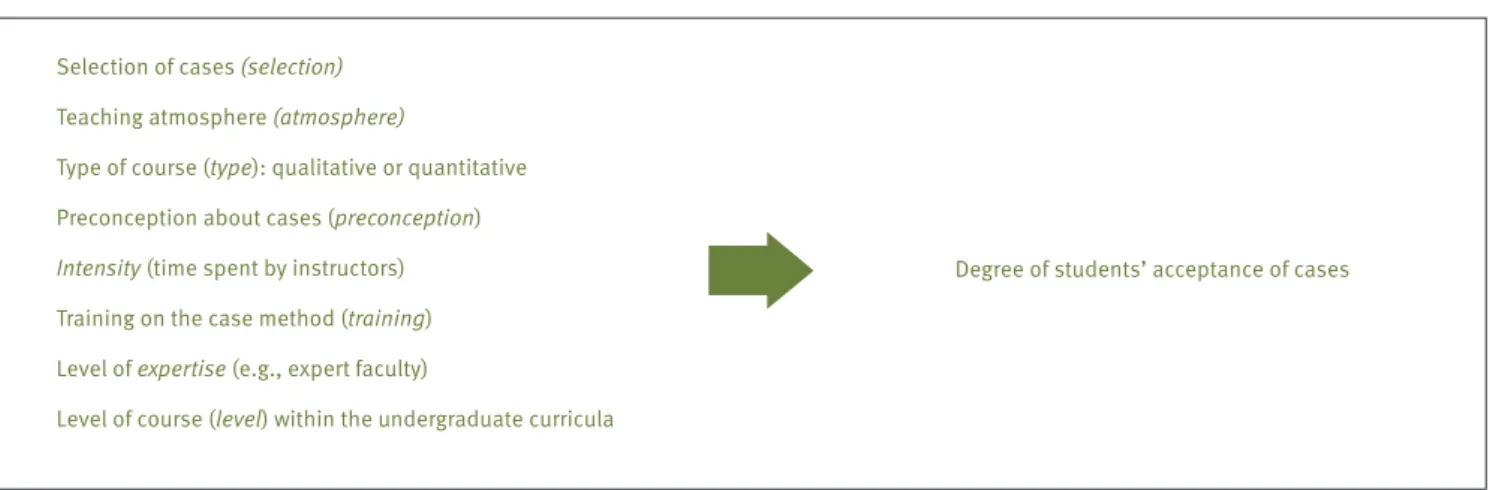
We propose a framework in which the degree of students’ acceptance of cases depends on the selection of cases (selection), the teaching atmosphere (atmosphere), type and level of courses (type and level), training in the case method (training), faculty preconceptions about cases (preconception), level of faculty expertise (expertise), and intensity of use (intensity). Figure 1 depicts the framework. Next, we present studies that support these constructs.
Bruner et al. (1999) discussed the “most prominent aspects of using the case method of instruction at the undergraduate level” (p. 114). They suggested that the degree of success with the use of cases depends on how the cases are selected (selection), how cases are used in the classroom and the teaching style (atmosphere), and the type and level of the course for which the cases are used. Furthermore, they emphasized that the careful selection of cases is vitally important, especially for undergraduates: “The elements of designing a case course difer little between graduate and undergraduate levels. The primary method of adjusting the course for level of its content is the selection of cases” (p. 116). Charan (1976) and Andersen and Schiano (2014) also emphasized selection as a main determinant of case course design depending on the audience. More speciically, Gitman, Lewis, and Yates (1987) suggested that selection depends upon three key parameters: cognitive educational objectives, course level, and case complexity.
Ambrosini et al. (2010) suggested the source of cases as an important determinant of selection.
(Healy & McCutcheon, 2010). In that role, instructors are more active in conducting the class but allow students to participate more than they would in a typical lecture class. Gitman et al. (1987) caution that, if this role is not properly assumed, the class might be poorly executed, and the discussion is highly likely to go of-track or become too wide-ranging. This might occur because undergraduates lack the business experience that graduate students usually have. Healy and McCutcheon
(2010) classiied teaching styles by dividing case teachers into controllers, facilitators, and partners, inding that only partners used cases with the explicit intention of fostering critical thinking and personal development. The authors concluded that cases can facilitate critical thinking, but that their efectiveness depends on the teaching style of the instructor. Thus, the attributes of the instructors teaching the cases are key determinants of atmosphere.
Figure 1.
Framework for students’acceptance of cases
Selection of cases (selection)
Teaching atmosphere (atmosphere)
Type of course (type): qualitative or quantitative
Preconception about cases (preconception)
Intensity (time spent by instructors)
Training on the case method (training)
Level of expertise (e.g., expert faculty)
Level of course (level) within the undergraduate curricula
Degree of students’ acceptance of cases
Note: Constructs indicated in italics.
Proper training is one of the main ways to learn the craft of case discussion facilitation (Gill, 2011), thus reducing the risk that cases will amount merely to the illustration of theories
(Foster & Carboni, 2009) when taught by instructors who do not fully understand the philosophy behind cases. Writing cases is considered to be part of the teaching–learning process. According to Mesny (2013), instructor training should emphasize the ainity between teaching cases and researching cases, and reairm the usefulness of the philosophy behind them. Furthermore, institutions joining case collections such as the European Case Clearing House are required to certify professional quality standards (Ambrosini et al., 2010), for which training is key.
Böcker (1987) found that motivation enhanced learning that applies knowledge and skills, but not when learning simply reproduced knowledge and skills. He concluded that motivation positively afected the case method as compared to lecturing. The author considered motivation as “a prerequisite for any cognitive process” (Böcker, 1987, p. 66). We use preconception as a proxy for motivation. Finally, case teaching requires instructors to spend more time preparing a case class than they would spend on lecturing, and requires more student time to solve the cases. In Böcker (1987), the question of teaching eiciency remained open for future research.
To proxy for teaching eiciency in the context of the case method, we use intensity, deined as the amount of time instructors spend preparing a case and the length of the cases they use.
METHODS AND MODEL
We use both quantitative and qualitative methods. Data were collected through an online survey among business school instructors in a Mexican private university and interviews with a subset of the sample. In Mexico, Business Administration undergraduate programs in private universities tend to emphasize a practical and realistic approach over a theoretical one. In an attempt to pursue their goals, those universities retain a considerable portion of instructors who are practitioners and invited adjunct professors. Given their closeness to irms, those instructors tend to ind the case method an attractive teaching tool. Case studies are widely used in MBA programs in Mexico and are familiar to most of the instructors in our sample, all of whom hold a master’s or a PhD degree.
delivered by a representative of the Harvard Latin American Case Consortium from Harvard Business School Publishing (HBSP), who was visiting the university. (This university has been a member of this consortium for more than 10 years; membership allows professors full access to most teaching materials available in the HBSP collection). Preliminary analysis of the pilot study and content extracted from interviews with experts on the case method helped with ine-tuning the inal questionnaire (available upon request), which included a statement on the objective of the study and a deinition of a case, as a validation check for our object of study. During the interviews with experts, we validated what respondents understood to be a case, with responses delimitating cases as written documents related to irms’ real situations, usually involving decision making issues, providing tools for the development of either practical tools for bringing theory into practice and/or developing soft skills (throughout the discussions and students’ teamwork). Our conceptualization of cases is consistent with that of Harvard-type cases, which immerse students in realistic business situations, are usually written from the point of view of top management, and include class discussion intended to stimulate the development of students’ critical thinking skills (Andersen & Schiano, 2014). Ninety-one instructors completed the survey, representing a 48% response rate. We use these data to conduct factor analysis and regression. The factor analysis identiied clusters of latent variables that capture the attributes of the case method. Thus, the set of questions in the survey was reduced to a smaller set of factors or constructs. We tested these constructs using OLS regression, according to the model below:
Acceptance_perception
i
= α
0+α
1selection
i+
α
2training + α
3preconception
i+ α
4intensity
i+
α
5type
i+ α
6expertise
i+ ε
i,
(1)
where Acceptance_perception measures faculty percep-tions of the degree of students’ acceptance of cases. The proxy is the faculty’s response to the question “According to your previous experience teaching cases, how would you evaluate students’ level of acceptance of cases?” We measure instruc-tor perceptions of the degree of students’ acceptance of cases rather than students’ acceptance directly. While this approach has potential limitations, we consider acceptance perception to be relevant because it captures instructors’ observations about the success of the case method, which is supported by student teaching evaluations.
Selection, training, preconception, and intensity, are scales calculated using the variables extracted from the factor analysis (discussed in the following section). Type is a dichotomous
variable set to one if the instructor teaches a qualitative course and zero otherwise. Similarly, expertise is a variable set to one for faculty who are experts on the case method.
In addition, we interviewed 15 instructors from the sample who, according to the department chairs, were experts in the case method. Each interview lasted one to two hours. This subsample was balanced, with seven instructors teaching quantitative courses such as inance and eight instructors of qualitative courses. The qualitative method used in this study was considered a two-round modiied Delphi technique (Covino & Iwanicki [1996] used a two-round modiied Delphi in research on teaching efectiveness). According to Dalkey and Helmer (1963), Helmer (1967), and Hsu and Sandford (2007), the purpose of this technique is to obtain the most reliable consensus from among a group of experts by following the irst round of questioning with a controlled feedback process. In the Delphi technique, experts do not interact with each other; rather, in subsequent rounds, they are asked to think again about the problem at hand and change their responses and provide additional insights. This is done by providing the experts with descriptive statistics about responses from previous rounds or with considerations suggested as being potentially relevant by another (anonymous) respondent. Opinions tend to converge as experts are allowed to reconsider their responses while obtaining feedback. However, consensus may not occur; instead, two “schools of opinion” may emerge. In any case, the Delphi method serves the purpose of “crystallizing the reasoning process that might lead to one or several positions on an issue and thus help to clarify the issue even in the absence of consensus” (Helmer, 1967, p. 9).
of instructors, attributes of the teaching process, and attributes of evaluation comprise the construct atmosphere. We also report in this study qualitative responses of level and selection. Other responses from the qualitative part of this study are not reported but served as a basis for improving our questionnaire.
RESULTS
Factor analysis
We conducted principal factor analysis on the (10) questions with interval value responses. The Kaiser–Meyer–Olkin measure veriied the sampling adequacy for factor analysis (KMO = 0.672). According to Kaiser (1974) and Hutcheson and Sofroniou (1999), KMO values above 0.5 are acceptable for sample adequacy.
Untabulated KMO values in this sample are consistently above 0.6 across individual items, with some values exceeding 0.7.
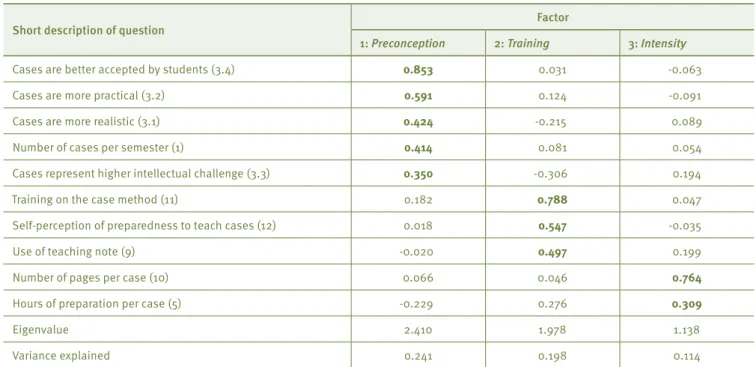
Table 1 provides the factor loadings after matrix rotation, sorted by loading magnitude. Questions are clustered by factor. We called these factors preconception, training, and intensity, following our theoretical constructs. Factor 1 could represent the construct preconception, which captures instructors’ beliefs regarding case teaching compared to traditional lecturing. Preconception includes responses to questions 3.1, 3.2, 3.3, and 3.4, which directly compare case teaching with lecturing (e.g., cases are more realistic, or cases represent higher intellectual challenges). In addition, question 1, which refers to the number of cases instructors use during a course, also belongs to the irst factor. This is consistent with the possibility that the stronger instructors’ beliefs are about the eicacy of cases, the more cases will be used in their courses. Preconception explains 24.1% of the variance.
Table 1.
Exploratory factor analysis for the attributes of the case method questionnaire
Short description of question
Factor
1: Preconception 2: Training 3: Intensity
Cases are better accepted by students (3.4) 0.853 0.031 -0.063
Cases are more practical (3.2) 0.591 0.124 -0.091
Cases are more realistic (3.1) 0.424 -0.215 0.089
Number of cases per semester (1) 0.414 0.081 0.054
Cases represent higher intellectual challenge (3.3) 0.350 -0.306 0.194
Training on the case method (11) 0.182 0.788 0.047
Self-perception of preparedness to teach cases (12) 0.018 0.547 -0.035
Use of teaching note (9) -0.020 0.497 0.199
Number of pages per case (10) 0.066 0.046 0.764
Hours of preparation per case (5) -0.229 0.276 0.309
Eigenvalue 2.410 1.978 1.138
Variance explained 0.241 0.198 0.114
Note: Extraction method = principal axis factoring. Rotation method = Oblimin with Kaiser normalization. For the pattern matrix rotation converged in 8 iterations. Number of question in brackets (questionnaire available upon request).
The second factor, which explains 19.8% of the variance, relates to training. Question 11 is directly related to the formal training instructors have received on the case method, question 12 addresses instructors’ self-perception of preparedness for teaching cases, and question 9 relates to the extent of teaching note usage, which should be positively correlated with the level of faculty training or expertise. The last factor, explaining 11.4% of the variance, is intensity. This factor comes from questions
Regarding the reliability of the internal consistency of the scales, we estimated the inter-item correlations for the constructs, obtaining 0.278 for preconception, 0.376 for training, and 0.270 for intensity. These values fall within the optimal range according to
Briggs and Cheek (1986), who suggested the use of these statistics instead of Cronbach’s alphas for scales with fewer than 10 items. In terms of content validity, we considered the procedure proposed by Rossiter (2002), which “relies on logical arguments, and the concurrence of experts, based usually on open-ended input from pre-interviews with raters… having a comprehensive deinition of
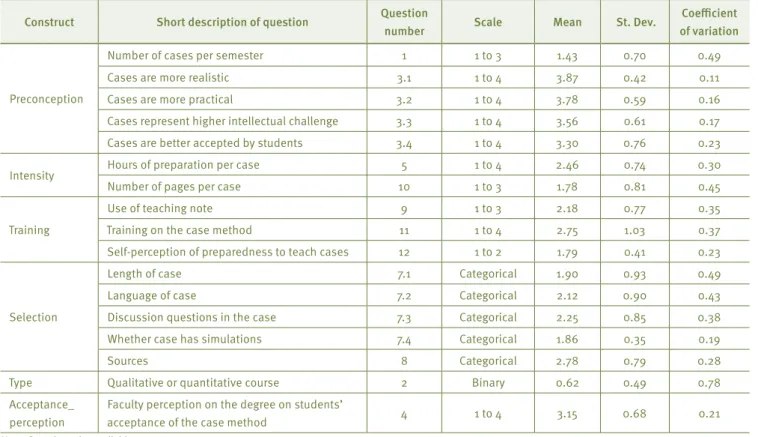
what the construct is” (p. 308). Table 2 provides the three constructs from the factor analysis, along with their items, their respective scales, means, standard deviations, and coeicients of variation. Table 2 also presents selection, which uses categorical variables from questions related to case length, the language used in the case, whether the case had discussion questions, whether the case had simulations, and the sources used by the instructors to choose the cases. Type is a binary variable set to 1 for qualitative classes. Acceptance_perception is the dependent variable in the regression analysis, with the other constructs acting as explanatory variables.
Table 2.
Constructs and items
Construct Short description of question Question
number Scale Mean St. Dev.
Coeicient of variation
Preconception
Number of cases per semester 1 1 to 3 1.43 0.70 0.49
Cases are more realistic 3.1 1 to 4 3.87 0.42 0.11
Cases are more practical 3.2 1 to 4 3.78 0.59 0.16
Cases represent higher intellectual challenge 3.3 1 to 4 3.56 0.61 0.17
Cases are better accepted by students 3.4 1 to 4 3.30 0.76 0.23
Intensity Hours of preparation per case 5 1 to 4 2.46 0.74 0.30
Number of pages per case 10 1 to 3 1.78 0.81 0.45
Training
Use of teaching note 9 1 to 3 2.18 0.77 0.35
Training on the case method 11 1 to 4 2.75 1.03 0.37
Self-perception of preparedness to teach cases 12 1 to 2 1.79 0.41 0.23
Selection
Length of case 7.1 Categorical 1.90 0.93 0.49
Language of case 7.2 Categorical 2.12 0.90 0.43
Discussion questions in the case 7.3 Categorical 2.25 0.85 0.38
Whether case has simulations 7.4 Categorical 1.86 0.35 0.19
Sources 8 Categorical 2.78 0.79 0.28
Type Qualitative or quantitative course 2 Binary 0.62 0.49 0.78
Acceptance_ perception
Faculty perception on the degree on students’
acceptance of the case method 4 1 to 4 3.15 0.68 0.21
Note: Questionnaire available upon request.
Descriptive statistics on individual items and
factors
We discuss the descriptive statistics, from Table 2, after the factor analysis because the latter facilitates the discussion due to the categorization of items by construct. We also discuss selected categorical variables from Table 2. Overall, the discussion that follows is consistent with the indings in the factor analysis section and the regression analysis, to be shown later.
Regarding preconception, instructors concur that the use of cases, as compared to that of traditional lectures, allows
for more realistic and practical sessions, and implies a higher intellectual challenge for students (items within this construct have relatively high means, and their coeicients of variation are the lowest across constructs in Table 2). Nevertheless, instructors are not as optimistic about cases being better accepted than lectures (e.g., 3.30 mean compared to values around 3.6, 3.7, and 3.8 for the rest of the items in this construct). Instructors might teach cases mainly because they perceive the case method as a highly attractive teaching tool in terms of the beneits for business education and to a lesser extent because students prefer it to traditional lecturing. This is consistent with the inding by
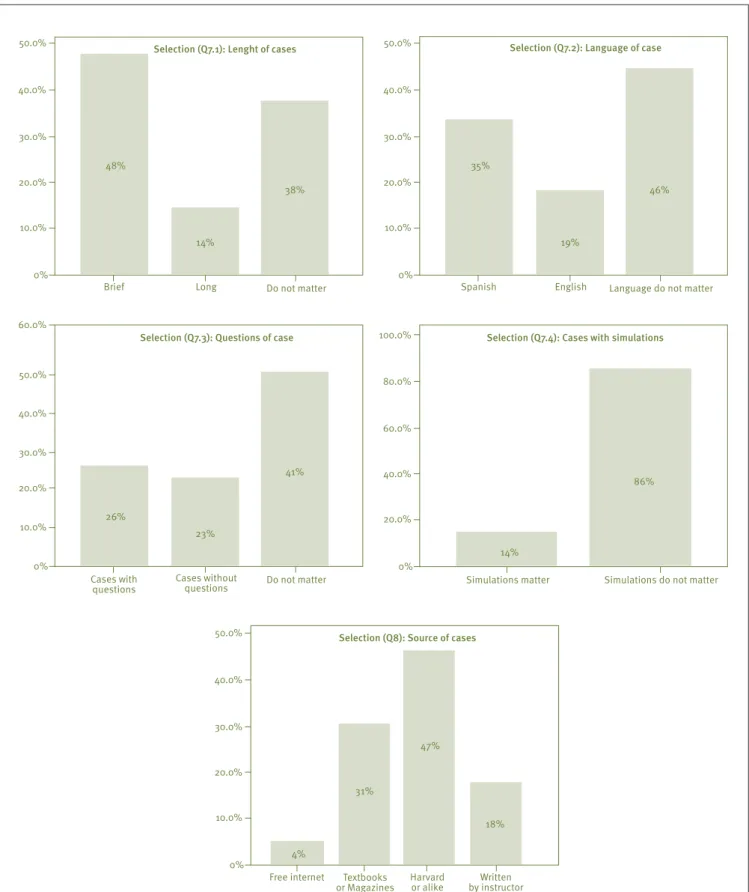
Items forming part of selection have the highest coeicients of variation across the constructs, implying less uniformity in the way instructors select case materials. Figure 2 depicts the frequency distributions of the items constituting selection (we refer to items as “attributes of the construct” hereafter). For length of cases, 48% of instructors prefer brief cases, and 38% are indiferent about this attribute. Of the sample, 35% of faculty prefer cases written in Spanish. Most instructors are indiferent as to whether cases contain discussion questions. Similarly, instructors are generally indiferent as to whether cases have simulations. Finally, 47% of instructors choose HBSP and similar case collections such as Darden Business School Publishing, among others, as their sources for cases, and 18% write the cases they teach. We consider these sources to be of higher quality than the other options (e.g., free cases from the internet and textbooks or magazines). Regarding selection, then, faculty prefer brief cases, cases in Spanish, and rely primarily on HBSP-type publishers.
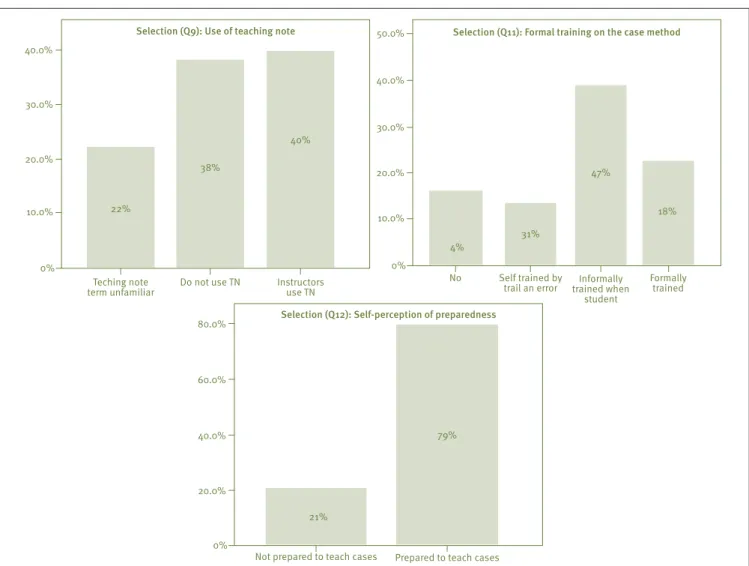
Figure 3 presents the attributes of training. The irst graph shows that only 40% of faculty use teaching notes. The second graph shows that 25% have received formal training in the case method, which may partially explain the low usage of teaching notes. Surprisingly, most instructors (79%) believe they are prepared to teach cases. Taken in combination, formal training is lacking, but almost half of the faculty received informal training through exposure to the case method as students in their MBA programs (see second graph in Figure 3), and instructors believe this is suicient preparation to teach cases.
Figure 4 provides the attributes of intensity. Most faculty (51%) spend one to three hours preparing a case to teach, and 34% spend three to six hours; these igures match estimates in
Ross, Engelseth, Kindred, and Shelman (2015). Moreover, 46% of instructors prefer cases of between one to ive pages long, and 31% prefer cases of six to 10 pages. This is consistent with their preference for brief cases. The deinitions of brief- and regular-length cases might be arbitrary, but, to establish a point of reference, we searched the HBSP collection and found that one-third of all cases labeled “HBS Brief Cases” had no more than 10 pages, and virtually all brief cases contained no more than 15. (We searched the HBSP collection online in September 2014; 117 cases were considered “HBS Brief Cases,” with 40 containing one to 10 pages, 80 containing 11 to 15 pages, and only 10 with more than 16). The preference for brief cases represents a challenge for instructors teaching undergraduates since brief published cases are scarce.
Table 3 provides the correlation coefficients for the questions used in the factor analysis. The low correlations suggest that multicollinearity problems are not a concern. Questions 5 and
10 (Q5 and Q10), relating to intensity, are positively correlated, with a rho of 0.26, and statistically signiicant at 5%. Questions about preconception (Q1, Q3.1., Q3.2., Q3.3., and Q3.4.) correlate negatively with hours of preparation per case (column Q5) and positively with the number of pages per case (Q10). This implies that the more instructors support the case method, the higher the number of pages per case, but the less time they spend preparing a case to teach. Responses in the qualitative part of this study conirmed that supporters of case teaching are more knowledgeable about the method and therefore spend less time preparing a case to teach.
Table 4, which provides the factor correlations rather than individual item correlations, summarizes the relationships. Preconception is positively related to intensity: the more instructors support the case method, the more resources they spend, despite the tradeof between length of cases and hours of preparation mentioned above. Preconception is negatively related to training: the more instructors support the case method, the more they realize their lack of preparation. Training and intensity relate positively, suggesting that heavy users might be a subset of instructors who are better-trained in the case method. Indeed, during the interviews, we found that expert instructors were intense users of cases and were better trained in the case method. Our interpretation of these relationships is the following. The case method is an attractive mode of teaching, especially in a private business school where realistic, practical education is emphasized, and instructors are eager to adopt it, though they realize that some training beyond their previous exposure as MBA students is necessary. Furthermore, the indings suggest that training in the case method encourages heavier use of cases.
Regression analysis
Figure 2.
Attributes of selection
50.0%
40.0%
30.0%
20.0%
10.0%
0%
Brief Long
48%
14%
38%
Do not matter Selection (Q7.1): Lenght of cases
50.0%
40.0%
30.0%
20.0%
10.0%
0%
Cases with questions
Cases without questions 26%
23%
41%
Do not matter Selection (Q7.3): Questions of case
50.0%
40.0%
30.0%
20.0%
10.0%
0%
Spanish English 35%
19%
46%
Language do not matter Selection (Q7.2): Language of case
60.0%
100.0%
80.0%
60.0%
40.0%
20.0%
0%
14%
86%
Simulations do not matter Selection (Q7.4): Cases with simulations
Simulations matter
50.0%
40.0%
30.0%
20.0%
10.0%
0%
Free internet Textbooks or Magazines 4%
31%
47%
Harvard or alike Selection (Q8): Source of cases
18%
Written by instructor
Figure 3.
Attributes of training
40.0%
30.0%
20.0%
10.0%
0%
Selection (Q9): Use of teaching note
Teching note term unfamiliar
22%
Do not use TN 38%
40%
Instructors use TN
50.0%
40.0%
30.0%
20.0%
10.0%
0%
Selection (Q11): Formal training on the case method
No 4%
Self trained by trail an error
31%
47%
Informally trained when
student
18%
Formally trained
0%
Selection (Q12): Self-perception of preparedness 80.0%
60.0%
40.0%
20.0%
21%
Not prepared to teach cases
79%
Prepared to teach cases
Note: QX means question X (short description of questions in Table 2).
Figure 4.
Attributes of intensity
10.0%
0%
Up to 5 pages 6 to 10 pages 46%
31%
24%
More than 10 pages Selection (Q10): Number of pages per cases 50.0%
40.0%
30.0%
20.0% 50.0%
40.0%
30.0%
20.0%
10.0%
0%
Intensity (Q5): Hours of preparations per case
Up to 1 6%
1 to 3 51%
34%
3 to 6
9%
More than 6
Table 3.
Pearson correlation coeicients
Q1 Q3.1 Q3.2 Q3.3 Q3.4 Q5 Q10 Q9 Q11 Q12
Q1 0.109 0.194 0.234 0.361 -0.112 0.103 0.101 0.059 0.044
Q3.1 0.195 0.267 0.256 0.404 -0.130 0.101 -0.182 -0.108 -0.136
Q3.2 0.061 0.016 0.146 0.473 -0.179 0.062 -0.047 0.163 -0.031
Q3.3 0.030 0.020 0.124 0.340 -0.124 0.138 -0.188 -0.163 -0.165
Q3.4 0.002 0.000 0.000 0.003 -0.192 0.045 -0.051 0.028 -0.061
Q5 0.186 0.151 0.077 0.163 0.063 0.260 0.221 0.332 0.165
Q10 0.207 0.211 0.312 0.136 0.360 0.018 0.272 0.190 0.067
Q9 0.212 0.074 0.356 0.067 0.344 0.039 0.014 0.385 0.300
Q11 0.321 0.196 0.098 0.097 0.413 0.003 0.065 0.001 0.421
Q12 0.364 0.139 0.403 0.095 0.315 0.095 0.299 0.008 0.000
Note: Correlation coeicients in the top half and signiicance level in the bottom half. QX means question X (short description of questions in Table 2).
Table 4.
Factor correlations
Preconception Training Intensity
Preconception 1.000 -0.177 0.094
Training -0.177 1.000 0.192
Intensity 0.094 0.192 1.000
Table 5.
Regression results
Estimate T Estimate T Estimate T
Intercept 2.991*** 3.980 2.667*** 3.404 2.446*** 3.185
Preconception 0.179* 1.600 0.233** 2.035 0.245** 2.107
Intensity -0.382*** -3.163 -0.429*** -3.287 -0.391** -2.634
Training 0.021 0.171 0.020 0.158 0.018 0.137
Selection_language -0.295** -2.630
Selection_brief -0.128 -1.081
Selection_source -0.005 -0.036
Type 0.132 1.158 0.120 1.007 0.119 0.985
Expertise 0.225* 1.957 0.243** 2.022 0.242* 1.938
Adj. R squared 0.243 0.169 0.152
F Value 4.419 3.171 2.918
***, **, and * indicate statistical signiicance at the 1%, 5%, and 10% levels respectively.
Intensity is negative and statistically signiicant at 1% for two models and at 5% for one. The more resources instructors expend in terms of number of pages per case and number of hours of preparation, the more detrimental the impact on the degree of student acceptance: too many resources negatively afect the output. It is possible that intense instructors, given the amount of resources they expend in the learning process, expect higher student acceptance than what they observe in the classroom.
Regarding selection, the language in which cases are written matters for these instructors: Selection_language is negative and statistically signiicant at 1%. Instructors for whom language matters (those who prefer cases in Spanish or English, compared to instructors for whom language is irrelevant) perceive lower levels of student acceptance. As shown in the descriptive statistics section, most of the faculty in this sample prefers cases in Spanish. This result implies that instructors who are indiferent to case language ind that cases are better accepted by students. This could be relevant for instructors and schools in non-English speaking countries: the ability to teach cases in English could become an advantage in terms of student acceptance because most high-quality cases are written in English. The other two proxies for cases selection, Selection_brief and Selection_source, are not statistically signiicant.
Training tends to be positive but is not statistically signiicant. However, a closely related estimate, the dummy variable expertise, indicates that faculty expertise positively afects acceptance levels. Since the interviews conirmed, as expected, that experts are better trained in the case method than is the average sample instructor, training in the case method is relevant. Finally, whether a class is quantitative or qualitative makes no diference to the level of acceptance by students, as type is not statistically signiicant.
As we report the standardized betas in Table 5, the relative importance of the explanatory variables can be compared directly by looking at the magnitudes of the coeicients. For instance, a one standard deviation increase in intensity would reduce students’ level of acceptance by 0.382 standard deviations. The next section, on the qualitative analysis, completes the discussion of the constructs, focusing on level and atmosphere. Further discussion on selection is also provided.
Qualitative analysis
Level
About 73% of the experts interviewed teach cases primarily to juniors and seniors. The experts commented that, to a lesser extent, they use cases when teaching freshmen or sophomores.
The consensus among the faculty was that senior students show higher interest and acceptance of the case method, while freshmen and sophomores sometimes show resistance. This is consistent with the inding in Kester et al. (2008), who surveyed students from many countries outside the US. According to experts in our study, freshmen and sophomores ind it diicult to coordinate work in teams, which is required in most case courses; they also cannot yet contextualize a typical business problem, as cases require and thus show little commitment to or interest in solving a case (relative to learning from a lecture). In contrast, seniors may have accumulated enough of a technical business background to be able to properly contextualize problems stated in cases, tolerate the uncertainty that cases present, and propose feasible solutions.
Atmosphere
In trying to understand the elements of atmosphere, we focused on three sets of attributes: (1) the attributes of instructors, (2) the attributes of the teaching process, and (3) the attributes of evaluation. Exhibit 1 provides all these attributes, with asterisks on those ranked the most relevant by at least 50% of the experts. The top attributes of instructors that create an appropriate atmosphere are listed in Panel A. At the top of the list, 91% of experts ranked as relevant the instructor’s lexibility in adjusting the teaching plan during class based on the technical background of the class, and in adjusting the pace and direction of the discussion (lexibility, in Panel A). Second, 64% considered relevant the ability to control the group in terms of discipline, respect, and harmony during the case discussion (ability to control the group). Third, tolerance of uncertainty concerning the discussion’s direction and of new or disruptive ideas, and even the lack of good ideas during the discussion, was ranked as relevant by 60%. Finally, about 55% of experts ranked as desirable a high level of instructor preference for the case method relative to other teaching modes. Other attributes mentioned during the interviews, but not ranked as most relevant, are listed in alphabetical order in Panel A.
Exhibit 1
. Construct atmosphere
Panel A: Attributes of instructors
(1) Flexibility*
(2) Ability to control the group*
(3) Tolerance*
(4) High level of preference for the case method*
Acting skills
Analytical skills
Dynamism
Extroversion
Time dedicated to prepare the case previous to the discussion
Panel B: Attributes of the teaching process
(1) Thorough reading of the case*
(2) The use of audios or videos related to the case*
(3) The assignment of written homework*
(4) The discussion of the case among team members*
(5) The discussion of the case with the complete class*
Closing remarks by the instructor with a solution to the case
Lecturing on the theoretical topics related to the case
The assessment with the complete group of alternative solutions
The assignment of roles (e.g., a team represents the production department, a second team marketing)
The assignment of reading theory related to the case
The discussion or search of additional information, available on the internet, related to the case or company
Panel C: Attributes of evaluation
(1) The quality of participation in class*
(2) The appropriate detection of the issue in the case*
(3) The correct detection of relevant facts in the case*
(4) The feasibility, correctness, and realism of the propose solution*
Some evidence that the student read the case
The level of creativity of the proposed solution
The quality of the analysis
Note: Attributes with an asterisk are those ranked as most relevant by at least 50% of experts during the second round of Delphi. The numbers that precede the attributes indicate their rank according to experts.
Regarding evaluation attributes, 90% of experts ranked as most important (1) the quality of participation in class, followed by (2) the appropriate detection of the issue in the case, (3) the correct detection of relevant facts in the case, and (4) the feasibility, correctness, and practicality of the proposed solution. There was no consensus among experts about speciic details concerning evaluation, such as percentage of the total grade, methods of evaluation, or what constituted good participation. However, several faculty members stated their preference for more weight placed on quizzes.
Selection
We further assessed selection because the attributes “brief cases” and “high quality cases” are important for faculty according to the surveys, but these variables were not statistically signiicant in the regression (regression analysis section). All of the expert faculty ranked a match between the objectives of the case and those of the teaching as the top attribute when selecting cases (see Exhibit 2); 60% chose length of cases, with a preference for brief ones; 60% also chose the case’s level of complexity, which needed to be suitable for the course level. A well-written case was also chosen by 60% of expert faculty as relevant when selecting cases. Finally, about half of the experts ranked the availability of teaching notes as important when selecting cases. These responses add insights to the quantitative results. For instance, the language in which a case is written is an important attribute for expert faculty but is not as relevant as the teaching objectives of the case, the length of cases, the attractiveness of the case, and the availability of teaching notes.
Exhibit 2
. Construct selection
(1) A match between objectives of the case and the teaching objectives*
(2) The length of cases (brief cases preferred)*
(2) The complexity level of case is in accordance to course level*
(2) A well-written case (e.g., logical structure, attractive narrative)*
(3) Teaching note availability*
Availability of complementary information or tools (e.g., simulations, readings)
Familiarity of instructor with the company or industry
Language in which the case is written
The topic of the case is of current importance
CONCLUSIONS AND IMPLICATIONS
This study has just begun to explore the use and acceptance of case studies in undergraduate courses. We develop constructs in order to evaluate the factors inluencing the degree of students’ acceptance of cases. In our proposed framework, students’ acceptance is afected by the case selection, intensity of faculty use, course type and level, level of instructor expertise, teaching atmosphere, and the faculty’s beliefs about the usefulness of the case method. We survey instructors and use factor analysis to validate several constructs and regression analysis to test our proposed model. We complement the quantitative analysis by interviewing a subset of the sample and employing a two-round modiied Delphi technique. Scholars might ind the proposed framework of interest and cross-validate it using diferent samples to improve the factor structure. The results might also be useful for administrators in business schools using or planning to use the case method.
Instructors’ beliefs about the case method as a mode of teaching superior to lecturing contribute positively to students’ level of case acceptance. Thus, eforts to educate faculty about the case method might enhance students’ degree of acceptance. Concerning case selection, we ind that faculty members prefer brief cases. This preference for shorter cases may indicate that undergraduates (and their instructors) prefer more focused cases with less ambiguity. The availability of brief cases represents a challenge for faculty, however, because case collections primarily publish cases of regular length. HBSP has recently increased its number of brief cases, and some publishers such as CASE Journal by Emerald have recently called for the publication of compact cases. Additional attributes of case selection such as usage of teaching notes and the language in which the case is written are discussed in this study.
We ind that case usage intensity negatively afects case acceptance among students: the more resources instructors spend in terms of number of pages per case and number of hours of preparation, the more detrimental to the level of acceptance by students. On the other hand, we ind a positive intensity efect among the subset of expert faculty. Being an expert instructor positively and signiicantly afects students’ acceptance of cases. Expert faculty recommend special attention and adjustments to the case method when cases are taught to freshmen and sophomores. A combination of short cases and lectures may work better in basic undergraduate courses. Finally, we ind that whether a class is quantitative or qualitative makes no diference to the level of student acceptance.
There are several limitations to this study, providing opportunities for future research. Since students were not
surveyed, we measured faculty perceptions of the degree of students’ acceptance of cases, rather than the degree of students’ actual acceptance. While this approach has potential limitations (for instance, the faculty’s enthusiasm for, or preconception with, the case method may inluence their assessment of students’ degree of acceptance), the dependent variable used in this study remains relevant because it measures instructors’ observations about the success of the case method, which is supported by student course evaluations. Thus, instructors are able to perceive the degree of students’ acceptance as the semester progresses. Future research may survey students or use students’ course evaluations to validate or contradict this analysis. In addition, while this study focuses on instructors at a Mexican university, where the language in which the cases are written and/or taught is clearly an important factor, it could be duplicated at US universities and in other countries to determine whether instructors and students elsewhere have the same preferences and attitudes.
REFERENCES
Andersen, E., & Schiano, B. (2014). Teaching with cases: A practical guide. Boston, USA: Harvard Business Review Press.
Ambrosini, V., Bowman, C., & Collier, N. (2010). Using teaching case
studies for management research. Strategic Organization, 8(3), 206–
229. doi: 10.1177/1476127010374254
Argyris, C. (1980). Some limitations of the case method: Experiences in
a management development program. The Academy of Management
Review, 5(2), 291–298.
Banning, K. C. (2003). The efect of the case method on tolerance for
ambiguity. Journal of Management Education, 27(5), 556–567. doi:
10.1177/1052562903252652
Barnes, L. B, Christensen, C. R, & Hansen, A. J. (1994). Teaching and the case method. Boston, USA: Harvard Business School Press.
Bazan, S., & Dugal, M. (2014). Surveying student perceptions of group
case assignments in strategic management classes. Academy of
Business Research Journal, 1, 44–52.
Böcker, F. (1987). Is case teaching more efective than lecture teaching
in business administration? An exploratory analysis. Interfaces, 17(5),
64–71. doi: http://dx.doi.org/10.1287/inte.17.5.64
Booth, C., Bowie, S., Jordan, J., & Ripplin, A. (2000). The use of the case method in large and diverse undergraduate business programmes:
Problems and issues. European Case Clearing House and the
Foundation for Management Education. Retrieved from http://www.
thecasecentre.org/iles/downloads/research/RP0302M.pdf.
Briggs, S. R., & Cheek, J. M. (1986). The role of factor analysis in the
development and evaluation of personality scales. Journal of
Bruner, R., Gup, B., Nunnally, B., & Pettit, L. (1999). Teaching with cases
to graduate and undergraduate students. Financial Practice and
Education (Fall/Winter), 111–119.
Burgoyne, J., & Mumford, A. (2001). Learning from the case method, Report to the European Case Clearing House. ECCH.Bedford, UK, RP0301.
Charan, R. (1976). Techniques in teaching by the case method. The
Academy of Management Review, 1(3), 116–123. doi: 10.5465/
AMR.1976.4400979
Christensen, C. M., & Carlile, P. R. (2009). Course research: Using the
case method to build and teach management theory. Academy of
Management Learning & Education, 8(2), 240–251. doi: 10.5465/
AMLE.2009.41788846
Covino, E. A., & Iwanicki, E. F. (1996). Experienced teachers: Their
constructs of efective teaching. Journal of Personnel Evaluation in
Education, 10, 325–363. doi: 10.1007/BF00125499
Dalkey, N., & Helmer, O. (1963). An experimental application of the Delphi
method to the use of experts. Management Science, 9(3), 458–467.
Diamond, R. (1998). Designing and assessing courses and curricula: A practical guide. San Francisco, USA: Jossey Bass.
Doran, J., Healy, M., McCutcheon, M., & O’Callaghan, S. (2011). Adapting case-based teaching to large class settings: An action research
approach. Accounting Education: An International Journal, 20(3),
245–263. doi:10.1080/09638180.2011.583742
Foster, P., & Carboni, I. (2009). Using student-centered cases in the classroom. An action inquiry approach to leadership
development. Journal of Management Education, 33, 676–698. doi:
http://dx.doi.org/10.1177/1052562908328747
Gardiner, L. (1996). Redesigning higher education: Producing dramatic gains in student learning. Report 7. Washington, DC: Graduate School of Education and Human Development, George Washington University.
Gill, T. G. (2011). Informing with the case method: Guidelines for case method research, writing and facilitation. Santa Rosa, USA: Informing Science Press.
Gitman, L., Lewis, W. F., & Yates, R. M. (1987). An approach for assessing,
selecting, and using inance cases. Journal of Financial Education,
1(Fall), 65–68.
Gonglewski, M., & Helm, A. (2010). An examination of business case
methodology: Pedagogical synergies from two disciplines. Global
Business Languages, 15, 17–31.
Halvorson, W., Crittenden, V., & Pitt, L. (2011). Teaching cases in a virtual environment: When the traditional case classroom is problematic.
Decision Sciences Journal of Innovative Education, 9(3), 485–492.
doi: 10.1111/j.1540-4609.2011.00322.x
Harper, J., Lamb, S., & Buington, J. (2008). Efective use of case studies in the MIS capstone course through semi-formal collaborative
teaching. Journal of Information Systems Education, 19(4), 411–418.
Healy, M., & McCutcheon, M. (2010). Teaching with case studies: An
em-pirical investigation of accounting lecturers’ experiences. Accounting
Education, 19(6), 555–567. doi: 10.1080/09639284.2010.501577
Helmer, O. (1967). Analysis of the future: The Delphi method. Paper No. 3558, Santa Monica: Rand Corporation.
Hsu, Ch., & Sandford, B. (2007). The Delphi technique: Making sense of consensus. Practical Assessment, Research & Evaluation, 12(10), 1–8.
Hutcheson, G., & Sofroniou, N. (1999). The multivariate social scientist. London, UK: Sage.
Jackson, J. H. (1926). The case method. The Accounting Review, 1(1),
108–111.
Kaiser, H. (1974). An index of factorial simplicity. Psychometrika, 39,
31–36. doi: 10.1007/BF02291575
Kester, G. W. (2011). Relections on thirty years of using the case method
to teach inance. Advances in Financial Education, 9, 62–80.
Kester, G. W., Anderson, M. A., Dean, R. A., Ding, D. K., Plessis, A., Hoover, S. A., & Skully (2008). The views of students outside the
United States on the case method of learning. Advances in Financial
Education, 6, 147–160.
Kooskora, M. (2002). Using case studies in class. EBS Review, 15, 57–67.
Mesny, A. (2013). Taking stock of the century-long utilization of the
case method in management education. Canadian Journal of
Administrative Sciences, 30(1), 56–66. doi: 10.1002/cjas.1239
Moore, S. (1999). Cases vs. lectures: A comparison of learning outcomes
in undergraduate principles of inance. Journal of Financial Education,
30(1), 37–49.
Pitt, N., Crittenden, V., Plangger, K., & Halvorson, W. (2012). Case
teaching in the age of technological sophistication. Journal of the
Academy of Business Education, 13, 77–94.
Prat, N. (2012). Teaching information systems with cases: An exploratory
study. Journal of Computer Information Systems, 52(3), 71–81.
Rose, J., & Delaney, C. (2007). Case studies in real estate education: The new AACSB accreditation standards and a proposed case study in
real estate management. Journal of Real Estate Practice and Education,
10(2), 175–186. doi: 10.5555/repe.10.2.w787461mxn336ru6
Ross, B., Engelseth, P., Kindred, N., & Shelman, M. (2015). Development and use of “teaching cases.” International Food and Agribusiness Management Association (IFAMA) Case Workshop. Minneapolis: IFAMA.
Rossiter, J. R. (2002). The C-OAR-SE procedure for scale development in
marketing. International Journal of Research in Marketing, 19(2002),
305–335.
Shugan, S. (2006). Save Research—Abandon the case method
of teaching. Marketing Science, 25(2), 109–115. doi:10.1287/
mksc.1060.0202