Original article
prescriptions in a city in southern Brazil
Frequência de potenciais interações entre drogas nas prescrições
médicas em uma cidade do Sul do Brasil
Genici Weyh Bleich
1, Ariana Bleich
2, Priscila Chiamulera
2, Andréia Cristina Conegero Sanches
3,
Deborah Sandra Leal Guimarães Schneider
4, Jorge Juarez Vieira Teixeira
5Parque Verde housing project, Cascavel, Paraná, Brazil
1Specialist pharmacist, Community Pharmacy, Cascavel, Paraná, Brazil.
2Undergraduate pharmacy student, Center for Medical and Pharmaceutical Sciences, Universidade Estadual do Oeste do Paraná (Unioeste), Cascavel, Paraná, Brazil. 3MSc. Pharmacist and professor, Center for Medical and Pharmaceutical Sciences, Universidade Estadual do Oeste do Paraná (Unioeste), Cascavel, Paraná, Brazil. 4MSc. Statistician and professor, Center for Exact and Technological Sciences, Universidade Estadual do Oeste do Paraná (Unioeste), Cascavel, Paraná, Brazil. 5PhD. Pharmacist and professor, Department of Clinical Analyses, Sciences Center of the Health, Universidade Estadual de Maringá (UEM), Maringá, Paraná, Brazil.
ABSTRACT
CONTEXT AND OBJECTIVE: Drug interactions form part of current clinical practice and they affect between 3 and 5% of polypharmacy patients. The aim of this study was to identify the frequency of potential drug-drug interactions in prescriptions for adult and elderly patients.
TYPE OF STUDY AND SETTING: Cross-sectional pharmacoepidemiological survey in the Parque Verde housing project, municipality of Cascavel, Paraná, Brazil, between December 2006 and February 2007.
METHODS: Stratiied cluster sampling, proportional to the total number of homes in the housing project, was used. The sample consisted of 95 homes and 96 male or female patients aged 19 or over, with medical prescriptions for at least two pharmaceutical drugs. Interactions were identiied using DrugDigest, Medscape and Micromedex softwares.
RESULTS: Most of the patients were female (69.8%), married (59.4%) and in the age group of 60 years or over (56.3%), with an income less than or equal to three minimum monthly salaries (81.3%) and less than eight years of schooling (69.8%); 90.6% of the patients were living with another person. The total number of pharmaceutical drugs was 406 (average of 4.2 medications per patient). The drugs most prescribed were antihypertensives (47.5%). The frequency of drug interactions was 66.6%. Among the 154 potential drug interactions, 4.6% were classiied as major, 65.6% as moderate and 20.1% as minor.
CONCLUSION: The high frequency of drug prescriptions with a potential for differentiated interactions indicates a situation that has so far been little explored, albeit a reality in household surveys.
RESUMO
CONTEXTO E OBJETIVO: As interações medicamentosas fazem parte da prática corrente na clínica médica e a sua incidência oscila entre 3% e 5% nos pacientes fazendo uso da polifarmácia. O objetivo do estudo foi identiicar a frequência de interações droga-droga potenciais em prescrições de pacientes adultos e idosos.
TIPO DE ESTUDO E LOCAL: Inquérito farmacoepidemiológico de corte transversal, realizado de 12/2006 a 02/2007 no conjunto habitacional Parque Verde, Cascavel, Paraná, Brasil.
MÉTODO: A amostra foi por conglomerado e estratiicada, proporcional ao total de residências no conjunto habitacional, constituída de 95 residências, com 96 pacientes de 19 anos ou mais, sexo feminino e masculino, com prescrição de no mínimo duas especialidades farmacêuticas. As interações foram identiicadas de acordo com os softwares DrugDigest, Medscape, Micromedex.
RESULTADOS: A maioria dos pacientes pertencia ao gênero feminino (69,8%), em situação conjugal casada (59,4%), com renda menor ou igual a três salários mínimos (81,3%), faixa etária 60 anos ou mais (56,3%) e 8 anos ou menos de estudo (69,8%) com 90,6% dos pacientes moravam com mais outra pessoa. O total de especialidades farmacêuticas foi de 406, correspondendo a uma média de 4,2 medicamentos por paciente. Os fármacos mais prescritos foram os anti-hipertensivos (47,5%). A frequência de interações medicamentosas foi de 66,6%. Dentre as 154 interações medicamentosas potenciais, 4,6% foram classiicadas como maior e 65,6% como moderada e 20,1% como menor.
CONCLUSÃO: A alta frequência de prescrições de drogas com potencial de interações diferenciado indica uma situação ainda pouco explorada, mas real em pesquisa domiciliar.
KEY WORD: Adult. Aged. Drug interactions. Pharmacoepidemiology. Prescriptions, drug
PALAVRAS-CHAVE: Adulto. Idoso.
INTRODUCTION
Simultaneous administration of several diferent drugs may cause signiicant changes in the efects brought about by their components. Interactions may increase the pharmacological efects at a toxic level, or they may inhibit the pharmacological efects and annul the patient’s therapeutic beneit.1 Drug interactions occur commonly in clinical
practice and their frequencies range from 3 to 5% among patients pre-senting polypharmacy. hey may even reach 20% among patients with daily use of more than 10 drugs.2 As a rule, drug-drug interactions are
the cause of about 3.8% of hospitalizations3 and they may cause several
adverse events in patients.4
Drug interactions consist of several mechanisms, which may be classiied (1) as pharmacokinetic mechanisms, when one drug interferes with the absorption, distribution, metabolism or excretion of another drug, or (2) as pharmacodynamic mechanisms, when drugs with simi-lar efects are administered together with the occurrence of either syn-ergism or opposition of their efects that reduces the reaction to one or both drugs. A third interaction classiication may occur in vitro when
one or both drugs are inactivated.5-7
Physicians may foresee potential interactions if they understand the basic pharmacokinetic principles and the characteristics of each drug. he steps required comprise careful monitoring of patients, changes to the doses of one or both drugs, or exchanging of one or both drugs to lessen the possible interactions.8
Vonbach et al.9 reported that to reduce the number and improve
the management of drug-drug interactions (DDIs), physicians primar-ily have to be aware of the presence of a DDI. Cruciol-Souza and hom-son10 reported that education for healthcare professionals, computerized
systems for prescriptions and drug information, along with collabora-tive drug selection and pharmaceutical care are some of the possible so-lutions for the problem. It should be emphasized that within the thera-peutic chain, the relationship between physicians and pharmacists pre-vents drug interactions.11
OBJECTIVE
he objective of this study was to identify the frequency of potential drug-drug interactions in prescriptions for adult and elderly patients.
METHODS
Design and setting
A cross-sectional pharmacoepidemiological survey was undertaken in the municipality of Cascavel, Paraná, Brazil, between December 2006 and February 2007. he estimated population of this municipality is 285,784 (Instituto Brasileiro de Geograia e Estatística, IBGE, 2008),12
and it is divided into 31 districts. he present survey was conducted in the Parque Verde district, which comprises many housing complexes. Among these, the Parque Verde housing project, consisting of 486 hous-es and a population of 1,458 inhabitants, was chosen for the study. his speciic area, with single-storey houses only, thus providing easy access for researchers, features a nearby primary healthcare unit (PHU) that is
frequented by the inhabitants. Since this study was developed in homes and not in the PHU, all the prescribed medicines used by the popula-tion could be identiied. In fact, the patients could also have prescrip-tions from specialist physicians attending other clinics, thus increasing the possibilities for potential drug interactions. he present study was initially assessed and approved by the Research Ethics Committee of the Universidade Estadual do Oeste do Paraná (Unioeste), under per-mit no. 238/2006.
Sample characterization
A stratiied cluster sample was taken, proportional to the total num-ber of homes in the housing project. he residential complex was divid-ed into ive strata; the homes were numberdivid-ed and classiidivid-ed with the due proportions. he randomized sample consisted of 95 homes, and this was increased to 105 in order to have a 10% safety margin for the sam-ple. Ten homes had to be discarded due to lack of information about the patients, refusals and non-fulillment of the inclusion criteria (at least 19 years of age and at least two prescriptions for pharmacological drugs). In spite of these exclusions, the minimum number of sample units for each stratum was achieved within the limit of the sample (Figure 1). he fol-lowing formula was used to calculate the inal sample size:
Nh/N = nh/n
Where: Nh = size of population stratum; N = size of population; nh = size of sample stratum; and n = size of sample.
Procedure
Data collection was undertaken by two undergraduate pharmacy students from the Universidade Estadual do Oeste do Paraná (Unioeste), who had previously been trained by the research coordinators. hey met the patients in their homes and asked them about their interest in
par-Figure 1. Characterization of sample of households in Parque Verde housing project, Cascavel, PR, Brazil.
Households (n = 486)
Nh1 Nh2 Nh3 Nh4 Nh5
128
Randomized sample: 105 households (106
patients)
104 95 81 78
nhi
nhf nhf nhf nhf nhf
nhi nhi nhi nhi
29 25 20 16 15
25 20 19 16 15
Missing sample: 10 households/patients
Final sample: 95 households
(96 patients)
ticipating in the research. he research aims were explained to the pa-tients, including assurances regarding secrecy and anonymity, and all participants signed a free and informed consent statement before inclu-sion in the study.
Information was collected using structured forms that had previous-ly been tested in similar populations. he variables of sex, age, school-ing, income, marital status, social isolation and prescribed drugs were recorded. he person interviewed in each home was someone who was actually present at the time of the researcher’s visit and who fulilled the preestablished inclusion criteria.
Data evaluation
Interactions were identiied using the DrugDigest, Medscape and
Micromedex software (series 2007 and 2008).13-15 After drug
interac-tions had been identiied, two researchers (GW and JT) independently conirmed the reactions that the undergraduates had reported, in order to ensure information quality. All interactions were graded according to their severity and were conirmed by at least two types of software. Only the interactions with a high degree of severity were selected for analysis, according to their clinical importance. Vonbach et al.9
report-ed that greater sensitivity might occur when two or more investigation programs relating to drug-drug interactions are combined. he drugs were classiied in accordance with the Anatomical herapeutic Chemi-cal (ATC) System.16 he data were recorded in the Epi Info 3.4.3
soft-ware, and the statistical analysis was descriptive. Data quality was en-sured through rerecording and revalidating the drug interactions ob-served by diferent independent researchers.
RESULTS
he sociodemographic characteristics of the 96 patients investigat-ed are shown in Table 1. Most of the patients were female (69.8%), married (59.4%), aged 60 years or over (56.3%) and living with other people (90.6%), with an income of less than or equal to three mini-mum monthly salaries (81.3%) and less than eight years of schooling (69.8%).
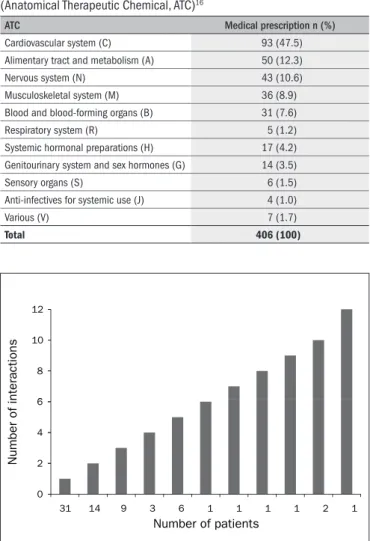
Four hundred and six diferent drugs had been prescribed and the mean number of drugs for each patient was 4.2, with a range from 2 to 13. Table 2 shows that drugs acting on the cardiovascular system ac-counted for 47.5% of these drugs and were the type most prescribed by physicians.
Drug interactions were reported in the cases of 64 patients, and thus the frequency of interactions was 66.7%. Since 91 out of the total of 154 drug interactions were diferent, these patients may have been si-multaneously subjected to between 1 and 12 interactions (Figure 2).
Taking the severity of the drug interactions into account, 7 (4.6%) were classiied as major (Table 3); 101 (65.6%) as moderate; 31 (20.1%) as minor; and 15 (9.7%) were not described in the literature.
DISCUSSION
he mean number of prescribed drugs reported in the present study, i.e. 4.2 (standard deviation, SD = 3.0), is close to indings from
oth-Variables n (96) % Variables n %
Gender Conjugal situation
Male 29 30.2 Married 57 59.4
Female 67 69.8 Unmarried 39 40.6
Family income* Social isolation
≤ 3 78 81.3 Living alone 9 9.4
> 3 18 18.7 Living with other people 87 90.6
Age (years) Education (years)
19 to 59 42 43.7 ≤ 8 67 69.8
60 to 99 54 56.3 > 8 29 30.2
Table 1. Sociodemographic characteristics of the adult and elderly patients who used pharmaceutical drugs
*In Brazilian minimum monthly salaries (US$ 165).
ATC Medical prescription n (%)
Cardiovascular system (C) 93 (47.5)
Alimentary tract and metabolism (A) 50 (12.3)
Nervous system (N) 43 (10.6)
Musculoskeletal system (M) 36 (8.9)
Blood and blood-forming organs (B) 31 (7.6)
Respiratory system (R) 5 (1.2)
Systemic hormonal preparations (H) 17 (4.2)
Genitourinary system and sex hormones (G) 14 (3.5)
Sensory organs (S) 6 (1.5)
Anti-infectives for systemic use (J) 4 (1.0)
Various (V) 7 (1.7)
Total 406 (100)
Table 2. Distribution of prescribed drugs to adult and elderly patients, according to the anatomical therapeutic chemical classiication system (Anatomical Therapeutic Chemical, ATC)16
6 8 10 12
0 2 4 6
31 14 9 3 6 1 1 1 1 2 1
Number of interactions
Number of patients
Figure 2. Frequency of potential drug interactions in prescriptions for adult and elderly patients.
Prescription drugs n Potential severity Drugdigest Medscape Micromedex
Propranolol + Methyldopa 4 Major Major Moderate
Propranolol + Clonidine 1 Major Major Major
Digoxin + Amiodarone 1 Major Major Major
Warfarin + Amiodarone 1 Major Major Moderate
er studies on patients living within the community, namely 3.2 (SD = 2.5)17 and 3.2 (SD = 2).18
Cardiovascular system drugs accounted for the largest propor-tion of the prescrippropor-tions (47.5%), although diferent results were re-ported in other studies undertaken elsewhere in Brazil: Fortaleza, Ceará (29.3%);19 Porto Alegre, Rio Grande do Sul (32.0%);16 and Bambuí,
Minas Gerais (36%).20
he frequency of potential risk of developing drug-drug interac-tions was 66.7% and the frequency of highly severe interacinterac-tions reached 4.6%, similar to the proportions reported in other studies. In an in-vestigation on outpatients over the age of 50 years at family clinics in Mexico, Doubova Dubova et al.21 reported that the prevalence of
po-tential risk was 78.8%, including a rate of high-severity interactions of 3.8%. A study at a government hospital in São Paulo, Brazil, involving patients who were prescribed antidepressive drugs showed that 21.3% were prone to develop potential drug interactions, including 5% with high-severity interactions.8 In a pharmacoepidemiological study,
Cru-ciol-Souza and homson10 reported a frequency of prescription
inter-actions of 49.7%, including 3.4% with high-severity interinter-actions. Al-though diferent studies in diferent locations have reported diferent characteristics, the data are not contradictory, especially with regard to high-severity risk. It is important to note that the data from the present study were compared with research results in which a single type of soft-ware was used. Consequently, the present study may show higher poten-tial risks of drug interactions.
he interaction that recurrently presented the highest-severity po-tential was between methyldopa and beta-adrenergicblocking agents. Methyldopa causes sedation and depression of the central nervous sys-tem.22 Propranolol associated with clonidine may cause a severe
hyper-tensive crisis when clonidine is abruptly suspended.23,24 Although
digox-in had been prescribed to only four patients, the drug had 16 entries among the interactions. One of them was seen to be of major severity. When digoxin is associated with amiodarone, signiicant drug interac-tions may occur,25 since it reduces renal excretion and increases
plas-ma levels.5 Digoxin therapy should be adjusted based on any signs and
symptoms of digoxin toxicity.26 Another potential interaction occurred
between warfarin and amiodarone, with the potential for anticoagulant efects due to amiodarone and higher risk of hemorrhage. In fact, the warfarin dose had to be modiied.24,27-29
Considering the therapeutic tools available to healthcare profession-als, physicians and pharmacists in particular need to be alert regard-ing detection of clinically signiicant drug-drug interactions. Cahill11
reported that, because of the close links between physicians and phar-macists, teamwork for revision and intervention within the context of drug-drug interactions is required. Moura et al.30 stated that
coordinat-ed discussions between physicians, pharmacists and nurses is highly im-portant for judicious evaluation of therapeutic schemes. Furthermore, the present study was the irst investigation, within the household con-text, to use three types of software for the risk analysis on drug interac-tions. his practice increases the sensitivity of the software towards cor-roborating the results relating to drug interactions.
Among the limitations to the current investigation is the fact that it only allowed an approximation to the real issue of drug interactions
within the home. Only prescribed drugs were taken into account, and there is little doubt that this will not precisely relect the reality with-in these households. It is very important to underlwith-ine the fact that all the visits were undertaken during normal working hours. Since this implies that there was a high likelihood of interviewing females and elderly people, it needs to be taken into account with regard to gen-eralization of the data obtained. Further studies must be undertaken, especially in relation to drugs that are sold without prescriptions. In-clusion of these drugs may worsen the potential risk of clinically rel-evant interactions. he randomized sampling was limited to a single housing project and, consequently, care should be taken in generaliz-ing these results.
CONCLUSION
he high frequency of drug prescriptions with a potential for difer-entiated interactions indicates a situation that has so far been little ex-plored, albeit a reality in household surveys.
It is highly prudent for healthcare professionals to pay more atten-tion not only to the prescripatten-tion but also to the pharmacotherapy dis-pensed, in order to reduce the possibility of clinical interaction and pro-vide patients with greater beneit from treatments.
REFERENCES
1. Nies AS. Princípios da terapêutica. In: Gilman AG, Hardman JG, Limbird LE, organizers. Goo-dman & Gilmann: as bases farmacológicas da terapêutica. 10a ed. Rio de Janeiro:
McGraw-Hill; 2003. p. 35-50.
2. Fonseca AL. Interações medicamentosas. 3a ed. Rio de Janeiro: EPUC; 2001.
3. Raschetti R, Morgutti M, Menniti-Ippolito F, et al. Suspected adverse drug events re-quiring emergency department visits or hospital admissions. Eur J Clin Pharmacol. 1999;54(12):959-63.
4. Becker ML, Caspers PW, Kallewaard M, et al. Determinants of potential drug-drug interac-tion associated dispensing in community pharmacies in the Netherlands. Pharm World Sci. 2007;29(2):51-7.
5. Katzung BG. Farmacologia básica e clínica. 9a ed. Rio de Janeiro: Guanabara Koogan;
2005.
6. Rang HP, Dale MN, Ritter JM, Moore PK. Farmacologia. 5a ed. Rio de Janeiro: Elsevier;
2004.
7. Marcolin MA, Cantarelli MG, Garcia Junior M. Interações farmacológicas entre medicações clínicas e psiquiátricas [Drug interactions among clinical and psychiatric drugs]. Rev Psi-quiatr Clin (São Paulo). 2004;31(2):70-81.
8. Miyasaka LS, Atallah AN. Risk of drug interaction: combination of antidepressants and other drugs. Rev Saúde Pública = J Public Health. 2003;37(2):212-5.
9. Vonbach P, Dubied A, Krähenbühl S, Beer JH. Evaluation of frequently used drug interaction screening programs. Pharm World Sci. 2008;30(4):367-74.
10. Cruciol-Souza JM, Thomson JC. Um estudo farmacoepidemiológico de interações medica-mentosas em um hospital universitário brasileiro [A pharmacoepidemiology study of drug interactions in a Brazilian teaching hospital]. Clinics. 2006;61(6):515-20.
11. Cahill JA. Responsibilities of physicians and pharmacists in preventing drug interactions. JAMA. 2002;287(5):586-7.
12. Brasil. Ministério do Planejamento, Orçamento e Gestão. Instituto Brasileiro de Geograia e Estatística. Estimativas populacionais para os municípios brasileiros em 01/07/2008. Available from: www.ibge.gov.br/home/estatistica/populacao/estimativa2008. Accessed in 2009 (Sep 2).
13. DrugDigest. Drug interaction 2007. Available from: www.drugdigest.org/wps/portal/ddi-gest. Accessed in 2007 (Aug 15).
14. Medscape. Drug information. Drug interaction 2007. Available from: http://www.medscape. com/.Accessed in 2007 (Aug 10).
16. World Health Organization. The anatomical therapeutic chemical classiication system with deined daily doses (ATC/DDD). Available from: http://www.who.int/classiications/ atcddd/en/. Accessed in 2009 (Sep 9).
17. Flores LM, Mengue SS. Uso de medicamentos por idosos em região do sul do Bra-sil [Drug use by the elderly in Southern Brazil]. Rev Saúde Pública = J Public Health. 2005;39(6):924-9.
18. Nóbrega OT, Melo GF, Karnikowski MGO. Pattern of drugs prescribed for community-residing middle-aged and older adults from the outskirts of Brasilia. RBCF Rev Bras Ciênc Farm (Impr). 2005;41(2):271-7.
19. Coelho Filho JM, Marcopito LF, Castelo A. Peril de utilização de medicamentos por idosos em área urbana do Nordeste do Brasil [Medication use patterns among elderly people in urban area in Northeastern Brazil]. Rev Saúde Pública = J Public Health. 2004;38(4):557-64.
20. Loyola Filho AI, Uchoa E, Firmo JOA, Lima-Costa MF. Estudo de base populacional sobre o consumo de medicamentos entre idosos: Projeto Bambuí [A population-based study on use of medications by elderly Brazilians: the Bambuí Health and Aging Study (BHAS)]. Cad Saúde Pública = Rep Public Health. 2005;21(2):545-53.
21. Doubova Dubova SV, Reyes-Morales H, Torres-Arreola Ldel P, Suárez-Ortega M. Potential drug-drug and drug-disease interactions in prescriptions for ambulatory patients over 50 years of age in family medicine clinics in Mexico city. BMC Health Serv Res. 2007;7:147. 22. Nobrega OT, Karnikowski MGO. A terapia medicamentosa no idoso: cuidados na
medica-ção [Pharmacotherapy in the elderly: precautions with medication]. Ciênc Saúde Coletiva. 2005;10(2):309-13.
23. Jounela AJ, Lilja M. Interactions between beta-blockers and clonidine. Ann Clin Res. 1984;16(4):181-2.
24. Staff PDR. Drug information for the health care professional. 27th ed. Massachusetts:
Thom-son Healthcare; 2006.
25. Weinfeld MS, Drazner MH, Stevenson WG, Stevenson LW. Early outcome of initiating amiodaro-ne for atrial ibrillation in advanced heart failure. J Heart Lung Transplant 2000;19(7):638-43. 26. DeVore KJ, Hobbs RA. Plasma digoxin concentration luctuations associated with timing of
plasma sampling and amiodarone administration. Pharmacotherapy. 2007;27(3):472-5. 27. Sanoski CA, Bauman JL. Clinical observations with the amiodarone/warfarin interaction:
dosing relationships with long-term therapy. Chest. 2002;121(1):19-23.
28. Zhang K, Young C, Berger J. Administrative claims analysis of the relationship between warfa-rin use and risk of hemorrhage including drug-drug and drug-disease interactions. J Manag Care Pharm. 2006;12(8):640-8.
29. Lu Y, Won KA, Nelson BJ, Qi D, Rausch DJ, Asinger RW. Characteristics of the amiodarone-war-farin interaction during long-term follow-up. Am J Health Syst Pharm. 2008;65(10):947-52. 30. Moura CS, Ribeiro AQ, Magalhães SMS. Avaliação de interações medicamentosas potenciais
em prescrições médicas do Hospital das Clínicas da Universidade Federal de Minas Gerais (Brasil). Lat Am J Pharm. 2007;26(4):596-601. Available from: http://www.latamjpharm. org/trabajos/26/4/LAJOP_26_4_4_3_L0B81ER36G.pdf. Accessed in 2009 (Sep 2).
Sources of funding: Not declared
Conlict of interest: None
Date of irst submission: August 11, 2008
Last received: September 4, 2009
Accepted: September 9, 2009
Address for correspondence: Jorge Juarez Vieira Teixeira Departamento de Análises Clínicas
Centro de Ciências da Saúde, Universidade Estadual de Maringá Avenida Colombo, 5.790