Methicillin- and vancomycin-resistant Staphylococcus
aureus in health care workers and medical devices
Staphylococcus aureus
resistentes a meticilina (MRSA) e vancomicina (VRSA)
em profissionais da saúde e artigos médicos
Angela Breves; Catia Aparecida C. Miranda; Claudia Flores; Ivano de Filippis; Maysa M. Clementino
Instituto Nacional de Controle de Qualidade em Saúde (INCQS) – Fundação Oswaldo Cruz (Fiocruz), Rio de Janeiro, Brazil.
First submission on 29/07/14; last submission on 09/03/15; accepted for publication on 09/04/15; published on 20/06/15
ABSTRACT
Introduction: Cross-contamination by Staphylococcus aureus among patients, professionals and medical supplies in health facilities is a constant concern, leading many researchers to study the prevalence of this pathogen in asymptomatic carriers. Objectives: We investigated
the colonization and the antimicrobial susceptibility proile of Staphylococcus spp. on surfaces of medical articles and in professionals
from two basic health units in the city of Rio de Janeiro. Materials and methods: Seventy-nine samples resulted in 49 isolates which underwent phenotypic and molecular characterization by polymerase chain reaction (PCR) of coa, mecA and femA genes. Results:
According to the phenotypes, the isolates were identiied as S. aureus (n = 35, 71.42%) and coagulase-negative Staphylococcus (CoNS) (n = 14, 28.57%). Among these 14 isolates, 42.85% were methicillin-resistant coagulase negative Staphylococcus (MRCoNS). Among the
35 S. aureus, 31.42% were methicillin resistant (MRSA), and 2.8% were vancomycin resistant, characterized as VRSA. Sixty-eight percent were susceptible to methicillin (MSSA). Genes coa, femA and mecA were ampliied from 75.51%, 71.42% and 30.61% of the isolates, respectively. After ampliication of the mecA gene, 20.41% were characterized as MRSA, and 10.20% as MRCoNS. The vancomycin-resistant strain was
characterized as VRSA after detection of the vanB gene. Conclusion: Our results show a higher frequency of MSSA and MRCoNS among
S. aureus and CoNS respectively, colonizing devices and health professionals. However, the already described transfer of the staphylococcal cassette chromosome mec (SSCmec) from MRCoNS to MSSA may alter these results, increasing the frequency of MRSA strains.
Key words:Staphylococcus aureus; MRSA; VRSA.
INTRODUCTION
Staphylococcus aureus is considered an opportunistic
pathogen responsible for great morbidity and mortality; man is its main reservoir. It can be present in several sites of the human body, including oropharynx, intestines, hands, skin, and nasal cavity, which is pointed as one of the areas where colonization occurs more frequently(1, 2).
In health care settings, this pathogen may contaminate furniture, clothes and equipment around colonized or infected patients, which function as sources or reservoirs(3). In this context,
Murray et al. suggested that the health staff should use adequate
techniques for hand washing, aimed at preventing S. aureus cross-infection among devices, professionals, and patients(4). Gialluly et al.
stressed the urgent need to alert and inform health care workers about the potential risk of hospital infection due to, mainly, lack of hand hygiene and handling of contaminated medical devices(5).
Since the study by Dr. Semmelweis, in the XIX century, health professionals’ hands have been implicated as a source of microorganism transmission in health care settings(6). In 1847,
Semmelweis instituted hand-washing with chlorinated water as mandatory for all physicians, medicine students, and nurses, reducing mother mortality by puerperal fever from 12.2% to 2.4%, in the irst month of intervention(7). Since then, this procedure has
been recommended as a primary measure to control dissemination of infectious agents.
Hand microbiota of mothers and health care workers at a maternity hospital revealed, among other organisms, the presence
of S. aureus and coagulase-negative Staphylococcus, which have been pointed in the literature as associated with hospital infection
outbreaks in nurseries(8).
Methicillin-resistant Staphylococcus aureus (MRSA)
emerged as a nosocomial pathogen in the beginning of the 1960(9)
decade, being irst isolated in 1961(10). In Brazil, MRSA isolates
were detected in Barretos (São Paulo), in the hands of 73% of dentists and 52% of other dental professionals at basic health units in that city(11).
The main MRSA propagation mechanism in hospital settings operates by the hands of health care workers(12, 13). There are reports
in the literature about prevalence of MRSA colonization (4.6%) among physicians and nurses(14). Braga et al., in 2004, highlighted
the importance of hands as reservoir of microorganisms associated with cross-transmission of S. aureus by health care personnel(15).
MRSA strains are endemic in many American and European hospitals, representing around 30%-35% of all clinical isolates, in which infected or colonized patients are the main reservoir(16).
In Brazil there are scarce microbiological criteria for diagnosing hospital-acquired infections (HAIs)(17), but there is evidence that
S. aureus is the most frequent agent and the most commonly transmitted by the hands of health professionals. However, few studies have been conducted to quantify this transmission(18). Hand
hygiene remains as the simplest and most important measure to prevent and reduce the risk of microorganism transmission between patients, and thus, the development of HAIs(19).
Dissemination of MRSA and oxacillin-resistant
Staphylococcus aureus (ORSA) has been an object of studies
in Brazil, aimed at verifying the frequency of resistance and implications in the hospital system due to the high percentage of HAIs caused by these microorganisms, what corresponds to 40%-80%, principally in intensive care units (ICUs)(20, 21).
Methicillin/oxacillin resistance in S. aureus and
coagulase-negative Staphylococcus (CoNS) is irstly mediated by the
production of penicillin-binding proteins (PBP2a), besides the normally produced proteins, PBP1, PBP2, PBP3 and PBP4, but with extremely low afinity for beta-lactam antibiotics, what hinders bacterial cell wall assembly(22). The mecA gene, which
encodes PBP2a, is highly conserved among methicillin-resistant
S.aureus and Staphylococcus epidermidis, and is contained in a
mobile genetic element, the staphylococcal cassette chromosome
mec (SCCmec)(23). There are some genes, called factor essential
for methicillin resistance (fem), which help the mecA gene to
express beta-lactam resistance. In 2011, a novel mecA homologue,
termed mecC, located at type-XI SCCmec, was described in MRSA strains isolated in human beings and cattle(24). Detection of the
mecC gene in MRSA, as well as in other Staphylococcus species, has been performed in several countries(25).
The high prevalence of S. aureus strains and the consequent employment of vancomycin in Brazilian hospitals, added to the lack of control on antimicrobial use and the inadequate conditions of public health institutions, predispose to the emergence of strains of intermediate susceptibility (VISA), or resistant to vancomycin (VRSA)(26). The reduced susceptibility to vancomycin in
S. aureus (VISA) emerged in 1996, in Japan, where in the
following year the irst strain with heteroresistance to vancomycin (hVISA) was isolated, with a minimal inhibitory concentration (MIC) ≤ 2 µg/ml to vancomycin, but with subpopulations of MIC ≥ 4 µg/ml of approximately 10-5 to 10-6 cells. Because they are
present at a much reduced number, they are not detected in the inocula used in the methodology recommended by the Clinical and Laboratory Standards Institute(CLSI)(27, 28).
In the subsequent years, isolated VISA strains were reported in the United States, France and Korea(29, 30). In Brazil, the irst
report of multiple VRSA strains isolated at a hospital was the result of a study in 140 isolates from hospitalized patients exposed to vancomycin. Five of these isolates presented vancomycin MIC of 8 µg/ml, four of the VRSA strains were characterized as belonging to the Brazilian endemic clone, and all the ive strains were
negative for vanA, vanB and vanC genes by polymerase chain reaction (PCR)(31, 32).
In 2002, in the city of Michigan, United States, the irst VRSA
was isolated(33, 34). This microorganism presented the vanA gene,
suggesting the transfer of genetic material from Enterococcus
spp., as the patient presented infection by vancomycin-resistant
Enterococcus (VRE). In the latest years, many cases of VRSA have been reported, principally in hospital settings(27).
OBJECTIVES
This study aimed to investigate the prevalence and the susceptibility proile to antimicrobials in strains of negative-coagulase S. aureus and Staphylococcus sp. isolated from health
MATERIALS AND METHODS
Study site and sample collection
The study was performed at two outpatient maternity clinics of two basic health centers in the region of Jacarepaguá, in the municipality of Rio de Janeiro. With the aid of dry sterile swabs, 79 samples were collected from the following medical appliances: stethoscope earpieces (n = 12, 24.49%), stethoscope
diaphragm (n = 4, 8.16%), sphygmomanometer cuff (n = 4,
8.16%), sphygmomanometer bulb (n = 4, 8.16%), Doppler device
(n = 9, 18.37%); and from health professionals: nostrils (n = 7,
14.29%) and hands (n = 9, 18.37%), from May 2009 to January
2010. After characterization, strains were stored at the collection of reference microorganisms on health surveillance (CMRVS) of Instituto Nacional de Controle de Qualidade em Saúde (INCQS) of Fundação Oswaldo Cruz (Fiocruz).
Approval by the research ethics committee
All health care workers that participated in the study illed and signed the free informed consent. The study was approved on October 15, 2009, by the research ethics committee (CEP) of the municipal health and civil defense ofice, under protocol nº 141/09, certiicate of presentation for ethical consideration (CAAE): 0160.0.314.000-09. All the precepts contained in Resolution nº 196 of 1996 of the Ministry of Health(35), which guides researches with
human beings, were respected.
Phenotypic characterization
Just after collection, the 79 samples were inoculated in test tubes containing brain-heart infusion (BHI) broth (Merck) and transported in a closed container at room temperature to the laboratory of reference microorganisms of INCQS/Fiocruz, as well as incubated at 37ºC for 24 hours. Later on, 0.1-ml aliquots were streaked onto mannitol salt agar (MSA) (Merck) and incubated at 37ºC for 24 hours. Among the cultures that fermented mannitol, two colonies were selected that underwent Gram stain, and catalase, deoxyribonuclease (DNase)(36) and free coagulase
biochemical tests, with the addition of 0.5 ml of 24-hour-old culture in BHI broth to a tube containing 0.5 ml of rabbit plasma with ethylenediaminetetraacetic acid (EDTA) (Becton Dickinson), incubated at 37ºC in a thermostatic bath for 24 hours, taking readings each hour during ive hours to verify clot formation. The absence of clot, in this period, led to the incubation of tubes for up to 24 hours. Reference S. aureus INCQS 00039 (ATCC 6538)
(positive control) and S. epidermidis INCQS 00016 (ATCC 12228) (negative control) strains were used as controls.
Susceptibility to antimicrobials
Antimicrobial susceptibility tests were conducted by the modiied Kirby-Bauer disk diffusion method (in agar), from a bacterial culture with a turbidity equivalent to a 0.5 McFarland
standard in Mueller Hinton (MH) broth(37). The reference strain
S. aureus INCQS 00015 (ATCC 25923) was used as control according to CLSI(38). The following antimicrobial agents were
assessed: erythromycin (15 µg), clindamycin (2 µg), oxacillin (1 µg), vancomycin (30 µg), rifampicin (5 µg), chloramphenicol (30 µg), gentamicin (10 µg), ciproloxacin (5 µg) and cefoxitin (30 µg) (Cefar, São Paulo-SP, Brasil). The results of vancomycin and teicoplanin susceptibility tests were interpreted in
line with the table Sensifar and Multifar – Cefar®, according to the criteria recommended in the technical note of Agência Nacional de Vigilância Sanitária (Anvisa) nº 01/2010.
Vancomycin and teicoplanin MICs were determined by the
Etest® (bioMérieux) system, using the reference strain S. aureus INCQS 000381 (ATCC 29213). After a culture was grown with microbial turbidity corresponding to a 0.5 McFarland standard in MH broth, the specimen was seeded with a swab over the surface of Petri plates containing MH agar, to which Etest® strips were applied, and incubated at 35ºC for 24 hours.
Molecular characterization
Genomic deoxyribonucleic acid (DNA) extraction and puriication were performed from aliquots of 500 µl of each one of the 49 cultures, which were transferred to Eppendorf tubes, and centrifuged for 10 min at 5,000 g. The sediment was used for genomic DNA extraction with the DNeasy Blood & Tissue kit (Qiagen GmgH, Hildeitialln, Germany), according to the instructions by the manufacturer. Puriied DNA samples were then stored at 20ºC for further use.
Detection of
coa
,
femA
,
mecA
,
vanA
and
vanB
genes
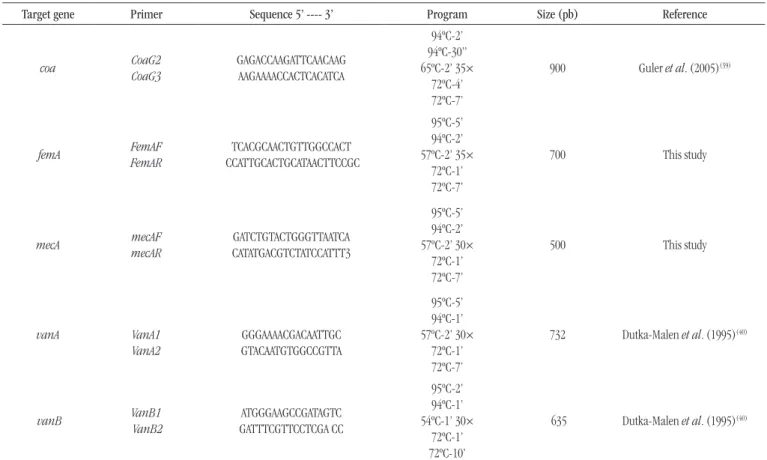
The PCR mixture had a inal volume of 25 µl of the Master Mix M7505 kit (Promega) added with 20 pmol of each oligonucleotide, following instructions by the manufacturer. The used primers were synthesized by Invitrogen (Carlsbad, CA); ampliications were conducted in PTC-200 Peltier Thermal Cycler (MJ Research) and Eppendorf EP Master Cycler (Table 1). All PCR reactions were
The following strains were used for PCR control: S. aureus (MRSA)
INCQS 00306 (ATCC 33591) and S. epidermidis INCQS 00016 (ATCC 12228). Electrophoresis was conducted in a horizontal Electrophoresis Cell (Bioamerica) apparatus containing 0.5× Tris/Borate/EDTA (TBE) buffer, for 60 minutes at 60 v with a Power Pac 300 (Bio-Rad). Images were digitized with the video documentation system ImageQuant 300®, GE.
Sequencing and identity analysis
The vanB gene PCR product was puriied with a QIAquick® PCR Puriication kit (Qiagen), according to the manufacturer’s manual. The puriied product underwent sequencing using the Big Dye Terminator kit for capillary electrophoresis in a ABI 3730 DNA Analyzer (Applied Biosystems, Foster City CA, USA) (Platform PDTIS/Fiocruz). The chromatogram was converted to Fasta format using the Sequencher 3.0 (Gene Codes Corporation, Ann Arbor, MI) software. Sequence similarity analysis was performed by BLASTn program (http://www.ncbi.nlm.nih.gov/BLAST/), at GenBank (National Center for Biotechnology Information [NCBI]).
TABLE 1 – Genes, primers, and PCR conditions
Target gene Primer Sequence 5’ ---- 3’ Program Size (pb) Reference
coa CoaG2
CoaG3
GAGACCAAGATTCAACAAG AAGAAAACCACTCACATCA
94ºC-2’ 94ºC-30” 65ºC-2’ 35×
72ºC-4’ 72ºC-7’
900 Guler et al. (2005)(39)
femA FemAF
FemAR
TCACGCAACTGTTGGCCACT CCATTGCACTGCATAACTTCCGC
95ºC-5’ 94ºC-2’ 57ºC-2’ 35×
72ºC-1’ 72ºC-7’
700 This study
mecA mecAF
mecAR
GATCTGTACTGGGTTAATCA CATATGACGTCTATCCATTT3
95ºC-5’ 94ºC-2’ 57ºC-2’ 30×
72ºC-1’ 72ºC-7’
500 This study
vanA
VanA1 VanA2
GGGAAAACGACAATTGC GTACAATGTGGCCGTTA
95ºC-5’ 94ºC-1’ 57ºC-2’ 30×
72ºC-1’ 72ºC-7’
732 Dutka-Malen et al. (1995)(40)
vanB
VanB1 VanB2
ATGGGAAGCCGATAGTC GATTTCGTTCCTCGA CC
95ºC-2’ 94ºC-1’ 54ºC-1’ 30×
72ºC-1’ 72ºC-10’
635 Dutka-Malen et al. (1995)(40)
PCR: polymerase chain reaction.
RESULTS
Biochemical identification and antimicrobial
susceptibility
The 79 samples collected from the two analyzed health units resulted in the isolation of 49 strains of Staphylococcus spp.
(62%): 33 (67.34%) from medical devices, and 16 (32.66%) from health professionals. The 49 isolates presented morphology and staining characteristics of Gram-positive cocci, produced catalase and fermented mannitol. Forty-one isolates (83.67%) produced DNase enzyme; 35 (71.42%), coagulase enzyme; and the other 14 (28.57%) were negative for coagulase production. Regarding antimicrobial susceptibility, the 49 isolates presented 19 resistance proiles (Table 2). According to the presented phenotypes, the isolates were identiied as S. aureus (n = 35, 71.42%) and
CoNS (n = 14, 28.57%). Among these 14 isolates, six (42.85%)
were methicillin-resistant coagulase-negative Staphylococcus
(MRCoNS). Among the 35 S. aureus, 11 (31.42%) were MRSA;
one isolate (6.66%) revealed the presence of a 635-bp fragment corresponding to the vanB gene. The presence of a vanA gene
speciic fragment was not veriied. The sequence of the vanB gene
presented 98% identity with sequences of this gene at GeneBank, where it was stored under KP 731622 access number.
Characterization of
Staphylococcus
spp.
After phenotypical and molecular identiication, the 49 isolates were identiied as MSSA (n = 27), MRSA (n = 10) – one
of these isolates was also identiied as VRSA –, CoNS (n = 7) and MRCoNS (n = 5). Among these isolates, 35 produced coagulase (S. aureus) and 14 did not (CoNS), by the conventional method of
free coagulase. However, the coa gene was ampliied in 37 isolates, which were then identiied as S. aureus. Among the 49 strains, 15 presented the mecA gene. Thirty-seven isolates were characterized as S. aureus; among them, 10 presented the mecA gene, and were
identiied as MRSA; another ive were considered MRCoNS.
DISCUSSION
Staphylococcus aureus is part of the skin microbiota of up to
a third of the general population; the nasal vestibules (35%) and the perianal region (30%) are the main reservoirs, followed by the axillary and interdigital regions (5%-10%), where dissemination can occur, causing infections(41). Therefore, infections in healthcare
settings caused by multiresistant S. aureus have become quite relevant in the latest decades, being responsible for high indices of
morbidity and mortality(42-44).
In health centers, the main reservoirs of S. aureus are the
infected patients, although physicians, nurses and other staff members may be reservoirs and elements of propagation and maintenance. In this perspective, it is worth emphasizing that
prevention of S. aureus infection depends principally on the mechanisms for controlling environment and healthy carriers(76).
Oxacillin or methicillin-resistant (MRSA) isolates are among the major pathogens causing infections in the world, leading to the emergence of and disseminating increasingly virulent and
multiresistant strains(46).
In this study, the use of a polyphasic identiication approach allowed the detection of Staphylococcus spp., presenting MRSA, VRSA, MSSA, CoNS, and MRCoNS phenotypes, in isolates from both equipment and health professionals. For example, presence of coagulase (71.42%) and detection of the coa gene (75.51%) made
us suggest that although the coagulase test in tubes is considered
the standard method for differentiation of Staphylococcus spp., it
The strains that presented resistance to ive or more antibiotic classes were considered multiresistant. One single isolate, from the hand of a physician, presented resistance to vancomycin, with CIM ≥ 256 µg/ml, and to ive other analyzed antibiotics: oxacillin, erythromycin, clindamycin, rifampicin and cefoxitin; resistance to teicoplanin was also veriied, with CIM ≥ 256 µg/ml. This isolate was stored at CMRVS, under access number P3425.
Identification of
femA
,
coa
,
mecA
,
vanA
and
vanB
genes
Among the 49 isolates, 35 (71.4%) presented a single 900-bp fragment compatible with femA gene. PCR of the coa gene resulted
in the ampliication of a single fragment of 650-900 bp in 37 (75.51%) of the analyzed strains. A 500-bp fragment corresponding
to the mecA gene was detected in 15 (30.6%) strains; among these,
TABLE 2 – Antimicrobial resistance profiles of Staphylococcus spp. isolates
Profiles Resistance phenotype Nº of isolates
1 Sensitive to all 15
2 ERY 7
3 RIF 1
4 CHL 2
5 CLI 1
6 ERY and OXA 3c
7 ERY and GEN 1
8 ERY and RIF 1
9 OXA and CFO 1c
10 ERY, OXA and CFO 7b
11 ERY, CHL and CLI 1
12 ERY, GEN and CFO 2
13 ERY, OXA, GEN and CFO 1a
14 ERY, CHL, CLI and RIF 1
15 ERY, CLI, OXA, RIF and CFO 1a
16 ERY, CLI, OXA, CIP and CFO 1c
17 ERI, CLO, CLI, OXA, RIF and CFO 1a
18 ERI, CLI, OXA, VAN, RIF, CFO and TEI 1a
19 ERI, CLI, OXA, GEN, CIP, RIF and CFO 1a
Total 49
aAll MRSA strains; bive MRSA strains and one MRCoN; call MRCoN strains; ERY:
may present false negative results, as demonstrated in our study, in which coagulase-negative strains revealed the presence of the coa gene by PCR(80).
Detection of the coa gene has been adopted in species differentiation and typing because it is considered accurate and often more sensitive than detection of coagulase by biochemical
assays(48, 49). Besides being a factor of virulence, the gene encoding
coagulase synthesis is present in several allelic forms, what makes it possible for isolates to be classiied into different variants. Like
the spa (protein A) gene, the coa gene has a polymorphic region
used for differentiation of S. aureus isolates with the analysis of
polymorphism of length of restriction fragments, a method used in epidemiologic studies(49-51).
In this study, the presence of the femA gene in 35 S. aureus
isolates was conirmed. It is present exclusively in this species and is used for the selective detection of this microorganism(52-54),
although homologues of this gene have been characterized into CoNS species, such as S. epidermidis, S. simulans, S. hominis and S. saprophyticus(55). The absence of the femA gene from two
coagulase-negative isolates that presented the coa gene may be
due to variations in the annealing regions of primers, making the ampliication of femA impossible(56).
Our results demonstrated that among the 17 oxacillin-resistant (ORSA) isolates, 11 (64.7%) expressed coagulase; and 10 (58.8%), the mecA gene, being identiied as MRSA. The oxacillin-resistant strain, which did not present the mecA gene, leads us to
suggest the presence of another mechanism of oxacillin resistance, as, for instance, hyperproduction of beta-lactamase, modiication of the PBP binding site or presence of the mecC gene(24, 57-60).
In Brazil, MRSA dissemination has been object of studies aimed at verifying the frequency of resistance and its implications
in the health system(20, 21, 41, 61). Two studies in Rio Grande do Sul
demonstrated the presence of 32.7% MRSA in hospitalized patients, and 20.6% in saliva of 13 cleaning workers at the hospital(61, 62). In
Pernambuco, the prevalence rate was 13% in ICU inpatients, while in Bahia, this rate was 28%(2, 20). An investigation of nasal swabs
of hospitalized newborn at a maternity hospital in Rio de Janeiro veriied a frequency of 47% of this pathogen(63). The presence
of MRSA was also detected in hands and buccal cavity of 73% of dentists, 52% of other health professionals and 54% of patients at dental clinics of basic health centers in the city(11).
In recent decades, vancomycin has been the drug of choice for the treatment of MRSA infections. However, the excessive use of this antibiotic has led to increased resistance in Enterococcus, CoNS and MRSA strains. VISA isolates were initially detected in Japan, United States, France, South Africa and South Korea, from single patients
or groups of patients in a same hospital, demonstrating the transfer capacity of this organism and drawing attention to the importance of improving control measures for nosocomial infections(64-67).
In Brazil, the presence of vancomycin tolerance in ORSA strains was determined in 49.1% of the 395 hospital isolates in São Paulo, what certainly increases the risk of failures in treatments with vancomycin, besides increasing the risk of emergence of VISA(31). In Brazil, HAIs by these microorganisms were initially
reported in São Paulo and Rio de Janeiro. Later, an outbreak of VISA was described at a hospital in São Paulo, with isolation of four strains at a burn center(31, 68, 69). The irst report of multiple
VRSA isolates at a Brazilian hospital was the result of a study in 140 isolates of inpatients exposed to vancomycin(32). At the present
study, one of the most surprising pieces of data was the detection of an isolate – VRSA – colonizing the hand of a physician at the health care center. This asymptomatic colonization is highly clinically signiicant, as the individual colonized in the nostrils may contaminate his own hands and become a vehicle for this pathogen via the mechanism of contact infection. Consequently, the pathogen dissemination can occur in the health care setting, where there is circulation of individuals and patients who are more susceptible to exogenous infection(32).
A study involving a thousand healthy individual also
demonstrated 22.5% and 16.6% of individuals colonized by
Staphylococcus aureus and MRSA, respectively, in nostrils, forearm and hands(70). Concern over VRSA colonization and transmission is
not caused exclusively by nasal carriers, but also by medical devices as vehicles of this transmission. Thus, this colonization is considered a public health problem, and it is of interest to investigate whether health professionals are also nasal carriers of MRSA(71).
Studies about the epidemiological role of hands in the transmission of infection among health care workers have recognized their potential as source of eventual hospital infections, as well as the possible relationship between isolates from different anatomical locations of the same individual, mainly between nasal cavities and hand(1). Besides, hands are also considered one
of the main sources of cross-transmission of nosocomial infections among patients, equipment and/or contaminated surfaces, attributed to inadequate hygiene processes(72-74).
Awareness of the risks of infection transmission, limitations of disinfection methods, and dificulties of processing inherent in the nature of each medical device is fundamental for the adequate
measures to be taken(75). Although hand hygiene has been the most
important and recognized measure for prevention and control of infections, mainly by S. aureus, strong resistance to it is still
RESUMO
Introdução: A contaminação cruzada por Staphylococcus aureus entre pacientes, proissionais e materiais de uso médico em unidades de saúde é uma preocupação constante, o que leva pesquisadores a estudar a prevalência desse patógeno em portadores assintomáticos.
Objetivos: Investigamos a colonização e o peril de suscetibilidade aos antimicrobianos de Staphylococcus spp. em superfícies de
artigos médicos e em proissionais de duas unidades básicas de saúde no município do Rio de Janeiro. Materials e métodos: Foram
coletadas 79 amostras que resultaram em 49 isolados, submetidos à caracterização fenotípica e molecular por meio da reação em cadeia da polimerase (PCR) dos genes coa, femA e mecA. Resultados: De acordo com os fenótipos apresentados, os isolados foram identiicados como S. aureus (n = 35; 71,42%) e Staphylococcus coagulase negativa (CoNS) (n = 14; 28,57%). Destes 14 isolados, 42,85% foram Staphylococcus coagulase negativa resistentes a meticilina (MRCoNS). Dos 35 S. aureus, 31,42% foram resistentes a
meticilina (MRSA). Uma cepa foi resistente a vancomicina e identiicada como S. aureus resistente a vancomicina (VRSA) após a
detecção do gene vanB. Sessenta e oito por cento foram suscetíveis a meticilina (MSSA). Os genes coa, femA e mecA foram ampliicados
em 75,51%; 71,42% e 30,61% dos isolados, respectivamente. Após ampliicação do gene mecA, 20,41% foram classiicados como
MRSA e 10,20% como MRCoNS. Conclusão: Nossos resultados mostraram frequência maior de MSSA e MRCoNS entre S. aureus e CoNS,
respectivamente, colonizando equipamentos e proissionais de saúde. No entanto, a já descrita transferência do cassete cromossômico
estailocócico mec (SSCmec) de MRCoNS para MSSA poderia alterar esses resultados, aumentando a frequência de cepas MRSA.
Unitermos:Staphylococcus aureus; MRSA; VRSA.
dificult task, as professionals need to be aware of its importance in health care settings for safety and quality of care(76, 77).
The main prevention measures to control the spread of multiresistant microorganisms include: laboratory data-based surveillance, isolation of infected or colonized patients, use of barrier precautions (gloves and caps), hand washing and antisepsis, and cleaning the environment near the patient(78).
Inherent in all control measures of HAIs, education of health care workers is very important to the correct performance of patient care duties(79). The factors associated with poor adherence to
hand hygiene are, principally, heavy workloads, glove use, and conduction of activities involving cross transmission during specialized techniques(80).
The implementation of control and prevention measures must include continuous education, monitoring of adherence to hand hygiene practices, besides feedback of data, installation and maintenance of equipment, rational use of antibiotics, and recommendations based on caution in invasive procedures(81).
CONCLUSION
Our results showed higher frequency of MSSA and MRCoNS
among S. aureus and CoNS isolates, respectively, colonizing
equipment and health care workers. However, the already described
SSCmec transfer from MRCoNS to MSSA(82) could alter these
results, increasing the frequency of methicillin-resistant strains. As far as we know, this is the irst report about isolation of a VRSA strain presenting the vancomycin resistance gene vanB,
with CIM ≥ 256 µg/ml to vancomycin and teicoplanin, from the hands of a health care worker in Brazil.
As a result, we demonstrate the increased dissemination of resistance, and conclude that the adoption of procedures for hand antisepsis and disinfection of medical items is essential to prevent dissemination of these pathogens among patients, health professionals, and individuals of the community.
ACKNOWLEDGEMENTS
REFERENCES
1. Santos BMO. Monitoramento da colonização pelo Staphylococcus aureus em alunos de um curso de auxiliar de enfermagem durante a formação proissional. Rev Latino-Am Enfermagem 2000; 8(1): 67-73. 2. Cavalcanti SMM, França ER, Vilela MA, Montenegro F, Cabral C, Medeiros, ACR. Estudo comparativo da prevalência de Staphylococcus aureus importado para as unidades de terapia intensiva de Hospital Universitário, Pernambuco, Brasil. Rev Bras Epidemiol 2006; 9: 436-46. 3. Gomes MZ, Oliveira LA. Infecção estailocócica. In: Lopes AC, editor. Tratado de clínica médica. v. 3. São Paulo: Roca Ltda; 1996. p. 3974-95. 4. Murray PR, Rosenthal KS, Kobayashi GS, Pfaller MA. Microbiologia médica. 3 ed. Rio de Janeiro: Guanabara Koogan; 2000, 151 p. 5. Gialluly C, Morange V, Gialluly E, Loulergue J, van der Mee N, Quentin R. Blood pressure cuff as a potential vector of pathogenic microorganisms: a prospective study in a teaching hospital. Infect Control Hosp Epidemiol 2006; 27: 940-3.
6. Elias J, Claus H, Frosch M, Vogel U. Evidence for indirect nosocomial transmission of Neisseria meningitidis resulting in two cases of invasive meningococcal disease. J Clin Microbiol. 2006; 44: 4276-8.
7. Andrade D, Angerami ELS. Relexões acerca das infecções hospitalares às portas do terceiro milênio. Rev Med, Ribeirão Preto. 1999; 32: 492-7. 8. Palos MAP. Microbiota das mãos de mães e de proissionais de saúde de uma maternidade de Goiânia. Rev Eletr Enf. 2009; 11(3): 573-8. 9. Lane WR. Methicillin resistance in staphylococci. Med J Aust. 1962; 49(1): 962-5.
10. Jevons MP. Celbenin resistant staphylococci. BMJ. 1961; 1(5219): 124-5. 11. Lancellotti M. Estudo epidemiológico de Staphylococcus spp. em ambientes, água e portadores sadios e determinação da sensibilidade a antimicrobianos [tese]. Jaboticabal: Faculdade de Ciências Agrárias e Veterinárias, Universidade Estadual Paulista; 2006.
12. Becker K, Friedrich AW, Lubritz G, Weilert M, Peters G, Von Eiff C. Prevalence of genes encoding pyrogenic toxin superantigens and exfoliative toxins among strains of Staphylococcus aureus isolated from blood and nasal specimens. J Clin Microbiol. 2003; 41(4): 1434-9. 13. Benício CG, Reis C, Pimenta FC. Isolamento e contagem de Staphylococcus sp. na saliva de acadêmicos de Medicina. Braz J Infect Dis. 2003; 7(S1): S91.
14. Albrich WC, Harbarth S. Health-care workers: source, vector, or victim of MRSA? Lancet Infect Dis. 2008; 8(5): 289-301.
15. Braga KAM, Souza LBS, Santana WJ, et al. Microrganismos mais frequentes em Unidades de Terapia Intensiva. Rev Med Ana Costa. 2004; 9: 71-4.
16. Oztoprak N, Cevik MA, Akinci E, et al. Risk factors for ICU-acquired methicillin-resistant Staphylococcus aureus infections. Am J Infec Control. 2006; 34(1): 1-5.
17. Gontijo Filho PP. Problemas de vigilância epidemiológica de infecção hospitalares sem o uso de critérios microbiológicos no Brasil. Rev Cien Farm Basil Aplic. 2006; 27: 97-102.
18. Gleeson TD. Prevention and control of methicillin-resistant Staphylococcus aureus. Dis Mon. 2008; 54(12): 801-6.
19. Silvestri L, Petros AJ, Sarginson RE, de la Cal MA, Murray AE, van Saene HK. Hand washing in the intensive care unit: a big measure with modest effects. J Hosp Infect. 2005; 59(3): 172-9.
20. Brites C, Silva N, Sampaio-Sá M. Temporal evolution of the prevalence of methicillin-resistant Staphylococcus aureus in a tertiary hospital in Bahia, Brazil: a nine-year evaluation study. Braz J Infect Dis. 2006; 10: 235-8. 21. Oliveira DC, Milheirico C, De Lencastre H. Redeining a structural variant of staphylococcal cassette chromosome mec, SCCmec type VI. Antimicrob Agents Chemother. 2006; 50: 3457-9.
22. Hackbarth CJ, Chambers HF. Methicillin-resistant staphylococci: genetics and mechanisms of resistance. Antimicrob Agents Chemother. 1989; 33: 991-4.
23. Ryffel C, Tesch W, Birch-Machin I, et al. Sequence comparison of mecA genes isolated from methicillin-resistant Staphylococcus aureus and Staphylococcus epidermidis. Gene. 1990; 94(1): 137-8.
24. García-Álvarez L, Holden MT, Lindsay H, et al. Meticillin-resistant Staphylococcus aureus with a novel mecA homologue in human and bovine populations in the UK and Denmark: a descriptive study. Lancet Infect Dis. 2011; 11(8): 595-603.
25. Vanderhaeghen W, Vandendriessche S, Crombé F, et al. Characterization of methicillin-resistant non-Staphylococcus aureus staphylococci carriage isolates from different bovine populations. J Antimicrob Chemother. 2013; 68(2): 300-7.
26. Oliveira GA, Levy CE, Mamizuka EM. Staphylococcus aureus apresentando resistência intermediária à vancomicina: mecanismos de resistência, detecção laboratorial e perspectivas de emergência no Brasil. J Bras Patol. 2000; 36(2): 96-102.
27. Tenover FC, Moellering RC Jr. The rationale for revising the Clinical and Laboratory Standards Institute vancomycin minimal inhibitory concentration interpretive criteria for Staphylococcus aureus. Clin Infect Dis. 2007; 44(9): 1208-15.
28. Howden BP, McEvoy CR, Allen DL, et al. Evolution of multidrug resistance during Staphylococcus aureus infection involves mutation of the essential two component regulator WalKR. PLoS Pathog. 2011; 7(11). 29. Chang FY, Peacock JE Jr, Musher DM. Staphylococcus aureus bacteremia: recurrence and the impact of antibiotic treatment in a prospective multicenter study. Medicine. 2003; 82: 333-9.
30. Sakoulas G, Moellering RC Jr. Increasing antibiotic resistance among methicillin-resistant Staphylococcus aureus strains. Clin Infect Dis. 2008; 46: S360-7.
31. Oliveira GA, Okada SS, Guenta RS, Mamizuka EM. Avaliação da tolerância à vancomicina em 365 cepas hospitalares de Staphylococcus aureus resistentes à oxacilina. J Bras Patol Med Lab. 2001; 37(4): 239-46. 32. Oliveira GA, Dell’Aquila AM, Masiero RL, et al. Isolation in Brazil of nosocomial Staphylococcus aureus reduced susceptibility to vancomycin. Infect Control Hosp Epidemiol. 2001a; 22(7): 443-8.
33. Mimica MJ, Mendes CMF. Diagnóstico laboratorial da resistência à oxacilina em Staphylococcus aureus. J Bras Patol Med Lab. 2007; 43(6): 399-406.
35. Ministério da Saúde (BR). Resolução do Conselho Nacional de Saúde nº 196, de 10 de outubro de 1996. Aprova as diretrizes e normas regulamentadoras de pesquisas envolvendo seres humanos. Brasília (DF): Diário Oicial [da] República Federativa do Brasil; 1996, Seção 1, p. 21082-5.
36. Koneman EW, Allen SD, Janda WM, Schreckenberger PC, Win WC. Diagnóstico microbiológico: texto e atlas colorido. 6 ed. Rio de Janeiro: Medsi; 2008, p. 551-88.
37. Bauer AW, Kirby WM, Sherris JC, Turck M. Antibiotic susceptibility testing by a standardized single disk method. Am J Clin Pathol. 1966; 45(4): 493-6.
38. Clinical and Laboratory Standards Institute. Performance standards for antimicrobial disk susceptibility testing; approved standard. 30 ed. Document M100-S20. Wayne (PA): Clinical and Laboratory Standards Institute. 39. Güler L, Ok U, Gündüz K, Gülcü Y, Hadimli HH. Antimicrobial susceptibility and coagulase gene typing of Staphylococcus aureus isolated from bovine clinical mastitis cases in Turkey. J Dairy Scien. 2005; 88: 3149-54.
40. Dutka-Malen S, Evers S, Courvalin SP. Detection of glycopeptide resistance genotypes and identiication to the species level of clinically relevant enterococci by PCR. J Clin Microbiol. 1995; 33: 24-7.
41. Cavalcanti SM, França ER, Cabral C, et al. Prevalence of Staphylococcus aureus introduced into intensive care units of a university hospital. Braz J Infect Dis. 2005; 9: 1: 56-63.
42. Grundmann H. Geographic distribution of Staphylococcus aureus causing invasive infections in Europe: a molecular-epidemiological analysis. PloS Med. 2010; 7: 1-15.
43. Michelin DC, Moreschi PE, Lima AC, Nascimento GGF, Paganelli MO, Chaud MV. Avaliação da atividade antimicrobiana de extratos vegetais. Rev Bras Farmac. 2005; 15: 316-20.
44. Martins A, Cunha MLRS. Methicillin resistance in Staphylococcus aureus and coagulase-negative Staphylococci: epidemiological e molecular aspects. Microbiol Immunol. 2007; 51(9): 787-95.
45. Tanaka M, Hayashida Y, Iguchi T, Nakao N, Nakai N, Nakashima K. Organization of the mouse ghrelin gene and promoter: occurrence of a short noncoding irst exon. Endocrinology. 2001; 142(8): 3697-700. 46. Velázquez-Meza ME. Staphylococcus aureus methicillin-resistant: emergence and dissemination. Salud Pública Méx. 2005; 47(5): 381-7. 47. Vannuffel P, Gigi J, Ezzedine H, et al. Speciic detection of methicillin-resistant Staphylococcus species by multiplex PCR. J Clin Microbiol. 1995; 33: 2864-7.
48. Vieira-da-Motta O, Folly MM, Sakyiama CCH. Detection of different Staphylococcus aureus strains in bovine milk from subclinical mastitis using PCR and routine techniques. Bras J Microbiol. 2001; 32(1): 27-31. 49. Gharib AA, Adel Attia MA, Bendary MM. Detection of the coa gene in Staphylococcus aureus from different sources by polymerase chain reaction. International J Microbiol Res. 2013; 4: 37-42.
50. Goh SH, Byrne SK, Zhang JL, Chow AW. Molecular typing of Staphylococcus aureus on the basis of coagulase gene polymorphism. J Clin Microbiol. 1992; 30: 1642-5.
51. Hookey JV, Richardson JF, Cookson BD. Molecular typing of Staphylococcus aureus based on PCR restriction fragment length
polymorphism and DNA sequences analysis of the coagulase gene. J Clin Microbiol. 1998; 36: 1083-9.
52. Browne DFJ, Brown L. Evaluation of E-test, a novel method for quantifying antimicrobial activity. J Antimicrob Chemother. 1991; 27: 185-90.
53. Leclercq R, Derlot E, Duval J, Courvalin P. Plasmid-mediated resistance to vancomycin and teicoplanin in Enterococcus faecium. N Engl J Med. 1988; 319: 157-61.
54. Mulligan ME. Methicillin-resistant Staphylococcus aureus: a consensus review of the microbiology, pathogenesis, and epidemiology with, implications for prevention and management. Am J Med. 1993; 94(3): 313-28.
55. Alborn WE Jr, Hoskins J, Unal S. Cloning and characterization of femA and femB from Staphylococcus epidermidis. Gene. 1996; 180(1-2): 177-81. 56. Vanuffel P, Heusterspreute M, Bouyer M, Vandercam B, Philippe M, Gala JL. Molecular characterization of femA from Staphylococcus hominis and Staphylococcus saprophyticus, and femA-based discrimination of staphylococcal species. Res Microbiol. 1999; 150(2): 129-41.
57. Geha DJ. Multiplex PCR for identiication of methicillin-resistant staphylococci in the clinical laboratory. J Clin Microbiol. 1994; 32: 1768-72. 58. Jorgensen JH. Selection criteria for an antimicrobial susceptibility testing system. J Clin Microbiol. 1993; 31: 2841-4.
59. Mohanasoundaram KM, Lalitha MK. Comparison of phenotypic versus genotypic methods in the detection of methicillin resistance in Staphylococcus aureus. Indian J Med Res. 2008; 27: 78-84.
60. Shore AC, Deasy EC, Slickers P. Detection of staphylococcal cassette chromosome mec type XI carrying highly divergent mecA, mecI, mecR1, blaZ, and ccr genes in human clinical isolates of clonal complex 130 methicillin-resistant Staphylococcus aureus. Antimicrob Agents Chemother. 2011; 55(8): 3765-73.
61. Spiandorello WP, Morsh F, Sebben S, Spiandorello FSA. A resistência do Staphylococcus aureus à oxacilina em hospital de Caxias do Sul. Rev AMRIGS. 2000; 44(3-4): 120-5.
62. Cruz EDA, Pimenta FC, Hayashida M, Eidt M, Gir E. Detecção de Staphylococcus aureus na boca de trabalhadores da limpeza hospitalar. Rev Lat Am Enferm. 2011; 19: 1-7.
63. Loureiro MM, Moraes BA, Quadra MRR, Pinheiro GS, Suffys PN, Asensi MD. Molecular epidemiology of methicillin resistant Staphylococcus aureus isolated from newborns in a hospital in Rio de Janeiro, Brazil. Mem Inst Oswaldo Cruz. 2000; 95(6): 777-82.
64. Hiramatsu K, Aritaka N, Hanaki H, et al. Dissemination in Japanese hospitals of strains of Staphylococcus aureus heterogeneously resistant to vancomycin. Lancet. 1997; 350: 1670-3.
65. Ploy MC, Grélaud C, Martin C, de Lumley L, Denis F. First clinical isolate of vancomycin-intermediate Staphylococcus aureus in a French hospital. Lancet. 1998; 351: 1212.
66. Tenover FC, Lancaster MV, Hill BC, et al. Characterization of staphylococci with reduced susceptibilities to vancomycin and other glycopeptides. J Clin Microbiol. 1998; 36: 1020-7.
MAILING ADDRESS
Maysa Mandetta Clementino
Instituto Nacional de Controle de Qualidade em Saúde; Fundação Oswaldo Cruz; Av. Brasil, 4365; CEP: 21045-900; Rio de Janeiro-RJ, Brazil; Phone: +55 (21) 3865-5236; Fax: +55 (21) 2290-0915; e-mail: [email protected].
68. Del’Alamo L, Cereda RF, Tosin I, Miranda EA, Sader HS. Antimicrobial susceptibility of coagulase-negative staphylococci and characterization of isolates with reduced susceptibility to glycopeptides. Diagn Microbiol Infect Dis. 1999; 34: 185-91.
69. Nunes APF. S. aureus coagulase-negativos: diferenciação em espécies, diversidade genômica de espécies resistentes à oxacilina e determinação da sensibilidade à glicopeptídios [dissertação]. Rio de Janeiro: Instituto de Microbiologia Prof. Paulo de Góes, Universidade Federal do Rio de Janeiro; 2000.
70. Gould IM, Cauda R, Esposito S, Gudiol F, Mazzei T, Garau J. Management of serious meticillin-resistant Staphylococcus aureus infections: what are the limits? Int J Antimicrob Agents. 2011; 37(3): 202-9.
71. Neves MC, Rossi Júnior OD, Alves ECC, Lemos MVF. Detecção de genes de resistência antimicrobiana em cromossomos e plasmídeos de Staphylococcus spp. Arq Inst Biol. 2007; 74(3): 207-13.
72. Bjerke BN. The evolution: handwashing to hand hygiene guidance. Crit Care Nurs Q. 2004; 27: 295-307.
73. Karabey S, Ay P, Derbentli S, Nakipoglu Y, Esen F. Handwashing frequencies in an intensive care unit. J Hosp Infect. 2002; 50: 36-41. 74. Larson EL. Hygiene of skin: when is clean too clean. Emerg Infect Dis. 2001; 7(2): 225-30.
75. Lacerda RA. Brazilian scientiic production on nosocomial infection and nursing contribution: past, present and perspectives. Rev Lat Amer Enferm. 2002; 10: 55-63.
76. Agência Nacional de Vigilância Sanitária. Resolução da Diretoria Colegiada da Agência Nacional de Vigilância Sanitária nº 14, de 28 de fevereiro de 2007. Aprova o regulamento técnico para produtos saneantes com ação antimicrobiana harmonizado no âmbito do MERCOSUL através da resolução GMC nº 50/06. Brasília (DF): Diário Oicial [da] República Federativa do Brasil; 2007, Seção 1.
77. Maskerine C, Loeb M. Improving adherence to hand hygiene among health care workers. J Contin Educ Health Prof. 2006; 26(3): 244-51. 78. Boyce JM. MRSA patients: proven methods to treat colonization and infection. J Hosp Infect. 2001; 48: 9-14.
79. Mayhall CG. Hospital epidemiology and infection control. 3 ed. Philadelphia: Lippicott-Raven; 2004, 2060 p.
80. Rangle J, Clarke M, Storr J. Hand hygiene compliance in healthcare workers. J Hosp Infect. 2006; 64: 205-9.
81. Pittet D. Infection control and quality health care in the new millennium. Am J Infec Control. 2005; 33(5): 258-67.