Identification of polymorphisms of
XRCC1
gene in
patients with cancer in a city of northern Brazil
Identificação dos polimorfismos do gene
XRCC1
em indivíduos com câncer em uma
cidade da Região Norte do Brasil
Artemis Socorro N. Rodrigues; Tainá L. Vanzeler; Gabriel O. Espíndola
Universidade Federal do Amapá (UNIFAP).
First submission on 13/01/15; last submission on 23/03/15; accepted for publication on 23/03/15; published on 20/06/15
ABSTRACT
Introduction: Cancer is considered a genetic disease. For this reason, identiication and characterization of the genes involved in its origin and progression are of fundamental importance in understanding its molecular basis. Objective: Our objective was to determine whether people from Macapá with a diagnosis of cancer have genetic polymorphisms related to the XRCC1 gene. Material and methods: We analyzed 30 samples of deoxyribonucleic acid (DNA) of cases with cancer and 30 control samples. All samples were ampliied and analyzed by the polymerase chain reaction-restriction fragment length polymorphisms (PCR-RFLP)method, with the use of restriction enzyme MspI. Results: Regarding the 194T polymorphism, we found that all samples of the cases presented the polymorphic allele Trp (Arg/Trp). In control samples, 96.6% also identify the polymorphic allele Trp and, among these, one was
homozygous for the same allele (Trp/Trp). Regarding the 399A polymorphism, 83.3% of the cases and 23.3% of the controls had the Arg/ Gln genotype, respectively. We found that 73.3% of controls and 16.6% of cases had the Arg/Arg genotype. Among the controls, we found only a sample that was homozygous for the polymorphic allele Trp/Trp. Conclusion: Our results demonstrated the allele frequency of 194Trp polymorphism in both sample groups analyzed. We also found a signiicant number of polymorphic allele 399A in people with cancer. Thus, we can highlight 399Gln polymorphism as a genetic marker of cancer risk in this population.
Key words: gene XRCC1; cancer; Macapá.
INTRODUCTION
The deoxyribonucleic acid (DNA) repair gene XRCC1 (X-ray
repair cross complementing family) has an important function in the repair of DNA single-strand breaks induced by oxidation in human cells(1). The deiciencies in DNA repair capacity due to mutations or polymorphisms of repair genes, including XRCC1, can lead to genomic instability, which results in chromosomal instability syndromes and increased risk of various tumor types(1, 2). These polymorphisms involving an amino acid change in evolutionarily conserved regions can alter the function of XRCC1 protein. Previous studies have reported that allele 399Gln of
XRCC1 was signiicantly associated with high levels of DNA adducts and glycophorin. Mutations in erythrocytes, increased frequency of sister-chromatid exchange and higher sensitivity to the immune response are also associated with this polymorphism(1).
Polymorphisms in DNA repair genes are common events, and some studies have shown the signiicant effect of many of these polymorphisms in the ability to repair DNA damage, thus inluencing individual susceptibility to carcinogenesis(3, 4).
Cancer may be regarded as a genetic disorder triggered by changes in the cell’s DNA. However, unlike other human genetic diseases, it is not necessarily a hereditary disease. Human cancers are mostly of somatic origin, resulting from the interaction of genetic and environmental factors(4).
Many changes in DNA are caused by endogenous mutagens, including reactive oxygen species (ROS) and errors during the processes of replication, recombination and repair. At the same time, several changes are the result of DNA interaction with a variety of physical, chemical and biological compounds, many of which are present in the environment, where man can remain in continuous exposure(4-7).
Among the endogenous factors that inluence carcinogenesis one may cite the individual variations in the defense mechanisms, including DNA repair and the detoxiication system, and elimination of carcinogens(7).
Because cancer is a genetic disease, identiication and characterization of the genes involved in its origin and progression are of fundamental importance in understanding its molecular basis(3, 4, 7). This better understanding of the disease contributes to new ways to diagnose it early, thus facilitating treatment(3, 4, 7).
Our proposal was to determine whether people in Macapá with a diagnosis of cancer have genetic polymorphisms related to the
XRCC1 gene.
MATERIAL AND METHODS
Studied samples
Sixty peripheral blood samples were selected: 30 samples from patients (cases) with clinical diagnosis of various cancer types, seen at Hospital de Clínicas Dr. Alberto Lima (HCAL); and 30 blood samples used as control from donors of Instituto de Hematologia e Hemoterapia do Amapá (Hemoap), after informed consent.
Methodological procedure
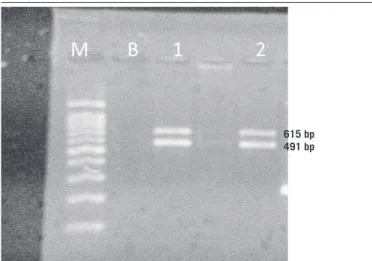
The DNA of the participants’ samples was isolated by GeneJET Genomic DNA Puriication Kit (Synapse Biotechnology), following the manufacturer’s recommended protocol. All samples were ampliied and analyzed by polymerase chain reaction-restriction fragment length polymorphisms (PCR-RFLP) technique, with the use of restriction enzyme MspI(1, 6, 7). The primers used were: 194F: 5’GCCCCGTCCCAGGTA3’, 194R: 5’AGCCCCAAGACCCTTTCACT 3’, 399F: 5’TTGTGCTTTCTCTGTGTCCA3’, and 399R: 5’TCCTCCAGCCTTTTCTGATA 3’, amplifying the fragments of 491 and 615 bp, respectively (Figure 1). The PCR conditions (25 µl) were 0.5 l of each primer; 300 ng of genomic DNA; 11.5 µl of 2X PCR Taq Master Mix (Molecular Brazil); 11.5 µl H2O. The ampliication cycle consisted of 94ºC for ive minutes, thirty cycles of 94ºC for 30 seconds, 65ºC for one minute and 30 seconds, and 72ºC for one minute, followed by ive minutes at 72ºC. After the ampliication reaction, 10 µl of the PCR product were digested with MspI
enzyme (New England BioLabs, Beverly, MA) at 37ºC for one night, and then underwent electrophoresis for identiication of the fragment (Figure 2).
DETERMINATION OF GENOTYPE
After ampliication and digestion with MspI enzyme,
genotyping was characterized by the following fragments: for the 194T polymorphism, the presence of the 292 bp fragment
FIGURE 1 − PCR agarose gel at 1.5% for the identification of fragments 491 and 615 bp
M: molecular weight marker (100 bp); B: white; line 1: sample 1; line 2: sample 2; PCR: polymerase chain reaction.
FIGURE 2 − Standard interpretation of XRCC1 genotype
M: molecular weight marker (100 bp); lines 1, 2 and 3: heterozygous for the Trp allele is homozygous for the Arg allele; line 4: homozygous for the Gln allele is heterozygous for the Trp allele.
615 bp 491 bp
374 bp
313 bp
292 bp
represents the wild-type allele (Arg), while the 313 bp fragment represents the polymorphic allele (Trp), indicating
absence of the restriction site of MspI enzyme (Figure 2). Regarding the polymorphism 399A, Arg/Arg genotype, Arg/Gln and Gln/Gln fragments were identiied by 374/221, 615/374/221 and 615 bp, respectively (Figure 2).
RESULTS
The results of the XRCC1 gene frequency in cases and control
samples are shown in Table.
The XRCC1 protein, encoded by the gene of the same name, is involved in the base excision repair (BER) pathway. This pathway is responsible for identifying and removing the DNA damage (e.g. oxidized, deaminated or alkylated bases) spontaneously arising in the cell or from exposure to exogenous agents, such as ionizing radiation and ultraviolet (UV) light(1, 7).
It is suggested that polymorphisms in the XRCC1 gene, which
cause amino acid changes, would prevent the XRCC1 protein to perform its function effectively and consequently alter the activity of the BER(7, 9). It has been reported that polymorphisms in repair genes may increase or reduce the susceptibility to the development of cancer and also to treatment with chemotherapeutic agents(1, 4, 5, 7, 10).
One goal of this study was to analyze the frequency of two polymorphisms of XRCC1 DNA repair gene (194T and 399A), and
to investigate their relationship with susceptibility to cancer in people from the city of Macapá.
The single-nucleotide polymorphism (SNP) Arg194Trp is one of the two most frequently observed polymorphisms in the XRCC1
gene. The variant CT and TT genotypes are associated with a risk more than ive times higher in female children. Several authors have also identiied association of this allele (194T) with the risk of colorectal cancer, nasopharyngeal carcinoma, oral cancer and thyroid cancer(7, 10).
Our results demonstrated the frequent presence of polymorphic allele 194Trp in both sample groups analyzed. Literature data report that the presence of the variant allele 194Trp is associated
with several malignancies(10). Skjelbred et al. (2006)(10) studied 530 samples of Caucasian subjects analyzed by the project Cancer Risk Biomarkers in Norway: only one had the Trp/Trp genotype at codon 194 of the XRCC1 gene, and the majority had the Arg/Arg genotype. In this study we found only a sample of the Trp/Trp genotype among the control samples, and did not identify any with Arg/Arg genotype.
A meta-analysis by Hu et al. (2005)(11) assessed the polymorphism in XRCC1 gene (Arg194Trp) susceptibility to various cancer types. In the study, one may observe the existence of conlicting results regarding the Arg194Trp polymorphism for the different ethnic groups investigated. A high frequency of 194T
allele was detected in Asians (31.2%; 95% CI 29.6-32.8) and lower frequencies in Europeans (6.6%, 95% CI 5.9-7.4) and Africans (7.3%, 95% CI 5.7-9.2, p < 0.0001).
We observed in this molecular analysis that the 194Trp allele is frequent in people from the city of Macapá, for the Trp allele is present in both cancer cases and controls. The literature reports that the Trp allele shows low frequency among people of African
TABLE − Results of the molecular analysis of polymorphisms
in the XRCC1 gene in cases and controls
Genotype Cases (%) Controls (%)
XRCC1/C194T
Arg/Arg 0/30 (0) 0/30 (0) Arg/Trp 30/30 (100) 29/30 (96.6) Trp/Trp 0/30( 0) 1/30 (33.3)
XRCC1/G399A
Arg/Arg 5/30 (16.6) 22/30 (73.3)
Arg/Gln 25/30 (83.3) 7/30 (23.3)
Gln/Gln 0/30 (0) 1/30 (33.3)
Analysis of genetic polymorphisms
In our analysis, we observed that all case samples showed the
Trp polymorphic allele (Arg/Trp), as well as 96.6% of the control
sample, and one control sample was identiied as homozygous for the same Trp allele (Table).
Regarding the polymorphism 399A; 83.3% of the case samples and 23.3% of controls had the Arg/Gln genotype. We found that 73.3% of controls and 16.6% of cases had Arg/Arg genotype. Among the controls, we found only a sample that was homozygous for the polymorphic allele Trp/Trp (Table, Figure 1 and Figure 2).
DISCUSSION
and European descent(11-13), however, the population of Amapá descends from Africans, Europeans and Indians, what differs from other data reported in the literature. Santos et al. (2009)(9), in a study in northern Brazil, identiied an increasing degree of population substructuring and evidence that this polymorphism differs with respect to ethnic groups. Thus, based on ancestry studies, it is possible that in a particular generation of Amapá population, the Trp allele was maintained and became part of the
genetic makeup of these people.
In the present study, we found no correlation between the
194Trp polymorphism and the development of cancer, as all DNA samples from cases and controls had this allele. Another polymorphism of XRCC1 gene analyzed in the present study was the 399A; 73.3% of the control samples and 16.6% of cases were identiied with the wild genotype Arg/Arg. However, we found that 83.3% of the samples of cancer cases had the Arg/Gln genotype, a high frequency compared to the frequency of 23.3% of the controls.
Au et al. (2003)(14) reported the interaction of 399GlnXRCC1 gene polymorphism with large deletions in human chromosomes
RESUMO
Introdução: O câncer é considerado uma doença genética, por isso identificar e caracterizar os genes envolvidos em sua origem e
progressão é fundamental para compreender suas bases moleculares. Objetivo: Nosso objetivo foi verificar se os indivíduos de Macapá com diagnóstico de câncer apresentavam os polimorfismos genéticos relacionados com o gene XRCC1. Material e métodos: Foram analisadas 30 amostras de ácido desoxirribonucleico (DNA) de indivíduos com câncer e 30 amostras controle. Todas elas foram amplificadas e analisadas pela técnica de reação em cadeia da polimerase (PCR)-polimorfismo de tamanho de fragmentos de restrição (RFLP), com a utilização da enzima de restrição MspI. Resultado: Com relação ao polimorfismo 194T, observamos que todas as amostras dos casos apresentaram o alelo polimórfico Trp (Arg/Trp). Nas amostras controle, em 96,6% também identificamos o alelo polimórfico Trp e, entre essas, uma foi homozigota para o mesmo alelo (Trp/Trp). Quanto ao polimorfismo 399A, 83,3% das amostras dos indivíduos com câncer e 23,3% das amostras controle apresentaram o genótipo Arg/Gln. Verificamos que 73,3% dos controles e 16,6% dos casos apresentaram genótipo Arg/Arg. Encontramos apenas uma amostra, entre os controles, homozigota para o alelo polimórfico Trp/Trp. Conclusão: Nossos resultados demonstraram a frequência do alelo polimórfico 194Trp nos dois grupos amostrais analisados. Encontramos também um número significativo do alelo polimórfico 399A em indivíduos com câncer. Desse modo, podemos destacar o polimorfismo 399Gln como possível marcador genético para ser usado no prognóstico do câncer nessa população.
Unitermos: gene XRCC1; câncer; Macapá.
REFERENCES
1. Alves PM, Canalle R, Martins PRJ, Antunes LMG. Identiicação dos polimorismos do gene XRCC1 em pacientes com anemia falciforme. Rev Bras Hematol Hemoter. 2007; 29(2): 198-9.
induced by X-ray. Angeliniet al. (2005)(15) demonstrated that the gene polymorphism of XRCC1 was positively correlated with the
increase in the number of chromosomal abnormalities found in peripheral blood lymphocytes of individuals occupationally exposed to low doses of ionizing radiation.
Studies have reported that individuals with at least one allele
399Gln haveincreased tendency for chromosomal aberrations(1). In the present study, we found a correlation between cases of cancer
and the 399Gln polymorphism. Our results show that probably
people with the Arg/Gln genotype show greater susceptibility to the development of some form of cancer. Thus, we can also consider the 399Gln polymorphism a possible genetic marker for use in
cancer prognosis, yet it is undoubtedly necessary to increase the number of cases and controls.
For the irst time in Macapá, a genetic study was conducted associating a gene polymorphism with the development of cancer. We intend to continue the study, increasing the number of samples. We are in the early stages of a more speciic study, which will analyze samples of developed cancer, as well as associate each patient’s genetic results to clinical practice.
2. Brem R, Hall J. XRCC1 is required for DNA single-strand repair in human cell. Nucleic Acids Res. 2005; 33(8): 2512-20.
4. Mandal RK, Kapoor R, Mittal RD. Polymorphic variants of DNA repair gene XRCC3 and XRCC7 and risk of prostate cancer: a study from North Indian population. DNA Cell Biol. 2010; 29(11): 669-74.
5. Lindhal T. Suppression of spontaneous mutagenesis in human cells by DNA base excision-repair. Mutat Res. 2000; 462(2-3): 129-35.
6. Lunn MR, Langlois RG, Hsieh LL, et al. XRCC1 polymorphism: effects on alatoxin B1-DNA adducts and glycophorin A variant frequency. Cancer Res. 1999; 59(11): 2557-61.
7. Viera PCM. Identiicação de polimorismos de nucleotídeo único (SNPs) nos genes de reparo XRCC1 e XRCC3 como possíveis marcadores de suscetibilidade ao câncer, na População de Belém-PA. [trabalho de conclusão de curso]. Curso de Biomedicina, Universidade Federal do Pará; 2010.
8. Pachkowski GF, Winkel S, Kubota Y, Swenberg JA, Millikan RC, Nakamura J. XRCC1 genotype and breast cancer: functional studies and epidemiologic data show interactions between XRCC1 codon 280 His and smoking. Cancer Res. 2006; 66(5): 2860-8.
9. Santos NPC, Ribeiro-Rodrigues EM, Ribeiro-dos-Santos AKC, et al. Assessing individual interethnic admixture and population substructure using a 48 insertion-deletion ancestry informative markers panel. Hum Mutat. 2009; 31(2): 184-90.
10. Skjelbred CF, Svendsen M, Haugen V. Inluence of DNA repair gene polymorphisms of hOGG1, XRCC1, XRCC3, ERCC2 and the folate metabolism gene MTHFR on chromosomal aberration frequencies. Mutat Res. 2006; 602(1-2): 151-62.
11. Hu Z, Ma H, Chen F, Wei Q, Shen H. XRCC1 polymorphisms and cancer risk: a meta-analysis of 38 case-control studies. Cancer Epidemiol Biomarkers Prev. 2005; 14(7): 1810-8.
12. Canalle R, Andrade V, Scrideli RG, et al. Polymorphisms in the thymidylate synthase promoter and the DNA repair genes XRCC1 and XPD in a Brazilian population. Environ Mol Mutagen. 2006; 47(9): 725-32.
13. Duarte FL, Colombo J, Rossit ARB, Silva AE. Polymorphism of the DNA repair genes XRCC1 and XRCC3 in a Brazilian population. Genet Mol Biol. 2005; 28(3): 397-401.
14. Au WW, Salama AS, Sierra-Torres CH. Functional characterization of polymorphism in DNA repair genes using cytogenetic challenge assays. Environ Health. 2003; 111(15): 1843-50.
15. Angelini S, Kumar R, Carbone F, et al. Micronuclei in humans induced by exposure to low level of ionizing radiation: inluence of polymorphism in DNA repair gene. Mutat Res. 2005; 570(1): 105-17.
MAILING ADDRESS
Artemis Socorro N. Rodrigues