Pharmaceutical care for patients with persistent asthma:
assessment of treatment compliance and use of inhaled
medications*
Atenção farmacêutica ao portador de asma persistente: avaliação da aderência ao tratamento e da técnica de
utilização dos medicamentos inalatórios
Daiane de Oliveira Santos, Maria Cleusa Martins, Sonia Lucena Cipriano, Regina Maria Carvalho Pinto, Alberto Cukier, Rafael Stelmach
Abstract
Objective: To evaluate treatment compliance and use of inhaled medications of patients with asthma receiving complementary pharmaceutical care. Methods: A controlled prospective parallel study involving a study group and a control group. We selected 60 patients with persistent asthma and using metered-dose inhalers (MDIs), dry powder inhalers (DPIs) or both. The patients were evaluated three times over 60 days. Instructions were provided to the patients in the study group at all visits but only at the first visit to those in the control group. The patients using < 80% or > 120% of the total number of prescribed doses were classified as noncompliant. The inhalation technique was quantified by a scoring system. A satisfactory technique was defined as a score higher than 7 (maximum, 9) for MDIs and higher than 4 (maximum, 5) for DPIs. Results: The final study sample comprised 28 study group patients and 27 control group patients, of whom 18 (64.3%) and 20 (74.7%), respectively, were considered treatment compliant. From the first to the third visits, there were increases, in the study and control groups, in the median MDI-use score (from 3 [range, 0-5] to 8 [range, 8-9]; p < 0.001; and from 5 [range, 2-6] to 7 [range, 6-8]), as well as in the median DPI-use score (from 3 [range, 2-4] to 5 [range, 4-5] and from 3 [range, 2-4] to 4 [range, 3-5]). Conclusions: The counseling provided by the pharmacist to the patient was important to assist in the implementation of the appropriate inhalation technique, especially for MDI use.
Keywords: Asthma; Pharmaceutical services; Administration, inhalation; Metered dose inhalers; Medication adherence.
Resumo
Objetivo: Avaliar a aderência ao tratamento e a técnica de utilização de dispositivos inalatórios em pacientes com asma após atenção farmacêutica complementar. Métodos: Estudo prospectivo controlado com dois grupos paralelos: grupo estudo e grupo controle. Foram selecionados 60 asmáticos persistentes, utilizando regularmente inaladores dosimetrados (IDs), inaladores de pó seco (IPS) ou ambos. Os pacientes foram avaliados em três visitas durante 60 dias. As instruções foram fornecidas em todas as visitas aos pacientes do grupo estudo e apenas na primeira visita do grupo controle. Os pacientes que utilizaram < 80% ou > 120% do total de doses prescritas foram classificados como não aderentes. A manobra inalatória foi quantificada por escores, e uma técnica satisfatória foi definida por uma pontuação superior a 7 (máximo, 9) para o uso de ID e superior a 4 (máximo, 5) para o uso de IPS. Resultados: Concluíram o estudo 28 pacientes no grupo estudo e 27 no grupo controle, dos quais 18 (64,3%) e 20 (74,7%), respectivamente, foram classificados como aderentes. Houve um aumento nas medianas dos escores do uso de ID entre a primeira e a terceira visitas tanto no grupo estudo quanto no grupo controle (de 3 [variação, 0-5] para 8 [variação, 8-9]; p < 0,001; e de 5 [variação, 2-6] para 7 [variação, 6-8]), assim como nas medianas dos escores do uso de DPS (de 3 [variação, 2-4] para 5 [variação, 4-5]; e de 3 [variação, 2-4] para 5 [variação, 4-5]). Conclusões: A orientação fornecida pelo farmacêutico ao paciente foi importante para auxiliar na adequada realização da técnica inalatória, principalmente quanto ao uso de IDs.
Descritores: Asma; Assistência farmacêutica; Administração por inalação; Inaladores dosimetrados; Adesão ao medicamento.
* Study carried out at the Hospital das Clínicas da Faculdade de Medicina da Universidade de São Paulo – HC-FMUSP, University of São Paulo School of Medicine Hospital das Clínicas – São Paulo, Brazil.
Correspondence to: Rafael Stelmach. Rua Manoel Nóbrega, 572/42, CEP 04001-002, São Paulo, SP, Brasil. Tel 55 11 3069-5034. E-mail: [email protected]
Financial support: None.
Methods
This was an open, controlled, prospective study carried out between August of 2005 and January of 2006. We selected patients with persistent asthma who were on regular mainte-nance treatment, had not participated in asthma education programs before and had been under follow-up at the asthma outpatient clinic of the Department of Pulmonology of the University of São Paulo School of Medicine Hospital das Clínicas for more than a year.
Those patients were evaluated at three time points: the first visit (V1, inclusion), at which point the patient agreed to participate in the study and gave written informed consent; and two other visits (V2 and V3, follow-up assess-ments), at four- and eight-week intervals, respectively.
The study participants were divided into two parallel groups: study and control. This divi-sion was performed sequentially at V2, the first patient being included in the study group, the second being included in the control group, and so on. The patients assigned to the study group were provided counseling on the correct use of the medications at all visits, whereas those assigned to the control group were provided counseling only at V1.
During the visits, the patients were submitted to the following procedures: completion of a specific anamnesis form; patient demonstration of the use of inhaled devices, which was evalu-ated and corrected by the pharmacist; and a second patient demonstration, after the correc-tions (only for the patients in the study group).
At every visit, the evaluations were performed by the same professional, who also empha-sized the importance of correctly observing the frequency and time at which the medica-tions should be taken, as well as the dose, in accordance with the medical prescription. The mean duration of each visit was approximately 60 min.
Treatment compliance was determined by counting the doses used by the patient, which made it possible to calculate the rate of compliance (number of days between the visits × number of doses prescribed per day = 100% compliance).(15) These assessments were
performed at V2 and V3, considering the inter-vals of medication use prior to those visits.
Introduction
Asthma is a chronic inflammatory disease with a high worldwide prevalence and increased morbidity, placing an onus on patients and their families.(1) An important aspect observed
in asthma, as well as in other chronic diseases, is noncompliance with or abandonment of the prescribed treatment.(2,3) Noncompliance with
physician-prescribed treatments is one of the leading causes of treatment failure.(4) It has
frequently been reported that rates of compli-ance with the recommended treatment are low among asthma patients, only half of all asthma patients actually using the prescribed medication.
(5,6) It should be emphasized that these low rates
of compliance can be associated with various factors, such as difficulty in administering the medications,(7,8) unsatisfactory benefits obtained
from the use of the medication, risk of adverse effects,(7) prolonged duration of treatment, use
of multiple medications and periods of symptom remission.(9)
The administration of inhaled medications is a fundamental component of the clinical treat-ment of patients with pulmonary disease. The use of inhalers makes it possible to selectively reach the lungs, increasing the concentra-tion of the drug and reducing systemic adverse effects.(10,11) The effectiveness of the inhaled
medication depends not only on the formula-tion and the type of device used but also on the ability of the patient to perform the inhalation technique correctly.(12)
Pharmacists have contributed significantly to the follow-up of patients with persistent asthma.(13) The literature has demonstrated that
the benefits of asthma education programs, in which pharmacists instruct asthma patients, result in better compliance with pharmacological treatment, promote the correct use of inhaled medications, detect medication-related prob-lems and improve the quality of life of patients, as well as reducing the number of emergency room visits and hospitalizations for asthma exacerbations.(13,14)
mining the doses available in the device, which were shown in the dose display itself.
The use of medications in the form of metered dose inhalers that do not allow dose count (beclomethasone dipropionate, 250 µg; and albuterol, 100 µg) was assessed by weighing the bottles after they were used by the patient. In order to determine the number of doses used in these inhalers, we instituted a weighing tech-nique, adapted from the Brazilian Pharmacopeia, based on the technique of bottle weighing,(16)
using 20 bottles of beclomethasone dipropionate (250 µg), 20 bottles of albuterol (100 µg) and an analytical scale (model AM220; Marte Balanças e Aparelhos de Precisão Ltda, São Paulo, Brazil), We used a 20% margin of error, which is in
accordance with the literature; the patients using less than 80% (fewer doses) or more than 120% (more doses) of the total number of prescribed doses were classified as noncompliant.(4)
The use of medications in the form of dry powder inhalers, such as Aerolizer® (budesonide,
200 µg; and formoterol/budesonide, 6/200 µg), was assessed by counting the empty capsules kept and returned by the patient and confirmed by counting the capsules remaining in the bottle. The use of medications in the form of metered dose inhalers, such as Diskus® and Turbuhaler®
(salmeterol xinafoate, 50 µg; and formoterol/ budesonide, 12/400 µg), was assessed by
deter-Table 1 - Inhalation technique score: metered dose inhalers.
Criterion Score
Exhales
No 0
Yes 1
TLC is maintained
< 10 s 0
10 s or more 1
Velocity
Rapid or < 5 s 0
Slow or ≥5 s 1
Depth
Not completely 0
Properly 1
Time point (inhalation)
Before the spray 0
Immediately after or together with the triggering 1 Positions
Incorrectly 0
Correctly 1
Shakes
No 0
Yes 1
Mode of use
Inside the mouth, without a spacer 0
Out of the mouth 1
With a spacer 2
Errors - Deduct the value(s) corresponding to the error(s) below Score
Extremely severe Nasal breathing −8
Severe Removes the spacer; starts inhalation too early; only sprays it into the mouth and does not inhale; does not
shake; sprays two or more jets; inhales too late.
−4
Moderate Uses the spacer irregularly; exhales into the spacer; inhales irregularly; mouth open to the inside.
−2
Mild Removes the barrel; breathes shallowly with the spacer. −1
The t-test was used in order to compare the study and control groups in terms of their characteristics and in terms of compliance with pharmacological treatment. In contrast, ANOVA with repeated measures was used to compare the results obtained in the assessment of the use of inhalation devices, and the median values were considered. The tests were performed using the software SigmaStat, version 2.01 (Jandel Scientific, San Rafael, CA, USA). Values of p < 0.05 were considered significant. The results are presented as median and interquartile range (25-75%).
Results
We included 60 patients, who were equally divided between the study and control groups. Five patients were excluded, since, for personal reasons, they failed to return for V3. The final study sample consisted of 55 patients, of whom 28 were included in the study group and 27 were included in the control group. The sociodemo-graphic characteristics of the patients are shown in Table 3. There were no statistically signifi-cant differences between the study and control groups regarding sociodemographic aspects.
The median rate of inhaled medication use in the study group was 93.1% at V2 and 100% at V3 (range, 44.6-172.2%), compared with 92.5% at V2 and 93.0% at V3 (range, 2.5-187.5%) in the control group.
In the study group, 18 patients (64.3%) were classified as treatment compliant at V2 and V3. In the control group, 20 patients (74.7%) and 19 patients (70.4%) were also classified as treat-ment compliant at V2 and V3, respectively. No statistically significant differences were found between the groups during the follow-up assessment. In both groups, 13% of the patients used doses that were higher than those recom-mended, and 36% used doses that were lower.
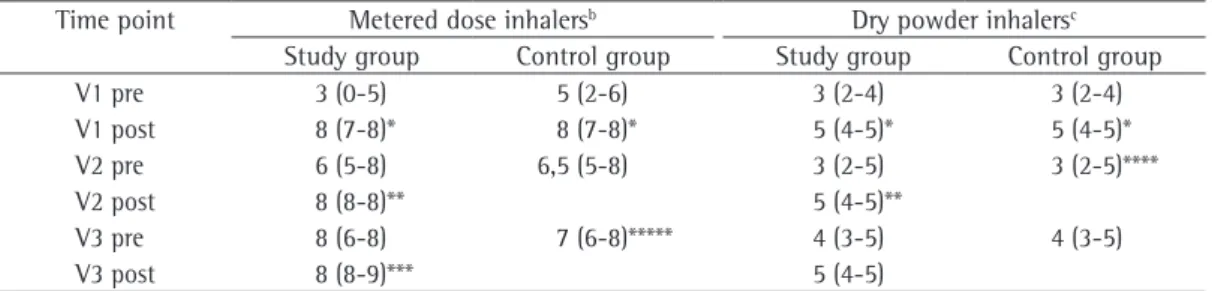
In the assessment of the use of metered dose inhalers, the medians obtained in the study group at V1 were 3.0 and 8.0, respectively, before and after counseling and corrections (p < 0.001; Table 4). At V2, the medians were 6.0 and 8.0, respectively, before and after coun-seling and corrections (p < 0.001). At V3, the median obtained was the same (8.0) before and after counseling. A statistically significant differ-ence (p < 0.001) was found between the results obtained after counseling at V1 and at V3. In sensitive and reproducible to within 0.1 mg. The
result obtained—the mean weight of each dose of beclomethasone dipropionate (250 µg) and albuterol (100 µg)—was 0.846 g.
For all patients, the assessment of the use of inhalation devices was based on the scores for the use of metered dose inhalers and the scores for the use of dry powder inhalers.(17) This scoring
system is based on the most common errors made by patients. If the patient follows each step correctly, the patient receives one point for each step taken; for each error made, in addition to not receiving the point, and depending on the severity of the given error, points are deducted from those already scored. Therefore, an unsat-isfactory inhalation technique was defined by a score lower than 80% of the maximum possible score.
These values were adapted and, in the present study, the maximum score was 9 points for metered dose inhalers and 5 points for dry powder inhalers (Tables 1 and 2). Therefore, a satisfactory inhalation technique was defined as scores ≥ 7 and ≥ 4, respectively, for metered dose inhalers and dry powder inhalers.
Table 2 - Inhalation technique score: dry powder inhalers.
Criterion Score
Dose is prepared (device is triggered)
Correctly 0
Incorrectly 1
Exhales
No 0
Yes 1
TLC is maintained
< 10 s 0
10 s or more 1
Velocity
Rapid or < 5 s 0
Slow or ≥5 s 1
Depth
Not completely 0
Properly 1
Errors - Deduct the value(s) corresponding to the error(s) below
Score
Severe Nasal breathing. −4
Moderate Exhales into the device; inhales irregularly.
−2
Mild Inhales shallowly. −1
In the control group, the medians obtained for the inhalation technique scores at V1 were 5.0 and 8.0, respectively, before and after coun-seling and corrections (p < 0.001). The medians obtained at V2 and at V3 were 6.6 and 7.0, respectively. The patients in the control group presented an increase in the quality of the inha-lation technique, reaching satisfactory scores after the first counseling session at V1, followed by a slight decline, which resulted in unsatisfac-tory scores being obtained at V2 and at V3, at which points only 11 patients (42.0%) were able to achieve the maximum score (Table 4).
Comparing the scores in the two groups after the counseling session at V1, the medians in the study and control groups were the same (8.0), indicating that, at this point, there were no differences between the groups. In contrast, at the end of V3, the medians in the study and control groups were 8.0 and 7.0, respectively (p < 0.001), and this difference was statistically significant.
In the assessment of the use of dry powder inhalers in the study group, the medians obtained for the scores at V1 were 3.0 and 5.0, respectively, before and after counseling and corrections (p < 0.01; Table 4). At V2, the medians for this group were 3.5 and 5.0, respectively, before and after counseling and corrections (p < 0.001). At V3, the medians were 4.0 and 5.0, respectively. In the analysis of the scores of the patients in the study group, it was observed that improvement occurred and satisfactory scores were reached after the first counseling session, there was a slight decline at V2, with scores being unsatis-factory, and improvement occurred again, with scores being satisfactory after the second coun-seling session and stabilizing after V2.
addition, at V3, 25 patients (96.0%) achieved the maximum score of 9 points. Therefore, the analysis of the progression of the patients in the study group regarding the use of metered dose inhalers reveals the following: the quality of the inhalation technique improved and satisfactory scores were achieved after the first counseling session; there was a slight but not significant decline at V2 before the counseling session; and there was a new and significant increase after the other counseling sessions. This indicates an improvement in the results obtained over the course of the follow-up assessment.
Table 3 - Sociodemographic characteristics of the population studied.
Characteristic Study group Control group (n = 28) (n = 27)
Gender n (%) n (%)
Male 8 (28.57) 4 (14.81) Female 20 (71.43) 23 (85.19) Age, years
15-30 3 (10.7) 2 (7.4)
30-60 17 (60.7) 19 (70.4) > 60 8 (28.6) 6 (22.2) Level of education
Illiterate 3 (10.7)
Junior high 17 (60.7) 18 (66.7) High school 7 (25) 6 (22.2) College 1 (3.6) 3 (11.1) Family income
1 to 3 times the MW (< R$ 700.00)
20 (71.43) 22 (81.48)
3 to 7 times the MW (R$ 700.00 to R$2,000.00)
8 (28.57) 5 (18.52)
MW: (national) minimum wage.
Table 4 - Score obtained by the patients in the assessment of the inhalation technique.a
Time point Metered dose inhalersb Dry powder inhalersc
Study group Control group Study group Control group
V1 pre 3 (0-5) 5 (2-6) 3 (2-4) 3 (2-4)
V1 post 8 (7-8)* 8 (7-8)* 5 (4-5)* 5 (4-5)*
V2 pre 6 (5-8) 6,5 (5-8) 3 (2-5) 3 (2-5)****
V2 post 8 (8-8)** 5 (4-5)**
V3 pre 8 (6-8) 7 (6-8)***** 4 (3-5) 4 (3-5)
V3 post 8 (8-9)*** 5 (4-5)
V1: first visit (inclusion); V2: second visit (follow-up assessment); V3: third visit (follow-up assessment); Pre: before coun-seling; Post: after counseling. aData expressed as median and interquartile range. bMaximum score for use of metered dose
inhalers = 9. cMaximum score for use of dry powder inhalers = 5. *p < 0.001 (V1 pre vs. V1 post). **p < 0.001 (V2 pre vs.
over the course of the follow-up period, the patients in the study group progressively learned how to improve their use of metered dose inhalers. A single session of counseling or correc-tion proved to be insufficient for the patients in the control group to learn to use metered dose inhalers correctly. However, the analysis of the use of dry powder inhalers revealed that there was an increase in the scores obtained in the two groups after the counseling session in the first visit, suggesting that the learning curve was similar in both groups. Nevertheless, only 47% of the patients in the control group achieved the maximum score.
Our data, compared with those reported in the literature, indicate that dry powder inhalers require a simpler technique and, there-fore, shorter training times. This is due to the fact that it is easier to coordinate respiratory and mechanical movements when using a dry powder inhaler than when using a metered dose inhaler.(12,18,19)
In the present study, more than 64% of the patients were classified as compliant. This percentage is slightly higher than those usually reported in the literature, according to which only half of the patients actually use the prescribed medication.(5) The low level of education and low
family income of the patients in the study group did not negatively affect treatment compliance, although, in the literature, it has been purported that compliance is affected by social, econom-ical, educational and psychological aspects.(20)
The strong institutional link between the patient and the hospital as a health care provider might explain the treatment compliance rates found in this study. In particular, the fact that our patients receive medications free of charge while they are under regular follow-up treatment might have played a role, since high compliance rates have also been observed in other studies in which medications were provided free of charge.(21)
Of the patients who were classified as noncompliant, 36% used fewer than the total recommended number of doses. According to previous studies, such patients neglect control-ling their disease and become exposed to the risk of asthma-related exacerbations because they receive suboptimal doses of maintenance medication(s).(22) Conversely, 13% of the
noncom-pliant patients used more than the number of prescribed doses, indicating overdosage, which In the control group, the median scores for
the use of dry powder inhalers at V1 were 3.0 and 5.0, respectively, before and after coun-seling and corrections (p < 0.001). The medians obtained at V2 and at V3 were 3.0 and 4.0 (p < 0.001), respectively. Therefore, the patients in the control group presented an increase in the inhalation technique scores at V1 and a slight but significant decline, with unsatisfac-tory scores, at V2.
The median inhalation technique scores were found to be the same (5.0) for both groups at V1 after the first counseling session. At V3, the last observation time point, the median scores were 5.0 and 4.0, respectively, for the study and control groups, although this difference was not statistically significant. Nineteen patients (73.0%) in the study group and 11 patients (47.0%) in the control group achieved the maximum score value.
Discussion
During the follow-up assessment of the patients included in this study, we observed positive results, with a progressive increase in the scores for the use of inhaled medications, especially among the patients using metered dose inhalers. Regarding compliance with pharmacological treatment, more than 64% of the patients included in the study were classi-fied as compliant. However, the percentage of compliant patients did not change during the follow-up visits. Complementary pharmaceutical care increased the quality of the use of inha-lation devices, even in patients who had been using such devices for a long time.
The experience of a pharmaceutical care study involving outpatients at a public tertiary hospital is important, since pharmaceutical care studies are typically conducted at community pharma-cies. Hospital outpatient clinics allow interaction between pharmacists and other members of the health care staff, as well as providing access to information included in medical charts of outpa-tients and inpaoutpa-tients.
Data from a study conducted in Europe indicate that there is a clear need for specific training of patients in correct inhalation tech-nique for the various devices currently available, and this should be repeated frequently to main-tain the correct inhalation technique.(24)
Problems related to treatment compliance are very common in patients with chronic diseases, and, since strategies to monitor and improve compliance are included in pharmaceutical care plan, the pharmacist is in an ideal posi-tion to have access to the problems related to poor treatment compliance, which can adversely affect patient health.(18) Therefore, it is essential
that pharmacists involved in the education of asthma patients master the techniques in order to provide safe training to the patient.
Despite having already been included in education programs, achieving positive results in the management of asthma, the participation of pharmacists in the treatment of patients remains minimal in many countries,(25,26) including Brazil.
It is essential that this problem be addressed in graduate or postgraduate courses, which could stimulate the development of pharmaceutical care projects adapted to our health care system. Pharmaceutical care will certainly improve treat-ment compliance rates and will ensure the correct use of inhalation devices in order to control asthma.
References
1. Global Initiative for Asthma (GINA) [homepage on the Internet]. Bethesda: National Heart, Lung and Blood Institute. National Institutes of Health, US Department of Health and Human Services; c2000. [cited 2008 Mar 4]. Global Strategy for Asthma Management and Prevention updated 2007. Available from: http://www. ginasthma.org/
2. Basheti IA, Reddel HK, Armour CL, Bosnic-Anticevich SZ. Counseling about turbuhaler technique: needs assessment and effective strategies for community pharmacists. Respir Care. 2005;50(5):617-23.
3. Rio EM, Gallo PR, Siqueira AA. Asthma mortality in the city of São Paulo, Brazil [Article in Portuguese]. Rev Saude Publica. 2002;36(2):149-54.
4. Delgado AB, Lima ML. Contributo para a validação concorrente de uma medida de adesão aos tratamentos. Psic Saude Doenças. 2001;2(2):81-100.
5. Fiterman J, Mattos W, Cukier A, Pizzichinni M, Silva RF, Kahan F, et al. Acceptability, preference, tolerance and clinical efficacy of dipropionate beclomethasone delivered by two inhalation devices in chronic asthma patients: Clenil pulvinal® versus Miflasona Aerolizer® [Article in Portuguese]. J Bras Pneumol. 2004;30(5):413-8. 6. Eshel G, Raviv R, Ben-Abraham R, Barr J, Berkovitch M,
Efrati O, et al. Inadequate asthma treatment practices
is not considered correct from the standpoint of compliance, even if this fact reduces the inci-dence of hospitalizations or emergency room visits for asthma.(22) In order to avoid
under-dosage/overdosage, a new strategy for asthma management has been proposed. Patients using budesonide and formoterol could be encouraged to increase the number of doses during sympto-matic periods to regain control of the disease and then automatically reduce the number of doses when the disease is under control.(22)
The results of the present study could have had a greater impact if the following require-ments had been met: inclusion of a greater number of patients in the study; longer follow-up assessment period; direct measurement of compliance (plasma monitoring) for comparison with results obtained by the indirect method to determine compliance, a method that is known to have limitations; measurement of compli-ance before the first counseling session; use of strict inclusion and exclusion criteria; and comparison of the results with those obtained for noninstitutionalized patients. In addition, there is evidence that different types of dry powder inhalers can present different degrees of efficacy, depending on the patient.(23) In this
study, dry powder inhalers were considered as a whole, in terms of the principle of inhalation, so that they could be compared with metered dose inhalers. A different study design would be necessary in order to evaluate the response to different dry powder inhalers, and that was not our objective.
Another weak point in this study was that the clinical impact of asthma control was not measured. Recent studies focusing on pharma-ceutical intervention have revealed a significant reduction in acute attacks and nocturnal asthma symptoms.(15) In one major study, it was observed
that there was a reduction in nocturnal asthma symptoms and an improvement in asthma control, as assessed by the Asthma Control Test, together with an improvement in treatment compliance, in the quality of the inhalation technique.(15)
corticoisteróides sistêmicos [dissertation]. São Paulo: Universidade de São Paulo; 1998.
18. Muniz JB, Padovani CR, Godoy I. Inalantes no tratamento da asma: avaliação do domínio das técnicas de uso por pacientes, alunos de medicina e médicos residentes. J Pneumol. 2003;29(2):75-81.
19. Chafin CC, Tolley EA, George CM, Demirkan K, Kuhl DA, Pugazhenthi M, et al. Gender differences in metered-dose inhaler-spacer device technique. Pharmacotherapy. 2000;20(11):1324-7.
20. Kulkarni SP, Alexander KP, Lytle B, Heiss G, Peterson ED. Long-term adherence with cardiovascular drug regimens. Am Heart J. 2006;151(1):185-91.
21. Santos Pde M, D’Oliveira A Jr, Noblat Lde A, Machado AS, Noblat AC, Cruz AA. Predictors of adherence to treatment in patients with severe asthma treated at a referral center in Bahia, Brazil. J Bras Pneumol. 2008;34(12):995-1002.
22. Rabe KF, Pizzichini E, Ställberg B, Romero S, Balanzat AM, Atienza T, et al. Budesonide/formoterol in a single inhaler for maintenance and relief in mild-to-moderate asthma: a randomized, double-blind trial. Chest. 2006;129(2):246-56.
23. Chrystyn H. The Diskus: a review of its position among dry powder inhaler devices. Int J Clin Pract. 2007;61(6):1022-36.
24. Crompton GK, Barnes PJ, Broeders M, Corrigan C, Corbetta L, Dekhuijzen R, et al. The need to improve inhalation technique in Europe: a report from the Aerosol Drug Management Improvement Team. Respir Med. 2006;100(9):1479-94.
25. Schulz M, Verheyen F, Mühlig S, Müller JM, Mühlbauer K, Knop-Schneickert E, et al. Pharmaceutical care services for asthma patients: a controlled intervention study. J Clin Pharmacol. 2001;41(6):668-76.
26. Cordina M, McElnay JC, Hughes CM. Assessment of a community pharmacy-based program for patients with asthma. Pharmacotherapy. 2001;21(10):1196-203. and noncompliance in Israel. Pediatr Pulmonol.
2002;33(2):85-9.
7. Sherman J, Patel P, Hutson A, Chesrown S, Hendeles L. Adherence to oral montelukast and inhaled fluticasone in children with persistent asthma. Pharmacotherapy. 2001;21(12):1464-7.
8. Jones C, Santanello NC, Boccuzzi SJ, Wogen J, Strub P, Nelsen LM. Adherence to prescribed treatment for asthma: evidence from pharmacy benefits data. J Asthma. 2003;40(1):93-101.
9. Rand CS, Wise RA. Measuring adherence to asthma medication regimens. Am J Respir Crit Care Med. 1994;149(2 Pt 2):S69-76; discussion S77-8.
10. Hess DR. Metered-dose inhalers and dry powder inhalers in aerosol therapy. Respir Care. 2005;50(10):1376-83. 11. Allen SC, Ragab S. Ability to learn inhaler technique in
relation to cognitive scores and tests of praxis in old age. Postgrad Med J. 2002;78(915):37-9.
12. Dolovich MB, Ahrens RC, Hess DR, Anderson P, Dhand R, Rau JL, et al. Device selection and outcomes of aerosol therapy: Evidence-based guidelines: American College of Chest Physicians/American College of Asthma, Allergy, and Immunology. Chest. 2005;127(1):335-71.
13. Närhi U, Airaksinen M, Tanskanen P, Erlund H. Therapeutic outcomes monitoring by community pharmacists for improving clinical outcomes in asthma. J Clin Pharm Ther. 2000;25(3):177-83.
14. Prabhakaran L, Lim G, Abisheganaden J, Chee CB, Choo YM. Impact of an asthma education programme on patients’ knowledge, inhaler technique and compliance to treatment. Singapore Med J. 2006;47(3):225-31. 15. Mehuys E, Van Bortel L, De Bolle L, Van Tongelen I,
Annemans L, Remon JP, et al. Effectiveness of pharmacist intervention for asthma control improvement. Eur Respir J. 2008;31(4):790-9.
16. Farmacopéia Brasileira. São Paulo: Atheneu; 1988. pt 1, p. v.1.1-2.
About the authors
Daiane de Oliveira Santos
Pharmacist. Department of Pharmacy, Hospital das Clínicas da Faculdade de Medicina da Universidade de São Paulo – HC-FMUSP, University of São Paulo School of Medicine Hospital das Clínicas – São Paulo, Brazil.
Maria Cleusa Martins
Pharmacist-in-charge. Department of Pharmacy, Hospital das Clínicas da Faculdade de Medicina da Universidade de São Paulo – HC-FMUSP, University of São Paulo School of Medicine Hospital das Clínicas – São Paulo, Brazil.
Sonia Lucena Cipriano
Director. Department of Pharmacy, Hospital das Clínicas da Faculdade de Medicina da Universidade de São Paulo – HC-FMUSP, University of São Paulo School of Medicine Hospital das Clínicas – São Paulo, Brazil.
Regina Maria Carvalho Pinto
Attending Physician. Department of Pulmonology, Hospital das Clínicas da Faculdade de Medicina da Universidade de São Paulo – HC-FMUSP, University of São Paulo School of Medicine Hospital das Clínicas – São Paulo, Brazil.
Alberto Cukier
Tenured Professor. Department of Pulmonology, Hospital das Clínicas da Faculdade de Medicina da Universidade de São Paulo – HC-FMUSP, University of São Paulo School of Medicine Hospital das Clínicas – São Paulo, Brazil.
Rafael Stelmach