ISSN 1806-3713 © 2016 Sociedade Brasileira de Pneumologia e Tisiologia
http://dx.doi.org/10.1590/S1806-37562016000000094
Multiple calciied nodules
Edson Marchiori1,2, Gláucia Zanetti2,3, Bruno Hochhegger4,5
1. Universidade Federal Fluminense, Niterói (RJ) Brasil. 2. Universidade Federal do Rio de Janeiro, Rio de Janeiro (RJ) Brasil. 3. Faculdade de Medicina de Petrópolis, Petrópolis (RJ) Brasil. 4. Santa Casa de Misericórdia de Porto Alegre, Porto Alegre (RS) Brasil.
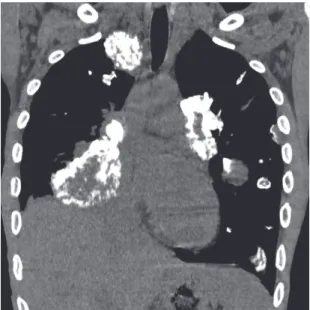
5. Universidade Federal de Ciências da Saúde de Porto Alegre, Porto Alegre (RS) Brasil. A 22-year-old male patient previously diagnosed with osteosarcoma in the right leg, which was amputated in 2011, sought medical attention. The patient had multiple
pulmonary nodules with calciications (Figure 1). The inal diagnosis was calciied metastases from osteosarcoma.
Multiple pulmonary nodules can have numerous
etiol-ogies. However, when these lesions have calciications,
the diagnostic possibilities are considerably reduced.
Calciied metastases, amyloidosis, hyalinizing granulomas,
epithelioid hemangioendothelioma, rheumatoid nodules, and multiple chondromas can be listed as the major
causes of the pattern consisting of multiple nodules and/or masses of various sizes and with calciications. The tumors that most commonly give rise to calciied
metastases are sarcomas, especially osteosarcomas; synovial sarcomas; chondrosarcomas; and carcinomas, particularly mucinous or papillary adenocarcinomas.
Amyloidosis, in its nodular form, is more common in patients over 60 years of age, and these patients are
usually asymptomatic. The nodules grow slowly, over
years, without regression. The deinitive diagnosis is made by histopathology, on the basis of the inding of deposition of amyloid, which stains with Congo red and shows apple-green birefringence in polarized light. Hyalinizing granulomas are rare ibrotic pulmonary lesions,
usually associated with autoimmune phenomena mainly
related to exposure to mycobacterial or fungal antigens. These lesions can remain stable or grow slowly for years. Epithelioid hemangioendothelioma is a rare multifocal pulmonary neoplasm of endothelial origin. It is considered a sarcoma of low aggressiveness. Although it does not
usually exhibit growth, it eventually grows slowly and
can lead to respiratory failure. In addition, it can develop calciication within 10-20 years of diagnosis. Necrobiotic
nodules can develop in patients with pneumoconiosis
associated with rheumatoid arthritis. The onset of these nodules characterizes Caplan’s syndrome. Calciication in pulmonary chondromas is a common radiological inding. The association of these chondromas with gastrointestinal
stromal tumors and extra-adrenal paragangliomas is
known as the Carney triad. In all these diseases, patients can be asymptomatic or present with nonspeciic chest symptoms. Therefore, the lesions are often incidental radiological indings. The association between clinical and radiological indings can signiicantly improve the accuracy of the diagnosis. However, in most cases, lung
biopsy with immunohistochemical staining is required
to establish the correct diagnosis. In the case of the patient in question, the history of osteosarcoma resection associated with the presence of calciied pulmonary nodules led to the inal diagnosis of metastases from osteosarcoma. This diagnosis is facilitated, in the vast majority of cases, because the primary bone tumor is already known before the onset of metastases.
RECOMMENDED READING
1. Webb WR, Muller NL, Naidich DP, editors. High-resolution CT of the lung. 4th ed. Philadelphia: Lippincott Williams & Wilkins; 2008.
Figure 1. Coronal CT section (mediastinal window settings)
showing multiple partially calciied nodules and masses, of various sizes, in both lungs.
J Bras Pneumol. 2016;42(3):164-164
164