Detecção de adenovírus em "swab" oftálmico empregando protocolo rápido por
reação da polimerase em cadeia
Instituto de Ciências Biológicas, Universidade Federal de Minas Gerais Departamento de Microbiologia -Laboratório de Vírus, Av. Antonio Carlos, 6627 - Belo Horizonte (MG) CEP 31270-901.
1Laboratório de Vírus, Departamento de Microbiologia, Instituto de Ciências Biológicas, Universidade Fede-ral de Minas Gerais.
2Programa de Pós-graduação em Oftalmologia, Faculda-de Faculda-de Medicina, UniversidaFaculda-de FeFaculda-deral Faculda-de Minas Gerais. 3Núcleo Especializado em Oftalmologia - Belo
Horizon-te, MG.
Supported by: CNPq, CAPES e FAPEMIG.
Endereço para correspondência: Erna Geessien Kroon, Laboratório de Vírus, Departamento de Microbiologia, Instituto de Ciências Biológicas, Universidade Federal de Minas Gerais - Av. Antonio Carlos, 6627, Belo Hori-zonte (MG) CEP 31270-901
E-mail: [email protected]
Recebido para publicação em 16.05.2003 Versão revisada recebida em 19.11.2003 Aprovação em 30.01.2004
Nota Editorial: Pela análise deste trabalho e por sua anuência na divulgação desta nota, agradecemos ao Dr. Maurício Brik.
Rodrigo Melo Mendes1 Maurício Lacerda Nogueira1 João Trindade Marques1 Maria Valéria Corrêa Pereira2 Maria Amélia de Souza Machado1 Anderson Saporetti Cunha3 Fernando Cansado Trindade2 Erna Geessien Kroon1
INTRODUCTION
Human adenoviruses (Ads) are non-enveloped icosahedral viruses that contain a 35 kb double-stranded DNA genome. Up-to-date 50 serotypes of Ads have been identified(1-3) and each serotype has a characteristic DNA
base composition, size and restriction enzyme map, and these genotype features are reflected in variations of sizes and antigenic properties of the virion proteins and of tissue specificity(4-5). The hexon protein is considered
to be the major subunit of the icosahedral shell of the virus. This protein constitutes a large proportion of the surface of the virus and has been shown to contain determinants for type- and group-specific neutralizing antibodies, although the epitopes involved remain largely undetermined(5-7).
Ads are associated with several clinical syndromes, and most of the population has experienced infection with one or more serotypes by the end of the first decade of life. Ads are a common cause of keratoconjuncti-vitis and, together with herpes simplex virus (HSV), are the major cause of viral infections of the external part of eye. Ads can cause acute follicular conjunctivitis which, epidemiologically, can occur sporadically or cause disease in large groups of contacts. Ad-associated conjunctivitis are prima-rily spread by common-use swimming pools and outbreaks usually occur during the summer and are caused by Ad3 and Ad7(8) although infections
adenovirus in eye swabs
Purpose: Viruses of the Adenoviridae family are associated with many
clinical syndromes, possessing 50 serotypes. These agents and viruses of the Herpesviridae family are the two major agents responsible for viral con-junctivitis, and a rapid diagnosis is important due to the epidemic character of adenoviral infections. Methods: We developed a PCR without DNA extrac-tion for adenovirus using primers that amplify a 300 bp fragment of the hexon capsid protein gene from many serotypes. Results: Swab samples from cornea of seven patients with keratoconjunctivitis were analyzed, and one of them was PCR positive for adenovirus. The sequence of this fragment shows a 100% homology with the sequence of adenovirus type 8.
Conclu-sion: Sequencing of 300 bp from the hexon gene allows to identify almost
all Ad serotypes, including all serotypes related to epidemic keratocon-junctivitis (8,19,37) and almost all serotypes involved with Ad-associated conjunctivitis.
ABSTRACT
Keywords: Polymerase chain reaction /methods; Adenoviruses, human/isolation &
caused by Ads types 9, 15 and 4 are also common(9). However
other types such as 1,2,5,6,10,11,16,17,20 and 22 have also been described(2,8).
Epidemic keratoconjunctivitis (EKC) is highly contagious and is considered a more serious disease. Ads serotypes com-monly associated with EKC are serotypes 8, 19 and 37(2,10). The
disease is mainly transmitted through inadequately washed hands and improperly sterilized ophthalmic instruments or solu-tions(11). Keratitis begins as the conjunctivitis wanes, and the
cornea may remain affected for several months and produce visual disturbance. Although not blinding, these ocular infec-tions may be associated with significant morbidity and econo-mic losses to employer and worker, absence from school, and persistent visual disability due to subepithelial opacities(12).
The onset of conjunctivitis is insidious, frequently bilateral, and preauricular adenopathy is common. Viruses can be isola-ted readily for at least 9 days after the onset of symptom(9).
Rapid and accurate diagnosis is advantageous to distin-guish ocular HSV from Ads infection. Early Ads diagnosis is important for the control of nosocomial outbreaks, which can involve many patients, while herpetic eye infections require prompt acyclovir therapy(1).
Laboratory diagnosis of ocular Ads infection relies on virus isolation in cell culture, which takes about 14 days or in antigen detection assays, including many rapid laboratory methods, such as enzyme immunoassay, immunofiltration, im-mune dot-blot test(11-13), which can be performed in a few
hours, but lack the sensitivity and specificity of virus isola-tion(1,14). Other laboratory method is the shell vial technique,
which has high sensitivity and specificity, but takes three days to be performed (13). Polymerase chain reaction (PCR) is a
rapid and specific method and has been used for the diagnosis of several viral infections.
We previously developed a PCR for herpesvirus that requi-res no DNA extraction (15-16). We adapted this protocol to a PCR
for Ads that can identify its DNA with high specificity and within a short period of time. Subsequent sequencing of the amplified DNA fragment can be a powerful tool in the attempt to determine the serotype of Ad, which causes the infection. PCR allied to sequencing can provide the diagnosis of the Ad sero-type faster than the isolation-neutralization test.
METHODS
Samples
Seven clinical samples were obtained (conjunctival swabs) from patients with external eye diseases and were in storage when this study was performed. These samples were previously tested for herpesvirus and three of them were PCR positive for HSV and were used as negative controls.
Sample preparation
The eye of the patient was washed with sterile saline and a sterile cotton swab was rubbed onto the conjunctiva and then
immersed in Eagle’s minimal essential medium supplemented with penicillin, amikacin, amphotericin B and 1% fetal bovine serum. A tenfold dilution of the clinical specimen was heated to 100ºC for 10 min and 5 µl were used as DNA template(13).
PCR assay
The adenovirus primers (P1 - 5' GCCGCAGTGGTCTTACA TGCACATC 3', P2 - 5' CAGCACGCCGCGGATGTCAAGT 3') were designed according to the DNA sequence of the hexon region of adenoviruses types 2 and 5. This pair of primers amplifies a fragment of 300 bp from the hexon gene of many serotypes(1). The PCR reaction was carried out as described
elsewhere(17). The PCR cycle was 1 cycle at 94ºC/5min, 35 cycles
at 94º C/30s, 55º C/30s, 72oC/1min and 1 cycle at 72ºC/15min. A
plasmid containing the hexon gene of Ad was used as a positive control (kindly provided by Prof. Armando Ventura, ICB/USP).
Cloning and sequencing procedure
The fragment of the hexon gene amplified by PCR was purified by PCR Preps System (Promega, USA) and cloned into pUC 18 plasmid (Sure-clone, Pharmacia). The cloned fragment was sequenced in both orientations by the dideoxy chain-termination method(18) using M13 universal primers (fmol DNA
Sequencing System - Promega) and (α 32P) dCTP for oligonu-cleotide labeling. The nuoligonu-cleotide sequences were compared with the sequences present in the GeneBank using the BLASTN program(19).
RESULTS
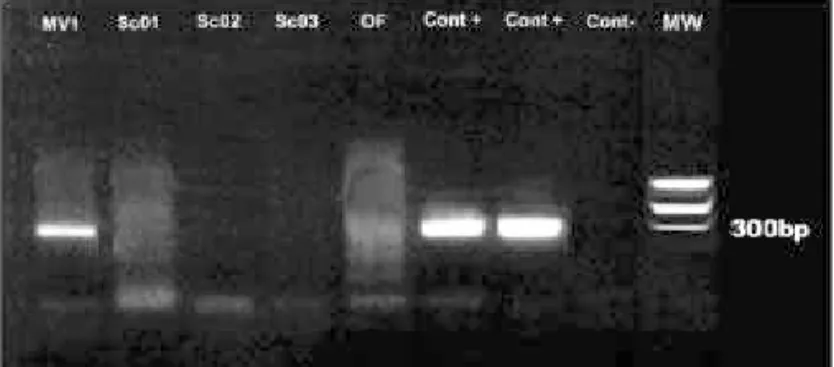
Of the seven samples studied, six were PCR negative for adenovirus (including the three negative controls) and one was positive (Figure 1, MV1). The amplified DNA fragment of 300 bp was cloned and then sequenced in both orientations. Analysis by BLASTN program of available databases (Gene-Bank) has pointed out complete homology of the sequenced fragment with Ad type 8 (Figure 2). Only the sample with a clinical hypothesis of Ad infection was positive in Ad PCR.
Figure 1 - PCR-amplified products from clinical samples. Swabs samples from patients with keratoconjunctivitis were tested by PCR. The amplified products were fractionated in a 2% agarose gel. MV1, SC01, SC02, SC03 and OF are clinical samples; Cont+ are the positive controls; Cont- is the negative control; and lane MW contains the
MV 1 26 GCCGGGCAGGACGCCTCGGAGTACCTGAGCCCGGGTCTGGTGCAGTTTGCCCGTGCCACCGACACGTACTTCAGCCTGGGCAACAAGTTTAGAAACCCCA 125
Ad 8 1 ... 100
Ad 37 1 ...C...G... 100
Ad 13 1 ...C...G... 100
Ad 9 1 ...C...G... 100
Ad 10 1 ...C...G... 100
Ad 44 1 ...C...G... 100
Ad 48 140 ...C...G... 239
Ad 19 1 ...C...G... 100
Ad 17 17829 ...G...C..G... 17928
Ad 40 46 ...C...C...T..C...G...C... 145
Ad 41 263 ...T...C...A...C...T...G...C...T.... 362
Ad 2 18883 T.G..C...C..G...C...G...AAT... 18982
Ad 5 270 T.G..C...C..G...C...G...AAT... 369
Ad 1 1 T.G..C...C..G...C...C...G...AAT... 100
Ad 6 1 T.G..C...C..G...C...C...G...AAT... 100
Ad 12 17785 ...T...T...T..C...A..C...C...G...C...C...A... 17884
Ad 31 1 ...T...T..C...A..C...C...G...C...C...A...G..T.... 100
Ad 18 1 ...T...T...A...T..C..G...A..C...G...C...C...T.... 101
Ad 4 1 ...A...T...T...C...C...A...C...T...G...G... 100
Ad 21 1 ...A...T..T...T...C...A...C...AT...G...G... 100
Ad 14 1 ...A...T..T...T...C...C...A...C...AT...A..T...T.... 100
Ad 11 1 ...A...T..T...T...C...C...A...C...AT...A..T...T.... 100
Ad 34 1 ...A...T..T...T...C...C...A...C...AT..T..A..T...T.... 100
Ad 35 1 ...A...T..T...T...C...C...A...C...ATT....A..T...T.... 100
Ad 3 46 ...A...T..T....G...C..T...C...A..A...C...TA....G...A... 145
Ad 16 46 ...A...T..T...T...C...A..A...C...TA....G... 145
Ad 7 46 ...A...T..T...T...A...A..A...C...TA....G...A... 145
MV 1 126 CGGTGGCTCCCACCCACGATGTGACCACGGACCGGTCCCAGCGTCTGACGCTGCGCTTTGTGCCCGTGGATCGCGAGGACACCACGTACTCGTACAAGGC 225 Ad 8 101 ... 200
Ad 37 101 ... 200
Ad 13 101 ...C..G...C... 200
Ad 9 101 ...C..G...C... 200
Ad 10 101 ...C..G...C... 200
Ad 44 101 ...C..G...C... 200
Ad 48 240 ...C..G...C... 339
Ad 19 101 ...C..A...C... 200
Ad 17 17929 ...C... 18028
Ad 40 146 .C...A...A...A....G...A...C...C..C...A...G.C...T...A.T 245 Ad 41 363 .T...G...A...A...A....A...A...A..C...A..C..C...G.T..T..T...A.T 462 Ad 2 18983 ...A..T..G...C..A...A...T...G..CA.C..T...C...T...G...A.. 19082
Ad 5 370 ...G..T..G...C...A...T...G..CA.C..T...C..T...T..TG... 469
Ad 1 101 ...G..T..G...C...A...T...T...G...A.C...C...T...G.A... 200
Ad 6 101 ...G..T..G...C...A...T...T...G..CA.C...C...T..TG... 200
Ad 12 17885 .C...T...T...C..T..C..G...T...G..A..T..T..C...C... 17984
Ad 31 101 .T...T...C...C...GCT..G...GT...T...G..A..T..TG.T..T..T... 200
Ad 18 101 .T..A...T..T..C..TA....C..T..T..T...G...A...T...G..A..T..TG.T...A... 200
Ad 4 101 ...G..T...C...CAG...G...C..G...A...C...A.T 200 Ad 21 101 .C...G...T...C...CAGT...G....T...T..C..G..A....AT..C...G.A...A.T 200 Ad 14 101 .C..A..G..A...C...TAG...G..C.T.T...C...T..C..G...AT..A...T...A.T 200 Ad 11 101 .C..A..G..G...C...TAG...G..C.T.T...C...T..C..G...AT..A...T...A.T 200 Ad 34 101 .C..A..G..G...C...TAG...G..C.T.T...C...T..C..G...AT..A...T...A.T 200 Ad 35 101 .C..A..G..G...C...TAG...G..C.T.T...C...T..C..G...AT..A...T...A.T 200 Ad 3 146 .A...G...C...TAG...C....T...C...T..C..G..A....AT..C...T...A.T 245 Ad 16 146 .A...G...C...TAG...A..A.T...C...T..C..G..A....AT..C...T...A.T 245 Ad 7 146 .A...G...C...TAGG...A....T...T..C..A...T..C..G..A...CAT..C...T...A.T 245 MV 1 226 GCGCTTCACTCTGGCCGTGGGCGACAACCGGGTGCTAGACATGGCCAGCACGT 278 Ad 8 201 ... 253
Ad 37 201 ...T. 253 Ad 13 201 ... 253
Ad 9 201 ...T. 253 Ad 10 201 ...T. 253 Ad 44 201 ...T. 253 Ad 48 340 ...T. 392 Ad 19 201 ...T. 253 Ad 17 18029 ... 18080
Ad 40 246 ...T..G...TT.G...C. 298 Ad 41 463 ...T..G...T.G...C. 515 Ad 2 19083 ...G...C...T...T...T...T..T...TTC... 19135
Ad 5 470 ...G...C..A..T...T..T...T...G...TTC... 522
Ad 1 201 ...G..T..C...T...T...T...T...TTC...A. 253 Ad 6 201 ...G...C..A..T...T..T...T...TTC... 253
Ad 12 17985 T...T..G...T...T...C...T...T..TT.T. 18037 Ad 31 201 T...T..G...T...G...T..C...T...T...T.T. 253 Ad 18 201 T..T..T..G..A..T...T..T...C..A..T..T...T..TT.C. 253 Ad 4 201 ...A...G...C...G...C. 253 Ad 21 201 T..A.A...CT....T...A.A...G..T...T. 253 Ad 14 201 ...G.A...C...A.A...G..T... 253
Ad 11 201 ...G.A...C...A.A...G..T... 253
Ad 34 201 ...G.A...C...A.A...G..T... 253
Ad 35 201 ...G.A...C...A.A...G..T... 253
Ad 3 246 T....A...G...T..A...A.A...T...A. 298 Ad 16 246 T....A...G...T..A..G...A.A..A..G..T... 298 Ad 7 246 T....A...G...T..A...A.A...T...A. 298
Figure 2 - Alignment of the sequence of the amplified DNA fragment from sample MV1 with those of serotypes 1, 2, 3, 4, 5, 6, 7, 8, 9, 10, 11, 12, 13, 14, 16, 17, 18, 19, 21, 31, 34, 35, 37, 40, 41, 44 and 48 present in GenBank. Points show regions of identity. These sequences were taken from previous reports as follows (accession number): Ad1 (AF161559.1), Ad2 (J01917), Ad3 (X76549), Ad4 (AF161569.1), Ad5 (J01966), Ad6 (AF161560.1), Ad7 (X76551), Ad8 (AF161561), Ad9 (AF161562.1), Ad10 (AF161563.1), Ad11 (AF161570.1), Ad12 (X73487.1), Ad13 (AF161564.1), Ad14 (AF161571.1), Ad16 (X74662), Ad17 (AF108105), Ad18 (AF161575.1), Ad19 (AF161565.1), Ad21 (AF161572.1), Ad31 (AF161576.1), Ad34
DISCUSSION
The PCR assay without DNA extraction has many advan-tages over phenol-chloroform extraction, which is the stan-dard method to extract viral DNA for PCR assay. The time to perform PCR is shorter than the time for assays in which DNA extraction is required. Moreover, this technique can prevent DNA from contamination of specimens by handling and requi-res no organic reagents that could inhibit PCR(15).
This protocol can also be used for HSV detection. The use of these two reactions together or in a multiplex Ad/HSV PCR can be a powerful and fast technique for the diagnosis of viral eye infections since it encompasses the two major causative agents of these diseases(1).
Other authors have also shown that preparing DNA for a PCR using a simple lysis buffer is more effective than phenol-chloroform extraction(11). In our case we have used only a one
to ten dilution plus a boiling procedure. This approach is not only faster but also cheaper. Comparing the sequence of the hexon gene fragment amplified by our set of primers with sequences of other human adenoviruses present in the Gene-Bank, we conclude that this region of the Ad genome can be used to identify almost all Ads serotypes, including all serotypes reported to cause EKC (8,19,37) and almost all sero-types involved in Ads-associated conjunctivitis (1, 2, 3, 4, 5, 6, 7, 11, 15, 16, 17, 20 and 22). However, this fragment is insuffi-cient to distinguish serotypes 9 (reported to cause Ad-asso-ciated conjunctivitis), 10, 44 and 48, because their DNA se-quence is identical in this region.
The transmission of this easily spread infection can occur through contaminated eye drops, hands and surfaces being important also in nosocomial infections. According to recent studies the cost per infected person is similar to the cost of other nosocomial infections(20).
CONCLUSIONS
We conclude that PCR without DNA extraction followed by sequencing of the amplified fragment can be used for both the diagnosis and the molecular epidemiology of viral eye diseases. This method is highly specific and faster than the isolation-neutralization test, especially if automatic sequen-cing is used. PCR can also be easily adapted to a multiplex Ad/ HSV PCR. Another advantage is the rapid serotyping of the Ad which causes the infection by sequencing the PCR ampli-fied fragment. Certainly, these characteristics are of great advantage for the diagnosis of diseases that can spread easily such as EKC. This approach, however, should be tested in a prospective study to validate its clinical applications.
ACKNOWLEDGMENTS
The author wishes to thank CNPq, CAPES e FAPEMIG for financial support. Rodrigo Melo Mendes, Maurício L.
No-gueira have a CNPq scholarship, João T. Marques have a CAPES scholarship, Maria Amélia S. Machado have a FAPEMIG scholarship and Cláudio A. Bonjardim, Paulo C. P. Ferreira, Erna G. Kroon have CNPq fellowships. We would like to thank Dr. FG da Fonseca for the critical reading of the manuscript.
RESUMO
Objetivo: Vírus da família Adenoviridae estão associados com
muitas síndromes clínicas, sendo conhecidos 50 sorotipos. Vírus desta família e da família Herpesviridae são os maiores responsáveis por conjuntivite viral, sendo um rápido diagnós-tico importante devido ao caráter epidêmico das infecções por adenovírus. Métodos: Reação em cadeia da polimerase (PCR) para adenovírus foi desenvolvida utilizando iniciadores que amplificam um fragmento de 300 bp do gene da proteína hexon do capsídeo de diversos sorotipos. A reação em cadeia da polimerase foi efetuada sem a etapa de extração de DNA.
Resultados: Amostras de "swabs" de córneas de sete
pacien-tes com ceratoconjuntivite foram analisadas, sendo que uma amostra foi positiva para adenovírus. O seqüenciamento des-te fragmento mostrou 100% de homologia com a seqüência do adenovírus tipo 8. Conclusão: O seqüenciamento do fragmen-to de 300 bp do gene do hexon permite a identificação de quase todos os sorotipos de adenovírus, incluindo aqueles relacionados com a ceratoconjuntivite epidêmica (8,19,37) e todas as amostras associadas com conjuntivite.
Descritores: Reação em cadeia da polimerase/métodos;
Ade-novirus humano/isolamento & purificação; Ceratoconjuntivite/ diagnóstico; Infecções humanas por adenovirus; Infecções oculares virais/diagnostico; Infecções por herpesviridae
REFERENCES
1. Jackson R, Morris DJ, Cooper RJ, Bailey AS, Klapper PE, Cleator GM et al. Multiplex polymerase chain reaction for adenovirus and herpes simplex virus in eye swabs. J Virol Methods 1996;56:41-8.
2. Takeuchi S, Itoh N, Uchio E, Aoki K, Ohno S. Serotyping of adenoviruses on conjunctival scrapings by PCR and sequence analysis. J Clin Microbiol 1999;37:1839-45.
3. Imai Y, Kameya S, Ohkoshi M, Yamaki K, Sakuragi S. Identification of the hexon region of an adenovirus involved in a new outbreak of keratoconjuncti-vitis. J Clin Microbiol 2001;39:2975-7.
4. Jörnvall H, Akusjärvi G, Aleström P, Von Bahr-Lindströn H, Pettersson U, Appella E, et al. The adenovirus hexon protein. The primary structure of the polypeptide and its correlation with the hexon gene. J Biol Chem 1981;256: 6181-6.
5. Kinloch, R, Mackay N, Mautner V. Adenovirus hexon: sequence comparison of subgroup C serotypes 2 and 5. J Biol Chem 1984;259:6431-6. 6. Toogood CI, Crompton J, Hay RT. Antipeptide antisera define neutralizing
epitopes on the adenovirus hexon. J Gen Virol 1992;73(Pt 6):1429-35. 7. Toogood CI, Murali R, Burnett RM, Hay RT. The adenovirus type 40
hexon: sequence, predicted structure and relationship to other adenovirus hexons. J GenVirol 1989;70:3203-14.
8. Horwitz MS. Adenoviruses. In: Fields BN, Knipe DM, editors. Virology. 2nd.ed.
9. Arnberg N, Mey Y, Wadell G. Fiber genes of adenoviruses with tropism for the eye and genital tract. Virology 1997;227:239-244.
10. Baum SG. Adenovirus. In: Mandell GL, Douglas R, Bennett JE, editors. Principles and practice of infectious diseases. 4th.ed. New York: Churchill
Livingstone; 1995. p.13.
11. Morris DJ, Bailey AS, Cooper RJ, Turner PC, Jackson R, Corbitt G, et al. Polymerase chain reaction for rapid detection of ocular adenovirus infection. J Med Virol 1995;46:126-32.
12. Wiley L, Springer D, Kowalski RP, Arffa R, Roat MI, Thoft RA, et al. Rapid diagnostic test for ocular adenovirus. Ophthalmology 1988;95:431-3. 13. Kowalski RP, Gordon YJ. Comparison of direct rapid tests for the detection
of adenovirus antigen in routine conjunctival specimens. Ophthalmology 1989;96:1106-9.
14. Hierholzer JC, Stone YO, Broderson JR. Antigenic relationships among the 47 human adenoviruses determined in reference horse antisera. Arch Virol 1991;121:179-97.
15. Nogueira ML, Carvalho AF, Barbosa EF, Bonjardin CA, Ferreira PCP,
Kroon EG. Diagnosis of mucocutaneous herpetic infections by PCR without DNA extraction. Mem Inst Oswaldo Cruz 1998;93:213-4.
16. Nogueira ML, Amorim JB, Oliveira JG, Bonjardim CA, Ferreira PC, Kroon EG. Comparison of virus isolation and various polymerase chain reaction methods in the diagnosis of mucocutaneous herpesvirus infection. Acta Virol 2000;44:61-5.
17. Innis MA, Gelfano DH. Optimization of PCRs. In: Innis MA, Gelfano DH, Snisnsky JJ, White TJ, editors. PCR protocols: a guide to methods and applications. New York: Academic Press;1990. p.3-12.
18. Sanger F, Nicklen S, Coulson AR. DNA sequencing with chain-terminating inhibitors. Proc Natl Acad Sci USA 1977;74:5463-7.
19. Altschul SF, Gish W, Miller W, Myers EW, Lipman D J. Basic local alignment search tool. J Mol Biol 1990;215:403-10.
20. Piednoir E, Bureau-Chalot F, Merle C, Gotzarmanis A, Wuibout J, Bajolet O. Direct costs associated with a nosocomial outbreak of adenovirus conjunc-tivitis infection in a long term care institution. Am J Infect Control 2002;30: 407-10.