ABSTRACT
BACKGROUND AND OBJECTIVES:Chest pain is a major reason for hospitalization in the public network due to its sub-jectivity, non-speciicity, lack of nurses and physicians’ qualiica-tion, quality of assistance and the fact that chest pain patients satisfaction is still far away from ideal. his study aimed at evalu-ating the quality of assistance of acute chest pain patients in the State of Ceará, Brazil.
METHODS: his is a descriptive, exploratory and analytical study. After applying a form, a sample of 430 patients and 50 professionals of a reference hospital was obtained. Non-para-metric statistics was used for analysis and discussion. Dependent variables and users’ satisfaction were correlated for the develop-ment of tables and simple descriptive statistical analysis.
RESULTS:hree hundred and eighty-one patients (65.65%) have looked for assistance more than once, returning for several reasons, even when there were other units for health follow up in their respective region. Most users (n=422) have not noticed assistance barriers with regard to materials and human resources (83.17). However, delay in assistance (9.0%) was the most im-portant barrier perceived by those referring diiculties (n=38). CONCLUSION:he complex assistance to acute chest pain pa-tients afects the analysis of the quality of assistance provided to users. he high number of patients makes the service chaotic be-cause the relationship between health professionals and structure is not satisfactory, requiring the insertion of more professionals and improvement in assistance time.
Keywords: Chest pain, Patients’ satisfaction, Quality.
Quality of assistance of acute chest pain patients in the State of Ceará, Brazil
Qualidade da assistência à pacientes com dor torácica aguda no estado do Ceará, Brasil
Ana Cláudia de Souza Leite1, Amaurilio Oliveira Nogueira2, Luis Gustavo Oliveira Farias1
1. Universidade Estadual do Ceará, Centro de Ciências da Saúde, Curso de Graduação em Enfermagem, Fortaleza, CE, Brasil.
2. Universidade Federal do Ceará, Departamento de Fisiologia e Farmacologia, Unidade de Farmacologia Clínica, Fortaleza, CE, Brasil.
Submitted in August 22, 2016. Accepted for publication in April 04, 2017.
Conlict of interests: none – Sponsoring sources: Programa de Pesquisa para o SUS-PPSUS do Ministério da Saúde (MS), Fundação Cearense de Amparo à Pesquisa-FUNCAP e Con-selho Nacional de Desenvolvimento Cientíico e Tecnológico-CNPq.
Correspondence to:
Avenida Dr. Silas Muguba, 1700 - Campus do Itaperi 60740-000 Fortaleza, CE, Brasil.
E-mail: [email protected]
© Sociedade Brasileira para o Estudo da Dor
RESUMO
JUSTIFICATIVA E OBJETIVOS: A dor torácica é uma das principais causas de internação na rede pública e devido ao caráter subjetivo da dor, à inespeciicidade da dor torácica, e à de-iciência na capacitação de proissionais enfermeiros e médicos, à qualidade dos atendimentos e à satisfação dos pacientes com dor torácica que ainda está longe de ser o ideal. Neste contexto, este estudo teve como objetivo analisar a qualidade da assistência à pacientes com dor torácica aguda no estado do Ceará-Brasil. MÉTODOS: Pesquisa do tipo descritiva, exploratória e analítica. Aplicou-se um formulário e obteve-se uma amostra 430 pacientes e 50 proissionais do hospital de referência. Utilizou-se estatística não paramétrica para análise e discussão. As variáveis dependentes e a satisfação dos usuários foram correlacionadas para a construção de tabelas e análise estatística descritiva simples.
RESULTADOS: Trezentos e oitenta e um pacientes (65,65%) já buscaram o serviço mais de uma vez para atendimento, retornan-do por diversos motivos, mesmo existinretornan-do outras unidades para o acompanhamento de saúde em sua respectiva regional. A maio-ria dos usuários (n=422) não percebeu barreiras no atendimento quanto a materiais e recursos humanos (83,17%). No entanto, a demora no atendimento (9,0%) constituiu a maior barreira percebida por aqueles referiram haver diiculdades (n=38). CONCLUSÃO: A complexidade do atendimento à pacientes com dor torácica aguda afeta a análise da qualidade da assistência prestada aos usuários. O elevado número de atendimentos torna o serviço caótico, pois a relação entre proissionais de saúde e estrutura é insatisfatória, requerendo a inserção de mais prois-sionais e a melhoria do tempo de atendimento.
Descritores: Dor torácica, Qualidade, Satisfação do paciente.
INTRODUCTION
he Federal Constitution of 1988 reformulated the Brazilian health paradigms leading to a new system till then scarcely seen and later praised by many First World countries, the so-called Sistema Único de Saúde (SUS), bringing in its formula-tion relevant principles to an equitable, integral and universal healthcare, among other1. Enrollment to the new healthcare system also generated new administrative and managerial needs to meet all the demands of a system of this magnitude and complexity. hus, the optimization of resources, as well as the search for quality and resolvability in healthcare be-came imperative2.
In this perspective, it is important to listen and to understand the demands of the users regarding care expectations since
other studies have already demonstrated that expectations as-sociated with the care received point to measures about the user’s satisfaction3. Moreover, currently, the user’s view can be extended to the evaluation of the SUS quality with opin-ions regarding the environment and the relatopin-ionship with the professionals4.
he term quality is deined by QualiSUS as an index that healthcare services are meeting the needs, expectations, and standards of care of the individuals and their families. he collection of this information generates a true database to build the knowledge about the reach of the quality of care4. Hospital units partnering with SUS are supported by the health managers in the process of strategical care planning, following the ideal of meeting health needs and the expecta-tions of the human being, enabling eiciency and efective-ness in the care of the patient, promoting the quality of care2. Chest pain has been one of the main causes of hospitalization in the public network since cardiovascular diseases account for greater mortality rate and its proper evaluation is a chal-lenge. Due to the subjective nature of pain, the unspeciicity of chest pain the deiciency in the training and qualiication of professional nurses and physicians, the quality of care, and the satisfaction of patients with chest pain is still far from ideal5. In this context, the purpose of this study was to analyze the quality of care of patients with acute chest pain in the State of Ceará-Brazil.
METHODS
he study was categorized as an exploratory survey with a quantitative approach, in which the quality of care of patients with acute chest pain was evaluated.
he population consisted of 430 users and 52 professionals (physicians, nurses, technicians and nurse practitioners) of a cardiopulmonary emergency unit of reference in the State. During March 2007 to February 2010, we included users and professionals with ages from 18 to 60 years from both genders and excluded those who had reports of psychiatric disorders, verbal, auditory incongruity and irritation.
A questionnaire was applied to the users with questions on socio-demographic data (gender, age, marital status, educa-tional level, occupation, and origin) and the diiculties in care (material, equipment, human resources, and user’ satis-faction). For professionals, a form containing questions about socio-demographic data, academic training and the diicul-ties perceived about materials, equipment, and human re-sources. In addition to these data collection tools, we looked for information about the number of care at hospitalization emergency service of the hospital.
he study was submitted to the Committee on Ethics in Re-search of the Hospital participating in the study, according to Resolution number 196, of the National Health Council, of October 10, 1996, that it regulates studies with human beings. After a favorable opinion from the Committee on Ethics in Research with registry number 431/07, we received the registry of acceptance of the patients participating in the
study by means of Free and Informed Consent Term (FICT). Patients were informed about the objectives of the study and the conidentiality of the information and identities.
Statistical analysis
he data was organized in an Excel 2007 spreadsheet to pro-vide a cross-section reading of the results. Dependable vari-ables (perception of diiculties in care) and users’ satisfaction were placed on a list and cross-referenced read to build tables for the descriptive statistical analysis with discussion accord-ing to relevant literature on responsiveness, user’s satisfaction, and QUALISUS texts.
RESULTS
In the emergency sector of the cardiovascular reference hos-pital in the macro-region of Fortaleza, the total number of medical care in 2008 and 2009 was 242,276 thousand pa-tients with an average (M±) of 80758.67 and standard devia-tion (SD) of 122394.67. he organizadevia-tion of this demand as risk management includes patients admitted to the cardiac arrest stay and observation room, as well as those scheduled for appointments and clinical care for acute chest pain in the Emergency Department.
Of this total, the part that is of interest for the study (n=430) were users who have been cared for acute chest pain and were not hospitalized, representing 57.07% of the total care. On average, there were 10,593 patients in 2008 (52.47%) and 9.597 (47.53%) in 2009. Both had a diference between monthly averages (M±) of 6.9314 and standard deviation of 8.1738, with signiicant results for the Fisher t (t=1.19) with 95% conidence interval, with a value of p=1.
Of the users cared for in this sector after screening and medi-cal consultation, the sample was 430 patients with chest pain. he majority were female (53.4%) aged from 61 to 70 years (33.79%), with incomplete elementary school (47.32%), married (52.56%), retired (39.07%), native or with residence in the city of Fortaleza (96.78%).
hese users have looked for care in the Emergency Depart-ment of this State reference hospital for diferent reasons (n=429) (Table 1) and had previous clinical care (n=281) (Table 2).
Table 1. Reason for going to a reference unit. Fortaleza/CE, Brazil, 2007-2010
Reason for seeking care (n=429) n (%)
Near home 28 (6.52)
Search for cardiopulmonary care 146 (34.03)
Due to the quality and speed of service 19 (4.42)
Referral of other health units 124 (28.9)
Guidance of family or friends 22 (5.12)
Is already a patient of this hospital 66 (15.38)
Others 24 (5.59)
The predominant reason manifested by users (n=429) was because the service in question is a reference unit in cardio-pulmonary care (34.03%) (Table 1).
The health macro-region of “Fortaleza” provides services of low, medium and high complexity, available in several healthcare units. The Family Health Basic Units (UBASF) provide free access to healthcare services and programs, es-pecially to users with cardiovascular and pulmonary risk, highlighting the “Hypertension,” “Diabetes” and “Elderly Health” programs, which theoretically should contribute to decreasing medical visits and the overload in cardiovascular emergencies. In this context, only 28.9% (Table 1) of the participants in this study said they were referred from other health care units.
Thus, 65.65% (381) have been to the service more than once for care, returning for several reasons, even existing services of reference for health monitoring in their respec-tive Regional Healthcare.
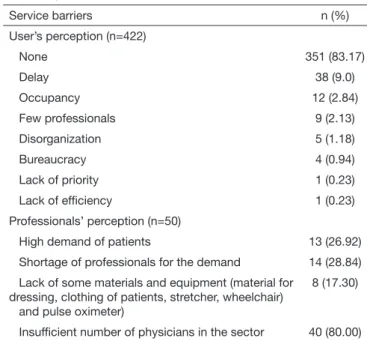
Most users (n=422) did not perceive any barriers in the ser-vice related to materials, equipment and human resources (83.17%). However, the delay in attendance (9.0%) was the biggest perceived barrier for those who reported having trouble (n=38) (Table 2).
In the professionals’ perception, the majority (n=40) reported as a predominant barrier the insuicient number of physi-cians in the sector (80%) (Table 2). Nevertheless, 84.61% of these professionals have considered the team qualiied to perform the activities successfully. Concerning the resolution of health problems at the service, most of the sample 71.6% (n=281) stated that the service was decisive (Table 3). The percentage of those who declared that the service care of acute chest pain did not have a resolution as very small, 2,04%, however, they reported some difficulties faced
previ-ously at the service, for example, delay in attendance, lack of professionals and disorganization. Those who described difficulties in attendance (Table 2) were the same users who declared that the service was in the process of resolution (24.82%) showing the difficulties listed in Table 2, and who were also being attended at the service for the first time. Therefore, we find satisfaction poles with respective levels. The first pole is of those who were satisfied, represented by levels between being “very satisfied” and “satisfied,” and the second pole of those who were unsatisfied, represented by “not much satisfied” and totally “unsatisfied.” Thus, it was observed that the level of satisfaction (Table 4) of users cared for chest pain had a predominance in the category “satisfied” with 63.8% (n=268).
Table 4. Satisfaction and dificulties according to the users of the ser-vice. Fortaleza/CE, Brazil, 2007-2010
Level of Satisfaction
Dificulty in care
Inexistent (n=351)
(n=69) n=420
Very satisied 106 (30.19%) 5 (7.24%) 111 (26.42%)
Satisied 229 (65.24%) 39 (56.52%) 268 (63.8%)
Somewhat satisied 13 (3.7%) 19 (27.53%) 32 (7.61%)
Unsatisied 3 (0.8%) 6 (8.69%) 9 (2.14%)
Source: primary data.
However, we noticed that even being satisied, 39 patients reported diiculties with regards to the attendance, which can be related to several factors, and even though did not interfere with the satisfaction index since there is a diference between what really happens and what is perceived by the patient. his percentage is sluggish when compared to those who did not report diiculties.
DISCUSSION
he clinical care of people with chest pain must be included at the beginning of the planning process until the execution, with continuous evaluation and with the participation of users and professionals. In this way, the social participation gains space in health management and allows the develop-ment of efective strategies to assess and treat these patients, avoiding delays in care that can lead to complications, and therefore providing quality service and satisfaction6.
he emergency care for patients with chest pain is extremely valuable because every year in Brazil there are more than 4
Table 2. Barriers to the service for users and professionals. Fortaleza/ CE, Brazil, 2007-2010
Service barriers n (%)
User’s perception (n=422)
None 351 (83.17)
Delay 38 (9.0)
Occupancy 12 (2.84)
Few professionals 9 (2.13)
Disorganization 5 (1.18)
Bureaucracy 4 (0.94)
Lack of priority 1 (0.23)
Lack of eficiency 1 (0.23)
Professionals’ perception (n=50)
High demand of patients 13 (26.92)
Shortage of professionals for the demand 14 (28.84)
Lack of some materials and equipment (material for dressing, clothing of patients, stretcher, wheelchair) and pulse oximeter)
8 (17.30)
Insuficient number of physicians in the sector 40 (80.00)
Source: primary data.
Table 3. Resolution of the problem that leads to a search for care reported by the patients in this study. Fortaleza/CE, Brazil, 2007-2010
Resolution (n=392) n (%)
Resolvability 281 (71.6)
No resolution 8 (2.04)
In progress of resolving 103 (26.27)
million patients with chest pain, and according to the data from 2001, cardiovascular diseases were the third major cause of hospitalization at SUS7,8.
This reality is in agreement with the statistics of the hospital of the study since by the data provided by SAME (Service of Medical Attendance and Statistics), the number of hospital-izations of patients with this pain in the sector emergency represents a significant value. These data has already been presented in the results and the literature evidence that the situation of the emergency services, in general, is a reason for concern because we’ve seen a significant growth in the last decades9.
The emergency sector is the best entrance door for public healthcare, and it is widely used by patients with chest pain since cardiovascular diseases are the main causes of death in Brazil, in both genders, with no significant impact on gender10.
The causes for gender-related differences have not been de-fined yet11. However, the presence of a higher number of women (53.4%), especially between 61 and 70 years, in the present study, can be associated with the fact that they are in the menopausal period. Studies show that the period of decrease in hormone production can lead to the likelihood of cardiovascular diseases12.
Other pieces of evidence found in the characterization of the sample, as the prevalence of retirees, married and low educational level were similar to a study carried out in the city of Campinas13.
The motivation to look for care at the hospital of this study brings to light the fact that the unit is a reference at SUS since 33.95% went there because it is a reference in car-diopulmonary care and 28.84% being referred from other health units.
Other notes regarding the reason for looking for care, even with a lower percentage, confirms the recognition by users that it is a service that provides qualified care, and they ac-cept and rely on the assistance.
he use of the service shows a working low in the oices of experts cardiologists and pneumologists with a high percent-age (65.65%) of previous visits. his is corroborated by the number of patients who validate the overcrowding of the unit since there are alternative health care units to follow-up the treatment, and the population should be properly oriented to allow a better organization of the hospital system. his can also be prevented visits by implementing health education strategies, that lead to a greater pharmacological treatment compliance decreasing hospital rehospitalizations13.
Rehospitalizations can be related to flaws existing in the or-ganizational system of the institution and to behavior fac-tors of the users of the service, for example, non-compliance with the pharmacological treatment, difficulty to change lifestyle, and even the delay in looking for health care when the clinical situation worsens13.
The resolvability of healthcare services is a way to evaluate institutions and the quality of the professional care from the results obtained from user’s care service, reflecting the final
resolution of the problems plus the patient’s satisfaction14. Among the 281 remaining patients, the service proved to be decisive for 65.35%, meeting patients’ expectations, mo-tivating them to go back to the service whenever they feel necessary.
The unit in question showed effectiveness to meet the needs of the population. However, due to high demand, there are some difficulties that were reported by professionals and us-ers of the service, such as the insufficient number of physi-cians to meet the demand (83.14%) and the delay in atten-dance (63.45%), respectively.
According to reports from patients, care satisfaction was positive; 26.24% reported being very satisfied, and 63.35% were satisfied. These values can be attributed from the anal-ysis of their perception of a hospital system that is run with quality, since only 16.31% have experienced difficulties in attendance, although the number of elderly (>65 years) and the low educational level of the sample of this study might indicate a greater acceptance of the public services offered. Currently, the authors support the idea of the importance of patients’ perception when evaluating the quality of care15,16. In Brazil, the National Council of Health Secretaries along with the Prosecution Office, conducted in 2003 the study “Health in the Brazilians’ Opinion,” to analyze users’ sat-isfaction with the health system17. This satisfaction is con-sidered a goal to be reached by the services, so, therefore, it shall be studied in order to improve the healthcare system. The Public Healthcare System in its guidelines aims to pro-vide fair health access, and together with the Prosecution Office is working to elaborate programs to provide qual-ity care, with principles to raise the qualqual-ity level, generat-ing greater patient’ satisfaction, legitimizgenerat-ing, the country’s healthcare policy4.
CONCLUSION
The complexity of care of patients with acute chest pain of-fered by the cardiopulmonary care reference unit of Ceará affects the analysis of the quality of care provided to users. The high number of attendances makes the service chaot-ic, since the relation between healthcare professionals, the structure, and the organization is unsatisfactory, requiring the addition of more professionals and improvement in the attendance time. These elements were considered major bar-riers to the service, although the level of satisfaction was good with a low percentage of difficulties in attendance.
REFERENCES
1. Santos MA, Cutolo LRA. A interdisciplinaridade e o trabalho em equipe no Programa de Saúde da Família. ACM Arq Catarin Med. 2004;33(3):31-40.
2. Camacho JLT. Qualidade total para os serviços de saúde. São Paulo: Nobel; 1998. 3. Donabedian A. La calidad de la atención médica. México: La Prensa Médica
Mexi-cana; 1984.
4. Brasil. Ministério da Saúde, Secretaria Executiva. QualiSUS: Política de qualiicação da atenção à saúde no Sistema Único de Saúde [internet]. Brasília (DF): Ministério da Saúde, 2003. [acesso em 8 dez 2010]. Disponível em: http://www.sbcg.org.br/ materialoicina- conteudoscd/cartilhas-todas/qualisusarquitetura.pdf
and nursing care in primary care settings. Nurs Res. 1975;24(1):45-52.
6. Vaistman J, Andrade JR. Satisfação e responsividade: formas de medir a qualidade e a humanização da assistência à saúde. Ciênc Saúde Coletiva. 2005;10(3):599-613. 7. Araújo RD, Marques IR. Compreendendo o signiicado da dor torácica isquêmica de
pacientes admitidos na sala de emergência. Rev Bras Enferm. 2007;60(6):676-80. 8. Freiberger L, Heinisch RH, Bernardi A. Estudo de internações por cardiopatias em
um hospital geral. ACM Arq Catarin Med. 2004;33(2):25-30.
9. Silva VP, Silva AK, Heinisch RH, Heinisch LM. Caracterização do peril da demanda da emergência de clínica médica do Hospital Universitário da Universidade Federal de Santa Catarina. ACM Arq Catarin Med. 2007;36(4):18-27.
10. Santo FC, Gazzi LA, Libardi MC, Santos DF, Silva DV, Fichinno MZ, et al. Epide-miologia e manejo dos fatores de risco na síndrome coronariana aguda na mulher. Rev Fac Ciênc Méd Sorocaba. 2009;11(2):6-11.
11. Santos JJ, Pellanda LC, Castro I. A dor torácica em mulheres no atendimento de emergência: conduta e evolução. Rev Assoc Med Bras. 2005;51(1):29-34.
12. Fuchs FD. Reposição Hormonal e Doença Cardiovascular: uma Diretriz Contrária à Evidência. Arq Bras Cardiol. 2009;93(1):11-3.
13. Margoto G, Colombo RCR, Gallani MC. Características clínicas e psicossociais do paciente com insuiciência cardíaca que interna por descompensação clínica. Rev Esc Enferm USP. 2009;43(1):44-53.
14. Turrini LC. Resolutividade dos serviços de saúde por inquérito domiciliar: percepção do usuário. Cad Saúde Pública. 2008;24(3):663-74.
15. Polizer R, D’Innocenzo M. Satisfação do cliente na avaliação da assistência de enfer-magem. Rev Bras Enferm. 2006;59(4):548-51.
16. Mendes AC, Araujo Junior JL, Furtado BM, Duarte PO, Santiago RT, Costa TR. Avaliação da satisfação dos usuários com a qualidade do atendimento nas grandes emergências do Recife, Pernambuco, Brasil. Rev Bras Saúde Matern Infant. 2009;9(2):157-65.