ABSTRACT
BACKGROUND AND OBJECTIVES: his study aimed at
describing, in a case series, the efect of ear acupuncture associ-ated or not to education and home self-care techniques in the treatment of chronic temporomandibular disorders in women. CASE REPORTS: Nine patients with chronic painful temporo-mandibular disorder, aged between 22 and 45 years of age (mean of 32.11 years) were evaluated with the clinical chart of tem-poromandibular disorders and orofacial pain of the Occlusion II discipline, Universidade de Araraquara, with the Research Diag-nostic Criteria for Temporomandibular Disorders and by a pain diary with visual analog scales delivered once a week in reference (irst week) and after each treatment session (ear acupuncture and/or counseling). During the three weeks of treatment, pa-tients were oriented to control temporomandibular disorders, being that six patients, in addition to self-care, have also received ear acupuncture in recommended points to treat temporoman-dibular disorders and associated symptoms (protocol: Shen-men, neurovegetative system, kidneys, temporomandibular disorders and anxiety triad). Ear acupuncture associated to education and home self-care has shown the best results in symptoms remis-sion/improvement after 3 weeks of treatment as compared to the group receiving just self-care orientations.
CONCLUSION: Ear acupuncture associated to education and home self-care techniques has shown better results to control pain of patients with temporomandibular disorder.
Keywords:Acupuncture, Ear, Facial pain, Temporomandibular joint disorders, herapeutics.
Ear acupuncture associated to home self-care in the treatment of
chronic temporomandibular disorders in women. Case reports
Acupuntura auricular associada aos autocuidados caseiros no tratamento das disfunções
temporomandibulares crônicas em mulheres. Relato de casos
Giovanna Gorgatti Bontempo1, Priscila Borges Gobbo de Melo1, Karina Eiras Dela Coleta Pizzol1, Ana Lúcia Franco-Micheloni1
1. Universidade de Araraquara, Faculdade de Odontologia, Araraquara, SP, Brasil.
Submitted in April 10, 2016.
Accepted for publication in July 26, 2016. Conlict of interests: none – Sponsoring sources: none.
Correspondence to:
Avenida Maria Antonia Camargo de Oliveira (Via Expressa), 170 – Vila Suconasa Unidade IV
14807-120 Araraquara, SP, Brasil. E-mail: [email protected]
© Sociedade Brasileira para o Estudo da Dor
RESUMO
JUSTIFICATIVA E OBJETIVOS: O objetivo desse estudo foi descrever, em uma série de casos, o efeito da acupuntura auric-ular associada ou não às técnicas de educação e autocuidados caseiros, no tratamento das disfunções temporomandibulares crônicas em mulheres.
RELATO DOS CASOS: Nove pacientes com disfunção tem-poromandibular crônica dolorosa, com idade entre 22 e 45 anos (média de 32,11 anos) foram avaliadas por meio da icha clínica de disfunções temporomandibulares e dor orofacial da Discip-lina de Oclusão II do Centro Universitário de Araraquara, pelo
Research Diagnostic Criteria for Temporomandibular Disorders e por um diário de dor com escalas analógicas visuais, entregues semanalmente na referência (primeira semana) e após cada ses-são de tratamento (acupuntura auricular e/ou aconselhamento). Durante as três semanas de tratamento, as pacientes receberam instruções para controle das disfunções temporomandibulares, sendo que seis pacientes receberam, além dos autocuidados, acu-puntura auricular nos pontos recomendados para o tratamento das disfunções temporomandibulares e sintomas associados (pro-tocolo: Shen-men, sistema neurovegetativo, rim, disfunções tem-poromandibulares e tríade da ansiedade). A acupuntura auricu-lar associada à educação e autocuidados caseiros apresentou os melhores resultados na remissão/diminuição dos sintomas após 3 semanas de tratamento quando comparada ao grupo que recebeu apenas as instruções de autocuidados.
CONCLUSÃO: A acupuntura auricular associada à educação e às técnicas de autocuidados caseiros demonstrou melhores resul-tados no controle da dor dos pacientes com disfunção temporo-mandibular.
Descritores: Acupuntura auricular, Dor facial, Terapêutica, Transtornos da articulação temporomandibular.
INTRODUCTION
According to the American Academy of Orofacial Pain (AAOP)1, temporomandibular disorder (TMD) is deined as a set of clinical signs involving masticatory muscles, tem-poromandibular joint (TMJ) and associated structures. Most frequently reported symptoms are: muscle fatigue, facial pain, TMD and/or masticatory muscles pain, headache and/or ear-ache and jaw movements limitation and/or shifts2.
Epidemiological studies have shown that approximately 40
to 70% of the population had already at least one TMD sign3. Since its etiology is multifactorial4, several treatment modalities are proposed and successfully used. However, most recommended therapies are reversible and noninva-sive, which should be the first choice to treat TMD aim-ing at controllaim-ing pain and recoveraim-ing stomatognatic system function2,3.
Most conservative therapeutic modality and one of the most important among those indicated to control TMD is based on patients’ education, responsibility and self-development, which includes self-care, muscle exercises and minimization of contributing factors5-7. Educating patients about the prob-lem to develop thermotherapy, self-massage, stretching, stabi-lization, coordination and jaw mobilization is certainly a key for efective treatment.
Acupuncture is a conservative therapeutic modality which has been successfully used in TMD patients9-13. Acupunc-ture reestablishes body balance, relieving pain and improv-ing inlammatory processes7. Ear acupuncture is a systemic acupuncture dimension based on speciic needles, seeds and/ or crystals insertion on relex points located in the ear. his technique has the advantages of presenting few adverse ef-fects, broad application and simple manipulation14. Since ear acupuncture has been used to control pain in diferent acute and chronic conditions15, it is important to study its clinical relevance also in TMD.
In light of the actuality and relevance of the subject, we have considered pertinent this case study aiming at evaluating and describing the efects of ear acupuncture, associated or not to education and home self-care techniques, in orofacial pain frequency and intensity in nine women with chronic TMD.
CASE REPORTS
Cases reported in this study are part of a larger study, approved by the Human Research Ethics Committee, Universidade de Araraquara (UNIARA), (CAAE – 44886715.9.0000.5383). Sample was made up of six patients of the TMD and oro-facial clinic, Discipline of Occlusion II, UNIARA, and by three students of the referred course. Participants were re-cruited by means of research disclosure and were then eval-uated and treated during the second semester of 2015 by trained students.
All participants were submitted to clinical evaluation accord-ing to the followaccord-ing tools and protocols:
1) Clinical record, developed by the Discipline of Occlusion II Clinic, to detail primary patients’ complaint, TMD pain characteristics (site, intensity, quality, duration, worsening and improving factors), presence of other painful conditions (such as headaches and body pain), as well as medical history; 2) AAOP1 criteria were used for diferential diagnosis with other clinical conditions which might mimic TMD; 3) Re-search Diagnostic Criteria for Temporomandibular Disorders (RDC/TMD)16 in its Portuguese version, was used to conirm TMD diagnosis obtained by previous clinical evaluation; 4) Pain diary and visual analog scale (VAS). Patients received a
pain diary to record every day when there was pain, recording also pain intensity in that day by means of VAS.
After clinical record illing and conirmed the presence of chronic TMD (more than six months), RDC/TMD question-naire was illed by patients, being that an investigator was present to help in case of doubt. Axis II exam protocol was applied by one investigator, graduating dentistry student and trained for its application.
During one week, patients were oriented to ill a pain diary to identify frequency and intensity of pain crises before treat-ment (reference). hen, patients were referred to treattreat-ment, that is, education and counseling, associated or not to ear acupuncture.
All patients received the same self-care orientation by means of an educative video and a lealet especially developed for this purpose. In addition, six patients have received ear acu-puncture in one ear by means of mustard seeds application in recommended points to treat TMD and associated symptoms (Shen-men points, neurovegetative system (NVS), TMD, anxiety triad and kidney), changing application side at each session. Two professors experienced in the area were respon-sible for supervising determination and application of seeds on patients.
At every session, a new diary was delivered to patients to be illed during the week in course, recording day(s) of pain and its(their) respective intensity(ies) and other relevant informa-tion. If needed, the educative lealet was redistributed. All pa-tients were treated by means of single weekly sessions along 3 weeks. During sessions, patients would again watch the video and were clariied about questions on past instructions (pa-tients 1 to 9), being that in the pertinent group, pa(pa-tients had their seeds replaced (patients 1 to 6).
he following inclusion criteria were considered for this study:
Presence of chronic painful TMD – pain lasting for more than six months (IASP); women gender aged between 18 and 50 years; chronic pain grade II or III, according to RDC/ TMD axis II.
Additionally, the following exclusion criteria were adopted: Patients under central action drugs for pain, such as antide-pressants, anxiolytics, anticonvulsants, muscle relaxants; pres-ence of tooth pain, neuropathic pain and intraoral injuries; patients with cognitive function changes and communication ability impairment; degenerative, inlammatory, infectious diseases, cancer or systemic neuromuscular diseases; in orth-odontic treatment; patients under physiotherapy treatment or other treatment for orofacial pain.
All patients selected for treatment were invited to participate in the study, receiving all relevant oral and written informa-tion. Only after reading, understanding and signing the Free and Informed Consent Term (FICT) treatment was started and considered a pilot study.
displacement with reduction, being that in two patients dys-function was unilateral (3 and 7) and on the others bilateral (5 and 9).
As to group III (other joint conditions), most patients had bi-lateral TMJ arthralgia (2, 3, 5, 6 and 9). So, one may say that most patients had mixed chronic painful TMD, that is, pain of muscle and joint origin, and just two had painful TMD of exclusively muscular origin (1 and 4).
With regard to the psychological proile of patients, it was observed that, according to inclusion criteria, all patients had chronic pain grade II (low incapacity and high pain intensity). However, with regard to depression, four patients had severe symptoms (3, 4, 6 and 8), while two had moderate symp-toms and three had normal scores. With regard to unspeciic physical symptoms, such as headache, body pain, weakness, dizziness, guilt feelings, among others, six patients (2, 4, 6, 7, 8 and 9) had severe levels, two had moderate and just one had normal level. Relative limitations regarding jaw function have varied a lot among patients, from 0 to 100% (Table 1). Figure 1 shows the number of days in which patients who received acupuncture plus counseling had pain during follow up weeks. With regard to the number of days with pain re-ported in the reference, it was observed that three patients have decreased the number of days with pain after the irst acupuncture session (1, 3 and 4). Two of them had marked decrease in the number of days with pain (1: 100%; 4: 83%). hree patients have maintained the same frequency of days with pain (2, 5 and 6) and in one pain has worsened after the third session (3:66%).
Figure 2 shows the evolution of patients just receiving self-care and it is observed that none of them had pain improve-ment after the irst orientation session. Two patients have maintained virtually the same pattern of days with pain as compared to reference (8 and 9), one of them with mild
in-Days with pain per week
8
7
6
5
4
3
2
1
0
Reference Week 1 Week 2 Week 3
Pat 1
Pat 2
Pat 3
Pat 4
Pat 5
Pat 6
Figure 1. Days of pain along 4 weeks (acupuncture + counseling patients)
Figure 2. Days of pain along four weeks (counseling patients)
Days with pain per week
8
7
6
5
4
3
2
1
0
Reference Week 1 Week 2 Week 3
Pat 7
Pat 8
Pat 9
Table 1. Mean pain intensity by visual analog scale along four weeks (counseling patients)
Age Group I Group II Group III Chronic pain
grading
Depression Unspeciic physical symptoms
Jaw function limitation (%)
22 Myofascial pain
with limitation
No diagnosis No
diagnosis
II Normal Normal 0
24 Myofascial pain
with limitation
No diagnosis R and L
arthralgia
II Moderate Severe 33
36 Myofascial pain
with limitation
Disc displacement with L reduction
R and L arthralgia
II Severe Moderate 41
22 Myofascial pain No diagnosis No
diagnosis
II Severe Severe 16
25 Myofascial pain
with limitation
Disc displacement with L and R reduction
R and L arthralgia
II Normal Moderate 41
45 Myofascial pain No diagnosis R and L
arthralgia
II Severe Severe 100
28 Myofascial pain Disc displacement with R reduction
R arthralgia II Severe Severe 50
50 Myofascial pain
with limitation
No diagnosis L arthralgia II Severe Severe 50
37 Myofascial pain Disc displacement with L and R reduction
R and L arthralgia
II Moderate Severe 50
crease in days of pain (9: 25% worsening). Just one patient had decreased days of pain with regard to reference, observed only after the third treatment week (7:50%).
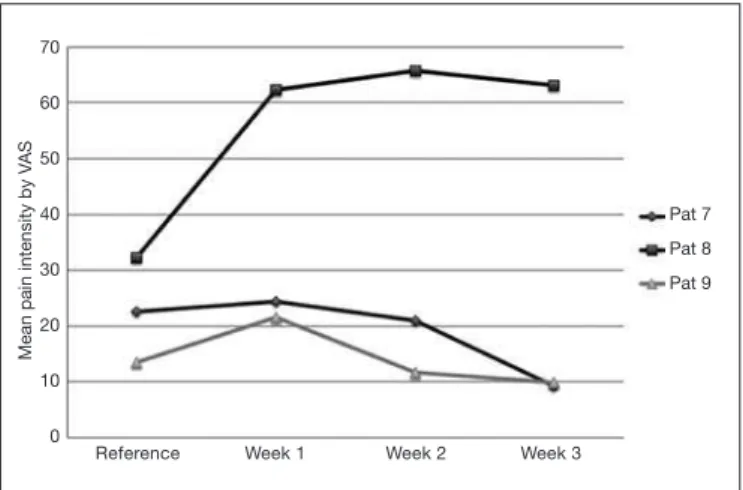
Figure 3 shows mean pain intensity of patients receiving acu-puncture plus counseling, according to VAS in the referred period. Immediately after the irst session, three patients had pain intensity decrease (1, 2 and 6). hree patients had de-creased pain intensity as compared to reference at treatment completion (1, 100%; 3, 27% e 6, 37%); one had virtually the same intensity (2) and in two it has increased (4: 28% e 5: 20%). Figure 4 shows pain intensity of patients receiving counseling alone.
All patients had pain intensity worsening after the irst session (7, 8 and 9). here was pain intensity decrease as compared to reference in two patients (7: 59% improvement, 9: 23%). One patient had pain intensity increase of almost 100% dur-ing the period (8).
DISCUSSION
Pain is one of the most common reasons for looking for health professionals and for the use of drugs15. Among these pains, there is TMD pain3. For Traditional Chinese Medicine, ear has points referring to the whole human body and this treatment has gained space in the Western world in recent years for being considered simple and efective to control pain and emotional factors, among other problems14. Recent re-sults suggest the eicacy of ear acupuncture to improve both chronic orofacial pain and quality of life10.
In patients 1 to 6, ear acupuncture was additional to self-care orientation, by means of mustard seeds applied to predetermined points on the ear, which represented systemic organs, pain sites and/or functional problems14, along four weekly sessions. Treatment protocol, based on available literature, consisted in the following points: 1- Divine gate (Shen-men), by the Chinese internal organs board, for its relaxing, analgesic, anti-inlammatory and sedative efects; 2- Kidney (Shen), by Chinese internal organs board, which maintains vital en-ergy, ilters blood and eliminates body toxins, in addition to neurasthenia; 3 – Neurovegetative or sympathetic system which, according to Chinese nervous system board, balances all involuntary body functions, such as hunger, sleepiness, digestion, heart beats; 4- TMD point, by French and Chi-nese boards (convergence zone of TMD, jaw, mandible, teeth, tongue and palate points) and 5- Anxiety triad, by French functional problems board, made up of happiness, metabolic and joy regulation13.
Although both groups had patients with constant pain and worsening levels, some patients had signiicant improvement, especially with regard to pain intensity decrease in the short term. Among patients receiving self-care associated to acu-puncture, percentage of decreased days of pain during the week and of pain intensities were descriptively higher. With acupuncture, body response seems to be faster, decreasing symptoms intensity, very often eliminating them.
Case reports available in the literature point to signiicant TMD improvement in patients treated with ear acupuncture in the points used in this study8-10, however they suggest ad-ditional points for this treatment, such as, neurasthenia/ner-vousness point, heart and lungs point, which act to control emotional aspects such as anxiety, nervousness, joy and sad-ness, and others such as liver, gallbladder and large intestine, also related to emotional aspects such as anger, decision-mak-ing/courage and sadness10,11. hese points were not selected for our study but could have complemented the approach and increased treatment eicacy.
Ear acupuncture is a sensible technique, acting by means of diferent systemic acupuncture mechanisms15. According to neurophysiology, aferent impulses of ear points project to-ward corresponding or adjacent neurons in the central ner-vous system. When there are changes in organs or body re-gions, there is a connection between aferent ear impulse and central nervous system neuron(s), generating speciic respons-es14. When these ear points are stimulated, patients feel pain
Mean pain intensity by V
AS
8
7
6
5
4
3
2
1
0
Reference Week 1 Week 2 Week 3
Pat 1
Pat 2
Pat 3
Pat 4
Pat 5
Pat 6
Mean pain intensity by V
AS
70
60
50
40
30
20
10
0
Reference Week 1 Week 2 Week 3
Pat 7
Pat 8
Pat 9
Figure 3. Mean pain intensity by visual analog scale along ive weeks (acupuncture + counseling patients)
VAS = visual analog scale
Figure 4. Mean pain intensity by visual analog scale along ive weeks (counseling patients)
by contrairritaiton, inhibitory efect on excitation pathologic focus, until the disease circle is blocked, relieved or cured. In addition, ear acupuncture acts regulating endocrine and im-mune systems by neuro-humoral transmission, strengthening disease ighting ability14.
To promote the leveling of patients with regard to pain sensa-tion and percepsensa-tion, only patients with chronic orofacial pain were included, that is, for more than six months. When TMD becomes chronic, symptoms such as headaches, depression, chronic fatigue, sleep disorders, decreased productivity, inade-quacy sensation, low self-esteem, isolation and mood variations override other symptoms17, which probably would require more points than those used in this study, in addition to the association of several complementary therapeutic modalities7. Certainly, this might have contributed for the improvement observed in patients receiving simultaneous therapies. It is also known that chronic TMDs demand longer treatment time for being more complex pains and the proposed treat-ment period was short. Studies have reported improved TMD symptoms with home therapy and self-care after six weeks7. In turn, for therapies with ear acupuncture, initial treatment cycles vary from ive to ten applications14. Notwithstanding the short period, promising improvements were observed. An important problem is that this study has used Western diagnosis13, based on the measurement of TMD signs and symptoms, objectively collected by means of clinical records and RDC/TMD. Notwithstanding standardization aiming at selecting individuals with same pain grading (II and III), there were variations in the sample with regard to structures afected by the disorder and other parameters such as depres-sion, unspeciic physical symptoms and jaw function limita-tion, which makes diicult the comparison of indings among patients and among treatment groups. One should also stress that treatment was based on the same protocol for the whole sample. Acupuncture is certainly an Eastern technique aiming at tailoring treatment based on a holistic view of particular systemic needs of each patient. In our study, which will act as a basis to determine the protocol of a clinical trial, there was the need to standardize the methodology, so, treatment tailor-ing, such as in the study by Elder et al.12, was not feasible as in most clinical trials.
CONCLUSION
In light of the above, one may stress that ear acupuncture associated to home self-care has shown better results to con-trol TMD. However, this technique needs further evidences, based on clinical trials with better deined and designed stan-dards, in the long term.
REFERENCES
1. American Academy of Orofacial Pain. General assessment of the orofacial pain
pa-tient. In: de Leeuw R, Klasser GD, editores. Orofacial pain - guidelines for assessment, diagnosis and management. 5th ed. Chicago: Quintessence; 2013. 25-46p.
2. Peck CC, Goulet JP, Lobbezoo F, Schifman EL, Alstergren P, Anderson GC, et al.
Expanding the taxonomy of the diagnostic criteria for temporomandibular disorders. J Oral Rehabil. 2014;41(1):2-23.
3. Carrara SV, Conti PC, Barbosa JS. Termo do primeiro Consenso em Disfunção
Tem-poromandibular e Dor Orofacial. Dental Press J Orthod. 2012;15(3):114-20.
4. Maixner W, Diatchenko L, Dubner R, Fillingim RB, Greenspan JD, Knott C, et al.
Orofacial pain prospective evaluation and risk assessment study--the OPPERA study. J Pain. 2011;12(11 Suppl):T4-11.e1-2.
5. Fricton J. Myogenous temporomandibular disorders: diagnostic and management
considerations. Dent Clin North Am. 2007;51(1):61-83.
6. Campi LB, Camparis CM, Jordani PC, Gonçalves DA. Inluência de abordagens
bi-opsicossociais e autocuidados no controle das disfunções temporomandibulares crôni-cas. Rev Dor. 2013;14(3):219-22.
7. Wieckiewicz M, Boening K, Wiland P, Shiau YY, Paradowska-Stolarz A. Reported
concepts for the treatment modalities and pain management of temporomandibular disorders. J Headache Pain. 2015;16:106.
8. Michelotti A, de Wijer A, Steenks M, Farella M. Home-exercise regimes for the
management of non-especiic temporomandibular disorders. J Oral Rehabil. 2005;32(11):779-85.
9. Borin GC, Corrêa EC, Silva AM, Milanesi JM. Acupuntura como recurso
ter-apêutico na dor e na gravidade da desordem temporomandibular. Fisioter Pesqui. 2011;18(3):217-22.
10. Florian MR, Meirelles MP, Sousa ML. Disfunção temporomandibular e acupuntura: uma terapia integrativa e complementar. Odontol Clin-Cient. 2011;10(2):189-92. 11. Rui A, Meirelles MP, Sousa ML. Relato de caso sobre o uso da acupuntura no
trata-mento da dor orofacial. Arq Ciênc Saúde UNIPAR. 2011;15(3):287-90.
12. Elder C, Ritenbaugh C, Aickin M, Hammerschlag R, Dworkin S, Mist S, et al. Re-ductions in pain medication use associated with traditional Chinese medicine for chronic pain. Perm J. 2012;16(3):18-23.
13. Porporatti AL, Costa YM, Stuginsky-Barbosa J, Bonjardim LR, Conti PC. Acupunc-ture therapeutic protocols for the management of temporomandibular disorders. Rev Dor. 2015;16(1):53-9.
14. Shi-ying J, Wan-cheng J. Manual prático de auriculopuntura. São Paulo: Rocca. 2012. 93 p.
15. Asher GN, Jonas DE, Coeytaux RR, Reilly AC, Loh YL, Motsinger-Reif AA, et al. Auriculotherapy for pain management: a systematic review and meta-analysis of ran-domized controlled trials. J Altern Complement Med. 2010;16(10):1097-108. 16. Dworkin SF, LeResche L. Research diagnostic criteria for temporomandibular
disor-ders: review, criteria, examinations and speciications, critique. J Craniomandib Dis-ord. 1992;6(4):301-55.