2011 Nov.-Dec.;19(6):1453-61 www.eerp.usp.br/rlae
Corresponding Author: Cristina Maria Galvão
Universidade de São Paulo. Escola de Enfermagem de Ribeirão Preto Departamento de Enfermagem Geral e Especializada
Av. dos Bandeirantes, 3900 Bairro: Monte Alegre
CEP: 14040-902, Ribeirão Preto, SP, Brasil E-mail: [email protected]
Prognosis of breast cancer during pregnancy: evidence for
nursing care
Ana Fátima Carvalho Fernandes
1Míria Conceição Lavinas Santos
2Tiago Barreto de Castro e Silva
3Cristina Maria Galvão
4This integrative review analyzed evidence available in the literature concerning the prognosis
of breast cancer during pregnancy. The following databases were used for selecting studies:
PubMed, CINAHL and LILACS. A total of 240 primary studies were identified; 13 papers
were included in the integrative review’s sample after reading the titles and abstracts and
according to the established inclusion and exclusion criteria. There is evidence indicating
that pregnancy does not worsen the evolution of breast cancer and a poor prognosis is
related to late stage tumors. Among the gaps identified in the studied theme, the need for
further studies addressing nursing care provided to pregnant women with breast cancer is
highlighted in order to promote improved care in the context of health care.
Descriptors: Breast Neoplasm; Pregnancy; Prognosis; Nursing.
1 RN, Ph.D. in Nursing, Associate Professor, Faculdade de Farmácia, Odontologia e Enfermagem, Universidade Federal do Ceará,
Fortaleza, CE, Brazil. E-mail: [email protected].
2 RN, Ph.D. in Nursing, Faculdade de Farmácia, Odontologia e Enfermagem, Universidade Federal do Ceará, Fortaleza, CE, Brazil.
E-mail: [email protected].
3 RN, M.Sc. in Sciences. E-mail: [email protected].
4 RN, Ph.D. in Nursing, Full Professor, Escola de Enfermagem de Ribeirão Preto, Universidade de São Paulo, WHO Collaborating Centre
O prognóstico de câncer de mama na gravidez: evidências para o cuidado de enfermagem
O presente estudo teve como objetivo analisar as evidências disponíveis na literatura
sobre o prognóstico de câncer de mama na gravidez. O método de revisão adotado foi
a revisão integrativa. Para a seleção dos estudos primários, utilizaram-se as bases de
dados PubMed, CINAHL e LILACS. Na busca, foram identiicados 240 estudos primários,
após a leitura dos títulos e resumos e, frente aos critérios de inclusão e exclusão
estabelecidos, 13 artigos foram incluídos na amostra da revisão integrativa. Na síntese
do conhecimento produzido, há evidências que indicam que a gestação não piora a
evolução do câncer de mama e o mau prognóstico está relacionado ao estadiamento
tardio do tumor. Dentre as lacunas identiicadas, sobre o tópico investigado, destaca-se
a necessidade de condução de estudos direcionados para a assistência de enfermagem,
prestada à mulher grávida, com câncer de mama, para promover a melhoria do cuidado
no contexto da atenção à saúde.
Descritores: Neoplasias da Mama; Gravidez; Prognóstico; Enfermagem.
El pronóstico de cáncer de mama en el embarazo: evidencias para la atención de enfermería
Esta revisión integradora de la literatura objetivó analizar las evidencias disponibles en
la literatura sobre el pronóstico del cáncer de mama durante el embarazo. La selección
de los estudios primarios fue realizada en las bases de datos PubMed, CINAHL y LILACS;
se identiicaron 240 estudios primarios. Después de la lectura de los títulos y resúmenes
y establecimiento de los criterios de inclusión y exclusión, 13 artículos fueron incluidos
en la muestra de la revisión integradora. En la síntesis del conocimiento producido hay
evidencias que indican que el embarazo no empeora la evolución del cáncer de mama y
el pronóstico malo está relacionado con la estadiicación clínica tardía del tumor. Entre
las lagunas en el tópico investigado hay que resaltar la necesidad de realizar estudios
sobre la atención de enfermería prestada a mujeres embarazadas con cáncer de mama
para mejoría del cuidado en el contexto de la atención a la salud.
Descriptores: Neoplasias de la Mama; Embarazo; Pronóstico; Enfermería.
Introduction
One of the problems that most seriously affects
women in all aspects of life is the diagnosis of breast
cancer, which is probably the most feared diagnosis
among the female population given its increased
incidence and the psychological and social impact it
causes, especially due to the atmosphere of fear and
taboo that surround such a disease(1).
According to estimates published by the Brazilian
Cancer Institute (INCA), the number of new cases of
breast cancer expected for Brazil in 2010 is 49,240,
with an estimated risk of 49.27 cases/100,000 women.
The estimates present a total of 8,270 new cases for
the northeast: 550 new cases are estimated to be
diagnosed in Paraiba and 210 in the capital of the state,
which amounts to raw rates of 28.68/100,000 and
59.34/100,000, respectively(2).
Conducting studies in this context is relevant,
especially studies producing evidence to ill in gaps of knowledge concerning the issue, speciically
pregnancy-associated breast cancer (PABC), which is addressed in
this study.
PABC is every breast cancer diagnosed during
pregnancy or up to one year after birth. The irst reports
of this disease, date to more than a hundred years
ago and had a poor prognosis. The irst researchers published a case series and after ive years of follow-up,
A study published in 1999 indicated that breast
cancer accounts for 0.2% to 3.8% of all cancers affecting
women during pregnancy, with a ratio from 1/3,000 to
1/10,000 pregnancies(4). Another study reported that
depending on the country, some case series presented
an association of 1/2,000 pregnancies(5). PABC is the
second most frequent cause of neoplasia associated with
pregnancy, surpassed only by cervical cancer(4,6).
Over the course of our careers, we have developed
activities with groups of women with cancer, including
women who were undergoing treatment and became
pregnant or who became pregnant after a cancer
diagnosis and those who within ive years due to the
pathology. From this experience emerged the need to
research the prognosis of PABC.
Given the preceding discussion, we believe this
study provides support based on the results of studies
that can help decision-making of nurses aiming to
improve care provided to women with breast cancer.
Objective
To analyze evidence available in the literature on
the prognosis of PABC.
Method
Evidence-based practice (EBP) involves the
deinition of a problem, the search for and critical
evaluation of available evidence, implementation of
evidence in practice and evaluation of the results obtained.
The clinical expertise of professionals and patients’
preferences are aspects that are also incorporated into
the EBP for decision-making concerning health care(7).
The method chosen to achieve the proposed
objective in this study was an Integrative Review (IR),
which considerably contributes to strengthening EBP.
The following stages were followed: identiication
of the theme or development of the guiding question,
sampling or search of studies in the literature,
categorization of studies, evaluation of studies included
in the review, discussion and interpretation of results,
and synthesis of knowledge found in the analyzed papers
or the presentation of the integrative review’s results(8).
The guiding question used in this integrative review
was: “What is the evidence available in the literature
concerning the prognosis of PABC?”
The following databases were used to search
for primary studies: PUBMED-MEDLINE (Medical
Literature Analysis and Retrieval System on-line),
CINAHL (Cumulative Index to Nursing and Allied Health
Literature) and LILACS (Latin-American and Caribbean
Health Sciences).
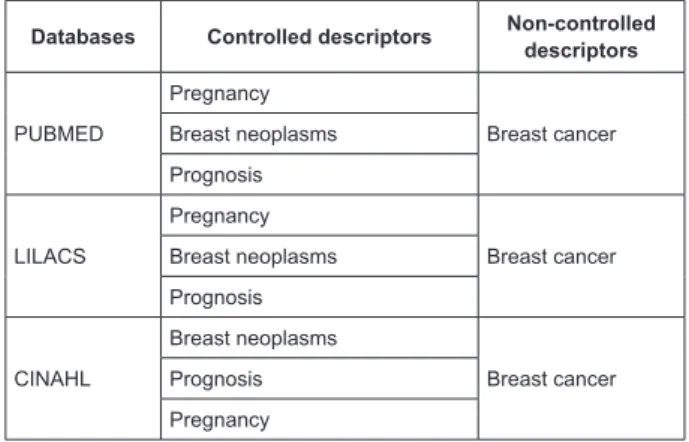
The controlled and non-controlled descriptors (key
words) selected for the primary studies search are
listed in Figure 1, which were combined and/or modiied
in each database according to the need to ensure a
comprehensive search.
Figure 1 – Controlled and non-controlled descriptors
according to the selected databases
Databases Controlled descriptors Non-controlled descriptors
PUBMED
Pregnancy
Breast cancer Breast neoplasms
Prognosis
LILACS
Pregnancy
Breast cancer Breast neoplasms
Prognosis
CINAHL
Breast neoplasms
Breast cancer Prognosis
Pregnancy
Inclusion criteria to select primary studies were:
papers addressing breast cancer during pregnancy, published in English, Spanish or Portuguese in the last
ten years (January 2000 up to April 2010). Literature
reviews or narrative reviews and editorials were
excluded.
Primary studies were selected by title and abstract
according to the study’s objective and adopted inclusion
and exclusion criteria. A total of 178 papers were pre-selected from PUBMED, 26 from LILACS, and 36 from
CINAHL, totaling 240 papers.
A total of 26 papers were drawn from those primary studies pre-selected from PUBMED after a fresh reading,
from which 17 were excluded. Hence, nine papers
from this database were included in the review. Only
two papers from the 26 pre-selected from LILACS were
included. Six primary studies were identiied in CINAHL
but they were all excluded. Therefore, the IR sample
was composed of 13 papers, which were fully analyzed. A data collection instrument proposed and validated
by Ursi(9) was used to extract data. Concepts proposed by researchers from the nursing ield were used to
analyze the studies’ design and level of evidence of the
primary studies included in the review(10-11)..
The analysis and synthesis of the primary studies
were performed in a descriptive form, allowing readers
Rev. Latino-Am. Enfermagem 2011 Nov.-Dec.;19(6):1453-61.
available in the literature concerning the investigated
theme, support decision-making in daily nursing care
provided to patients with PABC and also identify gaps of
knowledge for the development of future research.
Results
Ten out of the 13 papers included in the review were
published in English, two in Portuguese and one in Spanish.
Publications originated from many different countries and
the Irish Medical Journal stood out with two papers.
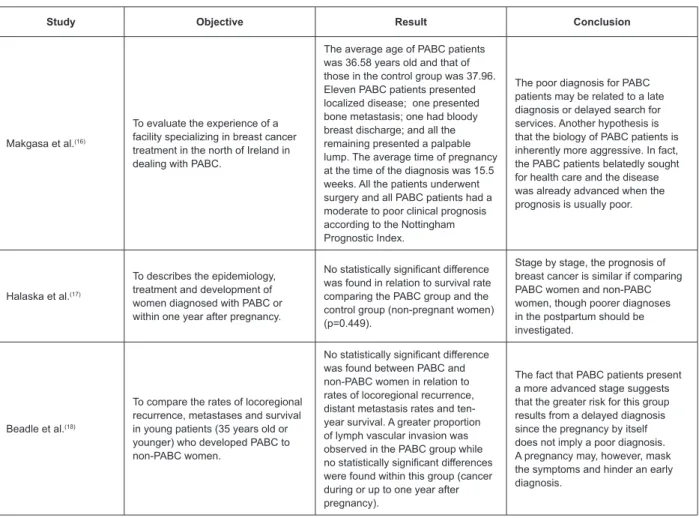
In relation to papers’ level of evidence: seven
primary studies presented level of evidence IV, that
is, case-control studies; ive studies presented level
of evidence VI: one descriptive, two case series, one
retrospective and a case study; one study presented
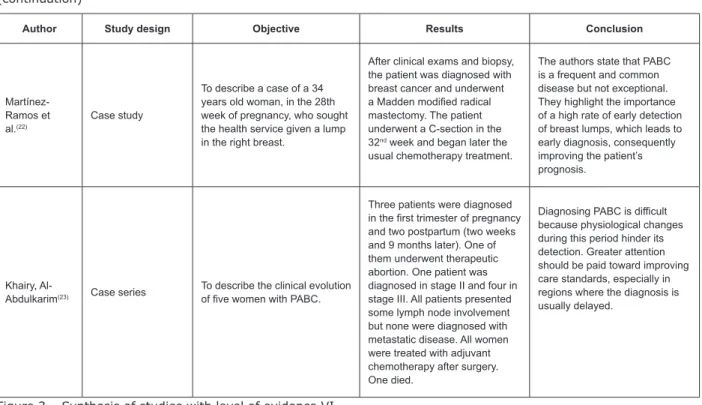
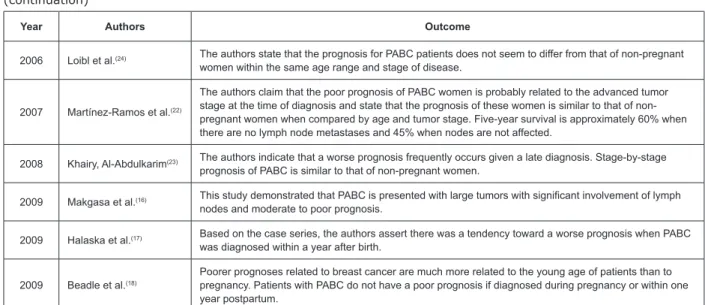
level of evidence VII: expert opinion. Figure 2, 3 and
4 present an abstract of each paper included in the IR
and Figure 5 presents the synthesis of primary studies
concerning the investigated outcome (prognosis).
Study Objective Result Conclusion
Gelber et al.(12)
To evaluate the impact of a pregnancy subsequent to diagnosis on the prognosis of patients with breast cancer in its initial stage.
The survival of women who became pregnant was greater than that of the compared group, for whom the five-year survival rate was 85% ± 3% and ten-year survival rate was 74% ± 4%.
Pregnancy subsequent to diagnosis did not adversely affect the prognosis of breast cancer in its initial stage. The greater survival observed in this study and in others may merely reflect a selection bias of healthy patients, though it is also consistent with the antitumor effect of pregnancy.
Mottola-Junior et al.(13)
To study 15 cases of PABC and compare them with a control group of young patients with invasive ductal carcinoma, evaluating the clinical stage, axillary lymph node involvement, nuclear grade, histological tumor grade, and hormone receptors for estrogen and progesterone.
In relation to disease-free survival and global survival: nine patients (60%) were alive and free of disease, four patients (26.6%) were alive with the disease, and two (13.4%) patients died. A statistically significant difference was found for the worst clinical stage (p=0.0022) and greater axillary lymph node involvement (p=0.0017) in pregnant women.
There was no difference when pregnant women were compared to non-pregnant women within the same age range in relation to the prognosis of PABC.
Reed et al.(14)
To evaluate prognosis factors in 173 patients with breast cancer subdivided into three groups: subsequent group, pregnancy group and breastfeeding group.
None of the studied parameters were significant predictors of prognosis when compared to breastfeeding + pregnancy versus subsequent group. Being 35 years old or younger was an unfavorable prognosis factor only for the breastfeeding + pregnancy groups. Five-year survival was 40%, 41% and 86% in the pregnancy, breastfeeding and subsequent groups respectively.
The results demonstrated that breastfeeding (birth 1-12 months before the breast cancer diagnosis) and pregnancy (birth 0-9 months after diagnosis) groups were very similar in relation to clinical-pathological parameters compared to the subsequent group (birth more than 9 months after diagnosis), with larger tumors, greater histological classification, negative status for hormonal receptors and high positivity for c-erb-2.
Aziz et al.(15)
To measure the various tumor markers (p53, C-erb-2, EGFR, Cathepsin-D, PCNA, DNA ploidy and S-phase fraction) jointly with the development of the disease in patients with PABC compared to a control group.
All the patients (case and control groups) had been diagnosed with infiltrating ductal carcinoma. No statistically significant difference was found in relation to global survival of tested patients and the control group, if compared stage by stage.
Malignant neoplasms of the breast may not be noticed for varying periods of time, which gives them a chance to increase in size before detection, leading to a larger tumor size found in PABC patients. Additionally, lymph nodes metastasis is common in these patients, again due to a delay in diagnosing it, which directly affects the prognosis.
Figure 2 – Synthesis of studies with level of evidence IV (case-control)
Study Objective Result Conclusion
Makgasa et al.(16)
To evaluate the experience of a facility specializing in breast cancer treatment in the north of Ireland in dealing with PABC.
The average age of PABC patients was 36.58 years old and that of those in the control group was 37.96. Eleven PABC patients presented localized disease; one presented bone metastasis; one had bloody breast discharge; and all the remaining presented a palpable lump. The average time of pregnancy at the time of the diagnosis was 15.5 weeks. All the patients underwent surgery and all PABC patients had a moderate to poor clinical prognosis according to the Nottingham Prognostic Index.
The poor diagnosis for PABC patients may be related to a late diagnosis or delayed search for services. Another hypothesis is that the biology of PABC patients is inherently more aggressive. In fact, the PABC patients belatedly sought for health care and the disease was already advanced when the prognosis is usually poor.
Halaska et al.(17)
To describes the epidemiology, treatment and development of women diagnosed with PABC or within one year after pregnancy.
No statistically significant difference was found in relation to survival rate comparing the PABC group and the control group (non-pregnant women) (p=0.449).
Stage by stage, the prognosis of breast cancer is similar if comparing PABC women and non-PABC women, though poorer diagnoses in the postpartum should be investigated.
Beadle et al.(18)
To compare the rates of locoregional recurrence, metastases and survival in young patients (35 years old or younger) who developed PABC to non-PABC women.
No statistically significant difference was found between PABC and non-PABC women in relation to rates of locoregional recurrence, distant metastasis rates and ten-year survival. A greater proportion of lymph vascular invasion was observed in the PABC group while no statistically significant differences were found within this group (cancer during or up to one year after pregnancy).
The fact that PABC patients present a more advanced stage suggests that the greater risk for this group results from a delayed diagnosis since the pregnancy by itself does not imply a poor diagnosis. A pregnancy may, however, mask the symptoms and hinder an early diagnosis.
Author Study design Objective Results Conclusion
Peralta-Musre(19) Descriptive study
To describe the profile of women enrolled in a breast pathology unit from a gynecological and obstetrical service in a hospital in relation to pregnancy and breast cancer.
Three-, four-, or ten-year disease-free survival was lower than that of non-pregnant women.
PABC prognosis is usually poor.
Hill et al.(20) Case series
To analyze the clinical evolution of 12 women with PABC history.
In the analysis of clinical evolution of the studied cases: five patients died and two already had metastatic disease at the time of diagnosis. Median of survival was 31 months. There were three stillbirths: one therapeutic abortion and two during chemotherapy treatment.
A PABC diagnosis is difficult and usually occurs in advanced stages. Surgery may safely be performed during pregnancy and adjuvant chemotherapy should not be postponed until postpartum
Grossmann et
al.(21) Retrospective study
To retrospectively evaluate 86 surgical specimens of women who underwent surgery and were cared for in the Institute of Tumors in Milan between 1977 and 1991 and their relationship to relative risk of death through the variables: tumor, nodes, age.
The results show the level of statistical significance for the variables of association by order of importance: histological classification of tumor size, axillary lymph node histopathologic classification and age.
Based on the studied variables, the authors concluded that the use of the product of the variables tumor histopathologic classification, number of involved axillary lymph nodes and age permit predicting with statistical significance relative risk of death for each patient with breast neoplasm during pregnancy.
(continue...)
Rev. Latino-Am. Enfermagem 2011 Nov.-Dec.;19(6):1453-61.
Figure 3 – Synthesis of studies with level of evidence VI (continuation)
Author Study design Objective Results Conclusion
Martínez-Ramos et al.(22)
Case study
To describe a case of a 34 years old woman, in the 28th week of pregnancy, who sought the health service given a lump in the right breast.
After clinical exams and biopsy, the patient was diagnosed with breast cancer and underwent a Madden modified radical mastectomy. The patient underwent a C-section in the 32nd week and began later the usual chemotherapy treatment.
The authors state that PABC is a frequent and common disease but not exceptional. They highlight the importance of a high rate of early detection of breast lumps, which leads to early diagnosis, consequently improving the patient’s prognosis.
Khairy,
Al-Abdulkarim(23) Case series
To describe the clinical evolution of five women with PABC.
Three patients were diagnosed in the first trimester of pregnancy and two postpartum (two weeks and 9 months later). One of them underwent therapeutic abortion. One patient was diagnosed in stage II and four in stage III. All patients presented some lymph node involvement but none were diagnosed with metastatic disease. All women were treated with adjuvant chemotherapy after surgery. One died.
Diagnosing PABC is difficult because physiological changes during this period hinder its detection. Greater attention should be paid toward improving care standards, especially in regions where the diagnosis is usually delayed.
Figure 4 – Synthesis of study with level of evidence VII
Study Expert opinion Conclusion / Recommendations
Loibl et al.(24) Report of an expert committee concerning PABC.
The objective of treatment provided to PABC women is the same as that provided to non-pregnant women: local control of the disease and prevention of metastases. However, certain types of treatment need to be modified given the potential adverse effects posed to the fetus. There is evidence that supports the safe use of chemotherapeutic anthracycline during the second and third trimesters of pregnancy (level of evidence Oxford 2b). Due to a lack of evidence concerning the routine use of new cytotoxic drugs such as taxanes, experts did not recommend their use during pregnancy.
Year Authors Outcome
2001 Gelber et al.(12) There are no adverse effects of pregnancy subsequent to diagnosis in the prognosis of PABC women and there is evidence that a pregnancy may be actually associated to a more favorable prognosis.
2001 Peralta-Musre(19) The prognosis of PABC is usually unfavorable due to delay in diagnosis and treatment. The studied patients presented lower five-year survival than non-pregnant women.
2002 Hill et al.(20) Even though stage-by-stage prognosis is similar, PABC has a worse general prognosis than when breast cancer does not occur in this period; delay in diagnosing the disease may contribute to it.
2002 Mottola- Júnior et al.(13)
PABC has a poor prognosis and no differences were found when non-pregnant women within the same age range were compared with PABC women. The determinant factor for survival is the advanced clinical stage at the time of diagnosis.
2002 Grossmann et al.(21)
Young pregnant and non-pregnant women with breast cancer tend to have a worse prognosis than premenopausal or postmenopausal women. Axillary involvement is an important element in staging and prognosis.
2003 Reed et al(14) The authors state that PABC prognosis is poor, though the reasons for that are still unknown. Also, the shorter the time between cancer diagnosis and a previous pregnancy, the worse the prognosis.
2003 Aziz et al(15) The results did not present a statistically significant difference between the PABC group and the control group in regard to survival and late staging.
Figure 5 – Synthesis of primary studies concerning studied outcome (prognosis)
Discussion
From the synthesis of evidence of the primary
studies included in the review concerning the prognosis
of PABC, we stress that nine out of the 13 studies
included indicate that a poor prognosis is associated to
late stage tumors(13-15,16-17,20-23).
A previous study had already indicated that poor
prognoses are related to the time between the breast
cancer diagnosis and pregnancies preceding the
diagnosis(25). One recent study also indicates that one
of the issues that complicate the prognosis of breast
cancer during pregnancy is a delayed diagnosis(26).
Poor prognoses are partially explained by the tendency
of pregnant women to be in more advanced stages
of the disease at the time of the diagnosis. Still, that
does not seem to be the only explanation since there
is also a study indicating that the pregnancy itself is an
independent factor for a worse prognosis(27).
A study published in 1999 reports that the survival
of patients in the stages II or III was 75%, suggesting
that with modern therapy and multidisciplinary help, the
prognosis would not be so poor as once believed(4). On
the other hand, in two studies included in the integrative
review, the results did not show statistically signiicant
difference concerning survival rate in a comparison
between PABC women and the control group
(non-pregnant women)(17-18).
The authors of another study claim that pregnancy
hormones would be responsible for a worse prognosis.
Pregnancy is characterized by a signiicant increase of
estrogen, IGF-1, progesterone and prolactin, which in
turn are closely related to the etiology of breast cancer
and its development. These hormones promote the
growth of tumor cells responsive to hormones(28).
It became clear in cell culture that the increase of
hormone concentrations during pregnancy can increase
the proliferation of cancer cells and tumor size. Another
hypothesis that would explain the high mortality of
pregnant women with breast cancer is that pregnancy
hormones select tumors with a worse prognosis. But
there are few studies addressing the topic(29-31).
An immunohistochemistry study conducted over
more than 700 cases of breast cancer reported that
tumors of women who had recently gave birth did not
differ in size, staging or receptors of estrogen and
HER2 but did present more progesterone
receptor-negative, positive p53 and a greater histological degree.
Hence, progesterone receptor-negative seems to be
associated with a worse prognosis, in part because it is
less sensitive to tamoxifen and also because it confers
an invasive phenotype on the tumor cells in a model
system. A greater expression of p53 in pregnant women
with breast cancer is also consistent in the selection of
more aggressive tumors during pregnancy(29).
There is evidence in the literature indicating that
a pregnancy does not worsen the evolution of breast
cancer, according to ive primary studies included in the
review(12,15,22-24). The authors report that the prognosis
of PABC women does not seem to differ from that of
non-pregnant women within the same age range and
who are at the same disease stage. These results are
corroborated by two other studies(32-33). Two studies in
the review indicate a poor prognosis for breast cancer
Year Authors Outcome
2006 Loibl et al.(24) The authors state that the prognosis for PABC patients does not seem to differ from that of non-pregnant women within the same age range and stage of disease.
2007 Martínez-Ramos et al.(22)
The authors claim that the poor prognosis of PABC women is probably related to the advanced tumor stage at the time of diagnosis and state that the prognosis of these women is similar to that of non-pregnant women when compared by age and tumor stage. Five-year survival is approximately 60% when there are no lymph node metastases and 45% when nodes are not affected.
2008 Khairy, Al-Abdulkarim(23) The authors indicate that a worse prognosis frequently occurs given a late diagnosis. Stage-by-stage prognosis of PABC is similar to that of non-pregnant women.
2009 Makgasa et al.(16) This study demonstrated that PABC is presented with large tumors with significant involvement of lymph nodes and moderate to poor prognosis.
2009 Halaska et al.(17) Based on the case series, the authors assert there was a tendency toward a worse prognosis when PABC was diagnosed within a year after birth.
2009 Beadle et al.(18)
Poorer prognoses related to breast cancer are much more related to the young age of patients than to pregnancy. Patients with PABC do not have a poor prognosis if diagnosed during pregnancy or within one year postpartum.
Rev. Latino-Am. Enfermagem 2011 Nov.-Dec.;19(6):1453-61.
patients when associated with young age, stating that
young women with breast cancer, pregnant or not, tend to have a worse prognosis(18,21).
One of the aspects that complicate the prognosis
of PABC is a delayed diagnosis. In this context, one should take into account the physiological changes
caused by the pregnancy in the mammary glands related to consistency and density, which may mask
the disease’s signs and symptoms and hinder a precise interpretation of screening exams, delaying diagnosis
and consequently reducing the rates of the survival of these women(26). It is common in professional practice
to encounter painless lumps that can go unnoticed due
to the breasts’ increased volume and engorgement. Hence, the nurses’ preparedness to perform physical
assessments, especially of the breasts during prenatal care and postpartum, is a relevant element that can
contribute to the early detection of PABC.
The studied problem may be a result of
inappropriate care that presents gaps mainly in prenatal care. Quality and humanized prenatal and postpartum
care is essential for the health of mother and child. For
care to be qualiied and humanized, one has to look at
the health-disease continuum from a new perspective
and understand the person in her totality of body and mind and also consider the social, economic, cultural and
physical environment where she is inserted. Moreover, new bases should be established for the relationships
of those involved in the production of health: health professionals, users and managers(34).
It is the role of nurses to implement integral and multidisciplinary care for women experiencing breast
cancer during pregnancy, intensifying continuous
and individualized evaluation during prenatal care, acknowledging the participation of women and families
in decision-making concerning the treatment and maintenance of pregnancy, and considering ethical,
religious, psychological, organic and legal aspects(35).
Conclusion
The synthesis of knowledge produced in this integrative review indicates there is evidence in the
literature that a pregnancy does not worsen the evolution
of breast cancer and that the poor diagnosis is related to the late stage tumors. However, given the reduced
number of papers included in the analysis and their level of evidence (IV, VI and VII) further studies addressing
the topic are needed.
The conduct of this integrative review reinforced the
importance of early diagnosis, which can contribute to an improved prognosis for PABC women. In this context,
we highlight the role of nurses since the results from this
review support decision-making of nurses concerning the planning and implementation of interventions in
nursing care provided to this population.
Nurses working with care delivered to women at all levels of care need to implement strategies to intensify
preventive actions and the early detection of breast cancer, especially during pregnancy, and develop actions
directed to primary care. The qualiication of nurses to
perform physical assessments, especially of breasts
during prenatal and postpartum care, is a relevant contribution to the early detection of PABC.
Among the required actions, we highlight health
education actions in which nurses should encourage an active role of women using the health services,
stimulating breast self-examination. Nursing has a preponderant role in developing actions jointly with the
population since the focus of its work is humanized care, centered on disease prevention of and health promotion.
Finally, among the gaps identiied in the studied
topic, we underscore the need to conduct studies
addressing nursing care provided to PABC women in order to promote improved health care.
References
1. Fernandes AFC, Mamede MV. Câncer de mama: mulheres que sobreviveram. Fortaleza (CE):
Universidade Federal do Ceará; 2003. 93 p.
2. Brasil. Ministério da Saúde. Instituto Nacional de
Câncer. Estimativa 2010: incidência de câncer no Brasil / Instituto Nacional de Câncer. Rio de Janeiro: INCA,
2009. 98p.
3. Kilgore AR, Bloodgood JC. Tumors and tumor-like
lesions of the breast in association with pregnancy. Arch
Surg. 1929;18(5):2079-98.
4. Berry DL, Theriaut RL, Holmes FA, Parisi VM, Booser
DJ, Singletary SE, et al. Management of breast cancer during pregnancy using a standardized protocol. J Clin
Oncol.1999;17(3):881-55.
5. Gemignani M, Petrek J, Borgen P. Breast cancer and
pregnancy. Surg Clin North Am. 1999; 79(5):1157-69. 6. Brewster WR, Disaia PJ. Breast cancer associated whit
pregnancy. In: Winchester DJ, Winchester DP, editors.
Atlas of clinical oncology: breast cancer. London: Hamilton; 2000.p.258-259.
7. Galvão CM, Sawada N, Rossi LA. A prática baseada
em evidências: considerações teóricas para a sua implementação na enfermagem perioperatória. Rev
Latino-am Enfermagem 2002;10(5):690-5.
8. Mendes KD, Silveira RCCP, Galvão CM. Revisão
evidências na saúde na enfermagem. Texto Contexto
Enferm. 2008;17(4):758-64.
9. Ursi ES. Prevenção de lesão de pele no perioperatório:
revisão integrativa da literatura. [dissertação de
mestrado]. Ribeirão Preto (SP): Escola de Enfermagem de Ribeirão Preto da Universidade de São Paulo, Ribeirão
Preto; 2005.128p.
10. Polit DF, Beck CT, Hungler BP. Fundamentos de
pesquisa em enfermagem: métodos, avaliação e utilização. 5. ed. Porto Alegre (RGS): Artmed, 2004.
p.487
11. Melnyk BM, Fineout-Overholt E. Making the case
for evidence-based practice and cultivating a spirit of
inquiry. In: Melnyk BM, Fineout-Overholt. Evidence-based practice in nursing & healthcare. A guide to
best practice. Philadelphia: Wolters Kluwer, Lippincott Williams & Wilkins; 2011.p.3-24.
12. Gelber S, Coates AS, Goldhirsch A, Castiglione-Gertsch M, Marini G, Lindtner J, et al. Effect of pregnancy
on overall survival after the diagnosis of early-stage breast cancer. J Clin Oncol. 2001;19(6):1671-5.
13. Mottola-Junior J, Berrettini-Junior A, Mazzoccato C, Laginha F, Fernandes CE, Marques JA. Câncer de mama
associado à gravidez: um estudo caso/controle. Rev
Bras Ginecol Obstet.2002;24(9):585-91.
14. Reed W, Hannisdal E, Skovlund E, Thoresen S, Lilleng P,
Nesland JM. Pregnancy and breast cancer: a population-based study. Virchows Arch. 2003;443(1):44-50.
15. Aziz S, Kayani N, Israr M, Rahbar M, Pervez S, Khan S, et al. Case control study of novel prognostic markers
and disease outcome in pregnancy/lactation-associated breast carcinoma. Pathol Res Pract.2003;199(1):15–21.
16. Makgasa M, Prichard RS, Malone C, Kerin MJ.
Pregnancy associated breast cancer. Ir Medical J. 2009;102(10):314-17.
17. Halaska MJ, Pentheroudakis G, Strnad P, Stankusova H, Chod J, Robova HMD, et al. Presentation, management
and outcome of 32 patients with pregnancy-associated Breast cancer: a matched controlled study. The Breast J.
2009;15(5):461–67.
18. Beadle BM, Woodward WA, Middleton LP, Tereffe W,
Strom EA, Litton JK, et al. The impact of pregnancy on breast cancer outcomes in women < 35 Years. Cancer
2009; 115(6):1174-84.
19. Peralta Musre O. Cáncer de mama y embarazo. Rev Chil Obstet Ginecol.2001;66(1):68-73.
20. Hill A, Dijkstra B, Healy CM, Kelly LM; Mcdermott EW, O’Higgins, N. Pregnancy-associated breast cancer.
Ir Medical J. 2002;95(2):51-2, 54.
21. Grossmann R, Zettler CG, Saccozzi R, Grossmann
S. Avaliação dos fatores prognósticos e preditivos de associação no câncer mamário durante a gestação. Rev
Bras Mastologia 2002; 12(2):23-7.
22. Martínez-Ramos D, Ferraris C; Greco M, Grosso I, Conti AR. Carcinoma de mama durante el embarazo. Cir
Esp.2007;82(5):305-7.
23. Khairy GA, Al-Abdulkarim HA. Breast carcinoma during pregnancy. Saudi Med J. 2008;29(11):1662-65.
24. Loibl S, Von Minckwitz G, Gwyn K, Ellis P, Blohmer JU; Schlegelberger B, et al. Breast carcinoma during
pregnancy. International recommendations from an expert meeting. Cancer 2006;106(2):237-46.
25. Von Schoultz E, Johansson H, Wilking N, Rutqvist LE. Influence of prior and subsequent pregnancy on breast
cancer prognosis. J Clin Oncol. 1995;13(2):430-4.
26. Lyons TR, Schedin PJ, Borges V. F. Pregnancy and breast cancer: when they collide. J Mammary Gland Biol
Neoplasia 2009;14(2):87–98.
27. Kettelhut JC, Modena MAB. Câncer de mama e
gestação Rev Fac Ciênc Med.2008;10(4):1-4.
28. Rossouw JE, Anderson GL, Prentice RL, Lacroix AZ,
Kooperberg C, Stefanick ML, et al. Risks and benefits of estrogen plus progestin in healthy postmenopausal
women: principal results from the Women´s Health Initiative randomized controlled trial. JAMA
2002;288(3):321-33.
29. Daling JR, Malone KE, Doody DR, Anderson BO, Porter PL. The relation of productive factors to mortality
from breast cancer. Cancer Epidemiol Biomarkers Prev. 2002;11(3):235-41.
30. Jacobsen BM, Schittone SA, Richer JK, Horwitz KB. Progesterone-independent effects of human
progesterone receptors in estrogen receptor-positive breast cancer. Mol Endocrinol.2005;19(3):574-84.
31. Vousden K. P53 and prognosis: news insights and
further complexity. Cell. 2005;120(1):7-10.
32. Melinda A, Maggard MD, Jessica B, O’Connell
MD, Karen E, Lane MD, et al. Do young breast cancer patients have worse outcomes? J Surgical Research
2003;113(1):109-13.
33. Azad G K, Ring AE. Breast cancer and pregnancy.
Breast Cancer Online 2007;10(10):1-5.
34. Brasil. Ministério da Saúde. Secretaria de Atenção
à Saúde. Departamento de Ações Programáticas
Estratégicas. Área Técnica de Saúde da Mulher. Pré-natal
e Puerpério: atenção qualificada e humanizada - Manual
técnico. Brasília (DF): Ministério da Saúde, 2005. 158p.
35. Lima AP, Teixeira RC, Corrêa ACP, Oliveira QC. Câncer
de mama e de colo uterino no período gestacional: uma
revisão de literatura. Ciênc Cuid Saúde
2009;8(4):699-706.
Received: Jan. 18th 2011