ABSTRACT
Treatment effects of R-appliance and Anterior
Inclined Bite Plate in Class II, Division I
malocclusion
1, Shahin Emami MEYBODI2, Abdolreza JAMILIAN34,
Elham Morshedi MEYBODI5
1- Associate Professor, Director of Orthognathic Surgery Fellowship, Orthodontics Department, Shahid Beheshti University of Medical Sciences, Tehran, Iran. 2- Associate Professor, Orthodontics Department, Dental Branch, Islamic Azad University, Tehran, Iran.
3- Associate Professor, Fellow of Orthognathic Surgery, Orthodontics Department, Dental Branch, Islamic Azad University, Tehran, Iran. 4- Orthodontic Department, Tehran University of Medical Sciences, Tehran, Iran.
5- DDS, Private practice, Tehran, Iran.
Corresponding address: Prof. Abdolreza Jamilian - Nº 2713 - Jam Tower - Valiasr St. - Tehran - 1966843133 - Phone: 00982122011892 - Fax: 00982122022215 - e-mail: [email protected]
!"#$%&'%%()#*#!%''%+%)-!#$'0'%+%
O
functional appliance (R-appliance) and the Anterior Inclined Bite Plate (AIBP) in Class II !"" # $% &$$ $' *+ &*$ *.!/0.!% 12**0$ &$' *' &*. 30*!$ 456*.0$ !4 7!8 9 beginning (T1, T 1) and end of the study (T2, T 2!1 62 <=5 7 ! "64 12+!*0/!>?.!.*& .!*0'!*?.!3456! 2 2"64 7?.!.'! <=4 ?.!3!425426 7! " &12 !
Key words: Functional orthodontic appliances. Removable orthodontic appliances. Angle !E!
INTRODUCTION
Class II malocclusion is a skeletal discrepancy that may be caused by maxillary protrusion, mandibular retraction must be replaced by retrusion. Class II subdivision malocclusions can be corrected through a variety of treatment protocols13.
Different removable functional appliances have
malocclusion5,6,8,19,28,30. Several studies have
appliances and have focused on their effects on skeletal and dental structures1,2,4,11,15,16,17,18,23,25.
U&
of the maxilla3,10,14,21,22,26,27 and cause labial tipping
3,20,29. Restriction of the maxilla and
disadvantages of such appliances.
# 7 &
acceptance by the patients9.
A recently introduced appliance named “the R-appliance”12 is believed to cause no labial tipping
! U& functional appliance named Anterior Inclined Bite 6456& for patients than the R-appliance.
Figure 1- R-appliance in patient’s mouth
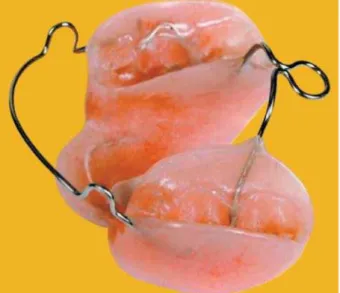
Figure 2- R-appliance
Figure 3- Pretreatment photograph of the patient
& V
achieved by the R-appliance12
AIPB in Class II Division I patients in the mixed dentition phase.
MATERIAL AND METHODS
This study consisted of 50 patients (22 boys, 28 using a standard random number table. All subjects
*2 4=5W/X& <=5?>%X& W' initial lateral cephalograms;
2- No syndromic or medically compromised patients;
3- No surgical intervention;
4- No use of other appliances before or during the period of functional treatment;
'2="62 SN);
[2< \ mandible.
27 *+ & *$ 12 # * $! *.!/0.!% **02 ! 6 R-appliances 18 hours a day. The R-appliance is a tooth and tissue borne appliance. It consists of & each other through the occlusal clearance during bite construction. These shields are extended to 7 and lingual region and the depth of vestibule; & ! ! * !4*& & connect the right and left acrylic part on the palatal !8 .!> \ ! V $+ ! 8 12
taken in centric occlusion at the onset (T1) and at
the completion (T2) of functional treatment.
The AIBP group consisted of 25 patients (15 &*. 30*!$ & 456! *.0$ ! the AIBP for 18 hours a day. This appliance consists
U #'! 8 456V
the onset (T 1) and after 18 months of observation
(T 2).
Table 1- Pretreatment and post treatment measurements of R-appliance group
Cephalometric Measures Before Treatment Mean±SD
After Treatment Mean±SD
Changes Mean±SD
P Value
SNA 78.7±3.7 79.3±3.9 0.6±1.7 0.1
SNB 72.3±2.9 75±3.2 2.7±1.6 0.001
ANB 6.7±1.7 4.2±1.3 -2.5±1.3 0.001
MP-SN 36.1±5.7 36.8±6.4 0.7±2 0.1
Ar-A 85.9±6.2 87.6±5.9 1.7±3.2 0.02
Ar-B 90.9±5.5 97±6 6.1±3.6 0.001
Ar-Pog 99.2±7.1 106.6±6.9 7.4±4.3 0.001
IMPA 101.1±5.3 98±5.9 -3.1±4.7 0.01
1 to SN 105.6±5.6 97.4±5.9 -8.2±6.5 0.001
Figure 4- Posttreatment photograph of the same patient
of Figure 3 treated by R-appliance Figure 5- Anterior Inclined Bite Plate
Cephalometric Measures Before Treatment Mean±SD
After Treatment Mean±SD
Changes Mean±SD
P Value
SNA 77.6±2.8 78.1±2.8 0.5±1.8 0.2
SNB 72.8±3.5 74.3±3.6 1.5±1.7 0.001
ANB 6±1.1 4.5±1.2 -1.5±0.9 0.001
MP-SN 36.5±6 36.1±6.2 -0.4±1.6 0.3
Ar-A 86.5±5 87.7±4.8 1.2±3 0.1
Ar-B 90.9±5.7 93.9±6 3±3.8 0.001
Ar-Pog 97.6±6.4 101.5±6.2 3.9±4.3 0.001
IMPA 97.2±11 97.3±10 0.1±5.1 0.9
1 to SN 102.7±5.5 97.2±8.3 -5.5±9.8 0.01
Table 2- Pretreatment and posttreatment measurements of Anterior Inclined Bite Plate (AIBP) group
5&426 & 1 to SN (angle \ &"64\
measured in T1, T2, T 1 and T 2. All measurements
! $ V & 7!
< ?.!.'! 9>^!< <6<<& _ *[ \!
RESULTS
62 12 <=5&424&425&426 7! 4=5 $!'X0*!+X?.!..*! <=4 2 ! "64 +!*X0/!>X?.!.**!
456<=5& 425& 426 7 ! 4=5 *!'0.!3?.!..*!<=42 7 "64 .!*X0'!*X?.!3$!
In intergroup evaluations T-test revealed that <=4 7`& <=5&425426 ! < "64 12 & increase in AIBP group (p<0.05) (Table 3).
# +/ treatment and after R-appliance treatment.
DISCUSSION
12 AIBP could successfully improve mandibular 7 ! 425 426 12 456! w& 12 ! 8 z465& they presented lingual tipping in R-appliance group. \ of the groups.
In order to get construction bite in R-appliance
achieve an edge to edge relationship parallel to the functional occlusal plane. The lingual shield 12 relieve. This relief must be done as minimally as ! order to avoid any potential trauma, all patients
`U& by no relieve in the lingual shield in R-appliance group, changed this compliance into an unconscious one in the long run. Due to activation of protractor V 7V!
of the mandible. In addition, this activation is effective in preventing headgear effect on maxillary \z !" closure might create excessive retracting force on & reason for upper anterior lingual tipping during the ! & the upper anterior takes place only at the beginning of mandibular closure. SNA might be decreased !U& the actual amount of SNA might be more than the resulted amount. Lingual tipping of the upper 2w& <=4!
412 & | ! Moreover, this appliance cannot be used in subjects !4 adapt to this appliance because of its large size 7\ !4 may lead to a decrease in patient’s compliance. On the other hand, AIBP does not restrict the 3-dimensional mandibular movement and does not
oral cavity. These are great advantages for patients’ cooperation. An ideal functional appliance should be && room for the tongue, provide skeletal rather than dental effects, and should be such that it could be
24.
Treatment mechanisms of R-appliance and AIBP are basically different from each other. In AIBP, the proprioceptive organ of periodontal space should be ! The proprioceptive sensory feedback mechanism synchronizes muscular activity and provides a functional stimulus to the full expression of ! 4 & \ 17.5 min a day. The unfavorable cuspal contacts of
Cephalometric Measures
AIBP Mean±SD
R-Appliance Mean±SD
P Value
SNA 0.5±1.8 0.6±1.7 0.9
SNB 1.5±1.7 2.7±1.6 0.02
ANB -1.5±0.9 -2.5±1.3 0.01
MP-SN -0.4±1.6 0.7±2 0.05
Ar-A 1.2±3 1.7±3.2 0.6
Ar-B 3±3.8 6.1±3.6 0.01
Ar-Pog 3.9±4.3 7.4±4.3 0.01
IMPA 0.1±5.1 -3.1±4.7 0.05
of the mandible. Therefore, the mandible does not !456 disoccludes the mandible from its lock position and V !
One of the shortcomings of this study is that development.
CONCLUSIONS
7
*2 12 456 positioning of the mandible.
2- Both AIBP and R-appliance did not cause any headgear effect on the maxilla.
3- Unlike AIBP, R-appliance does not cause any ` &z anterior incisors.
4- The smaller size of AIBP makes it more 12!
'212 mandibular advancement.
REFERENCES
1- Aelbers CM, Dermaut LR. Orthopedics in orthodontics: part & 7 2 ! 4 Dentofacial Orthop. 1996;110:513-9.
$25 <&11!# !4 Orthod Dentofacial Orthop. 1989;95:250-8.
+2V!V!$nd ed. Saint Louis:
Mosby; 2002. p. 343-56.
/2 V ! V dentofacial orthopaedics. London: Mosby-Wolfe; 1995. p. 45-6. '2 V ! V w! 4 appliance system. Am J Orthod Dentofacial Orthop. 1988;93:1-18. [2 & & 67 1& 6 ! 4 comparison of early treatment of Class II/1 cases: skeletal effects 7 !! 1999;60:392-408.
>2"<&4&<VV 4! inclined plane treatment on the dentoskeletal of Class II division 1 patients. J Indian Soc Pedod Prev Dent. 2007;25:130-2. %2E&<#<& U&"V98&8 LL. Headgear versus functional regulator in the early treatment of Class II, division 1 malocclusion: a randomized clinical trial. Am J Orthod Dentofacial Orthop. 1988;113:51-61.
9- Graber TM, Neumann B. Removable orthodontic appliances. Philadelphia: WB Saunders; 1984. p. 198-356.
10- Hägglund P, Segerdal S, Forsberg CM. The integrated Herbst 2 untreated control group. Eur J Orthod. 2008;30:120-7.
**2 & <V 6! = 1 7 !4!$..$`>$'>*2'!
*$2 4& <VV 1& ! 12 different design in functional therapy in Class II Division I !"V!$..3`$.**2*/!
13- Janson M, Janson G, Sant'Ana E, Simão TM, Freitas MR. An orthodontic-surgical approach to Class II subdivision malocclusion treatment. J Appl Oral Sci. 2009;17:266-73.
14- Kerr WJS, TenHave TR, McNamara JA Jr. A comparison of skeletal and dental changes produced by function regulators (FR-2 and FR-3). Eur J Orthod. 1989:235-42.
*'28V<<! != Jaypee Brothers Medical Publishers; 2008. p. 46.
*[2 " <& " 6& E 6& 8 1! 4 optical surface scanning and cephalometric and assessment of the effect of functional appliances on the soft tissues. Eur J Orthod. 2001;23:115-26.
17- McSherry PF, Bradley H. Class II correction - reducing patient w ! ! 2000;27:219-25.
18- Mills JR. The effect of functional appliances on the skeletal pattern. Br J Orthod. 1991;18:267-75
*325&&#&<&"=&V <&! U 2V 9&! Am J Orthod Dentofacial Orthop. 2003;124:128-37.
20- Pancherz H. The mechanism of Class II correction in Herbst appliance treatment. A cephalometric investigation. Am J Orthod. 1982;82:104-13.
21- Pangrazio-Kulbersh V, Berger JL, Chermak DS, Kaczynski R, Simon ES, Haerian A. Treatment effects of mandibular anterior ! Am J Orthod Dentofacial Orthop. 2003;123:286-95.
22- Perillo L, Johnston LE Jr, Ferro A. Permanence of skeletal changes after function regulator (FR-2) treatment of patients ! 4 Orthop. 1996;109:132-9.
23- Petrovic A, Stutzmann J, Lavergne J, Shaye R. Is it possible !*33*`$3+2%!
24- Sari Z, Goyenc Y, Doruk C, Usumez S. Comparative evaluation ! activator-headgear combination. Angle Orthod. 2003;73:286-93 25- Shen G, Hägg U, Darendeliler M. Skeletal effects of bite 2 !7\ appliances. Orthod Craniofac Res. 2005;8:2-10.
26- Toth LR, McNamara JA Jr. Treatment effects produced by the 2V#12$#V !4! 1999;116:597-609.
$>2 "! 2V appliance in the treatment of Class II Division 1 malocclusion !4! 2000;117:54-9.
$%2#&671&6 !z early treatment for Class II malocclusion. Am J Orthod Dentofacial Orthop. 1997;111:533-42.
29- Vargervik K, Harvold EP. Response to activator treatment in Class II malocclusions. Am J Orthod. 1985;88:242-51.