ABSTRACT
http://dx.doi.org/10.1590/1678-775720140453
The effect of systemic antibiotics administered
during the active phase of non-surgical periodontal
therapy or after the healing phase: a systematic
review
Aretuza FRITOLI, Cristiane GONÇALVES, Marcelo FAVERI, Luciene Cristina FIGUEIREDO, Paula Juliana PÉREZ-CHAPARRO, Daiane FERMIANO, Magda FERES
Department of Periodontology, Dental Research Division, Guarulhos University, Guarulhos, São Paulo, Brazil.
Corresponding address: Magda Feres - Centro de Pós-Graduação e Pesquisa - CEPPE - Universidade Guarulhos - Praça Tereza Cristina, 229 - Centro - 07023-070 - Guarulhos - SP - Brazil - Phone +55 11 2087 3594 - e-mail: [email protected]
Submitted: November 4, 2014 - Modiication: January 23, 2015 - Accepted: March 2, 2015
O
bjective: The aim of this systematic review was to compare the clinical effectiveness of systemic antibiotics administered in the active stage of periodontal treatment or after the healing phase. Material and Methods: An electronic search was performed in the databases EMBASE, MEDLINE and Cochrane Central Register of Controlled Trials (CENTRAL), in accordance with the Preferred Reporting Items for Systematic Reviews and Meta-analysis (PRISMA) statement. A manual search of the reference list of selected studies and of review articles was also performed up to November 2013. Randomized Clinical Trials (RCT) that evaluated the systemic administration of antibiotics as adjuvants to scaling and root planning (SRP) at different phases of periodontal treatment were included. Systematic reviews and studies that evaluated subjects with systemic diseases and those that usedsubantimicrobial doses of antibiotics were excluded. Results: The initial search identiied
1,039 articles, of which seven were selected, and only one met the inclusion criteria. This study showed that subjects taking metronidazole and amoxicillin at the initial phase of
treatment exhibited statistically signiicantly greater reduction in pocket depth and gain in clinical attachment level in initially deep sites (PD≥7 mm) than subjects taking antibiotics
after healing (p<0.05). This comparison was conducted 2 months after antibiotic intake, at the healing phase. Conclusion: To date, only one short-term RCT has directly compared different moments of systemic antibiotics administration, as adjuncts to SRP, in the
treatment of periodontitis. Although the results of this study suggested some beneits for antibiotics intake during the active phase of therapy, these indings need to be conirmed
by larger placebo-controlled randomized clinical trials with longer follow-up periods.
Keywords: Periodontal diseases. Chronic periodontitis. Aggressive periodontitis. Therapy. Antibiotics.
INTRODUCTION
Periodontal diseases are infectious-inlammatory
conditions that may lead to the loss of teeth. Scaling and root planing (SRP) is the most commonly therapy used for the treatment of periodontitis. Although SRP promotes an improvement in the clinical periodontal parameters in the majority of
cases, it is frequently insuficient to change the bacterial proile associated with periodontitis to a proile compatible with periodontal health, i.e.,
with lower levels and proportions of periodontal
pathogens and higher proportions of beneicial
microorganisms, such as the Actinomyces species4.
Therefore, the clinical beneicial results achieved
or due to the higher severity of disease observed in patients with diabetes mellitus3,13. For this reason, other treatments, such as the administration of systemic antibiotics have been proposed in association with SRP, with the goal of potentiating the effects of this therapy.
In spite of the clinical relevance and effective use of systemic antibiotics in the treatment of various infectious diseases, clinical studies on the effects of these agents in the treatment of periodontal diseases only began in the 1970s25. Over the course of the last few decades, antibiotics have been widely studied as adjuvants to mechanical periodontal therapy and several clinical studies have shown
additional beneits with the use of these agents5,10,12. However, it is important to highlight that antibiotics are biologically active substances that can lead to side effects of various intensities and their indiscriminate use might lead to the increase in the pool of bacterial species tolerant to the antibiotics4. In the light of this knowledge, it is important to highlight that the decision of whether or not to use these agents to treat periodontitis should follow the same principle used for the treatment of any other infection in the body, which is: the risks need
to be clearly offset by beneits to the patient. The only way to determine this risk/beneit ratio is by
evaluating the results of well-conducted randomized clinical trials (RCTs).
Recent RCTs and systematic reviews have suggested that the combination of metronidazole (MTZ) and amoxicillin (AMX) are effective for the treatment of aggressive periodontitis17,18,24 and chronic periodontitis2,6,8,23,29. However, although a notable therapeutic advantage has been shown when MTZ+AMX are used in periodontal therapy, some questions relative to the protocol for the use of these medications remain obscure, such as: “which would be the best phase of the non-surgical periodontal therapy treatment for the administration of antibiotics?”.
In clinical practice, the decision to use antibiotics
is commonly taken after the healing phase of the mechanical treatment, which may vary from 2 to 5 months9 post-SRP. However, some biologic concepts suggest that the effects of antibiotics could be potentiated if they were used during the active phase of treatment5. Apparently, a rapid and more profound reduction of the subgingival microbial
load may lead to a more beneicial recolonization
of the recently scaled pockets in the long term.
Lighter and sequential disturbances of the bioilm may not be suficient to change the highly stable climax community of bioilm26,27. Therefore, since there is no consensus in the literature about the ideal time for the administration of these agents, a systematic review of the literature could help with taking the correct clinical decision and could guide future studies on this topic.
MATERIAL AND METHODS
This systematic review was conducted in accordance with the recommendations of PRISMA (Preferred Reporting Items for Systematic Reviews and Meta-analysis)20.
Focused question
“At which phase of non-surgical periodontal therapy would systemic antibiotics promote the best clinical results, including reduction in probing depth (PD) and gain in clinical attachment level (CAL): during the active phase or after the healing phase of mechanical therapy?”
Inclusion criteria
In order to be included in the sample, the papers had to be: RCTs with at least two groups, one test (systemic antibiotic used in the active phase of mechanical treatment) and one control (systemic antibiotic used after the healing phase of the mechanical therapy) group; studies that included individuals with chronic or aggressive periodontitis; and studies that evaluated PD and CAL.
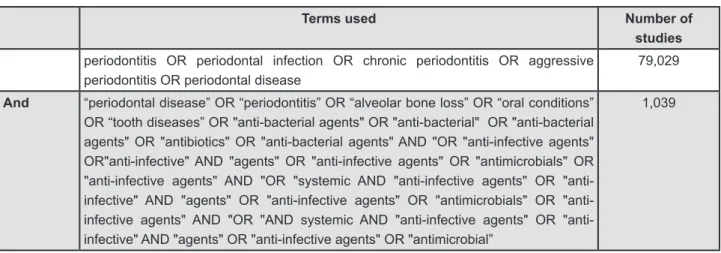
Terms used Number of
studies
periodontitis OR periodontal infection OR chronic periodontitis OR aggressive periodontitis OR periodontal disease
79,029
And “periodontal disease” OR “periodontitis” OR “alveolar bone loss” OR “oral conditions” OR “tooth diseases” OR "anti-bacterial agents" OR "anti-bacterial" OR "anti-bacterial agents" OR "antibiotics" OR "anti-bacterial agents" AND "OR "anti-infective agents" OR"anti-infective" AND "agents" OR "anti-infective agents" OR "antimicrobials" OR infective agents" AND "OR "systemic AND infective agents" OR infective" AND "agents" OR infective agents" OR "antimicrobials" OR infective agents" AND "OR "AND systemic AND infective agents" OR "anti-infective" AND "agents" OR "anti-infective agents" OR "antimicrobial”
1,039
Exclusion criteria
Studies published in languages other than Portuguese, English and Spanish, reviews of the
literature, and studies that used antibiotics in subantimicrobial doses were excluded from the sample.
Evaluation variables
Changes in full-mouth mean PD and CAL, as well as changes in mean PD and CAL in different categories of pockets.
Search strategy
The EMBASE, MEDLINE and Cochrane Central Register of Controlled Trials (CENTRAL) were searched up to November 2013 by two researchers (ARFS e CG), using the search strategy described in Figure 1. A manual search of the reference list of selected studies and of review articles about the topic was also performed. Studies were selected by the two researchers in an independent manner, and any disagreement was resolved by a third researcher (MFe).
Data extraction
Studies that fulilled the inclusion and exclusion
criteria were submitted to data extraction by one of the researchers (ARFS). The following items of Figure 2- Flow chart of the search strategy
Study Study
Design
Sample Intervention Follow-up Results Conclusion
Grifiths, et al.9 (2011)
RCT Group A n=20
5 smokers
16 females
GAgP
Group A FMRSD+AMX
500 mg+MTZ 500 mg (TID
for 7 days) starting right
after the completion of SRP+CHX
0.2% for two weeks
8 months after SRP (2 months
post-antibiotic intake in Group
B)
Group A: showed greater
reduction in mean PD and gain in CAL in initially deep sites (with PD≥7 mm)
than Group B. Difference between groups of 0.9 mm (PD reduction) and 0.7 mm
(CAL gain) (p<0.05).
Subjects who received
MTZ+AMX at the initial therapy showed statistically signiicant additional beneits compared with those who received the same antibiotic regimen after
the healing phase.
Group B n=21
4 smokers
12 females
GAgP
Group B FMRSD+AMX
500 mg+MTZ 500 mg (TID
for 7 days) starting 6 months after the completion
of SRP+CHX 0.2% for two
weeks
The percentage of sites converting from PD≥5 mm to ≤4 mm was 83% in Group A and 67% in Group
B (p=0.041)
RCT: randomized clinical trial; GAgP: generalized aggressive periodontitis; FMRSD: full mouth root surface debridement; AMX: amoxicillin; MTZ: metronidazole; TID: three times a day; SRP: scaling and root planning; PD: probing depth; CAL: clinical attachment level; CHX: chlorhexidine
information were collected and recorded on a piloted form: 1) place where the research was conducted – country and environment in which the patients were treated (private clinic or hospital/university clinics); 2) randomization method; 3) sample characteristics – sample size, age, gender, local and systemic health conditions, characteristics of the
interventions performed, statistical signiicance; 4) clinical results; 5) conlict of interest; 6) funding.
RESULTS
The low diagram of this study is represented in
Figure 2. In the electronic search, 1039 studies were
identiied. After reading the titles and abstracts,
1032 studies were excluded, and 7 were selected.
No article was identiied in the manual search.
After reading the full text of the 7 selected studies, 6 were excluded1,2,11,15,21,28 because they did not directly compare the moment of administration of the systemic antibiotics in the treatment of periodontitis. Therefore, only 1 study9 was included in this review. In this study, the authors compared
the clinical eficacy of MTZ+AMX administered in
the active phase of periodontal treatment, i.e., together with the SRP procedure (initial antibiotic therapy – Group A, n=20) or after the healing phase, i.e., 6 months after the completion of the SRP (antibiotic after healing – Group B, n=21). All subjects received periodontal maintenance scaling at 6 months. Clinical parameters were registered at 2 months after the treatment of Group B with antibiotics (i.e., 8 months after treatment of group A/Baseline). The data showed that subjects taking antibiotics at the initial phase of treatment exhibited
statistically signiicant greater reduction in pocket
depth and gain in clinical attachment level in
initially deep sites (PD≥7 mm) than subjects taking
antibiotics at re-assessment (difference between groups of 0.9 mm and 0.7 mm, respectively). In addition, the percentage of sites converting from
PD≥5 mm to ≤4 mm was 83% in Group A and 67%
in Group B (p=0.041) (Figure 3).
DISCUSSION
T h e r e s u l t s o f t h i s s y s t e m a t i c r e v i e w demonstrated that up until today, only one study in the literature compared the effects of systemic antibiotics administered in different phases of mechanical therapy. This study, published by
Grifiths, et al.9 (2011), suggested there were greater clinical benefits when MTZ+AMX were prescribed during the active phase of periodontal therapy than after the healing phase. Individuals treated with antibiotics together with SRP in the initial phase of treatment, showed greater reduction in PD and greater gain in CAL in deep pockets than
individuals treated with antibiotics 6 months after SRP. It is worth pointing out that this study presents some limitations, for example, the fact of not having used placebo and having had a short longitudinal evaluation time (the comparison between the two groups was conducted at 2 months post-antibiotic intake at the healing phase). The use of placebo allows blinding of the study, which is one of the
criteria that deine the high quality of a RCT20. In addition, a longer follow-up period would be important in order to establish whether or not these results would be maintained over the course of time.
Apart from the study included in this review, Kaner, et al.14 (2007) conducted a retrospective evaluation of individuals with generalized aggressive periodontitis treated with SRP+MTZ+AMX administered immediately or 3 months after mechanical treatment, and observed that the time
of administration of the antibiotics inluenced the
clinical response. Three months after the second group had taken the antibiotics, the group treated in the active phase of therapy obtained statistically
signiicantly higher reductions in the mean PD (4.09
mm) and relative gain in CAL (2.50 mm) in deep sites (with PD>6 mm) in comparison with the group that took MTZ+AMX at the time of re-evaluation (2.80 mm and 1.41 mm, respectively) (p<0.05).
The results of the studies of Grifiths, et al.9 (2011) and Kaner, et al.14 (2007) suggest a beneit for the administration of MTZ+AMX in the active phase of mechanical treatment. These results suggest that the systemic antibiotics administered together with the mechanical treatment in the initial phase of therapy has a greater potential to change the pathogenic bacterial community to a community compatible with periodontal health in the short term. This statement is in agreement with the concept that a rapid and striking reduction in the subgingival microbiota would be necessary in order
to obtain more beneicial and stable recolonization
over time in the recently scaled pockets26,27. The
bioilm structure, especially the mature bioilm
found in the subgingival pockets of individuals with periodontitis, presents resilience, meaning that they tend to go back to their original structure (i.e., a composition observed in disease, with high proportions of pathogens and low proportions of
beneicial species). Therefore, intense treatments
applied at once, such as the association of SRP and antibiotics during the initial therapy, might have greater potential to create an entirely new and
stable bioilm community, similar to that observed
in healthy individuals5. In addition, a hypothesis
related to the high degree of inlammation observed
in non-treated periodontal patients may also help
to explain the greater clinical beneit observed in
intense inlammatory process, there are higher levels of gingival luid; therefore, higher levels of
antibiotic are also released into the subgingival environment7,14. In addition, inlammation is also associated with great capillary permeability, which may contribute to better absorption of these agents7,14.
Implications for research and clinical practice
In daily clinical practice, periodontists tend to postpone the administration of antibiotics to the re-assessment phase, rather than as part of the initial treatment. An evidence-based appraisal of current literature presented in this manuscript showed that, to date, only one short-term RCT has directly compared different moments of systemic antibiotics administration as adjuncts to SRP in the treatment of periodontitis. Although the results of this study
suggested some beneits for antibiotics intake during the active phase of therapy, these indings need to be conirmed by larger placebo-controlled
randomized clinical trials with longer follow-up periods. This information could help clinicians with their decision-making in the daily practice.
ACKNOWLEDGMENTS
This work was partly supported by Guarulhos University (Guarulhos, São Paulo, Brazil; PIBIC/ UnG/I-13 grant) and São Paulo Research Foundation (FAPESP, grant no. 2012/20915-0 and
2012/23731-8). The authors declare no potential conlicts of
interest with respect to the authorship and/or publication of this article.
REFERENCES
1- Cionca N, Giannopoulou C, Ugolotti G, Mombelli A. Amoxicillin and metronidazole as an adjunct to full-mouth scaling and root planning of chronic periodontitis. J Periodontol. 2009;80:364-71. 2- Cionca N, Giannopoulou C, Ugolotti G, Mombelli A. Microbiologic testing and outcomes of full-mouth scaling and root planing with or without amoxicillin/metronidazole in chronic periodontitis. J Periodontol. 2010;81:15-23.
3- Emrich LJ, Shlossman M, Genco RJ. Periodontal disease in non-insulin-dependent diabetes mellitus. J Periodontol. 1991;62:123-31.
4- Feres M. Antibiotics in the treatment of periodontal diseases: microbiological basis and clinical applications. Ann R Australas Coll Dent Surg. 2008;19:37-44.
5- Feres M, Figueiredo LC, Soares GM, Faveri M. Systemic antibiotics in the treatment of periodontitis. Periodontol 2000. 2015;67:131-86.
6- Feres M, Soares GM, Mendes JA, Silva MP, Faveri M, Teles R, et al. Metronidazole alone or with amoxicillin as adjuncts to non-surgical treatment of chronic periodontitis: a 1-year double-blinded, placebo-controlled, randomized clinical trial. J Clin Periodontol. 2012;39:1149-58.
7- Gomi K, Yashima A, Iino F, Kanazashi M, Nagano T, Shibukawa
N, et al. Drug concentration in inlamed periodontal tissues
after systemically administered azithromycin. J Periodontol. 2007;78:918-23.
8- Goodson JM, Haffajee AD, Socransky SS, Kent R, Teles R, Hasturk H, et al. Control of periodontal infections: a randomized controlled trial I. The primary outcome attachment gain and pocket depth reduction at treated sites. J Clin Periodontol. 2012;39:526-36.
9- Grifiths GS, Ayob R, Gerrero A, Nibali L, Suvan J, Moles DR,
et al. Amoxicillin and metronidazole as adjunctive treatment in generalized aggressive periodontitis at initial therapy or re-treatment: a randomized controlled clinical trial. J Clin Periodontol. 2011;38:43-9.
10- Guerrero A, Grifiths GS, Nibali L, Suvan J, Moles DR, Laurell L, et al. Adjunctive beneits of systemic amoxicillin and metronidazole
in non-surgical treatment of generalized aggressive periodontitis: a randomized placebo-controlled clinical trial. J Clin Periodontol. 2005;32:1096-107.
11- Gürkan A, Emingil G, Cinarcik S, Berdeli A. Post-treatment effects of subantimicrobial dose doxycycline on clinical parameters
and gingival crevicular luid transforming growth factor-beta1 in
severe, generalized chronic periodontitis. Int J Dent Hygiene. 2008;6:84-92.
12- Haffajee AD, Socransky SS, Gunsolley JC. Systemic anti-infective periodontal therapy: a systematic review. Ann Periodontol. 2003;8:115-81.
13- Jimenez M, Hu FB, Marino M, Li Y, Joshipura KJ. Type 2 diabetes mellitus and 20 year incidence of periodontitis and tooth loss. Diabetes Res Clin Pract. 2012;98:494-500.
14- Kaner D, Christian C, Dietrich T, Bernimoulin JP, Kleber BM, Friedmann A. Timing affects the clinical outcome of adjunctive systemic antibiotic therapy for generalized aggressive periodontitis. J Periodontol. 2007;78:1201-8.
15- Loesche WJ, Giordano JR, Soehren S, Kaciroti N. The nonsurgical treatment of patients with periodontal disease: results after 6.4 years. Gen Dent. 2005;53:298-306.
16- Matarazzo F, Figueiredo LC, Cruz SE, Faveri M, Feres M.
Clinical and microbiological beneits of systemic metronidazole and
amoxicillin in the treatment of smokers with chronic periodontitis: a randomized placebo-controlled study. J Clin Periodontol. 2008;35:885-96.
17- Mestnik MJ, Feres M, Figueiredo LC, Duarte PM, Lira EA, Faveri
M. Short-term beneits of the adjunctive use of metronidazole plus amoxicillin in the microbial proile and in the clinical parameters
of subjects with generalized aggressive periodontitis. J Clin Periodontol. 2010;37:353-65.
18- Mestnik MJ, Feres M, Figueiredo LC, Souza S, Teles RP, Femiano D, et al. The effects of adjunctive metronidazole plus amoxicillin in the treatment of generalized aggressive periodontitis: a 1-year double-blinded, placebo-controlled, randomized clinical trial. J Clin Periodontol. 2012;39(10):955-61.
19- Miranda TS, Feres M, Perez-Chaparro PJ, Faveri M, Figueiredo LC, Tamashiro NS, et al. Metronidazole and amoxicillin as adjuncts to scaling and root planing for the treatment of type 2 diabetic subjects with periodontitis: 1-year outcomes of a randomized placebo-controlled clinical trial. J Clin Periodontol. 2014;41:890-9. 20- Moher D, Liberati A, Tetzlaff J, Altman DG, PRISMA Group. Reprint-preferred reporting items for systematic reviews and meta-analyses: the PRISMA statement. Phys Ther. 2009;89:873-80. 21- Moreira RM, Feres-Filho EJ. Comparison between full-mouth scaling and root planing and quadrant-wise basic therapy of aggressive periodontitis: 6-month clinical results. J Periodontol. 2007;78:1683-8.
22- Sampaio E, Rocha M. Figueiredo LC, Faveri M, Duarte PM, Gomes Lira EA, et al. Clinical microbiological effects of azithromycin in the treatment of generalized chronic periodontitis: a randomized placebo-controlled clinical trial. J Clin Periodontol. 2011;38:838-46.
24- Sgolastra F, Petrucci A, Gatto R, Monaco A. Effectiveness of systemic amoxicillin/metronidazole as an adjunctive therapy to full-mouth scaling and root planning in the treatment of aggressive periodontitis: a systematic review and meta-analysis. J Periodontol. 2012;83:731-43.
25- Slots J, Mashimo P, Levine MJ, Genco RJ. Periodontal therapy in humans. I. Microbiological and clinical effects of a single course of periodontal scaling and root planing, and of adjunctive tetracycline therapy. J Periodontol. 1979;50:495-509.
26- Socransky SS, Haffajee AD. Dental biofilms: difficult therapeutic targets. Periodontol 2000. 2002;28:12-55.
27- Teles RP, Haffajee AD, Socransky SS. Microbiological goals of periodontal therapy. Periodontol 2000. 2006;42:180-218. 28- Yashima A, Gomi K, Maeda N, Arai T. One-stage full-mouth versus partial-mouth scaling and root planing during the effective half-life of systemically administered azithromycin. J Periodontol. 2009;80:1406-13.