TRIDIMENSIONAL ARCHITECTURE OF THE
COLLAGEN ELEMENT IN THE ARACHNOID
GRANULATIONS IN HUMANS
A study on scanning electron microscopy
Celso Ivan Conegero¹, Renato Paulo Chopard²
ABSTRACT - The arachnoid granulations of adult individual of both sexes were studied through scanning electron microscopy. The dura mater and arachnoid meninges of individuals were collected at the Service of Death Verification of São Paulo - USP and fixed in Karnovsky solution. After this period the material was prepared for analysis in electron microscope. Our results demonstrated that the arachnoid granulations are formed by a pedicle, body and apex, being surrounded by a capsule of connective tissue, which in turn is composed of, basically, bundles of collagen fibers that line pores of different shapes and sizes. The smaller pores are lined by tiny bundles and are located at the apical region of the granulation and the larger are lined by thicker bundles and are located at the lateral regions. In the body we verified that the bundles of collagen fibers compose a fibrous meshwork and in some regions these bundles have circular orientation, forming pores similar to those found at the region of the capsule.
KEY WORDS: arachnoid granulations, meninges, cerebrospinal fluid, collagen, scanning electron microscopy.
Arquitetura tridimensional do elemento colágeno das granulações aracnóides em humanos: um estudo de microscopia eletrônica de varredura
RESUMO - As granulações aracnóides de indivíduos adultos de ambos os sexos foram estudadas por meio de microscopia eletrônica de varredura. Para tanto, as meninges dura-máter e aracnóides foram coletadas junto ao Serviço de Verificação de Óbitos da Capital – USP- SP e fixadas em solução de Karnovsky. Após a preparação, o material foi analisado em microscópio eletrônico. Nossos resultados demonstraram que as granulações aracnóides apresentam-se formadas pelas regiões de pedículo, corpo e ápice, sendo envoltas por cápsula de tecido conjuntivo, que por sua vez é constituída basicamente por feixes de fibras colágenas que delimitam poros de diferentes formas e tamanhos. Os poros menores são delimitados por feixes delgados e estão localizados na região apical da granulação e os maiores são delimitados por feixes mais espessos e localizam-se nas regiões laterais. No corpo verificamos que os feixes de fibras colágenas constituem o arcabouço fibroso das mesmas e que em determinadas regiões estes feixes apresentam orientação circular constituindo poros semelhantes aos encontrados na região da cápsula.
PALAVRAS-CHAVE: granulações aracnóides, meninges, fluido cerebrospinal, colágeno, microscopia eletrônica de varredura.
¹Department of Morphophysiological Sciences, State University of Maringá, Maringá PR, Brazil (UEM); ²Department of Anatomy, Institute of Biomedical Sciences, University of São Paulo, São Paulo SP, Brazil (USP);
Received 25 October 2002, received in final form 10 February 2003. Accepted 25 February 2003.
Dr. Celso Ivan Conegero - Rua José Barão Neto 176 - 87080-030 Maringá PR - Brasil.
The arachnoid granulations, first studied by Pac-chioni (1705), are projections of the arachnoid to the interior of the dura mater sinuses composed of fibrous and cellular elements and mainly located in the superior sagital sinus. These structures perform important functions on the transport of cerebros-pinal fluid, several being the investigations carried out to clarify the mechanisms through which this
transport occurs. Authors such as Sprong¹, Jayatila-ka2, Davson et al.3, Potts et al.4, Upton5, believe in
the existence of direct communication channels from the subarachnoid space to superior sagital sinus, thus a passive absorption process taking place. However, Shabo & Maxwell6,7, Alksne & Lovings8, and Triphati9,
anatomic substrate for the better understanding of the mechanisms involved in this process.
METHOD
Material
Ten encephalons with their respective meninges were used, obtained from corpses of individuals of both sexes. The samples were obtained at the Service of Death Veri-fication of São Paulo – USP, SP.
Method
The brains were from corpses of individuals aging from 21 and 80 years. Blocks were removed which contained the medium regions of the superior sagital sinus and the corresponding portion of the underlying brain. The supe-rior sagital sinus of this block was open lengthwise so as to expose the arachnoid granulations, which were washed in distilled water and fixed in Karnovsky solution for 48h. After this stage the material was subjected to treatment in 10% sodium hydroxide (NaOH) solution for 72 h for digestion of the cellular components. Then it was washed in distilled water for four days at 4ºC, washed three times in 0,1 M phosphate buffer solution, pH 7.2, and
post-RESULTS
In our study we observed that the arachnoid gra-nulations show a thinner region, named pedicle, and a more dilated one, called body, both being surroun-ded by bundles of collagen fibers coming from the dura mater and the granulation (Figs. 1 and 2). When we analyzed the morphology of the granulations we verified that these can be isolated ou clustered (Figs. 2 and 3). Isolated granulations are larger and have smaller numbers of lobules than the clustered gra-nulations (Figs. 2 and 3). The lobules of the clustered granulations are distributed randomly on their sur-face, varying in size and shape (Fig. 3).
Bundles of collagen fibers from the dura mater, predominately parallel, alter their orientation and morphology, becoming tortuous and thin, to com-pose the capsule of the arachnoid granulation (Fig. 4). When comparing the orientation of the bundles of collagen fibers from the capsule of the arachnoid granulations with that found in the inner leaflet of the dura mater, which is the floor of the superior sagital sinus, we observed that those have
characte-Fig 1. Photomicrograph of a 15µm frontal section of the superior sagital sinus where an arachnoid granulation with its portions is observed: pedicle (p), body (c), apex (a) and also the capsule (arrow) and the subcapsular space (es). Observe also thick bundles of collagen fibers from the dura mater (fc) and the lumen of the superior sagital sinus (sss). AZO-CARMIM, 55x.
ristic orientations, composing a dense and irregular meshwork lining openings of different shapes and sizes which we called pores (Figs. 5 and 6). The largest pores were predominately located at the lateral regions and were composed of thick bundles of collagen fibers, while the smallest pores predomina-ted at the apical regions and were formed by thin bundles of collagen fibers (Figs. 6 and 7).
The region of the body of the arachnoid granu lations was composed of bundles of collagen fi-bers of varied thicknesses, the largest and thickest bundles constituting the framework of the granula-tion, while the thinnest were widely distributed as structures similar to spider webs (Figs. 8 and 9). In some regions the more delicate bundles were circu-larly arranged like those found on the pores of the capsule of the granulations (Figs. 8 and 9).
DISCUSSION
After their discovery in 1701 by Pachionni, the arachnoid granulations and their relations with the dura mater have been the subject of investigations of authors who are mentioned in the classic literature, like Ham13, Warwick & Williams14, Gardner
et al.15, Junqueira & Carneiro16, and in the specific
literature on this tissue, like Shabo & Maxwell6,7,
Zaki17, Yamashima10, Miranda Neto et al.11,18, Chopard
et al.12, Okamoto et al.19 and Hasegawa et al.20.
In our study most of the granulations traversed the inner leaflet of the dura mater and projected on the lumen of the superior sagital sinus, as described by Ham13, Warwick & Williams14, Gardner et al.15,
Junqueira & Carneiro16, Grossman & Potts21 and
Okamoto19.
Fig 3. Photomicrograph of a scanning electron microscopy evidencing from the floor of the superior sagital sinus where clustered arachnoid granulations are preent. Observe different sizes and shapes of the lobules (arrows) and small bundles of collagen fibers linking the granulations. 20x.
Fig 4. Photomicrograph evidencing the bundles of collagen fibers of parallel orientation coming from the dura mater (fd) associated to meshwork-like bundles of collagen fibers on the capsule of the arachnoid granulation (fa). 800x
Fig 5. Photomicrograph of a scanning electron microscopy evidencing of the outer surface of the capsule of the arachnoid granulation evidencing thick bundlesof collagen fibers lining the larger pores (p), observe tiny bundles of collagen fibers composing a structure similar to a spider web (arrows). 1100x.
When we analyzed the distribution of the ara-chnoid granulations we verified that these were found individually or clustered; in the latter case the granulations had large numbers of lobules. Both the individual and the clustered granulations showed size variations. Our result is similar to that of Miranda Neto et al.18, who classified the granulations as simple
or lobuled and related their morphology with the development stage of the granulation, stating that the simple granulations are in an early phase of deve-lopment, while the lobuled granulations are in a later phase and would be in an ideal condition for cere-brospinal fluid absorption. We agree with the authors in what concerns the classification of the granula-tions; nevertheless, our results demonstrated that both types can be found with different sizes, and this fact could be related to the development stage. We believe also that both are capable of carrying out the process of cerebrospinal fluid absorption. Paturet22 also classified the granulations as isolated
or clustered.
Most of the authors refer to the arachnoid gra-nulations as being projections of the arachnoid on the lumen of the superior sagital sinus which have an important function on the process of absorption of cerebrospinal fluid: Weed23, Jayatilaka2,24, Rascol
& Izard25, Zaki17, and Miranda Neto et al11,18. These
authors also describe the arachnoid granulations as structures having regions of pedicle, body and apex and being surrounded by a capsule of connective tissue which limits the subdural space between the dura mater and the granulation body. We agree with the descriptions of the granulations, but, in what concerns the space between the capsule and the body of the granulation, we prefer to adopt the term
subcapsular space, once we believe that the subdural space does not exist and that the arachnoid granu-lations, as a whole, are derived from both meninges. We believe that the subcapsular space appears as a result of the tissue transformations taking place in this region during the process of formation of the arachnoid granulations. This does not mean that it must represent the subdural space, which is being widely discussed in the scientific medium. For Zaki17,
Schachenmayr & Fried 26 and Greenberg et al.27, this
space is not observed under normal conditions. When we analysed the body of the arachnoid gra-nulations we verified that this is composed of thick and more delicate bundles of collagen fibers. The thick ones are larger and tortuous, delimiting spaces and being oriented from center to periphery on the granulation, while the delicate bundles are smaller
Fig 7. Photomicrograph of a scanning electron microscopy of the outer surface of the arachnoid granulation at the apical region evidencing bundles of collagen fibers with circular orientation lining the smaller pores (arrows). 6000x.
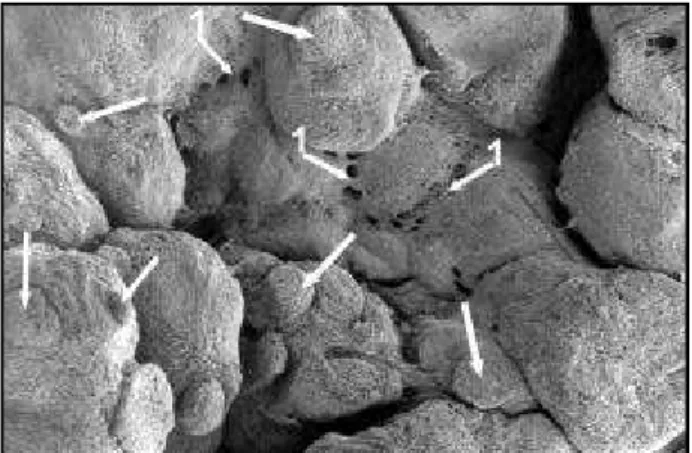
Fig 9. Photomicrograph of a scanning electron microscopy evidencing the region of the body of an arachnoid granulation evidencing thick bundles of collagen fibers (arrows) associated to thinner bundles (arrows 1). 3200x.
and arranged like a spider web. These, in some regions, are predominately circular, lining structures similar to the pores found on the capsule. Our results agree with those by Jayatilaka2,24, Triphati 9 and
Mi-randa Neto et al.11,18, which demonstrate bundles of
collagen fibers forming the framework of the gra-nulation and limiting spaces which form channels of direct communication with the periphery of the arachnoid granulation. Rascol & Izard25 also
descri-bed the collagen elements inside the granulation, but did not report having found this element on its periphery. However, the authors do not mention the orientation of the bundles of smaller and more delicate fibers that we observed using scanning elec-tron microscopy.
Among the authors which described the fibrous capsule of the granulation, only Yamashima10, Kida
et al.28 and Miranda Neto et al. 11,18, report on the
presence of bundles of collagen fibers; yet, they do not describe the tridimensional architecture of these elements. In our study we verified that the bundles of collagen fibers of the dura mater alter their orien-tation and morphology to form the capsule of the arachnoid granulation. Here, the bundles have cha-racteristic orientations, composing a dense and irre-gular meshwork and lining openings of different shapes and sizes which we called pores and which correspond to the opening sites mentioned by Zaki17
and Yamashima10. We found larger pores, especially
at the lateral regions of the granulation, composed of thicker bundles of collagen fibers, while the smaller pores, basically composed of bundles of reti-cular fibers, were mainly located at their apical re-gions. We believe that the location of the smaller pores corresponds to the fusion sites of the capsule with the body of the granulation.
CONCLUSIONS
1 - The arachnoid granulations may be isolated or clustered.
2 - Bundles of collagen fibers from the dura mater compose the capsule of the granulation and line the subcapsular space.
3 - The bundles of collagen fibers which form the capsule show varying morphology and orientation according to the region analyzed: at the apex the bundles are more delicate and circularly oriented, lining the smaller pores, while at the lateral regions thicker bundles, lining larger pores, predominate.
4 - At the body the thick bundles of collagen fibers are associated with a meshwork of delicate collagen bundles similar to a spider web which at some sites line circular structures.
REFERENCES
1. Sprong W. Disappearance of blood from cerebrospinal fluid in traumatic subarachnoid hemorrhage; ineffectiveness of repeated lumbar punctures. Surg Gynec Obst 1934;58:705.
2. Jayatilaka ADP. Arachnoid granulation in sheep. J Anat 1965;99:635-949. 3. Davson H, Hollingsworth G, Segal MB. The mechanism of drainage of
the cerebrospinal fluid. Brain 1970;93:665-678.
4. Potts DG, Deonarine V, Welton W. Perfusion studies of the cerebrospinal fluid absortive pathways in the dog. Radiology 1972;104:321-325.
5. Upton ML, Weller RO, Ath FRC. The morphology of cerebrospinal fluid drainage pathways in human arachnoid granulations. J Neurosurg 1985;63:867-875.
6. Shabo A, Maxwell DS. The morphology of the arachnoid villi. A light and electron microscopic study in the monkey. J Neurosurg 1968;29:451-463 7. Shabo A, Maxwell DS. Electron microscopic observations on the fate of
particulate matter in the cerebrospinal fluid. J Neurosurg. 1968;29:464-474. 8. Alksne JF, Lovings ET. The role of the arachnoid villus in the removal
of red blood cells from the subarachnoid space: an electron microscope study in the dog. J Neurosurg 1972;36:192-200.
9. Tripathi RC. Ultrastructure of the arachnoid mater in relation to outflow of cerebrospinal fluid. Lancet 1973;7:9-11.
10. Yamashima T. Functional ultrastructure cerebrospinal luid drainage channels in human arachnoid villi. J Neurosurg 1988;22:633-641. 11. Miranda Neto MH, Biazotto W, Chopard RP, Lucas GA. Estudo
micro-mesoscópico das granulações aracnóides humanas. Arq Neuropsiquiatr. 1990;48:151-155.
12. Chopard RP, Brancalhão RMC, Miranda Neto MH, Biazotto W. Arachnoid granulation affected by subarachnoid hemorrhage. Arq Neuropsiquiatr. 1993;51:452-456.
13. Ham AW. Histologia. 7.Ed., Rio de Janeiro, Guanabara Koogan 1977: 423. 14. Warwick R, Williams PL. Gray Anatomia, tomo II, 35.Ed., Rio de
Janei-ro. Guanabara Koogan, 1979.
15. Gardner E, Gray DJ, O’Rahilly R. Anatomia 4.Ed., Rio de Janeiro: Guanabara Koogan 1985:592.
16. Junqueira LC, Carneiro J. Histologia básica. 7.Ed., Rio de Janeiro, Guanabara Koogan 1990:144.
17. Zaki W. Developement des granulatins arachnoidennes. Bull Assoc Anat 1977;161:283-290.
18. Miranda Neto MH, Brancalhão RMC, Chopard RP, Molinari SL. Estu-do morfológico das granulações aracnóides humanas com referência a sua classificação. Arq Neuropsiquiatr. 1994;52:41-45.
19. Okamoto K, Ito J, Furusawa T, Nishihara M. Arachnoid granulation of the posterior fossa: CT and MR findings. Clin Imaging 1997;21:1-5. 20. Hasegawa M, Yamashima T, Kida S, Yamashita J. Membranous
ultrastructure of human arachnoid cells. J Neuropathol Exp Neurol 1997;56:1217-1227.
21. Grossman CB, Potts DG. Arachnoid granulations: radiology and anatomy. Radiology 1974;113:95-100.
22. Paturet G. Traité d’anatomie, T. IV Paris: Masson, 1964. apud. 23. Weed LH. An anatomical consideration of the cerebrospinal fluid. Anat
Res 1917;12:461-496.
24. Jayatilaka ADP. An electron microscopic study of sheep arachnoid granulations. J Anat 1995;99:315-327.
25. Rascol M, Izard J. Ultrastrastruture des granulations de Pacchini de la méninge humaine che adulte. J. Miscroscopie 1969;8:1017-1030. 26. Schachenmayr W, Friede RL. The origin of the subdural neomembranes:
fine structure of the dura-arachnoid interface in man. Am J Pathol 1978;92:53-68.
27. Greenberg RW, Lane EL, Cinnamon JC, Farmer P, Hyman. The cranial meninges: anatomic considerations. Seminars in utrasound, CT and MRI 1994;15:454-465.