Arq Neuropsiquiatr 2006;64(4):950-953
1Instituto Israelita de Ensino e Pesquisa Albert Einstein, São Paulo SP, Brazil;2AMBAN, Instituto de Psiquiatria da FMUSP, São Paulo
SP, Brazil; 3Neurociências, Universidade Federal de São Paulo, São Paulo SP, Brazil.
Received 10 April 2006, received in final form 13 July 2006. Accepted 28 August 2006.
D r. Mario Fernando Prieto Peres - Alameda Joaquim Eugenio de Lima 881 / 708 - 01403-001 São Paulo SP - Brasil. E-mail: [email protected]
PHOBIAS, OTHER PSYCHIATRIC
COMORBIDITIES AND CHRONIC MIGRAINE
Felipe Corchs
1,2, Juliane P.P. Mercante
1,2, Vera Z. Guendler
1,
Domingos S. Vieira
1,3, Marcelo R. Masruha
1,3, Frederico R. Moreira
1,
Marcio Bernik
2, Eliova Zukerman
1, Mario F.P. Peres
1,3ABSTRACT - B a c k g round:Comorbidity of chronic migraine (CM) with psychiatric disorders, mostly anxiety and mood disorders, is a well-recognized phenomenon. Phobias are one of the most common anxiety dis-o rders in the general pdis-opulatidis-on. Phdis-obias are mdis-ore cdis-ommdis-on in migraineurs than ndis-on-migraineurs. The clinical profile of phobias in CM has never been studied. Method:We investigated the psychiatric pro-file in 56 patients with CM using the SCID I/P interview. Results:Lifetime criteria for at least one mental d i s o rder was found in 87.5% of the sample; 75% met criteria for at least one lifetime anxiety disorder and 60.7% of our sample fulfilled DSM-IV criteria for lifetime phobic avoidant disorders. Mood and anxiety s c o res were higher in phobic patients than in non-phobic CM controls. Number of phobias correlated with higher levels of anxiety and depre s s i o n . Conclusion:Phobias are common in CM. Its recognition may influ-ence its management. Early treatment may lead to better prognosis.
KEY WORDS: headache, migraine, anxiety, phobias.
Fobias, outras comorbidades psiquiátricas e enxaqueca crônica
RESUMO -I n t rodução:As comorbidades psiquiátricas das enxaquecas crônicas são bem conhecidas. As fobias, transtorno ansioso mais comum, são mais prevalentes entre enxaquecosos do que entre não enxa-quecosos. O perfil clínico de fobias em uma população enxaquecosa nunca foi estudado. M é t o d o :
Estudamos aspectos psiquiátricos de uma população de 56 pacientes com enxaqueca crônica. R e s u l t a d o s :
Usando o SCID I/P para o DSM-IV, critérios diagnósticos para ao menos algum transtorno psiquiátrico durante a vida foram preenchidos por 87,5% de nossa amostra, 75% para ao menos um transtorno ansioso e 60,7% para condições fóbicas em algum momento de suas vidas. Os escores de ansiedade e humor foram maiore s e n t re os fóbicos e o número de fobias teve correlação positiva com o grau de ansiedade e depre s s ã o .
Conclusão:Fobias são comuns na enxaqueca crônica e seu reconhecimento poderia influenciar seu mane-jo e melhorar seu prognóstico.
PALAVRAS-CHAVE: cefaléia, enxaqueca, ansiedade, fobia.
The importance of psychiatric comorbidity in migraine has long been re c o g n i z e d1 , 2. There is a
g rowing body of evidences that they may share diverse epidemiological, pathophysiology, and tre a t-ment response aspects3. Among psychiatric
comor-bidities, those with mood and anxiety disorders are the most common. Anxiety disorders are common in episodic migraine patients but even more fre q u e n t in chronic migraineurs4. Somatic complains are
com-mon acom-mong anxious subjects, mostly tachycardia, dys-pnea, gastrointestinal discomfort, and muscular pain. Headaches can also be part of these unspecific somat-ic manifestations. On the other hand, migraine and anxiety may be more closely related than just
unspe-cific somatic complains5 , 6. Merikangas et al.5, in a
p rospective study, found anxiety disorders to be more f requently comorbid with migraine than aff e c t i v e d i s o rders. They also suggest that migraine with anx-iety and depression may constitute a distinct syn-d rome comprising anxiety, the primary phenomena, often manifested in early childhood, and followed by the occurrence of migraine headaches, and then by discrete episodes of depressive disorder in latter adulthood. In other study, phobias in adolescents and young adults were outstanding predictors of latter, incident migraines7.
Arq Neuropsiquiatr 2006;64(4) 951
annual direct costs (12,642 US$ vs 5,179 US$)8in the
United States of America. In addition, anxiety disor-ders creates additional decreases in quality of life lev-els in chronic migraine patients9. According to the
D S M - I V1 0, anxiety disorders encompass several
con-ditions including: generalized anxiety disorder (GAD), panic disorder (PD) and agoraphobia, posttraumat-ic stress disorder (PTSD), social phobia (SP), specifposttraumat-ic phobia, obsessive-compulsive disorder (OCD) and the less clearly defined mixed anxiety-depressive disor-der. Phobias are the most common anxiety disorder in the general population, the lifetime pre v a l e n c e has been found to be up to 12.5% in specific pho-bias and 13.0% in social phobia, which is one of the most common psychiatric condition1 1 - 1 3; up to 23% if
child life simple phobias are included. Phobias are m o re common in migraineurs than non-migraineurs; the clinical profile of phobias in CM has never been studied.
In this paper we re p o rt on a systematic investiga-tion on the clinical aspects of the comorbidity of pho-bias in CM patients and their relationship with oth-er psychiatric comorbidity.
METHOD
Fifty-six patients with CM according to the Intern a t i o n a l Headache Society criteria (IHS)1 4w e re selected for this study (51 women, 5 men, aged 24 to 64 y. mean±sd 41.69±1 1 . 7 1 ) . C h ronic users of acute migraine medication that did not fulfill criteria for medication overuse headache (MOE) were also included in the study. Doubtful cases were excluded. Headache disability was measured by the Migraine Disability Assessment (MIDAS)1 5, a 0 to 100 visual analogue
impact scale (0 meaning the highest impact and 100 no impact) assessing the amount of disability caused by headaches along the month (global) and during the attack. Total headache frequency was also ascertained.
Psychic profile was assessed by the SCID 1/P1 6, a stru c-t u red inc-terview for psychiac-tric disorders based on c-the DSM-IV diagnostic criteria1 0, and applied by a trained clinician. We further evaluated intensity of depressive symptoms with the Hamilton depression rating scale (HAM-D)1 7a n d the Beck depression inventory (BDI)1 8. The intensity of anx-iety symptoms was assessed by the Hamilton rating scale for anxiety (HAM-A)19and the Spielberger state-trait anx-iety inventory (STAI)20.
The re s e a rch protocol was reviewed and approved by
theHospital Israelita Albert EinsteinCommittee of Ethic in
R e s e a rch. All subjects signed written consent form s prior to assessment.
Statistical analyses were perf o rmed to investigate pos-sible diff e rences in headache characteristics and in anxiety/ d e p ression scores in patients with phobias versus those without phobias. The number of patients with a mood dis-o rder (majdis-or depressive episdis-ode and/dis-or dysthymia) was cal-culated in those with and without phobias. The anxiety and depression levels were also compared.
The Fisher’s exact and the Student’s T-test were used for the analysis. Results were considered significant when
P<.05 but trends ofP<.10 were also re p o rted. All tests w e re two tailed. Data were processed with the statistical package SPSS 10.0 for windows (SPSS, Chicago, Illinois).
RESULTS
F o rty-nine patients (87.5%) of our sample met cri-teria for at least one lifetime mental disord e r. Sixteen subjects (28.6%) fulfilled criteria for major depre s-sive disorder, one for dysthymia, 2 for bipolar disor-der and 3 for grief. Two patients met criteria for an eating disorder and 4 for alcohol and/or non-alco-holic substance use disorders. Forty-two subjects (75%) of our sample presented at least one lifetime anxiety disord e r. Twenty-five subjects (44.6%) ful-filled criteria for GAD, one for PD, one for OCD, and 3 cases for PTSD. The phobic conditions are fully described in results.
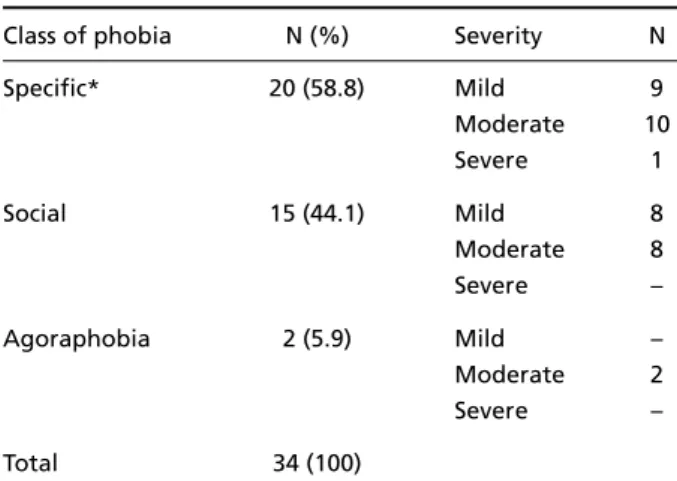
T h i rty-four patients (60.7%) of our sample ful-filled DSM-IV diagnostic criteria for a phobic anxious condition (social, specific, or agoraphobia) in their lifespan. At the moment of the evaluation, 20 (35.7%) patients had a diagnosis of specific phobia, 15 (26.8%) social phobia, and 2 agoraphobia. Four patients had a history of phobic conditions in the past but did not fulfilled criteria for these conditions at the moment of the evaluation (one specific, one social and two agoraphobia). Details upon prevalence, type and severity of phobias are presented on Table 1.
Interactions among phobias, mood disorders, and non-phobic anxiety disorders, proved to be complex Table 1. Detailed description of phobias according to specific
class and severity.
Class of phobia N (%) Severity N
Specific* 20 (58.8) Mild 9
Moderate 10
Severe 1
Social 15 (44.1) Mild 8
Moderate 8
Severe –
Agoraphobia 2 (5.9) Mild –
Moderate 2
Severe –
Total 34 (100)
with high levels of comorbidity. These interactions can be well visualized in the Ve n n ’s diagram below (Fig 1).
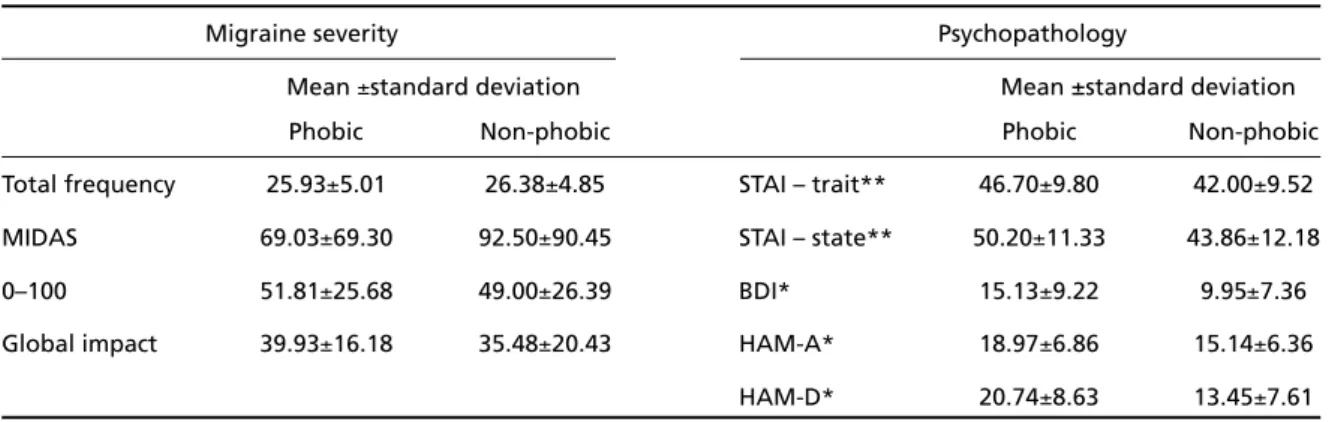
When phobic patients are compared with non-phobic patients, headache severity levels did not fer between the groups (Table 2) even though dif-f e rences were dif-found on severity odif-f psychiatric symp-toms (BDI, HAM-A and HAM-D or a trend in IDATE). Some patients fulfilled criteria for more than one kind of phobia, a variable that seem to exert influ-ence on psychopathology as illustrated on Figure 2.
DISCUSSION
Despite of the importance of phobic disorders and the avoidant behaviour characteristic of phobic-anx-ious conditions, among psychiatric comorbidities ob-s e rved in migraneurob-s, very little waob-s ob-studied about this issue. One study evaluated the personality of patients with headaches, demonstrating that patients with migraine and tension type headache score d higher on harm avoidance factor of personality than did contro l s2 1, even though this finding was not
con-f i rmed by other authors2 2. According to Cloninger’s
t h e o ry2 3, harm avoidance would be a heritable
tem-perament trait related to inhibition of behaviours, such as pessimistic worry and passive avoidance behaviours, such as fear of uncertainty and shyness.
Radat et al.24pointed a greater incidence of
psy-chiatric disorders among migraneous patients that c h ronically used substances compared with patients without that history. In this study, two of the thre e most frequent diagnosis observed were anxious con-ditions and the other one was major depressive dis-o rd e r, which was frequently accdis-ompanied by anxiety symptoms, such as fear and avoidant behavior. In a p rospective evaluation of this cohort, the authors found important longitudinal comorbidity between anxious disorders and migraine. However, in logistic
re g ression models including age, sex, and psychiatric illness in 1981, only phobia was predictive of future migraine7.
The present study provides more insight into the understanding of a yet unexplored matter on
migrai-952 Arq Neuropsiquiatr 2006;64(4)
Table 2. Comparison of migraine severity and psychopathology between phobic and non-phobic patients.
Migraine severity Psychopathology
Mean±standard deviation Mean ±standard deviation
Phobic Non-phobic Phobic Non-phobic
Total frequency 25.93±5.01 26.38±4.85 STAI – trait** 46.70±9.80 42.00±9.52
MIDAS 69.03±69.30 92.50±90.45 STAI – state** 50.20±11.33 43.86±12.18
0–100 51.81±25.68 49.00±26.39 BDI* 15.13±9.22 9.95±7.36
Global impact 39.93±16.18 35.48±20.43 HAM-A* 18.97±6.86 15.14±6.36
HAM-D* 20.74±8.63 13.45±7.61
*p<05; **.05<p<.1
Fig 1. Venn diagram showing the interaction of psychiatric comorbid disorders in chronic migraine patients.
Arq Neuropsiquiatr 2006;64(4) 953
ne field: the phobic-anxious aspects. A trend, a pho-bic-anxious trait of personality, or a psychiatric (anx-iety) disorder might play a role in the process of mi-graine chronification. A comparison, for example, of the rates of specific phobias in our sample (31.82%) with the prevalence of phobias in the general pop-ulation (12.5%)1 1 - 1 3, seems to show a trend of
high-er levels of phobias in CM then in the population as a whole.
A preliminary understanding of this relationship is provided by behavioral theories. A core feature of phobic-avoidant disorders is the anticipatory anxi-ety, a state of preparation for an imminent or likely t h reat. Subjects with a high level of trait anxiety tend to be more sensitive to potential threats or to the aversive nature of anticipatory anxiety. These sub-jects may develop avoidant behaviors to keep them away from those stimuli or aversive emotional states. This could explain, at least in part, why some patients take hold of analgesics in the least warning of pain. If so, we could be looking for a sub-group of CM pa-tients with poorer prognosis, making their headaches worse by overusing acute medication. Fear of hav-ing a headache attack or worsenhav-ing a baseline hea-dache in daily suff e rers may start a behavior of anal-gesic intake or decrease the threshold of analanal-gesic utilization25.
It must be clear, however, that definitive conclu-sions about the role of phobias in favoring chronic-ity and/or overuse could be drawn only by dire c t l y comparing frequency of headache with the use of acute migraine medication. In spite of the design of the present study do not allow this direct conclusion, we can observe that the more phobias patients pre s-ent, the higher the levels of anxiety and depression in CM patients. It has been recognized that they de-s e rve de-special pde-sychiatric attention, but a focude-s on phobic aspects may influence its management and eventually treatment response. Although there is a lack of evidence to support any re c o m m e n d a t i o n s when phobias and migraines are related, it is clear that treating the phobic condition is a key point as to avoid the overuse of analgesics. Psychological inter-ventions may be outstanding on the maintenance of the abstinence of analgesics. Treatment of phobias in CM may lead to lower level of anxiety and depre s-sion and a better quality of life.
REFERENCES
1. Cobb S, Miles HH. Psychiatric conference: migraine and character neu-rosis. Am Pract Diag Treat 1952;3:985-990.
2. M e rcante JPP, Peres MFP, Guendler V, Zukerman E, Bernik, M. De-p ression in chronic migraine: severity and clinical features. A rq Neuropsiquiatr 2005;63:217-220.
3. Radat F, Swendsen J. Psychiatric comorbidity in migraine: a re v i e w. Cephalalgia 2005;25:165-178.
4. Scher AI, Bigal ME, Lipton RB. Comorbidity of migraine. Curr Opin Neurol 2005;18:305-310.
5. Merikangas KR, Angst J, Isler H. Migraine and psychopathology: re s u l t s of the Zurich cohort study of young adults. A rch Gen Psychiatry 1990; 47:849-853.
6. B reslau N, Davis GC, A n d reski P. Migraine, psychiatric disorders, and suicide attempts: an epidemiologic study of young adults. Psychiatry Res 1991;37:11-23.
7. Swartz KL, Pratt LA, Armenian HK, Lee LC, Eaton WW. Mental dis-o rders and the incidence dis-of migraine headaches in a cdis-ommunity sam-ple: results from the Baltimore Epidemiologic Catchment area follow-up study. Arch Gen Psychiatry 2000;57:945-950.
8. Pesa J, Lage MJ. The medical costs of migraine and comorbid anxiety and depression. Headache 2004;44:562-570.
9. M e rcante JPP, Peres MFP, Guendler VZ, Corchs F, Bernik MA, Zu-kerman E. Impact of psychiatric comorbidity in the quality of live of chronic migraine patients. Migrâneas e Cefaléias 2005;8:76. 10. American Psychiatric Association. Diagnostic and statistical manual
of mental disorders, 4t hed. Washington: American Psychiatric A s s
o-ciation 1994.
11. Kessler RC, McGonagle KA, Zhao S, et al. Lifetime and 12-month pre v a-lence of DSM-III-R psychiatric disorders in the United States: re s u l t s from the National Comorbidity Survey. Arch Gen Psychiatry 1994;51: 8-19.
12. Magee WJ, Eaton WW, Wittchen HU, McGonagle KA, Kessler RC. Agoraphobia, simple phobia, and social phobia in the National Comorbidity Survey. Arch Gen Psychiatry 1996;53:159-168. 13. Regier DA, Boyd JH, Burke JD Jr, et al. One-month prevalence of
men-tal disorders in the United States: based on five Epidemiologic Catchment area sites. Arch Gen Psychiatry 1988;45:977-986.
14. International Classification of Headache Disorders, 2n de d i t i o n .
Cephalalgia 2004;24(Suppl 1):S9-S160.
15. Stewart WF, Lipton RB, Dowson AJ, Sawyer J. Development and test-ing of the Migraine Disability Assessment (MIDAS) questionnaire to assess headache related disability. Neurology 2001;56:20-28. 16. First MB, Spitzer RL, Gibbon M, Williams JBW, Janet B. Stru c t u red
clin-ical interview for DSM-IV Axis I disorders (SCID: clinclin-ical version users guide. Washington: APA, 1996.
17. Hamilton M. Rating scale for depression. J Neurol Neuro s u rg Psychiatry 1960;23:56-62.
18. Beck AT, Wa rd CH, Mendelson M, Mock J, Erbaugh G. An inventory for measuring depression. Arch Gen Psychiatry 1961;4:561-571. 19. Hamilton M. The assessment of anxiety states by rating. Br J Med
Psychol 1959;32:50-55.
20. Spielberger CD, Gorsuch RI, Lushene RE (eds.). Manual for the state-trait anxiety inventory. Palo Alto: Consulting Psychologists Press, 1970. 21. Di Piero V, Bruti G, Venturi P, et al. A m i n e rgic tone correlates of migrai-ne and tension-type headache: a study using the tridimensional per-sonality questionnaire. Headache 2001;41:63-71.
22. Nylander PO, Schlette P, Brandstrom S, et al, Adolfsson R. Migraine: temperament and character. J Psychiatr Res 1996;30:359-368. 23. Cloninger CR, Svrakic DM, Przybeck T. A psychobiological model of
temperament and character. Arch Gen Psychiatry 1993;50:975-990. 24. Radat F, Sakh D, Lutz G, el Amrani M, Ferreri M, Bousser MG.
Psy-chiatric comorbidity is related to headache induced by chronic sub-stance use in migraineurs. Headache 1999;39:477-480.