Microleakage Study of Three Adhesive Systems
Vanessa Gallego ARIAS1 Inger Teixeira CAMPOS2 Luiz André Freire PIMENTA1
1Department of Restorative Dentistry, Dental School of Piracicaba, UNICAMP, Piracicaba, SP, Brazil 2Department of Restorative Dentistry, Dental School - Estácio de Sá University, Rio de Janeiro, RJ, Brazil
The purpose of this in vitro study was to evaluate the efficacy of three hydrophilic dentin adhesive systems to reduce class II restoration microleakage. A total of 60 human molar teeth were used in which two box cavities were made on the distal and mesial surfaces, with a cervical margin in dentin. These cavities were randomly divided into 3 groups (n = 40 each), according to adhesive system tested: G1:OptiBond SOLO; G2:Amalgambond Plus; G3: Etch & Prime 3.0. The cavities were restored with the composite resin Z-100. The groups were thermocycled 2000 times (5 ± 1°C and 55 ± 1°C) with a dwell time of 1 min. The teeth were then immersed in 2% methylene blue, pH 7.0, for 4 h, sectioned and observed with a stereomicroscope MEIJI 2000 (35X). The evaluation was made using scores (0-4) and the results were expressed through the sum of the ranks. G1 = 1994.00; G2 = 2294.00; G3 = 2972.00. The three groups were significantly different. The self-etching adhesive system Etch & Prime 3.0 was less effective in preventing microleakage. The OptiBond SOLO adhesive was the most effective in reducing microleakage in dentin margins when compared with Amalgambond Plus and Etch & Prime 3.0.
Key Words: microleakage, adhesive systems, class II restorations.
Correspondence: Prof. Dr. Luiz André F. Pimenta, Faculdade de Odontologia de Piracicaba, UNICAMP, Av. Limeira 901, 13414-018 Piracicaba, SP, Brasil. e-mail: [email protected]
INTRODUCTION
The efficacy of adhesive systems on the enamel surface has been proven. However, the same is not observed on dentin and cementum surfaces (1). The bonding agents etch the dentin with acids and use hydrophilic primers to promote micromechanical bond-ing. Currently, adhesive systems etch the dentin with phosphoric acid or similar acids to decalcify the dentin surface. The total-etching techniques, proposed by Fusayama et al. in 1979 (2), remove the smear layer, open the dentinal tubules, and increase dentinal perme-ability. Decalcification can be acheived by various factors, including pH, concentration, viscosity, and application time of the etchant (2).
Removal of hydroxyapatite crystals leaves a col-lagen network that can collapse and shrink because of loss of inorganic support and excess dry time. After the etchant is rinsed off, a primer containing one or more hydrophilic resin monomers is applied. The hydro-philic group has affinity for the dentinal surface and the
hydrophobic group has affinity for resin, thereby form-ing the hybrid layer. This hybrid layer formation be-tween dentin and resin was first described by Nakabayashi et al. in 1982 (3), and it is thought to be the primary bonding mechanism of most current adhesive systems.
In an attempt to simplify clinical procedures, 2-step bonding systems were developed consisting of an etchant gel and a combined primer and bonding agent consisting of hydrophobic and hydrophilic monomers in one bottle. These monomers are dissolved in high-vapor pressure organic solvents such as acetone or ethanol and result in high bond strengths especially when dentin is moist or has been rewetted (4).
Self-etching products, consisting of a mixture of acid monomers that etch cut enamel and dentin as well as primers that allow the penetration of resins into the demineralized dentin, also achieve good shear bond strengths (5).
demon-strated that the progress in formulation of dentin adhe-sives has improved the clinical performance of cervical resin-based composite restorations (6). However, no dentin bonding agent currently available completely eliminates the microleakage at the cementum/dentin interface. The causes of microleakage are usually asso-ciated with polymerization, shrinkage, the composite resin used, occlusal load, location of the prepared margins and the technique used.
The clinical symptoms associated with the oc-currence of microleakage are breakdown and discol-oration of margins, secondary caries, increase in post-operative sensitivity, and pulp pathology (6). Many different techniques have been used to demonstrate microleakage. These techniques include the use of bacteria, compressed air, chemical and radioactive trac-ers, electrochemical investigations, scanning electron microscopy, and perhaps most common of all, dye penetration (7).
Investigation of leakage has been carried out
both in vivo and in vitro, but the latter is more common.
In vitro experiments fall broadly into two categories – one that uses a clinical simulation and the other that is purely a test of the behavior of materials (8).
The purpose of this in vitro study was to evaluate
the effects of three hydrophilic adhesive systems on microleakage on dentin in class II restorations with the total-etching technique.
MATERIAL AND METHODS
Sixty human molars were selected, cleaned, and stored in a 2% formol solution, pH 7.0, for 7 days. In each tooth, two vertical box cavities on the distal and mesial surfaces were made. The dimensions of the cavities were: 1 mm beyond the cementum-enamel junction; 3 mm in width; 1.5 mm in depth.
The cavities were made with #245 carbide burs (JET Brand, Wheeling, IL, USA), at high speed with water cooling, and were replaced after every 10 prepa-rations. The 120 cavity preparations were randomly assigned into 3 groups (n=40), according to the adhe-sive system used (Table 1).
The bonding agent systems were applied follow-ing manufacturer instructions. The cavities were re-stored with Z100 (3M/ESPE, St. Paul, MN, USA) composite resin in three increments. Each increment of composite resin was light-cured for 40 s. After 24 h, the restorations were finished with Sof-lex disc systems (3M/ESPE) in decreasing granulation. The specimens were thermocycled 2000 times between water baths at 5 ± 1°C and 55 ± 1°C for 1 min dwell time in a MCT2-AMM Instrumental machine (ERIOS, São Paulo, SP, Brazil).
After thermocycling, the root apex was sealed with epoxy resin and the teeth were covered with two coats of nail varnish. All areas of the teeth were covered with the varnish except for the restorations and a 1-mm rim of the tooth structure around each restoration. The teeth were im-mersed in 2% methylene blue for 4 h, rinsed with distilled water, dried for 10 min, and sectioned with a diamond disc (KG Sorensen, São Paulo, SP, Brazil). The samples were ana-lyzed with a stereomicroscope MEJI 2000 (Beijing, China) (35X).
The following criteria were used to score penetration: 0 = no microleakage, 1 = dye penetration within 1/3 of cavity wall, 2 = dye penetration within 2/3 of cavity wall, 3 = dye pen-etration within the last 1/3 of
Table 1. Adhesive systems evaluated.
Material Manufacturer Characteristics Composition of adhesives
Amalgambond Plus Parkell Multi-step adhesive 10% citric acid,
Farmingdale, NY system (a,b,c) 3% chloride acid, HEMA, META, MMA, TBB OptiBond SOLO Kerr One-bottle adhesive 37.5% H3PO4, Bis-GMA,
Orange, CA system (a,d) GPDM, HEMA, PAMM,
barium glass, silica, sodium hexafluorosilicate, ethanol Etch & Prime 3.0 Degussa Self-etching adhesive Pyrophosphate,
2-hydroxy-Dusseldorf, system (e) ethlymethacrylate,
Germany ethanol, distilled water,
cavity wall up to the axial wall, 4 = dye penetration spreading along the axial wall.
Statistical analyses were done using the Kruskall-Wallis test and Mann-Whitney non-parametric analysis, and the results were expressed through the sum of the ranks.
RESULTS
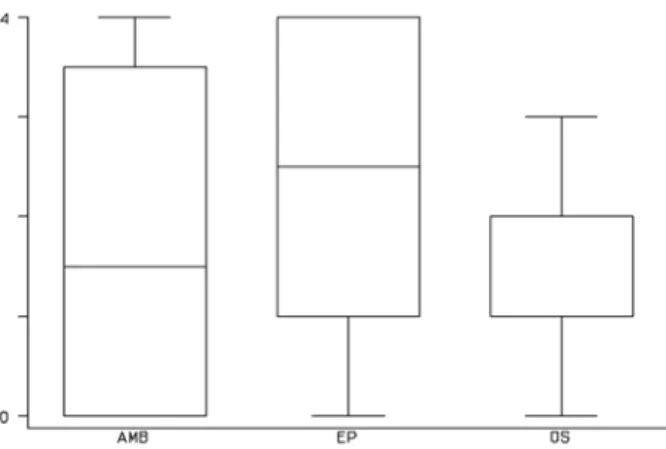
Marginal microleakage was observed in varying levels in all groups (Figure 1). The results of this study were expressed through the sum of the ranks and significant statistical differences were observed be-tween all groups: G1 = 1994.00; G2 = 2294.00; G3 =
2972.00 (p≤0.05). The Kruskal-Wallis and
Mann-Whitney tests (p≤0.05) showed that the Optibond SOLO
(OB) adhesive controlled microleakage more efficiently than Amalgambond Plus (AMP). The Etch & Prime 3.0 (EP) adhesive was the least effective system in control-ling microleakage.
DISCUSSION
The hybrid layer and resin tags are essential for a strong bond between the composite resin and the dentin surface (3). Complete dissolution of the smear layer, dentin peritubular and intertubular decalcifica-tion, resin infiltration in this decalcified dentin and the polymerization of polymer molecules are responsible for creating this bonding mechanism.
Self-etching primers do not completely remove the smear layer from dentin, rather, they impregnate the smear plug, fixing it at the entrance of the tubules. Dentin is demineralized up to 7.5 µm depending on the type of acid, the etching time, and the concentration of the etchant.
The adhesive systems of this study present dif-ferent etchants. OptiBond SOLO uses a separate phos-phoric acid-based conditioner in a concentration of 37.5% to etch enamel and dentin simultaneously (total-etch). Amalgambond Plus uses a solution of 10% citric acid and 3% ferric chloride to remove the smear layer and demineralize the dentin. The self-etching Etch & Prime 3.0 simultaneously conditions and primes the enamel and dentin substrate without rinsing the self-etching primer. This adhesive contains a weaker acid, pyrophosphate acid, in the primer composition. The self-etching primers produced less etching because of
their relatively high pH (1.5-3.0), when compared with the pH of 32-37% phosphoric acid (-0.43 to 0.02) (9). Ogata et al. (10) reported that bond strengths of self-etching primer bonding systems to dentin could be affected by differences in the quantity of residual smear layer left on the surface due to the weak acidity of self-etching primers (10).
The results of the present study demonstrated that this bonding agent is less effective in controlling microleakage when compared with Amalgambond Plus and OptiBond SOLO. It could be that the mixing of the pyrophosphate acid with water did not result in an adequate quantity of phosphoric acid to decalcify the dentin to a sufficient depth which would cause a regular and efficient hybrid layer to control microleakage. The 35-40% phosphoric acid concentration was more ef-fective than other dentin conditioners, however, Chan and Swift reported that 10% maleic acid, 10% phospho-ric acid and 1.6% oxalic acid reduced microleakage at restoration margins in dentin and enamel (11).
When dentin is etched, the smear layer and the mineral phase of dentin are dissolved and the collagen is exposed. The desiccation of the dentin can cause a collapse of the unsupported collagen network, inhibit-ing adequate wettinhibit-ing and the penetration of the resin to create the hybrid layer. The clinician must be aware that pooled moisture should not be allowed to remain on the tooth because excess water can dilute the primer and reduce its effectiveness. This phenomenon is known as overwet. Some hypotheses have been made concerning the Etch & Prime 3.0 adhesive. This system presents a 55% water volume (manufacturer’s information). It has been suggested that the presence of water might
ence the polymerization (12).
The results of this study are in agreement with those of Cardoso et al. (13) and Bedran de Castro et al (14), which demonstrated that the use of Etch & Prime 3.0 resulted in high leakage values.
Primer has been used to improve the bonding between the composite resin and the cavity walls. Cur-rent adhesive systems contain hydrophilic primers that utilize acetone, alcohol and/or water as solvent. These solvents carry the resin primers into the demineralized dentin by displacing water from the collagen network. Resin penetration into the collagen network and its occupation of the demineralized dentin is responsible for forming the interdiffusion zone or hybrid layer. HEMA is a hydrophilic monomer that penetrates into the collagen network. HEMA molecules are usually dissolved in different solutions with acetone, alcohol and/or water which work as chasers. These chasers compete with water present at the dentin surface by promoting a union of the water molecules and displac-ing water when compressed air is applied, permittdisplac-ing the penetration by the monomer (12). The removal of water from the collagen fibrils may stabilize the struc-ture by increasing the amount of interaction of weak forces between adjacent collagen molecules. Water removal may also permit additional hydrogen bonds to form between collagen molecules that were previously bonded to water molecules (15).
The adhesive system Amalgambond Plus uses acetone as the priming solvent. The adhesive systems with acetone-based primers required more diligence to achieve a primed dentin surface because of their mate-rial sensitivity. The Etch & Prime 3.0 and OptiBond SOLO systems are ethanol-based primers. Jacobsen et al. (16) showed that adhesive systems with alcohol are less sensitive to the technique utilized. Requirements for an effective dentin adhesive system include the ability of the system to thoroughly infiltrate the col-lagen network and partially demineralized zone, to co-mingle and encapsulate the collagen and hydroxyapa-tite crystallites at the surface of the demineralized dentin, and to produce a well-polymerized durable hybrid layer. It was been suggested that poor infiltration of adhesive resin into the rich collagen area of the demineralized dentin leaves gaps in the hybrid layer where water and microleakage can infiltrate, producing hydrolysis of the exposed collagen peptides not pro-tected by hydroxyapatite or resin (17).
Marginal leakage of the composite resin restora-tions might be influenced by external stress produced during thermocycling, which causes thermal variation that permits the formation of gaps, and internal stress produced by polymerization shrinkage and differences in the thermal expansion characteristics of the materials and the teeth. These stresses may hinder the properties of the materials by creating openings and deforming the tooth substrate.
However, the internal reorganization of the poly-mer molecules formed during polypoly-merization contrib-utes to a significant reduction in the generated stress that is dependent upon the configuration factor as well as the properties of the material. It has been suggested that the stress reduction produced by a resin-dentin bonding agent is attributable to the low elastic modulus of both the adhesive resin layer itself and the resin-dentin interdiffusion zone (18). The adhesive system should present median flexural strength between the dentin and the composite resin to increase the resis-tance of the adhesive thereby reducing the effects of polymerization shrinkage.
Another factor to be considered is the variation of layer thickness. The differences of thickness could be due to a number of factors, such as differences in viscosity of the adhesive systems, filled vs unfilled primer/adhesives, and variations in the number of coats and application techniques as indicated by the manu-facturers (19). Vargas et al. (19) observed that OptiBond SOLO, a filled adhesive system, had a significantly thicker primer/adhesive layer with a thickness of up to 50 µm.
The gradient of elastic modulus is more pro-nounced in systems that form a thicker layer or include a filled low-viscosity resin. Thus, dentin adhesives that contain a filled resin may have sufficient elasticity to relieve the stress that develops from the contraction of the composite resin used as the final restorative mate-rial (15).
relieved by an application of an increasing thickness of low-stiffness adhesive. Increasing the adhesive thick-ness can lead to improvement in marginal integrity and, as a consequence, may prolong the life of a restoration (20).
The present study showed that the one-bottle adhesive system Optibond SOLO was more effective in reducing microleakage in dentin margins when com-pared with the self-etching primer Etch & Prime 3.0 and the multi-step adhesive system Amalgambond Plus. However, although there has been progress in the development of adhesive systems, current bonding agents have not entirely eliminated microleakage even when the direct polymerization technique is used.
RESUMO
O objetivo deste estudo foi avaliar a eficácia de 3 sistemas adesivos hidrófilos na redução da microinfiltração de restaurações classe II. Foram selecionados 60 dentes molares humanos. Foi realizado em cada dente dois preparos classe II do tipo “slot vertical” nas superfícies mesial e distal, com margem cervical em dentina. As 120 cavidades foram sorteadas aleatoriamente em 3 grupos (n = 40), de acordo com o sistema adesivo testado G1: OptiBondo SOLO(Kerr); G2:Amalgambond Plus (Parkell); G3:Etch & Prime 3.0 (Degussa). As cavidades foram restauradas com resina composta Z 100 (3M/ESPE). As amostras foram termocicladas 2000 vezes (5 ± 1oC e 55 ± 1oC), durante 1 min em
cada banho. Após a termociclagem, os dentes foram imersos em uma solução de azul de metileno a 2%, pH 7,0, durante 4 h, seccionados e observados em microscópio ótico MEIJI 2000 (35X). A avaliação foi realizada utilizando-se escores (0-4) e os resultados expressos através da soma das ordens. G1:1994.00; G2:2294.00; G3:2972.00. Os 3 grupos foram significativamente diferentes. Os resultados indicaram que o sistema adesivo auto-condiconante Etch & Prime 3.0 foi menos efetivo no controle da microinfiltração marginal. Já o sistema adesivo OptiBond SOLO foi o mais efetivo no controle da microinfiltração quando comparado com o Amalgambond Plus e o Etch & Prime 3.0.
ACKNOWLEDGEMENTS
We wish to thank FAPESP for the financial support of this research (process # 98/015360).
REFERENCES
1. Yazici AR, Baseren M, Dayangac B. The effect of current-gen-eration bonding systems on microleakage of resin composite restorations. Quintessence Int 2002;33:763-769.
2 . Fusayma T, Nakamura M, Kurosaki N, Iwaku M. Non-pres-sure adhesion of a new adhesive restorative resin. J Dent Res 1979;58:1364-1370.
3 . Nakabayashi N, Kojima K, Masuhara E. The promotion of adhesion by the infiltration of monomers into tooth sub-strates. J Biomed Mater Res 1982;16:265-273.
4 . Perdigão J, Swift Jr EJ, Heymann HO, Malek MA. Effect of a re-wetting agent on the performance of acetone-based dentin adhesives. Am J Dent 1998;11:207-213.
5. Nikaido T, Nakajima M, Higashi T, Kanemura N, Pereira PN, Tagami J. Shear bond strengths of a single-step bonding system to enamel and dentin. Dent Mater J 1997;16:40-47. 6 . Kubo S, Yokota H, Sata Y, Hayashi Y. Microleakage of
self-etching primers after thermal and flexural load cycling. Am J Dent 2001;14:163-169.
7 . Al-Ehaideb AA, Mohammed H. Microleakage of “One Bottle” dentin adhesives. Oper Dent 2001;26:172-175.
8 . Taylor MJ, Lynch E. Microleakage. (Review). J Dent 1992; 20:3-10.
9 . Perdigao J, Lambrechts P, van Meerbeek B, Tome AR, Vanherle G, Lopes AB. Morphological field emission-SEM study of the effect of six phosphoric acid etching agents on human dentin. Dent Mater 1996; 12:262-271.
10. Ogata M, Harada N, Yamaguchi S, Nakajima M, Tagami J. Effect of self-etching primer vs phosphoric acid etchant on bond-ing to bur-prepared dentin. Oper Dent 2002;27:447-454. 11. Chan KC, Swift Jr EJ. Marginal seal of new-generation dental
bonding agents. J Prosthet Dent 1994;72:420-423. 12. Paul SJ, Leach M, Rueggeberg FA, Pashley DH. Effect of
water content on the physical properties of model dentine primer and bonding resins. J Dent 1999;27:209-214. 13. Cardoso PE, Placido E, Moura SK. Microleakage of four
simpli-fied adhesive systems under thermal and mechanical stresses. Am J Dent 2002;15:164-168.
14. Bedran de Castro AK, Pimenta LA, Amaral CM, Ambrosano GM. Evaluation of microleakage in cervical margins of various posterior restorative systems. J Esthet Rest Dent 2002;14: 107-114.
15. Perdigao J, Baratieri LN, Lopes M. Laboratory evaluation and clinical application of a new one-bottle adhesive. J Esthet Dent 1999;11:23-35.
16. Jacobsen T, Karl-Johan M, Söderholm K-J. Effect of primer solvent, primer agitation, and dentin dryness on shear bond strength to dentin. Am J Dent 1998;11:225-228.
17. Sano H, Shono T, Takatsu T, Hosoa H. Microporous dentin zone beneath resin-impregnated layer. Oper Dent 1994;19:59-64.
18. Van Meerbeek B, Inokoshi S, Braem M, Lambrechts P, Vanherle G. Morphological aspects of the resin-dentin interdiffusion zone with different dentin adhesive systems. J Dent Res 1992;71: 1530-1540.
19. Vargas MA, Cobb DS, Denehy GE. Interfacial micromorphology and shear bond strength of single-bottle primer/adhesives. Dent Mater 1997;13:316-324.
20. Choi KK, Condon JR, Ferracane JL. The effects of adhesive thickness on polymerization contraction stress of composite. J Dent Res 2000;79:812-817.