Página |91
https://periodicos.utfpr.edu.br/rebrapa
Effect of chitosan coatings on the quality of
persimmon under commercial storage
conditions
ABSTRACT
Alessandro de Oliveira Rios
Universidade Federal do Rio Grande do Sul, Instituto de Ciência e Tecnologia de Alimentos, Departamento de Ciências dos Alimentos, Porto Alegre, Rio Grande do Sul, Brasil
Nathalia Valderrama Bohórquez
Universidade Federal do Rio Grande do Sul, Porto Alegre, Rio Grande do Sul, Brasil, Brasil
The chitosan coating effectiveness for enhancing the shelf life and retaining the carotenoids content of persimmons under commercial storage was investigated. Persimmons (Diospyros kaki L.) var. “Kyoto” were disinfected, immersed, drained, dried at room temperature, packaged and stored in a controlled temperature chamber. Physical and chemical properties were measured. The coating application reduced significantly the hue angle values compared with the control which suggests a slight ripening by the coating effect. Finally, the analysis of the carotenoid concentration for the five specific carotenoids determined that the β-cryptoxanthin was the most abundant pigment and it was not significantly differences during the storage and coating application. The storage time did not influence the carotenoid content for uncoated samples excluding the α-carotene analysis. The chitosan coating influenced on the lutein and zeaxanthin concentration during the last storage and on the α-carotene and β-carotene concentration for some cases.
Página | 92
INTRODUCTION
The persimmon is a climacteric fruit from Asia that is cultivated in some subtropical countries. In 2012, the main important producers were China (3.3 M tons), Republic of Korea (401,049 tons), Japan (253,800 tons) and Brazil (158,241 tons). The main countries of the Brazilian exportations are Netherlands, Canada, France and Portugal (FAO, 2012).
This fruit has an excellent sensorial acceptation, a high nutritional quality, a good taste and appearance. The principal damages during storage are caused by the excessive maturity, the firmness loss, the decaying and the peel browning. However, some techniques are developed to increase the storage life, prevent the losses and improve the marketing expansion (ROCHA; APARECIDA, 2006). The more important techniques are the storage under controlled conditions, the innovative packaging, the modified atmospheres, the edible films and coating, and others (SILVA et al., 2011).
The chitosan (CH) (poly-(1,4)-2-amino-2-deoxy-P-D-glucose) has been used as a coating in fruits. It is obtained from the process of deacetylation of chitin (poly-(1,4)-2-acetamide-2- P-D- deoxy-glucose) by enzymatic or chemical methods. CH produces biodegradable, non-toxic and resistant coatings (THARANATHAN; KITTUR, 2003).
When chitosan coatings are applied on fruits, it has a good capacity to reduce the weight loss and the respiration rate (VALENCIA-CHAMORRO et al., 2011). Additionally, it can maintain the firmness, register higher values of titratable acidity and lower values of pH as well as lower total soluble solid on coated fresh fruits compared to the control fruits (ADAY; CANER, 2010; DUAN et
al., 2011). The application of coatings on food prevents discoloration during
storage, maintains the freshness and avoids the peel browning comparing with the control fruits (ANSORENA; MARCOVICH; ROURA, 2011; HOJO; DURIGAN; HOJO, 2011).
The persimmons are rich in polyphenols, vitamin C and carotenoid components such as β-cryptoxanthin, zeaxanthin, β,β-carotene and β,ε-carotene (ZHOU et al., 2011) wich are considered as powerful antioxidants. The persimmons consumption can carry health benefits such as the reduction of degenerative human diseases, the protection against free radicals and the prevention of oxidative damage, risk of cardiovascular disease, diabetes and cancer (GIORDANI et al., 2011). However, the antioxidant capacity and the carotenoid content of fruits are conditioned by the environmental factors and storage conditions which affect their nutritional value (BLESSINGTON et al., 2010). Consequently, the importance of these studies is focused on the conservation of carotenoid on the food storage for promoting health and preventing human diseases (JAVANMARDI; KUBOTA, 2006).
The objective of this study was to investigate the effectiveness of chitosan coatings for enhancing the shelf life and retaining the carotenoids content of persimmons under commercial storage conditions.
Página | 93
MATERIALS AND METHODS FRUITS
Persimmons (Diospyros kaki L.) var. “Kyoto” were harvested on mid-May, 2015, from Farroupilha, RS, Bazil located on 29°13'57"S 51°23'32"W. The fruits for the study were selected by size, absence of physical damage and at full orange color (grade 5 on the Japanese color chart) and transported to the Laboratório de Compostos Bioativos do Instituto de Ciência e Tecnologia de Alimentos da Universidade Federal do Rio Grande do Sul.
PREPARATION OF COATING SOLUTION
Chitosan with high degree of deacetylation (95%) and viscosity 74.03 cP was purchased from Polymar Indústria e Comércio LTDA, Fortaleza-CE, Brazil. The dissolution was prepared with CH in aqueous solutions (3%, w/v) of lactic acid to a final concentration of 1.0% v/v. It was mixed with glycerol (20% w/w) based in the chitosan weight using an Ultra-Turrax®.
COATING OF PERSIMMONS
Firstly the selected persimmons were sanitized with sodium hypochlorite solution (150 ppm) and following this, the fruits were divided into ten equal groups of three persimmons each one. Five groups were uncoated and were used as the control group and the remaining five groups were immersed completely in the edible coating solution of chitosan for 3 min. The excess coating solution on the fruits were drained and then dried at room temperature. The persimmons were placed into 20 x 30 cm polyethylene trays.
STORAGE AND PHYSICOCHEMICAL ANALYSIS CONDITIONS
They were packaged and were placed on the controlled storage conditions chamber at 5°C, 65% relative humidity (RH) during 14 days. From day 14th until day 18th all the groups of fruits were stored at 20°C with the objective of simulate the storage and marketing temperatures. The physicochemical analysis was done taking measurements straight away before storing, and on the days 7th, 14th, 16th and 18th after being stored. Each physicochemical analyses was taken for the coated and uncoated persimmons at the different evaluated time storage.
WEIGHT LOSS
Three persimmons were weighed during the study using a balance. The weight loss was calculated based on the reduction of the weight expressed as percentage loss of the initial weight.
Página | 94
TITRATABLE ACIDITY
Ten grams of the persimmons pulp and peel from three fruits were homogenized in 75 mL of distilled water using an Ultra-turrax®. Active coal was
used to remove the color of samples. The samples were filtered and 50mL of this dissolution was titrated with 0.1 N sodium hydroxide. The results were expressed as a percentage of malic acid (PERSON, 1986).
SOLUBLE SOLID CONTENT (SSC)
Soluble solid content was measured from the dissolutions using a refractometer. The results were expressed in °Brix.
pH MEASUREMENTS
The pH of these dissolutions was determined for triplicate using a pH-meter (Q400MT, Quimis Aparelhos Científicos LTDA, São Paulo, Brazil).
FIRMNESS
Three persimmons were used for firmness analysis. Values were taken at five points on the circumference of each fruit. Firmness was measured with a Wheel Manual Test Stand (Model SLJ-B, CentMas Sdn Bhd, Kedah, Malaysia). The results were expressed in Newtons (N).
COLOR
Color was measured on the center of the flat surface and on the pulp of three fruits using a Minolta chroma meter (Model CR-400, Konica Minolta, Inc., Tokyo, Japan). The parameters L* (lightness), a* (greenness [−] to redness [+]) and b* (blueness [−] to yellowness [+]), hue angle (H) and chroma (C) values were recorded.
EXTRACTION AND ANALYSIS OF CAROTENOIDS AND VITAMIN A CONTENT
The carotenoid extract was prepared according to Mercadante, Rodriguez-Amaya (1998). This extract was transferred to petroleum ether, saponified with 10 % methanolic KOH, and storage at room temperature overnight. The alkali was removed with distilled water and the solvents were evaporated in a rotary evaporator. The extract was dried in a nitrogen flow and stored in the freezer until the quantification of carotenoids by high performance liquid chromatography (HPLC). Analyses were performed using a high performance liquid chromatography (HPLC) system equipped with a degasser, a quaternary pump solvent and detector UV / visible. The column used was a 250 mm x 4.6 mm i.d., 3 µm, C 30 reversed phase polymeric column (YMC, Japan). The mobile phase was water, 99.99% methanol (J.T.Baker, Mexico) and 99.96% tert-methyl butyl ether (MTBE) (J.T.Baker – Mallinckrodt, EUA) starting at 5:90:5 (v/v/v), reaching 0:95:5 (v/v/v) in 12 min, 0:89:11 (v/v/v) in 25 min, 0:75:25 (v/v/v) in 40 min and finally 0:50:50 (v/v/v) after a total of 60 min, with a flow rate of 1
Página | 95
mL/min at 33 °C (MERCADANTE; RODRIGUEZ-AMAYA, 1998). The carotenoids were quantified using the standard curves obtained for lutein (1–65 mg.mL-1),
zeaxanthin (1–40 mg.mL-1), cryptoxanthin 4-100 mg.mL-1 and β-carotene (5-50
mg.mL-1). The results were expressed in micrograms per 100 g of sample. Vitamin
A activity was calculated by the bioconversion factor following Guilland, Lequeu (1995). Yielding a value of 13 mg of b-carotene with 1 mg of retinol.
STATISTICAL ANALYSIS
Analysis of multiple-range tests were used to perform statistical analysis on all results, using Statgraphics® Centurion XV (StatPoint Technologies Inc, Warrenton, Virginia, USA). Differences between means were considered to be significant when p ≤ 0.05.
RESULTADOS E DISCUSSÃO
WEIGHT LOSS
The loss weight during storage is produced due to transpiration and respiration processes that occur by the vapor pressure difference between fruit and air. This phenomenon causes significant economic losses during commercialization (VASILATOS; SAVVAIDIS, 2013).
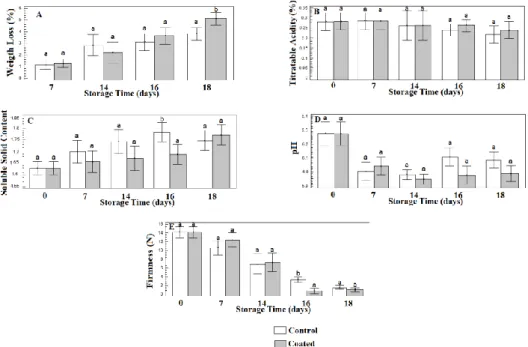
The coatings used as a packaging can reduce the food weight loss (FALGUERA et al., 2011). However, the results show that the chitosan coating did not reduce the weight loss. On the contrary the weight loss was higher for the coated persimmons on the 18th day (Figure 1A). The chitosan film is a semipermeable material to water vapor and this characteristic limits the food applications. Additionally, the acidity of the chitosan coating solution could produce damage on the fruit surface (ASSIS; ALVES, 2002, p. 5). Hojo, Durigan and Hojo (2011) and Santos et al. (2008) found that the increasing weight loss during storage of lychees and peaches was produced by the chemical reagents found in the commercial chitosan formulation as well as on the coating additives. However, most of researchers conclude that chitosan coating applications reduce the weight loss of food (JIANG; FENG; LI, 2012; PARK et al., 2005).
Página | 96
Figure 1. Evaluation of physicohemical properties of storage persimmons: A.
Weight loss (%), B. Titratable acidity (% acid citric), C. Soluble solid content (oBrix),
D. pH, E. Firmness (N). Lower-case letters highlight significance by Tukey’s test (p<0.05).
TITRATABLE ACIDITY
The coating did not present a significantly influence on the total acidity (Figure 1B). However, others studies reported the total acidity reduction on the coated fruits during storage due to the fruit ripening what caused a organic acid consumption on the respiration (DANIELI et al., 2002), for example using coatings on blueberries, strawberries, apples and lychees (DUAN et al., 2011; HAN et al., 2005; HOJO; DURIGAN; HOJO, 2011; SANTOS et al., 2008 ).
SOLUBLE SOLID CONTENT (SSC)
The chitosan coating did not present a significant effect on SSC values on the majority of the cases (Figure 1C). However, significant differences were registered only on the 16th day, when the control persimmons recorded higher SSC values than the coated one which suggests a slight inhibition to ripening (ADAY; CANER, 2010). According to Murray, Valentini (1998), this property presents a high variability due to the sugar bioconversion, the soluble molecules formation on the cell wall, the balance of organic acid and the solubilization of salt. Similar results were found by others researches that used coatings to extend the shelf life of some fruits (ADAY; CANER, 2010; DUAN et al., 2011; SILVA et al., 2011).
pH MEASUREMENTS
This property is defined as the hydrogen activity in a logarithmic scale. The results did not show a significant effect on the coating pH values during the
Página | 97
storage (Figure 1D). However, a great hydrogen alteration has to occur to detect pH value differences (BLUM; AYUB; BARBOZA, 2009).
FIRMNESS
The firmness loss is produced by the degradation of insoluble pectins to more soluble pectins and to pectic acids. This phenomenon is caused by pectinesterase and polygalactronase activities that produce the shortening of chain length of the pectin.
The coating application delays the firmness loss rate due to a hydrostatic pressure increasing and the respiration rate decreasing (BLUM et al., 2008; BLUM; AYUB; BARBOZA, 2009). However, there were no significant observed differences between coated and control persimmons in the majority of cases. On the contrary, the chitosan coating caused a significantly reduction of the persimmons firmness on the 14th day (Figure 1E). Similar results were obtained by other authors that did not observe significant differences on firmness of coated persimmons (CIA et al., 2010; SILVA et al., 2011).
COLOR
Color is one of the most important properties that consumer uses to judge the fruit maturity and quality. The control peel persimmons presented higher L* values than the coated persimmons only at the 0 day (Table 1). It could be produced by a non-homogeneous structure of the film on the fruit peel (FISK et
al., 2008). However, significant differences on the peel were not observed during
storage. Similar results were reported by other authors, which suggest that L* of the peel was not affected significantly by the storage or coating on persimmons (CIA et al., 2010). However, the pulp lightness suffered a slightly reduction in some stages. The coated persimmons registered a lower lightness than the control group after the 14th day. It means that the coating application had a significant effect on the darkening of the pulp (SANTOS et al., 2008).
Color changes are attributed to the ripening of fruits. It happens due to the chlorophyll reduction and the increasing of carotenes that produce higher values of a* and b*. Higher values of these properties on the peels and pulps were registered due to the coating application and the storage time (Table 1). It suggests a weak effect of the chitosan coating to retard the ripening process and thus it does not allow a significant extension of the persimmon shelf-life. However, other research found that the chitosan coating improves the fruit quality and appearance, avoids the darkening and retards the ripening for lychees, peaches and strawberries during storage (HAN et al., 2005; HOJO; DURIGAN; HOJO, 2011; SANTOS et al., 2008).
The chroma defines the color intensity or saturation represented in values near to zero for neutral colors as gray and near to 60 for intensive colors. It is represented as the distance of the hue angle from the center at the color tridimensional diagram. The chroma did not present significant differences for the persimmon peel and pulp during the storage time (CIA et al., 2010). However, significant differences were observed on the peel at the 7 and 16 days (Table 1).
Página | 98
Table 1. Color of surface and pulp persimmons during storage. Means with different uppercase letters indicate a significant difference on the storage time effect (p≤0.05) and
means with different lowercase letters indicate a significant difference on the coating effect (p≤0.05).
Pulp Surface
Days Control Coated Control Coated
L* 0 52.883a B 52.883aC 63.712bA 61.197aA 7 47.112a A 49.254aB 64.287aA 63.079aA 14 52.815a B 57.785bD 63.539aA 63.226aA 16 48.51b A 42.889aA 63.296aA 61.577aA 18 49.161b AB 41.24aA 63.236aA 61.505aA a* 0 14.54a B 14.54aA 19.763bAB 16.447aA 7 13.417a B 16.232bA 18.583aA 26.565bA 14 11.715a A 15.704bA 21.045aABC 26.808bA 16 14.430a B 16.416aA 22.825aBC 27.776bA 18 14.205a B 15.213aA 24.685aC 31.271bB b* 0 36.729a B 36.729aC 65.127aBC 66.975aB 7 32.841a A 33.279aBC 70.811aD 73.312aC 14 30.999a A 30.437aAB 67.376aC 72.448bC 16 31.145a A 30.144aAB 63.520bAB 58.591aA 18 30.776a A 26.84aA 62.456bA 57.919aA C* 0 39.576a B 39.576aC 68.124aAB 69.217aB 7 35.520a A 37.054aB 73.321aC 78.097bC 14 33.199a A 31.408aA 70.756aBC 77.476bC 16 34.368a A 34.356aA 67.601aA 65.027aA 18 33.963a A 30.917aA 67.361aA 66.221aAB Hº 0 68.128a BC 68.128aC 73.176aBC 76.21aC 7 67.785b ABC 63.986aB 75.419bC 70.154aB 14 68.943a C 68.658aC 72.695aBC 69.72aB 16 64.915b ABC 61.533aAB 70.284bAB 64.526aA 18 65.084b AB 60.253aA 68.382bA 61.459aA 1
Página | 99
The hue angle of persimmons was located into the first quadrant. The color associated with more advanced ripening stage is the darker orange/red colors in contrast to yellow/oranges indicative of less ripe fruit (CIA et al., 2010). The ripening produces the pigment synthesis like carotenoids which change the persimmons color (DONAZZOLO; BRACKMANN, 2002). A reduction of the hue angle values means an advanced ripening stage. The coating application reduced significantly the hue angle values compared with the control group during the days 7, 16 and 18. Additionally, the results showed a higher difference of hue angle values along the storage for the coated persimmons compared with the control group (Table 1). Different studies revealed opposite results which indicate the decrease of ripening by the coating effect on lychees, peaches and strawberries (HAN et al., 2005; HOJO; DURIGAN; HOJO, 2011; SANTOS et al., 2008). Although the chitosan coating did not delay the color changes, the darker orange color development on persimmons is associated with a ripe fruit which can improve the commercialization.
ANALYSIS OF CAROTENOIDS AND VITAMIN A
The most abundant carotenoid in the analyzed samples was the β-cryptoxanthin (ZHOU et. al., 2011) (Table 2). However, others research showed that the β-carotene was the most abundant on the varieties Fuyu and Sheng (RODRIGUEZ-AMAYA, 1997, ZHOU et al., 2011).
Table 2. Carotenoid content (mg/100 g dry weight) of persimmons (Diospyros kaki L.) var. “Kyoto” during storage to 18 days (two replicates).
Additionally, the carotenoids content results were similar than in some many reports. In some cases, they were higher, for example the β-cryptoxanthin
Lutein Zeaxanthin β-cryptoxanthin α-carotene
Day Control Coated Control Coated Control Coated Control Coated
0 99.44A 99.44AB 284.19A 284.19AB 682.72A 682.72A 32.57B 32.57AB 7 65.25aA 118.83aB 217.28aA 411.81aB 349.56aA 821.69aA 28.71aB 35.01bB 14 31.22aA 45.96aA 135.19aA 182.1 aA 215.55aA 568.65aA 18.47aA 31.20bAB 16 61.30a A 53.46aAB 193.05aA 168.69aA 331.20aA 441.67aA 25.90aAB 32.0bAB 18 33.46a A 83.05bAB 147.08aA 305.51bAB 453.17aA 853.84aA 32.61aB 25.55aA
β-carotene Total Carotenoid Vitamin A
Day Control Coated Control Coated Control Coated
0 364.71A 364.71AB 1463.62A 1463.62A 28,06A 28,06A 7 306.96aA 481.18aB 967.76aA 1868.52aA 23,61aA 37,01aA 14 216.41a A 376.38bAB 616.83aA 1204.34aA 16,65aA 28,95bA 16 301.47aA 338.49aA 912.92aA 1034.37aA 23,19aA 26,04aA 18 314.24aA 405.59aAB 980.56aA 1673.53aA 24,17aA 31,2aA
Means with different uppercase letters indicate a significant difference on the storage time effect (p≤0.05) and means with different lowercase letters indicate a significant difference on the coating effect (p≤0.05).
Página | 100
exceptions, the reported values were higher in others research, for example the β-carotene on the Rama Forte variety (CARDOSO et al., 2011), the zeaxanthin and the cryptoxanthin in others cultivars (ZHOU et al., 2011), the α-carotene, the β-carotene and the cryptoxanthin on the Yotsumizo variety (RODRIGUEZ-AMAYA, 1997).
During ripening stages, the carotenoid content increase (RODRIGUEZ-AMAYA, 1997). However, the reduction in some stages could be caused by the low carotenogenesis rate on the advanced maturation stage or by herbicides that could have inhibited the carotenoids biosynthesis (DUTTA; CHAUDHURI; CHAKRABORTY, 2005). Simões et al. (2009) observed that carotenoids were slightly reduced during storage particularly in coated carrot sticks. Nevertheless, the results suggest that the chitosan coating contributes to maintenance of the carotenoid content. Additionally, in some cases the carotenoid content is higher for coating samples than the control. Consequently, the use of chitosan coating can significantly delay the oxidative stress in some cases for α-carotene, β-carotene and Vitamin A, and on the last storage stage for lutein and zeaxanthin. CONCLUSION
Some physical and chemical properties are modified by the coating application during storage. Results suggest that the chitosan coating did not reduce significantly the persimmons weight loss neither increase significantly the firmness of the fruit during the storage By the other hand, titratable acidity and pH are not affected by coatings during storage. Additionally, the a* of the peel increases, the b* of the peel and pulp decrease and the L* of the peel is constant. Slightly higher carotenoids concentration is observed on the coated persimmons compared to the uncovered samples. Finally, the content of carotenoids has a different behavior during storage what suggests a low carotenogenesis rate and a significantly delay the oxidative stress in some specific cases.
ACKNOWLEDGEMENTS
The authors are grateful to the Laboratório de Compostos Bioativos do Instituto de Ciência e Tecnologia de Alimentos da Universidade Federal do Rio Grande do Sul for kindly providing the materials used in this research.
Página | 101
REFERENCES
ADAY, M.S.; CANER, C. Understanding the effects of various edible coatings on the storability of fresh cherry. Packaging Technology and Science, v.23, p. 441-456, 2010.
ANSORENA, M.R.; MARCOVICH, N.E.; ROURA, S. I. Impact of edible coatings and mild heat shocks on quality of minimally processed broccoli (Brassica oleracea L.) during refrigerated storage. Postharvest Biology and Technology, v. 59, p. 53-63, 2011.
ASSIS, O.B.G.; ALVES, H.C. Metodologia mínima para a produção de filmes
comestíveis de quitosanas e avaliação preliminar de seu uso como revestimento protetor em maçãs cortadas. São Carlos, SP: Embrapa
Instrumentação Agropecuária, 2002.
BLESSINGTON, T; NDAMBE, M.; SCHEURING, D.; HALE, A.; REDDIVARI, L.; MILLER, C. Cooking methods and storage treatments of potato: Effects on carotenoids, antioxidant activity, and phenolics. American Journal of Potato Research, v. 87, p. 479-491, 2010.
BLUM, J.; AYUB, R.A.; BARBOZA, M. Uso de cera na conservação pós-colheita de caqui cv. Fuyu. Revista Ceres, v. 56, p. 124-127, 2009.
BLUM, J.; HOFFMANN, F.B.; AYUB, R.A.; JUNG, D.; MALGARIM, M. Uso de cera na conservação pós-colheita do caqui cv. Giombo. Revista Brasileira de Fruticultura, v. 30, p. 830-833, 2008.
CARDOSO, P.; TOMAZINI, A.P.; STRINGHETA, P.; RIBEIRO, S.; PINHEIRO-SANT’ANA, H. Vitamin C and carotenoids in organic and conventional fruits grown in Brazil.
Food Chemistry, v. 126, p. 411–416, 2011.
CIA, P.; BENATO, E.A.; PASCHOLATI, S.F.; GARCIA, E. Quitosana no controle pós-colheita da podridão mole em caqui 'rama forte'. Bragantia, v. 69, p. 745-752, 2010.
DANIELI, R.; GIRARDI, C.L.; PARUSSOLO, A.; FERRI, V.; ROMBALDI, C. Efeito da aplicação de ácido giberélico e cloreto de cálcio no retardamento da colheita e na conservabilidade de caqui, Fuyu. Revista Brasileira de Fruticultura, Jaboticabal, v. 24, p. 44-48, 2002.
DONAZZOLO, J.; BRACKMANN, A. Armazenamento de caqui (Diospyros kaki L.) cv. Quioto, em atmosfera controlada. Revista Brasileira De Fruticultura, v. 24, p.
Página | 102
DUAN, J.Y.; WU, R.Y.; STRIK, B.C.; ZHAO, Y.Y. Effect of edible coatings on the quality of fresh blueberries (Duke and Elliott) under commercial storage conditions. Postharvest Biology and Technology, v. 59, p. 71-79, 2011.
DUTTA, D.; CHAUDHURI, U.R.; CHAKRABORTY, R. Structure, health benefits, antioxidant property and processing and storage of carotenoids. African Journal
of Biotechnology, v. 4, p. 1510-1520, 2005.
FALGUERA, V.; QUINTERO, J.P.; JIMÉNEZ, A.; MUÑOZ, J.A.; IBARZ, A. Edible films and coatings: Structures, active functions and trends in their use. Trends in Food
Science & Technology, v. 22, p. 292-303, 2011.
FAO. Faostat. 2012. Available at: http://faostat.fao.org/site/291/default.aspx [Last consulted on: 25 January 2016].
FISK, C.L.; SILVER, A.A.; STRIK, B.C.; ZHAO, Y.Y. Postharvest quality of hardy kiwifruit (Actinidia arguta 'Ananasnaya') associated with packaging and storage conditions. Postharvest Biology and Technology, v. 47, p. 338-345, 2008.
GIORDANI, E.; DOUMETT, S.; NIN, S.; MASSIMO, B. Selected primary and secondary metabolites in fresh persimmon (Diospyros kaki Thunb.): A review of analytical methods and current knowledge of fruit composition and health benefits. Food Research International, v. 44, p. 1752-1767, 2011.
GUILLAND, J. C.; LEQUEU, B. As vitaminas: do nutriente ao medicamento. São Paulo: Livraria Santos, 1995.
HAN, C.R.; LEDERER, C.; MCDANIEL, M.; ZHAO, Y.Y. Sensory evaluation of fresh strawberries (Fragaria ananassa) coated with chitosan-based edible coatings.
Journal of Food Science, v. 70, p. S172-S178, 2005.
HOJO, E.T.D.; DURIGAN, J.F.; HOJO, R.H. Use of plastic packaging and coverage of chitosan in the postharvest conservation of litchi. Revista Brasileira de
Fruticultura, v. 33, p. 377-383, 2011.
JAVANMARDI, J.; KUBOTA, C. Variation of lycopene, antioxidant activity, total soluble solids and weight loss of tomato during postharvest storage. Postharvest
Biology and Technology, v. 41, p. 151-155, 2006.
JIANG, T.J.; FENG, L.F.; LI, J.R. Changes in microbial and postharvest quality of shiitake mushroom (Lentinus edodes) treated with chitosan-glucose complex coating under cold storage. Food Chemistry, v. 131, p. 780-786, 2012.
Página | 103
MERCADANTE, A.Z.; RODRIGUEZ-AMAYA, D.B. Effects of ripening, cultivar differences, and processing on the carotenoid composition of mango. Journal of
Agricultural and Food Chemistry, v. 46, p. 128-130, 1998.
MURRAY, R.; VALENTINI, G. Storage and quality of peach fruit harvest at different stages of maturity. Acta Horticulturae, v. 2, p. 455-464, 1998.
PARK, S.I.; STAN, S.D.; DAESCHEL, M.A.; ZHAO, Y.Y. Antifungal coatings on fresh strawberries (Fragaria x ananassa) to control mold growth during cold storage.
Journal of Food Science, v. 70, p. M202-M207, 2005.
PERSON, D. Técnicas de laboratório para análise de alimentos. Zaragoza, 1986. RODRIGUEZ-AMAYA, D. Carotenoids and food preparation: the retention of
provitamin A. Carotenoids in prepared, processed, and stored Foods. Campinas,
SP: Universidade Estadual de Campinas, 1997.
ROCHA, P.; APARECIDA, E. Sistema productivo e pós-colheita do caqui Rama Forte e Fuyu. Informações Econômicas, v. 36, p. 58-64, 2006.
SANTOS, C.A.A; CASTRO, J.; PICOLI, A.; ROLIM, G. Uso de quitosana e embalagem plástica na conservação pós-colheita de pêssegos 'Douradão'. Revista Brasileira
de Fruticultura, v. 30, p. 88-93, 2008.
SILVA, M.; ATARASSI, M.; FERREIRA, M.; MOSCA, M.A. Qualidade pós-colheita de caqui 'fuyu' com utilização de diferentes concentrações de cobertura comestível.
Ciência e Agrotecnologia, v. 35, p. 144-151, 2011.
SIMÕES, A.; TUDELA, J.; ALLENDE, A.; PUSCHMANN, R.; GIL, M. Edible coatings containing chitosan and moderate modified atmospheres maintain quality and enhance phytochemicals of carrot sticks. Postharvest Biology and Technology, v. 51, p. 364-370, 2009.
THARANATHAN, R.N.; KITTUR, F.S. Chitin - The undisputed biomolecule of great potential. Critical Reviews in Food Science and Nutrition, v. 43, p. 61-87, 2003.
VALENCIA-CHAMORRO, S.A.; PALOU, L.; DEL RIO, M.A.; PEREZ-GAGO, M.B. Antimicrobial edible films and coatings for fresh and minimally processed fruits and vegetables: A Review. Critical Reviews in Food Science and Nutrition, v. 51, p. 872-900, 2011.
Página | 104
VASILATOS, G. C.; SAVVAIDIS, I. N. Chitosan or rosemary oil treatments, singly or combined to increase turkey meat shelf-life. International Journal of Food
Microbiology, v. 166, p. 54-58, 2013.
ZHOU, C.; ZHAO, D.; SHENG, Y.; TAO, J.;YANG, Y. Carotenoids in fruits of different persimmon cultivars. Molecules, v. 16, p. 624-636, 2011.
Recebido: 19 fev. 2016.
Aprovado: 27 set. 2016.
DOI: 10.14685/rebrapa.v8n1.3767
Como citar:
RIOS, A. O.; BOHÓRQUEZ, N. V. Effect of chitosan coatings on the quality of persimmon under commercial storage conditions. Brazilian Journal of Food Research, Campo Mourão, v. 8, n.1, p. 91-104, jan./mar. 2017. Disponível em: https://periodicos.utfpr.edu.br/rebrapa
Correspondência:
Alessandro de Oliveira Rios.
Universidade Federal do Rio Grande do Sul, Instituto de Ciência e Tecnologia de Alimentos, Departamento de Ciências dos Alimentos, Porto Alegre, Rio Grande do Sul, Brasil
Direito autoral: Este artigo está licenciado sob os termos da Licença Creative Commons-Atribuição 4.0