INSTITUTO DE INVESTIGAÇÃO E FORMAÇÃO AVANÇADA ÉVORA, JULHO DE 2018 ORIENTADORES:Professor Doutor Pedro Miguel Raposo de Almeida
Professor Doutor José Lino Vieira de Oliveira Costa
Tese apresentada à Universidade de Évora
para obtenção do Grau de Doutor em Biologia
Tadeu José Faria de Sousa Pereira
Effects of the implementation of the
MPAs from the Alentejo Coast on local
fish communities and on some species
with commercial/conservation interest
INSTITUTO DE INVESTIGAÇÃO E FORMAÇÃO AVANÇADA ÉVORA, JULHO DE 2018 ORIENTADORES:Professor Doutor Pedro Miguel Raposo de Almeida
Professor Doutor José Lino Vieira de Oliveira Costa
Tese apresentada à Universidade de Évora
para obtenção do Grau de Doutor em Biologia
Tadeu José Faria de Sousa Pereira
Effects of the implementation of the
MPAs from the Alentejo Coast on local
fish communities and on some species
with commercial/conservation interest
“Fish," he said softly, aloud, "I'll stay with you until I am dead.”
- Who are you, who are so wise in the ways of science?
- I am Arthur, King of the Britons.
Monty Python and the Holy Grail
I won't lie to you, boys, I was terrified! But I pressed on - and as I made my way past the
breakers, a strange calm came over me. I don't know if it was divine intervention or the
kinship of all living things, but I tell you, Jerry, at that moment - I was a Marine Biologist!
ix
Agradecimentos
Aknowledgements
A vida é como uma viagem de comboio e o percurso académico um pequeno trajecto. Ao longo deste trajecto, muitas foram as pessoas que entraram e muitas as que sairam. Muitas entraram antes, outras durante. Umas acompanharam-me parte da viagem. Outras acompanhar-me-ão para sempre. Mas todas acabaram por fazer parte desta inesquecível jornada, contribuindo duma maneira ou doutra para aquilo que sou hoje e para estar onde estou. Assim, obrigado a todos os que, de alguma forma, fizeram este percurso comigo. Apesar do contributo de todos, não posso, contudo, deixar de particularizar algumas das pessoas que me acompanharam de uma forma mais marcante.
Ao Professor Doutor Pedro Raposo de Almeida. O facto de ter aceitado orientar o trabalho conducente a esta tese é um dos motivos de agradecimento. O facto de o ter feito de forma irrepreensível é outro.Tudo o que lhe devo em termos de formação, enquanto pessoa e enquanto investigador, ao longo destes 20 anos não cabem nestas páginas.
Ao Professor Doutor José Lino Costa. Ter aceitado orientar esta tese foi apenas o culminar de um percurso durante o qual o seu apoio, a sua disponibilidade, o seu saber e a sua experiência foram uma constante e tiveram um papel fulcral no meu crescimento como investigador. O seu apoio nesta tese foi apenas a continuação desse trabalho. Irrepreensível.
Ao Professor Catedrático Henrique Cabral. Na qualidade de Coordenador do MARE – Marine and Environmental Sciences Centre que, como coordenador da instituição de acolhimento, sempre garantiu as melhores condições para que este trabalho fosse levado a bom termo.
À Professora Catedrática Maria José Costa. Como Directora do então Instituto de Oceanografia da Faculdade de Ciências da Universidade de Lisboa recebeu-me na sua equipa e ajudou cimentar o percurso que culminou nesta tese.
Ao Professor Doutor João Castro. Como Director do CIEMAR – Laboratório de Ciências do Mar da Universidade de Évora, em Sines, e coordenador do Projecto PROMAR no âmbito do qual o trabalho prático desta tese foi desenvolvido, sempre porporcionou as melhores condições, a todos os níveis, para desenvolver este trabalho.
Ao Professor Doutor Bernardo Quintella. O seu constante incentivo, ajuda, ideias e disponibilidade foram peças indispensáveis à conclusão deste trabalho.
À Professora Doutora Solange de Oliveira. Na qualidade de Directora do Programa de Doutoramento em Biologia da Universidade de Évora esteve sempre disponível para ajudar e resolver qualquer questão. A sua boa disposição, simpatia e pedagogia demonstradas desde o meu primeiro dia como aluno da Licenciatura em Biologia nesta Universidade ficarão para sempre.
A toda a equipa do MARE – Marine and Environmental Sciences Centre. Duma forma ou doutra, todos contribuíram para que este trabalho chegasse a porto seguro.
A toda a equipa do CIEMAR – Laboratório de Ciências do Mar da Universidade de Évora, em Sines. Pela ajuda, simpatia, disponibilidade e companheirismo demontrados nas estadias nessa magnífica casa da ciência do mar.
Ao Patrick. Pela amizade demonstrada ao longo de mais de uma década e que se manifestou na disponibilidade e ajuda em vários projectos, incluindo sobretudo este. A sua ascendência foi sem dúvida uma mais valia no processo de revisão desta obra.
Ao Nuno Castro, companheiro de aventuras ao largo da costa alentejana. Pela ajuda, amizade, companheirismo e paciência nas longas horas no barco ou debaixo de água. Pelos conhecimentos de mergulho e de ictiofauna.
Ao Zé Luís Bravo. Ter do nosso lado o melhor pescador de sargos da costa alentejana fez com que parte do trabalho de campo terminasse mais rápido. Onde está agora de certeza que também existem sargos e uma cana de pesca.
xi
Aos pescadores Noel Sabido e Rui Estragado, de Porto Covo, e tripulação. Os conhecimentos da costa alentejana e da arte de tirar peixes ao mar foram fundamentais para o sucesso deste trabalho. As dicas de como amanhar peixe foram um bónus.
Ao Joaquim Parrinha, da Ecoalga em Porto Covo e toda a sua equipa (Hélder, Goucha...). O seu conhecimento do mundo submarino da costa alentejana foram sem dúvida uma mais valia para este trabalho. O seu profissionalismo, disponibilidade e amizade fizeram o resto.
Mira, Andrade, Robalo, Marco, Berm, Frade. Não é preciso dizer nada, certo?
Ao Rui Costa, Pablo Aimar, Roger Waters, Wes Anderson, Scorcese, Irmãos Coen, García-Marquéz, Monty Python, Seinfeld, Gervais, Jonas, Jordan, Federer, Amado, Pessoa. Por me fazerem acreditar, voar, sonhar, viajar, rir, crescer e desanuviar.
À Iscas, a gata. E ao Sr. Luís, ao Piruças e à Pisca, os canídeos da minha vida.
À minha irmã. Por ser a minha “maninha”, minha cúmplice e companheira. E pelo sobrinho lindo que nos deu.
Aos meus Avós. Pelo exemplo constante de trabalho, luta e sabedoria. Pelo apoio e por me estragarem com mimos e chocolates. Pelo amor de sempre e para sempre.
Aos meus Pais. Por serem os alicerces onde a minha vida assenta. Por sempre me terem apoiado e sempre acreditado em mim. Por tornarem os meus sonhos realidade. Por uma vida feliz, desde o primeiro momento, plena de abundância e alegria. Por serem um exemplo de força. Por serem um poço de amor infindável. Por tudo.
À Vanda. Por seres minha amiga. Minha namorada. Minha esposa. O meu amor. Por seres a minha força e motivação. Por seres a minha inspiração e o meu motor. Por seres parte de mim e estares sempre a meu lado. Para sempre. Juntos somos um só e nada disto seria possível sem ti ao meu lado. Esta viagem toda só vale a pena e faz sentido porque a fazemos juntos!
Agradecimentos institucionais
Institutional acknowledgments
O presente trabalho foi financiado pela Universidade de Évora através do projecto ‘Estudos científicos para proteção marinha na costa alentejana − PROTECT’ e co-financiado pelo European Fisheries Fund 2007-2013 (EFF) através Programa Operacional Pesca (PROMAR) 2007-2013 (operação: 31-03-05-FEP-12)
The present work was funded by the University of Évora through the project ‘Estudos científicos para proteção marinha na costa alentejana − PROTECT’ and co-funded by the European Fisheries Fund 2007-2013 (EFF) through the Portuguese Fisheries Operational Program (PROMAR) 2007-2013 (operation: 31-03-05-FEP-12).
Adicionalmente, também foi obtido financiamento do FEDER, através do “Programa Operacional Fatores de Competitividade— COMPETE” e da FCT – Fundação para a ciência e Tecnologia, através do projecto UID/MAR/04292/2013 para o MARE - Centro de Ciências do Mar e do Ambiente.
Financial support was also granted by FEDER through ‘Programa Operacional Fatores de
Competitividade— COMPETE’ and National Funds through FCT— Foundation for Science and Technology via project (UID/MAR/04292/2013) for MARE − Centro de Ciências do Mar e do Ambiente.
O autor, Tadeu J. Pereira, beneficiou de uma Bolsa de Doutoramento da FCT - Fundação para a ciência e Tecnologia (SFRH/ BD/78739/2011) para a execução deste trabalho.
FCT— Foundation for Science and Technology also financially supported Tadeu J. Pereira through a PhD grant (SFRH/ BD/78739/2011).
xv
Resumo
Efeitos da implementação das AMPs da Costa Alentejana nas comunidades
piscícolas locais e em populações de algumas espécies com interesse
comercial e/ou conservacionista.
Tendo em conta o seu sucesso, as Áreas Marinhas Protegidas (AMP) têm sido implementadas como ferramenta de gestão de recursos pesqueiros. Contudo, o uso desta ferramenta em portugal é ainda relativamente recente. Tendo em conta esta necessidade, em 2011 foi criado o Parque Marinho do Sudoeste Alentejano e Costa Vicentina, que inclui várias AMPs. Duas destas estão localizadas na costa alentejana do referido parque. A eficiência destas ferramentas depende dum planeamento e gestão adequados. De facto, a dimensão duma AMP tem um papel importante na sua eficácia e no tempo necessário para que alterações nas suas comunidades piscícolas seja evidentes. AMPs de maior dimensão e mais antigas tendem a apresentar maiores densidades e exemplares de maior tamanho. Nesse sentido, o principal objectivo desta tese foi avaliar se a designação de pequenas AMPS podem causar impactos positivos a curto prazo em espécies de interesse comercial, nas suas comunidades piscícolas e nas actividades de pesca local. No caso da AMP da Ilha do Pessegueiro, esta provou ser importante e adequada para proteger algumas espécies de interesse comercial, como moreias, safios e sargos, que encontram na zona refúgio e alimento. As comunidades de peixes locais também foram positivamente impactadas, vendo um aumento significativo na sua abundância e diferenças na sua composição quando comparadas com áreas não protegidas. O efeito mais imediato destas medidas é a perda de área de pesca para a frota pesqueira. No entanto, a deslocalização da frota para áreas próximas resultou num aumento das descargas com o tempo. De um modo geral, este trabalho valida a implementação destas medidas como adequadas e eficazes para a proteção marinha e para a exploração sustentável dos recursos. Confirma também que pequenas AMPs podem ser eficazes a curto prazo. No entanto, uma monitorização contínua dos impactos é indispensável. Assim, é aconselhada a manutenção destas medidas de protecção na costa Alentejana.
Palavras – chave
Área Marinha Protegida, telemetria acústica, comunidades piscícolas, ecologia trófica, descargas de pescado, Parque Marinho do Sudoeste Alentejano e Costa Vicentina
xvii
Summary
Effects of the implementation of the MPAs from the Alentejo Coast on local fish
communities and on some species with commercial/conservation interest.
Given their success, MPAs have been widely implemented as fisheries management tools. However, the use of MPAs as conservation and management tools in Portugal is recent. In 2011, the Costa Vicentina and Sudoeste Alentejano (PNSACV) Marine Park was implemented which included several no take MPAs. Two of these were in the Alentejo coast of the Park. MPA efficiency depends on adequate planning and an appropriate management. In fact, the size of the MPA plays an important role on how effective it can be, and how fast changes on fish assemblages may occur. Larger and older MPAs tend to present higher densities and larger specimens than younger or smaller MPAs. The main objective of this dissertation was to evaluate if the designation of small no take MPAs can cause positive impacts at a short term on commercially important fish species, local fish communities and local fisheries. The implementation of the Pessegueiro Island no take MPA proved to be important and adequate for protecting commercially important species, such as morays, congers and seabreams, who find in this area optimal feeding and sheltering areas. Local fish assemblages were also positively impacted by the designation of both no take MPAs, with a significant increase in fish abundance and significant differences in their structure between protected and neighbouring areas. The most immediate consequence of these protective measures was the loss of available fishing grounds, but fleet relocation resulted in the increase in fish landings over time. Overall, this work validates the implementation of these measures as adequate and effective protection tools for marine conservation and sustainable resource exploitation. It also confirms that small no take MPAs can be short term effective. However, continuous monitoring is of the uttermost importance to adapt protective measures. Given this, the continuity of the protective measures in place is advised.
Keywords
Marine Protected Areas, acoustic telemetry, fish assemblages, trophic ecology, fish landings, PNSACV Marine Park
xix
Index
Agradecimentos
………. Aknowledgements ixAgradecimentos institucionais
………... Institutional acknowledgements xiiResumo
……… xvSummary
……… xviiIndex
……… xixChapter 1
General
introduction………..………
1 1.1. General introduction………..….………… 3 1.2. Main objectives……… 7 1.3. Thesis outline……… 8 1.4. General methodology……….. 8 1.4.1. Study area……… 8 1.4.2. Data collection………...……….. 10 1.5. References……… 12Chapter 2
Assessing the size adequacy of a small no take Marine Protected Area for
Mediterranean moray and European conger………..……
17Abstract………. 19 2.1. Introduction……….……….. 21 2.2. Methods……….……… 23 2.2.1. Study area……… 23 2.2.2. Field work………. 23 2.2.3. Data analysis……… 25
2.2.3.1. Residency, Activity and Covered Distance Index……… 25
2.2.3.2. Kernel Density Estimation (KDE) analysis………... 26
2.2.3.3. Network analysis (NA)………. 26
2.2.3.4. Environmental parameters………. 27
2.3. Results………..……….. 27
2.3.1. Residency, Activity and Covered Distance Index………….……… 27
2.3.3. Network analysis (NA)……… 30
2.3.4. Environmental parameters……….. 31
2.4. Discussion………..………… 31
2.5. References………..……….. 36
Chapter 3
Movements of Diplodus sargus (Sparidae) within a Portuguese coastal Marine
Protected Area: are they really protected?...
43Abstract………..……… 45 3.1. Introduction………..……….. 47 3.2. Methods………..……… 49 3.2.1. Study area………...………. 49 3.2.2. Field work………...……….. 49 3.2.3. Data analysis………..………. 52 3.3. Results……….……….. 55 3.3.1. Mark-recapture……….……….. 55 3.3.2. Acoustic telemetry……….. 55 3.4. Discussion……….……… 61 3.5. References………..……….. 69
Chapter 4
Changes in fish assemblage structure after implementation of Marine
Protected Areas in the Southwestern coast of Portugal………….………..
77Abstract………..……… 79 4.1. Introduction……….……….. 81 4.2. Methods……….……… 83 4.2.1. Study area………..……….. 83 4.2.2. Sampling……….. 83 4.2.3. Data analysis……… 85
4.2.3.1. Abundance and species richness………….………. 86 4.2.3.2. Fish assemblage structure……….………. 86
4.2.3.3. Fish size structure……….……… 86
4.2.3.4. Percentage of juvenile fish………. 87
4.3. Result……….. 87
4.3.1. Global composition……….……….. 87
4.3.2. Abundance and species richness……….………. 87
4.3.3. Fish assemblage structure……….………. 88
4.3.4. Fish size structure……….……… 91
xxi
4.4. Discussion………..……… 93
4.5. References………..………….. 98
Chapter 5
Changes in trophic ecology of fish assemblages after no take Marine Protected
Area designation in the Southwestern coast of Portugal………..
103Abstract……….. 105
5.1. Introduction………..……….………. 107
5.2. Methods………..……… 109
5.2.1. Study area………...………. 109
5.2.2. Sampling and laboratorial procedures……….……… 111
5.2.3. Data analysis………..……. 112
5.3. Results………..……….…..…….. 115
5.4. Discussion………….…..………..……… 118
5.5. References…………..………..……… 124
Chapter 6
Did no take Marine Protected Area designation affect fish landings on the
Southwestern coast of Portugal? ...
131Abstract………. 133
6.1. Introduction……….………. 135
6.2. Methods………..……….. 137
6.2.1. Study area………..………. 137
6.2.2. Data collection and analysis……….……… 138
6.3. Results……….. 141 6.4. Discussion……… 144 6.5. References……….……….. 150
Chapter 7
Final remarks
………..……… 155 7.1. Final remarks………..………...……… 157 7.2. References………..………..……… 160Appendix I
Appendix I………..……….. 163I.1. Data exploration………...….. 165
I.3. Kernel Density Estimation (KDE) analysis……….…………. 166
I.4. Network analysis (NA)………..………..………….. 166
I.5. Environmental parameters……… 167
I.6. References………..……… 167
Appendix II
……….……… 171 Appendix II………. 173Appendix III
………..……… 177 Appendix III……… 179Appendix IV
…………... 181 Appendix IV……… 183CHAPTER 1
3
1.1. General introduction
The growth of the human population together with the technological development observed in the recent decades have contributed to the expansion of fishing industries and consequent increase in fish consumption (FAO 2014). Inversely, however, the capture of commercially important species has been decreasing as a consequence of the pressure of the fishing industry on marine resources (FAO 2014). In fact, in 2011, 615 of fish stocks were considered near the limit of their Maximum Sustainable Yield (MSY) (FAO 2014), raising serious questions on their sustainability (Pauly et al. 2002). In 2009, the North Atlantic region was the third most exploited area in the world, having 93% of fish stocks near MSY or over exploited (Ye and Cochrane 2011).
Due to biological and ecological aspects as well as to technological issues, demersal fish stocks have been the most affected by over exploitation with 38% of stocks classified as over exploited (Ye and Cochrane 2011).
Portugal is the second largest fish consumer per capita worldwide (FAO-FIGIS 2015). In 2012, Portuguese fishing industry employed 13 156 people and had 16 559 registered fishermen (INE 2007-2015). Nevertheless, fish captures (gross tonnage) has decreased 65% over the past 50 years (FAO-FIGIS 2015). This can be explained by either the displacement of workforce to other activities or by the near over exploitation of fish stocks. Therefore, the adoption of scientific based management plans for marine resources is key.
Considering the recurrent failure of traditional measures of fisheries management, such as fishing effort control or capture control, the designation of Marine Protected Areas (MPA) has been proposed as a management tool that can effectively contribute to the sustainable exploitation of marine resources (e.g. Plan Development Team 1990, Allison et al. 1998, Pauly et al. 2002). An MPA can be defined as any intertidal or subtidal areas, together with their fauna, flora, and cultural and historical heritage, protected by law in order to maintain biodiversity and guarantee a sustainable use of their resources (Kelleher and Kenchington 1992). The objectives of establishing an MPA go from maintaining ecological and life support processes to protecting biodiversity, and assuring a sustainable use of marine resources, both species and ecosystems (Kelleher and Kenchington 1992).
From a conservationist point of view, MPAs have been considered an effective tool, namely by promoting the increase in biomass, density, abundance, species richness and specimens’ size (e.g. García-Rubies and Zabala 1990, Roberts 1995, Rius 2007). The increase in density may also increase competition for space and food, with prey-predator interactions, leading to the dispersion of specimens to outside MPA boundaries, benefiting fisheries in
adjacent areas (e.g. Sánchez-Lizaso et al. 2000, Abesamis and Russ 2005, Grüss et al. 2011). Biomass transport to outside MPA boundaries may also be independent from density increase, namely through pelagic eggs and larvae (Russ 2002, Grüss et al. 2011), and juvenile and adult migration, either onthogenic (Roberts and Polunin 1993, Vandeperre et al. 2008, Grüss et al. 2011) or caused by home range reallocation (Roberts and Polunin 1993, Kramer and Chapman 1999). Through this spill over phenomena, MPAs contribute not only for local fish stocks (Harmelin-Vivien et al. 2008, Forcada et al. 2009), but also at regional level, by exporting pelagic eggs and larvae (Forcada et al. 2009). This way, MPAs act as buffering zones in protecting marine resources against the inefficiency of the traditional measures for fisheries management and against the unpredictable and uncontrollable breaks in fish recruitment (Allison et al. 1998, Pauly et al. 2002, Pitchford et al. 2007).
Given their success, MPAs have been widely implemented as fisheries management tools (García-Charton and Pérez-Ruzafa 1999, Lubchenco et al. 2003). However, the use of MPAs as conservation and management tools in Portugal is only recent. In mainland Portugal, only four MPAs are in place and each with different protection levels: Litoral Norte Park (since 1987, north coast), Berlengas Natural Reserve (since 1981, central coast), Arrábida Marine Park (since 1998, central coast), and the Marine Park of Costa Vicentina and Sudoeste Alentejano Natural Park (PNSACV Marine Park, since 1995, south western coast). The PNSACV started as a 2 km wide maritime extension of the Sudoeste Alentejano and Costa Vicentina Natural Park (PNSACV) (Castro and Cruz 2009), following the entire coast of this park (FIGURE 1.1) (Gonçalves 2000).
Biophysical and ecological features of PNSACV result in highly productive marine systems, so fishing activities have an important role in local socio-economy (Gonçalves 2000, Reis 2011). Despite being mostly artisanal and traditional, local fisheries are performed intensively (Castro and Cruz 2009). This resulted in the need to regulate local fishing activities in the park and adjacent coastal area through a revised General Development Plan. As a result, the Sudoeste Alentejano and Costa Vicentina Marine Park (PNSACV Marine Park) was designated, comprising different areas with distinct protection levels. These included Type I Protection Areas, commonly referred to as no take MPAs, in which all fishing activities are forbidden with the exception of commercial harvesting of stalked barnacle, Pollicipes
pollicipes, Gmelin 1789 (Ordinance 11B/2011 February 4).
MPA efficiency depends on adequate planning, namely location, size and design (Claudet et al. 2008, Pérez-Ruzafa and García-Charton 2008, Forcada et al. 2009), as well as an appropriate management with an effective monitoring and law enforcement system (Allison et al. 1998, Claudet and Pelletier 2004, García-Charton et al. 2008). In fact, the size of an MPA plays an important role on how effective it can be and how fast changes on fish
5 assemblages may occur, with a larger and older MPAs presenting higher densities and larger specimens than younger or smaller MPAs (Claudet et al, 2008).
Solid knowledge on the area to be protected, such as oceanographic conditions, ecosystem structure, species biology and ecology, and socio-economy are determinant factors for an adequate planning (e.g. Allison et al. 1998, Claudet and Pelletier 2004, García-Charton et al. 2008).
FIGURE 1.1 – Location of the Sudoeste Alentejano and Costa Vicentina Marine Park (PNSACV Marine Park), in
South Western coast of Portugal, and of the Pessegueiro Island and Cabo Sardão Type I protection areas (no take MPAs).
Knowledge on the ecology and biology of targeted species are also key in planning and implementing MPAs that aim to restore fish stocks (Allison et al. 1998, Gonçalves 2000, Claudet and Pelletier 2004). In this context, movements and activity patterns of fish and their use of the territory are relevant (e.g. Kramer and Chapman 1999, Claudet and Pelletier 2004, Topping et al. 2005). A species’ home range is a relatively circumscribed area over which an organism moves to acquire vital resources for survival and reproduction (Dingle 1996). Therefore, an efficient no take MPA should include the entire or most of the species home range in order to reduce the probability of capture (Krammer and Chapman 1999, Pauly et al. 2002). This way, it is important to assess if the size of no take MPAs encompasses the home range of some commercially important fish species and is, therefore, adequate to protect them.
However, the application of single-species management tools to restore fisheries has proven quite ineffective when applied to multispecies fisheries. This scenario is particularly evident concerning artisanal fisheries (Vinther et al. 2004, Tzanatos et al. 2005). While in some cases the increment of fish species and density inside MPAs can be visible after only 2-3 years upon implementation (Halpern 2003), improvements in fisheries harvests and profits in adjacent areas are usually only visible in the mid to long-term (e.g. Russ et al. 2003, Goñi et al. 2010). Immediately after implementation, marine reserves usually reduce catches because fishers lose fishing grounds (Smith et al. 2010), which will lead to a redistribution of fishing effort through activity displacement (Halpern et al. 2004).
After the initial decrease in harvests, however, catch rates outside no take areas seem to develop (Vandeperre et al. 2011). Several studies focusing on global fish landings in the Portuguese coast indicate a decreasing trend in terms of gross tonnage (Baeta et al. 2009, Gamito et al. 2013, Ferreira et al. 2013, Teixeira et al. 2014). However, despite several studies focusing on the impact of MPA implementation on its animal communities becoming increasingly available (e.g. Gonçalves et al. 2003, Jacinto et al. 2011, Bertocci et al, 2012, Henriques et al. 2013, Haug et al. 2015), the effect of no take MPA implementation on the quantity of fish captured is yet to be evaluated, with the only available approach the work by Viegas (2013), precisely in the PNSACV Marine Park. In fact, the recent implementation, in 2011, of four partial protection areas within the PNSACV Marine Park, where fishing activities are prohibited, provided the opportunity to monitor the impact of these protective measures on local fish landings as well as the evolution of fish assemblages from an early stage and to determine how fast protection effects can become evident. Also, the insufficiency of updated data regarding fish assemblage characterization in this region (Castro 2004) urged to act rapidly in order to gather baseline information that can be used in future studies assessing reserve effects. More recently, following the implementation of the no take areas in the
7 PNSACV Marine Park, evaluating the effectiveness of these management tools to protect commercially important species has become a key necessity (Silva 2015).
1.2. Main objectives
The main objective of this dissertation was to evaluate if the designation of small no take MPAs can cause positive impacts at a short term on local fisheries, local fish communities and local commercially important fish species by studying two small no take MPAs (Pessegueiro Island and Cabo Sardão) on the southwestern coast of Portugal since the early stages of their implementation. More specifically the following questions were investigated:
a) Is the small size of the Pessegueiro Island no take MPA adequate for protecting
commercially important fish species? It is expected that despite its small size, this no take
MPA can be effective in protecting species that are highly targeted by local fisheries, especially species with reduced home range and high site fidelity. The Mediterranean moray, the European conger and the white seabream are such species and it is anticipated that the features of Pessegueiro Island are adequate for protecting the local populations of these species.
b) Did the implementation of the two northernmost protected areas of the PNSACV
Marine Park lead to positive changes in fish assemblage trophic ecology, fish species diversity and fish assemblage structure? It is expected to observe positive impacts in these
parameters with time, but is also important to assess how long do the fish communities take to respond to protective measures. However, if differences between protected and unprotected areas exist at an initial phase, there is a high probability that those are inherent to each locality’s characteristics and that protected sites naturally present a higher potential to be marine reserves. If those differences emerge with time, then no take MPA designation could be responsible for those changes to happen. In both cases, no take MPA designation is justified, as its purpose is to maintain existing biodiversity or create conditions to enhance biodiversity (Halpern 2003);
c) Did MPA designation impact fish landings between before and after MPA designation
inside and outside this marine park? By answering this question, it will be possible to
evaluate how these protective measures impacted local (mainly artisanal) fishing communities at short term, and create a basis from which the evolution of fish landings can be monitored and compared in order to assess eventual mid and long term benefits of no take MPA designation to local fisheries.
1.3. Thesis outline
The present work is divided into seven chapters.
In Chapter 1 a global framing of the study is provided and main objectives are described. Chapter 2 encompasses the analysis of the movements of morays and congers inside Pessegueiro Island no take MPA to assess its adequacy for protecting these two commercially important fish species. Chapter 3 addresses if the same no take area has an adequate size for protecting local white seabream populations by analysing fish movements inside this area. These two chapters answer the question about the adequacy of this small no take MPA in particular, and small no take MPAs in general, to effectively protect commercially important fish species from different habitats, namely demersal (seabreams) and benthic (congers and morays) species.
Chapter 4 comprises the analysis made to local fish communities to assess how no take MPA designation may have impacted local fish assemblages in terms of diversity and abundance by comparing between protected and unprotected areas as well as over time. Chapter 5 consists in assessing how protective measures impacted the trophic ecology of local fish assemblages by comparing the respective diets between protected and unprotected areas as well as over time. These two chapters altogether aim to answer if fish species diversity, fish assemblage structure and fish assemblage trophic ecology were impacted and in what extent.
In Chapter 6 fish landings data from inside and outside PNSACV Marine Park are compared to assess how the implemented protective measures impacted local fisheries.
Chapter 7 includes the general conclusions and the final remarks of the present work.
1.4. General methodology
1.4.1. Study area
The present work was conducted in the Sudoeste Alentejano and Costa Vicentina Marine Park (PNSACV Marine Park), a marine complement to the inland Sudoeste Alentejano and Costa Vicentina Natural Park (PNSACV).
9 The PNSACV extends over 120 km of coast, between Sines (Alentejo - southwestern coast) and Lagos (Algarve - South coast) (FIGURE 1.1). The inland park itself was first established as Protected Landscape in 1988, becoming a Natural Park in 1995. With limited human pressure, this natural park contains some of the most well preserved shores of southern Europe (ICNB 2008, Bastos et al. 2012). Its coastal line is characterized by cliffs interspaced by small near pristine waterlines (Bastos et al. 2012).
Since its inception, this park included a maritime extension, comprising a 2 km wide coastal strip along the Natural Park shore, comprising a marine area of about 29 000 ha. However, only in 2011 was it officially designated as Marine Park through the Ordinance 11B/2011. Since then, this large protected area is divided into three different protection regimes: total protected areas (42 ha), type I partial protected areas (2 478 ha), and type II partial protected areas (26 521 ha) (Ordinance 11B/2011). While on total protected areas all fishing activities are forbidden, inside type I partial protected areas only commercial harvest of stalked barnacle Pollicipes pollicipes (Gmelin 1790) is allowed. For this reason, these areas are commonly referred to as no take MPAs. Inside type II partial protected areas fishing restrictions mostly consist in species specific legislation and fishing gear regulation (Ordinance 11B/2011).
The western Portuguese coast is predominantly under north/northeastern winds, especially during summer (Relvas and Barton 2002). Also, upwelling occurs during this period with colder but nutrient enriched water emerging near the coast (Fiúza et al. 1982, Relvas and Barton 2002). Sea water temperature in the region ranges between 15 ºC during winter and 21 ºC during summer, although during upwelling water temperature may decrease down to 17 ºC (Portuguese Geographical Institute 2005, ICNB 2008). As in the rest of the western coast of Portugal, sea swell in the region of the PNSACV derives predominantly from Northwest with wave height ranging in average between 1 and 2 m (Institute of Meteorology 2004, ICNB 2008). The complexity of water current patterns and confluence of distinct water bodies in this region originate high productivity and consequent high biodiversity, including important fishing resources (e.g. Fiúza et al. 1982, Abrantes and Moita 1999, Peliz and Fiúza 1999).
Fish assemblages from the southwestern coast of Portugal encompass 149 species (ICNB 2008). Small pelagic, for example sardine [Sardina pilchardus (Walbaum, 1792)] and chub mackerel (Scomber colias Gmelin, 1789), and small demersal fish, such as horse mackerel [Trachurus trachurus (Linnaeus, 1758)] and boarfish [Capros aper (Linnaeus, 1758)], are dominant in terms of biomass (Gomes et al. 2001, Sousa et al. 2005, ICNB 2008).
Despite usually considered without significant impact on the Portuguese panorama, local fishing activities are economically important to the region. Typically, artisanal fishing activities mostly use multi gear or purse seine (Castro 2004, INE 2007-2015)
A total of 12 fishing harbours are at use in the PNSACV Marine Park, being Sines, Sagres and Vila Nova de Milfontes the most important. Despite the increase in tourism for the past years, agriculture and fisheries are the activities that provide the most employment in the region (INE 2007-2015). Either by recreation or profession, fishing is an intense and traditional activity inside the PNSACV Marine Park (Castro and Cruz 2009).
The present work focused exclusively in the Alentejo coast of the PNSACV Marine Park. In this region two Type I Partial Protected Areas (no take MPAs) were designated in 2011: Ilha do Pessegueiro to the north and Cape Sardão to the South. Both no take MPAs are relatively small. Pessegueiro Island has an area of ca. 6 km2 and Cape Sardão ca. 7 km2. Maximum depth on both areas is ca. 25 m and the bottom is composed by rock and sand in Pessegueiro Island no take MPA, while in Cape Sardão it is mainly rocky reef. The overall fish assemblage of these areas is very diverse, some of which of high commercial value for regional fisheries, such as breams Diplodus sargus (Linnaeus, 1758), Diplodus vulgaris (Geoffroy Saint-Hilaire, 1817), conger eel Conger conger (Linnaeus, 1758), sole Solea solea (Linnaeus, 1758) and moray eel Muraena helena (Linnaeus, 1758) (ICNB 2008).
1.4.2. Data collection
Acoustic telemetry twas used o investigate area use and movement patterns of some selected fish species inside no take MPAs. Specifically, this method was applied to evaluate the movements and area use by Muraena Helena Linnaeus 1758, Conger conger (Linnaeus, 1758) and Diplodus sargus (Linnaeus, 1758) inside the Pessegueiro Island Marine no take MPA.
An array of 20 automatic underwater acoustic receivers VR2W-69kHz (Vemco) was deployed around the Pessegueiro Island allowing them to cover most of the no take MPA. Since these species were monitored in different years, acoustic receivers display was adapted between years to better address the specific traits of each species. 16 morays and five congers were captured inside Pessegueiro Island no take MPA using baited fish traps deployed around the island and left fishing overnight. Captured specimens were transported to land, anesthetized and implanted with V9 2H-69 kHz (Vemco) acoustic transmitters. After
11 surgery, specimens were taken inside the MPA to be released and monitored by the acoustic receiver array. Regarding seabreams, 19 adult D. sargus were captured by angling from Pessegueiro Island. Contrary to morays and congers, these specimens were immediately anaesthetized, surgically implanted with the same model coded acoustic transmitters and released at capture site (SEE CHAPTERS 2 AND 3).
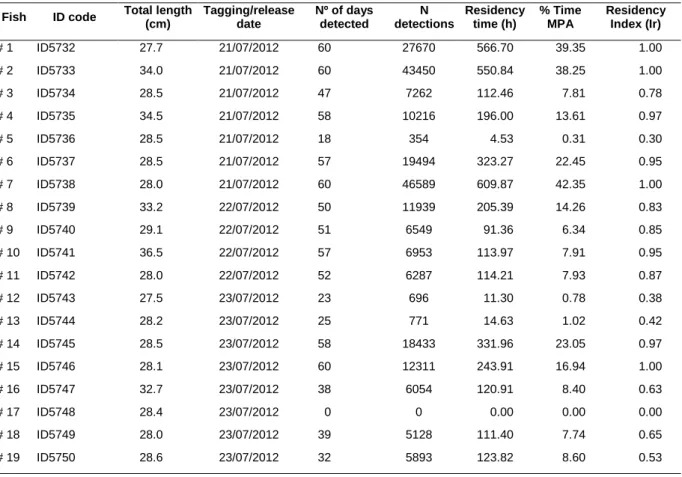
In both years, tagged specimens were continuously monitored for 60 days. Adverse sea conditions, typical of the region during most of the year, limited telemetry studies in the area to the summer periods. Additionally, mark-recapture was used on D. Sargus to evaluate its population dynamics and movements inside the entire Marine Park.
Data used for the analysis of fish assemblages from the Alentejo Coast of the PNSACV Marine Park was obtained by means of experimental fishing. Sampling consisted of 4 surveys: August 2011 (summer), February 2012 (winter), August 2013 (summer) and December 2013 (winter). This temporal design allowed for obtaining data from the first year the no take MPAs were implemented (2011/12) and from almost three years after protection (end of 2013), before and after eventual early effects of that protection would become evident. The first two sampling seasons comprised year 1 of protection while the remaining corresponded to year 3. Surveys were performed aboard a professional fishing vessel using trammel nets with inner mesh of 100 mm and two outer layers of 500 mm mesh. Trammel nets were the only fishing gear that could be used simultaneously in both areas in a cost efficient manner. Also, this gear provides a global sampling of the entire fish assemblage, rather than more selective gears such as fish traps and longlines. However, in the Pessegueiro Island no take MPA a bottom otter trawl was also used to sample juveniles and small size fish species. Further details on these methods are provided in the following chapters (SEE CHAPTERS 4 AND 5).
Fish landings data for the 6th chapter of this work was obtained either from yearly surveillances performed and published by the Portuguese National Institute for Statistics (Instituto Nacional de Estatística – INE 2007-2015) or provided by the National Authority for Natural Resources and Maritime Services and Security (Direção Geral dos Recursos Naturais, Segurança e Serviços Marítimos – DGRM). Further information is provided in the chapter (SEE CHAPTER 6).
All procedures were carried out in accordance with the Portuguese legislation regarding animal capture, manipulation and experimentation for scientific purposes. This includes certification on laboratory animal science that meets the requirements of FELASA level C courses to license people responsible for directing animal experiments and Veterinary National Authority proper accreditation.
1.5. References
Abesamis, R.A., Russ, G.R., 2005. Density-Dependent Spillover from a marine reserve: long-term evidence. Ecological Applications, 15(5), 1798–1812.
Abrantes, F., Moita, M.T., 1999. Water column and recent sediment data on diatoms and coccolithophorids, off Portugal, confirm sediment record of upwelling events. Oceanologica Acta, 22(1), 67–84.
Allison, W., Lubchenco, J., Carr H., 1998. Marine reserves are necessary but not sufficient for marine conservation. Ecological Applications 8, 79 – 92.
Baeta, F., Costa, M.J.,Cabral, H., 2009. Changes in the trophic level of Portuguese landings and fish market price variation in the last decades. Fisheries Research 97, 216 – 222.
Bastos, M.R., Dias, J.A., Baptista, M., Batista, C., 2012. Ocupação do Litoral do Alentejo, Portugal : passado e presente. Journal of Integrated Coastal Zone Management, 12(1), 101–118..
Bertocci, I., Dominguez, R., Freitas, C., Sousa-Pinto, I.. 2012. Patterns of variation of intertidal species of commercial interest in the Parque Litoral Norte (north Portugal) MPA: Comparison with three reference shores. Marine Environmental Research 77, 60 – 70.
Castro JJR de PP de (2004) Predação humana no litoral alentejano: caracterização, impacte ecológico e conservação. PhD Dissertation, Universidade de Évora, Évora.
Castro, J.J., Cruz, T., 2009. Marine Conservation in a Southwest Portuguese Natural Park. Journal of Coastal Research, (56), 385–389.
Claudet, J. et al., 2008. Marine Reserves: size and age do matter. Ecology letters, 11, 481–489.
Claudet J, Pelletier D (2004) Marine protected areas and artificial reefs : A review of the interactions between management and scientific studies. Aquatic Living Resources 17(2): 129 – 138.
Dingle, H., 1996. Migration: The biology of life on the move. New York: Oxford University Press. FAO, 2014. The State of World Fisheries and Aquaculture 2014, Rome.
FAO-FIGIS, 2015. Global Production Statistics 1950-2013.
Fernandéz, G.C., Paulo, D., Serrão, E.A., Engelen, A.H., 2016. Limited differences in fish and benthic communities and possible cascading effects inside and outside a protected marine area in Sagres (SW Portugal). Marine Environmental Research 10.1016/j.marenvres.2015.12. 003.
Ferreira, S., 2013. Fisheries landings variability for different fleet components along the Portuguese coast. MSc Thesis. University of Lisbon.
Fiúza, A.F.G., Macedo, M.E., Guerreiro, M.R., 1982. Climatological space and time variation of the Portuguese coastal upwelling. Oceanologica Acta, 5(1), 31–40.
Forcada, A. Valle, C. Sanchéz-Lizaso, J.L. Bayle-Sempere, J.T. Corsi, F. 2010.Structure and spatial-temporal dynamics of artisanal fisheries around a Mediter-ranean marine protected area. ICES Journal of Marine Sciences 67, 191–203.
Gamito, R., Teixeira, C., Costa, M.J., Cabral, H., 2013. Climate-induced changes in fish landings of different fleet components of Portuguese fisheries. Regional Environmental Change 13 (2), 413 – 421.
13
García-Charton, J.A., Pérez-Ruzafa, A., 1999. Ecological heterogeneity and the evaluation of the effects of marine reserves. Fisheries Research, 42(1-2), 1–20.
García-Charton, J.A., Pérez-Ruzafa, A., Marcos C, Claudet, J., Badalamenti, F., Benedetti-Cecchi, L., Falcón, J.M., Milazzo, M., Schembri, P.J., Stobart, B., Vandeperre, F., Brito, A., Chemello, R., Dimech, M., Domenici, P., Guala, I., Le Direách, L., Maggi, E., Planes, S., 2008. Effectiveness of European Atlanto-Mediterranean MPAs : Do they accomplish the expected effects on populations, communities and ecosystems ? Journal for Nature Conservation 16(4), 193-221.
García-Rubies, A., Zabala, M., 1990. Effects of total fishing prohibition on the rocky fish assemblages of Medes Islands marine reserve (NW Mediterranean). Scientia Marina 54(4), 317-28.
Gomes, M.C., Serrão, E., Borges, M.d.F., 2001. Spatial patterns of groundfish assemblages on the continental shelf of Portugal. ICES Journal of Marine Science 58, 633–647.
Gonçalves, J.M.S., 2000. Biologia pesqueira e dinâmica populacional de Diplodus vulgaris (Geoffr.) e Spondyliosoma cantharus (L.) (Pisces, Sparidae) na costa sudoeste de Portugal. PhD Dissertation, University of Algarve, Faro.
Gonçalves, E., Henriques, M., Almada, V., 2003. Use of temperate reef-fish community to identify priorities in the establishment of a marine area, in: Beumer, J., Grant, A., Smith, D. (Eds.), Aquatic Protected Areas: What works best and how do we know? Proceedings of the World Congress on Aquatic Protected Areas, Cairns, Australia, August 2002.
Goñi, R., Adlerstein, S., Alvarez-Berastegui, D., Forcada, A., Reñones, O., Criquet, G., Polti, S., Cadiou, G., Valle, C., Lenfant, P., Bonhomme, P., Pérez-Ruzafa, A., Sánchez-Lizaso, J.L., García-Charton, J.A., Bernard, G., Stelzenmüller, V., Planes, S., 2008. Spillover from six western Mediterranean marine protected areas: evidence from artisanal fisheries. Marine Ecology Progress Series 366,159–174.
Grüss, A., Kaplan, D.M., Guénette, S., Roberts, C.M., Botsford, L.W., 2011. Consequences of adult and juvenile movement for marine protected areas. Biological Conservation, 144(2), 692–702.
Halpern, B., 2003. The impact of marine reserves: do reserves work and does Reserve size matter? Ecolocial Applications 13, S117–S137.
Halpern, B.S, Gaines, S.D., Warner, R.R., 2004.Confounding effects of the export of production and the displacement of fishing effort from marine reserves. Ecological Applications 14 (4), 1248 – 1256.
Harmelin-Vivien, M., Le Diréach, L., Bayle-Sempere, J., Charbonnel , E., García-Charton , J.A., Ody, D., Pérez-Ruzafa, A., Reñones , O., Sánchez-Jerez , P., Valle, C.,2008. Gradients of abundance and biomass across reserve boundaries in six Mediterranean marine protected areas: Evidence of fish spillover? Biological Conservation 141(7), 1829–1839.
Haug, F.D., Paiva, V.H., Werner, A.C., Ramos, J.A., 2015. Foraging by experienced and inexperienced Cory’s shearwater along a 3-year period of ameliorating foraging conditions. Marine Biology 62(3), 649 – 660.
Henriques, S., Pais, M.P., Costa, M.J., Cabral, H.N., 2013. Seasonal variability of rocky reef fish assemblages: Detecting functional and structural changes due to fishing effects. Journal of Sea Research 79, 50 – 59.
ICNB, 2008. Plano de Ordenamento do Parque Natural do Sudoeste Alentejano e Costa Vicentina. Estudos de Base. Etapa 1 – Descrição, Volume I – III, Lisboa.
Institute of Meteorology, 2004. Caracterização Climática da Costa. IM, Lisboa.
Lubchenco, J., Palumbi , S.R., Gaines, S.D., Andelm, S., 2003. Plugging a hole in the ocean: the emerging science of marine reserves. Ecological Applications, 13(1), 3–7.
Jacinto, D., Cruz, T., Silva, T., Castro, J.J., 2011. Management of the stalked barnacle (Pollicipes pollicipes) fishery in the Berlengas Nature Reserve (Portugal): evaluation of bag and size limit regulation measures. Scientia Marina 75(3), 439 – 445.
Kelleher, G., Kenchington, R., 1992. Guidelines for establishing Marine Protected Areas. A Marine Conservation and Development Report. Gland, Switzerland: IUCN.
Kramer, D.L., Chapman, M.R., 1999. Implications of fish home range size and relocation for marine reserve function. Environmental biology of Fishes 55, 65-79.
Pauly, D., Christensen, V., Guénette, S., Pitcher, T.J., Sumaila, U.R., Walters, C.J., Watson, R., Zeller, D., 2002. Towards sustainability in world fisheries. Nature 418: 689-695.
Pérez-Ruzafa, A., García-Charton, J.A., 2008. European marine protected areas (MPAs) as tools for fisheries management and conservation. Journal for Nature Conservation, 16,187–192.
Pitchford, J.W., Codling, E.A., Psarra, D., 2007. Uncertainty and sustainability in fisheries and the benefit of marine protected areas. Ecological Modelling, 207(2-4), 286–292.
Plan Development Team, 1990. The potential of marine fishery reserves for reef fish management in the U.S. Southern Atlantic. NOAA Technical Memorandum NMFS-SEFC-261.
Peliz, A.J., Fiúza, A.F.G., 1999. Temporal and spatial variability of CZCS-derived phytoplankton pigment concentrations off the western Iberian Peninsula. International Journal of Remote Sensing, 20 (7), 1363–1403. Portuguese Geographic Institute ed., 2005. Atlas de Portugal 1a ed., Lisboa: Editorial do Ministério da Educação. Reis, R., 2011. Avaliação de efeitos ecológicos da interdição da pesca lúdica no litoral rochoso alentejano. Tese de Mestrado, Instituto Superior de Agronomia, Lisboa, Portugal.
Relvas, P., Barton, E.D., 2002. Mesoscale patterns in the Cape São Vicente (Iberian Peninsula) upwelling region. Journal of Geophysical Research, 107(C10), 3164–3187.
Rius, M., 2007. The effect of protection on fish populations in the Ses Negres Marine Reserve (NW Mediterranean, Spain). Scientia Marina, 71(3), 499–504.
Roberts, C.M., 1995. Rapid build-up of fish biomass in a Caribbean marine reserve. Conservation Biology 9(4), 815-826.
Roberts, C.M., Polunin, N.V.C., 1993. Effects of marine reserve protection on Northern Red Sea fish populations. In: Proceedings 7th International Coral Reef Symposium. 979–987.
Russ, G.R., 2002. Yet another review of marine reserves as reef fishery management tools, in: Sale, P.F., (Ed.), Coral Reef Fishes: Dynamics and Diversity in a Complex Ecosystem. Academic Press, New York, NY.
Russ, G.R., Alcala, A.C., Maypa, A.P., 2003. Spillover from marine reserves: the case of Naso vlamingii at Apo Island, the Philippines. Marine Ecology Progress Series 264, 15 – 20.
Silva, J., 2015. Alterações na composição e na estrutura trófica das comunidades de peixes das Áreas Marinhas Protegidas da Ilha do Pessegueiro e Cabo Sardão após a proibição da pesca. MSc Dissertation. Faculty of Sciences, University of Lisbon, Lisbon.
15
Smith, M.D., Lynhamb, J., Sanchirico, J.N., Wilsone, J.A., 2010. Political economy of marine reserves: Understanding the role of opportunity costs. P. Natl. Acad. Sci. USA. 43, 18300 – 18305, doi: 10.1073/pnas.0907365107.
Sousa, I., 2011. Assessment of reserve effect in a Marine Protected Area: the case study of the Professor Luiz Saldanha Marine Park (Portugal). MSc Dissertation, Universidade do Algarve, Faro, Portugal.
Sousa, P., Azevedo, M. Gomes, M.C., 2005. Demersal assemblages off Portugal: Mapping, seasonal, and temporal patterns. Fisheries Research, 75(1-3), 120–137.
Teixeira CM, Gamito R, Francisco F, Murta AG, Cabral HN, Erzini K, Costa MJ, 2014. Environmental influence on commercial fishery landings of small pelagic fish in Portugal. Regional Environmental Change DOI 10.1007/s10113-015-0786-1.
Topping, D.T., Lowe, C.G., Caselle, J.E., 2005. Home range and habitat utilization of adult California sheephead, Semicossyphus pulcher (Labridae), in a temperate no take marine reserve. Marine Biology 147, 301–311. Tzanatos, E., Dimitriou, E., Katselis, G., Georgiadis, M., Koutsikopoulos, C., 2005. Composition, temporal dynamics and regional characteristics of small-scale fisheries in Greece. Fisheries Research 73, 147 – 158. Vandeperre, F., Higgins, R., Santos, R.S., Pérez-Ruzafa, A., 2008. Fishery Regimes in Atlanto-Mediterranean European Marine Protected Areas. EMPAFISH Project, Booklet no 2, 97p.
Vandeperre, F., Higgins, R.M., Sánchez-Meca, J., Maynou, F., Goñi, R., Martín-Sosa, P., Pérez-Ruzafa, A., Afonso, P., Bertocci, I., Crec’hriou, R., D’Anna, G., Dimech, M., Dorta, C., Esparza, O., Falcón, J.M., Forcada, A., Guala, I., Le Direach, L., Marcos, C., Ojeda-Martínez, C., Pipitone, C., Schembri, P.J., Stelzenmuller, V., Stobart, B., Santos, R.S., 2011. Effects of no take area size and age of marine protected areas on fisheries yields: a meta-analytical approach. Fish and Fisheries. 12, 412 – 426. DOI: 10.1111/j.1467-2979.2010.00401.x.
Viegas, V.,2013. Pesca comercial na costa alentejana: rendimento, esforço de pesca, rejeições e efeitos da proteção. MSc Dissertation. Universidade de Évora and Instituto Superior de Agronomia, Portugal.
Vinther, M., Reeves, S.A., Patterson, K.R., 2004. From single-species advice to mixed-species management: taking the next step. ICES Journal of Marine Science 61 (8), 1398 – 1409.
Ye, Y., Cochrane, K., 2011. Global overview of marine fishery resources. In Review of the state of world marine fishery resources. FAO Fisheries Technical Paper. No.569. Rome: FAO, p. 33.
Chapter 2
ASSESSING THE SIZE ADEQUACY OF A SMALL NO TAKE
MARINE PROTECTED AREA FOR MEDITERRANEAN
MORAY AND EUROPEAN CONGER
19
Abstract
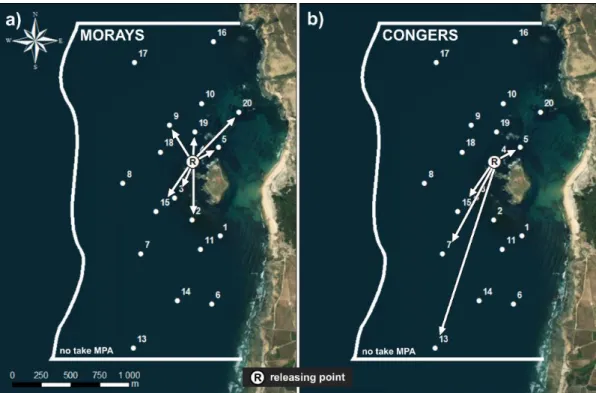
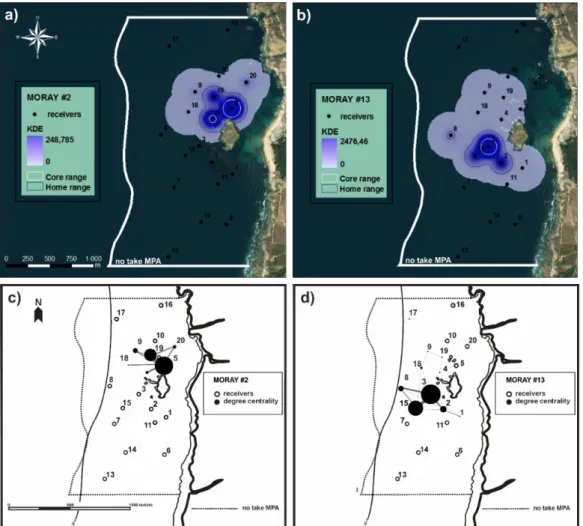
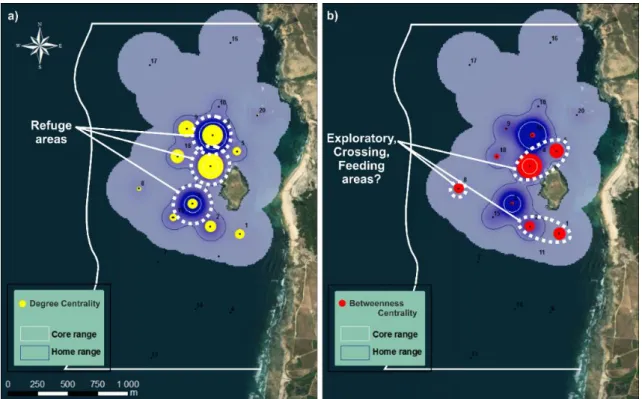
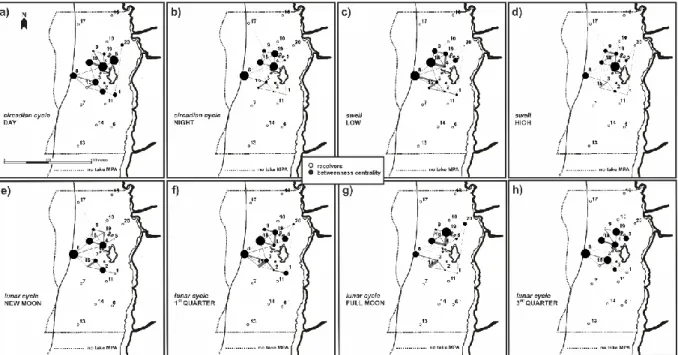
In 2011, several type I Marine Protected Areas (no take MPAs) were implemented inside the Sudoeste Alentejano and Costa Vicentina Marine Park, along the southwestern coast of Portugal. This study quantified the home range, movement patterns and activity levels of 19 moray (Muraena Helena) and 6 conger (Conger conger) eels to assess if the size of one of these MPAs (Pessegueiro Island) is adequate to protect these heavily fished species. Individuals were captured inside and outside the no take MPA, tagged with acoustic transmitters and monitored for 2 months during the summer of 2013. Morays and congers showed mean residency index of 0.48, and home ranges of 19.4 and 34.4 ha, respectively, corresponding to 4% and 8% of the MPA. Morays and congers were active for 3.3 % and 12.0 % of the time, respectively, mainly at night and during quarter lunar phases. Morays moved less than 1 km per day around reefs near the island, while congers roamed more widely. Results highlight the importance of this no take MPA as a refuge and feeding area for both species at least during the summer period, and suggest that its size is adequate for protecting these species against fishing activity. Ultimately, the present study provides evidence that small no take MPAs can be adequate for protecting species with reduced home ranges.
Keywords:
Activity patterns, acoustic telemetry, Conger conger, home range, Muraena helena, PNSACV Marine Park
21
2.1. Introduction
Human population growth is leading to an increase in fish consumption and a decrease in the abundance of commercially fished species (FAO 2014), with associated problems regarding fisheries sustainability (Pauly et al. 2002). In face of this, management plans for marine resources based on scientific evidence are essential. Given the limited success of traditional management tools such as fishing effort control, implementation of Marine Protected Areas (MPAs) has been highly advocated in promoting fisheries sustainability and biodiversity preservation (Allison et al. 1998, Pauly et al. 2002). These protected areas are generally accepted as being effective and contributing to increases in the number, biomass, abundance and size of individuals of multiple key species (e.g. García-Rubies and Zabala 1990, Roberts 1995, Russ 2002). An MPA can be defined as any intertidal or subtidal area that is protected by law to preserve biodiversity and assure a sustainable use of its resources (Kelleher and Kenchington 1992). In 1995 a 2-km wide coastal stretch was designated as an extension of the Sudoeste Alentejano and Costa Vicentina Natural Park (PNSACV), southwest Portugal. At the time no fishing restrictions were implemented. However, in 2011 this area was designated as a Marine Park and no take and type I partial protection areas were implemented. In these areas, commonly referred to as no take MPAs, almost all fishing activities are now forbidden.
The efficiency of an MPA depends on its location and size (e.g. Claudet et al. 2008) together with an appropriate management plan and adequate monitoring and surveillance (Allison et al. 1998, Claudet and Pelletier 2004, García-Charton et al. 2008). Furthermore, knowledge of fish species biology and ecology is a key factor when designating an MPA or a network of MPAs (Allison et al. 1998, Claudet and Pelletier 2004). Thus, knowledge on fish movements, activity patterns and habitat use throughout MPA and adjacent areas is paramount (e.g. Kramer and Chapman 1999, Claudet and Pelletier 2004, Topping et al. 2005). Furthermore, a no take MPA to be efficient should encompass at least most of the home ranges of the species of interest, to reduce the probability of their capture by commercial or recreational fisheries (Kramer and Chapman 1999, Pauly et al. 2002); with home range defined as the relatively circumscribed area over which an organism moves to acquire vital resources for survival and reproduction (Dingle 1996).
Home range estimation can be based on presence indicators (Powell 2000) and acoustic telemetry is a widely used method to study the movement of marine organisms (Zeller 1999, Heupel et al. 2006) which has been used to help plan and manage several MPAs (e.g. Abecasis and Erzini 2008, Abecasis et al. 2009, Alós et al. 2012). Although acoustic
telemetry is often used to study the spatial ecology of many marine fish (e.g. Finn et al. 2014, Farris et al. 2016, Lédée et al. 2016), this technique has not been previously used on several commercially important species, such as the Mediterranean moray (Muraena helena Linnaeus, 1758) and the European conger (Conger conger Linnaeus, 1758) (Pita and Freire 2011, Matić-Skoko et al. 2014).
The Mediterranean moray (Muraenidae) is a territorial fish, which lives in crevices on rocky reefs (La Mesa et al. 2008) and forages mainly during the nighttime on crustaceans, cephalopods, and other fish (e.g. Bauchot and Saldanha 1986a, Matić-Skoko et al. 2014). Moray eels inhabit shallow waters near the coast to up 800 m in depth (Jiménez et al. 2007). Near shore, where fisheries targeting M. helena generally occur, individuals are mostly females and juveniles (Matić-Skoko et al. 2014). The European conger (Congridae) inhabits coastal areas from a few meters to over 1000 m in depth (Mytilineou et al. 2005). Juveniles are demersal and display cryptic behaviour and high site fidelity (Correia et al. 2012) typically within rocky reefs associated with sandy bottoms (Day 1880, Bauchot and Saldanha 1986b, La Mesa et al. 2008). Individuals seem to be more active during sunset and nighttime (Day 1880, Morato et al. 1999, Pita and Freire 2011), feeding mostly on crustaceans, cephalopods (octopus) and other fish (Morato et al. 1999, O’Sullivan et al. 2004, Matić-Skoko et al. 2012). Due to their semelparitiy, congers are particularly vulnerable to intense targeted fishing (Morato et al. 1999).
Both species are common inside the Pessegueiro Island no take MPA, where, unlike in adjacent areas, individuals are supposedly protected from fishing activities. No previous study has examined whether the size of the no take MPA around Pessegueiro Island encompasses most of the home range of conger and moray eels. Previous studies indicated that this small, no take MPA was adequate to protect white seabream (Diplodus sargus Linnaeus, 1758), a species which is also highly targeted by fishers and displays a reduced home range and high site fidelity (e.g. Belo et al. 2016). Nevertheless, it is important to test an MPA’s suitability for a broad array of commercially exploited fish species in order to further confirm the effectiveness of this management tool.
Regardless of their wide distribution and commercial importance, most studies on conger and moray focus on diet (e.g. Morato et al. 1999, O’Sullivan et al. 2004, Matić-Skoko et al. 2014), age and growth (e.g. Matić-Skoko et al. 2011, 2012), reproduction (e.g. Cau and Manconi 1984, Sbaihi et al. 2001, Matić-Skoko et al. 2011) and population structure (e.g. Correia et al. 2012). Very few studies have examined the home range, movement patterns, space use and site fidelity of moray and conger eels. To the best of our knowledge, only one study (Pita and Freire 2011) has provided preliminary information on these aspects of the
23 ecology of conger eel. This lack of knowledge makes it challenging to promote management measures for the sustainable exploitation of both species.
The main objective of this study was to assess whether the size of the Pessegueiro Island no take MPA is adequate for the protection Mediterranean moray and the European conger. Activity patterns and habitat use of both species were studied by means of acoustic telemetry and the influence of environmental factors on the behaviour of both species was also evaluated. The results from this study provide important and useful information on the adequacy of small no take MPAs to protect fish species, whilst delivering valuable information on moray and conger ecology and behaviour.
2.2. Methods
2.2.1 Study area
The study was carried out in the Pessegueiro Island type I MPA (fishing activities forbidden with the exception of commercial harvest of stalked barnacle Pollicipes pollicipes (Gmelin, 1790)), the northernmost protected area in the PNSACV Marine Park (FIGURE 2.1). This protected area belongs to a network of several small no take (all fishing activities forbidden) and type I protected areas, implemented within the PNSACV Marine Park in 2011. All these small areas are commonly referred to as no take MPAs. This no take MPA has an area of approximately 450 ha surrounding a small rocky island. Maximum depth is ca. 18 m and the seabed is mainly composed of rocky reefs delimited by sandy bottom. Several islets surround the island. On the northern and western sides, a rocky platform extends over 400 m after which sandy bottoms abound. These areas are exposed to the dominant north-western wind and swell. The fish community of this region is diverse, with 149 fish species described, some with high commercial value, such as morays and congers (ICNB 2008).
2.2.2 Field work
In July 2013 an array of 20 underwater acoustic receivers (VEMCO VR2W 69 Hz) was deployed inside the no take MPA and covering most of its area (FIGURE 2.1). Receivers were attached to a removable cable secured with stainless steel snap hooks on each end and connected to the main cable fixed to a 100kg cement block. A rigid plastic buoy
maintained the receiver in a vertical position. The entire mooring apparatus measured ca. 2 m in height and was permanently submersed. Mooring geographical coordinates were recorded by GPS.
FIGURE 2.1 – a) Sudoeste Alentejano and Costa Vicentina Marine Park (grey) with its network of no take Marine
Protected Areas (black). b) Detail of the Pessegueiro Type I Protection Area (i.e., no take MPA) and location of acoustic receivers.
Detection range depends on environmental conditions and habitat type, from 600 m in deep water and low turbulence conditions to 30 m in the shallow waters of tidal creeks (e.g. Finstad et al. 2005, O'Toole et al. 2011, Welsh et al. 2012). Range testing was not conducted, since detection range would greatly vary among receivers. However, it was assumed that individuals would be detected within at least 100 m a receiver, as previously observed in this area with an almost identical receiver array (e.g. Belo et al. 2016). Sentinel tags would be the most adequate method of continuously measuring home range (e.g. Payne et al. 2010, Currey et al. 2014) but this method was discarded since both studied species potentially display high site fidelity (e.g. Pita and Freire 2011, Correia et al. 2012). This fact would increase the chance of code transmission collision. To optimize signal coverage near the island, 10 receivers were deployed less than 200 m from each other.
25 Remaining receivers located farther from the island were positioned farther apart (ca. 400 m), since bottom characteristics in those areas enable higher detection range.
Individuals were caught in early August 2013 inside Pessegueiro Island no take MPA using overnight fishing with baited traps. A total of 16 morays and 5 congers was captured. Three additional morays and one conger captured southwest outside the protected area were also tagged. Individuals were placed inside a 600L oxygenated renewed sea water tank and individually anesthetized with a 2-phenoxyethanol (0.4 ml.dm-3) solution. After measuring for length (mm) and weight (g), a 9 mm diameter coded acoustic transmitter (VEMCO V9 2H-69kHz) was implanted in the intraperitoneal cavity. Each transmitter measured 29 mm in length and weighed 2.9 g (in water). Power output was 151 dB, with a 99-day expected battery life and transmission rate of 60 s (30-90 s) nominal delay. After sugery, individuals were placed in a recovering tank for a minimum of 2 hours before being released inside the MPA (FIGURE 2.1). Tagged fishes were monitored until receivers were collected in early October 2013 to avoid winter storms season. Data from the first two days after release was discarded as tagged individuals were presumably recovering from surgery and eventually relocating to the capture sites, resulting in a 60-day study period. Adverse sea conditions, typical of the region during most of the year, restricted this study to summer.
2.2.3. Data analysis
After removing false detections and assessing noise quotient, each individual detection was assigned location, date, time, lunar cycle and swell height at the time of detection (Appendix I).
2.2.3.1 Residency, Activity and Covered Distance Index
Residency Index (Ir) was calculated for each individual as the ratio between number of days the fish was detected and total number of days of monitoring (Afonso et al. 2008). Individuals were considered active when intervals between consecutive detections were less than 10 minutes. Activity index (Ia) was calculated as the ratio between individual activity time and total time of monitoring. Individual Covered Distance Index (Icd) was calculated as the sum of the minimum distances covered between consecutive detections (Lino 2012).