TRANSLATING THE INVISIBLE
LANGUAGE OF LIGHT
María Renée Morales Lam
"Dissertação para Obtenção do grau de Maestrado em Arte e Ciência do Vidro"
Supervisor
Fernando Pina
Co-supervisor
Robert Wiley
ACKNOWLEDGEMENTS
I would like to thank both my advisors, professors Fernando Pina (who showed me the poetry within science) and Robert Wiley (who taught me the significance of magic) for sharing their knowledge with me. It was because of them, that I first experienced dwelling between Art and Science.
Also, I would like to express my special gratitude to Professor António Nunes dos Santos who enlightened my path towards the discovery of an interconnected universe and encouraged me to begin a personal pursuit of the Real.
TABLE OF CONTENTS
ABSTRACT ...i
INTRODUCTION ...5
I. FUNDAMENTALS AND METHODOLOGY ...6
A. Energy (Light) ...6
1. Wave ...7
2. Particle ...8
3. Quantum Theory ...9
4. Interaction of Ligh and Matter ...10
5. Reflection, Refraction, Dispersion and Transmission ...11
6. Electromagnetic Spectrum ...13
7. Visible Light and Color ...14
B. Matter, Glass as a medium ...17
C. Concepts and Language...17
D. Maps and Scales ...19
E. Metaphors and Analogies ...20
F. Defining the Experimental Process ...21
II. EXPERIMENTAL DESIGN ...23
A. Artificial conversion of graphic frequencies and wavelengths ...23
B. Bending the Space-Time ...26
C. Gravity and Impact ...28
D. Funnels ...30
E. Water wave ...30
III. RESULTS AND DISCUSSION ...32
A. Synesthetic Spectrum (Translating matter) ...32
B. Bending the Space-Time (Matter interacting with space) ...33
C. Projections (Looking into the structure of matter) ...34
D. Gravity Mirrors (Transforming matter) ...35
E. Funnels (Transmitting information) ...36
F. Exhibition: "Evidência intangivel de uma ação recíproca" ...36
CONCLUSIONS ...38
ANNEX ...40
BIBLIOGRAPHY ...55
ABSTRACT
This work discusses the relationship between art and science by the study of the fundamentals of light alongside an experimental process that emphasizes the transformation of matter, through which the main material of exploration is glass.
Being exposed to scientific subjects throughout the master program facilitated a great interest and countless curiosities towards the nature of light from the point of view of an observer, but also as an experimenter and a maker. Through these inquiries, I recognized a relationship between the interaction of energy and matter, similar to the interaction of the artist with matter and space. Consequently I began a pursuit in which I immersed myself in a universe of light to later analyze its possible influence on my artwork and inevitably becoming part of the experiment myself.
INTRODUCTION
I am neither an artist, nor a scientist.
Nevertheless, I am undertaking this research in the fields of art and science, seeking to turn my personal circumstance into a premise for this thesis. Thus, I will consider the interdisciplinary practice, both scientific and artistic, within this framework in order to explore the effects caused by dwelling between them. One of the aims of this work is to make concrete the influence of both disciplines in the experimental work and/or the experimenter and maker: me. This research is an opportunity to re-explore the fundamentals of light that I certainly learned some time ago. Yet, they did not grow as many curiosities back then as they are growing now. Currently, I have been amazed by the rediscovery of the subject, as much as a child would be on his first visit to a science museum. I was encouraged and driven by my new inquiries to engage in a full immersion on the topic in order for the information to be absorbed, breathed in, thought over, digested, spoken and reused. Once the knowledge starts residing in my consciousness it can influence, affect and join other thoughts and ideas, mutating, deforming, multiplying and reconstructing each other. This would urge the formation of new blocks of understanding, letting me recognize the way I perceive the world, motivating an awareness of and within myself, and the way I shape reality.
One of the main subjects of this work, as previously mentioned, is the nature of light from a scientific point of view that gave way to a conceptual exploration: the interaction of energy and matter in allusion to the interaction of the artist with space and matter. It is also an unconventional artistic approach to the fundamentals of light, seeking to translate phenomena invisible to the human eye into a physical and material language.
The work is presented in two main chapters: the scientific fundamentals of the nature of light and the parallel experimental process.
The first one is almost a synopsis of the vast universe regarding light, energy and all the subsequent wonders involved with it, as well as a quick review to some of the major experiments that helped me understand these remarkable events better than a description itself. I decided to place a real significance on this section, hoping that it might be as insightful to others, as it has been for me; perhaps giving one a second chance to be astonished and reengaged in the fascinating way our universe works, and therefore reconnecting to a whole. It is a personal way to honor science, every person who has contributed to the discoveries that lead us to our present understanding, the irrepressible human curiosity, the ever-growing desire to go further, the accelerating technological progress, our implacable thirst for knowledge and for having a greater consciousness. It is about our own existence, the world we live in, and finally the dark and distant universe, tiny and immeasurable at the same time. It is in fact a way to honor science, because through it, we have been able to encapsulate infinity in our illuminated imagination.
The second part explores the making, concretizing and materializing thoughts. It speaks about a process that is constantly evolving, cultivating and transforming ideas. It contemplates these ideas, nurturing and letting them reproduce and continually adding new directions to give rise to nonexistent species, enabling a fluid way of thought. It also considers the maker as a propagator of new connections, a vehicle of information that will, hopefully, reach into a new and versatile vision of the Real.
I. FUNDAMENTS AND METHODOLOGY
"We all know what light is, but it is not easy to tell what it is."
Samuel Johnson
A. Energy (Light)
Light was, for many centuries, the subject of many disputes. Throughout history several scientists would agree on Isaac Newton's corpuscular theory where particles are emitted by light sources and propagate in straight lines, yet, many others would support Christian Huygens' description of the light's behavior similar to a water wave.1 It was only at the beginning of last century that the wave-particle duality of light was finally acknowledged.
As Brill, Falk and Stork advice in their book Seeing the light, one should try to shape an understanding of light's nature relying on the scientists' classic experiments instead of chasing the historical path: "...we shall use the well-tested method of scientist to discover what light does, and thereby understand what it is." 2 Through these experiments, it is now possible to state that light has a rectilinear propagation, traveling from a light source and it is possible to observe, not the light beam itself but the object affected by it, which redirects the light into the human eye.
Figure 1. Sunlight reflecting on the moon
In the past, scientist thought that light needed a medium to propagate, like sound waves in air, and it had an infinite speed. Nowadays, it can be asserted that light travels at a finite speed through the vacuum, not being dependent of a medium to carry it. One of the fundamental constants of nature is the speed of light in a vacuum: 3
c = 3 x 1010 cm/s (I-1)
Nevertheless, the medium of propagation does affect the speed of light. The denser the medium, the slower light travels, as in water. 4 Light can also bend, so when it passes from one medium to another, refraction happens, changing the direction of the ray of light.
Newton discovered that white light could be separated through a prism into pure colors. This separation is called dispersion. Dispersion is interconnected with the previous definition of
1
Brill, Dieter; Falk, David; Stork, David, Seeing the light, Optics in Nature, Photography, Color, Vision, and Holography, John Wiley and & Sons, p.3, 1986
2
Idem, p.3
3
Jenkins, Francis A.; White, Harvey E., Fundamentals of Optics - Fourth Edition, McGraw-Hill International Editions, p.6, 1981
4
refraction. At the same time, color is directly related with the light energy and therefore with the wave frequencies. 5
The concepts of refraction, reflection, dispersion and visible light, will be further explored in the coming chapters.
1. Wave
Concerning the wave nature of light, it is important to understand the basic defining parameters of a wave, since they have a direct influence on this work.
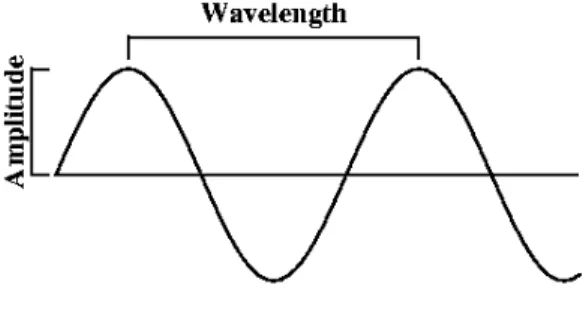
The figure (#) pictures the oscillation of a simple wave, where the amplitude a, refers to the vertical displacement of the wave from the average or the rest position. The distance between peaks is called wavelength λ, and the frequency v is the amount of oscillations a wave completes per second. 6
Figure 2. Sine Wave motion
Two centuries ago, James Clerk Maxwell, defined light as electromagnetic waves. The electromagnetic spectrum consists of radio waves, microwaves, infrared radiation, visible spectrum, ultraviolet radiation, x-rays and gamma-rays.7 The theory proposed that single light waves were formed by electric and magnetic waves. The magnetic waves oscillate on the horizontal axis (x), while electric waves on the vertical axis (y) and both vibrate through the (z) axis, called the wave propagation vector. They are also in phase and perpendicular to each other. It is the interaction between both, the electric and the magnetic field, that generates the propagation of the wave.8
5
Brill, Thomas B., Light - Its interaction with Art and Antiques, Plenum Press, p.4, 1980
6
Idem, p.2
7
Fowles, Grant R., Introduction to modern Optics, Dover Publications, p.2, 1989
8
Figure 3. Electromagnetic Wave
Although the magnetic field is an essential component of the electromagnetic waves, the electric field is the one that interacts with electrons and the electric fields in atoms. As Brill claims in his book Light: "This electric vector interaction produces refraction, reflection, and transmission of the wave, in addition to color, chemical reactions, and heating effects in most materials." 9
A good example of this interaction happens in transparent materials, such as glass. As previously mentioned, the speed of light in vacuum is constant, yet in glass, the electric fields of a light wave energize de electrons in the material and these emit new waves. The charges add to the original wave, decelerating its speed.
It is worth to mention that all kinds of radiation consist of electromagnetic waves, so as visible light. They simply interact with matter at different wavelengths, depending on their frequencies.
2. Particle
Previously, scientist knew that waves were propagating disturbances carrying energy, but not matter. This was the fundamental struggle to understand the dual nature of light; the properties of light also needed to be acknowledged through the particle theory.
By means of Newton's research, it is possible to understand the corpuscular theory of light, where individual particles are emitted by light sources. This argument was later, expanded by Albert Einstein. In 1905, he introduced the concept of "quanta", as particles of light that carried energy and possessed momentum.10 Max Planck defined the quanta or photon's energy expressed through the following equation11
E = hv (I-2)
in which the energy E (emitted radiation) is proportional to its frequency v and h is Planck's constant:
h = 6.626 × 10⁻³⁴J s (I-3)
9
Brill, Thomas B., Light - Its interaction with Art and Antiques, Plenum Press, p.7, 1980
10
Feynman, Richard P., QED - The Strange Theory of Light and Matter, Princeton University Press, pp.9,14, 1985
11
This energy defines the different colors of light, so that each color represents a photon with a different energy. Consequently, since the quanta energy is proportional to its frequency, each color can also be related with a specific light wave frequency.
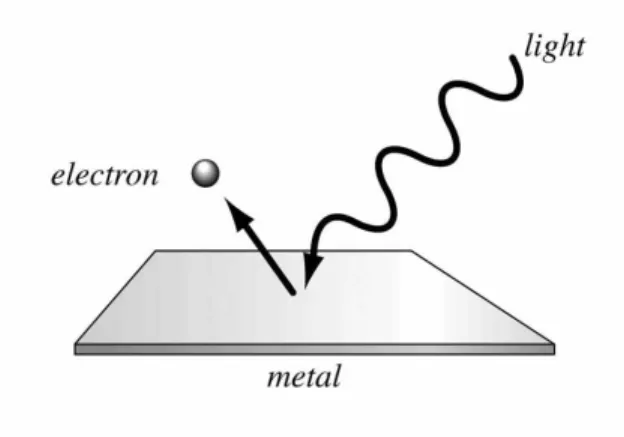
In order to better understand the particle theory of light, it is of great use to mention its direct effect on matter. A good example to picture light particles is the Photoelectric Effect, where incident ultraviolet light (photons) causes the emission of electrons within atoms on a metal plate. The electrons absorb the quanta energy, promoting a kinetic energy and finally leaving the metallic surface.12
The electrons are to be found regularly in a ground state. However, when the incident light, in this case the ultraviolet light, hits the electrons, in an excited state, these jump to a higher energy level. If the energy provided is higher than the ionization energy, the electron will leave the metal surface carrying that extra amount of energy. In this way, it is possible to take advantage of the Photoelectric Effect, through which the light energy is transformed into an electric energy.
Figure 4. Photoelectric Effect
3. Quantum Theory
The equation to unify the quantum theory of light is based on Planck expression (I-1).
However, if, frequency v relates with wavelength λ
c = v λ
it means another correspondent way to express Planck's equation would be13
E = hc/λ (I-4)
In this case c should be fixed as the speed of light (I-1). From these understandings we can conclude that the light quanta is directly proportional to the frequency and inversely proportional to the wavelength. In other words, as the frequency increases or the wavelength decreases, the energy of the photon will be higher.
12
http://galileo.phys.virginia.edu/classes/252/photoelectric_effect.html
13
Concerning emitted radiation, on the wave model, the intensity of light is obtained by the square of the amplitude a of the electric wave. In the particle model the intensity is related to the photon density.
The point where the theories finally confluence, is through the theory of quantum electrodynamics, combining Maxwell's explanation of the electromagnetic propagation of light and Einstein's definition of the photons' energy, intimately related to the interaction of light and matter.
4. Interaction of Light and Matter
"A luz é, afinal de contas, a mais refinada forma da matéria."
Louis de Broglie
Most of the known chemical and biological events happen because atoms and molecules are affected differently by each radiation. All phenomena, besides gravitation and nuclear phenomena, can be explained through the theory of quantum electrodynamics. They are produced by the interaction of electromagnetic radiation with matter, more specifically light's energy with particles in matter.14
Light is emitted and absorbed in discrete packets of quanta. Regardless of the flux of photons carried by a light beam, these cannot be observed. Here, the insistence on the interaction of light and matter; it is a fundamental evidence concerning the existence of quanta.
Figure 5. Electromagnetic Radiation
Some of the phenomena concerning this interaction are better known as the basic properties of light, such as reflection, refraction, dispersion, absorption and emission. They all contributed to the discovery of the principles of modern physics and will be discussed later.
The electromagnetic spectrum has a wide range of radiations differing from each other through their frequencies (and wavelengths). The frequency will determine the behavior of light interacting with matter. This event is also subject of the detectors for these frequencies, because the charges in matter have resonance frequencies that need to be coherent with the frequencies of light. In other words, the different types of electromagnetic waves do not necessarily interact with every material they encounter. There needs to be a relationship in the scale they coexist.
14
Concerning the receptors in matter, the photoreceptors in the eye would make a great example to illustrate this process.
Within the human eye, behind the cornea, the eye-lens and the vitreous humor, lies the retina, at the back of the eyeball. The retina consists of three layers, one of them containing the photoreceptors called cones and rods. The cones cells are responsible of the high resolution and color vision, absorbing light of high levels (photopic conditions), whereas, rods are sensitive to the low levels of light, providing peripheral and under-dark(scotopic) conditions' vision.
These receptors absorb the visible light entering the eye through a light-sensitive chemical, produced within the cell. When light hits one of the molecules, its electrons resonate, causing a change in the shape of that molecule. This action generates an electric signal, releasing a neurotransmitter that passes through the synapse to the optic nerve and to the brain. All the information transmitted to de brain is processed to, ultimately, produce a symbolic neural representation of the scenery: the sight.15
The photoelectric effect previously described, is another example of the interaction between light and matter. It exemplifies the transmission of energy from photons to electrons.
It is important to mention the photosynthesis as the main interaction of light and matter related to humans and life itself. This is the process in which the energy of light is collected by plants and transformed into chemical energy "feeding" all living beings on earth and therefore enabling life.16
These examples are an essential evidence of the major role that light has played in the evolution of the world and the human history, confirming that as a continuous universal event it has determined our whole way of living and how we have perceived and shaped reality.
5.Reflection, Refraction, Dispersion and Transmission
Light travels through the vacuum in straight lines until encountering material obstacles. When this event occurs, an interaction happens on the surface of matter and consequently the ray of light can be refracted, reflected, absorbed or transmitted. These are just some of the possible phenomena that can result from this reciprocated action and will contribute to determine the appearance of an object.
When the light encounters another medium, it can bounce back into the first one. In Physical Optics this effect is called reflection and it is determined by a principal law in nature, in which the angle of an incident ray of light is equal to the angle of the reflected ray.17
There are, however, two types of reflection: the specular and the diffused reflection. Specular reflection occurs on smooth and polished surfaces, whereas diffused reflection is characteristic from an irregular interface.
15
Brill, Dieter; Falk, David; Stork, David, Seeing the light, Optics in Nature, Photography, Color, Vision, and Holography, John Wiley and & Sons, pp.144-156, 1986
16
Idem, p.27
17
Figure 6. Reflected and Refracted Ray
Refraction is related to the effect that materials have on light. When a ray of light passes from one medium to another, light bends. In other words, light is redirected while entering in a material. This is a consequence of the interaction of light with the molecules within matter that affects the velocity of light. In vacuum the velocity of light is constant, but for every other medium the velocity decreases.
Therefore, the index of refraction n of a medium determines the ratio between the
velocity or speed of light in vacuum and the velocity of light in a medium. Its algebraic expression is18
n = c/v (I-5)
where c is the constant speed of light in a vacuum and v the velocity of light in the medium.
Thanks to the accurate example made by Brill, it is possible to better understand the refraction index with this citation: "...because water has a refractive index of 1.33, visible light will travel 1.33 times slower in water than in a vacuum..." 19 Other values for the refraction indices are:20
Vacuum: n = 1
Air: n = 1.000292 or n = 1.000 (For practical purpose)
Glass: n = 1.520
Diamond: n = 2.4
Most of the characteristics that determine the index of refraction have to do with the temperature, the density of a medium and the wavelength of light. For the purpose of this research, only the last two subjects will be discussed.
Concerning the density of a specific medium, which refers to the amount of particles (mass) in a specific volume, the greater the density of the medium, the higher its index of
18
Jenkins, Francis A.; White, Harvey E., Fundamentals of Optics - Fourth Edition, McGraw-Hill International Editions, p.10, 1981
19
Brill, Thomas B., Light - Its interaction with Art and Antiques, Plenum Press, pp.45,46, 1980
20
refraction and therefore the slower light will propagate in this medium. At the same time, the shorter the wavelength, the higher the refraction index and the greater the dispersion.21
Figure 7. Refraction: The straw looks as if it was bent, since the n for water is greater than the n for air, making the light refract from its original path.
Dispersion needs to be defined within the parameters of refraction. Sunlight, or white light, for this matter, is a mix of all the visible colors represented by different wavelengths traveling at the same speed in vacuum. However, when the light beam strikes a transparent surface like glass, the ray of light is refracted and decomposed in different wavelengths traveling at a different speed. The dispersion of wavelengths from this white light creates a spectrum of visible colors from the shortest wavelength being violet and the longest wavelength being red. All the other colors are to be found between these two. As mention above, the longer the wavelength, the lower the refraction index (propagates faster) and the smaller the dispersion relative to the incident path. Such is the case of red light. Whereas for the shortest wavelength, violet, the index of refraction is higher, traveling slower in the medium with a greater dispersion.22 In general the higher the index of refraction in a medium, the wider the dispersion it produces.
After a beam of light has been emitted at certain incident angle, the ray is refracted when entering in the transparent medium and some reflection occurs. The light is dispersed, propagating along the material, and finally, it leaves the glass at the same angle and velocity as it entered. This phenomenon is called transmission of light. Notwithstanding, in a horizontal plane, the point where the ray leaves the material is displaced from the entering point. This shift is subject to the thickness of the glass and its index of refraction.23
6. Electromagnetic Spectrum
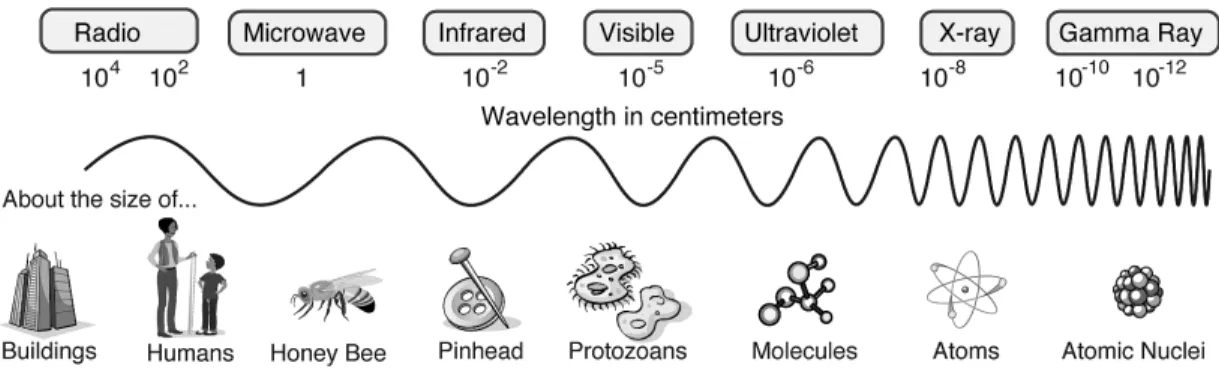
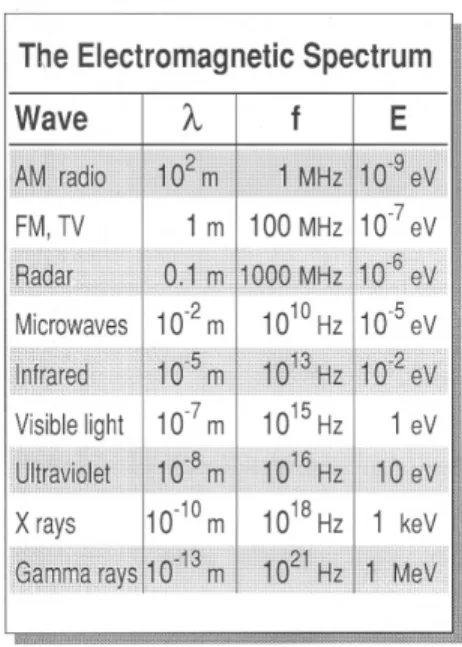
There are many types of electromagnetic radiation and they all affect in one way or another the molecules in matter, if they happen to interact. The variation between electromagnetic waves is defined by their specific frequencies and wavelengths. They were named differently in reference to their use, and their scales can vary from wavelengths with a distance in miles, to wavelengths the size of the nucleus of an atom.
21
Brill, Thomas B., Light - Its interaction with Art and Antiques, Plenum Press, p.46, 1980
22
Idem, p.11
23
Table 1. Electromagnetic Spectrum
Humans do not see ultraviolet light, because the resonance frequency in the detectors of the eye does not match the high frequencies of U.V light, they are out of phase.24 Ultraviolet radiation wavelengths are shorter than visible light. As mentioned by Brill, Falk and Stork: "...there is very little interaction between the radiation and the system - the radiation just passes through the system."25 In other words, the receptors within the eye do not perceive this type of energy. Nevertheless ultraviolet radiation does have effects on human skin, because it interacts with atomic structures, affecting the cells in the epidermis.
For the electromagnetic radiation to be used, specific instruments have been developed in order to "translate" the wave's intrinsic information into a language that humans can perceive. So is the case of the antennae. This object captures radio waves, magnifying them and finally converting them into mechanical vibrations that result in sound.26
7. Visible Light and Color
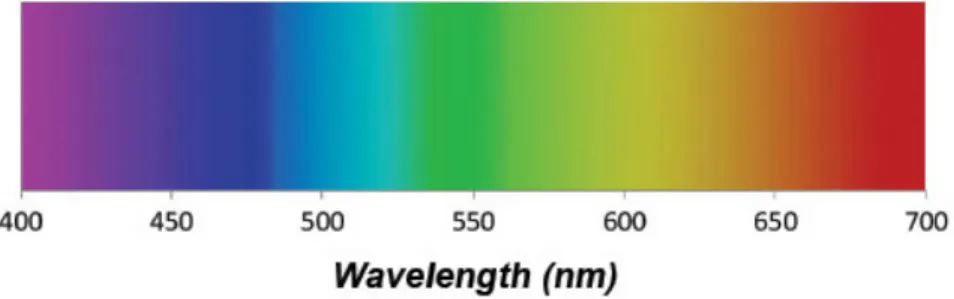
Within the electromagnetic spectrum, the range between 400nm to 700nm is to be found and is called visible radiation or visible light. This is a very limited fraction of the spectrum. However, this portion of wavelengths, has determined human life. That is because the human eye responds to frequencies in the visible range.
As previously mentioned, the eye is the instrument that human posses to detect visible radiation, transmitting the information carried by light in the brain and finally creating an image, producing the sensation of colors, shapes, textures, transparency, brightness and depth. The study of all phenomena contained in this range is called Optics.
24
Brill, Dieter; Falk, David; Stork, David, Seeing the light, Optics in Nature, Photography, Color, Vision, and Holography, John Wiley and & Sons, p.12, 1986
25
Idem, p.19
26
In the late 17th century, Newton discovered how to recreate the diffraction of light. For it, he would perform an experiment in which a ray of white light would go into a polished glass prism refracting and dispersing the beam in a range of six different colors that could not be separated further. These intervals would go from the shortest wavelength, violet, through the color blue, green, yellow, orange, to the longest wavelength, the color red. These are all components of white light.27
The dispersion, as explained before, happens as a result of the light bending while going into a different medium. In a vacuum, the mix of all colors, or white light, travels at the same speed. As soon as the beam of light strikes the prism each component wavelength refracts at a different range, causing the dispersion of the white ray. The color blue, for instance, has the shortest wavelength, therefore the highest index of refraction resulting in a greater dispersion.
Figure 8. Dispersion through a prism
The brightness of light is related to the amplitude of the wave. In the wave model, intensity of light can be measured through the square of the amplitude a of the electric field from an electromagnetic wave.28
I = ka2 (I-6)
In this sense, the intensity of a wave can be defined through its amplitude, thus the greater the electric field, the more energy it carries.
In the particle model, the density of photons of a beam needs to be measured in order to determine the intensity of the light.
The color might be expressed as a sensation produced by the brain by means of the detection of light through the eye. It responds to the wavelengths and light energies contained in light beams. In sunlight, or white light all wavelengths are present, being a mix of all colors. When the incident light illuminates object, these absorb some of the wavelengths and reflect others. The wavelength that has not been absorbed is reflected, giving as a result the visible color determining its appearance. For example, an object green in appearance is absorbing all wavelengths but the green one, which is being reflected.29
The saturation of a color refers to the dominant wavelength present in an object. Hence the color reflected is complementary to the dominant wavelength.
27
Brill, Thomas B., Light - Its interaction with Art and Antiques, Plenum Press, p.11, 1980
28
Idem, p.5
29
Table 2. Color wavelengths in nanometers
Apparent white objects are due to the reflection of all the wavelengths present in light. As it was previously mentioned, white light is the combination of all spectral colors. On the contrary, black objects absorb all wavelengths and reflect none.
Newton invented a disc, which was segmented in 7 parts, one for each color of the spectrum. While the disc was spinning, it appeared white, due to the combination of all the colors.30
30
B. Matter, Glass as a medium
As previously mentioned, in the past, light was wrongly thought as needing a medium to propagate. It was inconceivable to imagine a light beam radiating into the void, instead it was thought to have traveled through a medium called aether.
In allusion to this mistaken, nevertheless, poetic belief, I propose glass as the hypothetical medium for light to "circulate" throughout this work.
Glass plays a main role in the history of light, since it was crucial for the understanding of its essence. Experiments conducted with glass, like the refraction of light through a prism, enable the scientist to finally grasp the behavior and properties of this luminous body: light
The minuscule fraction of time involved when light enters the glass is in fact the moment when the paramount interaction between energy and matter occurs and also what guides my thinking in this work. Light bends as it is going into the vitreous medium and thus a number of important events take place.
Through my work I seek to emphasize some of these events, resulting from the above mentioned interaction. Through a process of experimentation including, both traditional and unconventional approaches to making, I use glass as the main character to tell this story.
C. Language and Concepts
This chapter is a parenthesis in the thesis, which has, until now, followed a scientific approach. However, this moment acts as a link between the artistic, that I will now describe as the experimental work, and the scientific ideas presented to me within the master program
Language has many connotations. It is however, essentially related to a system of symbols that embody specific meanings with the intent to express. In other words, language is a transmission of information.
The symbols within language are most commonly spoken, performed or written and although these characteristic features allude to the categories of human language, it does not exclude the rest of the animal kingdom. Language enables humans to communicate. The spoken language, for instance, relies on vocal sounds emitted by the movements of the organs associated with the mouth and the throat. The sound that consists of vibrating waves propagating through the air joins and mixes these noises producing words. Connecting words creates sentences, and the expressions of ideas and thoughts can finally result from these formulations. By way of explanation, language needs some physical effort, linking the body with the reasoning.
Communication is mostly an interaction between a sender and a receiver. The human language allows people to share information, knowledge, thoughts, feelings, emotions, unequivocally influencing others. That is why it has been critical for the formation and development of societies.31 It defines how people relate to one another or to other systems. Language, as a mean of transmission of information, also empowers humans with understanding. It relates people to their community, context or locality, granting them with a sense of belonging.
In the chapter "geometria e pensamento", Tavares suggests in his book Atlas do Corpo e da Imaginação, that as a structure that determines what belongs to a territory and what does not, the thinking defines spaces: "The intellectual understanding is a physical understanding (...). To understand is to locate." 32 One could say that through reasoning it is possible to localize intangible realities. For instance, the universe. The main key in this process of locating is the imagination. It allows us to create a visual understanding, an image of the unseen. In a way we reach out to those far places through knowledge. Through science we can glance at the cosmos, so as through art we can peek at the inner universes within ourselves, which might be, in my opinion, equally distant.
31
http://www.britannica.com/topic/language
32
Tavares also introduces the concept as a place to organize and categorize ideas, recalling the metaphor from Bachelard: "The concepts are drawers that classify knowledge." 33 In this sense, concepts arrange thoughts and once they have been understood or classified they become static. When we create an understanding around things, we often stop thinking of them. That is when they become still. As we do not understand those concepts, we deform them; we turn them around, play with them, seeking to find a side that fits our reasoning. Once we make sense out of them, we place them inside of those classifying drawers, letting them fall in a static oblivion, like old books on library shelves, covered with dust.
To this solidification of thoughts, the Portuguese writer makes a counter proposal that is to let the thinking be flexible and dynamic. 34 A thought in motion changes with disagreement or questioning, and by using new ideas as points of departure and curiosity. Here, they serve as mediums to grow new inquiries, proliferating new ideas, new understandings and therefore new languages.
This might be the appropriate moment to reiterate the leading intention of the present work. My aim is to deform (shape, bend, borrow) and activate otherwise static concepts of light's nature and turn them flexible for artistic interpretation. The new system of expressions will attempt to transform thought into something visible in an effort to create an understanding of a universe that the human eye cannot see. Most of all, the artwork serves to scale the imperceptible in which the interaction of light and matter happens. Subsequently, a universe of concepts that does not exist in a physical realm will be materialized as artwork.
It is also worth mentioning that language has been, in part, responsible for much ambiguity. For instance, language has hindered the recognition of colors and has interfered in their individual definitions by virtue of its limitations. Being incapable of naming all existing colors, we have limited the color spectrum to our personal benefit and cultural needs, economical positions, and technological developments.35 Therefore it is essential to describe the new language resulting from this work, as a system not only consisting of words, but one formed by symbols, interpretations, figures, drawings, objects, phenomena, effects, actions and all kinds of representations that can enhance and contribute to shape a new comprehension of light's nature.
To continue with the idea of flexible concepts, Tavares suggests to analyze these as though they were a case of study in a laboratory: "If we will, every concept is a bacteria, a virus that our language should explore, as the microscope or many other instruments that explore matter: magnifying the size of what is being observed (...) - creating the conditions, infinite if possible, for an intense replication of a concept-virus." 36
In this sense, the imaginary language (the art work) I propose in my work, will serve as the microscope to examine and consider the quantum probabilities concerning the behavior of "light-bacteria", seeking to scale its main properties and futures to formulate an understanding of the unseen world around it. The ultimate goal will be to construct a visual or physical map of the Invisible in a quest to locate it within my reasoning, establishing new starting points for fresh curiosities and therefore new understandings, and so on.
"Aquilo que existe pode ser desenhado, mesmo que nao seja facilmente localizável pelos olhos."
Gonçalo M. Tavares
33
Bachelard, Gaston in Atlas do corpo e da imaginação, Tavares, Gonçalo M., Editorial Caminho, p.29, 2013
34
Tavares, Gonçalo M., Atlas do corpo e da imaginação, Editorial Caminho, p.29, 2013,
35
Gage, John, Colour, Art of Science, Cambridge University Press, p.175, 1995
36
D. Maps and Scales
"Light played a paramount role in the discoveries of modern physics. One reason was simply that our curiosity was reaching ever farther beyond the earth and the solar system, and light is the only reliable and available messenger from these distant places."
Brill, Thomas B.
Scales can be defined from many different perspectives, a ratio of dimensions between a model and the original object, a ratio of the distance in a map with the actual distance between places, a sequence of parameters or circumstances, etc. They commonly indicate a range of measurable references.
As humans we need those maps as starting points and references, may it be to start a journey, head to a new destination or begin a project. Every circumstance has an origin based on specific precedents.
Feynman states in his book, QED, that all things can be given a value in a sequence of determined parameters: "Things have been checked at distance scales that range from one hundred times the size of the earth down to one-hundredth the size of an atomic nucleus." 37 Regardless of the size and human capacity to rely on their senses, it has been possible to measure colossal eventualities in the universe just like quantum particles that are invisible even to the most potent microscope. For this Hecht states in his book, Óptica: "...and all matter, including light, is quantified." 38
Humans have invented and developed creative instruments to interpret the intrinsic information within matter, and in general all known phenomena, being able to estimate and provide concrete and comparable measurements in their referential scales. Analogous to this scale system, language translates abstract (immeasurable) thoughts into communicative (concrete) ideas through words. To a great extent, these interpretations can be made due to the interconnection of previous thoughts, experiences or set of references. This will be, however, the subject of the coming section.
Throughout this research, scales have been mostly mentioned in allusion to the different types of energies within the electromagnetic spectrum. We know now, that electromagnetic waves have characteristic frequencies inversely proportional to the size of their wavelengths, and they determine the way the energy interacts with matter.
The human body is equipped with several "instruments" to serve as detectors and translators of the external information concerning, essentially, the interactions mentioned above. Still, we cannot rely only on these mechanisms, for they are configured through history’s evolution to respond mainly to human's survival needs. In this sense, people are not granted with a vision capable to see a shower of light, recalling the metaphoric description of Feynman about light particles being as "raindrops".39 Our eyes can only perceive and interpret, together with the brain, the light reflected from the objects. It does not observe, whatsoever, the stream of particles emitted from the light source.
In other words, we are basically at the mercy of our corporal receptors in order to perceive the world around us. Lotto recalls Berkeley's statement, in his TED TALK, Optical Illusions show how we see: "We have no direct access to our physical world other than through our senses." 40 Here what is significant is how we handle the information that we receive through these senses. It will (this information), at a certain point, become the affirmations of the world
37
Feynman, Richard P., QED - The Strange Theory of Light and Matter, Princeton University Press, p.7, 1985
38
Hecht, Eugene, Óptica, Second Edition, Fundação Calouste Gulbenkian, Translated by José Manuel N. V. Rebordão, p.75, 2002
39
Feynman, Richard P., QED - The Strange Theory of Light and Matter, Princeton University Press, p.14 1985
40
around us. However these should not be constant or rigid, they should be ever-changing realities. If there is a truth within science it is the fact that no universal truth exists, because our knowledge, technological and scientific development, just as our consciousness have limitations. Things are in a continual transformation. This can only means that new discoveries are ready to be found unexpectedly, and with them theories will keep on adjusting. Thus, like thoughts, the formation of the Real should be dynamic, we should be constantly seeking for different ways to approach the information, letting knowledge be fluid, interacting with new concepts.
E. Metaphors and Analogies
The metaphor and simile are rhetoric figures of speech, contained within language. Primarily, they will contribute to the understanding of less known (new) concepts through the comparison of more familiar references, very much like the previous discussion about scales. The implied resemblances transfer borrowed attributes from the source to the unrelated target. Similes differ from metaphors through the usage of the words "like" and "as" to link the comparisons. They both promote new relationships and the more these connections are made in a free, malleable and creative way, they will result in further unconventional courses of thought. In a way they seem to be the perfect tool to keep knowledge in motion, interconnecting old concepts with new ideas.
One should not forget that metaphors will be employed in the conceptual and therefore in the experimental work, as a creative instrument to build a language capable of articulating new understandings. As Tavares suggest: "The imagination seen, not as ignorance or as an accident, but a reasoning, a free reasoning that constructs a logic for itself, a methodology."41
I propose the creation of a new physical (material) language to understand the interaction of light, similar to the action of changing the angle from where a person stares at another, in an effort to recognize him or her by glancing to other facial features from a different perspective. In other words, I will try to grasp knowledge through new approaches.
Analogy is "a similarity in proportional relationships".42In a sense, analogies themselves are equivalent to scales; they both serve as representations to interpret difficulties in understanding. These comparisons can show a similarity of two things, two objects or two results in which one of them might be unknown but can be deducted through the first one. The similarity can also be functional as Aristotle stated: “As A is to B, so C is to D” 43
Seeking to understand the metaphoric universe surrounding light and its interaction with matter, I embark myself in a pursuit to create an imaginary language to translate the intricate and sometimes not evident fundamentals of light into a visible map of possibilities. For this, I will make use of different tools, like metaphors, making free comparisons and analogies, shaping concepts, drawing unconventional connections, scaling invisible phenomena and finally, materializing these probabilities through different experimental processes related to glass making.
In reference to the previous sections, a starting point is needed in order to explore new inquiries. A reference, a concept, a hypothesis, a metaphor, a value, a decision...no matter how it might be called, one needs to assume a group of settings to start generating a chimerical
41
"A imaginação vista, não como uma ignorância ou um improviso mas uma racionalidade, uma
racionalidade livre que constrói para si própria uma lógica, uma metodologia." Tavares, Gonçalo M., Atlas do corpo e da imaginação, Editorial Caminho, p.33, 2013, translated by María Renée Morales Lam
42
BRITANNICA, article "analogy", http://www.britannica.com/topic/analogy-reason
43
language. Therefore, the first parameters to begin the experimental process will be defined through a metaphor and an analogy.
The first metaphor or starting point presented for the development of the experimental work is: "The artist is a translator."
1. METAPHOR: Artist = Translator
In support to the relevance of the imaginative process and the deformation of concepts, I cite Feynman's great remark regarding the difficulty to replace Newton's laws of motion: "One had to lose one's common sense in order to perceive what was happening at the atomic level." 44
The process will be enriched by the unrestricted leaps between disciplines. Considering that the master program of Art and Science of Glass, for which this research is being held, build upon its dual nature. I, myself, dwell between vocational worlds and personal curiosities, facts that allowed my organic incorporation of ideas into this interdisciplinary exploration.
2. ANALOGY: "The interaction of light and matter as the interaction of the artist with space and material."
Light is energy, which is constantly traveling in the inter-atomic void from the moment it is emitted from a source until encountering an obstacle. When the ray of light hits the object, an interaction at the very surface of matter starts to happen, triggering an infinite amount of possible wonders. Metaphorically, the same extent of opportunities can occur when the artist, analogous to the energy, confronts the material and space in which she or he creates, concretizing this interaction through the transformation of matter.
The experimental process will be performed with emphasized awareness of this analogy, especially because the term interaction implies motion. This last one has been acknowledge several times throughout the work and will become an essential precedent, as it is the main attribute of a dynamic, non-static thinking.
F. Defining the Experimental Process
Having recognized the parameters, I can assume a starting point in order to begin the experimental process. For that, I will adopt a curious concept that is closely related to the subject of our senses: the synesthesia.
Synesthesia is a condition related to the cognitive functions and perception of humans, where the stimulation of a sense triggers other senses. For instance, a synesthete might smell colors, perceive noises through visual stimulus, or taste flavors while hearing music. This is a gift only few people possess in the world. Nevertheless, the perceptions they get from their senses are as real as anyone else's who does not experience this condition.45
The term synesthesia comes from the Greek words syn (together) and aisthesis (perception) alluding to a joined perception. These neuro-cognitive features open a great opportunity to question ourselves about how we individually perceive the world, for synesthesia is an undeniable proof of the limitations we encounter towards the comprehension of our consciousness and our conception of the Real.
44
Feynman, Richard P., QED - The Strange Theory of Light and Matter, Princeton University Press, p.5 1985
45
Based on this premise, I will start the exploration towards the formulation of a new and personal language in an effort to better apprehend the nature of light. I work by emphasizing my own interaction with materials and the space things occupy (or not), as an analogy of the interaction of energy and matter. I will lend the characteristic aspects of synesthesia seeking to mimic the behaviors of light through unconventional approaches, bringing them into a new visible or evident scale.
The very first synesthetic attempt to transform rigid concepts into malleable approximations is introduced through the next hypothesis: Turn a frequency of light into a hearable experience. I will consider the graphical representation of the light waves, containing intrinsic information of each color, and grant them a human-visible scale. In other words, I will enlarge the wavelengths, converting their values in nanometer into centimeters, carrying out the beginning of the translation.
II. EXPERIMENTAL DESIGN
Simultaneously with the theoretical research, the experimental work was developed in a range of materials. Nevertheless, glass was the focal point throughout this practical process.
A. Artificial conversion of graphic frequencies and wavelengths
The first step in the experimental process was the conversion of wavelengths from a scale in nanometers into one in millimeters.
Color
Wavelength in nm
Wavelength in mm
Violet 400nm
4mm
Indigo 450nm
4.5mm
Blue 500nm
5mm
Green 550nm
5.5mm
Yellow 600nm
6mm
Orange 650nm
6.5mm
Red 700nm
7mm
Table 3. Color wavelengths in nm into mm
From this conversion, and because wavelengths embody the distance between peaks in a wave, the points representing these wavelengths were marked in a horizontal line. This process was repeated for each color of the visible spectrum: violet, blue, (indigo)46, green, yellow, orange and red. (ref. Figure 1 in annex) Also new graphical wave frequencies were drawn with the values in millimeters.
Figure 9. Dotted lines representing each color wavelength
The next step is of great interest to the whole work. After drawing the new frequencies, there was an urge to put them in motion. Therefore a wood piece was made, embodying the frequency of a color from the visible spectrum. So the distance between points did no longer
46
represent a horizontal and linear period of time. The wave was brought into a three-dimensional plane and I started using the wood piece as a tool to draw with India ink.
Figure 10. Wood tool with India ink
After some free experimenting with the wood tool, a circular motion was constantly reproduced with ink on paper. I began relating my gestures with the rotations of a vinyl disc played on a record player.
Figure 12. India ink drawings showing spinning motions
Keeping this last idea in mind, I produced float glass plates with a diameter of 30cm, in allusion to the size and shape of vinyl records. On them, I laser engraved information related to the wavelengths of colors. Many experiments were done, representing the spacing between peaks in different ways. Still, for the record player to be able to move the needle around the plate, there needed to be a continuous line, instead of rings. Therefore a spiral made out of dots was finally drawn, in which the space between points would stand for the wavelength of each color. Seven engraved plates were finally reproduced and recorded with a record player in collaboration with the Portuguese sound producer, Mike Stellar.
Picking up the idea of the wood tool, I produced seven borosilicate glass tools in reference to each corresponding color from the ones mentioned above. (ref. Figure 2 in annex) Subsequently, seven plaster molds of 35cm x 35cm x 3cm, in relation with the dimensions of a modern record player, were built. Later, each glass tool was placed in the center of a mold and a circular motion was performed, holding on to the end of the tool. After letting them dry, the flat areas of the mold were sanded. (ref. Figure 3 in annex)
B. Bending the Space-Time
Simultaneously to the glass plate making, I was exploring the idea of bending of the Space-Time. For it, I produced several square plaster and silica molds, which were later hand-carved with deep depressions, alluding to the warping of the time-space and the funnel-like shape characteristic of wormholes.
Figure 13. Hand-carved plaster mold
Float glass sheets were placed on the top surface of the molds and were fired at a temperature of 750º.
The deformed glass sheets resulting from the slumping process were placed on an old projector to amplify the texture of the glass through the projected images.
Figure 14. Slumped float glass on overhead projector
In order to achieve the depressions, related to the warping of the surface by effect of gravity, I also experiment letting heavy planet-like objects fall on semi-liquid plaster. Some of the two objects employed were: a hollow ceramic sphere and a basketball filled with plaster.
Figure 16. Plaster mold with an impact
C. Gravity and Impact
Following the impacts of heavy objects onto plaster molds, I began hitting layers of float glass. Because the early experiments were made in small squares, less than 10cm x 10cm, I first hit the glass with a hammer, in an effort to control the location of the impact. I tried different numbers of layers, from a single sheet up to ten sheets stacked together. As the size of the sheets increased up to 35cm x 35cm, in relation to the size of the previous mold, I employed other alternatives, a cannon ball and the filled basketball.
The shape was modify from a square into a circle and went from two layers of glass with 20cm in diameter to a three layer round piece with 60cm in diameter. The utilized glass sheets were 3mm thick. In order to hold the pieces together through the impact, the stacks of glass were wrapped in masking tape.
Figure 17. Three layers of float glass hit by a basketball filled with plaster
Afterwards, the broken pieces were fired at a temperature of 705º to fuse them back together, laying in a bed of kaolin to hold the deformations caused on the glass surface and a 1mm ceramic fiber paper to prevent the powder from going into the cracks.
Some of the final pieces were mirrored through the deposition of a thin film of metallic silver. The mirror is produced by the reduction of silver nitrate by an aldehyde, in this case, dextrose. (ref. Figure 4 in annex)
To prepare the solution the followings compounds were employed:
- Silver Nitrate (AgNO3)
- Ammonia (NH3)
- Potassium Hydroxide (KOH)
- Dextrose (C6H12O6)
- Distilled Water (H2O)
Here the quantities used to mirror the piece with 60cm in diameter (for 3.5L mirroring solution):
AgNO3 = 32.3 g
KOH = 40.5 g
C6H12O6 = 57.5 g
NH3 = Undefined 47
D. Funnels
In an effort to achieve the funnel shape, different sizes of funnels were hand blown with the assistance of Professor Robert Wiley and the master student Carissa Baktay.
Figure 18. Hand-blown glass funnel
E. Water wave
The last piece produced was a closed borosilicate tube for which many tests were conducted during the experimental process towards the exploration of the shadows produced by the borosilicate glass.
After many attempts I designed a very simple piece that consisted of a borosilicate tube of 5 cm in diameter and 100 cm long, closed from both ends and half-filled with distilled water. The piece was produced by José Luis Pereira, flame-working technician of Vicarte.
47
Figure 19. Detail of the glass tube half filled with water
III. RESULTS AND DISCUSSIONS
A. Synesthetic Spectrum (Translating matter)
The first result obtained from the experimental process was the translation of graphical interpretation of the color wavelengths and frequencies into a familiar scale in centimeters, which were marked as points and curves. Transcribing the information inherent in light into visible drawings was the first step to the de-solidification and deformation of rigid scientific fundamentals. The "body"of an abstract concept was just starting to be outlined.
The act of drawing the waves by hand, mimicking the frequencies of color, initiated a creative dialogue between my artistic awareness and the concepts that were being articulated, aligning my consciousness to the new traced ideas.
Constructing a functional tool out of the graphical models enabled a new dimension of possibilities; a brand new field of experimentation. I was able to move the piece on different axis, attributing motion to a static representation. Even though light travels in straight lines, meaning it transits in space, this new way of ambulation referred to a less restricted one, in terms of the directions of propagation.
With the new representation of the frequency of light, I was able to draw other lines and curves, as well as rings. This last action brought me to a new awareness. There was a relationship between the circular gestures of my hand and a turning vinyl on a record player. That was also a main precedent to link light, in its graphic representation, with sound. Consequently, an opportunity to transcribe visible light into a hearable experience arose.
I explored different possibilities of representing wavelengths in engraved glass plates in the same direction I had started with the drawings. One of them was an engraving of a spiral with decreasing frequencies, ranging from the lowest (red) to the highest (violet). The one chosen was the spiral with spaced dots serving as the peaks between crests in a wave. After being engraved, the glass plates were played in a record player, being able to listen to distinctive sounds out of each plate. The records were named after the color they represented.
At this point I was very pleased to have embodied a hearable spectrum of colors. Nevertheless, I was not fully content about the aesthetic properties of the project, so I started exploring the morphology of the wood tool as I previously described. I came up with a rectilinear design of it that was later flame-worked in borosilicate glass. The new instrument could trace the physical path of light. Having in mind the premise concerning the interaction of light and matter, I performed the circular motion on different surfaces and materials such as sand, clay, and finally, plaster. The property this last material posses to harden quickly, allowed me to accentuate the valleys that the glass tools were forming as they turned. New analogies and metaphors emerged for me from this process. For instance, the spinning of the glass and the rings resulting from it suggested a similarity with the way radars work.
Afterwards, I produced a mold for each glass "frequency" with the evidence of its spinning path. The tools were left standing in the plaster, as if they were frozen while performing this constant rotation. A representation of the track of light for every color of the visible spectrum had been materialized.
The quest to translate the visible spectrum into sound, motivated by the simultaneous stimulation of multiple senses that synesthets experience, derived in many artistic possibilities. Nevertheless, two main bodies of work were completed and presented as a whole: the sound of colors and the physical track of light in matter. Together, they were named Synesthetic Spectrum and were shown at the group exhibition "1180º" at the Bilblioteca Camões in Lisbon. The recordings of the sounds of color were played as part of the installation with the plaster pieces, so people could experience color through different senses. (ref. Figure 5 in annex)It was possible to see the path left in the matter by the frequencies of color and their respective sounds. Still there was no visible color within the pieces, just their interpretations to be experienced through different means.
As a continuation of this project I recorded the rotation of the tools on many different