Ciências
Ionic liquids for the purification and stabilization
of nucleic acids
Ana Rita Mugeiro Carapito
Dissertação para obtenção do Grau de Mestre em
Biotecnologia
(2º ciclo de estudos)
Orientador: Professora Doutora Fani Pereira de Sousa
Co-orientador: Professora Doutora Mara Guadalupe Freire Martins
Acknowledgments
For the accomplishment of this work I had the unconditional support of several people, to whom I am deeply grateful.
First, I want to thank Doctor Fani Sousa and Doctor Mara Freire for the excellent follow-up throughout this year. During this time, I have learned that work is done in many ups and downs, and when we are down there is always a way around, no matter how difficult it may seem. Thank you for all your unconditional support, effort, trust, patience and scientific knowledge, which were fundamental for my development as student, person and professional worker. A big thank you to Doctor Patrícia Pereira and Doctor Augusto Pedro for their excellent knowledge transmitted, even not for so long as I would wish, was an indispensable help for the development of this work. Also want to deeply thank Tiago Santos for helping me in any kind of situation, you were always willing to support me even if you could not. To Doctor Márcia Neves for welcoming me so well in a new environment for me, and for all her effort and knowledge transmitted through my brief stay in Aveiro.
A deep thanks to my so special friend, Micaela Riscado, to whom I am forever grateful. You taught me so much, at so many levels, professionally and personally. There really are not enough words to describe what you meant to me throughout this turbulent year, and I know that without you, I would never have done it. I really love you with all my heart. You are my perfect story book.
A very special thanks to Bruno Baptista, for all his incredible patience and unconditional support. Thank you for always being someone I could count on in many situations, and for making me grow both professionally and personally. Without you this journey would never have been the same.
To all my friends, Diana Pereira, Raquel Neves, Adriana Pinto, Rosa Sequeira, Rita Proença, Mariana Flor, Diana Gomes, Diana Esteves and Duarte Rocha, who are very important to me, you made this year so much better and even more special. Also, to my most recent laboratory colleagues Pedro Ferreira, Pedro Vicente and Sofia Oliveira. All of you are like family to me. I also want to thank all the people I have worked with in CICS, specially Jorge Ferreira, and to all Path members. A special thanks to Liliana Azevedo, Maria João Santos, Johanna Simões, Catarina Almeida and Jéssica Bairos for making my stay in Aveiro so amazing and memorable. Last, but not least, I want to thank my parents, Maria do Carmo Carapito and Carlos Carapito, as well as my dearest brother, Luís Carapito, for all their incredible patience and support through everything in my life.
Resumo Alargado
As terapias baseadas em ácidos nucleicos têm surgido como excelentes abordagens no que diz respeito ao tratamento de diversas doenças como cancro e doenças neurodegenerativas. Contudo, para que estas biomoléculas possam ser usadas como biofármacos elas devem ser obtidas com elevados graus de pureza, apresentando atividade biológica e integridade estrutural. Sendo estes os maiores desafios na obtenção de biofármacos, é necessário desenvolver estratégias de purificação que assegurem a qualidade dos mesmos. Os líquidos iónicos (ILs) são sais líquidos à temperatura ambiente que apresentam propriedades muito interessantes, nomeadamente a possibilidade de criar inúmeras combinações entre catiões e aniões, adequando assim as estruturas aos objetivos pretendidos.
Neste âmbito, o presente trabalho tem como principal objetivo o desenvolvimento de uma nova estratégia de purificação de ácidos nucleicos usando suportes funcionalizados com diferentes ILs. Paralelamente, pretende-se também avaliar a capacidade de estabilização de RNA que determinados ILs apresentam, assim como a sua toxicidade em linhas celulares humanas, de forma a averiguar a biossegurança destas substâncias.
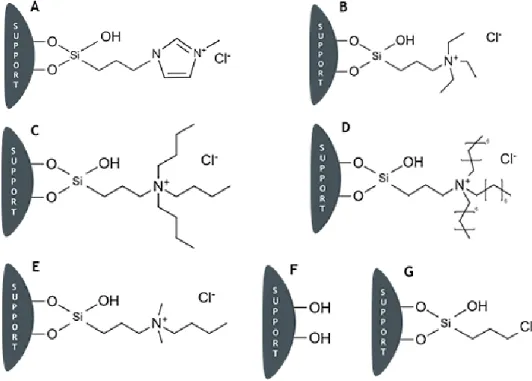
Inicialmente, diferentes ILs foram imobilizados covalentemente em suportes de sílica esférica, usada como fase estacionária, dos quais resultaram os seguintes materiais: [Si][C3C1Im]Cl, [Si][N3222]Cl, [Si][N3444]Cl, [Si][N3888] e [Si][N3114]Cl. Considerando estruturalmente os ILs selecionados, destaca-se a utilização como catião de um composto heterocíclico, um baseado em uma amina assimétrica e três com aminas simétricas que variam no tamanho da cadeia carbonada (contendo 2, 4 ou 8 carbonos). Para além da caracterização estrutural dos suportes, cada um deles foi empacotado em colunas de bancada e foram realizados ensaios de screening de ligação e eluição com amostras de RNA. Nestes ensaios, foi possível verificar que todos os ligandos tinham a capacidade de estabelecer interações electroestáticas e hidrofóbicas com o RNA, isto porque todos possuem grupos de carácter iónico e hidrofóbico, demonstrando assim a possibilidade de explorar um comportamento multimodal. Contudo, os resultados mais promissores foram obtidos com os suportes de [Si][N3222]Cl e [Si][N3114]Cl, pelo que foram estes os materiais usados nos ensaios seguintes. Neste contexto, a etapa seguinte foi de avaliação do potencial destes suportes para separar DNA e RNA presentes em amostras de lisado, considerando também o efeito do pH (entre 6 e 8) nos perfis de retenção e padrão de seletividade entre estas biomoléculas. Ambos os suportes demonstraram essa capacidade de separação, apesar de [Si][N3114]Cl ter apresentado melhor seletividade que [Si][N3222]Cl, sendo por isso mais promissor para outros estudos de separação.
Adicionalmente, foram realizados ensaios de estabilização de amostras de RNA com quatro diferentes ILs, nomeadamente [N1111]Cl, [N2222]Cl, [N3333]Cl e [N4444]Cl. Com este estudo foi observado um efeito negativo na estabilidade do RNA consoante o aumento do tamanho da cadeia carbonada do catião, tendo-se apenas obtido aumento da estabilidade térmica do RNA com o IL [N1111]Cl. Por fim, e de forma a averiguar a toxicidade dos suportes e dos ILs análogos, foram realizados ensaios de citotoxicidade numa linha celular humana, em que os materiais e
ILs foram colocados em contacto com as células até um período de tempo de 48 horas. Verificou-se que os suportes com os ILs imobilizados na superfície não demonstraram qualquer toxicidade para estas células, ao contrário do observado com os ILs análogos aos usados nos suportes. Estes demonstraram significativa toxicidade, que também se verificou ser dependente do tamanho das cadeias carbonadas e da concentração de IL aplicada, apresentando assim uma vantagem dos ILs imobilizados em suportes, comparativamente ao uso de ILs no estado líquido. Desta forma, foi possível demonstrar a importância de vários ILs na purificação e estabilização dos ácidos nucleicos, tratando-se de uma área em constante crescimento.
Palavras-chave
Abstract
Nucleic acids-based therapies have emerged as excellent approaches to treat various diseases such as cancer and neurodegenerative disorders. However, for these biomolecules to be used as biopharmaceuticals they must be obtained with high purity, presenting biological activity and structural integrity. As these are the main challenges in obtaining biopharmaceuticals, it is necessary to develop purification strategies that ensure their quality. Ionic liquids (ILs) are liquid salts at room temperature that have very interesting properties, namely the vast combination of cation and anion that can be made, thus tailoring the structures to the intended purpose.
This work has as main objective the development of a new strategy for the purification of nucleic acids using functionalized supports with different ILs. In addition, we also intend to evaluate the RNA stabilizing capacity of certain ILs as well as their toxicity in human cell lines in order to ascertain the biosafety of these substances.
Initially, different ILs were covalently immobilized onto spherical silica supports, used as a stationary phase, resulting in the following materials: [Si][C3C1Im]Cl, [Si][N3222]Cl, [Si][N3444]Cl, [Si][N3888]Cl and [Si][N3114]Cl. In addition to the structural characterization of the supports, and as a screening procedure, the binding and elution of low molecular weight RNA molecules was tested under ionic and hydrophobic conditions with all the synthesised supports, in order to select the most promising ligand(s) for nucleic acids purification. [Si][N3222]Cl and [Si][N3114]Cl were the chosen supports for further separation procedures between genomic DNA and RNA. Both supports showed ability for separating these two species, although [Si][N3114]Cl displayed better selectivity, thus becoming more promising for future separation assays. Additionally, RNA stabilization assays were performed with four different types of ILs, analogues to the ligands, namely [N1111]Cl, [N2222]Cl, [N3333]Cl and [N4444]Cl. Only [N1111]Cl showed to enhance RNAs thermal stability, verifying by this, a negative contribution of the alkyl chains lengths in the stabilization of this biomolecule. Besides, cytotoxicity assays with the two chosen supports and these four ILs were performed. IL-immobilized supports did not present any cytotoxicity, while liquid ILs were discovered to largely compromise cell viability. In this sense, the usage of ILs immobilized onto solid supports appears to be safer than using bulk ILs. Thus, was possible to demonstrate the importance of various ILs in purification and manipulation of nucleic acids, becoming a continuously growing area.
Keywords
Table of Contents
CHAPTER 1 – Introduction ... 1
1.1.Nucleic Acids ... 2
1.1.1.Ribonucleic Acid (RNA) ... 3
1.1.1.1.Coding and Non-coding RNA ... 4
1.1.1.2. ncRNAs: Role and Applications ... 7
1.2.Production of RNA ... 8
1.3.Chromatography for RNA purification ... 9
1.3.1.Size exclusion chromatography (SEC) ... 10
1.3.2.Hydrophobic interaction chromatography (HIC) ... 11
1.3.3.Ion-exchange chromatography (IEC) ... 12
1.3.4.Affinity chromatography (AC) ... 12
1.4.Ionic Liquids: Brief History ... 15
1.4.1.General Properties ... 15
1.4.2.Applications of Ionic Liquids ... 17
1.4.2.1.Biomolecules Stabilization ... 18
1.4.2.2.Extraction of Biomolecules by Aqueous Biphasic Systems ... 18
1.4.2.3.ILs in chromatography ... 20
1.4.2.3.1.ILs as mobile phase additives ... 20
1.4.2.3.2.ILs as stationary phase ... 20
1.4.2.3.3.ILs as ligands of the stationary phase ... 21
1.4.2.3.4.ILs to modify other chromatographic supports ... 22
CHAPTER 2 – Global Aims ... 23
CHAPTER 3 – Materials and Methods ... 25
3.1. Materials ... 26
3.2. Methods ... 27
3.2.1. Ligand immobilization in silica ... 27
3.2.2. Support characterization ... 27
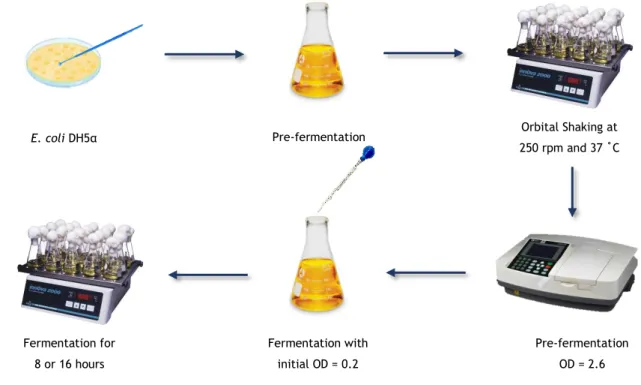
3.2.3. Nucleic acids production in Escherichia coli DH5α ... 29
3.2.5. Nucleic acids extraction ... 30
3.2.6. Agarose gel electrophoresis ... 31
3.2.7. Chromatographic assays ... 31
3.2.7.1. Screening of RNA binding/elution with different supports ... 31
3.2.7.2. Separation between nucleic acids ... 32
3.2.8. Column regeneration ... 32
3.2.9. Circular Dichroism (CD) spectroscopy ... 32
3.2.10. Eukaryotic cell culture and cytotoxicity assay (MTT) ... 33
3.2.11. Statistical analysis ... 33
CHAPTER 4 – Results and Discussion ... 34
4.1. Characterization of functionalized supports ... 35
4.1.1. Elemental Analysis ... 36
4.1.2. Nuclear Magnetic Resonance... 38
4.1.3. Scanning Electron Microscopy ... 39
4.2. Screening of binding/elution conditions for RNA ... 40
4.2.1. Electrostatic interactions ... 40
4.2.2. Hydrophobic interactions ... 42
4.3. Separation between gDNA and RNA ... 44
4.4. Circular Dichroism ... 48
4.5. Cytotoxicity effect of ILs ... 52
CHAPTER 5 – Conclusion and Future Perspectives ... 56
References ... 59
List of Figures
Figure 1: Structure of nucleotides 2 Figure 2: Structure of the major purines and pyrimidines that constitute nucleic acids (Adapted from Nelson et al., 2011) 2 Figure 3: siRNA, miRNA and piRNA silencing pathways and their essential components (Pereira et al., 2016) 6 Figure 4: Chemical structure of some IL cations and anions described in literature (Adapted from Soares et al., 2016) 16 Figure 5: Illustration of distinct ways of IL immobilization onto a support 21 Figure 6: Summarized scheme of the reactions performed for the functionalization of the silica supports with ionic liquids 28 Figure 7: Summarized scheme of the E. coli fermentation process 29 Figure 8: Representation of chemical structures functionalized silica with the different ILs 35 Figure 9: Results of 13C NMR analysis of functionalized silica supports in the solid state with the
different ILs 38 Figure 10: SEM analysis of activated and functionalized silica surface 39 Figure 11: Elution behaviour of RNA at each step of the chromatographic process in conditions that favour electrostatic interactions 41 Figure 12: Elution behaviour of RNA at each step of the chromatographic process in conditions that favour hydrophobic interactions 43 Figure 13: Representative chromatogram of the assays performed with RNA in [Si][N3222]Cl (A) and respective agarose gel electrophoresis of pH 8, 7 and 6 assays (B). In (C) is the chromatogram of the assays performed in [Si][N3114]Cl and respective agarose gel electrophoresis of pH 8, 7 and 6 assays (D) 45 Figure 14: Representative chromatogram of the assays performed with more complex samples of gDNA and RNA in [Si][N3222]Cl (A) and respective agarose gel electrophoresis of of pH 8, 7 and 6 assays (B). In (C) is the chromatogram of the assays performed in [Si][N3114]Cl and respective agarose gel electrophoresis of pH 8, 7 and 6 assays (D) 47 Figure 15: CD spectra (210 – 320 nm) of RNA collected from the purification assays with [Si][N3222]Cl and [Si][N3114]Cl 48 Figure 16: Chemical structure of the four different ILs used for RNA stabilization 49
Figure 17: CD spectra (210 – 320 nm) of RNA in the absence and presence of ILs 50 Figure 18: CD melting curves (265 nm) of RNA fractions incubated for 1 hour at 4 ºC with different ILs 51 Figure 19: Cellular viability (MTT assay) of human fibroblasts after 24 (A) and 48 hours (B) incubation with [Si][N3114]Cl support, and 24 (C) and 48 hours (D) incubation with [Si][N3222]Cl support 52 Figure 20: Cellular viability of human fibroblasts after 24 (A) and 48 hours (B) incubation with different IL’s 54
List of Tables
Table 1: Features comparison between RNA and DNA (Adapted from Pierce, 2016) 4 Table 2: Different types of ncRNAs with their corresponding lengths and main applications in various investigation areas 7 Table 3: Affinity Chromatography methods used in bioseparation of ncRNAs (Adapted from Pereira et al., 2016) 14 Table 4: General advantages and disadvantages of ILs (Adapted from Kunz & Häckl, 2016) 16 Table 5: Extraction of various interest compounds using IL based ABS 19 Table 6: Elemental analysis results of carbon, nitrogen and hydrogen for each synthesized support 37 Table 7: Melting temperatures (Tm) obtained from CD melting curves for each sample of RNA
List of Acronyms
AABS
Adenine
Aqueous Biphasic System AC C CD circRNA DEPC DNA dsRNA E. coli Affinity Chromatography Cytosine Circular Dichroism Circular RNA Diethyl Pirocarbonate Deoxyribonucleic Acid Double-stranded RNA Escherichia coli G GB-ILs gDNA hFIB HIC HIV HPLC IEC IL lncRNA mcDNA miRNA mRNA MTT ncRNA NMR pDNA PILs piRNA pre-miRNA pri-miRNA Guanine
Good’s Buffers ILs Genomic DNA Human Fibroblasts
Hydrophobic Interaction Chromatography Human Immunodeficiency Virus
High-Performance Liquid Chromatography Ion Exchange Chromatography
Ionic Liquid
Long non-coding RNA Minicircle DNA Micro RNA Messenger RNA
3-(4,5-dimethylthiazol-2-yl)-2,5-diphenyltetrazolium bromide Non-coding RNA
Nuclear Magnetic Resonance Plasmid DNA Poly(ionic liquids) Piwi-interacting RNA miRNA precursor Primary miRNA RISC RNA RNase rRNA SEC SEM
RNA-induced silencing complex Ribonucleic Acid
Ribonuclease Ribosomal RNA
Size Exclusion Chromatography Scanning Electron Microscopy
SILs siRNA snRNA
Supported Ionic Liquids Short-interfering RNA Small Nuclear RNA T Tm tRNA U Thymine Melting Temperature Transfer RNA Uracil
Scientific Communications
Oral Presentation - Award for “Best short-communication”Rita Carapito, Márcia Neves, Patrícia Pereira, Augusto Pedro, João A. Queiroz, Mara G. Freire, Fani Sousa. Ionic liquids-based supports for the purification of RNA. XIV Anual CICS-UBI Symposium. 4-5 July 2019, Covilhã, Portugal.
Poster Presentation (Accepted)
Rita Carapito, Márcia Neves, Patrícia Pereira, Augusto Pedro, João A. Queiroz, Mara G. Freire, Fani Sousa. Ionic liquids-based supports for the separation of nucleic acids. III International Congress in Health Sciences Research: Towards Innovation and Entrepreneurship - Trends in Aging and Cancer. 14-16 November 2019, Covilhã, Portugal.
1.1. Nucleic Acids
Deoxyribonucleic acid (DNA) and ribonucleic acid (RNA), which are the molecular storage of genetic information in cells (Nelson & Cox, 2011), are constituted by nucleotides, which also have a variety of roles in cellular metabolism. Nucleotides are composed by three characteristic elements: a nitrogen-containing base, a pentose, and a phosphate group. The common bases and pentoses of the nucleotides are heterocyclic compounds. The base of a nucleotide is covalently attached by an N-β-glycosyl bond to the 1’ carbon of the pentose ring, and the phosphate is esterified to the 5’ carbon (Figure 1). Relatively to nitrogen bases they can be classified as purines, which include adenine (A) and guanine (G), and pyrimidines, which include cytosine (C), thymine (T) and uracil (U) (Figure 2). Purines are constituted by two rings of five and six atoms, while pyrimidines are constituted only by one ring of six atoms (Nelson & Cox, 2011; Quintas et al., 2008).
Both DNA and RNA contain the two purines, adenine and guanine, and the pyrimidine cytosine. However, they differ in one pyrimidine, because DNA has thymine in its constitution, while RNA has uracil. Only rarely thymine occurs in RNA or uracil in DNA (Nelson & Cox, 2011; Quintas et
al., 2008).
Figure 2: Structure of the major purines and pyrimidines that constitute nucleic acids (Adapted from Nelson et al., 2011).
Figure 1: Structure of nucleotides. A represents the general structure of a nucleotide, with the convention numbering of the pentose ring. In this case, it is shown a ribonucleotide, due to the presence of the −OH group on the 2’ carbon (in orange), which is replaced by −H in deoxyribonucleotides. B and C represent the general structures of pyrimidine and purine bases of nucleotides, with the respective numbering conventions (Adapted from Nelson & Cox, 2011).
Nucleotides in nucleic acids are successively linked by a covalent bond through phosphate-group “bridges”, in which the 5’-phosphate group of one nucleotide is linked to the 3’-hydroxyl group of the next nucleotide, and so creating a phosphodiester linkage. This molecules organization confers a moderate hydrophilic nature to both DNA and RNA. The phosphate groups, with a pKa
near to 0, are completely ionized and negatively charged at pH 7, and the negative charges are generally neutralized by ionic interactions with positively charged groups on proteins, metal ions and polyamines (Nelson & Cox, 2011).
1.1.1.
Ribonucleic Acid (RNA)
Regarding the role of RNA in cells, for long time it was only seen as a simple intermediate in the transference of genetic information from DNA to proteins, with no further functionalities in the complex gene expression process. However nowadays, it is known that different types of RNA play a pivotal role in several essential biological processes, including epigenetic control, gene transcription, translation, RNA turn over, chromosomal organization, genome defense, among others. Examples of classes of RNA involved in the catalysis and genetic regulation are ribozymes and micro RNAs (miRNAs), respectively. Meanwhile, new roles for RNA continue to be discovered, thus proving the tremendous importance of this macromolecule in cell biology and consequently, in the potential diagnosis and treatment of many diseases (Guil & Esteller, 2015; Martins et al., 2014; Sharp, 2009; Quintas et al., 2008).
RNA is a polymer with a long chain of ribonucleotides, that often presents a single-stranded structure and is quite flexible. This biomolecule resembles to DNA in many ways, except for one nucleotide, as mentioned above. Besides this, each nucleotide in RNA has a 2’-OH group in the pentose ring (ribonucleotide), contrary to DNA, that has only a hydrogen atom in the same position (deoxyribonucleotide). This characteristic confers DNA a greater resistance to alkaline hydrolysis, and so RNA is less stable due to its 2’-OH group making the 3’-phosphodiester bond susceptible to nucleophilic cleavage, being easily hydrolyzed by hydroxide ions (Martins et al., 2014). Therefore, RNA is quite unstable in vivo given that ribonucleases (RNase) are always present in serum and in cells (Burnett & Rossi, 2012). Though RNA displays usually a single-stranded conformation, when short regions within the nucleotide strand have complementarity, they can pair and form secondary structures. In contrast, since DNA is already constituted by two complementary strands, is inherently more restricted in the range of secondary structures that can assume. RNA secondary structures are often designated as hairpins (or hairpin-loop or stem-loop structures). Once these secondary structures are determined by the base sequence of the nucleotide strand, many different types of structures can take place, and since their structures dictate their function, RNA molecules have the potential of performing a tremendous variety of functions (Pierce, 2016). These comparison between DNA and RNA characteristics is summarized in Table 1.
1.1.1.1.
Coding and Non-coding RNA
Coding RNA refers to the RNA that encodes for a protein, which is messenger RNA (mRNA). The mRNA contains the information needed to produce a protein, which means that the nucleotides sequence on the mRNA dictates the sequence of amino acid residues in the polypeptide chain resulting from the translation process (Pierce, 2016; Quintas et al., 2008).
The first step of gene expression is transcription, in which an mRNA molecule is formed based on the information of a DNA template, by the enzyme RNA polymerase in the nucleus. The product of transcription of DNA is a single-stranded RNA, which tends to assume a right-handed helical conformation dominated by base stacking interactions, and when there are any self-complementary sequences in the molecule, more complex structures take place (Nelson & Cox, 2011). Following some modifications, the mature mRNA is then used in the translation process to obtain the encoded protein.
Non-coding RNA (ncRNA) refers to RNA that does not encode a protein but modulates cell function by controlling gene expression programs through many different mechanisms (He et
al., 2018; Idda et al., 2018). ncRNAs are divided into two groups: housekeeping ncRNAs and
regulatory ncRNAs. The housekeeping ncRNAs are constitutively and ubiquitously expressed and play crucial roles in diverse cellular activities; they include transfer RNA (tRNA), ribosomal RNA (rRNA) and small nuclear RNA (snRNA). The tRNA acts like an adaptor molecule during protein synthesis, being the carrier of amino acids and acting as the physical linkage between mRNA and the amino acid sequence of the protein. In its turn, rRNA is one of the structural components of the ribosome and is the predominant product of transcription, constituting about 80-90% of total mass of cellular RNA. In prokaryotes there are three types of rRNA: 16S, 23S, and 5S, while in eukaryotes exist 4 types: 18S, 28S, 5.8S, and 5S. Lastly, snRNAs comprise a small group of non-polyadenylated non-coding transcripts that act in the nucleoplasm (Quintas
et al., 2008; Matera et al., 2007).
On the other hand, regulatory ncRNAs are expressed in specific cell types and act in response to developmental cues, internal conditions, and environmental stimulations. Thus, regulatory
Features DNA RNA
Composed by nucleotides Yes Yes
Sugar type Deoxyribose Ribose
Presence of 2’-OH group No Yes
Bases A, G, C and T A, G, C and U
Double or single stranded Usually double Usually single
Secondary structure Double helix Many types
Stability Stable Easily degraded
ncRNAs include short-interfering RNA (siRNA), piwi-interacting RNA (piRNA), long non-coding RNA (lncRNA), circular RNA (circRNA) and micro RNA (miRNA) (Idda et al., 2018; Quintas et al., 2008). The siRNAs (20-25 nt) are a class of double-stranded RNAs (dsRNAs) designed specifically to silence the expression of target genes (Gallas et al., 2013). The piRNAs (24-32 nt) are short single-stranded ncRNAs produced via DICER-independent mechanism. By interacting with piwi-proteins, these RNAs regulate gene expression programs through transposon silencing, gene transcription, as well as mRNA turn over and translation (Ponnusamy et al., 2017). LncRNAs (>200 nt) consist in pivotal molecules in the regulation of gene expression, once they bind to the mRNA with few or no protein-coding capacity. This type of RNAs can be located within nuclear or cytosolic fractions, and have some structural features similar to mRNA, including 5’ capping, polyadenylated 3’ tails and undergo through alternative splicing to give origin to the final product (Pereira et al., 2016 (b)). Regarding circRNAs (50-2000 nt), that were more recently discovered as a special novel type of endogenous ncRNAs, they present covalently closed loop structures with neither 5’ or 3’ polarities, and non-polyadenylated tails, unlike linear RNAs (Qu et al., 2015). This specific structure allows this class to not be affected by exonuclease RNase R. Although circRNAs in humans are considered to belong to ncRNAs class, some of them are experimentally verified to encode protein products (Bagchi, 2018).
In respect to miRNAs (20-30 nts), they are the most intensively studied type of ncRNAs due to their great potential for the development and application in therapeutic strategies for diseases that are caused by gene defections, since Human Immunodeficiency Virus (HIV) infection, to various types of cancer, and even Alzheimer’s disease (AD). This therapeutic effect can be accomplished because miRNAs, depending on the degree of complementarity, are capable of binding to mRNA and directly repress the expression of the protein encoded in that same mRNA. This regulation is made through a series of successive biological steps, at the post-transcriptional level, involving a miRNA precursor (pre-miRNA), and consequently, a mature miRNA that will be incorporated into the RNA-induced silencing complex (RISC) in order to regulate the target mRNA. This biochemical mechanism is more detailed in Figure 3 (Pereira et
al., 2017; Pereira et al., 2016 (b); Gomes et al., 2013; Burnett & Rossi, 2012;).
There are two different types of therapeutic strategies based on miRNA. One approach goes through a miRNA replacement, where a specific miRNA is under expressed in a disease, and therefore, a small double-stranded RNA molecule is delivered into the cells attempting to mimic the activity of the absent or downregulated miRNA. On the other hand, the other strategy undergo miRNA targeting, where antisense oligonucleotides bind to endogenous miRNAs to restrain their interaction with targets (Vidigal & Ventura, 2015; Guo et al., 2011). Since this targeting process requires the presence of such short-conserved sequences, experimental evidence has shown that under or overexpression of a miRNA in cultured cells results in the regulation of hundreds of genes (Vidigal & Ventura, 2015).
Figure 3: siRNA, miRNA and piRNA silencing pathways and their essential components (Pereira et al., 2016 (b)).
1.1.1.2. ncRNAs: Role and Applications
In Table 2 are summarized the main functions of each ncRNA presented in the previous topic, as well as their corresponding applications in many different research areas.
ncRNAs Length Function Applications References
tRNA 76-90 nt
Helps to incorporate amino acids into polypeptide chain
In vitro kinetics studies of
translation rate
Pierce, 2016; Ledbetter et al. , 2018
rRNA Variable
Structural and functional components of the ribosome
Structural and functional studies of mechanism features of translation process
Pierce, 2016; Weisser & Ban, 2019
snRNA ~150 nt Splicing and other functions
Understanding many human diseases
Martins et al., 2014; Matera et
al., 2007
siRNA 20-25 nt mRNA cleavage and translation repression
Therapeutic tool for many diseases, including cancer
Martins et al., 2014; Hajiasgharzadeh et al., 2018 piRNA 24-32 nt Supresses the transcription of transposable elements in reproductive cells Studies of molecular mechanisms, associated to various diseases, specially cancer
Öner, 2019; Pierce, 2016
lncRNA > 200 nt
Transcriptional and post-transcriptional
regulation of gene expression
Maintain cell physiology and are involved in a range of human diseases including AD, cardiovascular disorders and cancer
Gomes et al., 2013; Idda et al., 2018
circRNA 50-2000 nt
Regulate gene expression by acting as a miRNA sponge, RNA binding protein sponge and translational regulator
Novel therapeutic
approaches to treat various diseases from neurological disfunctions to cancer
Sekar & Liang, 2019; Zhang et
al., 2018
miRNA 20-30 nt mRNA cleavage and translation repression
Already shown promising results for treatment of cancer, degenerative disorders and viral infections
Martins et al., 2014; Saliminejad
et al., 2018 Table 2: Different types of ncRNAs with their corresponding lengths and main applications in various investigation areas.
Besides the applications referred above, it must be noted that siRNA, lncRNA, piRNA, circRNA and miRNA are believed to be potential biomarkers for various diseases, thus developing an important role in the diagnosis and prognosis of these diseases (Fattahi et al., 2019; Öner, 2019; Sekar & Liang, 2019; Hajiasgharzadeh et al., 2018; Saliminejad et al., 2018). By this, we can infer the great importance of preparing these biomolecules in order to be applied in a large range of studies.
1.2. Production of RNA
RNA is gaining more and more relevance as an increasing number of functions, including regulatory and enzymatic functions, are being discovered. In order to understand RNA functions and perform biochemical, biophysical and genetic studies, sample preparation is required, and most techniques are still in development (Baronti et al., 2018; Beckert & Masquida, 2011). Several available techniques are adequate for molecular biology procedures, but if it is intended the preparation of RNAs for therapeutic purposes, other challenges must be overcome, and the procedures must be improved in accordance with the product requirements. Most miRNAs used in the development of new therapeutic strategies have been obtained by chemical synthesis, enzymatic synthesis, or recombinant production (Pereira et al., 2017 (a)).
Chemical synthesis is the method of choice to produce oligonucleotides shorter than 10 nucleotides, being the upper size limit of approximately 80 nucleotides. The synthesis reaction proceeds from the 3’ end to the 5’ end, and comprises four steps, that include 2’-OH and 5’-OH protecting groups of phosphoramidite monomers and successive reactions of deblocking-coupling-capping-oxidation. The whole cycle can be repeated until the desired length of the oligonucleotide polymer is achieved. Therefore, it is a fast method and possible to modify, however, it requires expensive equipment, it has a limited chain length, and modified phosphoramidites are very expensive (Baronti et al., 2018; Hogrefe et al., 2013; Caruthers et
al., 2011).
In the other hand, enzymatic synthesis, or in vitro transcription, allows template-directed synthesis of RNA molecules with any sequence, since short oligonucleotides to those of several kilobases. An RNA molecule is synthesized by in vitro transcription using the promotor components of bacteriophage systems, being the most frequently used the T7 system that requires only Mg2+ as a co-factor to perform RNA synthesis. Although this method can produce
RNA molecules on a microgram scale, large-scale production is more difficult by the necessity of high quantities of RNA polymerases, which are very expensive. Besides that, the method often results in low yields and multiple enzymatic and purification steps are required in order to remove impurities associated to the process. In fact, the presence of some impurities can lead to non-targeted gene silencing, which unable these produced RNAs to be applied onto preclinical or clinical studies (Baronti et al., 2018; Pereira et al., 2017 (a); Beckert & Masquida, 2011).
However, considering that there is a need for rapidly produce promising biopharmaceuticals, and even achieve sustainable production procedures at large scale, recombinant production
emerges as the more promising method for this purpose. Recombinant RNA techniques using in
vivo agents are more capable to retain the structure, function and safety properties of natural
RNAs. The principle of this production strategy consists in the introduction of the target RNA coding sequence into a vector, and the resulting plasmid is inserted into the host cells, usually
Escherichia coli (E. coli). Posteriorly, the cell machinery will produce the target RNA that will
be accumulated in the cytosol. The recovery of RNA depends on the lysis of these cells, and finally the RNA of interest must be purified mainly by chromatographic techniques. Thus, recombinant approaches offer a cheap and simple alternative to in vitro synthesis, being capable of achieving high yields in a shorter period of time (Baronti et al., 2018; Pereira et al., 2017 (a) ; Pereira et al., 2017 (b); Ponchon & Dardel, 2011).
The possibility of using different expression hosts has been considered by Pereira and co-workers, when using Rhodovulum sulfidophilum as an expression system. In that work, it was shown that, even though E. coli production could lead to higher yield within a shorter period of time, the production in R. sulfidophilum could be advantageous because of its ability to secrete the RNA to the extracellular medium, which greatly simplifies the downstream purification and limits protein contamination (Pereira et al., 2016 (a)).
1.3. Chromatography for RNA purification
Usually, RNA molecules are obtained from complex mixtures, being of great importance the establishment of a robust purification process in order to obtain the target molecule with total integrity, stability, and purity. In this sense, chromatography techniques arise as the method of choice for the purification of biomolecules, since they are capable of isolating different products with high intrinsic value (Scott, 2003).
Chromatography consists in a very robust, efficient and versatile technique, in which with only a single step, it can be possible to separate a mixture into its individual components and simultaneously, have a quantitative characterization of each component. This differential separation of the mixture is achieved by the co-existence of two main phases, the stationary phase and the mobile phase of the system. The stationary phase is always composed by a solid phase, or solid support with ligands or a layer of a liquid adsorbed on its surface, while the mobile phase is always a liquid or a gaseous component (Coskun, 2016; Scott, 2003). The constituents of the mobile phase that interact more with the stationary phase are more retained in the system than those that are distributed selectively in the mobile phase. As a result, solutes are eluted from the system in the increasing order of affinity to the column, this is, the more interacting solutes will be eluted at the end, while the least interacting will be eluted at the beginning of the run (Grob, 2004). The elution process can be controlled by different conditions, including ionic strength, temperature, pH, various additives such as detergents, reducing agents and metals. Therefore, by appropriately adjusting the buffer composition, the conditions of binding and elution of the target biomolecule can be optimized (Janson, 2011).
As a matter of fact, a chromatographic process occurs in five main stages: 1) An equilibration of the two phases, adjusting de column to the binding conditions; 2) Sample injection; 3) A washing or elution of non-binding molecules; 4) Elution of the target biomolecule by altering the buffers composition; 5) A regeneration/re-equilibration step, in which all the remaining bound material and impurities are eluted, and de column is ready for another chromatographic process. An ideal matrix should be chemically and physically stable so that it can be resistant to extreme conditions usually used in regeneration and sterilization steps between chromatographic assays. It should also be rigid enough to allow high linear flow rates (5 cm/min or more), and the matrix substance should allow the formation of gels with a wide range of controllable porosities (Janson, 2011).
1.3.1.
Size exclusion chromatography (SEC)
Size exclusion chromatography (SEC) or gel filtration consists of a separation technique that discriminates different compounds by their size or molecular weight. So, in the mobile phase, larger molecules, with higher molecular weight, flow through the column without being retained because they do not fit into the pores of the stationary phase. Therefore, these bigger compounds are the first ones to be eluted. Meanwhile, smaller particles that can fit into de smaller pores, reside longer in the stationary phase, being eluted later. Thus, in SEC, components of the mobile phase elute by decreasing order of their size (Coskun, 2016; Janson, 2011; Grob, 2004).
SEC is a separation process often chosen when a sample is already clarified, having the purpose of evaluating the presence of high-order impurities such as aggregates or degradation products (Shimoyama et al., 2017; Sousa et al., 2008). Regarding nucleic acids purification, SEC can be applied in a mixture containing genomic DNA (gDNA) or plasmid DNA (pDNA) that elute firstly in the run due to their high molecular weight, and other impurities like RNA, proteins and endotoxins, with lower molecular weights that elute later. It should be noted that this effective separation between DNA and RNA can only be accomplished by choosing an appropriate support. As a matter of fact, inherent disadvantages are associated with this type of chromatography, namely low resolution and the need for higher dilutions of the sample. Thus, SEC is mainly seen as a final step in the downstream processing of nucleic acids (Sousa et al., 2009; Fani Sousa et
al., 2008).
In a recent study, a novel minicircle DNA (mcDNA) purification method was established by Almeida and co-workers. In here, it was possible to successfully isolate mcDNA from RNA, parental plasmid and miniplasmid by size exclusion chromatography with a Sephacryl S-1000 SF matrix, achieving 66.7% of mcDNA recovery with 98.1% of purity (Almeida et al., 2019).
1.3.2.
Hydrophobic interaction chromatography (HIC)
Hydrophobic interaction chromatography (HIC) is a well-established bioseparation technique at the laboratory and industrial scales. HIC explores hydrophobic interactions between immobilized hydrophobic ligands and non-polar regions of the biomolecules surface, having few solvent requirements. In this method, the target biomolecule retention occurs at relatively high salt concentrations (usually ammonium sulfate), due to a displacement of ordered water molecules around the solute leading to an increase of the entropy. Then, desorption of bound solutes is achieved by performing a stepwise or linear gradient elution with buffer containing low salt concentration, thus weakening the hydrophobic interaction occurring between the biomolecules and chromatographic ligands. It is one of the simplest chromatographic separation methods in terms of operation mode, and although the interaction mechanism is complex, a minimal structural damage occurs to the biomolecule, preserving its biological activity (Guerrero-Germán et al., 2011; Janson, 2011; Freitas et al.,2009; Sousa et al., 2009; Sousa et
al.,2008).
Nevertheless, the need for high concentrations of salt in the binding step constitutes a major disadvantage, regarding the industrial application of this method, because the use of salt is directly associated with higher costs and negative environmental impact (Sousa et al., 2009). In what concerns to nucleic acids purification, HIC has been applied more properly on preparative purification of pDNA. In this case, it takes place a negative chromatography, in which the aim is to bind impurities (RNA, gDNA, oligonucleotides, denatured pDNA) instead of binding the target biomolecule. Since the majority of impurities possess more hydrophobic character than the target molecule, they bind easily to the column in the presence of salt, while the double-stranded pDNA elutes in the first place. The single-stranded hydrophobic impurities can then be eluted by decreasing the ionic strength of the eluent (Sousa et al., 2009; Diogo et al., 2003).
Diogo and co-workers studied the capacity of the support Sepharose CL-6B treated with 1,4-butanediol diglycidyl ether to separate nucleic acids by exploring hydrophobic interactions. It was observed that, when a nucleic acids-containig mixture obtained from E. coli cells was loaded onto the column, it was possible to separate single stranded from double stranded nucleic acids. RNA and gDNA were more retained in the column, due to interactions occurring with the hydrophobic exposed bases of these biomolecules, while pDNA was eluted in the beginning since nitrogenous bases are less exposed (Diogo et al., 2002). These results allow to infer that HIC supports can also be used for RNA purification, exploiting its ability to bind and taking advantage from the different interaction strengths between ligands and other retained species.
1.3.3.
Ion-exchange chromatography (IEC)
In ion-exchange chromatography (IEC), the separation is based on the reversible electrostatic interaction between a charged solute and an oppositely charged chromatographic column. The strength of the interaction depends upon the overall net charge of the analyte, and the competition from other ions for the charged groups of the ion exchanger (Janson, 2011). This separation technique can be performed in two distinct ways. When the matrix is positively charged, the solutes that are negatively charged are going to be adsorbed onto the column, being this designated as anion-exchange chromatography. On the other hand, when the matrix is negatively charged, the solutes that are positively charged are going to be adsorbed, being this the cation-exchange chromatography (Coskun, 2016). When oligonucleotides are meant to be separated, it is anion-exchange chromatography that is used, and elution is achieved through competition of the binding site with an increasing gradient of anions in the mobile phase, and so nucleic acids elute in the order of an increasing overall net charge (McGinnis et al., 2012; Sousa et al., 2008). Nucleic acids, which are polyanionic molecules due to the presence of phosphate groups on their backbone structures, are conveniently captured on a support functionalized with positively charged groups. IEC offers many different advantages, such as a rapid separation and analysis, does not need the use of organic solvents, it is possible to perform sanitization with sodium hydroxide and there are many commercial stationary phases available in the market. However, there are some drawbacks, because in some cases RNA can co-elute with pDNA, and has a relatively low resolution between pDNA and endotoxins (Fani Sousa et
al., 2008; Eon-duval & Burke, 2004). Easton and co-workers have described a fast method for
RNA oligonucleotides purification using anion-exchange liquid chromatography with suitable quality for structural and biochemical studies. By using a diethylaminoethyl sepharose support it was possible to separate the desired RNA product from other RNA species like T7 RNA polymerase, small abortive transcripts and the plasmid DNA template (Easton et al., 2010).
1.3.4.
Affinity chromatography (AC)
Affinity chromatography (AC) is the most powerful and versatile type of chromatography, even when the target biomolecule is a minor component of a complex mixture. The separation of sample components and the recognition of the target biomolecule is based in specific interactions, as the ones found for example between antigen-antibody, enzyme-substrate or nucleic acid-protein. So, these different types of interactions that naturally occur in many biological systems are extrapolated to AC, by immobilizing one of the members of the pair in the stationary phase (ligand), while the other member passes through the column in the mobile phase, being adsorbed in the solid phase (Janson, 2011). Nevertheless, the biological nature of the ligands can represent a limitation to this purification technique, since these ligands tend to be fragile and present low binding capacities. Hence, there is a growing interest on the design of synthetic ligands that would mimic the biologic ones, presenting the same selectivity, as well as high capacity, durability, robustness, and reproducibility (Pereira et al., 2016 (b); Sousa et al., 2008).
The interactions occurring in AC can be of many different natures, like electrostatic and/or hydrophobic interactions, hydrogen bonds, van der Waals forces, dipole-dipole forces, and π-π interactions. The selectivity results from the conjugation of multiple interactions. However, some interactions can be preferentially established depending on the chromatographic conditions used, namely in the mobile phase, which confers high selectivity and resolution to this technique. Hence, the elution step can be performed in two distinct ways: specifically (biospecific elution), where a competitive agent is applied in the mobile phase that can either bind to the retained target or to the immobilized ligand, depending on their characteristics, or non-specifically, where chemical changes are made in the mobile phase by altering ionic strength, type of salt, pH or polarity depending on the matrix and the chemical features of the biomolecule. It should be noted that the binding strength between ligand and target molecule should not be too weak, or there will be no adsorption, nor be too strong, in order to be possible to perform elution in moderate conditions. Thus, it is crucial that the complex ligand-biomolecule forms a reversible bonding in order to preserve the good quality and biological activity of the target biomolecule (Pereira et al., 2016 (b); Sousa et al., 2009; Janson, 2011). Due to the high nucleotide bases exposure, RNA becomes very accessible for the establishment of many interactions with the ligand chosen for the separation. Therefore, different types of AC have already been tested and proven to succeed in the purification of ncRNAs, taking advantage of properties such as its size, charge and hydrophobicity, namely boronate AC, RNA affinity tags and amino acid-based AC, being their respective advantages and disadvantages discriminated in Table 3 (Wei et al., 2014; Pereira et al., 2014; Flores-jasso et al., 2013; Srivastava et al., 2012). It should be noted that our research group developed a successful purification method of pre-miR29 from other small RNA molecules through the use of an Arginine-Sepharose 4B gel, with high purity levels and structural integrity (Pereira et al., 2014).
Methods Target RNA Advantages Disadvantages Boronate Affinity Chromatography • tRNAs ✓ Isolation from complex cell extracts ✓ No pre-treatment of the sample is needed ✓ High purity and
quality
✓ Efficient elimination of gDNA
✓ Very fast process
x Sometimes, the column must be washed with 6M urea prior to washing with the regeneration buffer RNA Affinity Tags • shRNA • miRNA • miRNA-mRNA complex RNA oligonucleotides
✓ Reliable, fast and robust method ✓ Broadly applicable to
any RNA of interest ✓ High recovery and
purity
x Chemical modifications during the process can lead to structural perturbations x Contamination of
the target RNA with tag can occur x Use of proteases requires additional purification steps Amino Acid-based Affinity Chromatography • pre-miRNA • rRNAs • tRNAs • total RNA ✓ Isolation from complex cell extracts ✓ Robust method using
natural small ligands ✓ High purity and
quality of purified RNA
✓ High reproducibility ✓ Efficient elimination
of endotoxin, proteins, gDNA and single/double stranded RNAs ✓ Occurs under
non-denaturing conditions
x High salt
concentrations can be required for the elution of the target RNAs x Low recovery yields x Lower durability of
supports
1.4. Ionic Liquids: Brief History
In the last few years, ionic liquids (ILs) have attracted the interest of many researchers, due to their versatility and many different applications in several areas. They can be used on almost all kinds of chemical transformations, and they present some exceptional properties, which will be discussed below (Kuchenbuch & Giernoth, 2015).
The first IL was discovered by Paul Walden in 1914 when he was searching for molten salts that were liquid at temperatures at which he could use his equipment without special adaptations. Walden’s interest in these molten salts was the relation of their molecular size and their conductivity, however, and unfortunately, the potential of this breakthrough went unnoticed for a long time. Almost 40 years later, in 1951, another group recognized the potential benefits of lower melting points of the molten salts (Welton, 2018). Nowadays, ILs are extensively employed in various fields, like, organic, inorganic, physical, and biological chemistry (Shukla
et al., 2018).
1.4.1.
General Properties
ILs are pure salts that, in contrast with common electrolytes, are liquid at room temperature, because their melting point is below 100 ºC. They are constituted by a large and unsymmetrical organic cation and an organic or inorganic anion. This fact contributes to their enormous versatility since there are numerous possible cation and anion combinations, with the possibility of designing task-specific ILs, and because of that, they are designated as “Designer Solvents” (Ventura et al., 2017; Freire et al., 2012). Due to their ionic character, ILs present some outstanding features, including low volatility, non-flammability, variable viscosity, high ionic conductivity, wide electrochemical potential window, high solvation ability, as well as excellent chemical, thermal and electrochemical stability (Sintra et al., 2017; Ventura et al., 2017; Freire et al., 2012). The first two characteristics contribute to the classification of ILs as “Green Solvents”, and as a result, these fluids have been viewed as good alternatives to replace dangerous and volatile organic solvents (VOSs) recurrently used in a wide range of processes. Theoretically, this replacement would eliminate these solvents’ losses to the atmosphere, and consequently reduce the harmful effects to the environment and human resources, making it possible to develop “greener” processes (Taha et al., 2017; Freire et al., 2012). ILs are also usually recognized by their excellent solvation capacity for a wide range of compounds, as well as a good stabilizing media for proteins, nucleic acids, and others (Ventura et al., 2017). In Figure 4 are represented the structures of commonly used IL cations and anions and in Table 4 their general advantages and some disadvantages.
However, the fact that ILs have a negligible vapor pressure is not enough to assure that these fluids can be considered as environmentally harmless solvents, making it imperative to determine their environmental, health and safety impact (Sintra et al., 2017; Petkovic et al., 2011). The ionic character of ILs makes most of them soluble in water, even the most hydrophobic ILs, which can lead to an environmental problem if they happen to be toxic to the
Advantages Disadvantages
Number of imaginable solvents
High number, up until 1018
possible combinations Cost
Commonly 5-20 times more expensive than molecular solvents
Tunability
Tunable by varying functional groups or alkyl chain length (“Designer Solvents”)
Viscosity Often very high viscosity of pure ILs
Vapour pressure
Negligible vapour pressure at normal conditions, with almost no emission to the atmosphere
Vapour pressure
Low vapour pressure limits distillative solvent separation Flammability Usually non-flammable Synthesis In many cases costly multi-step synthesis Detachability Vaporable compounds can easily be separated Sustainability
Green image, but often toxic, biodegradable and non-sustainable in their way of synthesis
Stability Thermo and electrochemically stable in a wide potential range Corrosiveness Often significant to very high corrosiveness Figure 4: Chemical structure of some IL cations and anions described in literature (Adapted from Soares et al., 2016).
aquatic environment and organisms living in it. The main challenges in using ILs for manipulation of biomolecules are the significant uncertainty of their toxicity, both eco and cytotoxicity, biodegradability and the eventual effect of the ILs on biomolecules (Sivapragasam
et al., 2016). Due to that, researchers are more concerned about their potential impact on the
aquatic and terrestrial environments, and since ILs are constituted by an anion and a cation, those two parts must be considered in this issues (Amde et al., 2015; Kudłak, 2015; Jordan & Gathergood, 2015). From the data hitherto reported, several studies have been done, in various cell types, like bacteria, fungi, algae, mammalian cell lines, vertebrates, and others (Sintra et
al., 2017). It was found that the toxic effects of ILs vary considerably according to their type,
test conditions and morphology of the model organisms (Amde et al., 2015). For example, it is well established that cation toxicity highly depends on the alkyl side chains length, due to increasing hydrophobicity and consequently, lipophilicity. This is, ILs with long alkyl chains in the cation, are significantly more toxic than ILs with shorter chain versions (Mikkola et al., 2015). In addition to the strong side-chain effect, the chemical structure of the cationic group also has a significant effect on toxicity, this is, imidazolium, pyridinium and quinolinium groups display stronger toxicological effects even when they have shorter side chains linked (Sivapragasam et al., 2016). Regarding the effect of the anion part, studies have shown that this counterpart presents less toxicity effect than changing the alkyl chain substituent in the cation. However anions impact in toxicity should not be underestimated (Kudłak, 2015; Pham
et al., 2010). Hence, it is of great importance to perform a complete ecotoxicological
characterization before assuming ILs as environmentally compatible, as well as cytotoxic assays (Santos et al., 2015).
There is also an agreement on the fact that functionalized cations tend to form less toxic ILs when compared with non-functionalized counterparts since they are made more hydrophilic, and that the cation is the main driver of toxicity (Santos et al., 2015). So, it was observed that incorporation of functional polar groups like ether, hydroxyl and nitrile groups to the side chains reduces toxicity when compared to those with “simple” alkyl side chains, and additionally increases the biodegradation efficiency to some extent (Pham et al., 2010). Considering their “designer solvent” character becomes possible to tailor ILs by combinaing suitable funtional groups on their structure, which will lead to a more environmental friendly compound, thus ensuring its safe application in biotechnological processes.
1.4.2.
Applications of Ionic Liquids
It should be noted that ILs are not only limited to the role of solvents, on the contrary, due to their enormous versatility and beneficial features, in the last two decades, they could be extended to many different fields of industry like chemistry, electrochemistry, nanotechnology, medicine, material production, power engineering, biotechnology, among others (Kudłak, 2015). In the next topics we will focus mainly in the application of ILs in stabilization, extraction, and purification of different types of biomolecules.
1.4.2.1. Biomolecules Stabilization
ILs have recently been studied as versatile solvents and additives in biotechnology field, particularly as stabilizers of proteins, enzymes and nucleic acids. In this industry it is of extreme importance the formulation of stable biopharmaceuticals, therapeutic proteins and vaccines, which have revolutionized the treatment of various diseases, as mentioned above. Thus, becomes very important to assure the preservation of these therapeutic biomolecules in long-term storage, maintaining their integrity and biological function (Clark et al., 2018). Proteins storage in water limits their application in many fields since their thermal stability decreases. Most of the preservation methods used to overcome this problem, like chemical modification, immobilization and stabilizers addition do not prevent their irreversible thermal denaturation. By this, numerous studies have shown that some ILs are efficient in maintaining or even increasing proteins solubility and stability. Once proteins solubilization in ILs is favoured, it is less likely to occur protein aggregation, consequently improving their stability and activity (Sivapragasam et al., 2016). Taha and co-workers have discovered that stability of bovine serum albumin (BSA) in aqueous solutions of cholinium-based Good’s buffers ILs (GB-ILs) was increased when compared to other aqueous solutions (Taha et al., 2015).
Regarding DNA, it also has been proven many advantages of using ILs in their storage, including enhanced solubility and excellent stability. Nucleic acids are highly susceptible to nuclease cleavage, mainly RNA since it is less stable, however most stabilization studies with ILs have been more focused on DNA (Pedro et al., 2018; Clark et al., 2018). For example, in a study, 25% (w/w) of DNA was solubilized in 2-hydroxyethylammonium formate, which is an ammonium-based IL, and a long-term chemical and structural stability was verified upon storage under ambient conditions for at least one year. This was indicative of a great nucleic acid preservation medium (Singh et al., 2017). Another study performed by Tateishi-Karimata and co-workers, proved that solutions with high concentrations of choline dihydrogen phosphate induced an increased stability of G-quadruplex and i-motif DNA (Karimata et al., 2015). A more recent study with RNA, performed by our research group, has proven that some GB-ILs like [Ch][HEPES] and [Ch][MES] would also increase this biomolecule thermal stability, preserving its structural characteristics. Besides this, these specific ILs also shown no cytotoxicity to human cell lines, which is extremely relevant when envisaging the use of RNA as biopharmaceutical (Pedro et
al., 2018).
1.4.2.2. Extraction of Biomolecules by Aqueous Biphasic Systems
The ability of ILs to create biphasic splitting makes them promising candidates for Aqueous Biphasic Systems (ABS). ABS are a softer and greener alternative to traditional liquid-liquid extraction techniques, which generally make use of hazardous VOSs and aim for the efficient separation of biomolecules.
ABS consist of two immiscible aqueous rich phases based on combinations of polymer-polymer (for example polyethylene glycol and dextran), polymer-salt, or salt-salt. Both solutes are water soluble, however, above a given concentration, they separate into two coexisting phases:
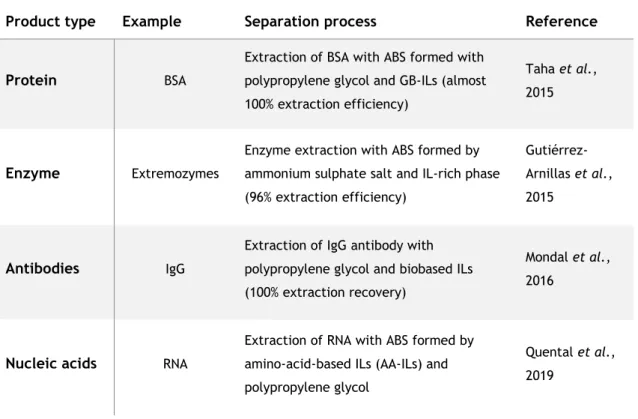
one of the aqueous phases is rich in one solute, whereas the other phase is enriched with the other polymer/salt. These systems have been recognized as an economical method, exhibiting low-energy consumption, high performance, high biocompatibility and suitability for scale-up. Furthermore, IL-based ABS have many advantages when compared to conventional liquid-liquid extractions, such as their low viscosity, which leads to quick phase separation, and the ability to tune their polarities and affinities (Shukla et al., 2018; Taha et al., 2017; Freire et al., 2012). This last advantage is one of the most interesting, which can be accomplished by proper manipulation of the cation/anion design and their combinations. Moreover, this aspect is usually viewed as a tremendous limitation to polymer-based ABS, given that the polarity range is limited, making the application of ILs even more advantageous (Freire et al., 2012). ABS are used for the extraction of various products like proteins, enzymes, antibodies, and nucleic acids, some of which are described in Table 5.
Despite their advantages, these systems are not capable of good selectivity, comparatively to chromatography, that can achieve great selectivity and better purity levels, which are required for biopharmaceuticals. Thus, extraction techniques are mainly used as a capture, clarification or pre-purification procedure, that can be combined with a chromatographic step to complete the purification process.
Product type Example Separation process Reference
Protein BSA
Extraction of BSA with ABS formed with polypropylene glycol and GB-ILs (almost 100% extraction efficiency)
Taha et al., 2015
Enzyme Extremozymes
Enzyme extraction with ABS formed by ammonium sulphate salt and IL-rich phase (96% extraction efficiency)
Gutiérrez-Arnillas et al., 2015
Antibodies IgG
Extraction of IgG antibody with polypropylene glycol and biobased ILs (100% extraction recovery)
Mondal et al., 2016
Nucleic acids RNA
Extraction of RNA with ABS formed by amino-acid-based ILs (AA-ILs) and polypropylene glycol
Quental et al., 2019
1.4.2.3. ILs in chromatography
The purity level of the target compounds is a crucial parameter to be considered when attempting the development of novel purification and separation processes (Ventura et al., 2017). The usage of bulk ILs in the liquid state has some drawbacks, such as high cost derived from large quantities required, low diffusion coefficients and sometimes inherent difficulties in product purification and solvent recycling. On the other hand, the concept of IL immobilization onto solid supports can overcome some of these disadvantages, since fewer IL quantities are needed, their unique physicochemical properties can be transferred to substrates (mainly their “designer solvent” capacity) and can be achieved higher recovery yield and purity levels (Xin & Hao, 2014). During the last two decades, ILs have been used in liquid chromatography in three distinct ways: as additives of the mobile phase, as stationary phase itself or as ligands of the stationary phase (Wang et al., 2006; Zhang et al., 2004).
1.4.2.3.1. ILs as mobile phase additives
Several studies demonstrated that the use of ILs in separation techniques, namely in high-performance liquid chromatography (HPLC) as additives in mobile phases, can contribute to a decrease in the amount of organic solvents used, as well as to a decrease in the energy consumption by increasing the speed of analysis without compromising the analytical performance or even improving it (Soares et al., 2016). Since ILs work as low concentration additives they were found to be more useful than organic modifiers in HPLC. So, the primary aim of adding ILs to the mobile phases is to shield the acidic silica surface (common support for HPLC) in order to obtain better peak shapes and reduce peaks broadening. The retention mechanism of ILs as additives is complex, once both the cation and anion can be adsorbed on the stationary phase, creating a bilayer. This justifies the alteration in the retention behaviour and peak shape (García-alvarez-coque et al., 2015; Sun & Armstrong, 2010). However, implementation of ILs in mobile phases requires also an extensive knowledge of their potential hazardous environmental impact, and only being much less harmful than organic solvents would justify their replacement.
1.4.2.3.2. ILs as stationary phase
ILs-based stationary phases can be synthesised using ILs that display mechanical and physical properties of a polymer. Poly(ionic liquids) (PILs) consist in many IL species connected through a polymeric backbone that forms a macromolecular framework, which are being explored as novel separation phases in gas separation membranes, gas chromatography and solid-phase microextraction. In this last one, it is possible to extract specific components from complex systems, such as gas, metal ions and even pharmaceuticals inorganic pollutants. In a very recent study, PILs have been used as separation matrices for purifying M13 phages, that are a possible antimicrobial agent for treatment of bacterial infections. This method enabled the usage of PILs as anion exchanger as a fast and simple method for recovering phage M13 with over 70% recovery. However, it should be noted, that PILs have some limitations due to structural
instability under certain circumstances and there is still a need of understanding their physical properties (Jacinto et al., 2018; Tomé & Marrucho, 2016; Yuan et al., 2013).
1.4.2.3.3. ILs as ligands of the stationary phase
Usually, ILs are immobilized on the surface of solid supports by covalent bonding of their cations or anions (Shi et al., 2015). By this, there are five distinct ways to perform the IL immobilization onto the supports, as shown in Figure 5.
In Figure 5, A, IL cation is covalently attached to the solid support while the anion acts as a free counterion. This case is relatively easy to prepare and has the advantage that free anions can be easily replaced, making regenerations processes simpler, or even exchanged, enabling slightly modifications by the conversion of various anions (Shi et al., 2015). Spherical porous silica is often used as a stationary phase matrix for HPLC, in which an imidazolium ring (most commonly used IL for covalent modification) is immobilized with a spacer arm. This type of stationary phase has already proven to be efficient in the separation of alkaloids, inorganic anions and cations (Qiu et al., 2009), xylose and glucose (Bi et al., 2010). Besides that, this solid phase shows capacity of exploring different types of interactions, demonstrating hydrophobic and ionic properties, and hence, multi-mode separation. Usually, the cation is anchored on the silica by a small spacer arm, and different lengths of these spacers may influence selectivity of the support by alteration of hydrophilicity (Shi et al., 2015; Zhang et
al., 2014; Qiu et al., 2012). Moreover, in a study performed by our research group, where a
macroporous support was functionalized with an IL (1-methylimmidazole), it was also proven the establishment of different types of interactions between the ILs and biomolecules like gDNA and RNA, enabling the effective separation of these two species. Several aspects point to the potential of ILs as truly multimodal ligands, considering their ability to interact with analytes through different mechanisms, including hydrophobic, electrostatic, hydrogen bonding, π-π, and dipole-dipole interactions, owning to their unique structure that comprises both Figure 5: Illustration of distinct ways of IL immobilization onto a support. In A and B only the cation or anion is immobilized on the supports, while the counterions are free. In C and D are immobilized zwitterionic ILs, where the cation and anion are linked through a covalent bond. In E the cation and the anion of the IL are co-immobilized on the support (Adapted from Shi et al., 2015).