A teaching-learning proposal using gamification:
MATCH BASED LEARNING
Uma proposta de ensino-aprendizagem utilizando gamificação: MATCH
BASED LEARNING
DOI:10.34117/bjdv6n2-198
Recebimento dos originais: 30/12/2019 Aceitação para publicação: 18/02/2020
Natália Pacheco Lanzoni Yamashita
Master Student in Popular Demands and Regional Dynamics by the Federal Faculty of Tocantins (UFT), a specialist in Dermato-Functional Physiotherapy by the Faculty of Medicine of São José do
Rio Preto (FAMERP)
Institution: Centro Universitário Tocantinense Presidente Antônio Carlos (UNITPAC) Address: 568 Filadélfia Avenue, West Sector - Araguaína - TO, Brazil
E-mail: [email protected]
Anette Kelsei Partata
Ph.D. in Health Sciences
IPEN / USP-Universidade de São Paulo
Institution: ITPAC Palmas. Address: 1002 Buenos Aires Street. Jorge Sector. Araguaína (TO). ZIP Code: 77.817-140
E-mail: [email protected]
Ana Lúcia Roselino Ribeiro
PhD in Dentistry, area of concentration in Periodontics Faculty of Dentistry of Araraquara - UNESP
Institution: Centro Universitário Tocantinense Presidente Antônio Carlos (UNITPAC) Address: 568 Filadélfia Avenue, Nº568, Setor Oeste - Araguaína - TO, Brazil
E-mail: [email protected]
ABCTRACT
Match Based Learning is a new proposal for active learning strategies, based on gamification, which is justified by the need for innovation compared to what is currently used in the classroom. The methodology is based on a game of dispute between teams, which elaborates questions related to the class subject, and, in the sequence, the teacher analyzes and selects the questions that will be used in the duel between the teams. The proposal follows the stages: the teaching of the topic by the professor, division of teams, question elaboration, discussion of questions and answers, appointment of teams and selection of game leaders, and the game itself, where there are duels between members of each team, using the questions previously selected by the teacher. For each duel, it is possible to assign a value. The subject teaching in the new methodology can be associated with other types of teaching methods such as station rotation, inverted classroom, traditional class, dialog class, practical class, and others that can be used according to the professor's need. It is regarded that this methodology favors the participation and interaction of the students, as well as the interest in the proposed subject. Also, it places the student as the center of learning, using the game as a facilitator of their academic development, providing knowledge. It is believed that Match Based Learning contributes positively, so that classroom objectives are achieved, providing the student with building knowledge and developing skills and attitudes.
RESUMO
O Match Based Learning é uma nova proposta de metodologia ativa de ensino, baseada em gamificação, que se justifica pela necessidade de inovação frente ao que é atualmente utilizado em sala de aula. A metodologia é baseada em um jogo de disputa entre equipes, as quais elaboram questões relacionadas à temática da aula e, na sequência, o professor analisa e seleciona as questões que serão utilizadas no duelo entre as equipes. A proposta segue as seguintes etapas: exposição do tema pelo professor, divisão das equipes, elaboração das questões, discussão das perguntas e respostas, nomeação das equipes e seleção dos líderes do jogo, e, o jogo em si, em que há duelos entre os integrantes de cada equipe, utilizando como perguntas as questões previamente selecionadas pelo docente. Para cada duelo, pode-se atribuir um valor. A nova metodologia pode ser associada a outros tipos de métodos de ensino como rotação por estações, sala de aula invertida, aula expositiva, aula dialogada, aula prática e outras que poderão ser inseridas conforme a necessidade do professor na apresentação do tema. Considera-se que esta metodologia favorece a participação e interação dos alunos, bem como o interesse pelo tema proposto. Além disso, coloca o aluno como centro do aprendizado, utilizando o jogo como facilitador do seu desenvolvimento acadêmico, propiciando a geração de conhecimento. Acredita-se que o Match Based Learning contribui de forma positiva para que os objetivos traçados em sala de aula sejam alcançados, proporcionando ao aluno a construção de conhecimento e desenvolvimento de habilidades e atitudes.
Palavras-chave: Aprendizagem, Gamificação, Jogo, Match Based Learning, Metodologias Ativas.
1 INTRODUCTION
Match Based Learning is a new proposal to carry out active methodologies in the classroom, using a methodology that is based on play, in dispute, and competition, which is justified by the need for innovation compared to the methodologies used in the classroom.
The new proposal starts with the question: can the use of an active methodology, based on a competitive game, encourage the student to participate in classroom activities, and generate knowledge?
Based on this questioning, the new teaching-learning methodology proposal was conceived based on concepts of active methodology and principles of the use of games in this process.
2 THEORETICAL REFERENCE
2.1 TRADITIONAL METHOD X ACTIVE METHODOLOGIES
The higher education scenario in Brazil has taken large stages in terms of the paths taken in the art of teaching and learning, adopting transformative practices and thus improving the evolvement of the students when compared to the traditional and banking method, previously considered the only way to close the learning cycle of the student.
According to Freire (2011), the traditional teaching method is based on the banking education conception, in which the teacher is a narrator, and the students assume only the role of the listener. In this type of education, it is up to the teacher to narrate the content and the student to fix, memorize, repeat, without even realize what the content passed on means. Thus, students adapt to this process
and do not make changes, as they do not develop their creativity and critical sense. In other words, the student is the repeater of the communicator's knowledge.
The main characteristic of the traditional teaching method is the teacher at the center of learning (HADDAD et al., 1993; MEZZARI, 2011; PEREIRA, 2003; STACCIARINI; ESPERIDIÃO, 1999), in which he assumes the role of active subject and places the student as a passive subject (CHEMELLO; MANFRÓI; MACHADO, 2009; KODJAOGLANIAN et al., 2003). That is, the focus of the learning process is channeled on the teacher, so he has the knowledge and is the protagonist of this cycle, thus leaving the student as an adjunct to the teaching-learning process.
The lecture is the model that most represents traditional teaching. For many teachers, it is not only the fundamental teaching technique but the only one. This teaching modality has been condemned and rejected recently, but it bravely resists all the changes that appear (MADEIRA, 2015). However, we should use the lecture as a possible way to mobilize and stimulate the student and combine this class with other didactic procedures, such as group work, guided study, among other active methodologies, that is, the lecture should be considered as a set of didactic forms and not be totally discarded, can be part of a learning cycle and not be excluded from this process (LIBÂNEO, 1998; MADEIRA, 2015).
Poh, Swenson, and Picard (2010) mapped a student's brain activity for a week when performing their daily living activities normally. It was possible to notice that the student had his brain activities at a low level watching a lecture and the television, different from the mapping captured when he was working and producing in laboratory classes when the brain activities were at a high level.
The result of this research is in line with the position of some authors cited in this text, regarding the objectives achieved by the student during a lecture. This leads us to reflect on the best methodology to be used in front of a classroom and makes us rethink the model of class that contemplates our goals as a teacher in the teaching-learning cycle offered to the student.
Thus, the greatest challenges of education today are to promote reforms that accompany scientific, technological, social, cultural, economic, and environmental development, with a view to contributing to the development of a more just society, socially and economically. The reform process in education, which inevitably brings several changes, proposes to break with rigid structures and the traditional teaching model (CAMBI, 1999; FREIRE, 1996, 2011; LIBÂNEO, 2002; MIZUKAMI, 1986; SAVIANI, 1997).
Proposals for transformations in teaching are marked by a phrase by the Chinese philosopher Confucius: "what I hear, I forget; what I see, I remember; what I do, I understand." This sentence richly details the current moment of these changes in the methodologies used in higher education in
Brazil. It confirms that the paths of learning through active methodologies are, in fact, the best way to close the cycle of teaching and learning and say goodbye to the conventional classroom, where the teacher was the maximum holder of knowledge.
In the contemporary world, accompanied by technology, at least two impulses saturate the classic teaching model and its indispensable replacement by a more participatory exchange of ideas: the latest discoveries in neuroscience and the peculiarities of the labor market (COHEN, 2017). Thus, the student must be able to manage their formation, based on the principles of Paulo Freire, who states that autonomy is the theoretical principle of active methodologies (MITER, 2008).
The teacher must always be attentive to changes in the academic scenario, to new proposals for innovation, as well as to be concerned with adapting to new trends in methodologies and their application in the classroom. It is also the role of the teacher to have the perception of what activity is best suited to the profile of a certain class and, also, to create and recreate activity proposals that aim at better learning.
According to Borges (2005), the pedagogy that uses the game as a tool to support the learning process offers some advantages such as playfulness, cooperation, participation, pleasure, and motivation. Therefore, due to the wide acceptance of this type of tool, mainly by the young audience, the adoption of games in the educational area represents a natural process (TIMM et al., 2008).
2.2 GAMES AS A TEACHING-LEARNING STRATEGY
“Etymologically, the word game comes from the Latin locus, which means play, mockery and which was used instead of ludu: toy, game, fun, pastime” (GRANDO, 1995, p. 30). Therefore, the game can be used as a form of entertainment and socialization, but it can also have the purpose of developing skills and concepts, once employed in the teaching-learning process (BAUMGARTEL, 2016).
Game-based teaching and learning may involve the use of digital or virtual tools, such as mobile devices, computers, and video games, or just use the game as motivation and dispute, using traditional resources, such as a common classroom with face-to-face participation from the students. According to Kishimoto (2010), a game can be described in several ways, such as political games, chess, hopscotch, riddles, among others, so its definition is not so simple, as each person can understand the word game differently. For Connolly et al. (2012), serious games are simulations of a game genre, together with puzzles, strategy games, role interpretations, and, therefore, can be mistakenly confused with simulations.
For Dondlinger (2007), the serious game should not be confused with "edutainment", which by definition, has no interactivity and is based on the "skill and drill" format, where the student practices repetitive skills or memorizes facts.
According to McGonigal (2011), well-built games have a specific structure with defining features. The traits are: the rules provide limits to the student's path to the objective, and the objectives are the specific results that the students must achieve in order to provide purpose to the game and focus on their attention since the objectives must change at different levels of play.
The game can be used as a learning facilitator, with several possibilities, such as concept construction and the memorization of processes, because its repetition can be more pleasant than solving an extensive list of exercises. Games can come at the beginning of new content with the purpose of arousing the student's interest or at the end with the aim of establishing learning and reinforcing the development of attitudes and skills (BAUMGARTEL, 2016; MIORIM; FIORENTINI, 1990).
A concern in relation to the game is to leave the field of serious teaching and learning. In addition, there may be dissatisfaction on the part of academics. Many do not understand the dynamics of the methodology and how it can be positive for their learning process or do not feel comfortable participating in group "dispute" activities.
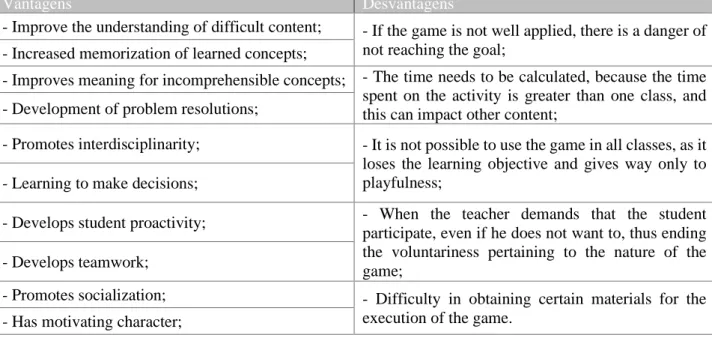
Thus, we can understand, like all teaching-learning strategies, the use of games has advantages and disadvantages, which have been described by several authors (CORBALÁN, 2002; GIMÉNEZ, 1993; GRANDO, 1995, 2000; KISHIMOTO, 2010; MACHADO, 1990) and are compiled in Table 1.
Table 1 - Advantages and disadvantages of using games as a teaching-learning strategy
Vantagens Desvantagens
- Improve the understanding of difficult content; - If the game is not well applied, there is a danger of not reaching the goal;
- Increased memorization of learned concepts;
- Improves meaning for incomprehensible concepts; - The time needs to be calculated, because the time spent on the activity is greater than one class, and this can impact other content;
- Development of problem resolutions;
- Promotes interdisciplinarity; - It is not possible to use the game in all classes, as it loses the learning objective and gives way only to playfulness;
- Learning to make decisions;
- Develops student proactivity; - When the teacher demands that the student participate, even if he does not want to, thus ending the voluntariness pertaining to the nature of the game;
- Develops teamwork;
- Promotes socialization; - Difficulty in obtaining certain materials for the execution of the game.
- Improves creativity; - Develops critical sense;
- Promotes teacher assessment to face the student's difficulties.
Source – GRANDO (2000, p.35).
In view of the information presented, the strategy that will be proposed next concerns a new proposal to carry out active methodologies in the classroom, using gamification.
3 METHODS AND TECHNIQUES
The methodology was based on the creation of a new teaching-learning proposal, which had gamification as its starting point. In this way, Match Based Learning was developed, a teaching-learning method that is based on games to encourage student participation and interaction, as well as interest in the lesson theme proposed by the teacher. In this methodology, the student positions himself as the center of learning, facilitating his development and knowledge generation.
For the development of the work, articles searched in the Google Scholar and Pubmed database were used, using the keywords: teaching, active methodology, and gamification.
4 RESULTS
4.1 MATCH BASED LEARNING
The new teaching-learning methodology Match Based Learning can be associated with other types of teaching methodologies such as rotation by seasons, inverted classroom, expository class, dialogue class, practical class, and others that can be inserted according to the teacher's needs. The methodology starts with the exposition of the class theme, using the strategy of preference of the teacher, followed by the division of the teams that will participate in the game, elaboration of questions, and the dispute between the teams, as described below.
1st stage: Exposition of the Theme
In the first stage of Match Based Learning, the teacher addresses the theme to be developed during the class. The choice of methodology is at the discretion of the teacher, and the teacher must choose the best way to teach its content, either by traditional expository class or by active methodologies, such as rotation by seasons, inverted classroom, dialogue class, practical class and others which can be inserted as needed by the teacher. Figure 1 illustrates this first stage of the methodology, using a traditional class.
Figure 1 - Illustration showing the first stage of the Match Based Learning methodology, using traditional class
Source: Own authorship. Illustrator: Carlos Miler (2018).
2nd stage: Division of the teams
At this stage, the number of teams and the number of participants per team must be established, usually with an equal number of members. The division of teams should occur according to the number of students in the classroom, which can be two, three, four, or more teams. However, the dispute always takes place between two teams and is of an eliminatory nature. Therefore, the winning teams in each dispute play again in pairs until only two teams reach the final.
The division of teams can be done by the students themselves or by the teacher, at random, as a draw, for example.
In this methodology, the terms are used:
- Duel: the dispute between two student leaders; - Match: a set of duels;
- Round: a set of matches.
1st Round - draw between teams to select matches and duels. The winning teams from each match guarantee participation in the next round.
2nd Round – the winning teams of the first round compete against each other. The team that wins the match wins the game.
3rd stage: Elaboration of the questions
Each team is responsible for the elaboration of questions based on the content taught in the class (1st stage). It is recommended that this moment be done within a maximum time of 30 minutes and can be done under the consultation of physical or digital documents. One team should not be aware of the questions raised by the other team. All students must participate actively, contributing to the development of their team, and being aware of all the questions and answers developed. Questions should have objective questions and answers. Figure 2 illustrates the third stage of the
methodology, in which the academics of each team come together to elaborate on the questions and their respective answers.
Figure 2 – Illustration showing the third stage of the Match Based Learning methodology, in which academics meet to elaborate questions and answers regarding the theme proposed by the teacher
Source: Own authorship. Illustrator: Carlos Miler (2018).
4th stage: Questions and answers discussion
After elaborating on the questions, the students have 10 minutes to go through the questions among the team, so that everyone really knows the content developed.
5th stage: Naming the team and selecting the game leaders
Each team must name itself (name the team) and select the students who will be the leaders of the game, who will represent the teams, participating in the duels. While the students organize themselves, the teacher should check the questions prepared by the students, and choose the questions that will be used in the duels. The number of leaders for each team must match the number of questions to be used in each match, that is, the number of duels.
6th stage: The game
After choosing the questions and the student-leaders, the teacher places a table in the center of the room and transcribes the teams' names on the board.
The teacher should now explain to the students how the activity will take place:
• One student-leader from each team will be asked to go to one end of the table in the center of the room so that they can duel.
• The teacher chooses/draws a question from those pre-selected and, the student who answers correctly, wins the first duel, and then, a new duel begins with new student-leaders and new questions. An amount of 5 duels is suggested for each match.
• At the end of each match, the winning teams will start a new round following the same criteria as described.
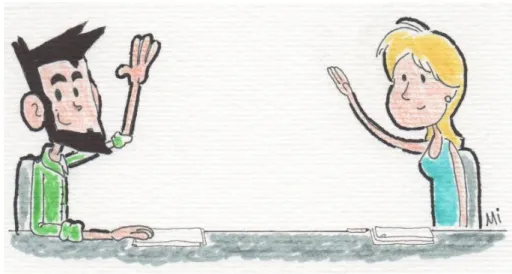
Figure 3 illustrates the sixth stage of the methodology, in which a student-leader from each team is positioned at the end of a table to duel. The teacher can suggest that everyone put their hands up and, after the question is asked, the student slaps his hand on the table if he knows the answer. Whoever knocks first has the opportunity to answer the question.
Figure 3 – Illustration showing the sixth stage of the Match Based Learning methodology, in which a student-leader from each team is positioned for the duel.
Source: Own authorship. Illustrator: Carlos Miler (2018).
Of the realization of the game
o The teacher directs a question prepared by one of the teams;
o At the end of the question, the teacher must give a commanding voice to the student leaders that the question is valid for dueling;
o At that time, the student-leader of each team should reflect on the question-answer and hit the table (or ring the harebell/bell, the teacher can use whatever resource he has).
o The first student-leader to speak has the opportunity to answer the question (alone or using help);
o After the duel, the teacher asks for the change of student-leader of each team to start the next duel. Remembering that these students must be within the pre-selected students for each team, and so on.
o The teacher must write down the score of each team on the board.
About the rules
o The student-leader who hits the table first has a chance to respond;
o The student-leader can pass the turn giving an opportunity to respond to another group; o The student-leader can ask for help from a colleague in the group, but when that help is
requested, the value of the question will be half of the total value.
• Colleagues who will be able to participate in assisting with the response may not be among the student-leaders pre-selected for the game.
• Colleagues who will assist with the response will be prevented from talking to peers or consulting the material in class, both physical and digital.
• This strategy gets all students involved in the activity.
4.3 QUESTIONS VALUE
The value assigned to each question is free, and the teacher can determine the activity score. It is suggested that for this methodology, a score of 5% to 15% of the semester grade in the discipline is assigned.
It is at the discretion of the teacher to score only the winning team of the game, or at each match, the team wins the achieved score, which can be accumulated. It is suggested that all members of each team receive the same score if they actively participate in the game.
5 FINAL CONSIDERATIONS
The use of active methodologies is important for student learning, and it is believed that Match Based Learning, when inserted in the teaching-learning cycle, contributes positively so that the objectives outlined in the classroom are achieved, whether these theoretical or practical objectives, in which the student builds knowledge, develops skills and attitudes.
Finally, it is necessary that the teacher always reinvent himself to meet the needs and demands of today, always improving and adjusting the active methodologies in front of a classroom.
REFERENCES
BAUMGARTEL, Priscila. O uso de jogos como metodologia de ensino da Matemática. In: ENCONTRO BRASILEIRO DE ESTUDANTES DE PÓS-GRADUAÇÃO EM EDUCAÇÃO MATEMÁTICA, XX, 2016, Curitiba.
BORGES, Célio José. O Lúdico nas Interfaces das Relações Educativas. Revista de Pedagogia, v. 6, n. 12. 2005.
CAMBI, Franco. História da Pedagogia. São Paulo: UNESP, 1999. 701 p.
CHEMELLO, Diego; MANFRÓI, Waldomiro Carlos; MACHADO, Carmen Lúcia Bezerra. O papel do preceptor no ensino médico e o modelo preceptoria em um minuto. Revista Brasileira de Educação Médica, Rio de Janeiro, v. 33, n. 4, p. 663-668, out./dez. 2009.
COHEN, Marleine. Foco no aluno. Revista Ensino Superior, ano 19, n. 218, p. 24-28, abr. 2017.
CONNOLLY, Thomas M et al. A systematic literature review of empirical evidence on computer games and serious games. Computers & Education, v. 59, n. 2, p. 661-686, sep. 2012.
CORBALÁN, Fernando. Juegos Matemáticos para Secundaria Y Bachillerato. Madrid, Espanha: Editorial Síntesis, 2002. 271 p.
DONDLINGER, Mary Jo. Educational video game design: a review of the literature. Journal of Applied Educational Technology, v. 4, n. 2, p. 21-31, Spring/Summer. 2007.
FREIRE, Paulo. Pedagogia da autonomia. Saberes necessários à prática educativa. 27. ed. São Paulo: Paz e Terra, 1996. 144 p.
FREIRE, Paulo. Pedagogia do oprimido. 50. ed. São Paulo: Paz e Terra, 2011. 256 p.
GIMÉNEZ, J. Aprendiendo Algebra Atraves de Juegos. Barcelona, Espanha: Universitat Rovira I Virgili, 1993.
GRANDO, Regina Célia. O conhecimento matemático e o uso de jogos na sala de aula. 2000. 224 p. Tese (Doutorado) – Faculdade de Educação, Universidade Estadual de Campinas, Campinas, 2000.
GRANDO, Regina Célia. O jogo e suas possibilidades metodológicas no processo ensino-aprendizagem na matemática. 1995. 175 p. Dissertação (Mestrado) – Faculdade de Educação, Universidade Estadual de Campinas, Campinas, 1995.
HADDAD, Maria do Carmo Lourenço et al. Enfermagem médico-cirúrgica: uma nova abordagem de ensino e sua avaliação pelo aluno. Revista Latino-Americana de Enfermagem. Ribeirão Preto, v. 1, n. 2, p. 97-112, jul. 1993.
KISHIMOTO, Tizuko Morchida (org.). Jogo, Brinquedo, Brincadeira e a Educação. 13ª ed. São Paulo: Cortez, 2010. 207 p.
KODJAOGLANIAN, Vera Lucia. Inovando métodos de ensino-aprendizagem na formação do psicólogo. Psicologia: Ciência e Profissão. Brasília, v. 23, n.1, p. 2-11, mar. 2003.
LIBÂNEO, José Carlos. Democratização da escola pública: a pedagogia crítico-social dos conteúdos. 18ª ed. São Paulo: Loyola, 2002. 150 p.
LIBÂNEO, José Carlos. Didática. 16ª reimpressão. São Paulo: Cortez, 1998, p.161.
MACHADO, N. J. et al. Jogos no Ensino da Matemática. Cadernos de Prática de ensino – Série Matemática. São Paulo: USP, ano 1, n. 1, 1990.
MADEIRA, Miguel Carlos; SILVA, Rosa Maria Alves da. Ensinar na universidade. Didática para professores iniciantes. Petrópolis: Vozes, 2015. 260 p.
MCGONIGAL Jane. Reality is broken: why games make us better and how they can change the world. New York: Penguin Press, 2011. 416 p.
MEZZARI, Adelina. O uso da Aprendizagem Baseada em Problemas (ABP) como reforço ao ensino presencial utilizando o ambiente de aprendizagem Moodle. Revista Brasileira de Educação Médica, Rio de Janeiro, v. 35, n. 1, p. 114-121, mar. 2011.
MIORIM, Maria Ângela, FIORENTINI, Dario. Uma reflexão sobre o uso de materiais concretos e jogos no Ensino da Matemática. Boletim da SBEM-SP, São Paulo, v. 4, n. 7, p. 5-10, 1990.
MITRE, Sandra Minardi et al. Metodologias ativas de ensino aprendizagem na formação profissional em saúde: debates atuais. Ciência & Saúde Coletiva, Rio de Janeiro, v. 13, supl. 2, p. 2133-2144, dec. 2008.
MIZUKAMI, Maria da Graça Nicoletti. Ensino: as abordagens do processo. São Paulo: EPU, 1986. 123 p.
PEREIRA, Adriana Lenho de Figueiredo. As tendências pedagógicas e a prática educativa nas ciências da saúde. Cadernos de Saúde Pública, Rio de Janeiro, v. 19, n. 5, p. 1527-1534, out. 2003.
POH, Ming-Zher; SWENSON, Nicholas C; PICARD, Rosalind W. A wearable sensor for unobtrusive, long-term assessments of electrodermal activity. IEEE Transactions on Biomedical Engineering, vol. 57, no. 5, p. 1243- 1252, May. 2010.
SAVIANI, Dermeval. Escola e Democracia. 41. ed. São Paulo: Cortez, 1997. 90 p.
STACCIARINI, Jeanne Marie R.; ESPERIDIÃO, Elizabeth. Repensando estratégias de ensino no processo de aprendizagem. Revista Latino-Americana de Enfermagem, Ribeirão Preto, v. 7, n. 5, p.59-66, dez. 1999.
TIMM, Maria I. et al. Game educacional: desafios da integração de elementos ficcionais, tecnológicos, cognitivos e de conteúdo. In: SBGames 2008 - VII Symposium on Computer Games and Digital Entertainment, 2008, Belo Horizonte. Proceedings Games & Culture Track. Belo Horizonte: Sociedade Brasileira de Computação – SBC, 2008. P. 107-114.