ASSESSING MANDATED CREDIT PROGRAMS:
CASE STUDY OF THE MAGNA CARTA IN THE
PHILIPPINES
Ryan Jacildo*, Niny Khor*, Ruth Tacneng**
*Asian Development Bank**CEGE, School of Economics and Management, Universidade Catolica Portuguesa, Portugal
Abstract
We examine the effects of a mandated credit program to small and medium enterprises in the Philippines (Magna Carta Law) using a panel dataset compiled from official data published by the Bangko Sentral ng Pilipinas. The final sample of 109 financial institutions represented over 90% of total finance sector assets in the Philippines. We highlight three important findings. First, although the total lending levels to micro, small, and medium enterprises (MSMEs) grew slightly, the percentage shares of loans allocated to MSMEs declined drastically from a peak of 30% of total loans in 2002 to 16.4% in 2010. Second, following the upwards revision of the loan target (from 6% to 8%) for smaller firms in 2008, there was a sharp increase in noncompliance especially amongst universal and commercial banks. On the other hand, total loans to medium enterprises were still more than threefold larger than the targeted 2%. Third, there is an increased heterogeneity in optimal loan portfolio across banks. Most surprisingly, the absolute level of MSME lending by rural and cooperative banks declined since 2008. Direct compliance amongst universal and commercial banks decreased beginning in the late 2007, while that of thrift banks increased to almost 100%. Abolishing the Magna Carta targets for medium-sized enterprise loans would most likely yield little adverse effects. Meanwhile, efforts to improve financial access to MSMEs should focus on alternative nondistortionary ways to increase financing supply, such as improving institutional framework for informational availability and development of equity and bond markets for MSMEs.
Keywords: Financial Inclusion, Financial Markets, Financial Policy, Philippines, SME, Targeted Lending
1. INTRODUCTION
Micro, small, and medium enterprises (MSMEs) is the lifeblood of most economies. A vibrant MSME sector is especially essential in spreading the economy’s wealth in developing economies, by creating more opportunities in rural areas, maintaining social stability, and fostering inclusive economic growth. Central to MSME development is access to finance. Availability and cost of funds determine firms’ ability to compete for market share, innovate, expand and withstand business-related stresses. However, since financial markets in most developing economies are largely underdeveloped with far from ideal regulatory frameworks, many governments in developing Asia have designed medium and long-term MSME development plans, with the main goal of improving financing for MSMEs.
In the Philippines, one of the most important inclusive financing policies is the mandated credit program known as the MSME Magna Carta (Magna Carta). MSMEs account for 99.6% of total firms and 61% of total employment in the Philippines. A recent study of the Philippines found that access to formal sector financing is indeed one of the key constraints that strongly affect firms’ dynamism (see Khor, Sebastian, and Aldaba 2013). At the same time, MSMEs do not have easy access to the equities nor bonds market.
The main objective of the Magna Carta legislation was to promote, support, strengthen and encourage the growth and development of MSMEs in all productive sectors of the economy particularly rural and agriculture-based enterprises.7 The Magna Carta was first enacted and implemented in 1991 (courtesy of Republic Act 6977)—a time when the authorities were grappling for ways to resurrect an ailing economy following a decade of tumultuous business climate. In the subsequent twenty years, the law was amended twice to take into account the changes in the business and economic conditions.
The Magna Carta mandated Filipino banks to allot 10% of their loan portfolio to MSMEs. Although not explicitly mentioned, there are three reasons why the regulation specifically targeted banks. Firstly, banks hold the biggest stock of financial resources in the Philippines, accounting for approximately 80% of domestic financial resources. Secondly, banks have the most extensive branches among credit intermediaries. Lastly, banks are administratively easier to monitor since they regularly report their activities to the Philippines central bank.8
7 Republic Act No. 9501. Magna Carta for Micro, Small, and
Medium Enterprises (MSMEs). http://www.lawphil.net/ statutes/repacts/ra2008/ra_9501_2008.html
8 While there were questions raised on the rationale of the
Mandated credit program such as the Magna Carta is not unique to the Philippines. Lending targets set for priority sectors, including small and medium enterprises (SMEs), are imposed in developing economies such as Afghanistan, India, Pakistan, and Sri Lanka. The Magna Carta is also not the first mandated credit provision imposed on Filipino banks. In 1974, the Philippines central bank had directed banks to allot a portion of their loan portfolio to the agriculture sector. This central bank issuance eventually became known as the Agri-Agra Law and continues to be an active regulation to date.
How has the Magna Carta impacted banks’ lending towards MSMEs? Surprisingly, literature assessing the implementation of the law and its economic impact is very limited. Medalla and Ravallo (1997) assessed the way banks responded to the Agri-Agra Law and the Magna Carta. The authors found out that between 1975 and 1996, compliance with Agri-Agra Law had continuously declined. Furthermore, compounded annual growth of Agri-Agra Law loans during the period is roughly 3 percentage points lower than the annual growth of total loan portfolio of Filipino banks during the same period.9 The authors also noted that from 1991 to 1996, aggregate compliance ratios to the Magna Carta by bank type remained above what the law requires by a good margin. They just highlighted that foreign banks tend not to comply with the law on a consistent basis and are drawn toward alternative compliance mechanisms rather investing directly in firms in spite of the general trend in the industry that is skewed heavily on direct lending.
Furthermore, little is known on the compliance with Magna Carta beyond 1996. This paper is thus undertaken to investigate the patterns of bank lending to MSME in the Philippines after the 2008 Global Financial Crisis and in conjunction to that, the compliance of banks to the Magna Carta lending provisions post 1996. We will also attempt to shed light on the characteristics of banks base on their lending exposure to the MSMEs in terms of bank type. To our knowledge, this is the first publicly available study on MSME lending in the Philippines from banks’ perspective.
This paper is organized as follows: Section 2 briefly describes the domestic financial market conditions, the customary sources of credit of MSMEs in the Philippines and the government initiatives to boost MSME financing particularly the Magna Carta. Section 3 will layout the salient features of the lending provisions of the Magna Carta. Section 4 will assess the trends of bank lending to MSMEs as well as their compliance to the lending provisions of the Magna Carta using the datasets compiled by the central bank of the Philippines, Bangko Sentral ng Pilipinas (BSP) up to end of 2012. Section 5 will explain recent developments that could potentially influence banks’ lending behavior concerning MSMEs in the near term and discuss areas for further research.
measure can be justified from a social standpoint since otherwise, banks are driven to channel funds to projects that generate high private returns but not necessarily social returns.
9 Medalla and Ravallo (1997) also argued that until 1988,
banks have taken advantage of alternative compliance in the form of special series treasury bills that masked the degree of decline in lending. When alternative compliance is accounted for, the drop in lending became very apparent.
2. FINANCING MICRO, SMALL, AND MEDIUM
ENTERPRISES IN THE PHILIPPINES
2.1. Definitions
MSMEs in the Philippines are legally defined in two ways. The first definition is based on employment levels according to the National Statistics Office, while the second definition is based on asset values specified by the BSP (Table 1). According to employment-based classification, large firms are defined as those employing more than 200 workers, while micro-firms employ less than 10 workers, small firm 10 to 99 workers, and medium 100 to 199 workers. According to BSP, micro firms are those whose assets do not exceed PHP 3 million (approximately USD 70,000), while the asset limits for small and medium firms are respectively PHP 15 million and PHP 100 million (approximately USD 349,000 and USD 2.5million). Those whose assets exceed PHP 100 million are categorized as large firms. This sometimes presents a challenge when we examine data on MSMEs financing, since there exists no harmonized supply and demand-side dataset. Credit demand-side data on firms are usually based on employment clusters since these datasets are mostly compiled by the National Statistics Office. On the other hand, supply-side credit data such as total loans are typically based on asset clusters defined by the BSP since reporting banks have to follow the BSP’s framework.
Table 1. Definitions of MSMEs in the Philippines
Firm
Type Range (number of employees) NSO, Employment Level BSP, Asset Size Range (P)
Micro 1–9 <3,000,000
Small 10–99 3,000,001–15,000,000
Medium 100–199 15,000,001–100,000,000
Large >200 >100,000,00
Note: BSP = Bangko Sentral ng Pilipinas, MSME = micro, small, and medium enterprise, NSO = National Statistics Office
Source: SMED Council Resolution No. 1 (2003); Republic Act 9501 (2008)
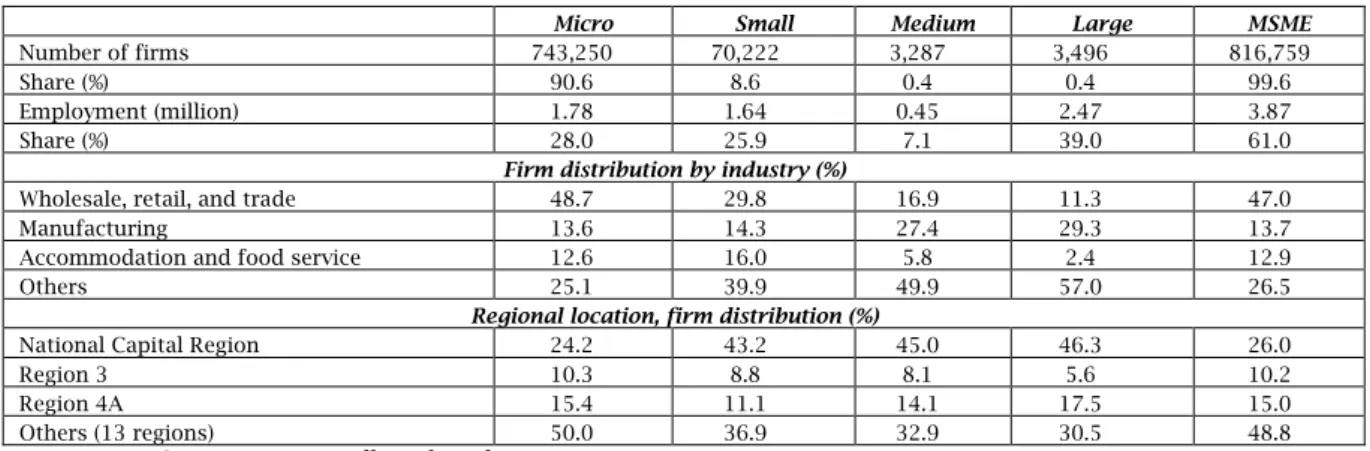
MSMEs comprise almost all of the total 820,255 firms in the Philippines. According to the 2011 survey data from the National Statistics Office, 90.6% were microenterprises, 8.6% small, 0.4% medium and 0.4% large (Table 2). Altogether MSMEs employ roughly 61% of the total employees in the economy. This distribution profile hardly changed in the last two decades. In spite of their enormous number, however, MSMEs only contributed 35.7% to gross domestic product (GDP) in 2011. The largest concentrations of MSMEs are found in wholesale, retail, and trade segment. Over 50% of them are located in the National Capital Region, Central Luzon (Region 3), and Calabarzon (Region 4A)—the top three regions which, as of 2012, contribute over 60% to the national GDP. 10
Table 2. Profile of firms in the Philippines, 2011
Micro Small Medium Large MSME
Number of firms 743,250 70,222 3,287 3,496 816,759
Share (%) 90.6 8.6 0.4 0.4 99.6
Employment (million) 1.78 1.64 0.45 2.47 3.87
Share (%) 28.0 25.9 7.1 39.0 61.0
Firm distribution by industry (%)
Wholesale, retail, and trade 48.7 29.8 16.9 11.3 47.0
Manufacturing 13.6 14.3 27.4 29.3 13.7
Accommodation and food service 12.6 16.0 5.8 2.4 12.9
Others 25.1 39.9 49.9 57.0 26.5
Regional location, firm distribution (%)
National Capital Region 24.2 43.2 45.0 46.3 26.0
Region 3 10.3 8.8 8.1 5.6 10.2
Region 4A 15.4 11.1 14.1 17.5 15.0
Others (13 regions) 50.0 36.9 32.9 30.5 48.8
Note: MSME = micro, small, and medium enterprise Source: National Statistics Office
2.2. Sources of credit
Firms’ need for additional capital is typically addressed by (i) banks; (ii) bonds market; (iii) equities market; (iv) nonbank lending institutions like quasi banks and investment houses, pawnshops, financing cooperatives, savings and loans associations, insurance companies, venture capitalists, and specialized government lending corporations; and (v) informal sector players, such as family members, friends, and unaccredited retail lenders.
Just like in many developing economies, MSMEs in the Philippines have limited access to the equities market. MSMEs accounted for a mere 0.005% of total market capitalization by end of 2012, and are also not considered reputable enough to enter the bonds market.11 Other large scale credit sources like quasi banks, investment houses, and insurance companies typically also shy away from MSME clients while the role of venture capital firms remain quite small. Thus, given that access to formal financing is relatively scarce for MSMEs, capital options usually narrow to informal sectors, such as financing cooperatives, savings and loans associations, pawnshops, and informal sector lenders.
Assessments of credit provisions suggest that MSMEs rely on their internally generated resources to bankroll up to 78% of their operations (Table 3). In contrast, formal financial institutions only contribute somewhere between 11% and 21% of the MSMEs’ funding. The lack of reliable financial information from MSMEs leads to the perception of higher risk. In addition, lower expected profitability, the absence of acceptable collateral by MSMEs, the lack of a national credit rating system for MSMEs contribute to the low loan releases from banks to the sector.
2.3. The micro, small, and medium enterprise Magna
Carta
In an effort to aid MSMEs with their credit needs, the Philippine authorities enacted the Magna Carta in 1991, mandating banks to allocate 10% of their lending portfolio to MSMEs. The MSME Magna Carta
11 By the end of December 2012, the declared market
capitalization of SMEs in the Philippine stock exchange is P586.4 million ($14.2 million) whereas the total market capitalization is P10.9 trillion ($265.3 billion).
also laid out a number of important supporting measures. These measures include classification of enterprises by asset size (micro, cottage, small, and medium) and laying out a coordinated structural support and safeguards system to enhance the growth of each category of enterprises.
The Magna Carta led to the creation of several government agencies across several ministries. The Small and Medium Enterprise Development Council12 was created as an attached agency of the Department of Trade and Industry to carry out the objectives of the law and appointed the Bureau of Small and Medium Enterprises Development (BSMBD)13 as the council secretariat. The Small Business Guarantee and Finance Corporation was set up to improve production operations and business network of firms, provide financial services to small and medium enterprises (except those involved in trading and crop-level production) and develop alternative modes of financing and guarantee loans secured by qualified SMEs. The Small Business Guarantee and Finance Corporation and the Guarantee Fund for Small and Medium Enterprises14 were merged in November 2001 to form the Small Business Corporation (SBC) to consolidate their resources.15 Today, the SBC and the much older Philippine Export-Import Credit Agency are presently the two main agencies charged to expand financial access for MSMEs.16
12 This agency was later renamed as the Micro, Small, and
Medium Enterprise Development Council (MSMEDC).
13 This bureau was later renamed as Bureau of Micro, Small
and Medium Enterprises Development (BMSMED).
14 The Guarantee Fund for Small and Medium Enterprises
was established earlier in 1984 operated by the Livelihood Corporation attached to the office of the president tasked to provide guarantee services to participating financial institutions (PFIs) that had been lending to SMEs. (ADB 2010)
15 The agency which was put under the supervision of the
central bank has a board comprised of representatives both from the private sector and the public sector, namely the National Government, Land Bank of the Philippines, Development Bank of the Philippines, Department of Trade and Industry, and Department of Finance (DOF).
16 The Philippine Export-Import Credit Agency (PhilEXIM)
was established in 1977 under the DOF to pursue the policy of the State “to encourage and promote the expansion of Philippine exports and to establish a strong and credible export credit institution, which shall be dedicated to the provision of export financing facilities and services to support the country’s sector (See PhilEXIM’s website). See also ADB (2005).
Table 3. SMEs' sources of funding (% of current funding)
SERDEF-UP ISSI, 1992 WBES, 2000 ICPS-ADB, 2004 PEP-IFC, 2006 WBES, 2009a
Own resources 78 52 60 69 76.4
Bank loans 15 21 11 19 10.2
Nonbank financial institution 0.9
Informal creditb 7 27 29 12 12.4
Total 100 100 100 100 100
Note: ICPS-ADB = Investment Climate and Productivity Study, Asian Development Bank, PEP-IFC = Private Enterprise Partnership for the Philippines (PEP-Philippines) SME Financing Survey, International Finance Corporation, SERDEF-UP ISSI = Small Enterprise Research and Development Foundation-University of the Philippines Institute for Small Scale Industries; SME = small and medium enterprise, WBES = World Bank Enterprise Survey; a Shares in the
firms' working capital; b Purchases on credit from suppliers/advances from customers + loans from moneylenders,
friends, and relatives
Source: Nangia and Villancourt 2007; WBES 2009 These agencies unified and simplified business procedures and requirements, making government services readily available to businesses outside the centers of commerce and “incentivizing” financing to the MSMEs. The latter include both monetary and nonmonetary incentives, as well as directing public government banks (which at that time including the Philippine National Bank, the Development Bank of the Philippines and the Land Bank of the Philippines) to provide financing assistance to MSME entrepreneurs.
The Magna Carta was amended twice in 1997 and 2002 (RA 6977 amended by RA 8289 and RA 9501) to adjust the legislation to firms’ needs and changing economic conditions. Most importantly, the thresholds for asset-based enterprise classification were significantly adjusted in these two revisions. The thresholds for micro and medium firms changed the most, approximately tripling between 1991 and 1997, and roughly doubling between 1997 and 2002 (Table 4). These variations
would prove to be very important to banks in their compliance to the mandated lending provision of the law. The increased thresholds mean that their target market for MSMEs had also increased in size.
In addition, the coverage of the law and the mandated share of MSMEs bank lending have also changed over the years (Table 5). In 1991, the initial mandated share of bank lending to small firms was 5% of total bank lending. This was doubled in 1992 to 10%, and then reduced to 5% again in 1996. The 1997 revision recognized that medium firms are fundamentally different from smaller firms, and established of two separate compliance rates for medium and smaller firms: for the next ten years, Philippines banks were mandated to set 6% of their total loan portfolio to small firms and another 2% to medium firms. In the 2008 revision, the law was extended to cover microenterprises, and mandated all banks to allocate 2% of their total loan portfolio to medium firms, and a further 8% to micro and small firms.
Table 4. Evolution of asset-based definition of MSMEs
Law/ regulation Year enacted Micro Cottage Small (P) Medium Large
RA 6977 1991 <50,000 500,000 50,001– 5,000,000 500,001– 5,000,001–20,000,000 >20,000,000 RA 8289 1997 <1,500,001 1,500,001–15,000,000 15,000,001–60,000,000 >60,000,000 SMED Councila and RA 9501 2003 2008 <3,000,000 3,000,001– 15,000,000 15,000,001–100,000,000 >100,000,00
Note: MSME = micro, small, and medium enterprise; RA = Republic Act; SMED = Small and Medium Enterprise Development; a Refers to SMED Council Resolution No. 1 (2003)
Table 5. Mandatory share of MSME in banks’ loan portfolio
Law Year Enacted Coverage (enterprises) Share in Banks’ Loan Portfolio (years in effect)
RA 6977 1991 Small 5% (1991); 10% (1992–1995); 5% (1996); 0% (1997)
RA 8289 1997 Small and medium Small: 6% (1997–2007)a
Medium: 2% (1997–2007) RA 9501;
BSP Circular 625 (2008) 2008 Micro, small, and medium
Micro and Small: 8% (2008–2018)
Medium: 2% (2008–2018)a
Note: BSP = Bangko Sentral ng Pilipinas; RA = Republic Act;a RA 8289 should have ended in May 2007 but
implementation of the lending provision was extended until early December 2008 (BSP Circular Letter 2007-039) because the BSP issued circular 625-2008 pursuant to RA 9501 only on 14 October 2008, which became effective 15 days after it was published on 20 October 2008
Firms considered eligible to be covered by the law have to satisfy the following four conditions. First, firms need to be registered with the appropriate agencies as presently provided by law. Second, firms should be fully (100%) owned, capitalized by Filipino citizens, whether single proprietorship or partnership. If the enterprise is a juridical entity, at least 60% of its capital or
outstanding stocks must be owned by Filipino citizens. Third, firms should be participating in a business activity within the major sectors of the economy, namely, industry, trade, services, including the practice of one’s profession, the operation of tourism-related establishments, and agribusiness. Lastly, eligible firms are those that are not a branch, subsidiary or division of larger scale enterprises.
2.4. Other initiatives to encourage lending to micro,
small, and medium enterprises
To keep bank funds flowing steadily to the MSME sector, the BSP also instituted a number of measures to compensate lending institutions for the burden brought about by the Magna Carta. These include:
Allowing the establishment of microfinance-oriented thrift banks and rural banks as an exemption from branching moratorium;
Exemption of microfinance loans from normal documentation applicable to regular bank loans;
Reduction of the reserve requirements on thrift banks and rural banks which deal with SMEs and small borrowers;
Reduction of the risk weight applicable to qualified SMEs and microfinance loan portfolios from 100% to 75% subject to certain conditions, such as performance and financial soundness of the bank and adequacy of risk management system;
Exemption of SME loans without latest income tax returns and/or audited financial statements from “Loans Especially Mentioned” classification provided said loans are current, have not been restructured, and are supported by income tax return and/or audited financial statement at the time they were granted;
Deferment, for a period of 1 year, of the implementation of the market-based pricing mechanism for rediscount loans below the 91-day Treasury bill rate to help jumpstart SME lending; and Approval of the 12-point accreditation guidelines for rural and thrift banks and the lending features of short- and long-term loans for direct or retail lending by participating government financial institutions under the SME Unified Lending Opportunities for National Growth (SULONG).
The government also tried to increase the appeal of banking MSMEs, such as (i) establishing an effective loan guarantee system, (ii) finding ways to deal with collateral requirement issues, (iii) creating a public credit bureau, (iv) developing more appropriate ways to assess risk associated with lending to SMEs, and (v) optimizing the network of state-owned firms in delivering services to SMEs.
In order to alleviate information gaps, one important solution considered by both regulators and financial institutions is the creation of a reliable credit scoring system to assess the credit viability of firms that can be used by the entire banking system. Notably, according to ADB report (2004), “SBC’s management has discovered (as have many other lenders in many places) that there is no clear correlation between the kind and quality of collateral offered to a lender and loan default. This implies that loan underwriting techniques that do not rely on traditional collateral are highly relevant in the Philippines.”
To further strengthen its overall approach to facilitate financing for SMEs, the government implemented the SME Unified Lending Opportunities for National Growth (SULONG) program. The SULONG program, launched in 2003, essentially sought to provide SMEs alternative credit sources through participating government financial
institutions.17 The general objectives of the program were to: (i) simplify and standardize the lending procedures, (ii) reduce documentary requirements and expedite procedures, (iii) provide SMEs greater access to short- and long-term funds, and (iv) lower the effective cost of borrowing by SMEs and liberalize the requirement.
More recently, the BSP rolled out the Credit Surety Fund program on 2 July 2008. The rationale of this fund is “to increase the credit worthiness of MSMEs that are experiencing difficulty in obtaining loans from banks due to lack of acceptable collaterals, credit knowledge and credit track records” (BSP 2013b). Essentially, the Credit Surety Fund can serve as: (i) an alternative to acceptable collaterals, (ii) security for loans of MSMEs that are members of a cooperative, and (iii) an assurance for payment of bank loans. Investors in the fund are comprised of cooperatives, nongovernment organizations, local government units, banks, donors, and the BSP. Eligible borrowers include MSMEs who are members of cooperatives and who have businesses that meet certain conditions (BSP 2013c).
2.5. The structure of the banking industry in the
Philippines
The banking industry in the Philippines forms the core of the financial system in the Philippines. Banks hold 80% of the approximately P10 trillion of total domestic financial assets as of end of 2012.18 Nonbanks, which include investment houses and companies, among others, accounted for the remaining 20%. For the last 3 decades, this distribution hardly changed despite a fivefold growth in total financial assets from 1990 to 2000, and another 2.5-fold growth from 2000 to 2012 (Table 6).
Overall, banks in the Philippines are supervised by the BSP as prescribed by the General Banking Law passed in 2000. The law also classified banks in the Philippines as universal banks, commercial banks, thrift banks, rural and cooperative banks, or Islamic banks. The Monetary Board, which is the decision-making body of the central bank, may also create another type of bank if the need arises. The minimum capitalizations are highest for universal banks (P4.95 billion), followed by commercial banks (P2.4 billion), thrift banks (P1 billion for those headquartered in Manila and P250 million for others). The minimum capital requirement for rural banks and cooperatives are much lower, ranging from P100 million for those headquartered in Manila to below P5 million for those based in rural 5th–6th class municipalities. In our subsequent analysis, we group all these institutions into three broad groups: universal and commercial banks (UKBs), thrift banks (THBs or thrifts), and rural and cooperative banks (RCBs or rural co-ops). The average UKB has approximately 20 times the assets of the average thrift bank, which in turn has average total assets 20 times the average rural and cooperative banks.
17 These include the Development Bank of the Philippines,
Land Bank of the Philippines, Small Business Guarantee Corporation, and the Social Security System.
18 This is approximately equivalent of $250.4 billion, based on
Table 6. Total resources of the Philippine financial system (PHP, billion)
Year Total UKBa THBb RCB Total Banks Nonbanksc
1970 18.8 17.2 0.9 0.7 18.8 1980 248.1 172.6 10.6 5.6 188.8 59.3 1990 800.2 558.2 37.6 13.9 609.7 190.5 2000 4,077.9 3,013.6 245.8 67.4 3,326.7 751.1 2010 9,046.3 6,423.7 626.4 180.1 7,230.2 1,816.1 2012 10,516.2 7,486.7 681.6 190.1 8,358.3 2,157.8
Note: RCB = rural and cooperative bank, THB = thrift bank, UKB = universal and commercial bank; a Includes
specialized government banks; b Includes savings and mortgage banks, private development banks, and stock savings
and loan associations; c Includes investment houses, finance companies, investment companies, securities
dealers/brokers, pawnshops, lending investors, nonstock savings and loan associations., venture capital corporations, credit card companies, which are under BSP supervision, and private and government insurance companies (e.g., Social Security System and Government Service Insurance System)
Source: Bangko Sentral ng Pilipinas
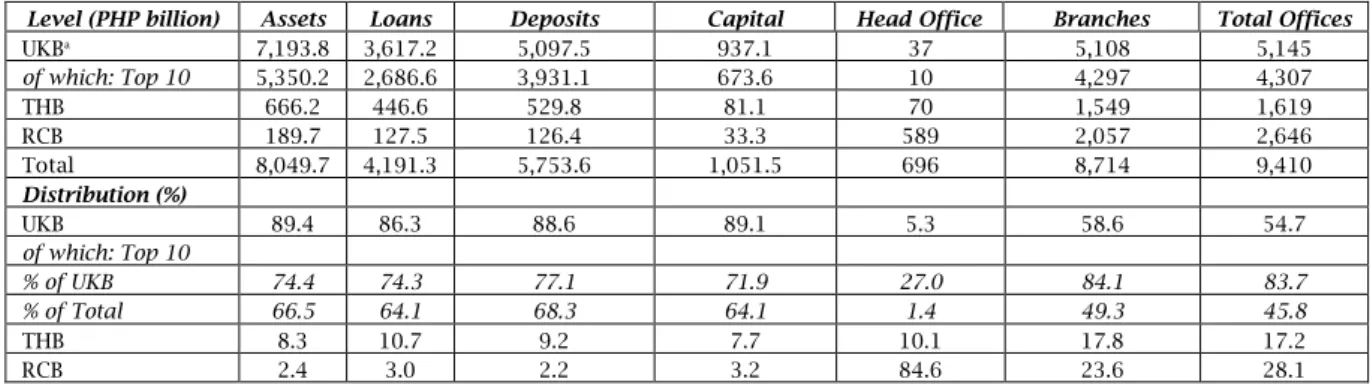
As of end of 2012, there were a total of 696 banks in the Philippines, of which 36 are UKBs, 70 are THBs, 589 are RCBs, and 1 Islamic Bank (which is also classified by the BSP as a UKB). Although universal and commercial banks were the least numerous out of the three broad banking classifications, they have the most extensive branch networks and hold the biggest proportion of banking resources (e.g., asset, loans, deposits, and capital). All of the 37 UKBs accounted altogether for 89.4% of total banking assets, 86.3% of total loans, 88.6% of total deposits, as well as 54.7% of total bank offices around the country. Within this UKB group, there was also a huge dispersion in terms of resources: the biggest 10 UKBs housed 74.4% of the segment’s assets, release 74.3% of the segment’s loans, handle 71.9% of the segment’s deposits, and
operate 83.7% of all the segment’s offices. In other words, two-thirds of the Philippines’ total financial assets and loans were concentrated in the top 10 universal and commercial banks in the country.
Compared to the universal and commercial banks, the other banking institutions in the Philippines were comparatively much smaller. Rural and cooperative banks, which accounted for 84.6% of all banking institutions (589 institutions out of 696 total in 2012), only accounted for 2.4% banking sector’s value, 3% of total lending, 2.2% of total deposits while running just 28.1% of all the banking counters nationwide. Thrift banks, which were represented by 70 institutions, hold only 8.3% of the sector’s total assets, disburse 10.7% of total loans, and manage 9.2% deposits through their 1,619 bank offices (17.2% of total) (Table 7).
Table 7. Financial indicators and bank network (units) by bank type, Philippines, 2012
Level (PHP billion) Assets Loans Deposits Capital Head Office Branches Total Offices
UKBa 7,193.8 3,617.2 5,097.5 937.1 37 5,108 5,145 of which: Top 10 5,350.2 2,686.6 3,931.1 673.6 10 4,297 4,307 THB 666.2 446.6 529.8 81.1 70 1,549 1,619 RCB 189.7 127.5 126.4 33.3 589 2,057 2,646 Total 8,049.7 4,191.3 5,753.6 1,051.5 696 8,714 9,410 Distribution (%) UKB 89.4 86.3 88.6 89.1 5.3 58.6 54.7 of which: Top 10 % of UKB 74.4 74.3 77.1 71.9 27.0 84.1 83.7 % of Total 66.5 64.1 68.3 64.1 1.4 49.3 45.8 THB 8.3 10.7 9.2 7.7 10.1 17.8 17.2 RCB 2.4 3.0 2.2 3.2 84.6 23.6 28.1
Note: RCB = rural and cooperative bank, THB = thrift bank, UKB = universal and commercial bank; a Al-Amanah
Islamic Investment Bank of the Philippines is subsumed under UKB (per BSP directory of Banks)
Source: Bangko Sentral ng Pilipinas; Annual Reports and Press Releases of the top 10 banks (by asset size) for the number of branches
Each category of banks operated in generally distinct markets, though the market niches are starting to overlap. Rural and cooperative banks typically focused on retail clients and microloans in the countryside. The universal and commercial banks, on the other hand, serve as the primary arteries of credit for larger urban firms and are usually part of a bigger conglomerate groups themselves. Lastly, the thrift banks, some of which were large enough to compete with universal and commercial banks for big borrowers, normally focus on small and medium enterprises in metropolitan and provincial business centers left unaddressed by the UKBs. It is also important to note that a number
of major thrift banks are likewise either affiliates of UKBs or financial arms of big holding companies.
3. COMPLIANCE TO THE MICRO, SMALL, AND
MEDIUM ENTERPRISE MAGNA CARTA
3.1. Direct compliance
The most important part of the MSME Magna Carta is the legal mandate for mandatory credit allocation that all lending institutions have to set aside 8% of their total loan portfolio for micro and small enterprises (MSEs), and a further 2% for medium enterprises (MEs). The BSP allows banks various channels to comply with the mandatory credit
allocation for MSMEs. Basically, these can be divided into two categories namely, the direct compliance and the indirect compliance. As stipulated in BSP Circular 625 issued in 2008, ways to comply directly are enumerated below, and vary across the targeted firm size.
For micro and small enterprises:
Actual extension of loans to eligible MSEs, other than to Barangay Microbusiness Enterprises (BMBEs) which are covered in Item “c(3)” hereof:19 Provided, however, that loans granted to MSEs other than BMBEs, to the extent funded by wholesale lending of, or rediscounted with, another bank shall not be eligible as compliance with the mandatory credit allocation; or
Loans granted to export, import, and domestic micro and small scale traders, other than to BMBEs which are covered in Item “c(3)” hereof: Provided, however, that loans granted to MSEs other than BMBEs, to the extent funded by wholesale lending of, or rediscounted with, another bank shall not be eligible as compliance with the mandatory credit allocation; or
Purchase of eligible MSE loans listed in Items “i” and “ii” of this list on a “without recourse” basis from other banks and financial institutions; or
Purchase/discount on a “with or without recourse” basis of MSE receivables, other than BMBE receivables which are covered in Item “c(3)” hereof; or
Wholesale lending or rediscounting facility granted to participating financial institutions (PFIs) for on-lending to MSEs, other than to BMBEs which are covered in Item “c(3)” hereof; or
Wholesale lending or rediscounting facility granted to PFIs for on-lending to export, import, and domestic micro and small scale traders, other than to BMBEs which are covered in Item “c(3)” hereof; or
Commercial letters of credit outstanding, net of margin deposits, issued for the account of MSEs.
For medium enterprises:
Actual extension of loans to eligible MEs provided that loans grantedf to MEs to the extent funded by wholesale lending of, or rediscounted with, another bank shall not be eligible as compliance with the mandatory credit allocation; or
Loans granted to export, import, and domestic medium scale traders provided that loans granted to MEs to the extent funded by wholesale lending of, or rediscounted with, another bank shall not be eligible as compliance with the mandatory credit allocation; or
Purchase of eligible ME loans listed in items “i” and “ii” of this list on a “without recourse” basis from other banks and financial institutions; or
Purchase/discount on a “with or without recourse” basis of ME receivables; or
Wholesale lending or rediscounting facility granted to PFIs for on-lending to MEs; or
19 Item c(3) under subsection X342.3 (Eligible credit
exposures) of the BSP Manual of Regulations for Bank (MORB) 2008 stipulates the mechanisms considered as “Alternative compliance for either or both MSEs or/and MEs." The provision classifies “Loans from whatever sources granted to BMBEs as provided under Subsection X365.5” as a form of alternative compliance. Section 365 of MORB 2008 covers regulations concerning “Loans to Barangay Micro Business Enterprises” while subsection X365.5 pertains to the “Incentives to participating financial institutions.”
Wholesale lending or rediscounting facility granted to PFIs for on-lending to export, import, and domestic medium scale traders; or
Commercial letters of credit outstanding, net of margin deposits, issued for the account of MEs.
3.2. Alternative compliance
Acknowledging the difficulty and the risks of lending to fledgling enterprises early on, the government has established a set of alternative vehicles in order to comply with the MSME lending provisions of the Magna Carta.
Alternative compliance for either or both MSEs or/and MEs are allowed on the following grounds: first through paid subscription or purchase of liability instruments offered by the SBC, through paid subscription of preferred shares of stock of the SBC, or through loans (irrespective of sources) granted to Barangay Microbusiness Enterprises.20
Earlier, banks can also set aside special accounts consisting of cash or “due from BSP” for MSMEs which are free, unencumbered, not hypothecated, not utilized or earmarked for other purposes and include the corresponding amounts to their compliance reports as per BSP Circular 147 (1997). But this was no longer included as a mode of compliance under the new Magna Carta (RA 9501) beginning from 2008.
Another interesting feature of the law is the provision for aggregated group compliance. BSP Circular 625 (2008) states that “banks may be allowed to report compliance on a groupwide (i.e., consolidation of parent and subsidiary bank/s) basis so that excess compliance of any bank in the group can be used as compliance for any deficient bank in the group on the following conditions: (a) provided that the subsidiary bank/s is/are at least majority-owned by the parent bank and (b) provided further that the parent bank shall be held responsible for the compliance of the group.”
3.3. Penalty for noncompliance
In case of non-compliance, the current penalty is relatively lenient compared with the previous versions of Magna Carta law. Under initial versions of the law, non-compliant banks are fined by an amount no less than P500,000 and other officers of the erring lending institutions shall be individually liable for imprisonment of not less than 6 months. The subsequent revision of the law in 1997 extended the loan earmarking program for SMEs to 2007, and dropped imprisonment provision while maintaining the monetary fine (Table 5).
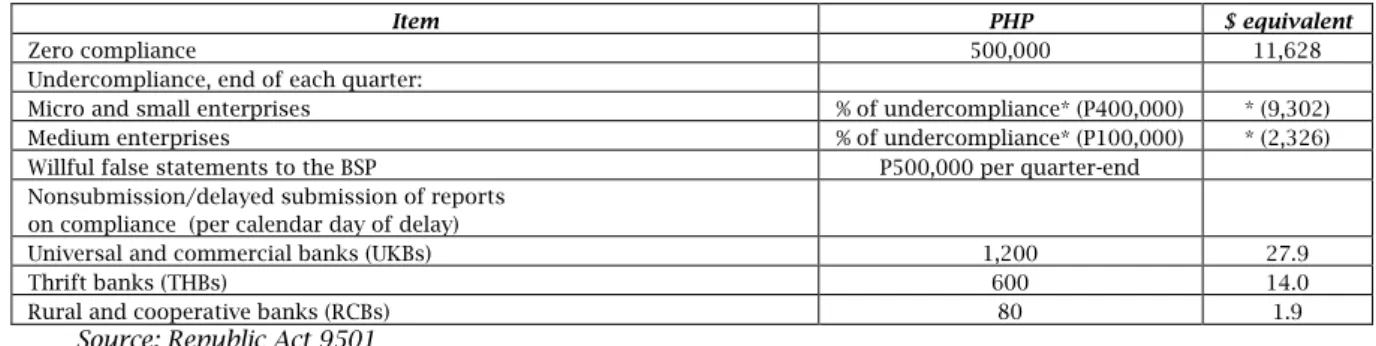
The monetary penalty for noncompliance varied according to bank types though the amount was miniscule compared to the average banking assets of these institutions. Based on the most recent revision in 2008, banks were mandated to allocate 2% of their loan portfolio to medium enterprises, and 8% to micro and small enterprises. Yet banks were fined a mere $2,300 for every percentage point that the banks failed to meet the stipulated medium enterprises loan share, and a mere $9,300 for every percentage point below the stipulated micro and small enterprises share of the banks’ loan portfolio. The penalty for other
20 See BSP No. 625 dated 14 October 2008. Subsection X365.5
compliant reporting behaviors was even smaller— the daily fines for the delay in submitting compliant reports range from a mere $2 for rural and
cooperative banks to $28 for universal and commercial banks (Table 8).
Table 8. Penalty matrix
Item PHP $ equivalent
Zero compliance 500,000 11,628
Undercompliance, end of each quarter:
Micro and small enterprises % of undercompliance* (P400,000) * (9,302)
Medium enterprises % of undercompliance* (P100,000) * (2,326)
Willful false statements to the BSP P500,000 per quarter-end
Nonsubmission/delayed submission of reports on compliance (per calendar day of delay)
Universal and commercial banks (UKBs) 1,200 27.9
Thrift banks (THBs) 600 14.0
Rural and cooperative banks (RCBs) 80 1.9
Source: Republic Act 9501
4. ASSESSING BANK COMPLIANCE TO THE MICRO,
SMALL, AND MEDIUM ENTERPRISE MAGNA CARTA
Given the low levels of legal penalty stipulated for non-compliance with the MSME Magna Carta, we assessed actual bank compliance to the law. This section intends to shed light on the levels and trends of bank lending to MSMEs in the Philippines and to assess banks’ compliance to the Magna Carta. We proceed in two steps. First we provide an industry-level analysis, which examines the overall aggregate MSMEs lending activity of banks as a group. Second we use bank-level data to analyze patterns of compliance to the Magna Carta for MSMEs by individual universal and commercial banks, and thrift banks.4.1. Data sources
For the industry aggregate-level analysis, we used the data on banking industry’s lending to MSMEs provided by the BSP. The data series present information about the compliance to the Magna Carta for MSMEs of the three major bank types (UKBs, thrifts, and rural co-ops) covering the years from 1999 to 2010. Moreover, the data show the disaggregation of the MSME compliance to the Magna Carta according to type of compliance; in other words, we know whether the banks complied through direct compliance, indirect compliance, or “funds set aside for MSMEs.”21 However, as mentioned earlier, funds set aside for MSMEs are no longer considered as mode of compliance beginning 2008.
To assess compliance at the bank-level, we compiled a comprehensive panel dataset from the Published Statements of Condition of each lending institution posted on the BSP’s website. The data series covers periods from the first quarter of 2005 to the second quarter of 2011 but limited to UKBs and thrifts because the BSP does not post the compliance information for individual rural co-ops. While these published statements comprised the most complete data publicly available on the
21 The “funds set aside for MSMEs” is defined by the BSP (as
indicated in the data file) as the item consisting of either Cash on Hand and Due from BSP which are free, unencumbered, not hypothecated, not utilized or earmarked for other purposes. The Due from BSP is a special account deposited with the BSP and does not form part of the bank's legal reserves. Under the new mandatory credit allocation (RA 9501).
compliance patterns of financial institutions, we note two caveats pertaining to the quality of data. Firstly, the format of the compliance ratios in these published statements (i.e., whether in percentage or absolute terms) is not consistent across reports. Thus, caution was exercised in building the panel dataset of compliance ratios. Secondly, a number of banks do not report their Magna Carta compliance ratios in some of their public statements. Hence, we distinguished zero lending to MSMEs from absence of data. Nevertheless, our post-cleaning final sample with complete data consists of 109 financial institutions (out of an initial sample of 136), which altogether represented over 90% of the finance sector assets in the Philippines.
4.2. Descriptive statistics of aggregate lending
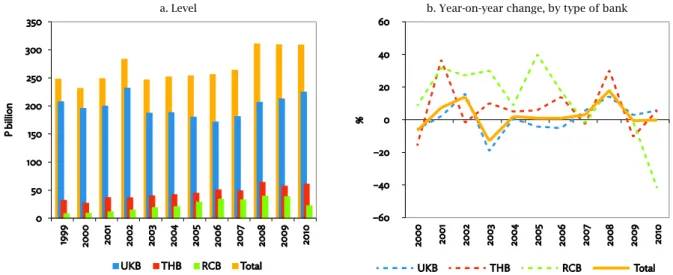
The outstanding amount lent by all lending institutions to MSMEs increased modestly from 1990 to 2010 (Figure 1). Financing to MSMEs rose from P248.2 billion to P308.5 billion in those 12 years, representing a growth rate of 2.3% per year. UKBs provide the bulk of these bank loans. Although their share decreased from 83.7% in 1999, they still accounted for 72.9% of the total loans in 2010. Thrifts, on the other hand, saw their share of MSME lending rising from 13% in 1999 to 19.8% in 2010. The strongest growth in market share is observed for rural co-ops, which tripled their share of MSME financing from below 3.3% to12.6% in 2009, before retreating to just above 7.3% by the end of 2010.The decline in commercial banks’ market share is partially a result of tepid growth in their overall lending operations between 1999 and 2010, which saw a compounded annual growth rate of only 0.72%. Thrifts expanded their loans to MSMEs by over 7% annually during the 11-year span. Rural co-ops were even more aggressive in lending to MSMEs, growing their MSME portfolio by 20% annually until 2008 until a pullback beginning in 2009. In 2009, total MSME lending by rural co-ops declined by 1.4%, and then contracted sharply in 2010 by 41.9%.22
The aggregate data reveals two important trends. Firstly, despite the increase in total lending volume, the share of MSMEs in the banking sector’s lending portfolio has declined significantly since
22 The compounded annual growth rate of MSME lending for
thrifts was 6%. In contrast, the compounded annual growth rate for rural co-ops was 19.3% from 1998 to 2008, and compounded annual growth from 1998 to 2010 fell to 9.8%.
2002. Secondly, despite the decreasing share in MSME loans, aggregate lending to the MSME sector still far exceeds the explicit 10% goal of the Magna Carta. At the peak in 2002, MSMEs accounted for 30% of the total loan portfolio of all lending institutions. This declined to 16.4% in 2010
(Figure 2). The reduction in banks’ MSME exposure is common across banking groups. Thrifts have started moving away from the MSME market in 2000. The UKBs followed a similar track in 2002. And even the rural co-ops began expanding more in non-MSME market in 2006.
Figure 1. Bank lending to MSMEs
a. Level b. Year-on-year change, by type of bank
Note: MSME = micro, small, and medium enterprise; RCB = rural and cooperative bank; THB = thrift bank; UKB = universal and commercial bank
Source: Bangko Sentral ng Pilipinas
It is important to point out that despite the decline, lending to medium firms in 2010 was more than 300% above the Magna Carta target of 2%, while that for micro and small firms were closer to the targeted 8% of total bank lending. Not so surprisingly, the reduction affected smaller firms more than medium firms (Figure 2). What is intriguing is that in 2010, the bank lending to medium firms, despite declining from a peak of 12.6% of all loans, was still more than threefold of the relevant Magna Carta target. Meanwhile, lending to the micro and small segment was closer to the mandatory requirement of 8%. This is mainly driven by the continuous decline of UKB lending to medium-sized enterprises—which in itself is already 1.4 percentage points below the legal requirement in 2010. Thrifts and rural co-ops, on the other hand, still keep their ratios above what is mandated by the Magna Carta but the pace at which these ratios are decreasing raises the question of the future trends for loans to micro and small firms. These trends imply that although absolute levels of lending to MSMEs are rising, the growth rates of lending to the said target sectors are consistently slower than the growth of bank lending to other sectors.
4.3.
Direct
compliance
versus
alternative
compliance
As we can see from Figure 3, banks favored direct compliance since 1999 and even more so since 2008. Data provided by the central bank indicate that banks have actually reduced exposure to other facilities and instead increased direct lending operations since 2008 to almost 100% of their lending to MSMEs. The lack of attractiveness of the yields of alternative notes appears to be one of the
key issues.23 SBC’s wholesale lending also took a hit during the height of the global financial crisis when the central bank expanded and reduced the interest rate of its re-discounting facility to keep the banking system liquid, which directly competed with SBC's wholesale lending operations (ADB 2010).
In response, the SBC, through Memorandum No. 6 (2011), has decided to narrow the spread of its notes against the benchmark secondary bond rate (PDST-F) from 33% of the yields of the corresponding reference fixed-income notes (1 year and 6 months) to 20%.24 SBC also issued preferred shares worth P1.6 billion at P100 per share (minimum of 2,000 shares) to further boost its capital. Notably, the ADB loan granted to SBC has been the corporation’s biggest infusion of rolling capital between 2000 and 2010. In 2005 the loan accounted for 11% of the corporation's total lending in 2006, 51% in 2007, 61% in 2008, and 76% in the first half of 2009 (ADB 2010).
4.4. Bank-level data and descriptive statistics
This section examines individual bank compliance to the Magna Carta for MSMEs, using comprehensive panel data that we have compiled. This is, as far as we are aware, the first panel data and analysis on this question. Data on these individual lending institutions were available quarterly from 2005 to 2011, and did not cover rural and cooperative banks.23 Lamberte (2002) observes that alternative modes of
compliance like SBC notes “do not pay market rates” while deposits with the central bank allotted for SMEs do not bear interest.
24 This secondary bond rate is also referred to as the Money
Market Association of the Philippines (MART 1) benchmark rate.
Figure 2. Bank lending to MSMEs, by type of bank (% of loan portfolio)
Note: ME = medium enterprise; MSE = micro and small enterprise; MSME = micro, small, and medium enterprise; RCB = rural and cooperative bank; THB = thrift bank; UKB = universal and commercial bank; Total loan portfolio is net of certain exclusions per BSP Circular 625 (2008)
Source: Bangko Sentral ng Pilipinas
4.4.1. General trends of direct compliance
Data from individual lending institutions reveals significant heterogeneity in the direct compliance of various lending institutions to the law. In particular, there was a decrease in direct compliance amongst universal and commercial banks beginning in the late 2007. Based on the data, approximately 33% of all the UKBs reporting data to the BSP were lending less than 8% of their total loan to micro and small enterprises by 2011. Another 10% of all UKBs also did not meet the 2% of loan portfolio mandatory lending requirement to medium enterprises (Figure 4).
This was a stark contrast to the earlier years, when direct compliance was much stronger. In 2005, non-compliant UKBs were only about 5% (small) and 5.3% (medium) of the group. Moreover, about a quarter of the supervised banks did not indicate their MSME lending ratios in their reports. Approximately three quarters of these banks with no data are foreign-owned. Based on the available information on loan portfolios of foreign-owned banks, it is possible that the actual noncompliance
among UKBs could exceed 60% for micro and small, and around 25% for medium enterprises.25
One of the reasons the sharp decrease in direct compliance could be the increase in the mandated MSME loan share from 6% to 8% following the revision of the law in 2008. It is possible that many UKBs found it challenging to increase their loans to micro and small enterprises by another 2 percentage points when the regulation was altered. Even though microenterprises were added into the equation, this proved to be of little value to them since microenterprises were not the focus of most UKBs. Unfortunately the data does not disaggregate loans to small and microenterprises. As for UKBs’ declining share of loans to medium firms, one potential explanation could be the uncertainties of the economic conditions that affected the country’s external position following the global financial crisis of 2008.
On the other hand, direct compliance among thrift banks has increased from 86% in 2005 to almost 97% as of the first quarter of 2011 (Figure 5). Although it appears that the revision in the Magna Carta
25 In a separate study, SBC also estimated that 60% of UKBs
are not complying with the mandated MSE portfolio while 32% of UKBs are not complying with the mandated ME portfolio (See Lagua 2011).
compounded by the sudden downturn in the general business climate has affected the UKBs lending to MSMEs adversely, these factors seem to have muted effect on thrift banks. Perhaps, the policy change may have even benefited them since thrift banks have better access to microenterprises than the
universal banks. Hence, the inclusion of microenterprises in the mandated lending requirement has most likely allowed some of these thrift banks that are formerly below the benchmark to meet the legal requirement in spite of the 2 percentage point increase in the legal threshold.
Figure 3. Distribution of direct and indirect lending to MSMEs, by type of bank (% of total compliance)
Note: ME = medium enterprise; MSE = micro and small enterprise; MSME = micro, small, and medium enterprise; RCB = rural and cooperative bank; THB = thrift bank; UKB = universal and commercial bank; Indirect compliance includes “Funds Set Aside for MSMEs” for the years 1999–2007
Source: Bangko Sentral ng Pilipinas
Figure 4. Share of UKBs not directly complying with the Magna Carta
Note: UKB = universal and commercial bank; Lending to small enterprises mandated by law was increased from 6% to 8% of total portfolio starting in 2008
Figure 5. Share of THBs not directly complying with the Magna Carta
Note: THB = thrift bank; Lending to small enterprises mandated by law was increased from 6% to 8% of total portfolio starting Q4 2008
Source: Author's calculation using BSP data (published statements of conditions)
4.4.2. Robustness of direct compliance from 2005 to
2010
Just as the aggregated data has highlighted, the average loan shares of both micro and small enterprises and medium enterprises were far higher than the legal targets of 6% and 2% respectively (Table 9). On average, the banks in this truncated sample increased the share of micro and small
enterprises loans within their portfolio from an average of 15.8% in 2005 to 17.5% in 2010. Thus the average lending institution (out of 130) was lending 3 times the targeted share for small and medium enterprises. However, loans to medium firms were only slightly higher than targeted: in 2010, the average bank lent 10% of their portfolio to medium firms.
Table 9. Summary statistics of MSME lending, 2005–2010
2005 2006 2007 2008 2009 2010 All
% of loans to micro and small: Whole sample
Mean 15.8 16.07 17.31 16.51 15.79 17.49 16.64
Std Dev 14.44 15.29 16.73 14.99 14.8 15.6 25.34
Min 0.95 0.59 1 0.77 0.55 1.12 0.55
Max 87.99 75.57 84.56 87 88.31 88.18 88.31
% of loans to medium: Whole sample
Mean 11.12 10.63 11.7 11.7 10.32 10.01 10.92
Std Dev 11.4 11.06 12.68 11.05 9.08 9.56 10.91
Min 0.53 0.22 0.09 0.15 0.1 0.12 0.09
Max 61.83 59.04 63.5 62.45 54.01 62.39 63.5
% of loans to micro and small: UKB
Mean 8.16 7.54 7.57 7.78 7.66 7.66 7.73
Std Dev 3.8 3.19 3.45 3.17 2.95 3.1 3.31
Min 5.27 5 4.75 1.79 1.97 1.74 1.74
Max 30.05 23.83 27.34 22.63 15.73 21.54 30.05
% of loans to medium: UKB
Mean 7.13 6.35 6.49 7.53 7.43 7.86 7.06
Std Dev 5.25 4.51 4.57 4.83 4.18 5.12 4.78
Min 1.98 2 1.64 0.15 0.1 0.12 0.1
Max 24.93 20.98 21.85 19.39 17.18 24.53 24.93
% of loans to micro and small: Thrift banks
Mean 20.78 21.31 22.61 20.52 20.71 21.81 27.3
Std Dev 16.51 17.29 18.61 16.5 16.07 16.94 17.01
Min 0.95 0.59 1 0.79 0.55 1.12 0.55
Max 87.99 75.57 84.56 87 88.31 88.18 88.31
% of loans to medium: Thrift banks
Mean 13.93 13.32 14.65 13.66 11.54 10.98 12.99
Std Dev 13.54 12.96 14.7 12.52 10.24 10.86 12.58
Min 0.53 0.22 0.09 0.2 0.31 0.26 0.09
Max 61.83 59.04 63.5 62.45 54.01 62.39 63.5
Source: Authors’ calculations using data from the ADB SME Financing Survey Nonetheless, there is considerable dispersion in
banks’ decisions to lend to MSMEs. Although UKBs supplied the biggest amount of loans to MSMEs,
their own loan portfolio reflected that lending to MSMEs were not their priorities. For these banks, the share of micro and small firms in their loan
portfolios ranged from 1.7% to 25.4% in 2010, while the share of medium firms ranged from 0.1% to 24.9%. It is noteworthy that the average UKB reported only 7.7% of loans to micro and small enterprises, which is below the Magna Carta target.
Meanwhile, there is even greater dispersion in the portfolio decisions of the smaller thrift banks although on average they greatly exceeded the Magna Carta targets. The average thrift bank allotted 21.8% of its loans to micro and small firms (almost 3 times the target), and another 11% to medium firms (over 5 times the target). This suggests that on average, the focus of thrift banks was indeed the smaller firms. Nevertheless, the share of loans to micro and small firms ranged from 1.1% to 88.2%, while that of medium firms ranged from 0.2% to 62.4%. Clearly, some thrift banks were focusing on micro and small firms, while some focused on larger firms.
The trends from individual banks reporting data can be summarized in the following three points. First, universal and commercial banks tend to not focus on MSMEs though they supplied the
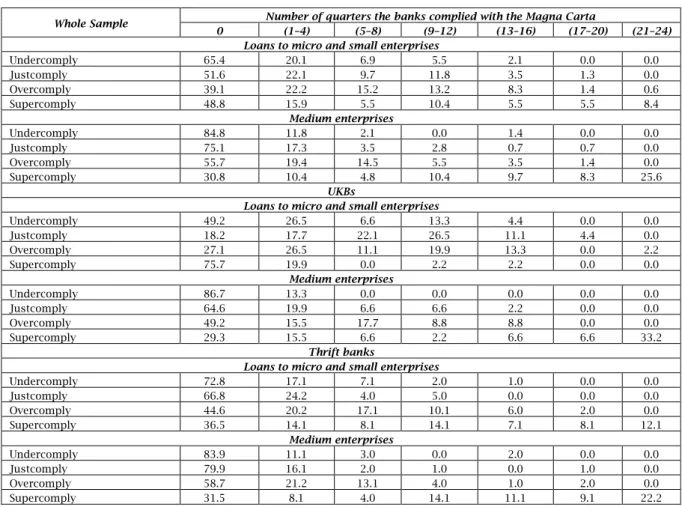
bulk of credits to MSMEs. Second, loans to medium firms were much higher than legally mandated across all banks. Third, there was a huge dispersion across banks in their optimal loan portfolio choices. How many banks were directly complying with the Magna Carta Law? Our panel dataset on compliances included 24 quarters of data that can shed some light on the dispersion in portfolio choices (Table 10). We find that only 65.4% of all banks were complying directly on the target for micro and small enterprises at least one quarter. In other words, 36.4% of banks reported at least one incident of under-compliance. Only 2.1% of all banks reported under-complying with the target of direct lending to the micro and small enterprises for 13 to 16 quarters (more than half of all the periods observed). Another 5.5% of banks reported under-complying between 9 and 12 quarters. More importantly, the majority of banks reported over-complying (and even super-over-complying) with the micro and small lending targets for at least one quarter. In fact 8.4% of all banks reported that they super-complied for most of the periods observed.
Table 10. Frequency of bank direct compliance to the Magna Carta targets across
bank types in the Philippines, 2005–2010
Whole Sample Number of quarters the banks complied with the Magna Carta
0 (1–4) (5–8) (9–12) (13–16) (17–20) (21–24) Loans to micro and small enterprises
Undercomply 65.4 20.1 6.9 5.5 2.1 0.0 0.0 Justcomply 51.6 22.1 9.7 11.8 3.5 1.3 0.0 Overcomply 39.1 22.2 15.2 13.2 8.3 1.4 0.6 Supercomply 48.8 15.9 5.5 10.4 5.5 5.5 8.4 Medium enterprises Undercomply 84.8 11.8 2.1 0.0 1.4 0.0 0.0 Justcomply 75.1 17.3 3.5 2.8 0.7 0.7 0.0 Overcomply 55.7 19.4 14.5 5.5 3.5 1.4 0.0 Supercomply 30.8 10.4 4.8 10.4 9.7 8.3 25.6 UKBs
Loans to micro and small enterprises
Undercomply 49.2 26.5 6.6 13.3 4.4 0.0 0.0 Justcomply 18.2 17.7 22.1 26.5 11.1 4.4 0.0 Overcomply 27.1 26.5 11.1 19.9 13.3 0.0 2.2 Supercomply 75.7 19.9 0.0 2.2 2.2 0.0 0.0 Medium enterprises Undercomply 86.7 13.3 0.0 0.0 0.0 0.0 0.0 Justcomply 64.6 19.9 6.6 6.6 2.2 0.0 0.0 Overcomply 49.2 15.5 17.7 8.8 8.8 0.0 0.0 Supercomply 29.3 15.5 6.6 2.2 6.6 6.6 33.2 Thrift banks
Loans to micro and small enterprises
Undercomply 72.8 17.1 7.1 2.0 1.0 0.0 0.0 Justcomply 66.8 24.2 4.0 5.0 0.0 0.0 0.0 Overcomply 44.6 20.2 17.1 10.1 6.0 2.0 0.0 Supercomply 36.5 14.1 8.1 14.1 7.1 8.1 12.1 Medium enterprises Undercomply 83.9 11.1 3.0 0.0 2.0 0.0 0.0 Justcomply 79.9 16.1 2.0 1.0 0.0 1.0 0.0 Overcomply 58.7 21.2 13.1 4.0 1.0 2.0 0.0 Supercomply 31.5 8.1 4.0 14.1 11.1 9.1 22.2
Note: UKB = universal and commercial bank; UNDERCOMPLY (lending < mandated), JUSTCOMPLY
(mandated=lending< 1.1*mandated), OVERCOMPLY (1.1*mandated≤lending< 2*mandated), and SUPERCOMPLY (lending≥2*mandated)
Source: Authors’ calculations using data from the ADB SME Financing Survey Not surprisingly, banks were better able to
comply with the legal targets for medium enterprise loans. Most banks (69.2%) reported super-complying at least for one quarter by lending more than twice the legal mandate to medium firms. Only 15% of all
banks reported any incidence of under-compliance. Furthermore, only 3.5% of all banks reported that they failed to comply with the medium-firm targets for more than 4 quarters during the period we observed.