GRAPE MUST MINERALIZATION BY HIGH PRESSURE MICROWAVE
DIGES-TION FOR TRACE ELEMENT ANALYSIS: DEVELOPMENT OF A PROCEDURE
DESENVOLVIMENTO DE UM PROCEDIMENTO DE MINERALIZAÇÃO DE MOSTO PARA ANÁLISE ELEMENTAR, POR DIGESTÃO POR MICROONDAS
S. Catarino1*, I.M.Trancoso1, R. Bruno de Sousa2, A.S. Curvelo-Garcia1
1Instituto Nacional de Recursos Biológicos I.P./INIA-Dois Portos, 2565-191 Dois Portos, Portugal.
2UIQA - Instituto Superior de Agronomia, Universidade Técnica de Lisboa, Tapada da Ajuda, 1349-017 Lisboa, Portugal.
*Corresponding author: Sofi a Catarino. Instituto Nacional de Recursos Biológicos I.P./INIA- Dois Portos, 2565-191 Dois Portos, Portugal. Tel.: +351 261 712106; Fax: +351 261 712426; e-mail address: sofi [email protected]
(Manuscrito recebido em 10.11.10 . Aceite para publicação em 21.12.10)
SUMMARY
The present work describes the development and validation of a high pressure microwave-assisted mineralization procedure for the determina-tion of metals in grape must by spectrometric techniques. Metals of special oenological and food safety importance (Al, Co, Cu, Cd, Pb) were used as model elements to achieve the optimum working conditions. The study was conducted by monitoring their concentration in experimen-tal samples by ETAAS. Different combinations of HNO3 and H2O2 were tested and an optimal volume of 1 mL of each reagent, added to 2 mL of sample, was selected for further studies. In comparison with experimental conditions described in literature for the mineralization of grape must and wine by HPMW, the proposed procedure requires very low reagent consumption. Time and temperature were regarded as factors in the optimization study of microwave oven program, resulting in 72 minutes of extension including ventilation. The procedure trueness and precision were evaluated using grape must and wine samples. For each element three different levels of addition were performed. The recovery range was from 94% (Co) to 113% (Pb) in grape must and from 96% (Cu) to 128% (Al) in wine. Relative standard deviations ranged from 1% (Cd) to 11% (Al) in grape must and from 2% (Cd, Pb) to 9% (Co) in wine (n = 10). The proposed procedure is suitable for grape must and wine mineralization with a view to trace element analysis.
RESUMO
Apresenta-se um procedimento de mineralização de mosto e de vinho, com recurso à técnica de digestão, em vaso fechado, por microondas (sistema de alta pressão), com vista à análise elementar por espectrometria. Na optimização das condições experimentais foram utilizados como elementos modelo metais com especial importância enológica e de segurança alimentar (Al, Co, Cu, Cd e Pb). A determinação analítica destes elementos nas amostras experimentais foi realizada por ETAAS. Foram ensaiadas diferentes combinações de volumes de HNO3 e H2O2 a utilizar na digestão de 2 mL de amostra. O procedimento proposto apresenta baixo consumo de reagentes (1 ml HNO3 e 1 mL de H2O2) comparativamente com os procedimentos de mineralização de mosto por HPMW descritos na literatura. Na optimização do programa de forno do microondas foram considerados os factores tempo e temperatura. A duração total do programa de digestão é de 72 minutos (incluindo a etapa de ventilação). A exactidão e precisão do procedimento foram avaliadas através do cálculo de taxas de recuperação e do coefi ciente de variação, respectivamente. As taxas de recuperação, calculadas com base em três níveis de adição de cada elemento, variaram entre 94% (Co) e 113% (Pb) em mosto e entre 96% (Cu) e 128% (Al) em vinho. A precisão variou entre 1% (Cd) e 11% (Al) em mosto e entre 2% (Cd, Pb) e 9% (Co) em vinho (n = 10). O procedimento proposto é adequado para a mineralização de amostras de mosto e de vinho para análise elementar a nível vestigial.
Key words: grape must, wine, mineralization, high pressure microwave digestion (HPMW), trace element analysis Palavras-chave: mosto, vinho, mineralização, digestão por microondas (sistema de alta pressão), análise elementar vestigial
INTRODUCTION
The elemental analysis of wine is often required from a nutritional, technological, sensorial, toxicological, origin and authenticity point of view (Catarino et al., 2008). The grape must is a complex substance with high organic matrix content, mainly carbohydrates but also organic acids, proteins and polyphenols in much lower concentrations, with large agglomera-tions of organic matter.
Usually the concentration of sugars in grape must is below 250 g/L. The accurate analysis of grape must
and wine elemental content by spectrometric tech-niques strongly depends on their matrix composition since they can lead to spectral and non-spectral inter-ferences. Thus, a sample pre-treatment is advisable in order to destroy the organic matter that could cause serious interferences in Electrothermal Atomization Atomic Absorption Spectrometry (ETAAS) or Induc-tively Coupled Plasma Mass Spectrometry (ICP-MS) both suitable for the analysis of elemental content of grape must and wine (Kingston and Walter, 1998; Schlemmer and Radziuk, 1999).
Historically, the preparation of organic samples relied
on acid dissolution in an open or closed vessel, with heating applied through the vessel by conduction or convection. Despite their frequent use, hot-plate dissolution procedures are limited by several factors: long dissolution times (hours to days), the potential loss of volatile elements, contamination of the sample by excessive amounts of reagents, airborne contami-nants, and prolonged contact with vessel materials. Based on this approach, several procedures using distinct apparatus and experimental conditions were described, and are nowadays used for mineralization of grape berries, grape must and wine (Correia et al., 2006; Laurie et al., 2010).
Microwave digestion offers better performance in the destruction of organic matter in samples with high sugar content, compared to conventional ap-proaches. High pressure microwave assisted diges-tion (HPMW), which enables sample decomposidiges-tion at high temperatures without signifi cant losses of volatile elements, is currently the most usually ap-plied digestion technique. This procedure completely destroys the organic matter content of the sample by using concentrated acids. Organic components are oxidized; carbon and hydrogen are converted into carbon dioxide and water. An important advantage is the high throughput, depending on the digestor rotor characteristics. Nevertheless, closed vessel decomposition has a signifi cant drawback: these systems usually limit the sample amount to an only few grams of organic matter.
The most common acid for organic matrices oxidation is HNO3, dissolving most metals to form the soluble metal nitrates. Its oxidizing strength can be enhanced by the addition of H2O2 or by increasing the reaction temperature. Carbohydrates are rapidly decomposed in HNO3 at approximately 140 ºC and for matrices with high concentrations of these easily oxidizable components, the heating rate must be slow to allow safe and under control decomposition (Kingston and Walter, 1998).
The control of the microwave digestion is achieved through combination of temperature feedback control and power settings. Because the reaction is highly exothermic, the contribution of energy depends on the quantity of sample digested and the speed and intensity of the reaction (Kingston and Walter, 1998). Many applications of microwave digestion for grape, must and wine treatment may be found in the literature data (Teissedre et al., 1993; Puig-Deu et
al., 1994; Lopez et al., 1998; Cabrera-Vique et al.,
2000; Almeida, 2002; Kristl et al., 2002; Gómez et
al., 2004; Capelo et al., 2005; Gromboni et al., 2010).
apparent explanation. Only a small part of the ex-perimental conditions diversity could be attributed to the specifi cities of microwave apparatus. This variety might lead to some confusion about the procedure to apply for sample treatment.
For example, the following conditions were applied by Almeida (2000) in grape treatment by HPMW digestion: 0.90 g dry grapes were attached with 1.5 mL of concentrated HNO3 and 3.5 mL of 30% H2O2. For the same purpose, Kristl et al. (2002) treated 6 g of grapes with 5 mL of concentrated HNO3 and 2 mL of 30% H2O2, while Chopin et al. (2008) treated 0.25 g of grapes with 10 mL of HNO3. As regards to experimental conditions applied for wine mineraliza-tion, several reagent combinations are also indicated: 2.0 mL of wine was treated with 2.5 mL of HNO3 and 30 μg of V2O5 (Lopez et al., 1998); 1.5 mL of wine with 0.15 mL of concentrated HNO3 and 1.5 mL of 30% H2O2 (Almeida e Vasconcelos, 1999); 1.5 mL of wine and 8 mL of HNO3 (Esparza et al., 2004). As previously referred numerous HPMW proce-dures for the mineralization of grape, grape must and wine may be found in literature. However, to our best knowledge, a complete description of the digestion procedure optimization and validation is not available. Thus, the aim of the present work was to develop and validate a procedure for grape must mineralization by microwave digestion, which can be applied in other laboratories, with a view to elemental analysis by spectrometric techniques. The study was conducted by monitoring the levels of aluminium, cadmium, copper, cobalt and lead, in grape must and wine samples by ETAAS.
MATERIAL AND METHODS
Apparatus
A Milestone ETHOS Plus Microwave Labstation (Milestone, Sorisole, Italy), equipped with a Mile-stone HPR-1000/6m monoblock high pressure rotor (closed system, maximum operating pressure of 100 bar) with one reference TFM Tefl on vessel used for temperature control and fi ve TFM Tefl on standard vessels, was used for digestion of the grape must and wine samples.
ETAAS measurements were performed by means of a Perkin-Elmer 4110 ZL ETAAS system (PerkinElmer, Shelton, CT, USA), using Zeeman-effect background correction, equipped with a model AS-72 autosampler and hollow-cathode lamps from Perkin-Elmer as radiation source. Pyrolytically coated graphite tubes with end caps and L’vov platforms were used. Argon
Reagents and standard solutions
Ultrapure concentrated HNO3 (J.T.Baker) and Trace Select® 30% (v/v) H2O2 (Fluka, Sigma-Aldrich) were used for digestion optimization procedures.
For ETAAS analysis, monoelement standard solu-tions of Al, Cu and Pb (10, 20, 30, 40 and 50 μg/L), Co (1.0, 2.5, 5.0, 7.5 and 10 μg/L), Cd (1, 2, 3, 4 and 5 μg/L) were daily prepared from monoelement standard solutions (CertiPUR, Merck, 1000 mg/L), in ultrapure HNO3. Matrix modifi ers, graphite furnace grade, of palladium nitrate [Pd(NO3)2] and magne-sium nitrate [Mg(NO3)2], both from Merck (10 g/L), were used. Both were injected on the graphite tube with digested samples as follows: 0.5 μg Mg(NO3)2 plus 2.3 μg Pd(NO3)2 for Cd and Pb; 15 μg Mg(NO3)2 for Co, 5 μg Pd(NO3)2 plus 3 μg Mg(NO3)2 for Cu. Al was analyzed without addition of matrix modi-fi ers. All standard solutions were performed in 0.2 % (v/v) nitric acid.
To avoid contamination of the samples, all glassware and polyethylene material (volumetric fl asks, micro-pipette tips and autosampler cups) were immersed at least for 24 hours in 20% (v/v) HNO3 (v/v), and rinsed thoroughly with pure water before use. The reaction vessels were cleaned with 10 mL of a 5% HNO3 solution before each digestion.
For decontamination solution preparation, HNO3 reagent grade was double-distilled using an infra-red subboiling distillatory system (model BSB-939-IR, Berghof, Germany).
Purifi ed water (conductivity < 0.1 μS/cm) was pro-duced using a Seralpur Pro 90CN apparatus (Seral, Ransbach-Baumbach, Germany).
Sample preparation and MW digestion procedure
The optimization of the microwave digestion oven program (temperature and time) was carried out with a red grape must (Aragonez variety, 2009 vintage year). Grape must was prepared, in the laboratory, by smashing the berries in plastic cups, being the juice transferred to polyethylene tubes. Immediately, a volume of 5 mL of ultrapure HNO3 was added to a sample volume of 45 mL, in order to inhibit the
alcoholic fermentation and to start the decomposi-tion reacdecomposi-tion.
By safe reasons, the amount of organic matter intro-duced into the digestor vessels used in our experi-ments should not exceed 1 g. On the other hand, for strong exothermic reactions a minimum volume of 2 mL of water should be used (Milestone, 2009). Thus, a volume of 2.0 mL of grape must (wine) was weighted into TFM Tefl on vessels together with dif-ferent combinations of volumes of HNO3, H2O2 and H2O (Table I), always resulting in a total volume of 8 mL (which is required for the temperature sensor operation). The mixture was allowed to react and after clearance of fumes the vessel was closed. Initial assays were performed to ensure that samples were homogeneous. For contamination control, a blank experiment (treated as a sample) was prepared each run. Blank solutions were regularly analyzed in order to subtract the background signal.
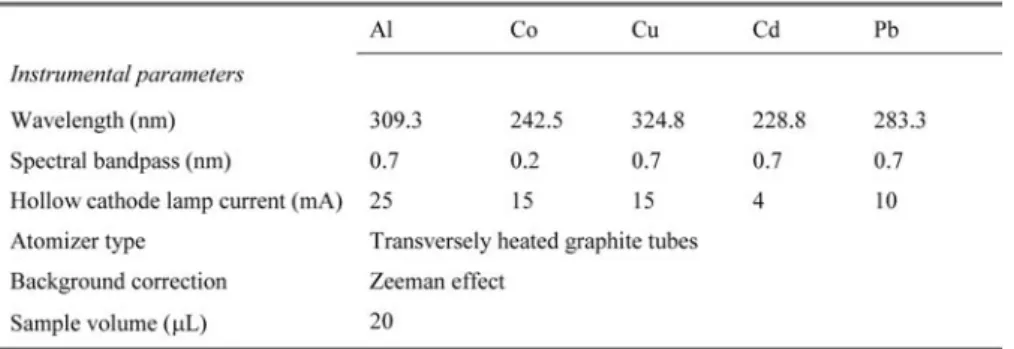
With the purpose of obtain a concentration of each analyte that could be confidently quantified by ETAAS, the natural grape must was spiked with 500 μg/L of Al, Cu and Pb and 50 μg/L of Co and Cd. Concentrations of Al, Co, Cu, Cd and Pb, in all experimental samples, were determined by ETAAS, under the operating conditions indicated in Table II. The overall conditions were previously described by the authors (Catarino, 2000; Catarino et al., 2002, Catarino et al., 2005, Catarino et al., 2009).
Recovery and precision of the MW digestion pro-cedure
To the best of our knowledge, reference grape must and/or wine with certifi ed concentrations of Al, Co, Cu, Cd and Pb elements are not available. For this reason, the trueness of the microwave digestion procedure was estimated by the technique of stand-ard additions to determine recovery of each spiked analyte. Three different fortifi cations of each element were performed in grape must and red wine before the digestion step and samples processed in the same way as other experimental samples. Depending of the element, samples were spiked with 20-1500 μg/L. The average recovery and standard deviation were
TABLE I
Grape must mineralization by High Pressure Microwave Digestion – reagent combinations used in the procedure development Mineralização de mosto por Digestão por Microondas (sistema de alta pressão) – combinações de reagentes ensaiadas no desenvolvimento
calculated from the three recovery values obtained for the three spikes.
The within-batch precision of the digestion proce-dure was evaluated by ten parallel digestions of the samples. A red wine obtained in the distribution was also used for the evaluation of recovery and preci-sion of the digestion procedure. Concentrations of Al, Co, Cu, Cd and Pb elements were determined in all experimental samples by ETAAS.
Statistical Analysis
Descriptive statistics of the results (namely, aver-age and standard deviation) and analyses of vari-ance (ANOVA) were performed using Microsoft Excel 2007 and Statistica 5.1 data analysis software (Statsoft Inc. 1998).
RESULTS AND DISCUSSION
Optimization of the HPMW program for grape must decomposition
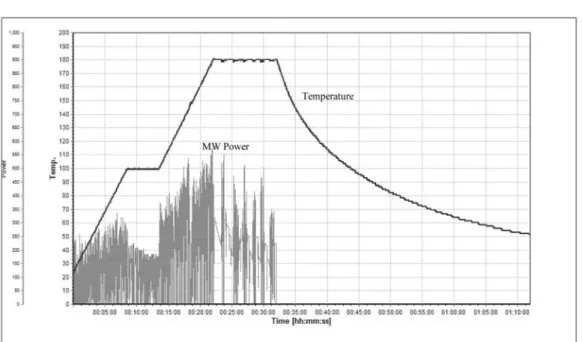
to be completed. This temperature was kept constant for 5 more minutes. Afterwards, the temperature was increased up to 180 ºC at 800 W following a ramp that takes 8.5 min to be completed. This temperature was kept constant for another 10 min at 1000 W. A 40 min ventilation step completed the whole sequence (Table III). The carousel was left overnight and after cooling it was removed from the oven, the vessels were uncapped and samples were diluted to 20 mL with ultrapure water.
During the course of the digestion, the reaction conditions inside the control vessel were compared to the performance-based protocol. The microwave power was adjusted based on the difference between the prescribed settings and the measured conditions. During the described experiments, temperature feed-back control, accurately and safely, controlled the digestion of grape must matrix. The reaction profi le of grape must with nitric acid and hydrogen peroxide is shown in Figure 1.
Concerning the elements in study, with exception of Al, no signifi cantly different concentrations were TABLE II
Operating conditions employed for Al, Co, Cu, Cd and Pb analytical determination by ETAAS Condições operatórias utilizadas nas determinações analíticas de Al, Co, Cu, Cd e Pb por ETAAS
TABLE III
Optimized oven program for grape must mineralization by High Pressure Microwave Digestion
Programa de forno optimizado para a mineralização de mosto por Digestão por Microondas (sistema de alta pressão)
Figure 1 - Reaction profi le (temperature and microwave power) of 2 mL of grape must with 1 mL of HNO3, 1 mL of H2O2 and 4 mL of H2O.
Perfi l da reacção (temperatura e potência emitida) de 2 mL de mosto com 1 mL de HNO3, 1 mL de H2O2 e 4 mL de H2O.
TABLE IV
Effect of reagent combination used in High Pressure Microwave Digestion procedure on the concentrations of Al, Co, Cu, Cd and Pb in grape must (results for Al and Cu are expressed as mg/L and as μg/L for Co, Cd and Pb)
Efeito da combinação de reagentes utilizados no procedimento de Digestão por Microondas (sistema de alta pressão) nas concentrações de mosto em Al, Co, Cu, Cd e Pb (Al e Cu expressos em mg/L, Co, Cd e Pb expressos em μg/L)
Concentration values correspond to the mean of two independent digestions and corresponding standard deviation. Mineralized samples were analysed by ETAAS (three dependent replicates).
concentrations could signifi cantly reduce the graphite tubes lifetime. Consequently, the mode using 4 mL of H2O, 1 mL of HNO3 and 1 mL of H2O2 was selected.
Analytical fi gures of merit
Aluminium, Cu and Pb blank digestion concentra-tions, before correction of the dilution factor (1:10), were 2.4, 2.9 and 0.27 μg/L, respectively. The levels of Co and Cd were lower than the detection limit of the corresponding analytical method (0.37 and 0.05 μg/L). It can be concluded that the procedure is suitable for sample preparation with a view to trace analysis.
The results concerning recovery and precision tests are presented in Table V. Regarding the Al element
the average percentage recovery was of 111% for grape must and of 128% for wine, suggesting the occurrence of contamination during analytical proc-ess, despite all the efforts taken. For Co element the average percentage recovery was of 96% (grape must). By practical reasons it was not possible to carry out similar study with wine. Recovery per-centages very close to 100% were observed for Cu element: an average value of 103% for grape must and an average value of 96% for wine. Concerning Cd element an average recovery of 98% was found in grape must and a higher value, 111%, in wine. For Pb element, recovery percentages higher than 100% were observed in grape must (112%) and red wine (106%). Assuming as acceptance criterion for overall recovery (mineralization procedure and analytical
TABLE V
Recovery percentages and precision by element obtained in grape must and wine samples mineralized by High Pressure Microwave Digestion
Taxas de recuperação e precisão, por elemento, determinadas em amostras de mosto e vinho mineralizadas por Digestão por Microondas (sistema de alta pressão)
precision (Table V). The relative standard deviation values obtained for Al (11% and 7% for grape must and wine, respectively) and Co (7% and 9% for grape must and wine, respectively) are explained by the low concentrations of these elements both in grape must and wine. Concerning Cu element, the preci-sion in wine was not determined because the natural concentration of Cu in this sample was lower than the quantifi cation limit of the analytical method.
CONCLUSIONS
The procedure proposed for sample mineraliza-tion by high pressure microwave digesmineraliza-tion can be used to the treatment of grape must and wine, in view to trace analysis by spectrometric techniques.
It provides a number of advantages, such as rapid and complete mineralization of the sample without analyte losses and/or additional contamination and a high throughput. A very important advantage is the very low consumption of reagents. On the other hand, the low concentration of acids in treated samples enables its analysis by ETAAS (with no compromise of graphite tubes lifetime) or ICP-MS, without any further dilution. It can be concluded that some of the experimental conditions described in literature for the mineralization of must grape and wine, in particular the amounts of acids used for sample oxidation, are probably overestimated. Concerning the metals used as models, the precision and recovery of the proce-dure are satisfactory (with exception of Al) and in agreement with the required quality of the analytical
(PTDC/AGR-ALI/64655/2006).
REFERENCES
Almeida C.M.R., Vasconcelos M.T.S.D., 1999. UV-irradiation and MW-digestion pre-treatment of Port wine suitable for the determination of lead isotope ratios by inductively coupled plasma mass spectrometry. Journal of Analytical Atomic Spectrometry,
14 (12), 1815-1821.
Almeida C.M.R., 2002. Isotopic and multi-element characterisa-tion of wine for identifi cacharacterisa-tion of lead contaminacharacterisa-tion sources and of the provenance region. Doctoral thesis, 252 p. Faculdade de Ciências da Universidade do Porto, Porto.
Cabrera-Vique C., Teissedre P.L., Cabanis M.T., Cabanis J.C., 2000. Manganese determination in grapes and wines from different regions of france. American Journal of Enology and Viticulture,
51 (2), 103-107.
Castiñeira M.M., Brandt R., von Bohlen A., Jakubowski N., 2001. Development of a procedure for the multi-element determination of trace elements in wine by ICP-MS. Fresenius Journal of Analytical Chemistry, 370, 553-558.
Catarino S.C.G., 2000. A ocorrência de chumbo e cádmio em vinhos. MSc Thesis, University of Porto, Porto.
Catarino S., Curvelo-Garcia A.S., Bruno de Sousa R., 2002. Deter-mination of aluminum in wine by ETAAS: Validation of Analytical Method. Atomic Spectroscopy, 23 (6), 196-200.
Catarino S., Pimentel I., Curvelo-Garcia A.S., 2005. Determination of copper in wine by ETAAS using conventional and fast thermal programs: Validation of Analytical Method. Atomic Spectroscopy,
26 (2), 73-77.
Catarino S., Curvelo-Garcia A.S., Bruno de Sousa R., 2008. El-ementos contaminantes nos vinhos (a review). Ciência e Técnica Vitivinícola, 23 (1), 3-19.
Catarino S., Neves A., Bruno de Sousa R., 2009. Determination of cobalt in wine and must by ETAAS: Analytical method develop-ment and validation. Ciência e Técnica Vitivinícola, 24 (2), 65-72. Capelo J.L., Catarino S., Curvelo-Garcia A.S., Vaião M., 2005. Fo-cused ultrasound versus microwave digestion for the determination of lead in must by electrothermal-atomic absorption spectrometry. Journal of AOAC International, 88 (2), 585-591.
Chopin E.I.B., Marin B., Mkoungafoko R., Rigaux A., Hopgood M.J., Delannoy E., Cancès B., Laurain M.J., 2008. Environmental Pollution, 156, 1092-1098.
Correia L., Soares M.E., Bastos M.L., 2006. Validation of an Elec-trothermal Atomization Atomic Absorption Spectrometry Method for the determination of aluminum, copper and lead in grapes. Journal of Agricultural and Food Chemistry, 54, 9312-9316.
Esparza I., Salinas I., Caballero I., Santamaría C., Calvo I., García-Mina J.M., Fernández J.M., 2004. Evolution of metal and polyphenol content over a 1-year period of vinifi cation: sample fractionation and correlation between metals and anthocyanins. Analytica Chimica Acta, 524, 215-224.
Gómez M.M.C., Brandt R., Jakubowski N. Andersosn J.T., 2004. Changes in the metal composition in german white wines through the winemaking process. A study of 63 elements by inductively coupled plasma – mass spectrometry. Journal of Agricultural and Food Chemistry, 52, 2953-2961.
Gromboni C., Carapelli R., Pereira-Filho E.R., Nogueira A.R.A., 2010. Evaluation of different sample preparation procedures using chemometrics: comparison among photo-fenton reaction; microwave irradiation, and direct determination of mineral in fruit juices. Food Analytical Methods, 3 (2), 98-103.
Kristl J., Veber M., Slekovec M., 2002. The application of ETAAS to the determination of Cr, Pb and Cd in samples taken during different stages of the winemaking process. Analytical and Bio-analytical Chemistry, 373, 200-204.
Kingston H.M.S., Walter P., 1998. The art and science of mi-crowave sample preparations for trace and ultratrace elemental analysis. In: Inductively Coupled Plasma Mass Spectrometry. 33-81. Montaser A. (ed.), Wiley-VCH, USA.
Laurie V.F., Villagra E., Tapia J., Sarkis J.E.S., Hortellani M.A., 2010. Analysis of major metallic elements in chilean wines by atomic absorption spectrometry. Ciência e Investigación Agrária,
37 (2), 77-85.
Lopez., F., Cabrera C., Lorenzo M.L., Lopez M.C., 1998. Alumin-ium levels in wine, beer and other alcoholic beverages consumed in Spain. The Science of Total Environment, 220, 1-9.
Milestone, 2009. ETHOS 1. User manual. Rev. 4/2008. Milestone Microwave Laboratory Systems, Italy.
Puig-Deu M., Lamuela-Raventós R.M., Buxaderas S., Torre-Boronat C., 1994. Determination of copper and iron in must: Comparison of wet and dry ashing. American Journal of Enology and Viticulture, 45 (1), 25-28.
Schlemmer G., Radziuk B., 1999. Analytical Graphite Furnace Atomic Absorption Spectrometry. A laboratory guide. 286 p. Birkhauser Verlag, Basel, Switzerland.
Teissedre P.L., Cabanis M.T., Cabanis J.C., 1993. Comparison of two mineralization methods for determination of lead by elec-trothermal atomic-absorption spectrometry – application to soils, vine-leaves, grapes, must grapes and lees samples. Analusis, 21 (5), 249-254.